
chapter
3
The Adjusting Process
______________________________________________
OPENING COMMENTS
Chapter 3 introduces students to the adjusting process. The beginning of the chapter briefly describes the
cash basis of accounting and includes examples of businesses that use it. The focus of the text is on the
accrual basis accounting. The basic idea of the matching concept was presented in Chapter 1, where
expenses incurred were matched against revenues. Now in Chapter 3, matching is introduced formally
and as a stand-alone concept. The matching concept is defined and discussed, and the chapter includes
full coverage of the accrual basis. Of all the accounting concepts and principles introduced in the early
chapters of the text, matching is the most important.
The chapter’s main emphasis is on the preparation of adjusting entries. Definitions, calculations where
pertinent, and examples of the four basic types of deferrals and accruals are included. The chapter then
covers the adjustment of fixed assets (depreciation). The chapter ends with an explanation and
demonstration of analyzing financial statements using vertical analysis. Interpretation explains the value
of examining relationships within financial statements.
After studying the chapter, your students should be able to:
2. Journalize entries for accounts requiring adjustment.
4. Prepare an adjusted trial balance.
5. Describe and illustrate the use of vertical analysis in evaluating a company’s performance and
financial condition.
STUDENT FAQS
• Why can’t we just do cash basis accounting?
• Why is unearned revenue a liability instead of a revenue account?
34 Chapter 3 The Adjusting Process
• Adjusting entries give me a headache. Can we just skip them?
• Why are adjusting entries done at the end of the accounting period instead of at the beginning?
• Expired and unexpired give me problems. Is there an easy way to understand them?
• Why is matching revenues and expenses so important?
• Accrual means what, again?
• Deferral means what, again?
• Why do we sometimes record a revenue or expense as a deferred item? Wouldn’t it be easier to
always record revenue to a revenue account and remove any unearned revenue at year end? Wouldn’t
it be easier to always record an expense item to an expense account and then remove any unused
expense at year end?
• How can an expense item temporarily be treated as an asset? I thought an asset was something of
value or worth, not a cost of doing business.
• How can revenue temporarily be treated as a liability? I thought revenue was a good thing, not a debt
or obligation.
OBJECTIVE 1
Describe the nature of the adjusting process.
KEY TERMS
Accounting Period Concept
Cash Basis of Accounting
Accrual Basis of Accounting
Matching Concept (or Matching Principle)
Accrued Expenses
Prepaid Expenses
Accrued Revenues
Revenue Recognition Concept
Adjusting Entries
Unearned Revenues
Adjusting Process
Chapter 3 The Adjusting Process 35
SUGGESTED APPROACH
Under this objective, you will need to revisit the matching concept from Chapter 1. Emphasize again that
the matching concept is necessary in order to match revenues and expenses in the proper accounting
period. If the concept is violated, the financial statements for the period will not be accurate. The
adjusting process discussed in this chapter is critical to conforming to the matching concept.
To check your students’ understanding of these concepts, pose the following questions:
If rent for May is paid on June 1, in which month will it be reported as an expense under
GROUP LEARNING ACTIVITY—Introduction to the Matching Concept
TM 3-1 provides financial information about an individual filling out a loan application. The loan
application asks for total monthly expenses. The person applying for the loan has a few expenses that are
paid annually or semiannually. Therefore, your students must “match” expenses to the time period
LECTURE AID—Matching Concept
Remind your students that, similar to personal expenses, not all business expenses are paid monthly. If a
business wants to know its true expenses for the month, it must consider all expenses incurred, not just
the expenses paid that month.
Likewise, payment for services provided to customers is not always received in the same month that the
service is completed. If a business wants to know how much revenue it has earned, it must determine the
value of services provided, not just the cash received in payment for services rendered.
36 Chapter 3 The Adjusting Process
GROUP LEARNING ACTIVITY—Reviewing the Matching Concept
TM 3-3 asks students to apply the matching concept by determining the profit on a stone patio laid by
Artisan Stone and Brick. TM 3-4 provides the solution to this exercise.
Remind students that adjusting entries are necessary to update the accounting records to include all
LECTURE AID—Accruals and Deferrals
Deferrals adjust accounts that are already a part of a company’s accounting records.
Deferred expenses occur when an asset that will be used up or will expire is purchased. As this asset is
used, its cost must be recorded as an expense. Therefore, you defer recording the cost of the asset as an
expense until it is used. An example of a deferred expense for a student is tuition paid at the beginning of
each term. Business examples of deferred expenses include the following:
2. Prepaid insurance—When an insurance policy is paid in advance of the period covered, its cost is
recorded as an asset. An adjusting entry must be made to transfer the cost of the insurance policy to
an expense account as the policy expires.
Revenues are deferred when cash is received from a customer before a business completes its service for
the customer or delivers its product. When cash is received under these circumstances, it cannot be
recorded as revenue, since it has not been earned. Instead, it is recorded as a liability, reflecting the
company’s obligation to provide its service or to deliver its product to the customer. Once this obligation
Chapter 3 The Adjusting Process 37
1. Accrued expenses—salaries/wages owed to employees at the end of an accounting period that have
not been paid; interest owed on loans that have not been paid.
OBJECTIVE 2
Journalize entries for accounts requiring adjustment.
KEY TERMS
Accumulated Depreciation
Depreciation
Book Value of the Asset (or Net Book Value)
Depreciation Expense
Contra Accounts (or Contra Asset Accounts)
Fixed Assets (or Plant Assets)
Depreciate
SUGGESTED APPROACH
Adjusting entries can be effectively presented to your class by working through an example of each
adjusting entry covered in the text. Or, you may choose to work a problem opposite an assigned
DEMONSTRATION PROBLEM—Adjusting Entry for Prepaid Insurance
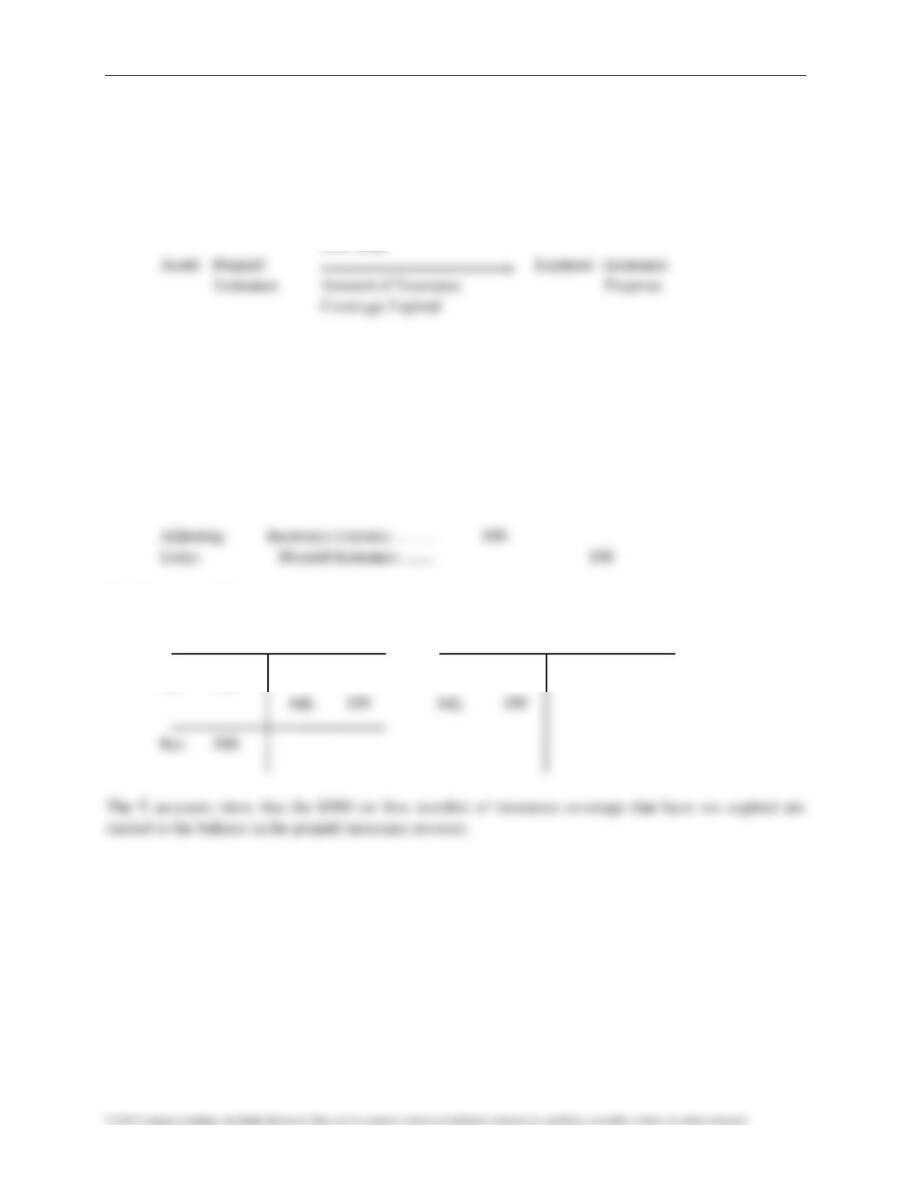
An example of an expense that is typically paid in advance is insurance. Insurance policies are paid at the
beginning of a policy period. This outlay of cash is recorded in Prepaid Insurance—an asset account. The
portion of the insurance coverage that has expired by the end of the accounting period must be transferred
to an expense account. You may want to point out to students that an insurance policy can be cancelled at
any time and the insured party will receive a refund for the unused portion of the policy. This may help
38 Chapter 3 The Adjusting Process
students understand how the unused portion of the insurance policy is an asset, and the portion that has
expired and cannot be refunded becomes an expense. The adjusting entry will bring the asset account up
to date and accurately reflect the expenses for the period.
Graphically, this can be illustrated as follows:
New Data
For example, on December 1, Atherton Plumbing purchased a six-month insurance policy for $600. As of
December 31, one month (or $100) of that coverage had expired.
Original Prepaid Insurance……… 600
Entry: Cash………….……….. 600
The T accounts follow:
Prepaid Insurance Insurance Expense
12/1 600
DEMONSTRATION PROBLEM—Adjusting Entry for Supplies
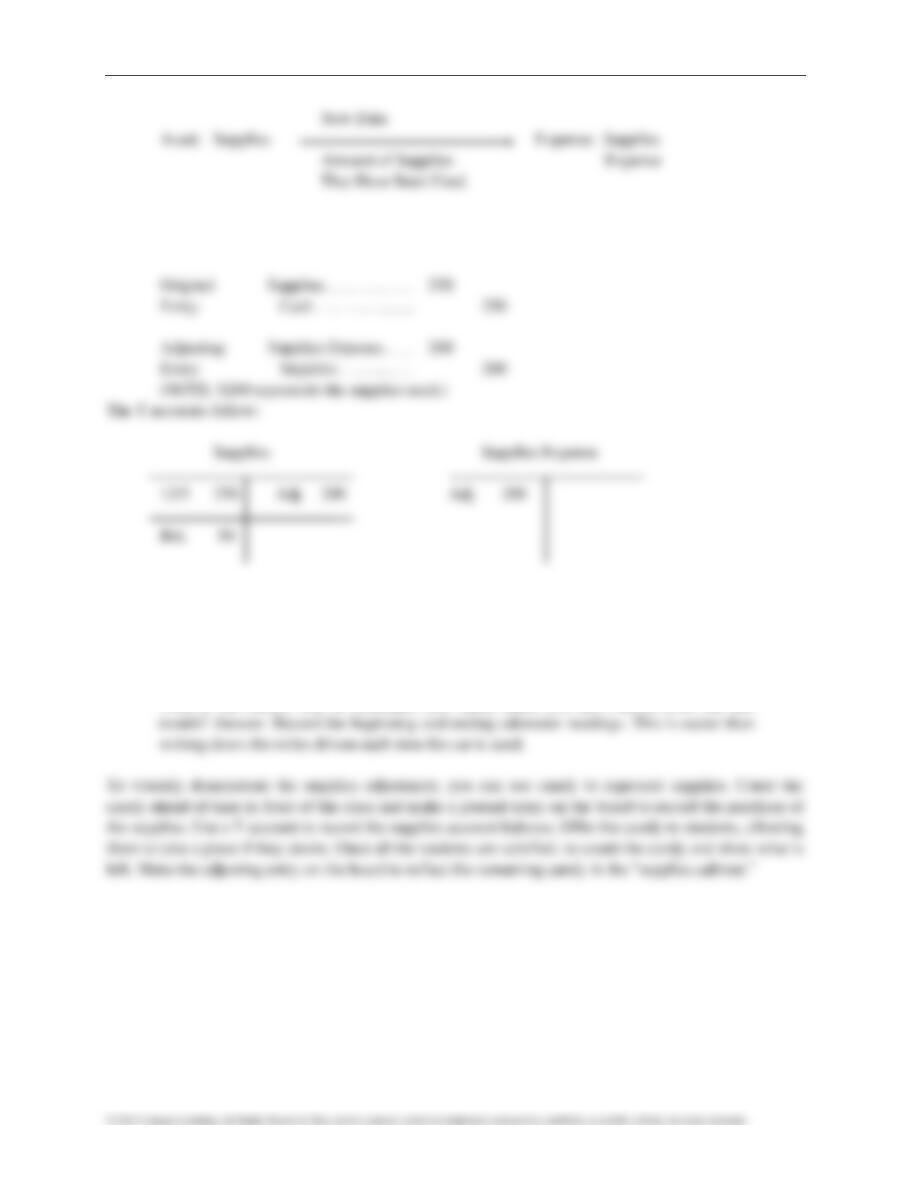
Another asset that must be adjusted at the end of the accounting period is the supplies account. All
supplies are recorded in the supplies account as they are purchased. By the end of the accounting period,
some of the supplies will have been used. The supplies used must be taken out of the supplies account and
transferred to an expense account.
Graphically, this can be illustrated as follows:
Chapter 3 The Adjusting Process 39
For example, on December 5, Atherton Plumbing purchased $250 in supplies. As of December 31, only
$50 worth of those supplies was left.
The T accounts show that the balance of the supplies account is $50—the amount of supplies left.
To illustrate why businesses typically count the amount of supplies left at the end of the month and use
that information to determine the cost of supplies used, ask your students the following question:
What is the easiest way to determine how many miles you have driven your car this
DEMONSTRATION PROBLEM—Adjusting Entry for Unearned Revenue
If payment for goods or services is received before the goods are delivered or the service is performed, it
cannot be recognized as revenue. Revenue can be recorded only after it is earned. Therefore, when
payment is received in advance, it is recorded in an unearned revenue account. This is a liability account.
By receiving payment, the company has obligated itself to deliver the goods or provide the services for
which it was paid. This obligation is expressed in the accounting records as a liability. If a portion (or all)
40 Chapter 3 The Adjusting Process
of the revenue has been earned by the end of the accounting period, some (or all) of the unearned revenue
is transferred to a revenue account.
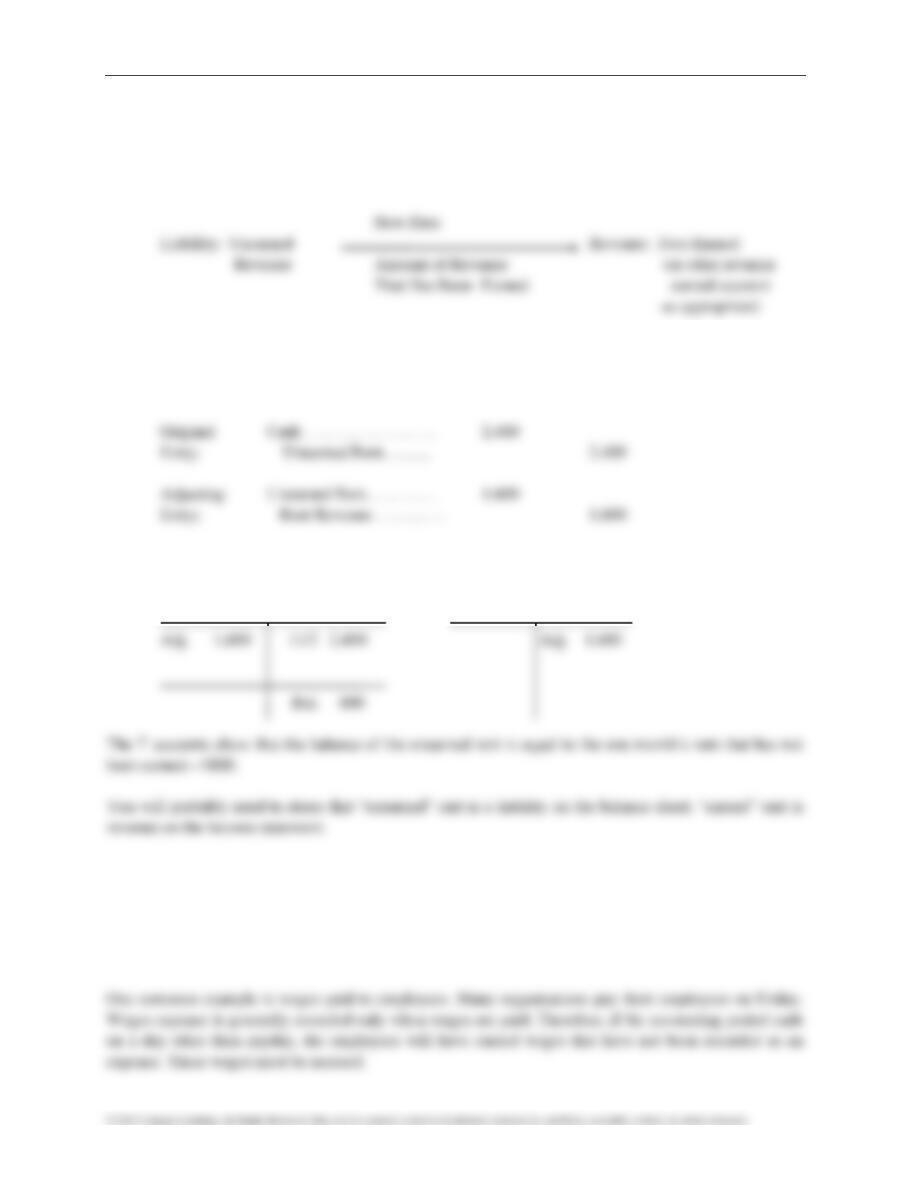
Graphically, this can be illustrated as follows:
For example, on November 2, Huber Rental Properties received three months’ rent, totaling $2,400, in
advance for one of its commercial properties. As of December 31, two months’ worth of this rent had
been earned.
The T accounts follow:
Unearned Rent Rent Revenue
DEMONSTRATION PROBLEM—Adjusting Entry for Accrued Expenses
Any expenses that a business has incurred must be recorded before preparing financial statements in order
to get a true measure of profitability. The act of recording expenses that have not been paid is called
accruing expenses.
Chapter 3 The Adjusting Process 41
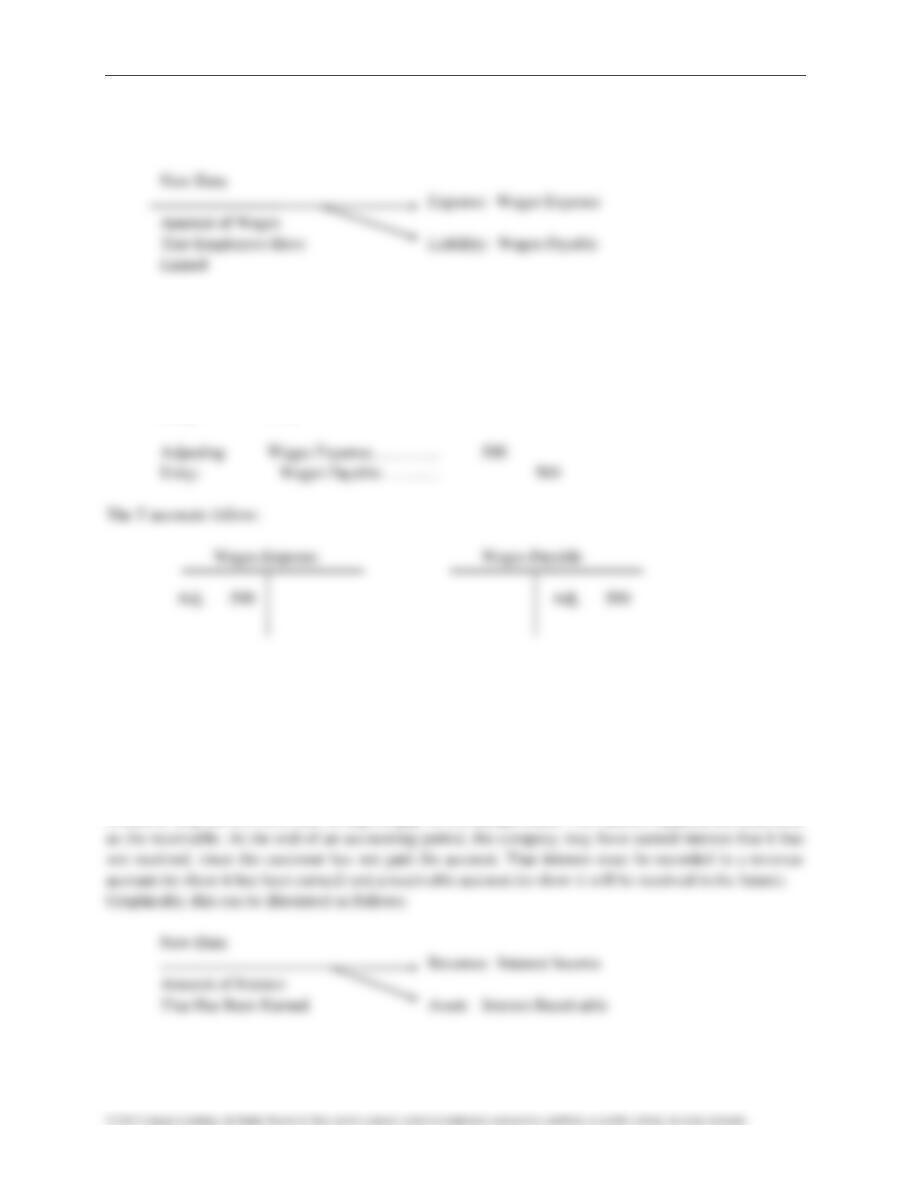
Graphically, this can be illustrated as follows:
For example, assume that December 31 is a Wednesday. On that date, Huber Rental Properties owes $500
in wages to employees. These wages will be paid on Friday, the usual payday.
Original
Entry: None
DEMONSTRATION PROBLEM—Adjusting Entry for Accrued Revenues
Any revenue that a business has earned must be recorded before preparing financial statements in order to
get a true measure of profitability. The act of recording revenues that have not been received is called
accruing revenues.
One example of accrued revenue is interest. Assume that a company charges its customers interest
whenever they ask for more than 30 days to pay for a credit purchase. The interest is paid at the same time
42 Chapter 3 The Adjusting Process
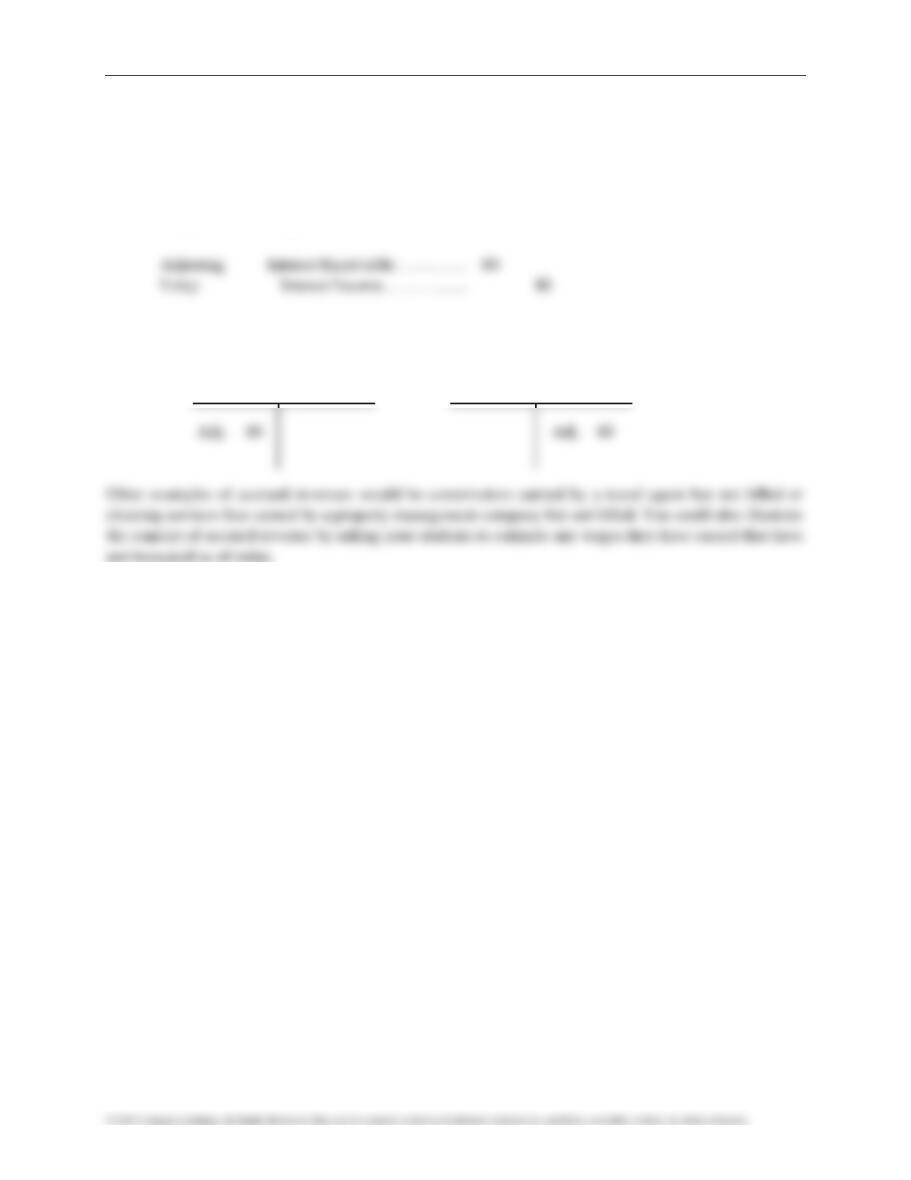
For example, Atherton Plumbing granted a customer additional time to pay an invoice; however, the
customer must pay interest at a rate of 10 percent annually. At the end of the accounting period, the
interest that has accumulated totals $80.
Original
Entry: None
The T accounts follow:
Interest Receivable Interest Income
not been paid as of today.
DEMONSTRATION PROBLEM—Adjusting Entry for Depreciation
Read the following scenario to your class:
Assume that your car needs four new tires. One set of tires you are considering costs $200.
The manufacturer estimates that these tires will last 20,000 miles. Since you drive about
10,000 miles per year, that equates to two years.
Another set of tires costs $300. These tires should last 40,000 miles or four years.
Assuming that you plan to keep your car at least another four years, which set of tires is
the best deal? Why?
The $200 set of tires will cost the driver $100 per year. The $300 set will cost only $75
per year. Therefore, the $300 set is a better value in the long run.
It is common to break the cost of a long-term asset into a cost per year or a cost per month when
evaluating whether or not to purchase the asset. Allocating the cost of an asset (such as the tires) to the
years it is used makes it easier to determine the yearly expense of owning the asset. The cost of owning
the $300 set of tires is $75 per year.
The accrual basis of accounting requires business owners to allocate the cost of fixed assets to the years
they are used. This process is called depreciation.
Chapter 3 The Adjusting Process 43
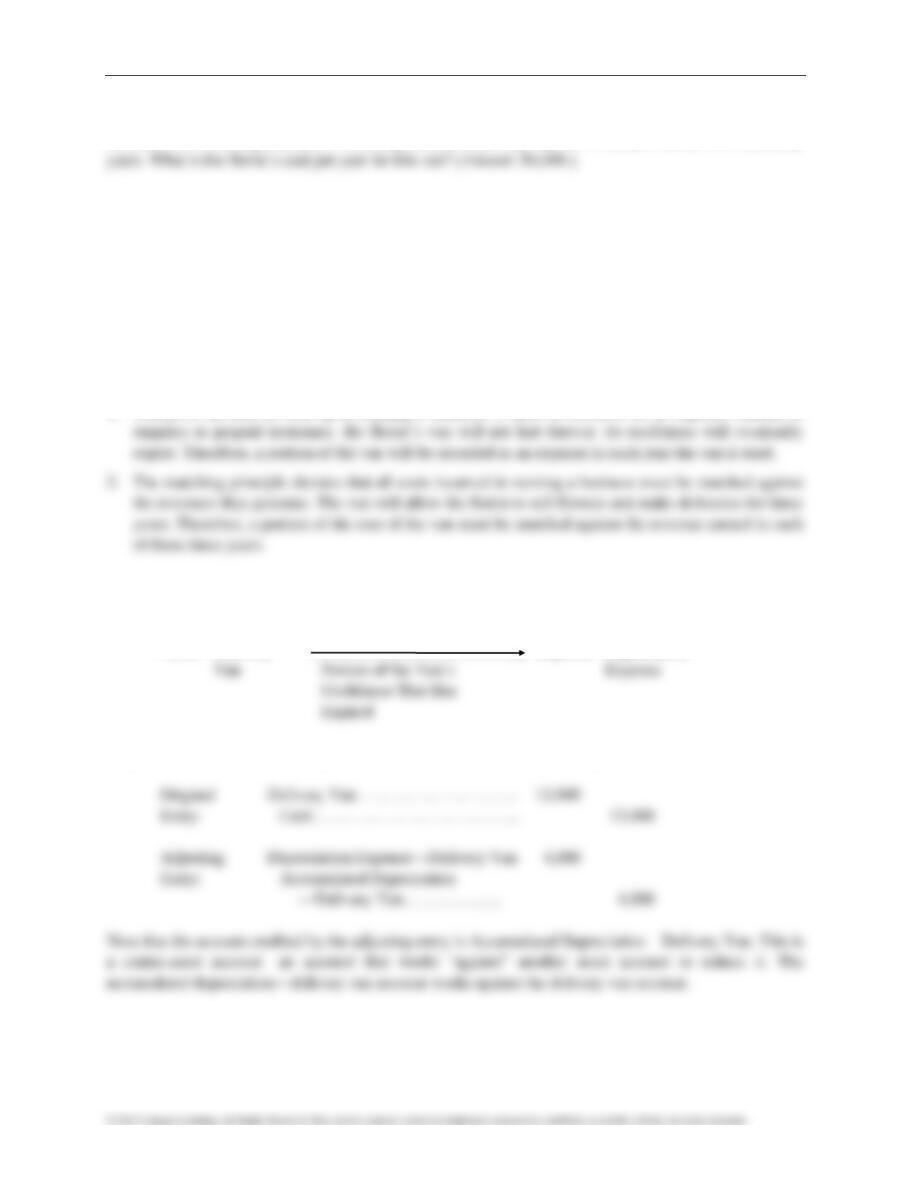
Consider the following example. A florist purchases a delivery van for $12,000. The van will last three
When the florist purchases the van, he will record it in an asset account. The van’s cost must be
transferred from the asset account to an expense account over the three years it is used. In other words,
the van must be depreciated over the three years it is used. The van may be useful past the three-year
period, and the asset will remain on the balance sheet until the asset is disposed of. The book value of the
asset, however, will fall to zero after the third year of depreciation, assuming no residual value is stated in
the depreciation calculations. This topic is discussed in Chapter 10 in detail.
The florist’s accountant is required to record depreciation on the delivery van for the following two
reasons:
1. Whenever an asset is used up in running a business, it must be recorded as an expense. Similar to
Graphically, this can be illustrated as follows:
New Data
Asset: Delivery Expense: Depreciation
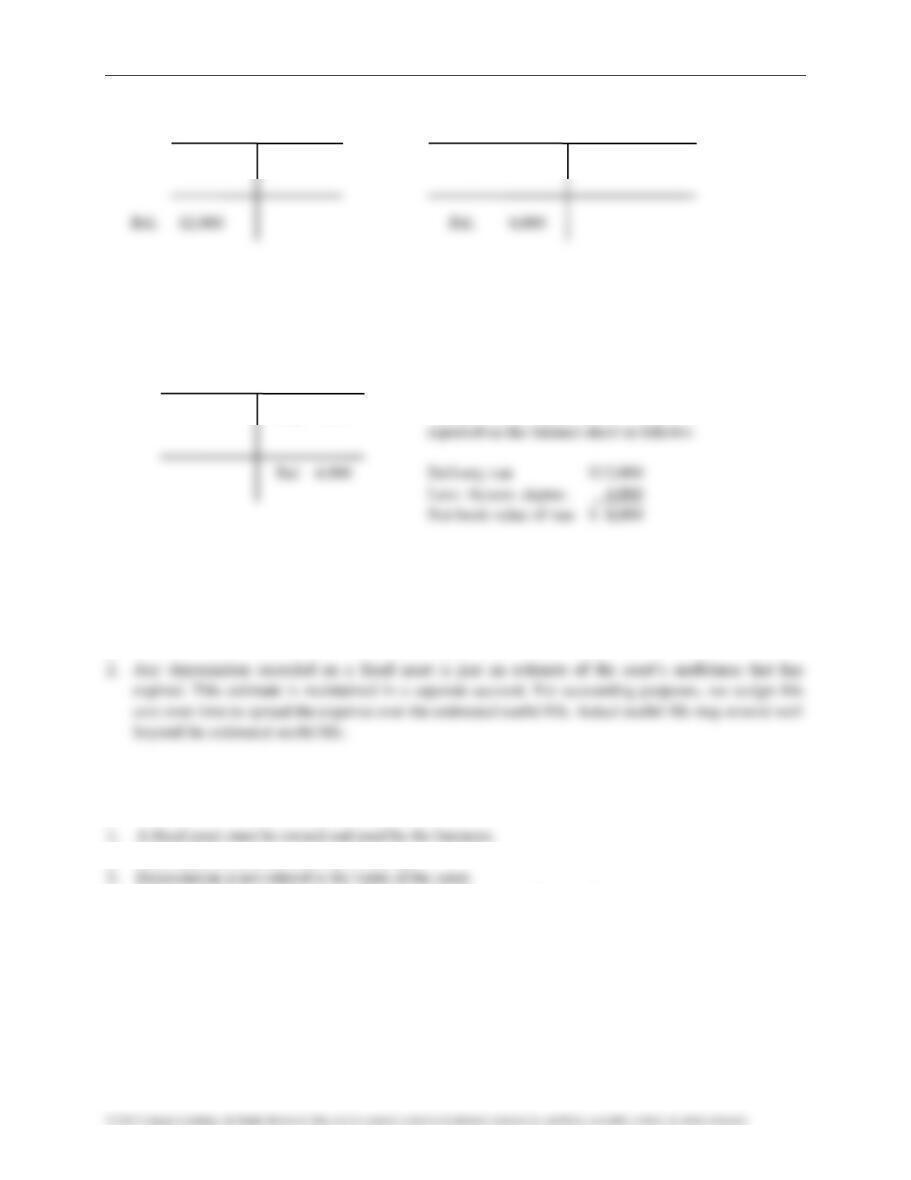
The journal entries to record the purchase of the van and the first year’s depreciation are as follows:
The T accounts follow:
44 Chapter 3 The Adjusting Process
Delivery Van Depreciation Expense—Delivery Van
12,000 Adj. 4,000
Accumulated Depreciation—
Delivery Van
Adj. 4,000 The asset and contra-asset accounts are
Why use a contra account to record the adjusting entry for depreciation? Why not just reduce the delivery
van account directly?
1. Both the original cost and the amount of depreciation recorded on a fixed asset should be reported on
the balance sheet. Therefore, the amounts are kept in separate accounts.
As you cover the adjusting entries for depreciation, you will probably need to emphasize the following
points:
2. Depreciation expense is a noncash expense.
4. The normal balance of the accumulated depreciation account is a credit.
Chapter 3 The Adjusting Process 45
TEACHING SUGGESTION—Use of an Accumulated Depreciation Account
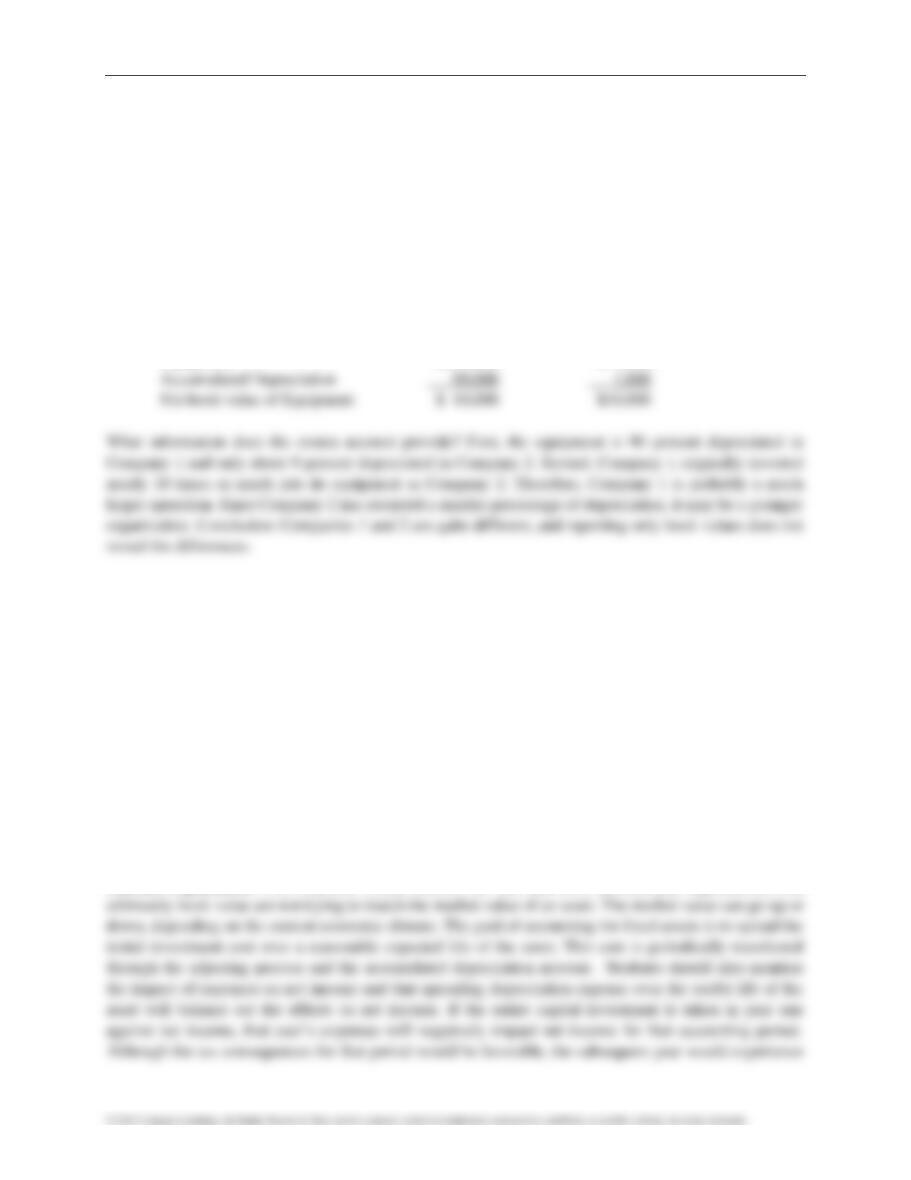
To help students understand the purpose of accumulated depreciation contra-accounts, show the following
example:
Company 1 Company 2
Net book value of Equipment $10,000 $10,000
Without using a contra account, both companies look identical. Now show the following:
Company 1 Company 2
Equipment $100,000 $11,000
WRITING EXERCISE—Adjusting Entry for Depreciation
To see how well your students have grasped the concept of depreciation, ask them to write an answer to
the following question (also shown on TM 3-6):
Assume that you are the accountant for Computer Consultants. Prior to this year, Computer
Consultants operated out of a leased office. However, the company purchased its own
office building this year. The building is in an area where real estate values have been
increasing an average of 6 percent per year.
The owner of Computer Consultants has asked why you recorded depreciation on the
building if real estate values are appreciating. Write a response to the owner explaining
why depreciation must be recorded on the company’s accounting records.
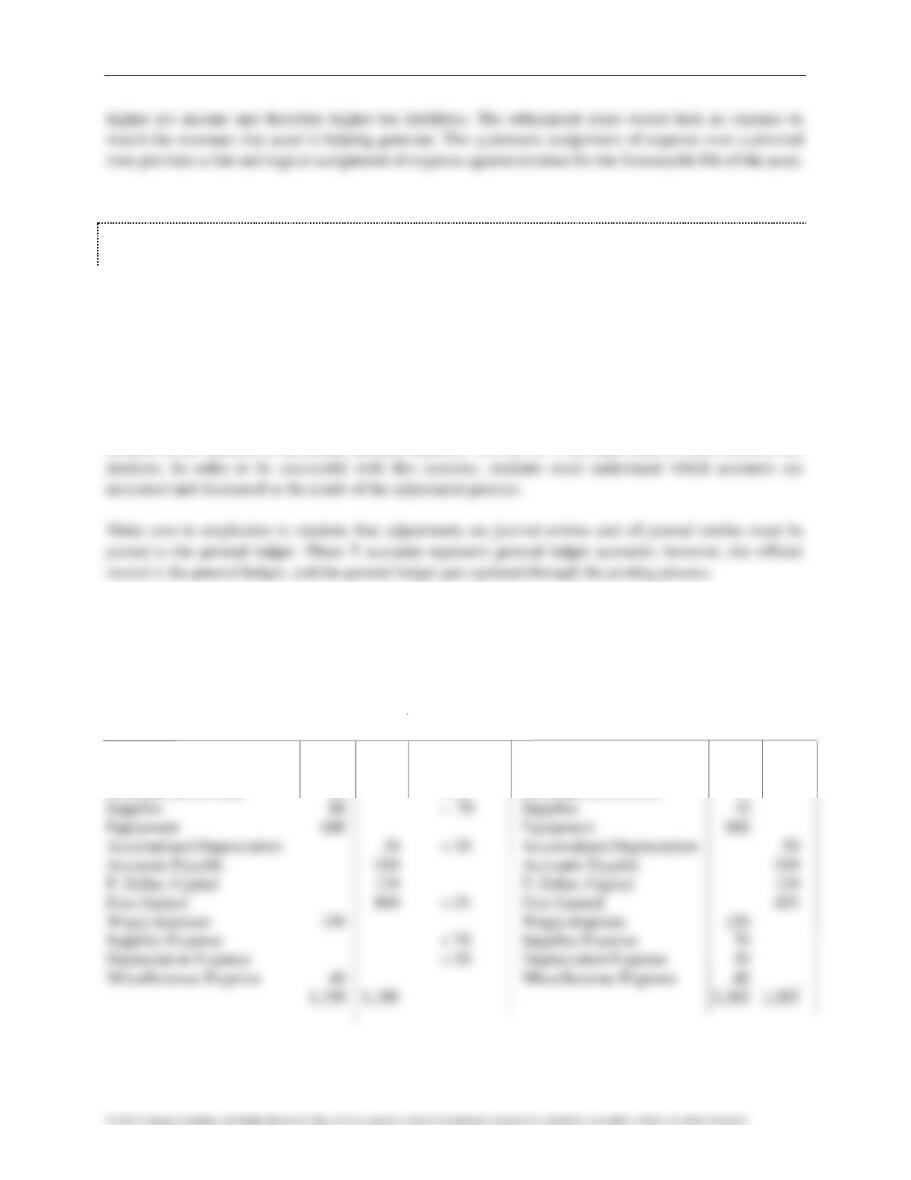
Possible explanation: The response should address the fact that cost, accumulated depreciation, and
46 Chapter 3 The Adjusting Process
OBJECTIVE 3
Summarize the adjustment process.
SUGGESTED APPROACH
This objective illustrates the posting of adjusting entries.
Handout 3-1 presents two exercises to assess your students’ understanding of adjusting entries. The
student is given to option to track account balances using T accounts or the “Effect on Adjusting Entry”
column of the handout to determine account balances. The use of T accounts may be more intuitive for
The solution to Part 1 of Handout 3-1 is presented below.
Zeller Company Effect of Zeller Company
Unadjusted Trial Balance Adjusting Adjusted Trial Balance
Dec. 31 Entry Dec. 31
DR CR DR CR
Cash 300 Cash 300
Accounts Receivable 20 + 55 Accounts Receivable 75

Chapter 3 The Adjusting Process 47
OBJECTIVE 4
Prepare an adjusted trial balance.
KEY TERM
Adjusted Trial Balance
SUGGESTED APPROACH
This objective introduces the adjusted trial balance.
Explain to students that like the unadjusted trial balance, the trial balance is merely copying information
from the general ledger to the trial balance. Accounts with balances are copied from the general ledger in
the order in which they appear, and the balance is copied to the proper column (debit or credit). The final
step is to “foot” the columns and compare the debit and credit balances. You may want to point out that in
the accounting cycle, the trial balance process is repeated three times: unadjusted trial balance, adjusted
trial balance, and post-closing trial balance (Chapter 4). The process each time is the same; the only
difference is the timing of when account balances change due to posting of journal entries.
OBJECTIVE 5
Describe and illustrate the use of vertical analysis in evaluating a company’s performance
and financial condition.
KEY TERM
Vertical Analysis
SUGGESTED APPROACH
This objective introduces the value of vertical analysis as a tool to indicate relationships within the
financial statement. It is also often used to examine changes in these relationships between time periods,
which in turn demonstrate how a company is performing.
TM 3-8 shows an example of what a vertical analysis of income statements for Music Express using
figures from TM 2-14 might look like. Note that while the June expenditures were greater than those in
May, as a percentage of fees earned they were less than May’s, resulting in a greater net income.
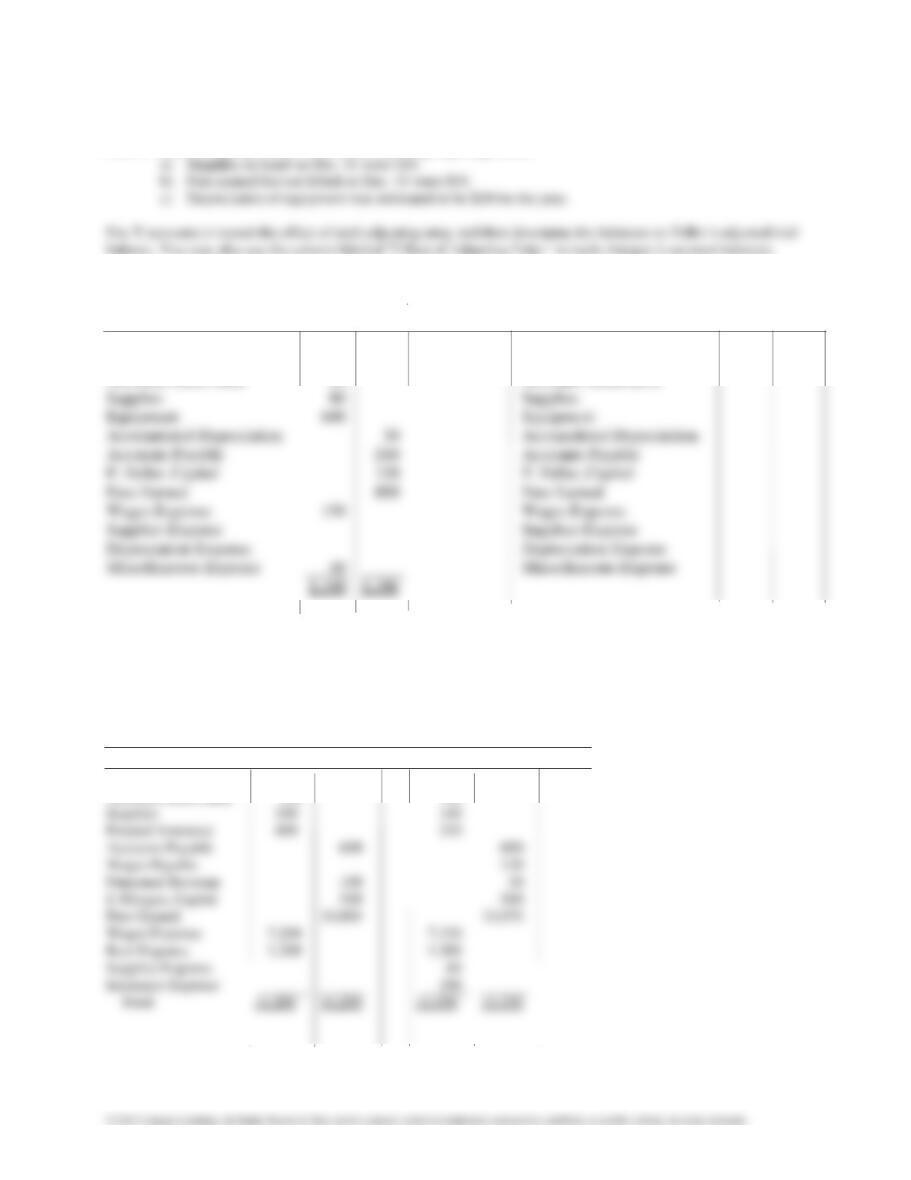
Handout 3-1
Part 1: Zeller Company needs to record the following adjusting entries:
balance. You may also use the column labeled “Effect of Adjusting Entry” to track changes in account balances.
Zeller Company Effect of Zeller Company
Unadjusted Trial Balance Adjusting Adjusted Trial Balance
Dec. 31 Entry Dec. 31
DR CR DR CR
Cash 300 Cash
Accounts Receivable 20 Accounts Receivable
Part 2: The trial balance and the adjusted trial balance for Matrix Company are presented below. Compare the numbers
on these trial balances to determine which adjusting entries were prepared by Matrix’s accountant. Journalize the four
adjusting entries on a separate sheet of paper. You may assume none of the accounts were affected by more than one
adjusting entry.
Matrix Company
Trial Balance
Dec. 31
Unadjusted Adjusted
Cash 1,500 1,500
Accounts Receivable 700 700
DIFFICULTY BUSPROG AICPA AICPA ACBSP ACBSP BLOOM’S TIME
Number
Learning
Objective
Description Primary
Broad
Business
Functional Primary Secondary
Spread-
sheet
GL
DQ3-1 3-1 Easy Analytic Measurement Cash vs. Accrual Knowledge 5 min.
DQ3-2 3-1 Easy Analytic Measurement Cash vs. Accrual Knowledge 5 min.
DQ3-3 3-1 Easy Analytic Measurement Adjusting Entries Knowledge 5 min.
DQ3-4 3-1 Easy Analytic Measurement Adjusting Entries Knowledge 5 min.
DQ3-5 3-2 Easy Analytic Measurement Adjusting Entries Knowledge 5 min.
DQ3-6 3-2 Easy Analytic Measurement Adjusting Entries Knowledge 5 min.
DQ3-7 3-2 Easy Analytic Measurement Adjusting Entries Knowledge 5 min.
DQ3-8 3-3 Easy Analytic Measurement Adjusting Entries Knowledge 5 min.
DQ3-9 3-2 Easy Analytic Measurement Adjusting Entries Knowledge 5 min.
DQ3-10 3-2 Easy Analytic Measurement Adjusting Entries Knowledge 5 min.
PE3-1A 3-1 Accounts requiring adjustment Easy Analytic Measurement Adjusting Entries Knowledge 5 min.
PE3-1B 3-1 Accounts requiring adjustment Easy Analytic Measurement Adjusting Entries Knowledge 5 min.
PE3-2A 3-1 Type of adjustment Easy Analytic Measurement Adjusting Entries Knowledge 5 min.
PE3-2B 3-1 Type of adjustment Easy Analytic Measurement Adjusting Entries Knowledge 5 min.
PE3-3A 3-2 Adjustment for prepaid expense Easy Analytic Measurement Adjusting Entries Application 5 min.
PE3-3B 3-2 Adjustment for prepaid expense Easy Analytic Measurement Adjusting Entries Application 5 min.
PE3-4A 3-2 Adjustment for unearned revenue Easy Analytic Measurement Adjusting Entries Application 5 min.
PE3-4B 3-2 Adjustment for unearned revenue Easy Analytic Measurement Adjusting Entries Application 5 min.
PE3-5A 3-2 Adjustment for accrued revenues Easy Analytic Measurement Adjusting Entries Application 5 min.
PE3-5B 3-2 Adjustment for accrued revenues Easy Analytic Measurement Adjusting Entries Application 5 min.
PE3-6A 3-2 Adjustment for accrued expense Easy Analytic Measurement Adjusting Entries Application 5 min.
PE3-6B 3-2 Adjustment for accrued expense Easy Analytic Measurement Adjusting Entries Application 5 min.
PE3-7A 3-2 Adjustment for depreciation Easy Analytic Measurement Adjusting Entries Application 5 min.
PE3-7B 3-2 Adjustment for depreciation Easy Analytic Measurement Adjusting Entries Application 5 min.
PE3-8A 3-3 Effect of omitting adjustments Moderate Analytic Measurement Adjusting Entries Application 10 min.
PE3-8B 3-3 Effect of omitting adjustments Moderate Analytic Measurement Adjusting Entries Application 10 min.
PE3-9A 3-4
balance
Moderate Analytic Measurement Adjusting Entries Application 10 min.
PE3-9B 3-4
Effect of errors on adjusted trial
balance
Moderate Analytic Measurement Adjusting Entries Application 10 min.
PE3-10A 3-5 Vertical analysis Moderate Analytic Measurement Financial Statement Analysis Application 10 min.
PE3-10B 3-5 Vertical analysis Moderate Analytic Measurement Financial Statement Analysis Application 10 min.
Ex3-1 3-1 Classifying types of adjustments Easy Analytic Measurement Adjusting Entries Knowledge 5 min.
Ex3-2 3-1 Classifying adjusting entries Easy Analytic Measurement Adjusting Entries Knowledge 5 min.
Ex3-3 3-2 Adjusting entry for supplies Easy Analytic Measurement Adjusting Entries Application 5 min.
Ex3-4 3-2 Determining supplies purchased Easy Analytic Measurement Adjusting Entries Application 5 min.
Ex3-5 3-2, 3-3 Effect of omitting adjusting entry Moderate Analytic Measurement Adjusting Entries Application 5 min.
Ex3-6 3-2
Adjusting entries for prepaid
insurance
Easy Analytic Measurement Adjusting Entries Application 5 min.
Ex3-7 3-2
insurance
Easy Analytic Measurement Adjusting Entries Application 5 min.
Ex3-8 3-2 Adjusting entries for unearned fees Easy Analytic Measurement Adjusting Entries Application 5 min.
Adjusting entries for prepaid
Ex3-9 3-2, 3-3 Effect of omitting adjusting entry Moderate Analytic Measurement Adjusting Entries Application 5 min.
Ex3-10 3-2 Adjusting entry for accrued fees Easy Analytic Measurement Adjusting Entries Application 5 min.
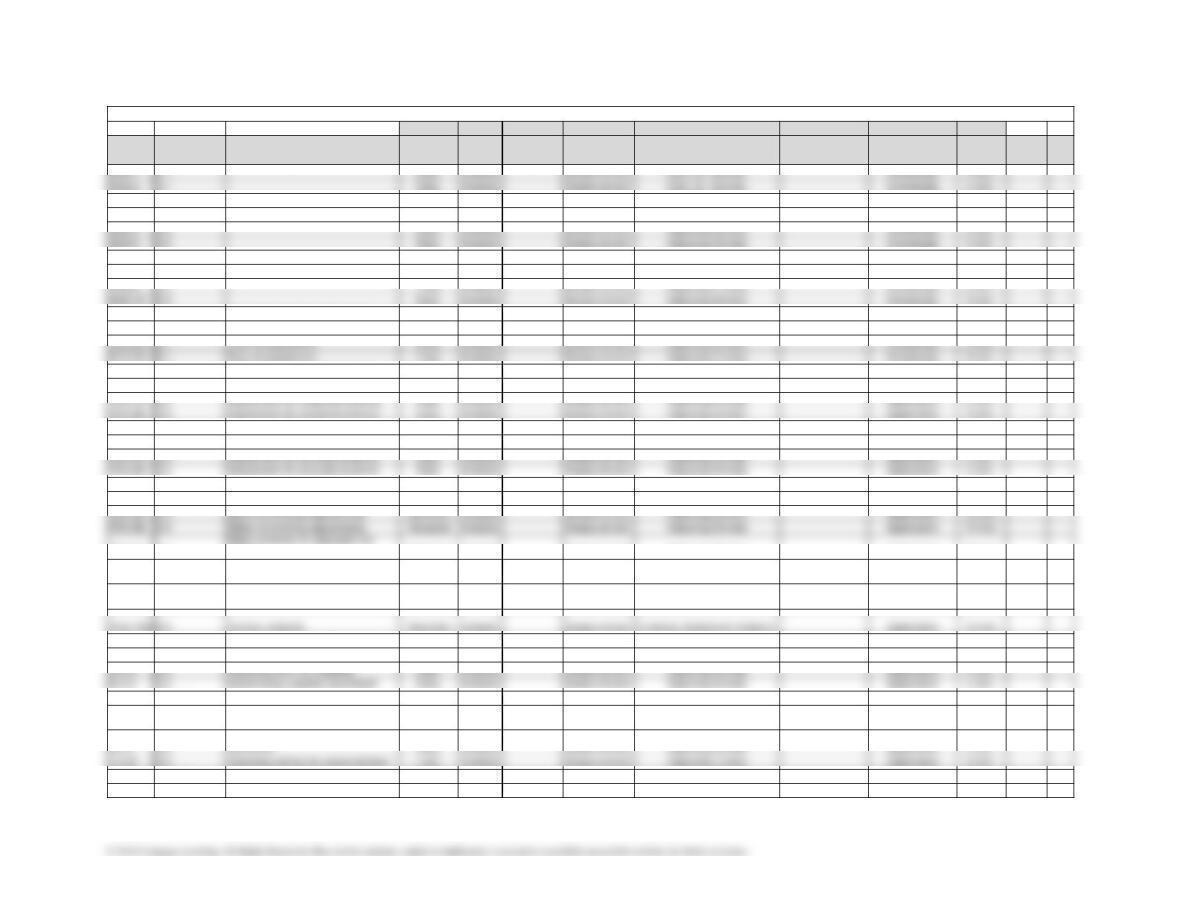
HOMEWORK CHART WITH LEARNING OUTCOMES TAGGING
DIFFICULTY BUSPROG AICPA AICPA ACBSP ACBSP BLOOM’S TIME
Number
Learning
Objective
Description Primary
Broad
Business
Functional Primary Secondary
Spread-
sheet
GL
Ex3-11 3-2
Adjusting entries for unearned and
accrued fees
Easy Analytic Measurement Adjusting Entries Application 5 min.
Ex3-12 3-2, 3-3 Effect of omitting adjusting entry Moderate Analytic Measurement Adjusting Entries Application 5 min.
Adjusting entries for accrued
Ex3-14 3-2 Determining wages paid Easy Analytic Measurement Adjusting Entries Application 5 min.
Ex3-15 3-2, 3-3 Effect of omitting adjusting entry Moderate Analytic Measurement Adjusting Entries Application 5 min.
Ex3-16 3-2, 3-3 Effect of omitting adjusting entry Moderate Analytic Measurement Adjusting Entries Application 5 min.
Adjusting entries for prepaid and
accrued taxes
Ex3-18 3-2 Adjustment for depreciation Easy Analytic Measurement Adjusting Entries Application 5 min.
Ex3-19 3-2 Determining fixed asset‘s book value Easy Analytic Measurement Adjusting Entries Application 5 min.
Ex3-20 3-2 Book value of fixed assets Easy Analytic Measurement Adjusting Entries Application 5 min.
Ex3-21 3-2, 3-3
Effects of errors on financial
statements
Easy Analytic Measurement Adjusting Entries Application 5 min.
Effects of errors on financial
Ex3-22 3-2, 3-3
statements
Easy Analytic Measurement Adjusting Entries Application 5 min.
Ex3-23 3-2, 3-3
Effects of errors on financial
statements
Moderate Analytic Measurement Adjusting Entries Application 10 min.
Ex3-24 3-2, 3-3
statements
Moderate Analytic Measurement Adjusting Entries Application 10 min.
Effects of errors on financial
Ex3-26 3-4 Adjusting entries from trial balances Moderate Analytic Measurement Adjusting Entries Application 10 min.
Ex3-27 3-4 Adjusting entries from trial balances Challenging Analytic Measurement Adjusting Entries Application 15 min.
Ex3-28 3-5
Vertical analysis of income
statement
Moderate Analytic Measurement Financial Statement Analysis Application 10 min.
Ex3-29 3-5
Vertical analysis of income
statement
Moderate Analytic Measurement Financial Statement Analysis Application 10 min.
Pr3-1A 3-2 Adjusting entries Moderate Analytic Measurement Adjusting Entries Application 30 min. X
Pr3-2A 3-2, 3-3 Adjusting entries Moderate Analytic Measurement Adjusting Entries Application 45 min.
Pr3-3A 3-2 Adjusting entries Moderate Analytic Measurement Adjusting Entries Application 1 hour X
Pr3-4A 3-2, 3-3, 3-4 Adjusting entries Moderate Analytic Measurement Adjusting Entries Application 45 min. X
Pr3-5A 3-2, 3-3, 3-4
balances
Challenging Analytic Measurement Adjusting Entries Application 1 hour X X
Pr3-6A 3-2, 3-3 Adjusting entries and errors Challenging Analytic Measurement Adjusting Entries Application 1 hour X
Pr3-1B 3-2 Adjusting entries Moderate Analytic Measurement Adjusting Entries Application 30 min. X
Pr3-2B 3-2, 3-3 Adjusting entries Moderate Analytic Measurement Adjusting Entries Application 45 min.
Pr3-3B 3-2 Adjusting errors Moderate Analytic Measurement Adjusting Entries Application 1 hour X
Pr3-4B 3-2, 3-3, 3-4 Adjusting entries Moderate Analytic Measurement Adjusting Entries Application 45 min. X
Pr3-5B 3-2, 3-3, 3-4
balances
Challenging Analytic Measurement Adjusting Entries Application 1 hour X X
Pr3-6B 3-2, 3-3 Adjusting entries and errors Challenging Analytic Measurement Adjusting Entries Application 1 hour X
MD-3 Continuing Problem X
CP3-1 3-1
Ethics and professional conduct in
business
Moderate Ethics Industry Cash vs. Accrual Analysis 15 min.
DIFFICULTY BUSPROG AICPA AICPA ACBSP ACBSP BLOOM’S TIME
Number
Learning
Objective
Description Primary
Broad
Business
Functional Primary Secondary
Spread-
sheet
GL
CP3-2 3-1 Accrued expense Easy Analytic Measurement Adjusting Entries Application 5 min.
CP3-3 3-1 Accrued revenue Easy Analytic Measurement Adjusting Entries Analysis 5 min.
CP3-4 3-3, 3-4
CP3-5 3-1 Codes of ethics Easy Ethics
Thinking
Purpose Knowledge 15 min.