3-1
————————————————-Chapter 3——————————————
REVIEW QUESTIONS
Q3-1 A budget is a formal estimate of the resources that an organization plans to spend
for a particular purpose or over a particular time period, and the proposed means of
Q3-2 State and local governments prepare operating budgets and capital budgets. They
also prepare cash forecasts.
Q3-3 Approaches to budget preparation include object-of-expenditure budgeting,
Q3-4 A cash forecast is a plan of the monies expected to be received and expended during
Q3-5 The steps in preparing a budget are:
1. Prepare budgetary policy guidelines.
2. Prepare a budget calendar.
9. Prepare the budget document.
10. Present the budget document to the legislative body.
Q3-6 In addition to copies of forms and worksheets to be used, a set of budget instructions should
contain the following:
2. A copy of the budgetary policy guidelines
3-2
4. A statement of specific policies to be followed when preparing
expenditure requests
Q3-7 A budget calendar is needed to ensure each person knows when his or her (and
Q3-8 A capital budget is a supplement to the capital outlay request summary which
presents information on the capital improvements desired over a long period of
Q3-9 A millage rate is a tax rate that, when applied to the assessed valuation of property
being taxed, will provide the desired amount of revenue. It is determined by
Q3-11 The legal level of budgetary control refers to the organizational unit or budgetary
Q3-12 No, the balance in the estimated revenues account does not represent an asset. The
Q3-13 The budgetary fund balance account predicts the effect (increase or decrease) on
3-3
Q3-14 Five typical sources of revenues received by local governments are property taxes, sales
Q3-15 The subclassifications of expenditures used in governmental budgeting and accounting are
Q3-16 The purpose of encumbrances in governmental accounting is to protect an
DISCUSSION SCENARIOS AND ISSUES
D3-1 The problem with these reports is that they are not tailored to the needs of their
users. An assumption is made that all activities performed by this city occur ratably
during the year. While this is true for many activities, others often are performed in
D3-2 This is a controversial issue. We suggest that the most logical and orderly choice of
the three is the third. The third alternative allows the accumulation of a “budget
cushion” to counter longer-term economic contractions and at the same time
D3-3 No. This is not ethical behavior. The “extra” money in the Director’s budget is money
that can be used elsewhere. In order to provide this money to Streets and Parkways,
D3-4 A budget is a formal estimate of resources that an organization plans to expend for a
given purpose or over a given period and the proposed means of acquiring these
resources. A budget can be used for:
1. Planning – It forces managers to formulate goals, identify the
interrelationship of various activities and to consider future events
2. Evaluating Performance– It provides a “standard” with which to
3. Coordinating Activities – It encourages thinking about the over-all
4. Implementing Plans – It communicates management‘s expectations of
5. Communicating Plans – It is a means of expressing the goals of the
6. Motivation – If presented properly, it can motivate employees to
work more effectively and efficiently, since it provides a goal for the
7. Authorizing Actions – In the case of governmental units, budgets are
EXERCISES
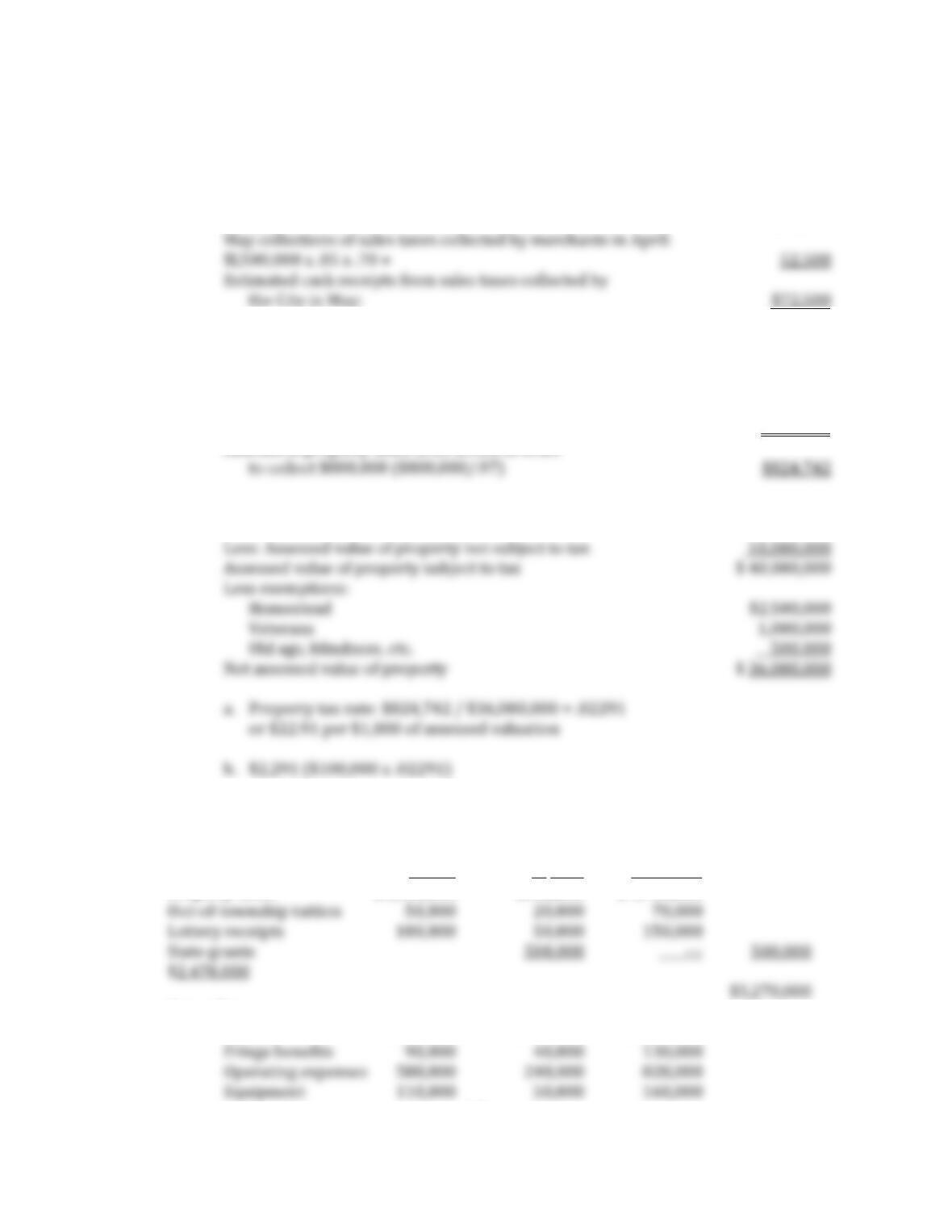
E3-1 July payments for July purchases, $650,000 x .50 = $325,000
3-5
E3-2 May collections of sales taxes collected by merchants in May:
$2,000,000 x .05 x .20 = $20,000
E3-3 Budgeted revenues from property taxes $800,000
Amount of property taxes to be levied in order
Property tax base:
Assessed valuation of all property $ 50,000,000
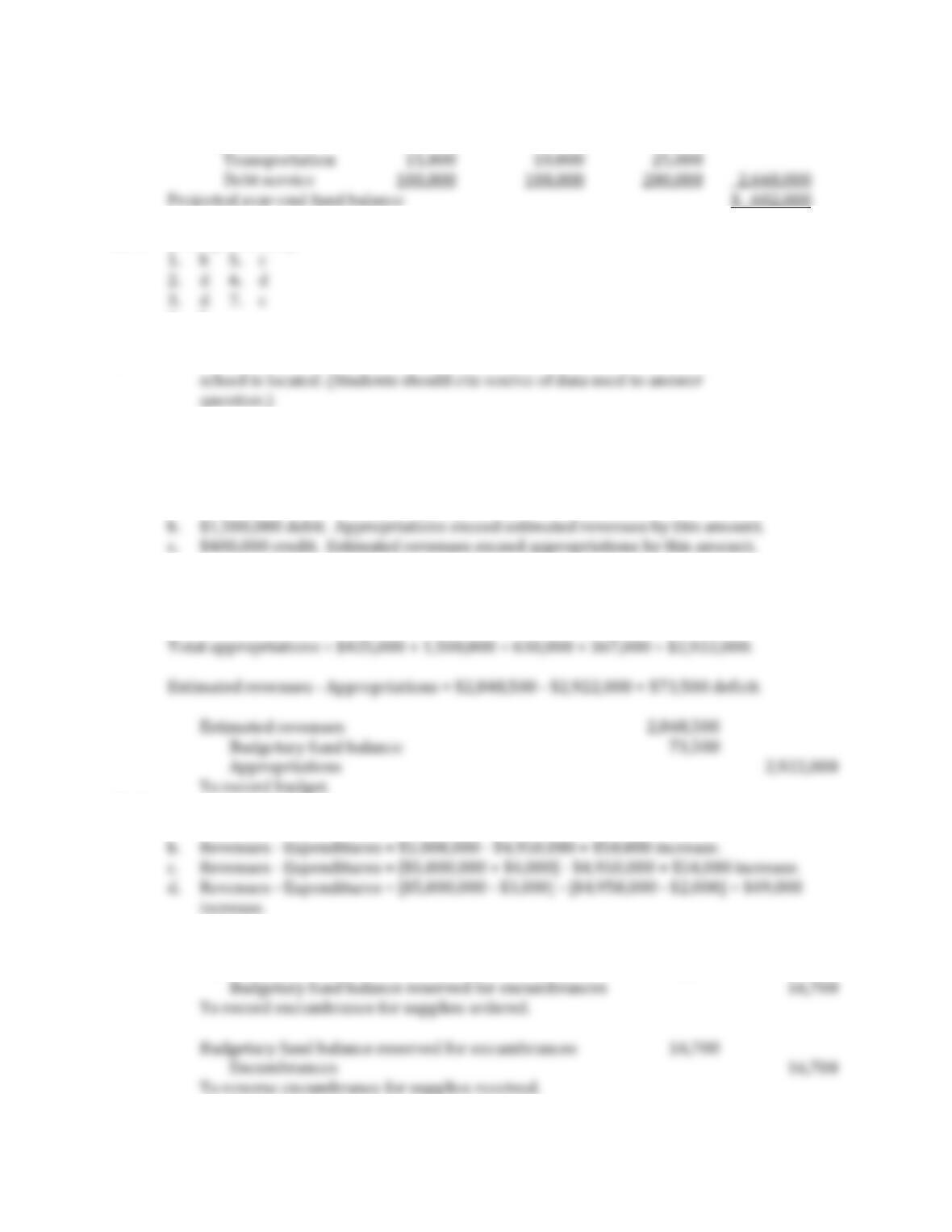
E3-4 Surplus from prior year $ 800,000
Year-to– Estimated
Date Remainder Total
Actual of Year Revenues
Property taxes $1,250,000 $500,000 $ 1,750,000
Expenditures:
Salaries $875,000 $450,000 $1,325,000
3-6
E3-5 (Multiple-choice)
4. b
E3-6 Students’ answers to this exercise will be specific to the state in which their
E3-7
a. 0. Estimated revenues equal appropriations.
E3-8
Total estimated revenues = $2,000,000 + 720,000 + 120,000 + 8,500 = $2,848,500.
E3-9
a. Revenues – Expenditures = $5,000,000 – [$4,950,000 – 7,000] = $57,000 increase.
E3-10
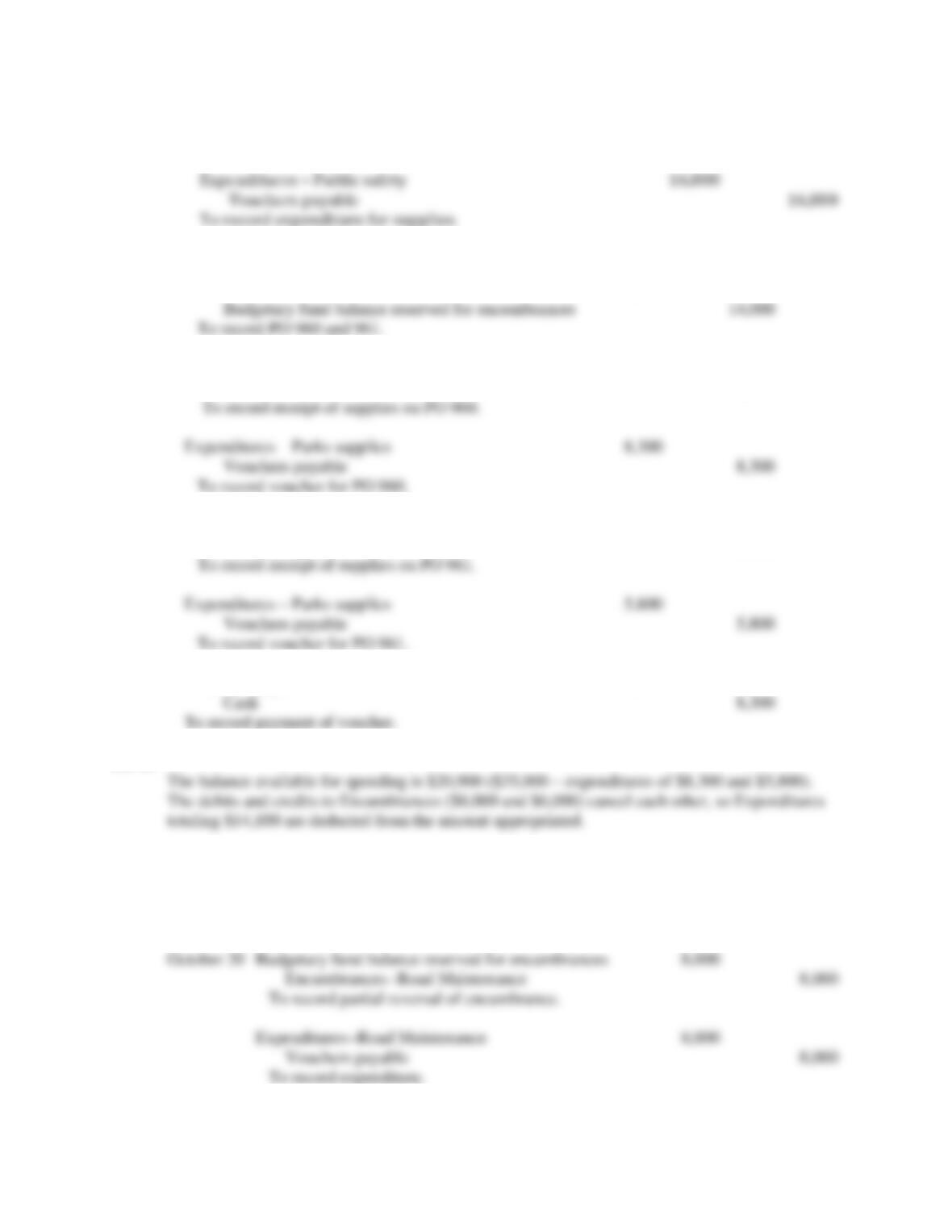
Encumbrances 16,700
3-7
E3-11
1. Encumbrances 14,000
2. Budgetary fund balance reserved for encumbrances 8,000
Encumbrances 8,000
3. Budgetary fund balance reserved for encumbrances 6,000
Encumbrances 6,000
4. Vouchers payable 8,300
E3-12 The balance available for spending is $20,900 ($35,000 – expenditures of $8,300 and $5,800).
E3-13 October 1 Encumbrances—Road Maintenance 10,000
Budgetary fund balance reserved for encumbrances 10,000
To record encumbrance.
3-8
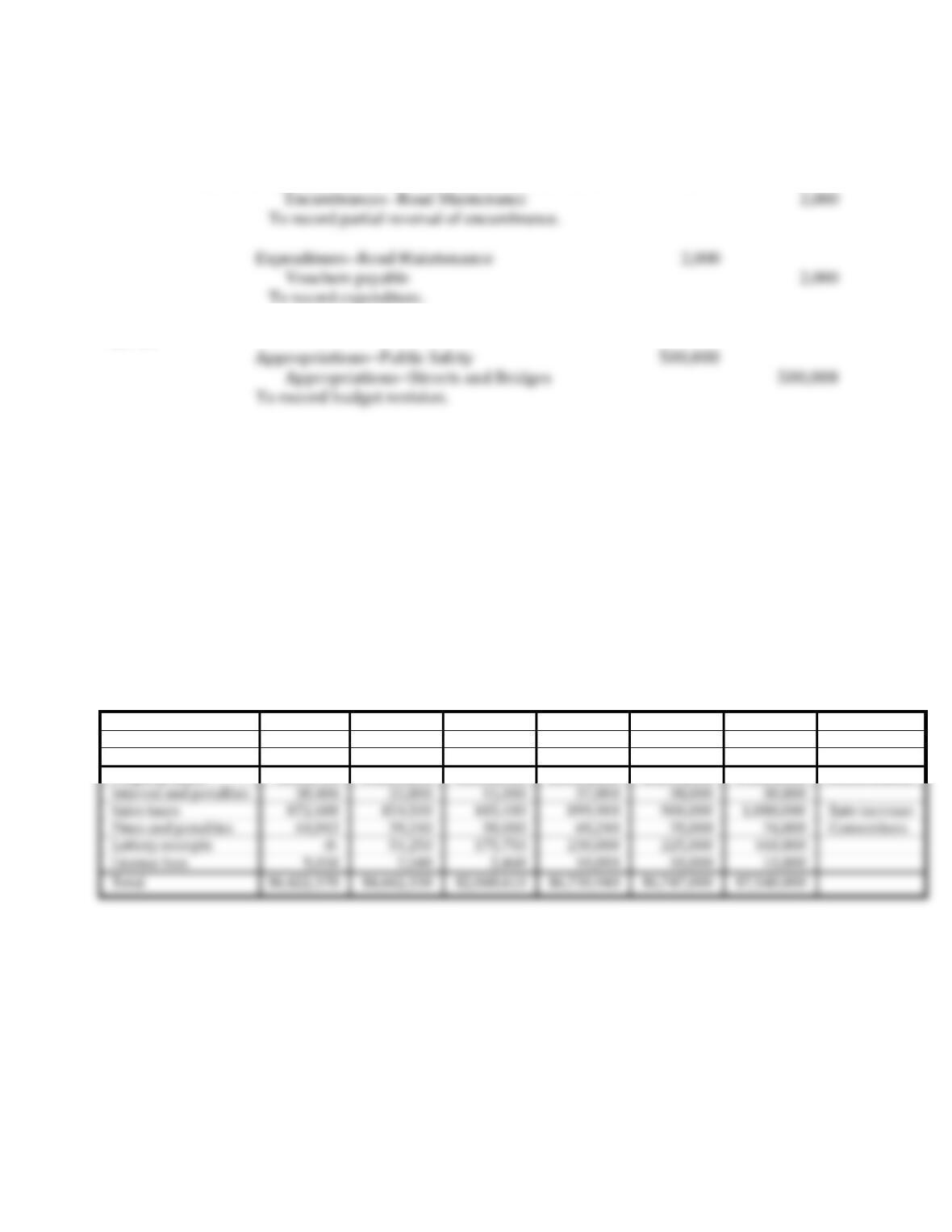
November 1Budgetary fund balance reserved for encumbrances 2,000
E3-14
PROBLEMS
P3-1
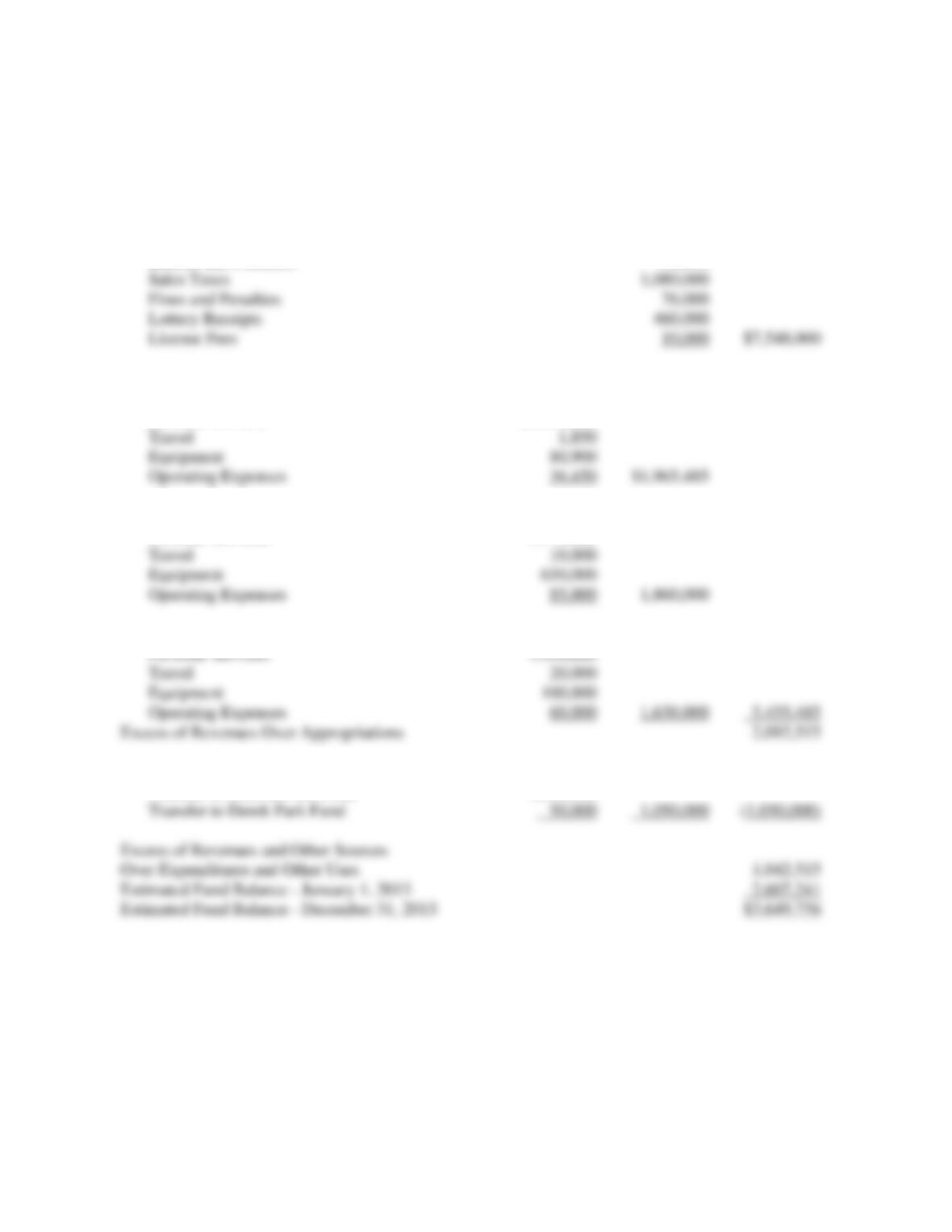
STATEMENT OF ACTUAL AND ESTIMATED REVENUES
Fund: General
Date: October 15, 2012
Prepared by ____________
Approved by ____________
Jan.-Sept.
Oct.-Dec.
Total
2011
2012
2012
2012
2012
2013
Source
Actual
Actual
Est. Act.
Est. Act.
Budget
Estimated
Remarks
Property taxes
5,436,720
$4,084,000
$1,400,000
$5,484,000
$5,504,000
$5,884,000
Reassessment
Interest and penalties
Sales taxes
872,680
454,500
900,000
Rate increase
Fines and penalties
Conventions
Lottery receipts
175,750
230,000
225,000
460,000
License fees
9,650
7,540
2,460

3-10
P3-2
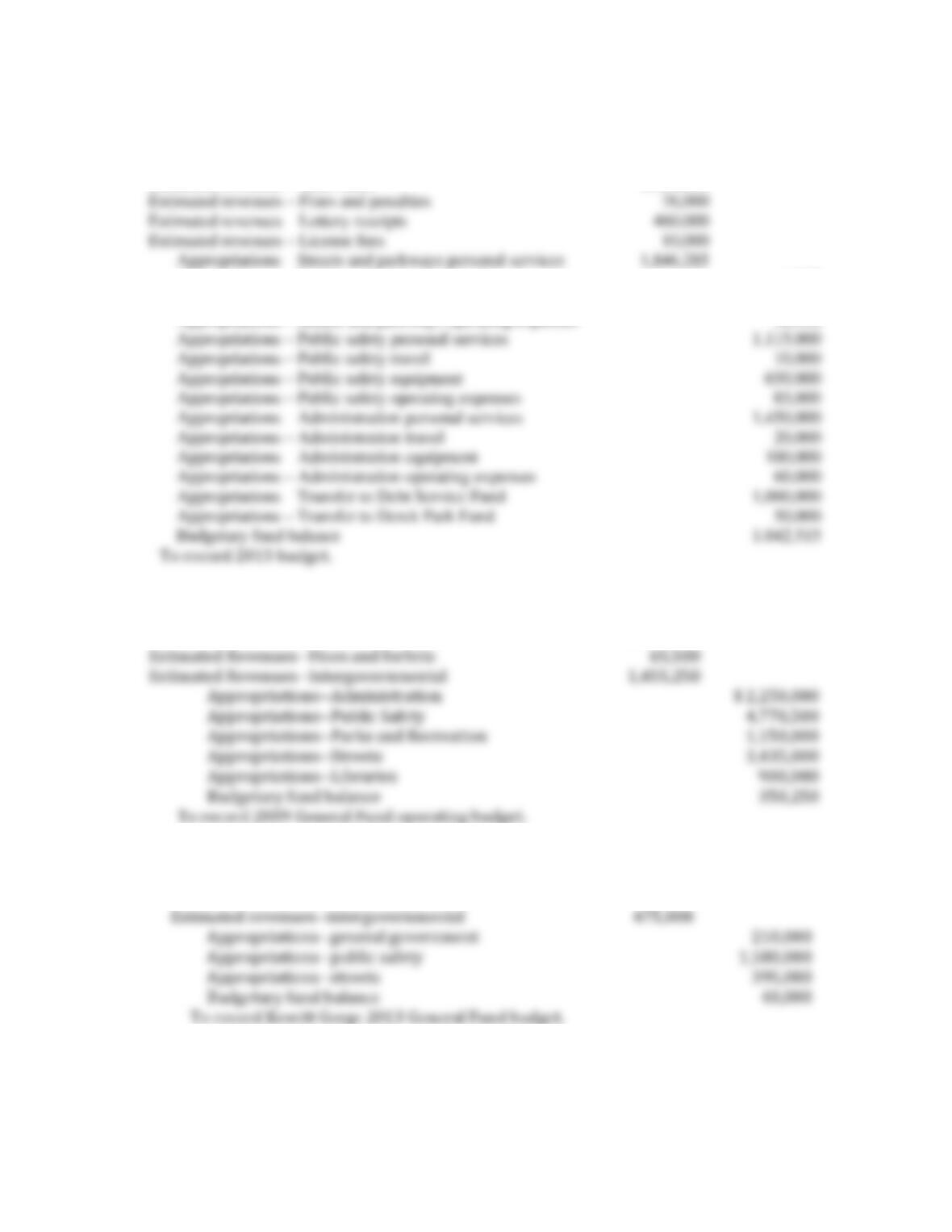
Jeter Village
General Fund
Budget Summary
Fiscal Year 2013
Revenues:
Property Taxes $5,884,000
Interest and Penalties 38,000
Appropriations:
Streets & Parkways
Personal Services $1,846,285
Public Safety
Personal Services 1,115,000
Administration
Other Financing Sources (Uses):
Transfer to Debt Service Fund 1,000,000
3–11
P3-3
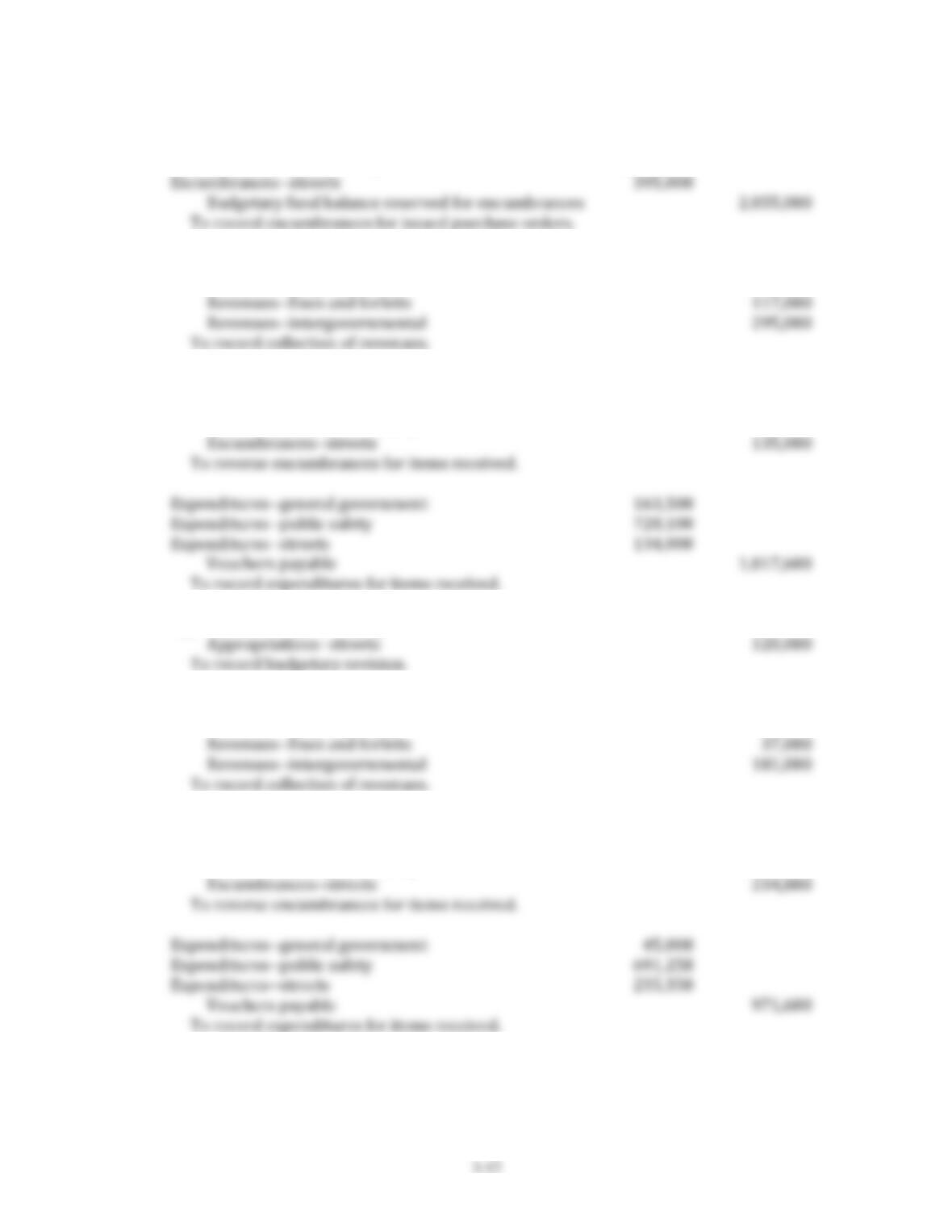
Estimated revenues – Property taxes 5,884,000
Estimated revenues – Interest and penalties 38,000
Estimated revenues – Sales taxes 1,080,000
Appropriations – Streets and parkways travel 1,850
Appropriations – Streets and parkways equipment 80,900
Appropriations – Streets and parkways operating expenses 36,450
P3-4
Estimated Revenues—Property taxes $ 9,500,000
Estimated Revenues—Sales taxes 1,835,000
P3-5
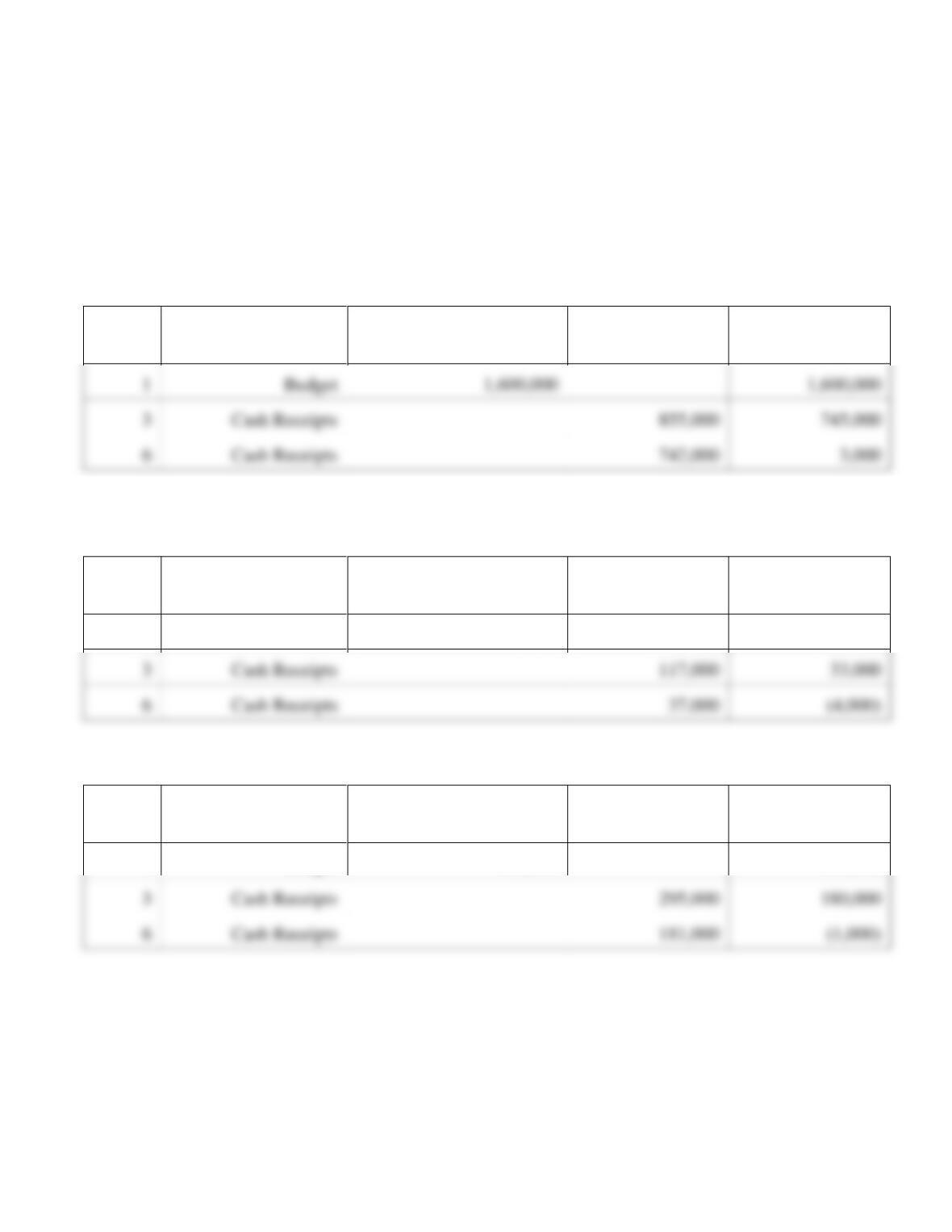
1. Estimated revenues—property taxes 1,600,000
Estimated revenues—fines and forfeits 150,000
2. Encumbrances—general government 210,000
Encumbrances—public safety 1,450,000
3. Cash 1,267,000
Revenues—property taxes 855,000
4. Budgetary fund balance reserved for encumbrances 1,019,000
Encumbrances—general government 165,000
Encumbrances—public safety 719,000
5. Appropriations—public safety 120,000
6. Cash 960,000
Revenues—property taxes 742,000
7. Budgetary fund balance reserved for encumbrances 973,500
Encumbrances—general government 45,000
Encumbrances—public safety 693,700
3–13
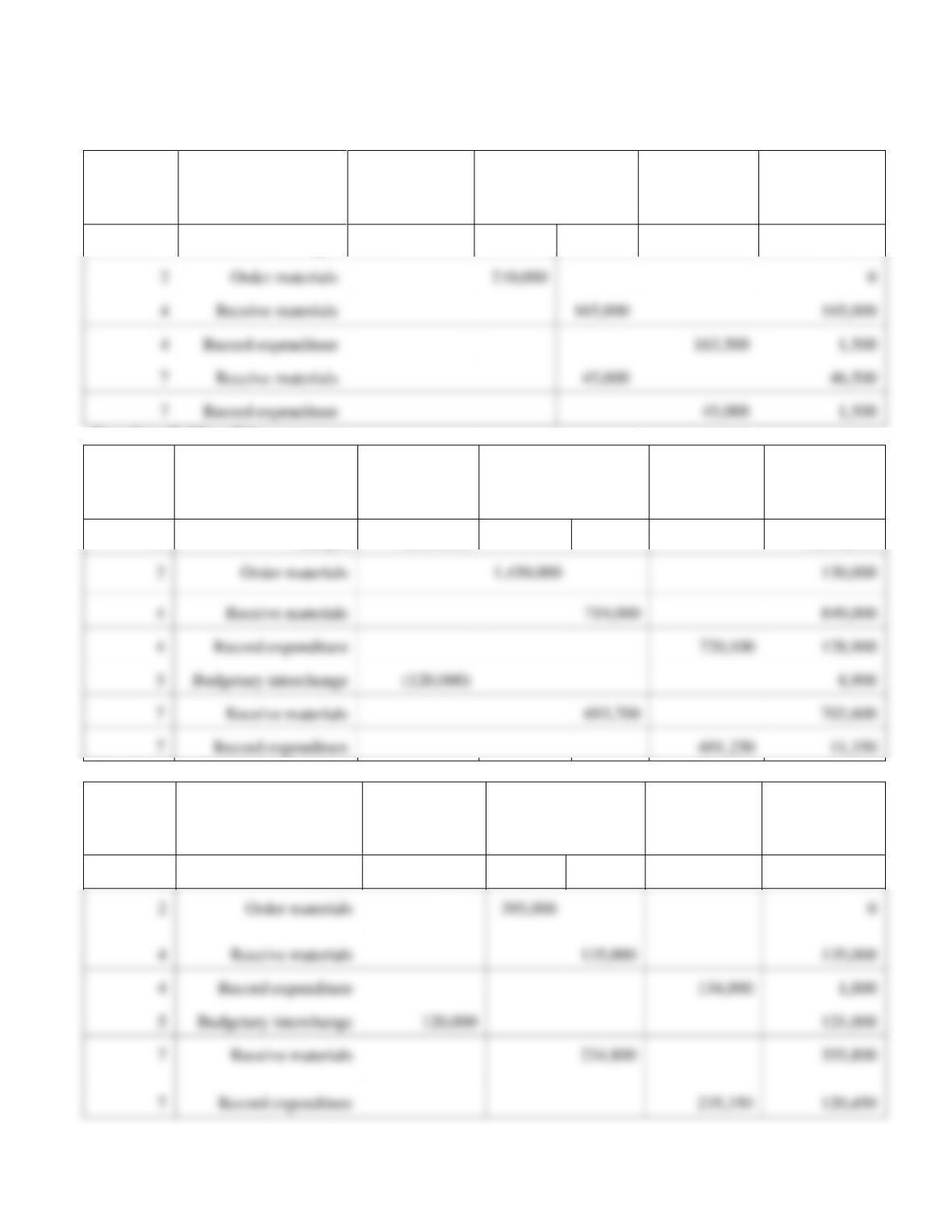
P3-6 Kowitt Gorge
General Fund
Revenues Ledger
2013
Source: Property taxes
Entry
No.
Item
Estimated Revenues
Dr
Actual Revenues
Cr
Difference
Dr (Cr)
Source: Fines and forfeits
Entry
No.
Item
Estimated Revenues
Dr
Actual Revenues
Cr
Difference
Dr (Cr)
1
Budget
150,000
150,000
3
117,000
6
Source: Intergovernmental
Entry
No.
Item
Estimated Revenues
Dr
Actual Revenues
Cr
Difference
Dr (Cr)
1
Budget
475,000
475,000
3
295,000
180,000
6
181,000
1
Budget
3
855,000
745,000
6
742,000
Kowitt Gorge
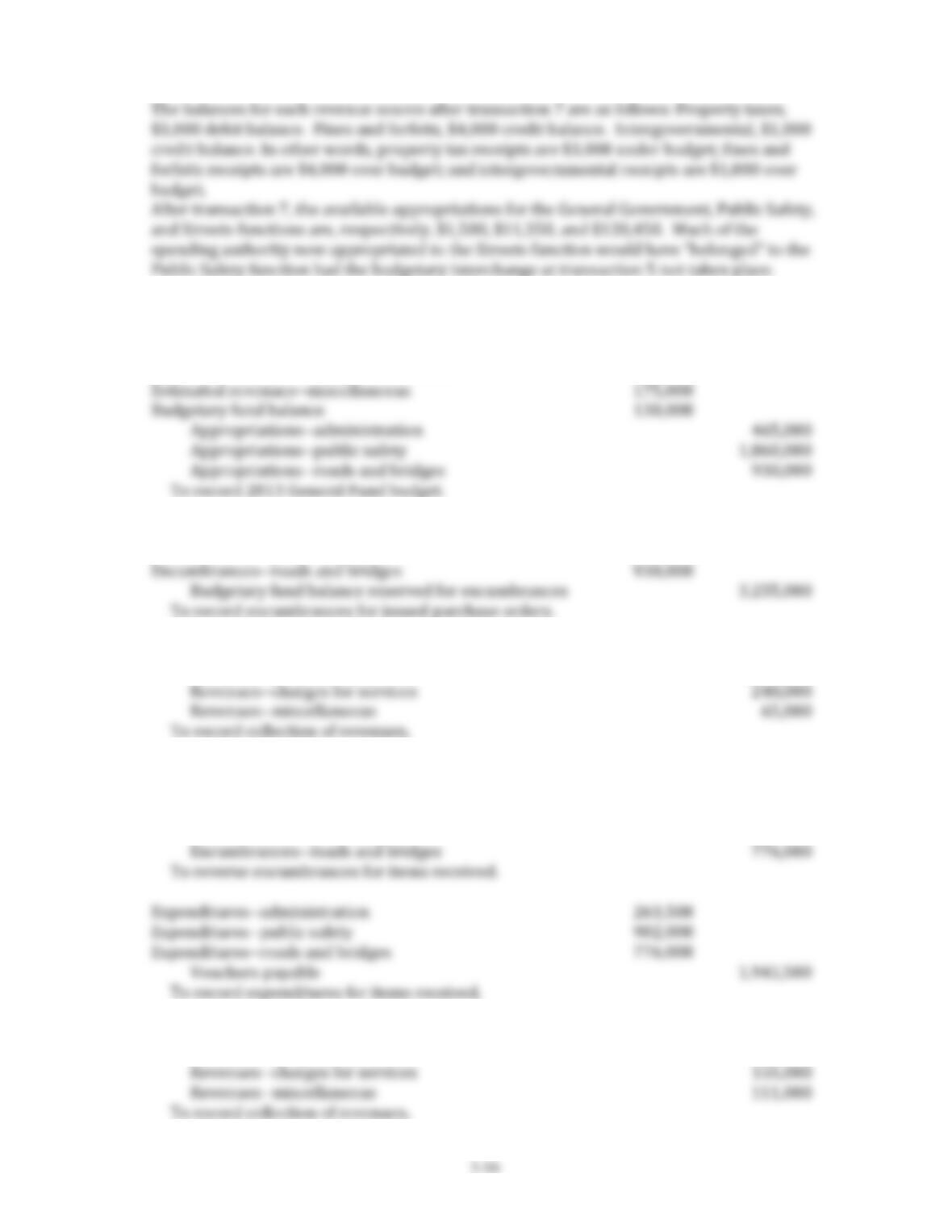
General Fund
Appropriations Ledger
2013
Function: General government
Entry No.
Item
Appropriation
Cr
Encumbrances
Dr Cr
Expenditures
Dr
Available
Appropriation
Cr
1
Budget
210,000
210,000
Function: Public safety
Entry No.
Item
Appropriation
Cr
Encumbrances
Dr Cr
Expenditures
Dr
Available
Appropriation
Cr
1
Budget
1,580,000
1,580,000
4
4
5
7
7
Function: Streets
Entry No.
Item
Appropriation
Cr
Encumbrances
Dr Cr
Expenditures
Dr
Available
Appropriation
Cr
1
Budget
395,000
395,000
4
135,000
1,000
5
120,000
121,000
4
45,000
7
P3-7
1. Estimated revenues—property taxes 2,550,000
Estimated revenues—charges for services 400,000
2. Encumbrances—administration 465,000
Encumbrances—public safety 1,860,000
3. Cash 2,318,000
Revenues—property taxes 2,005,000
4. Budgetary fund balance reserved for encumbrances 1,943,000
Encumbrances—administration 265,000
Encumbrances—public safety 902,000
5. Cash 801,000
Revenues—property taxes 535,000
6. Budgetary fund balance reserved for encumbrances 1,302,000
Encumbrances—administration 200,000
Encumbrances—public safety 948,000
3-18
P3-8
Lawton City
General Fund
Revenues Ledger
2013
Source: Property taxes
Entry No.
Item
Estimated Revenues
Dr
Actual Revenues
Cr
Difference
Dr (Cr)
1
Budget
2,550,000
2,550,000
Source: Charges for services
Entry No.
Item
Estimated Revenues
Dr
Actual Revenues
Cr
Difference
Dr (Cr)
1
Budget
400,000
400,000
3
Cash Receipts
248,000
152,000
5
Cash Receipts
155,000
(3,000)
Source: Miscellaneous
Entry No.
Item
Estimated Revenues
Dr
Actual Revenues
Cr
Difference
Dr (Cr)
1
Budget
175,000
175,000
3
Cash Receipts
65,000
110,000
5
Cash Receipts
111,000
(1,000)
Lawton City
General Fund
Appropriations Ledger
2013
Function: Administration
Entry No.
Item
Appropriation
Cr
Encumbrances
Dr Cr
Expenditures
Dr
Available
Appropriation
Cr
1
Budget
465,000
465,000
2
Order materials
465,000
0
265,000
200,000
6
Record expenditure
3
Cash Receipts
2,005,000
545,000
6
Cash Receipts
535,000
10,000
6
10,000
Function: Public safety
Entry No.
Item
Appropriation
Cr
Encumbrances
Dr Cr
Expenditures
Dr
Available
Appropriation
Cr
1
Budget
1,860,000
1,860,000
2
Order materials
1,860,000
0
Function: Roads and bridges
Entry No.
Item
Appropriation
Cr
Encumbrances
Dr Cr
Expenditures
Dr
Available
Appropriation
Cr
1
Budget
930,000
930,000
2
Order materials
930,000
0
4
776,000
4
6
Record expenditure
P3-9
1. Estimated revenues – property taxes 1,000,000
Estimated revenues – sales taxes 2,900,000
2. Appropriations – parks all other 60,000
4
902,000
4
Record expenditure
0
6
948,000
6
Record expenditure
1,000
3. Appropriations – general government all other 75,000
Budgetary fund balance 50,000
Estimated revenues – sales taxes 125,000
To record budget revision.