Ethical Obligations and Decision Making in Accounting, 4/e 1
Case 3-7 Olympus
Summary of the Case
On September 25, 2012, Japanese camera and medical equipment maker Olympus Corporation
and three of its former executives pleaded guilty to charges related to an accounting scheme and
cover-up in one of Japan’s biggest corporate scandals. Olympus admitted that it tried to conceal
investment losses by using improper accounting under a scheme that began in the 1990s.
The scandal was exposed in 2011 by Olympus’s then-CEO, Michael C. Woodford. As the new
President of Olympus, he felt obliged to investigate the matter and uncovered accounting
irregularities and suspicious deals involving the acquisition of UK medical equipment
manufacturer Gyrus. He called the company’s auditors, PwC, to report it. The firm examined
payments of £1.1 billion (US$687) related to financial advice on the acquisition paid to a non-
existent Cayman Islands firm. A fraud of $1.7 billion emerged, including an accounting scandal
to hide the losses. Along the way, the Japanese way of doing business came under attack by
Woodford.
Ethical Obligations and Decision Making in Accounting, 4/e 2
Olympus Spent Huge Sums on Inflated Acquisitions,
Advisory Fees to Conceal Investment Losses
Olympus’s cover-up of massive losses has shed light on several murky methods that some
companies employed to clean up the mess left after Japan’s economic bubble burst. Many
companies turned to speculative investments as they suffered sluggish sales and stagnant
operating profits. The company used “loss–deferring practices” to make losses look smaller on
the books by selling bad assets to related companies.
To take investment losses off its books, Olympus spent large sums of money to purchase British
medical equipment maker Gyrus Group PLC and three Japanese companies and paid huge
consulting fees. Olympus is suspected of having deliberately acquired Gyrus at an inflated price,
Olympus’s Tobashi Scheme
At the heart of Olympus’s action, was a once-common technique to hide losses called tobashi,
which Japanese financial regulators tolerated before clamping down on the practice in the late
1990s. Tobashi, translated loosely as “to blow away,” enables companies to hide losses on bad
assets by selling those assets to other companies, only to buy them back later through payments,
often disguised as advisory fees or other transactions, when market conditions or earnings
improve.
Ethical Obligations and Decision Making in Accounting, 4/e 3
Olympus Scandal Raises Questions about the “Japan Way”
of Doing Business
The scandal rocked corporate Japan, not least because of the company’s succession of firings,
denials, admissions, and whistleblowing. It also exposed weaknesses in Japan’s financial
regulatory system and corporate governance.
“This is a case where Japan’s outmoded practice of corporate governance remained and reared its
ugly head,” according to Shuhei Abe, president of Tokyo–based Sparx Group Company. “With
Olympus’s case, it will no longer be justifiable for Japan Inc. to continue practicing under the
excuse of the ‘Japan way of doing things.”
Accounting Explanations
Olympus hid a $1.7 billion loss through an intricate array of transactions.
A one paragraph summary of what it did appears in the investigation report:
Ethical Obligations and Decision Making in Accounting, 4/e 4
Auditor Responsibilities
Arthur Andersen was the external auditor through March 31, 2002, after which Andersen closed
its doors for good in the post-Enron era. Then KPMG AZSA LLC was the auditor through
March 31, 2009. The 2010 and 2011 fiscal years were audited by Ernst & Young ShinNihon
LLC.
The investigative report noted that the fraud was hidden quite well. Three banks were involved in
hiding information from the auditors. The summary report said that all three of them agreed not
to tell auditors the information that would normally be provided on an audit confirmation.
KPMG did come across one of the tobashi schemes carried out through one of the three different
routes that had been set up. According to the investigative report:
Ethical Obligations and Decision Making in Accounting, 4/e 5
Olympus Finally Had Enough of the Deception
The last part of the bad investments was finally written off in March 2010. That was the last
month of the fiscal year, when Ernst & Young took over the audit from KPMG. Mori and
Yamada had finally decided to unwind and write off the underwater financial assets and repay
the loans that it had made through its unconsolidated subsidiary. Of course, by then, the financial
press had gotten wind of what was going on at Olympus.
*The facts of this case are drawn from: Michael Woodford, Exposure: Inside the Olympus
Scandal: How I went from CEO to Whistleblower, (NY: Penguin Books, 2012).
Exhibit 1
Detailed Bookkeeping Analysis of Olympus’s Accounting Fraud*
Phase 1
Transaction 1:
This is a summary of a complex move—it involved making a CD deposit at several banks that
were asked to loan the money back to an unrelated entity, with the CD as collateral, so the
subsidiary can buy investments from Olympus.
(Olympus books)
DR Certificate of deposit
CR Cash
(CD purchase at banks; banks loan it to unconsolidated subsidiary)
(Unconsolidated subsidiary books)
DR Cash
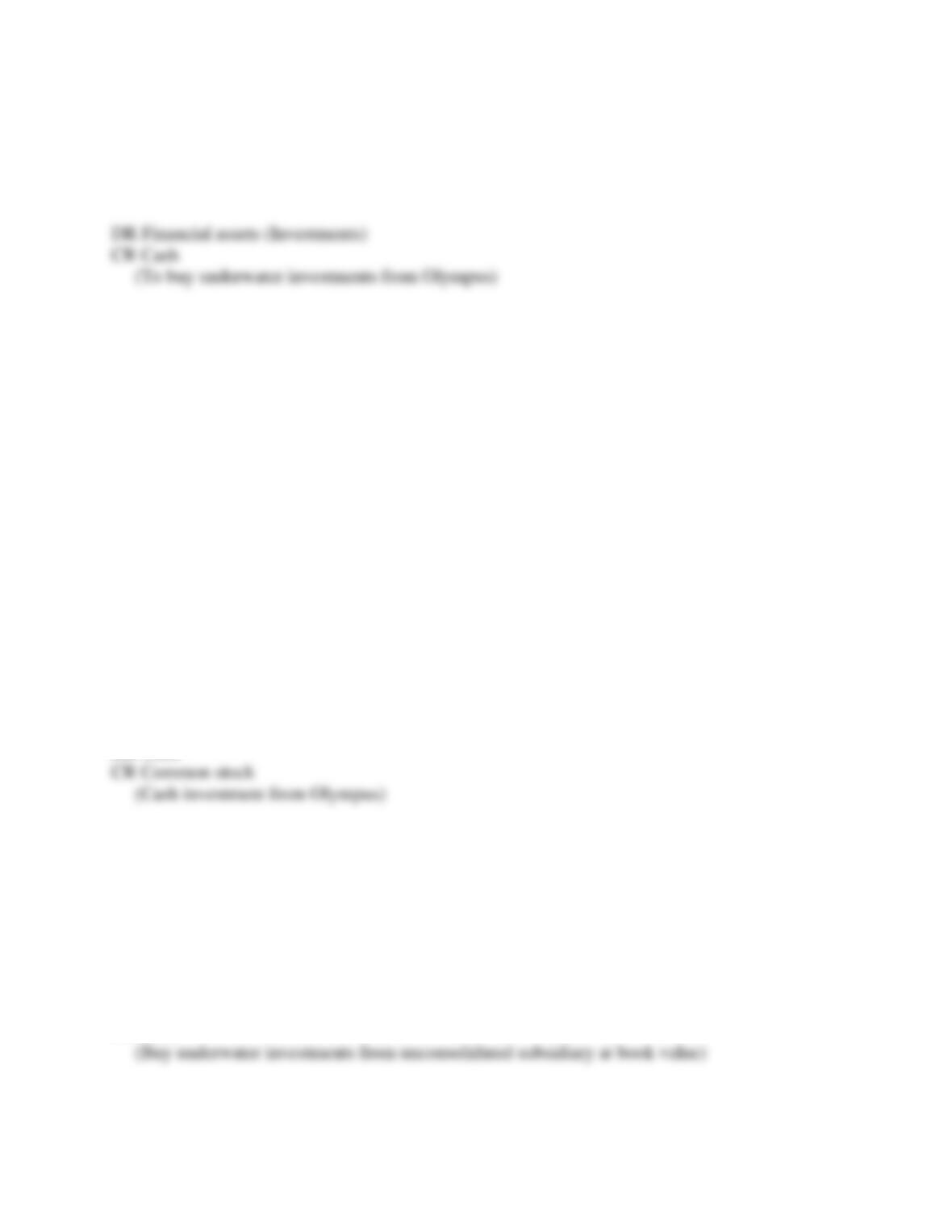
Transaction 2:
(Olympus books)
DR Cash
CR Financial assets (Investments)
Ethical Obligations and Decision Making in Accounting, 4/e 6
(Proceeds from selling underwater investments to unconsolidated subsidiary; may have
triggered gain on sale)
(Unconsolidated subsidiary books)
Phase 2
Eventually the CDs would have to be rolled over and brought back. In addition, the unrealized
losses would have to be written down eventually, so the second phase was launched.
Transaction 3:
Olympus bought some tiny (startup) companies. They paid significantly more than they were
worth and paid large amounts for consultants for their service as finders and intermediaries.
(Olympus books)
DR Investments (startup subsidiary)
DR Goodwill—(cash paid less fair market value of subsidiary net assets)
CR Cash
(Investments in new subsidiaries)
Note: The investment in the consolidated subsidiary shows a large amount of goodwill, which
could then be written down.
(Entries by the newly formed consolidated subsidiary)
DR Cash
Transaction 4:
The effect of these transactions was to transfer money into the newest consolidated subsidiary,
which used the money to buy the bad investments from the older, unconsolidated subsidiary. The
unconsolidated subsidiary then repaid the note payable to the bank and Olympus liquidated its
CD.
(Entries by the newly formed consolidated subsidiary)
DR Financial assets (Investments)
CR Cash
Ethical Obligations and Decision Making in Accounting, 4/e 7
(Unconsolidated subsidiary books)
DR Cash (from consolidated sub)
CR Financial assets (Investments)
(Repay loan to banks)
Entries by Olympus
DR Cash
CR Certificate of deposit
(CD liquidated)
A good video that discusses the basic facts of the case, the role of Michael Woodford,
corporate governance, and efforts of PwC is at:
Questions
1. Does it seem reasonable that Olympus engaged in an accounting fraud for so long and
the auditors did not detect it? Were the transactions in question and accounting for them
something that should have been detected earlier through proper auditing procedures?
What caused the failure of the auditors to act on the fraud? Explain.
Audits are designed to find material errors. Thus, it is possible that the fraud and errors in the
financial statements was adding to incrementally immaterial amounts until it was a material
amount. The concealing of the losses on acquisitions began in the 1990s by three top company
officials: former Chairman Tsuyoshi Kikukawa, Mori and auditor, Hideo Yamada. The losses
were first hidden by tobashi, which practice was banned for business years after March 2001;
Ethical Obligations and Decision Making in Accounting, 4/e 8
2. Evaluate the corporate culture at Olympus including corporate governance. What were
the shortcomings and what do you think caused them?
The ethical issues at Olympus included untruthful and inaccurate financial statements and
disclosures. The corporate culture at Olympus included a board that was not independent, but
was controlled by Kikukawa, the former chair, and a few other executives. Olympus’s board of
auditors was supposed to supervise the board of directors, but seemed to do the bidding of
3. Do you believe Michael Woodford did the right thing by blowing the whistle on
accounting irregularities? Were there other options open to him? Once he was fired, could
he have made a whistleblower’s claim with the SEC under Dodd-Frank? Why or why not?
In April 2011, British-born Michael Woodford, an Olympus veteran of 30 years, was promoted
to the post of president and chief operating officer and became the first ever non-Japanese
chairman of Olympus. Six months later, Olympus elevated him to its chief executive officer; at
that time, he was regarded as an unlikely choice. There were rumors that he only got the job