Matching
A.
Break-even point
G.
Operating leverage
Contribution margin ratio
H.
Profit equation
Cost structure
Profit-volume analysis
D.
Cost-volume-profit analysis
Total contribution margin
Margin of safety
K.
Unit contribution margin
Margin of safety percentage
_____ 1. Operating profit equals total revenues less total costs.
_____ 2. Volume level at which profits equal zero.
_____ 3. Extent to which an organization’s cost structure is made up of fixed costs.
_____ 4. Version of the cost-volume-profit analysis using a single profit line.
_____ 5. The proportion of fixed and variable costs to total costs of an organization.
Matching Answers
1. H
3. G
5. C
7. J
9. D
11. F
Multiple Choice
Use the following information to answer questions 1 through 4:
Company A currently sells a product for $2 each. Fixed cost and unit variable cost are $12,000
and $0.80, respectively.
1. What is the break-even point in units and in sales dollars, respectively?
2. What is the contribution margin ratio?
3. To reach a target profit of $33,000, how many units of output should be sold?
a. 22,500 units
b. 31,750 units
c. 37,500 units
d. 42,000 units
4. If variable cost per unit is increased by 15%, fixed cost is increased to $15,120, and the unit
price remains the same, what is the new break-even point in sales dollars?
a. $22,000
b. $24,000
c. $26,000
d. $28,000
5. Relative to companies with low operating leverage, a company with high operating leverage:
a. is more sensitive to economic fluctuations.
6. The excess of actual or projected sales over the break-even sales is known as:
a. contribution margin.
7. A company produces key chains. The data include price $1, unit variable cost $0.40, monthly
fixed cost $3,000, and tax rate 30%. The owner wants to earn an after-tax profit of $10,500
per month. How many key chains must be produced and sold to meet that goal?
a. 24,000
b. 30,000
c. 32,000
d. 36,000
8. When more than one product is involved:
a. the CVP method reaches its limit.
9. A start-up company manufactures two products: X is sold for $5 with variable cost of $3
each; Y is sold for $8 with variable cost of $4 each. An annual fixed cost of $10,000 is
projected. The marketing department estimates a 3:1 ratio between X and Y. How many units
of X must be sold to break even for the first year of operation?
a. 3,000
b. 3,600
c. 1,000
d. 1,500
10. CVP analysis:
a. requires certain assumptions to be made.
11. In October, Fashionable Clothing manufactured 2,000 items with the following financial
statement amounts: direct materials $12,000, sales $48,000, direct labor $16,000,
depreciation $3,600, rent $1,500, and variable overhead $9,000. What is contribution margin
per unit?
a. $5.50
b. $2.95
c. $3.40
d. $4.10
12. Which of the following statements regarding margin of safety is correct?
Multiple Choice Answers
1. a (LO1)
2. d (LO1)
3. c (LO1)
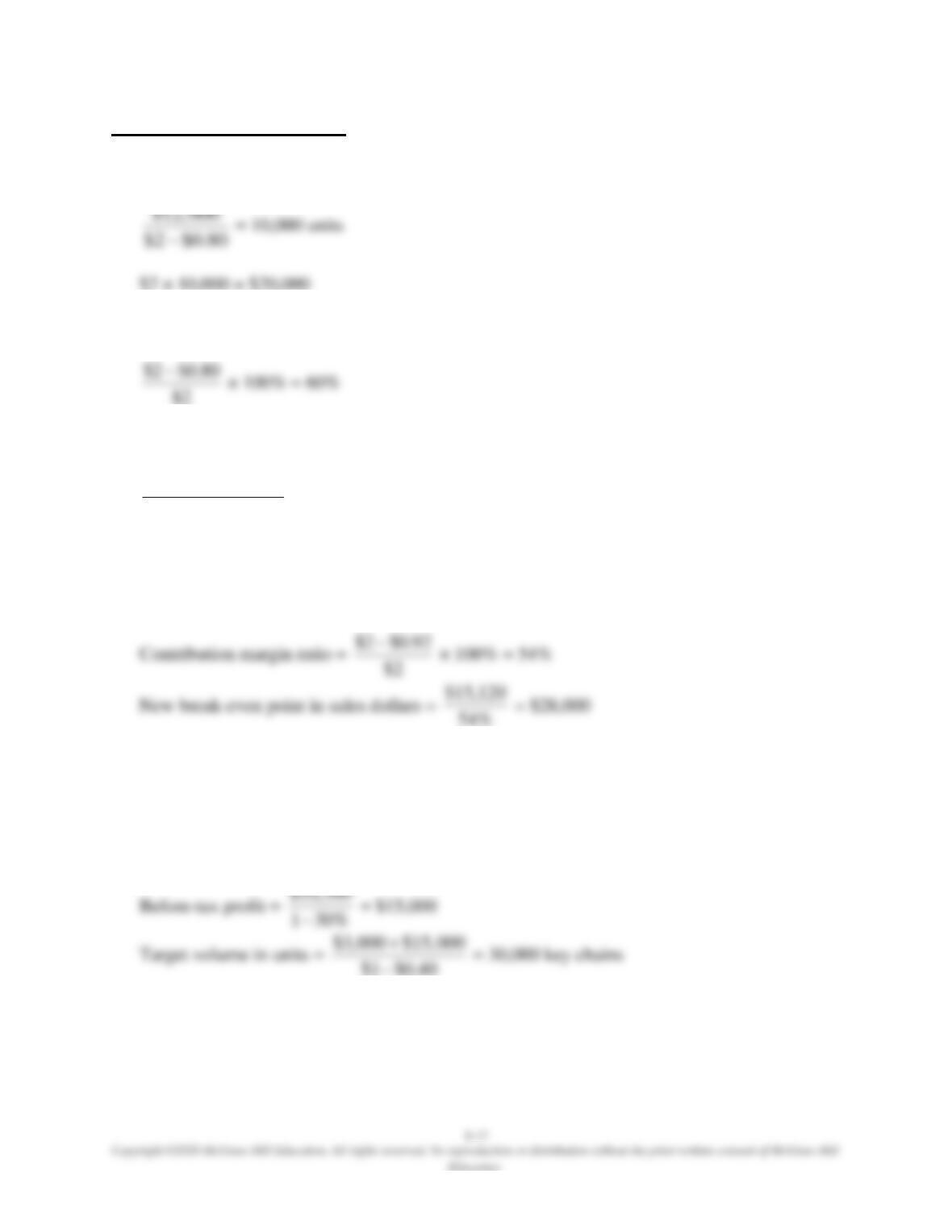
$12,000 $33,000
$2 $0.80
+
−
= 37,500 units
4. d (LO2)
Variable cost = $0.80 × (1 + 15%) = $0.92
5. a (LO2)
6. b (LO2)
7. b (LO4)
8. c (LO4, LO5)
9. a (LO4)
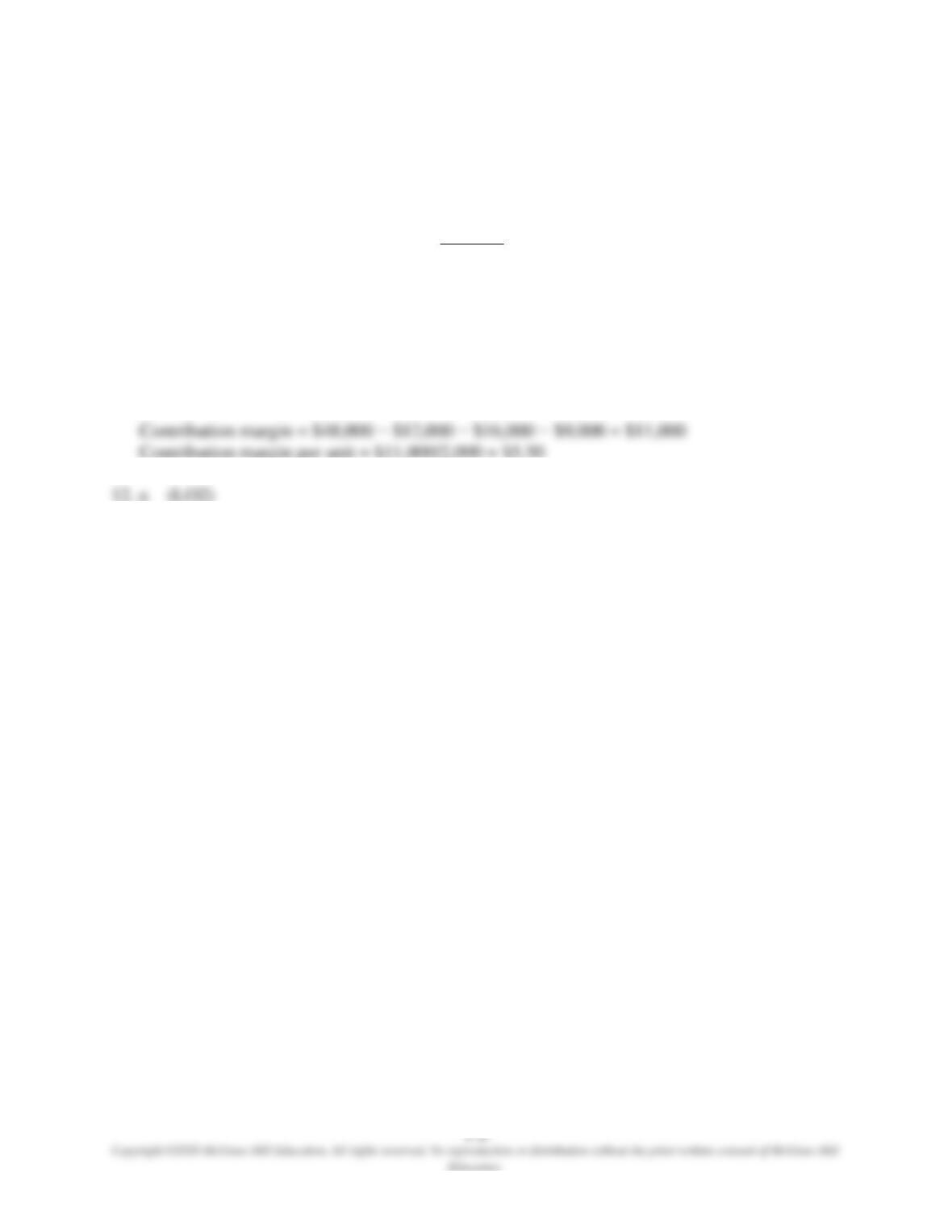
Weighted-average contribution margin per unit = ($5 − $3) × 0.75 + ($8 − $4) × $0.25 =
$2.50
The multiproduct break-even volume =
$10,000
$2.50
= 4,000 units
X’s share of the total output = 4,000 × 0.75 = 3,000 units
10. a (LO5)
11. a (LO1)
Demonstration Problem 1
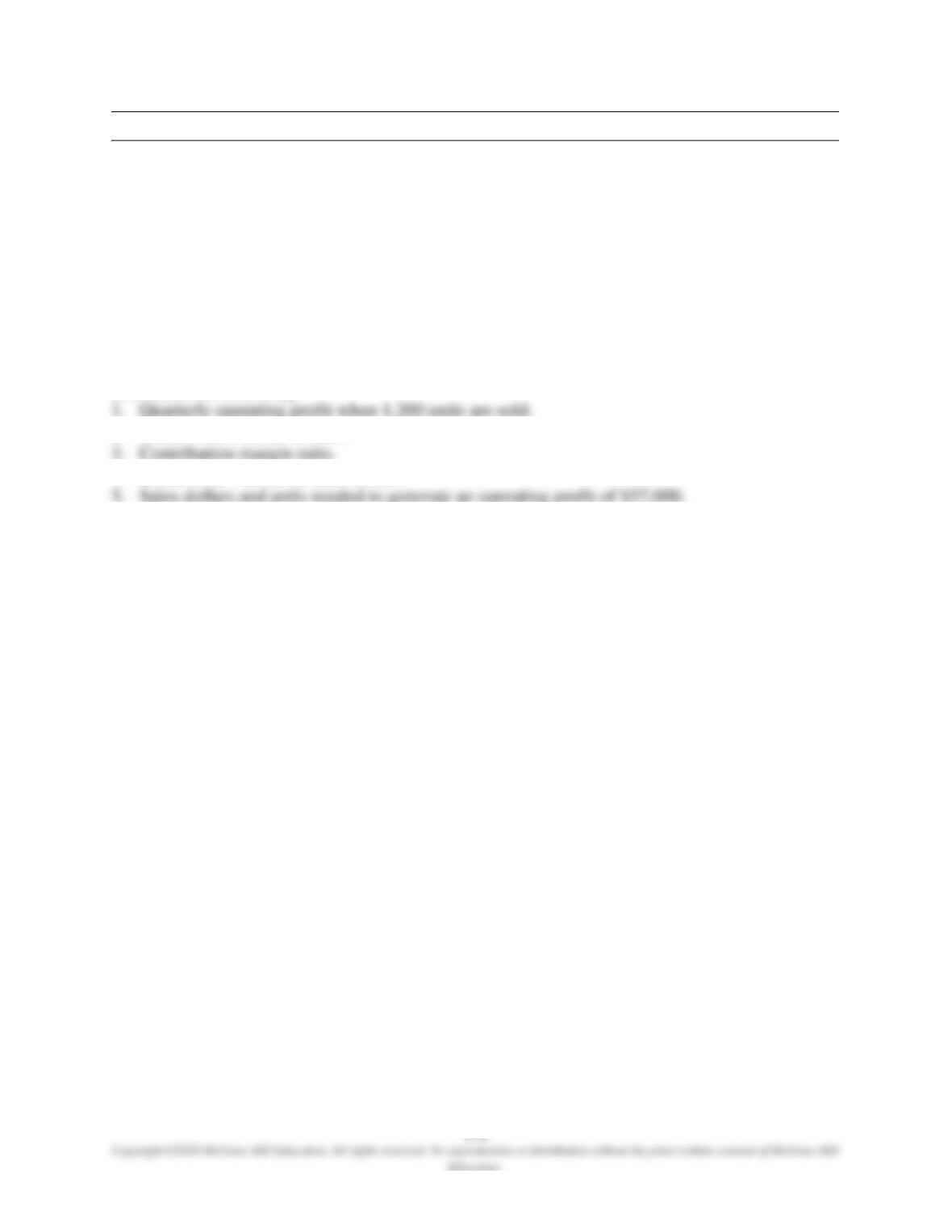
The Power Tool Division of ABC Hardware sells one product, Jig Saw, and has the following
data for the second quarter:
Units of output
1,200 units
Price per unit
$ 150
Variable cost per unit
90
Total fixed costs
48,000
Required:
Determine the following:
2. Break-even volume in units.
4. Break-even volume in sales dollars.
6. Number of units sold that would produce an operating profit of 15% of sales dollars.
Demonstration Problem 1 – Solution
CM = Contribution margin
F = Fixed costs
P = Price
V – Variable costs per unit
X = Units of output
Part 1
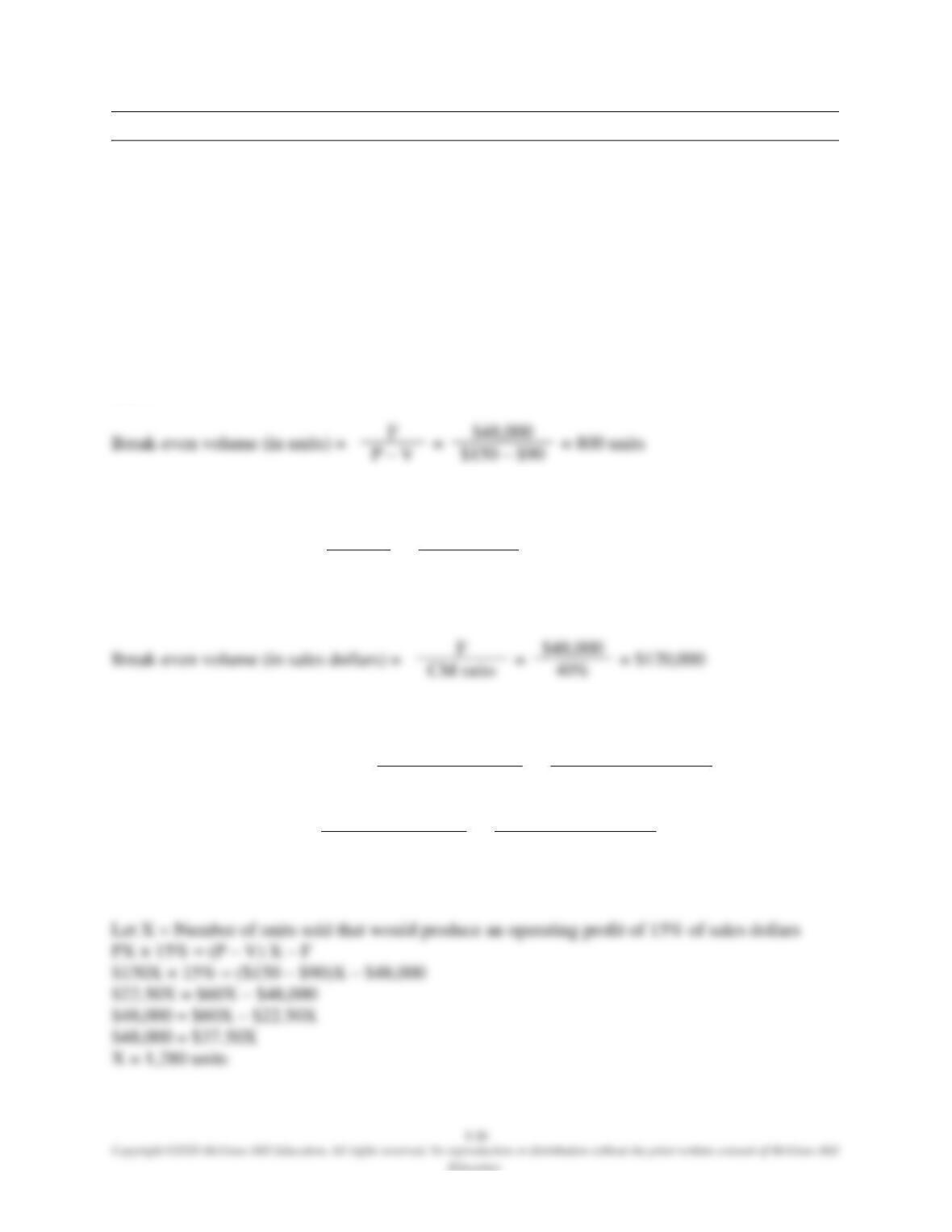
Operating profit = (P – V)X + F = ($150 – $90) × 1,200 – $48,000 = $24,000
Part 2
Break-even volume (in units) =
=
= 800 units
P – V
$150 – $90
Part 3
Contribution margin ratio =
P – V
=
$150 – $90
= 40%
P
$150
Part 4
Break-even volume (in sales dollars) =
F
=
$48,000
= $120,000
CM ratio
Part 5
Target volume (in sales dollars) =
F + Target profit
=
$48,000 + $57,000
= $262,500
CM ratio
40%
Target volume (in units) =
F + Target profit
=
$48,000 + $57,000
= 1,750 units
Unit CM
$150 – $90
Part 6
Demonstration Problem 2
(Same background information as in Demonstration Problem 1.)
The Power Tool Division of ABC Hardware sells one product, Jig Saw, and has the following
data for the second quarter:
Units of output
1,200 units
Price per unit
$ 150
Variable cost per unit
90
Total fixed costs
48,000
Required:
Demonstration Problem 2 – Solution
CM = Contribution margin
F = Fixed costs
t = Tax rate
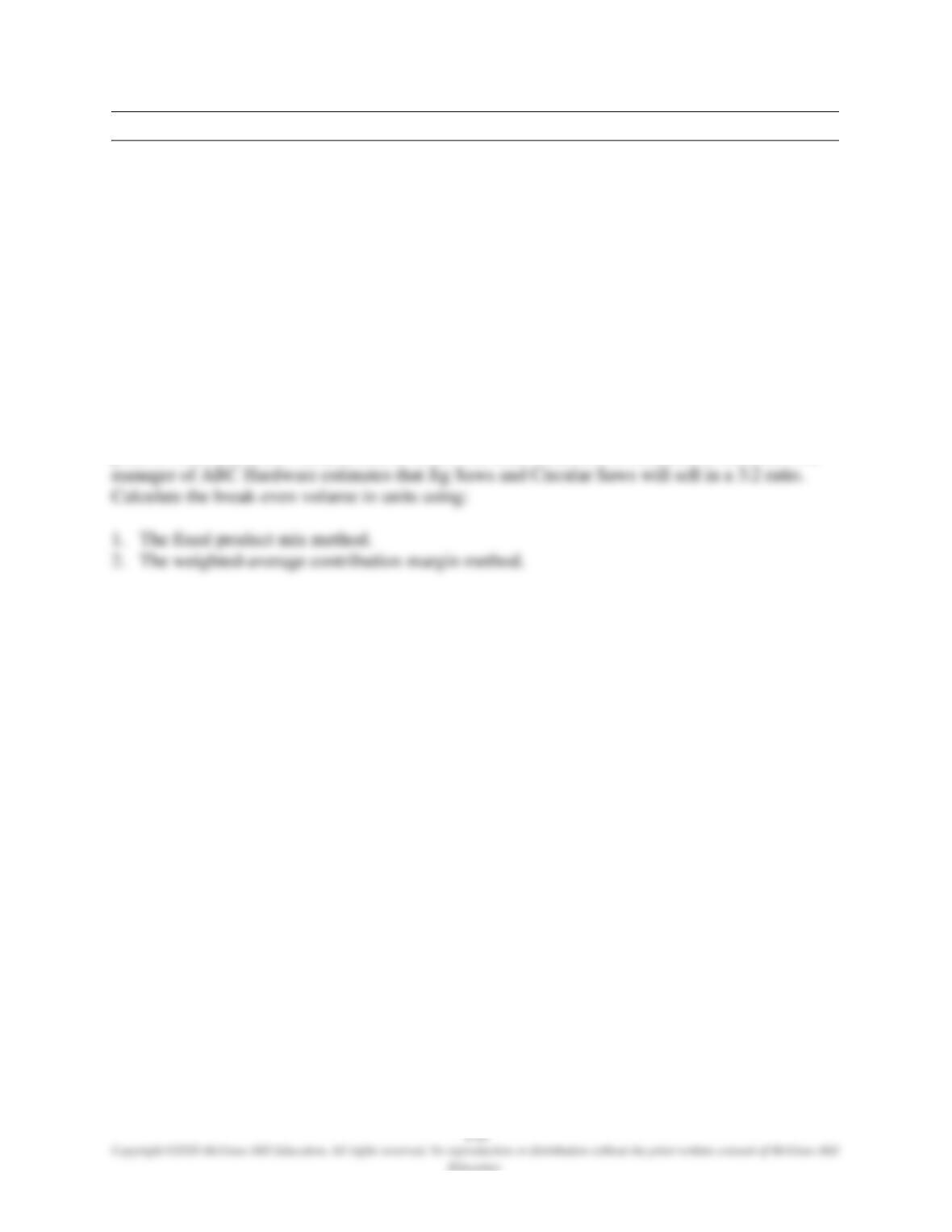
Target volume (in units) =
Demonstration Problem 3
(Same background information as in Demonstration Problem 1.)
The Power Tool Division of ABC Hardware sells one product, Jig Saw, and has the following
data for the second quarter:
Units of output
1,200 units
Price per unit
$150
Variable cost per unit
90
Total fixed costs
48,000
Required:
Assume that the Power Tool Division introduces a second product, Circular Saw, with a unit
price of $200 and a unit variable cost of $120. The total fixed cost is increased to $68,000. The
Demonstration Problem 3 – Solution
CM = Contribution margin
F = Fixed costs
P = Price
V – Variable costs per unit
Part 1
According to the product mix, out of every 5 units sold, three will be Jig Saws and two will be
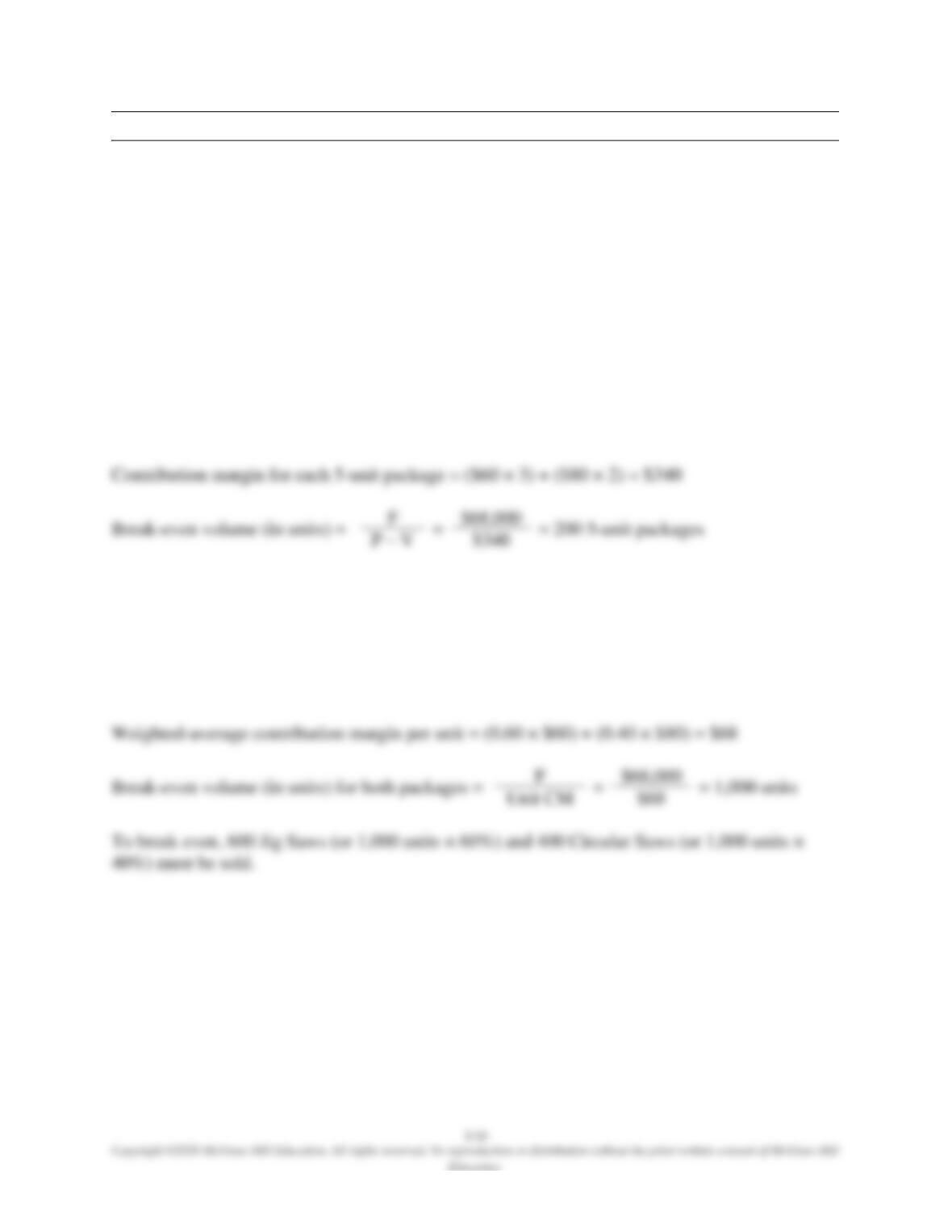
Circular Saws. Let X represent the number of such 5-unit packages to break even.
Unit contribution margin = P – V:
Jig Saws = $150 – $90 = $60
Circular Saws = $100 – $120 = $20
This means that a total of 600 Jig Saws (or 200 units × 3) and 400 Circular Saws (or 200 units ×
2) must be sold to break even.
Part 2
The produce mix consists of 60 % (or 3 ÷ 5) Jig Saws and 40% (or 2 ÷ 5) Circular Saws.