Chapter 3
Comparative Accounting: Europe
Discussion Questions
1. Regulating and enforcing financial reporting is a government function in France. The
National Accounting Board (CNC) and the Accounting Regulation Committee (CRC) set
accounting standards under the jurisdiction of the Ministry of Economy and Finance. The
Financial Markets Authority (AMF) ensures compliance with French accounting rules (for
listed companies). It is also a government agency.
Public and private sector bodies are involved in the regulation and enforcement of financial
reporting in Germany. The German Accounting Standards Board is a private sector body
that develops German reporting standards for consolidated financial statements. However,
The regulation and enforcement of financial reporting is in the public sector in the Czech
Republic. The Ministry of Finance is responsible for setting accounting principles and it
also oversees the Czech Securities Commission which is responsible for enforcing
compliance with Czech requirements. Some observers question the effectiveness of the
Czech system.
A private sector group is responsible for regulating financial reporting in the Netherlands.
The Dutch Accounting Standards Board issues guidelines on acceptable accounting
principles. Enforcement is handled by the Enterprise Chamber, a special accounting court.
2. Given the requirement that all EU listed companies must use International Financial
Reporting Standards in their consolidated financial statements, all five countries follow fair
presentation principles for this group of companies’ financial statements. The difference
among the countries comes with listed companies’ individual financial statements and with
nonlisted companies. The overall picture is quite confusing.
At the individual company level, France and Germany require local accounting standards.
Both can be characterized as legal compliance, conservative, and tax-driven. Individual
company financial statements in the Netherlands and United Kingdom may use either local
3. The recently established auditor oversight bodies discussed in this chapter are:
a. France—Haut Conseil du Commissariat aux Comptes (High Council of External
Auditors)
4. Consolidated financial statements are the statements of a group of companies under
common management or control. Individual company financial statements are the
statements of the separate legal entities (parent and subsidiaries) that make up the group.
5. This quote paraphrases a statement in the preamble to the charter establishing the German
Accounting Standards Committee. We agree. Private sector initiatives (self-regulation)
have been more successful than governmental initiatives in developing financial reporting
regulations for national and international capital markets.
Two noteworthy examples are the Accounting Standards Board in the United Kingdom
(discussed in Chapter 3) and the Financial Accounting Standards Board in the United States
6. Existing French companies’ legislation in the form of the Plan Comptable Général and
7. The statement is true. The German Accounting Standards Board is a private-sector body
like the FASB (United States), ASB (United Kingdom), and IASB. The process for
8. Accounting requirements in the Czech Republic are based on EU Directives. Examples
noted in the chapter are the following:
a. True and fair view embodied in the Accountancy Act.
b. Required audit.
9. The Dutch Enterprise Chamber of the Court of Justice of Amsterdam helps ensure that filed
or published Dutch financial statements conform to all applicable laws. Shareholders,
employees, trade unions, or public prosecutors may bring proceedings to the Chamber by
alleging that officially filed or published financial statements do not conform to applicable
requirements.
10. British financial statements must present a “true and fair view” of a company’s financial
position and results of operations. The intent is similar to the U.S. “presents fairly” test.
However, the “presents fairly” test in the United States is whether financial statements
Exercises
1. France
a. The Conseil National de la Comptabilité, or CNC (National Accounting Board) through
the latest Plan Comptable Général and the Comité de la Réglementation Comptable, or
CRC (Accounting Regulation Committee). The CNC and CRC are attached to the
Ministry of Economy and Finance.
b. The Autorité des Marches Financiers (AMF) for French listed firms. The Division of
Corporate Finance (SOIF) conducts a general review of legal and other filings with the
AMF. The Accounting Division (SACF) verifies compliance with accounting standards.
The Ministry of Justice is indirectly responsible for compliance with reporting
requirements by nonlisted companies through its role in supervising statutory auditors.
Germany
a. The German Accounting Standards Board for consolidated financial statements.
Czech Republic
a. The Ministry of Finance.
b. The Ministry of Finance also has supervisory responsibilities. Audits are regulated by the
The Netherlands
a. Dutch Accounting Standards Board.
United Kingdom
a. Accounting Standards Board.
b. Both the Department of Trade and Industry and the Financial Reporting Review Panel of
2. Good arguments can be made that France and Germany have the most effective accounting
and financial reporting supervision mechanism for publicly traded companies. In France, the
Autorité des Marches Financiers (AMF) is a government agency that supervises the stock
market. It is the French equivalent of the U.S. Securities and Exchange Commission (SEC).
Two divisions within the AMF enforce compliance with reporting rules. The Division of
Corporate Finance (SOIF) conducts a general review of legal and other filings with the AMF
(including the annual report). The Accounting Division (SACF) verifies compliance with
accounting standards. The AMF has the power to force compliance with accounting
requirements. Germany has a two-tiered system. A private sector body, the Financial
3. At the time of writing, the following accounting organizations discussed in this chapter were
linked to IFAC’s Web site:
France
Compagnie Nationale des Commissaires aux Comptes
Conseil Supérieur de l’Ordre des Experts-Comptables
Germany
Institut der Wirtschaftsprüfer
Wirtschaftsprüferkammer (WPK)
Czech Republic
Chamber of Auditors of the Czech Republic
4. The question asked for five expressions, terms, or short phrases unfamiliar or unusual in the
student’s home country. Taking the United States as the home country, here are sixteen:
a. Duality in individual company and consolidated statements—the idea that the two sets of
financial statements may be based on different GAAP, as in France in Germany.
b. Social report—required in France for companies with 300 or more employees, it
f. National chart of accounts—a formal chart of accounts designed for an entire economy
and typically used for strong central economic control.
g. Secret reserves—undisclosed and deliberate understatements of assets or overstatements
of liabilities.
h. Plan Comptable Général—French uniform national chart of accounts.
i. Sworn book examiners—a class of statutory auditors legally sanctioned in Germany to
conduct independent audit examinations of companies.
n. Legal reserves—appropriations of retained earnings required by law in most code law
countries.
o. Coupon voucher privatization system—the method used by the Czech Republic to
privatize large-scale, government-owned enterprises. Vouchers allowed CR citizens to
buy shares for a nominal price.
5. For each country discussed in the chapter, there are several financial accounting practices or
principles at variance with international norms. The items below are illustrative only.
a. France—Liabilities for post-employment benefits do not have to be recognized and
finance leases do not have to be capitalized. Both accounting treatments are examples of
form over substance and violate fair presentation. The treatment of post-employment
b. Germany—Two different purchase methods are allowed, and goodwill can be treated
several ways. The effects on reported earnings and the debt-to-asset ratio are unclear and
it is unlikely that an analyst can adjust for these variances.
c. Czech Republic—Goodwill may be written off in the first year of consolidation or
capitalized and amortized over a maximum of 20 years. The international norm is now to
capitalize goodwill and impairments test it each year. If goodwill is written off
d. The Netherlands—Comprehensive current value accounting. Though only used by a
minority of Dutch companies, this microeconomics approach to measurement is
e. United Kingdom—Assets may be valued at historical cost, current cost, or a combination
of the two. To the extent that current cost is used, the effects on reported earnings and the
6. The country whose GAAP is most oriented toward equity investors appears to be the United
Kingdom. Its GAAP is closest to IFRS, which is clearly aimed at equity investors. Under
7. The role of government in developing accounting and auditing standards is strongest in
France. Government agencies are responsible for both activities and government involvement
is all-encompassing. The private sector has little or no influence. The government plays the
8. The European Commission has set up the European Group of Auditors’ Oversight Bodies
(EGAOB) to coordinate the new public oversight systems of statutory auditors and audit
firms within the European Union. The EGAOB may also provide input to the Commission on
issues such as endorsing International Standards on Auditing and assessing the public
oversight systems in individual European countries. These public oversight systems have
responsibility for overseeing:
At the time of writing, the EU Web site listed the following EU countries with an auditing
oversight body:
a. Austria (Qualitätskontrollbehörde—Austrian Audit Quality Control Oversight Board)
b. Belgium (High Council for Economic Professions)
c. Bulgaria (Bulgarian Commission for Public Oversight of Registered Auditors)
j. Greece (Accounting & Auditing Oversight Board)
k. Hungary (Auditors’ Public Oversight Committee)
l. Ireland (Irish Auditing & Accounting Supervisory Authority)
m. Italy (CONSOB)
n. Latvia (Ministry of Finance)
o. Lithuania (The Authority of Auditing and Accounting)
p. Luxembourg (Commission de Surveillance du Secteur Financier)
q. Malta (Accountancy Board)
r. Netherlands (Netherlands Authority for the Financial Markets, AMF)
s. Portugal (Conselbo Nacional de Supervisao de Auditoria, Somissao do Mercado de
Valores Mobiliarios)
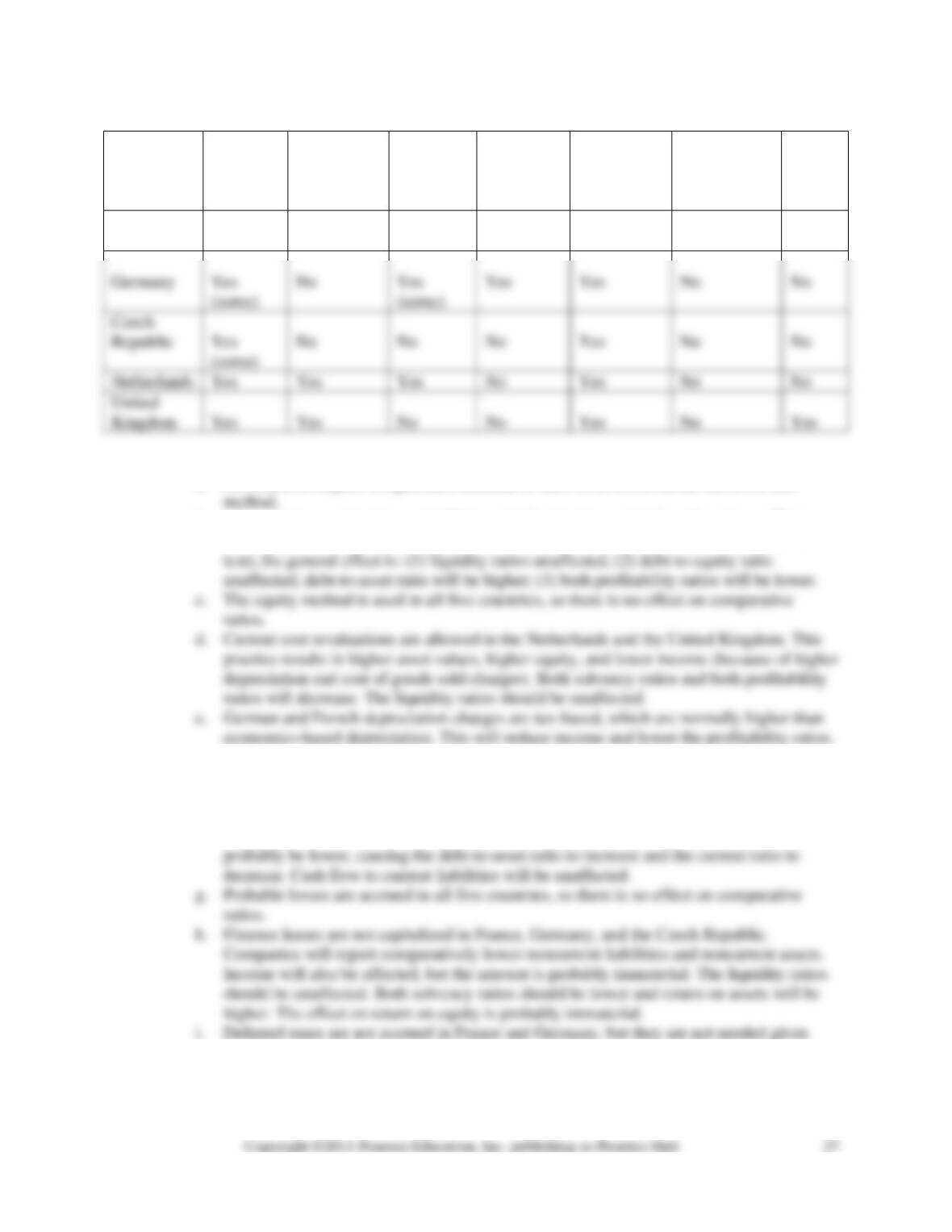
9.
Account-
ing
profes-
sion
Users/Pre-
parers
Organized
Labor
Tax
Authorities
Commercial
Law
Securities
Commissions
Stock
Market
France
Yes
(some)
No
Yes
(some)
Yes
Yes
Yes (some)
No
Germany
Yes
No
Yes
Yes
Yes
No
No
Czech
Republic
Yes
(some)
No
No
No
Yes
No
No
United
10.
a. All countries require the purchase method, so there is no effect on the ratios for this
b. All countries require that goodwill be capitalized and amortized, so there is no effect on
the ratios for this method. Compared to the IFRS treatment (capitalize and impairments
The more rapid write-off of fixed assets will cause lower total asset values. Thus, the
debt-to-asset ratio should increase. The debt-to–equity ratio and both liquidity ratios
should be unaffected.
f. LIFO is permitted in Germany and the Netherlands, but not widely used. Companies
using LIFO should have lower income, so lower profitability ratios. Inventory will
book-tax conformity. The effects on the six ratios depend on other differences. The
liquidity ratios are likely to be unaffected. The effects on the solvency and profitability
ratios are unclear.
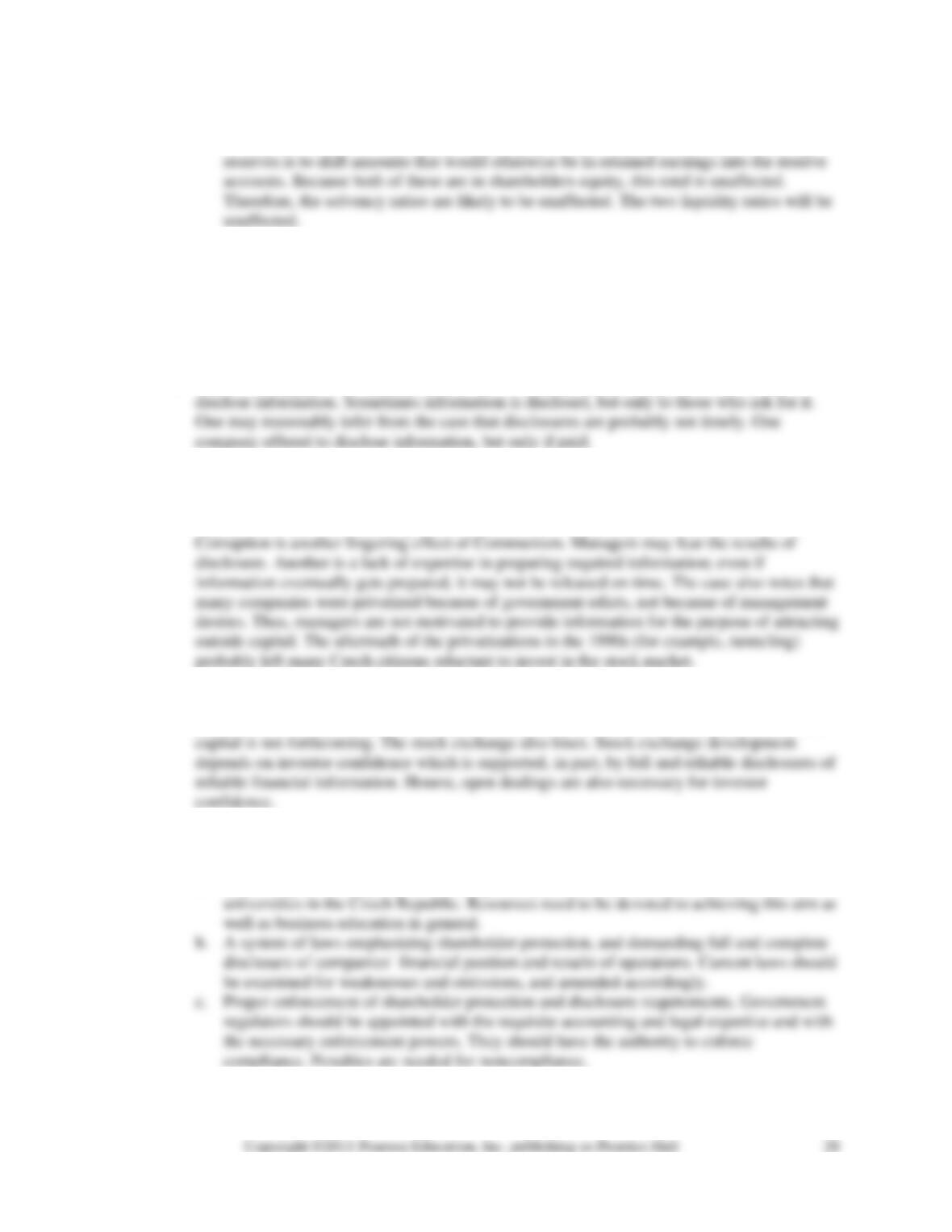
j. Income smoothing has an indeterminate effect on income in any given year. Therefore it
is not possible to know how the profitability ratios are affected. The effect of creating
Case 3-1 Old Habits Die Hard
This case shows that old habits die hard and that requirements for information do not ensure that it will be
provided.
1. The article suggests that the key feature of Czech financial reporting is a reluctance to
2. Apparently, Czech managers are only slowly recognizing the value of full and prompt
disclosure to the investment community. There are several reasons for this. One is the 50-year
legacy of Communism, where public disclosure was unnecessary or even inadvisable.
3. Investors kept in the dark will seek opportunities elsewhere. They will invest in other
companies or in other countries besides the Czech Republic. Secretive companies lose when
4. A program of changes needed to correct the problems identified in this case include the
following:
a. Improving accounting expertise through comprehensive professional education at
Case 3-2A What Difference Does It Really Make?
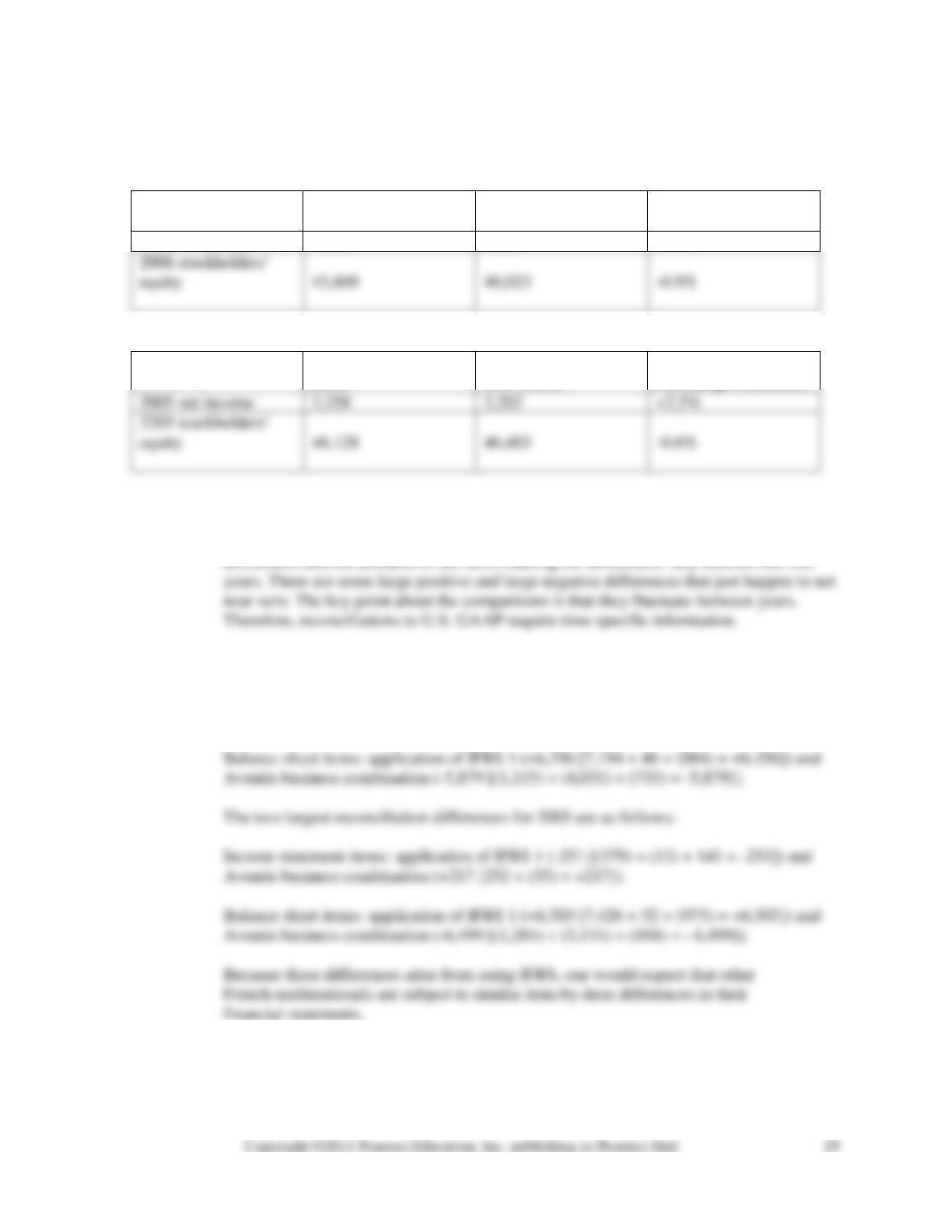
1. (Amounts in millions of euros)
a.
IFRS
U.S. GAAP
Percentage Difference
2006 net income
4,006
4,034
-0.7%
equity
45,600
46,023
-0.9%
b.
IFRS
U.S. GAAP
Percentage Difference
2005 net income
2,258
2,202
+2.5%
equity
46,128
46,403
-0.6%
The percentage differences for net income and stockholders’ equity are both close to zero
for both years. However, as discussed next, the items responsible for most of the
c. The two largest reconciliation differences for 2006 are as follows:
Income statement items: restructuring provision (+173) and Aventis business
combination (+258 [783 – 525 = +258]).
2. The financial statement reconciliations once required by the SEC for non-U.S. registrants
would seem to be useful to U.S. readers of non-U.S. financial statements. Although the
individual percentage changes are at best imprecise measurements, they convey a sense of the
3. Note to instructors: This question will tweak students’ interest in discussions of IFRS–U.S.
GAAP differences and the SEC’s decision to accept IFRS filings, as found in Chapters 4 and
8. The analysis above suggests a loss of information for investors. There are some significant
individual differences between IFRS and U.S. GAAP as they affect net income and the
balance sheet. The company discusses these differences quite extensively over several pages
of its footnote disclosure. Of course, the question is whether IFRS and U.S. GAAP were
Case 3-2B Do The Differences Really Matter?
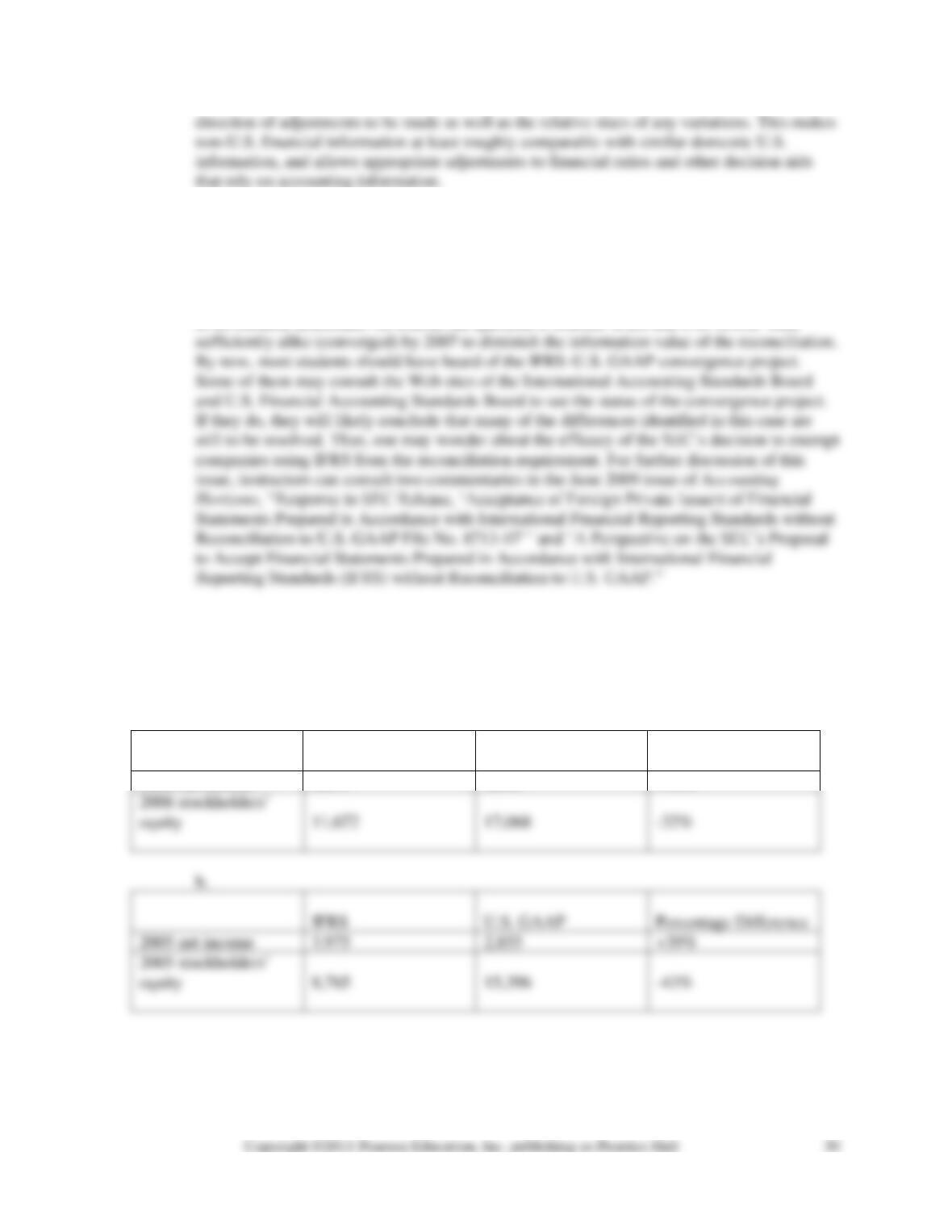
1. (Amounts in millions of euros)
a.
IFRS
U.S. GAAP
Percentage Difference
2006 net income
5,015
4,385
+14%
equity
11,672
17,068
-32%
IFRS
U.S. GAAP
Percentage Difference
2005 net income
3,975
2,855
+39%
equity
8,765
15,396
-43%
The percentage differences for net income are not the same between the two years. IFRS
income is 14 percent higher than U.S. GAAP net income in 2006 and 39 percent higher in
2005. The percentage differences for stockholders’ equity are also not the same. IFRS
c. The two largest reconciliation differences for 2006 are as follows:
Income statement items: pensions and other similar obligations (-464) and profit/loss on
disposal of group companies (-167).
2. The financial statement reconciliations once required by the SEC for non-U.S. registrants
would seem to be useful to U.S. readers of non-U.S. financial statements. Although the
3. Note to instructors: This question will tweak students’ interest in discussions of IFRS–U.S.
GAAP differences and the SEC’s decision to accept IFRS filings, as found in Chapters 4 and
8. The analysis above suggests a loss of information for investors. There are some significant
individual differences between IFRS and U.S. GAAP as they affect net income and the
balance sheet. The company discusses these differences quite extensively over several pages
of its footnote disclosure. Of course, the question is whether IFRS and U.S. GAAP were