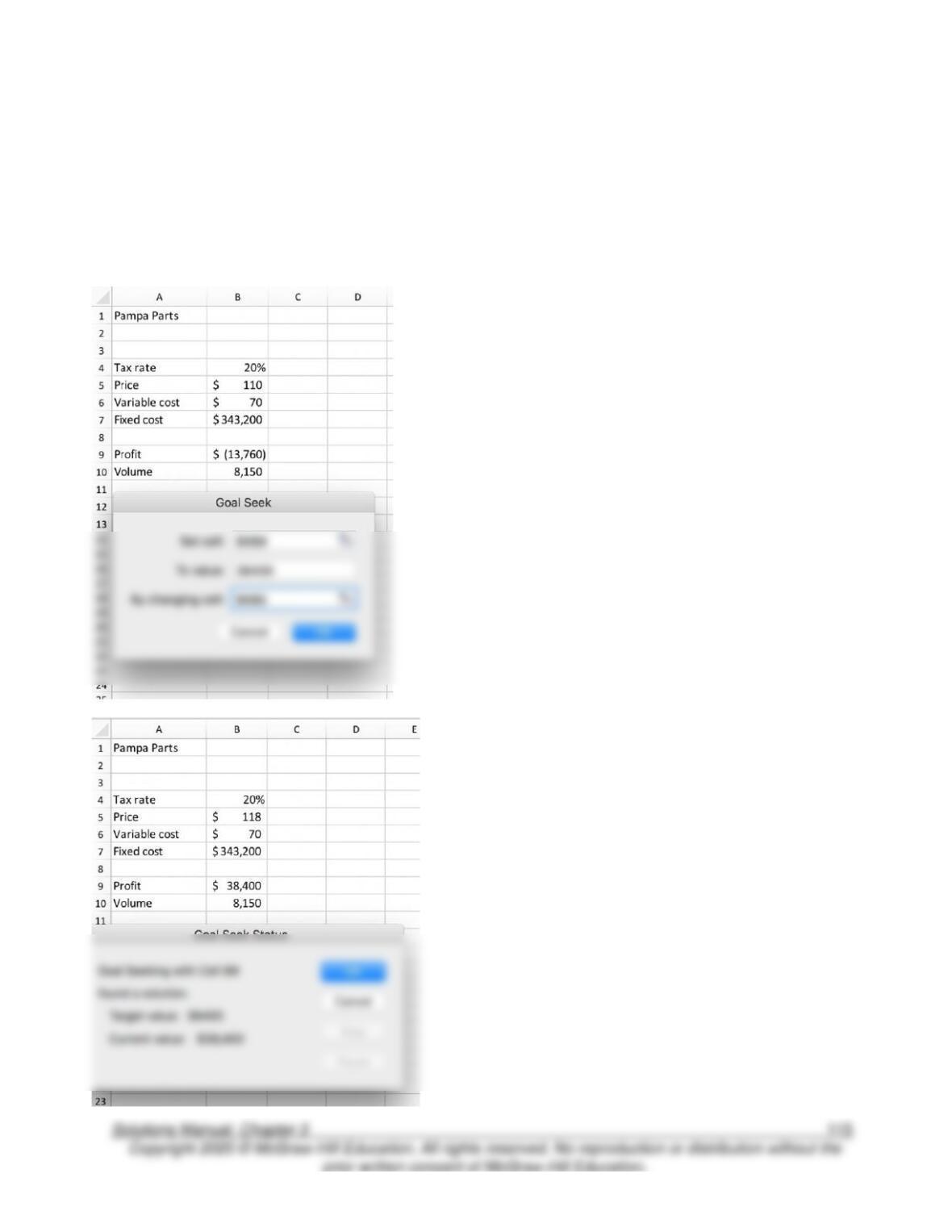
3-45. (15 min.) Using Microsoft Excel to Perform CVP Analysis with Taxes: Pampa
Parts.
$118.
The following two screenshots show the setup and solution.
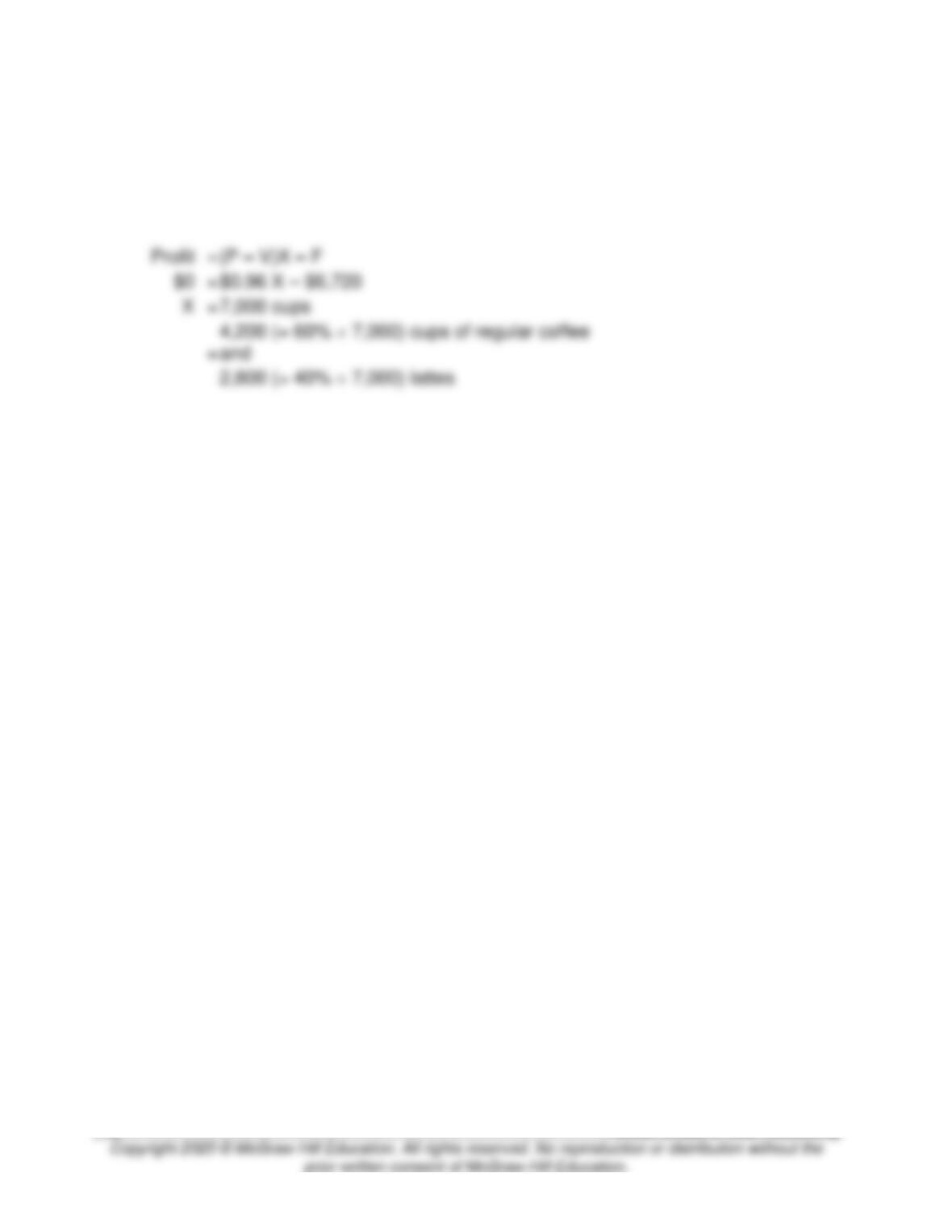
3-46. (20 min.) Multiproduct CVP Analysis: Rio Coffee Shoppe.
First, compute the weighted-average contribution margin per unit:
= $0.96 = 60% ($1.50 – $0.70) + 40% ($2.50 – $1.30)
The total number of cups of regular coffee and lattes (X) to break even is:
3-47. (20 min.) Multiproduct CVP Analysis: Mission Foods.
a. Profit = ($3.00 – $1.50) 200,000 + ($4.50 – $2.25) 300,000 – $117,000
= $858,000
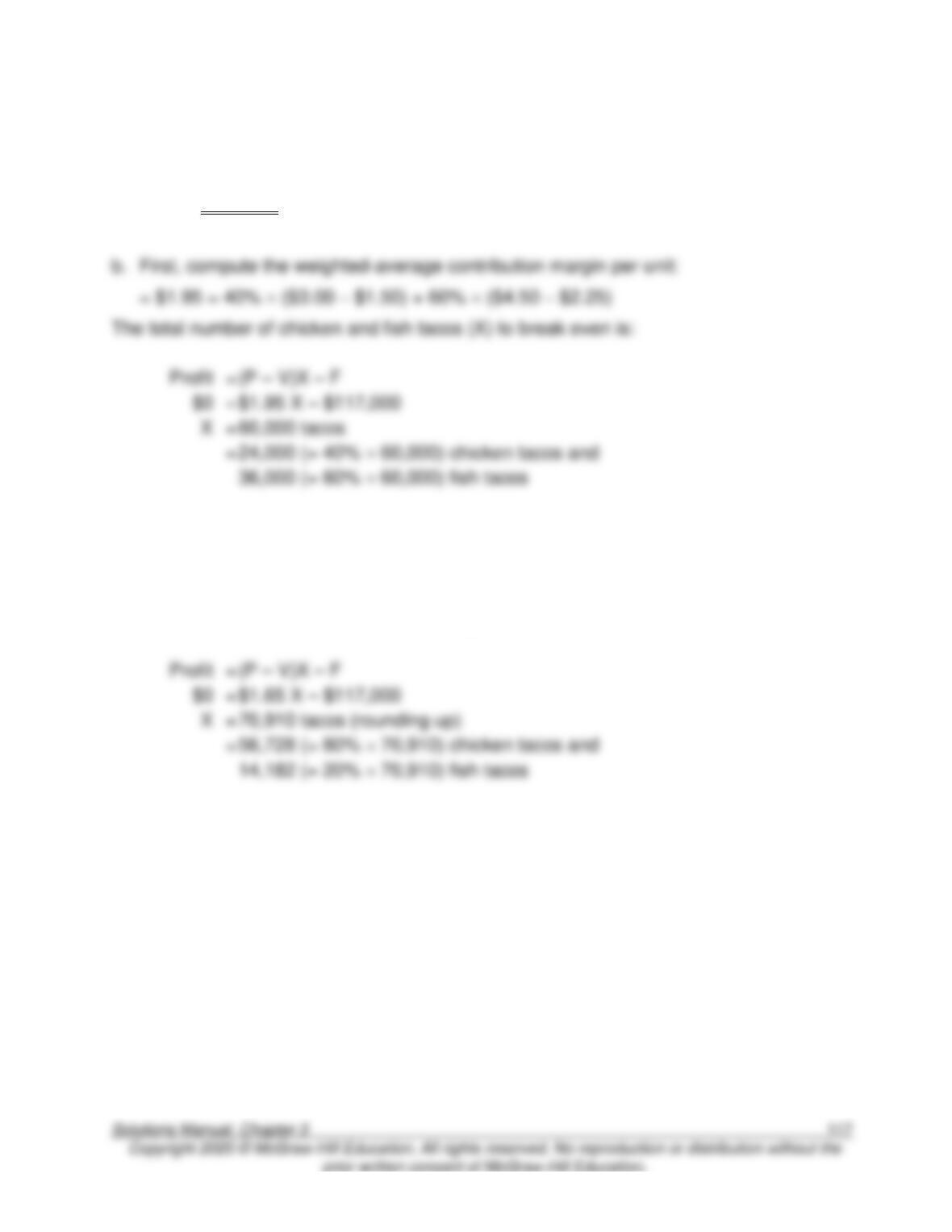
c. First, compute the weighted-average contribution margin per unit:
= $1.65 = 80% ($3.00 – $1.50) + 20% ($4.50 – $2.25)
The total number of chicken and fish tacos (X) to break even is:
Solutions to Problems
3-48. (35 min.) CVP Analysis and Price Changes: Argentina Partners.
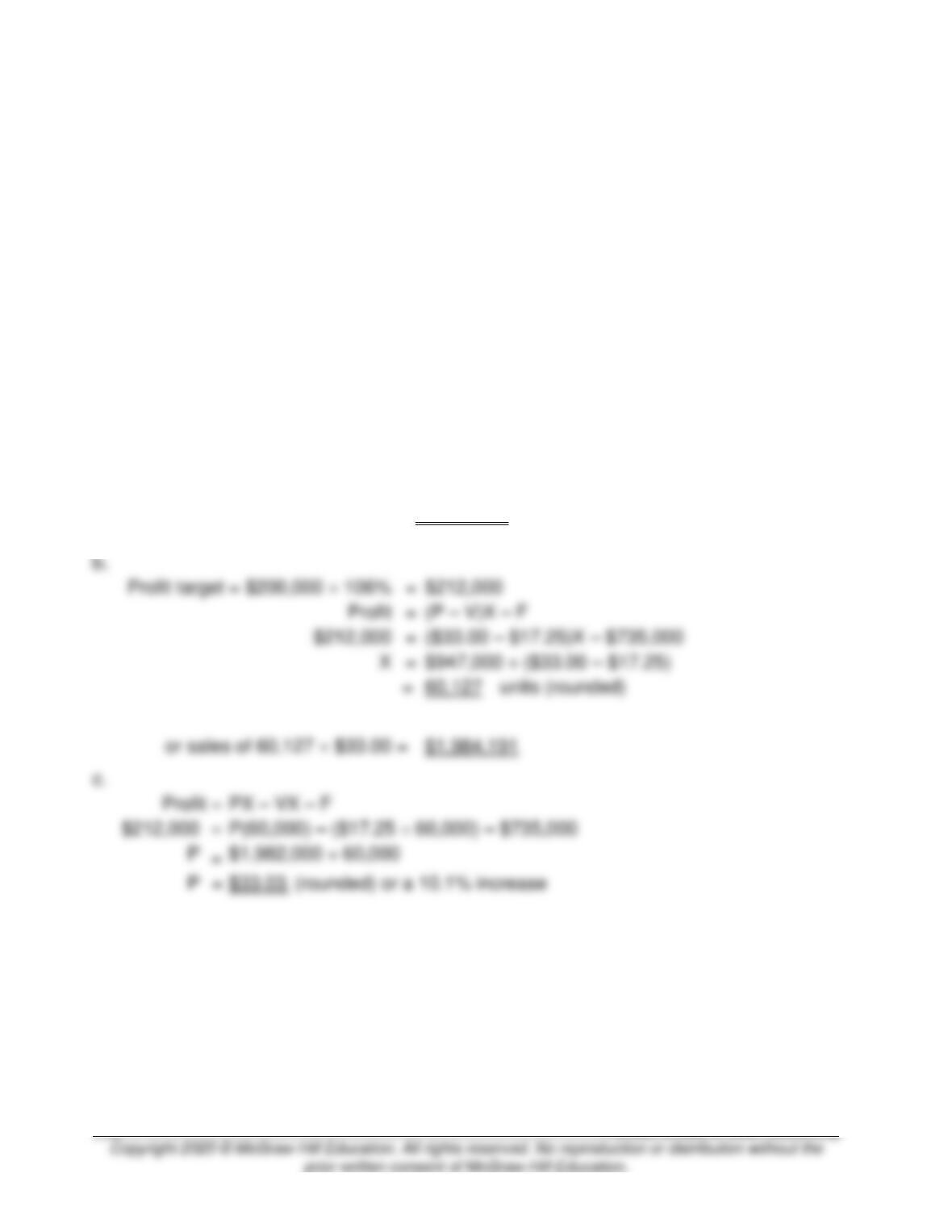
a. Current profit = 60,000 units x ($30 – $15) – $700,000 = $200,000
Variable costs. New variable cost per unit:
Labor
+
Materials
+
Overhead
115% 50% $15
+
110% 25% $15
+
120% 25% $15
= $17.25
Price:
New price
=
110% $30 = $33.00
Fixed costs:
New fixed costs
=
105% $700,000 = $735,000
Sales:
Profit target
=
$200,000
Profit
=
(P – V)X – F
$200,000
=
($33.00 – $17.25)X – $735,000
X
=
$935,000 ÷ ($33.00 – $17.25)
=
59,365 units (rounded)
or sales of 59,365 $33
=
$1,959,045
=
$212,000
=
(P – V)X – F
=
($33.00 – $17.25)X – $735,000
=
$947,000 ÷ ($33.00 – $17.25)
=
$212,000
=
P(60,000) – ($17.25 60,000) – $735,000
=
3-49. (35 min.) CVP Analysis and Price Changes: Scholes Systems.
a. Current profit = 80,000 units ($60 – $30) – $1,400,000 = $1,000,000
Variable costs. New variable cost per unit:
Labor
+
Materials
+
Overhead
115% 50% $30
+
110% 25% $30
+
120% 25% $30
= $34.50
Price:
New price
=
110% $60 = $66.00
Fixed costs:
New fixed costs
=
105% $1,400,000 = $1,470,000
Sales:
Profit target
=
$1,000,000
Profit
=
(P – V)X – F
$1,000,000
=
($66.00 – $34.50)X – $1,470,000
X
=
$2,470,000 ÷ ($66.00 – $34.50)
=
78,413 units (rounded)
or sales of 78,413 $66
=
$5,175,258
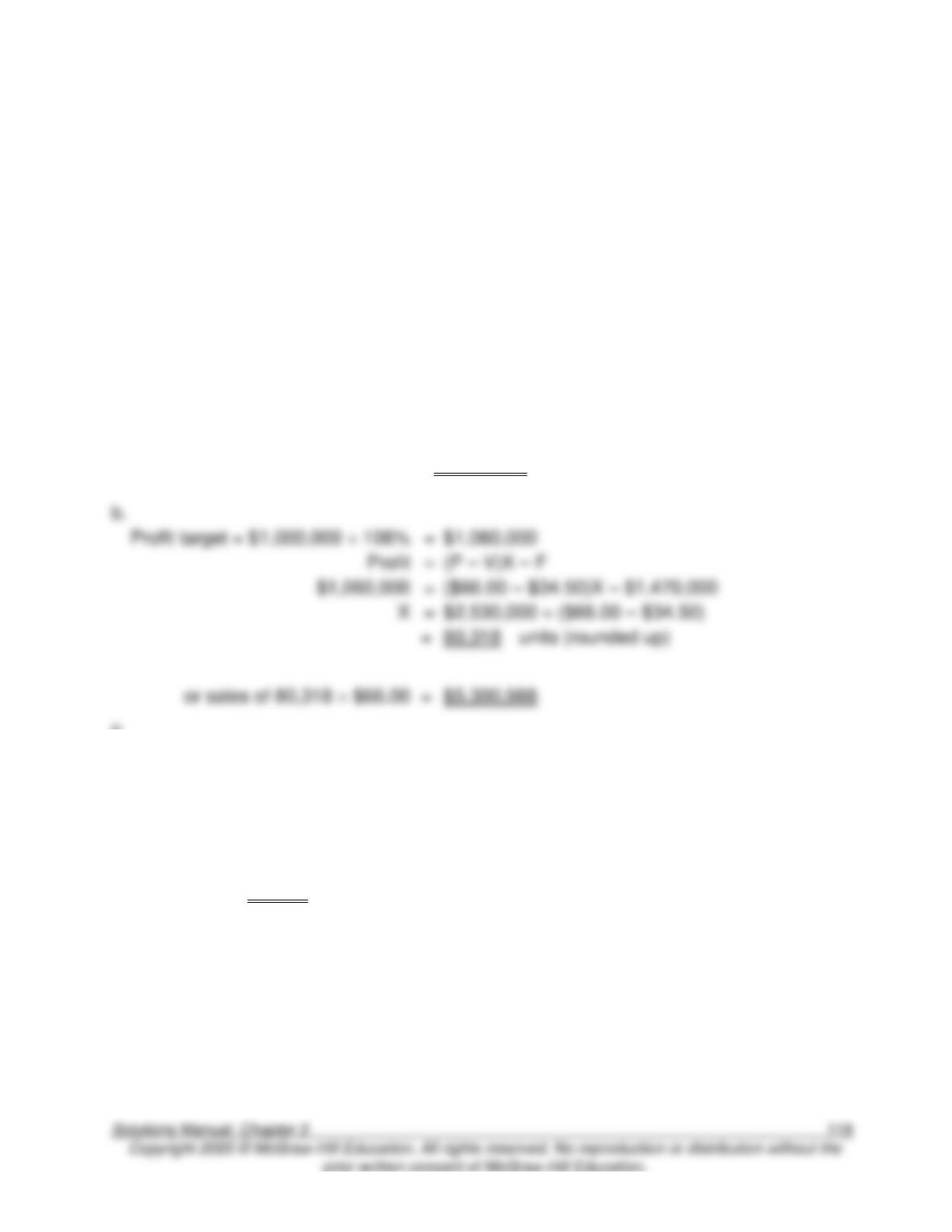
Profit target = $1,000,000 106%
=
$1,060,000
=
(P – V)X – F
=
($66.00 – $34.50)X – $1,470,000
=
$2,530,000 ÷ ($66.00 – $34.50)
c.
Profit
=
PX – VX – F
$1,060,000
=
P(80,000) – ($34.50 80,000) – $1,470,000
Rearranging,
$1,060,000 + ($34.50 80,000) + $1,470,000
=
P(80,000)
P
=
$5,290,000 ÷ 80,000
P
=
$66.13
(rounded) or a 10.2% increase
3-50. (20 min.) CVP Analysis―Missing Data: Breed Products.
a. $8.20
Because the volume is given, it is not necessary to know the fixed and variable costs
separately.
Profit
=
Revenues – Costs
Profit
=
150,000 Price – Costs
$600,000
=
150,000 P – $630,000
$1,230,000
=
150,000 P
P
=
$8.20
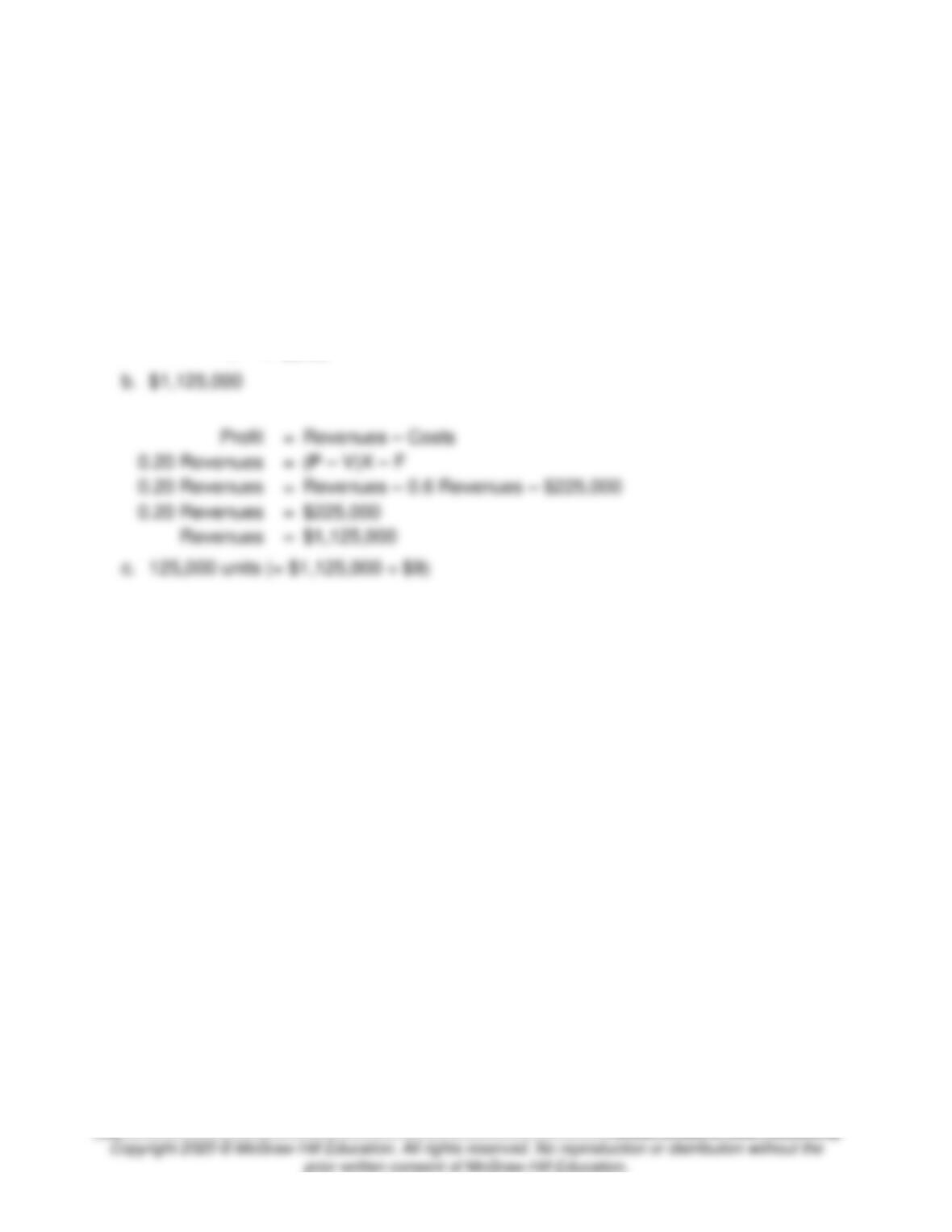
=
Revenues – Costs
=
(P – V)X – F
=
Revenues – 0.6 Revenues – $225,000
=
=
3-51. (20 min.) CVP Analysis―Missing Data: Remington Inc.
(1) Set this up as two equations with two unknowns (Price and the breakeven point).
Let P = Current price, BE the breakeven point at the current price, and FC fixed cost.
Then
BE = FC ÷ (P – $5) at the current price.
If the price is cut by 50 percent, we know that the breakeven point is tripled, so
(3 BE) = FC ÷ [(0.5 P) – $5].
Substituting the first equation in the second, we have:
[(3 FC)/(P – $5)] = FC ÷ [(0.5 P) – $5].
Solving for P yields P = $20.
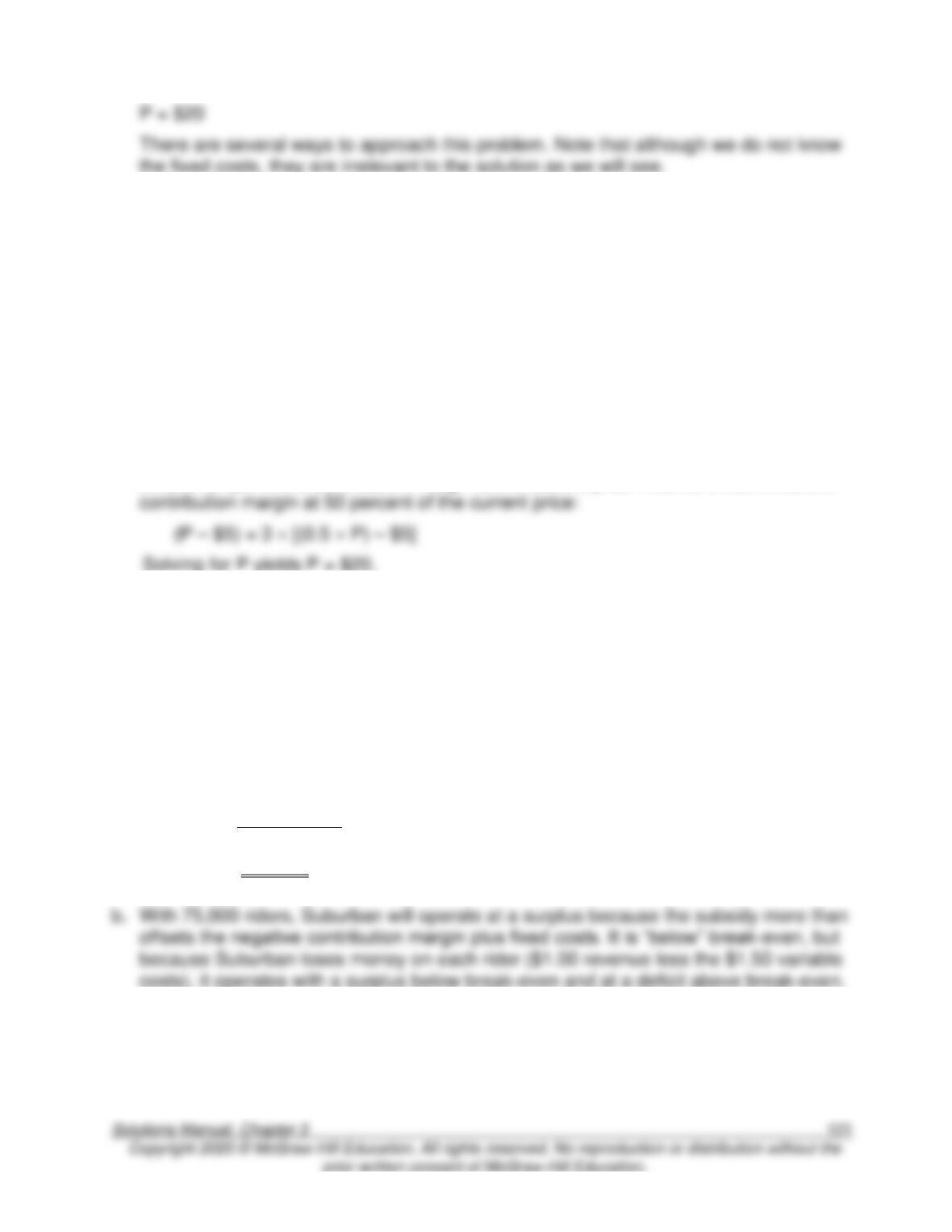
(2) For the same fixed cost, if the new breakeven point is three times the old
breakeven point, the contribution margin at the current price must be three times the
3-52. (20 min.) CVP Analysis With Subsidies: Suburban Bus Lines.
a.
Surplus
=
(P – V)X – F + Subsidy
$0
=
($1.00 – $1.50)X – $200,000 + $250,000
$0.50X
=
$50,000
X =
$50,000
$0.50
X
=
100,000
riders
3-53. (35 min.) CVP Analysis―Sensitivity Analysis: Alameda Tile.
a.
Profit
=
(P – V) X – F
Profit
=
($800 – $480) X – $160,000
0
=
($800 – $480) X – $160,000
X
=
$160,000 ÷ $320
=
500 students
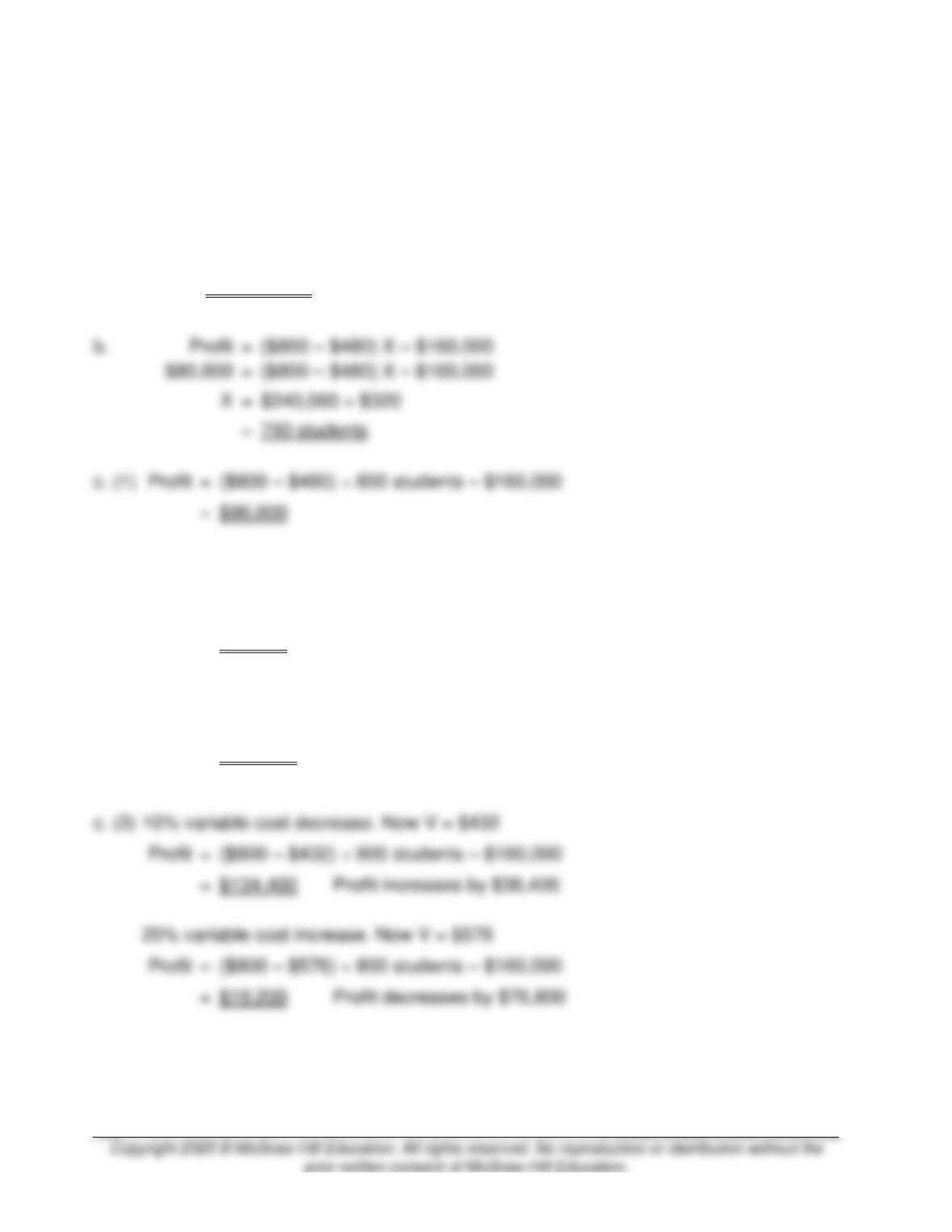
b.
=
($800 – $480) X – $160,000
=
=
$240,000 ÷ $320
=
c. (1)
Profit
=
($800 – $480) 800 students – $160,000
c. (2)
10% price decrease. Now P = $720
Profit
=
($720 – $480) 800 students – $160,000
=
$32,000
Profit decreases by $64,000
20% price increase. Now P = $960
Profit
=
($960 – $480) 800 students – $160,000
=
$224,000
Profit increases by $128,000
c. (3)
10% variable cost decrease. Now V = $432
Profit
=
($800 – $432) 800 students – $160,000
20% variable cost increase. Now V = $576
Profit
=
($800 – $576) 800 students – $160,000
=
Profit decreases by $76,800
3-53 (continued).
c. (4)
10% fixed cost decrease, 10% variable cost increase.
Now F = $144,000 and V = $528
Profit
=
($800 – $528) 800 students – $144,000
=
$73,600
Profit decreases by $22,400
3-54. (35 min.) CVP, Operating Leverage, and Margin of Safety Percentage:
Canton Corp.
a.
Profit
=
(P – V) X – F
1. Unit-rate
=
($40 – $20 – $4) X – $200,000
0
=
($40 – $24) X – $200,000
X
=
$200,000 ÷ $16
=
12,500 parts
2. Flat-rate
=
($40 – $20) X – ($200,000 + $60,000)
0
=
($40 – $20) X – $260,000
X
=
$260,000 ÷ $20
=
13,000 parts
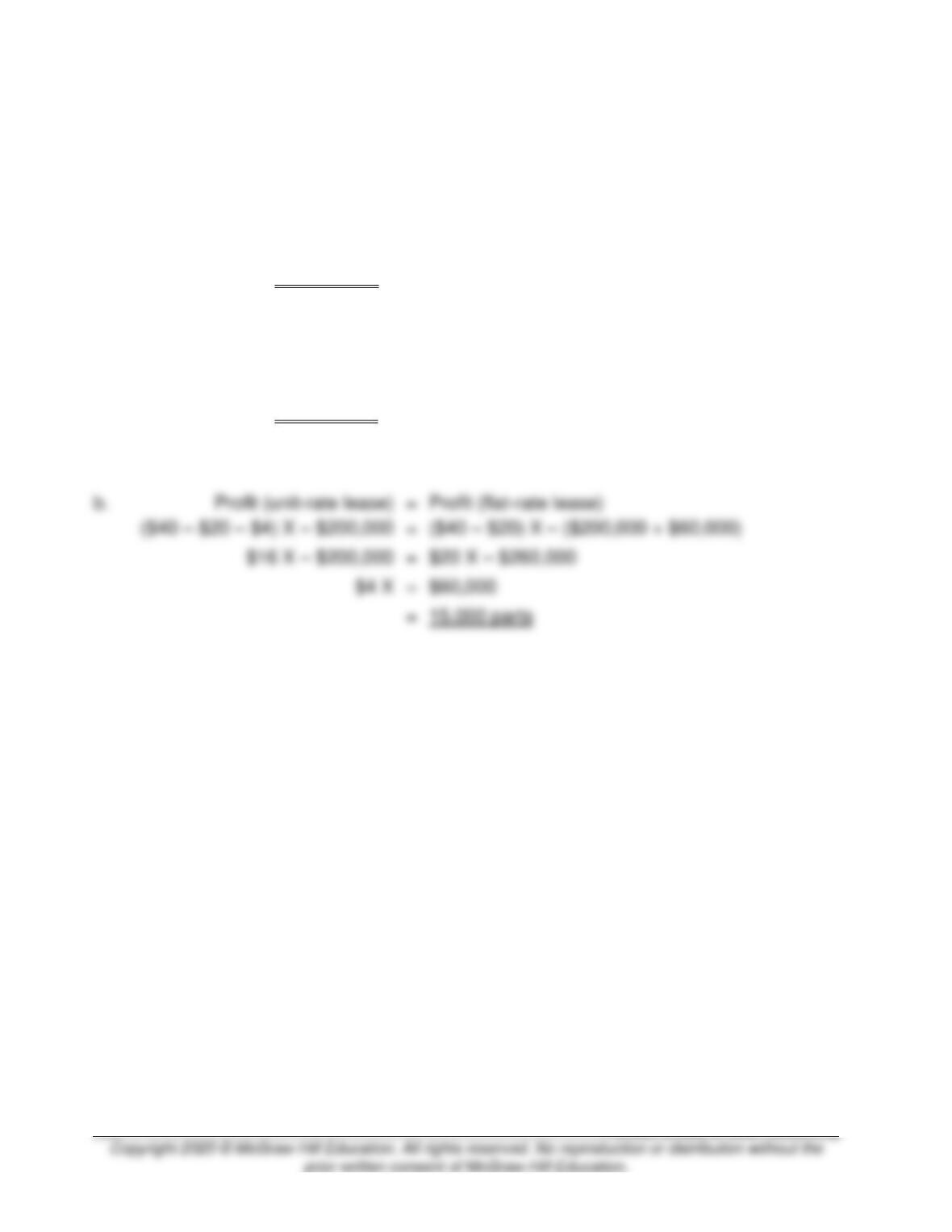
b.
=
Profit (flat-rate lease)
=
($40 – $20) X – ($200,000 + $60,000)
=
=
=
15,000 parts
3-54 (continued).
c.
Operating leverage
=
Contribution margin ÷ Operating profit
1. Unit-rate lease
=
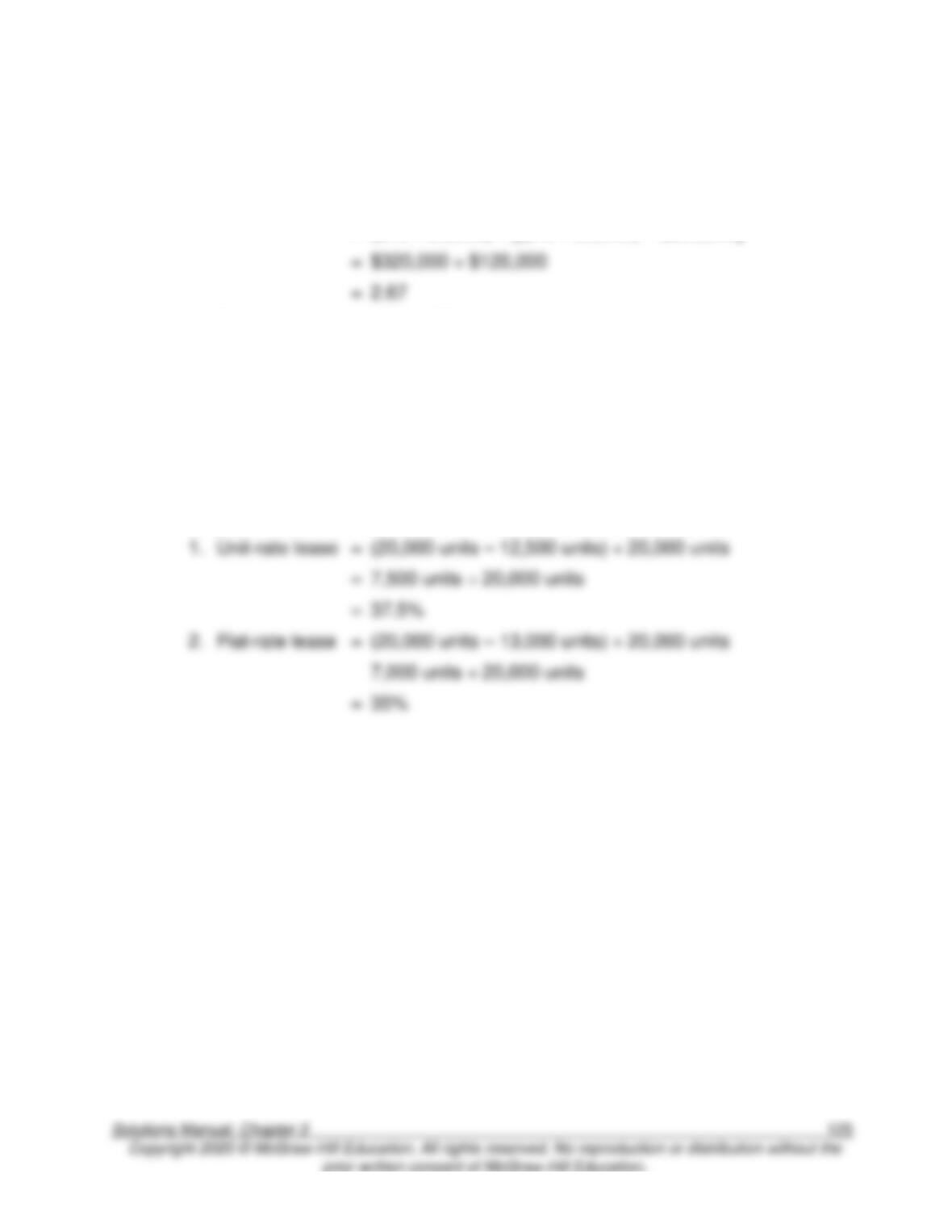
[($40 – $20 – $4) X]
÷ ($40 – $20 – $4) X] – $200,000
=
($16 20,000) ÷ [($16 20,000) – $200,000]
=
$320,000 ÷ $120,000
=
2.67
2. Flat-rate lease
=
[($40 – $20) X]
÷ ($40 – $20) X] – ($200,000 + $60,000)
=
($20 20,000) ÷ [($20 20,000) – $260,000]
=
$400,000 ÷ $140,000
=
2.86
d.
Margin of Safety %
=
(Actual sales – Break-even sales) ÷ Actual sales
1. Unit-rate lease
=
(20,000 units – 12,500 units) ÷ 20,000 units
=
7,500 units ÷ 20,000 units
=
37.5%
7,000 units ÷ 20,000 units
=
35%
3-55. (35 min.) CVP, Operating Leverage, and Margin of Safety Percentage:
Lemon Ltd.
a.
Profit
=
(P – V) X – F
1. Revenue-based
=
[$1,600 – $300 – ($1,600 x 0.25)] X – $585,000
0
=
($1,600 – $700) X – $585,000
=
$585,000 ÷ $900
=
650 seminars
2. Flat-rate
=
($1,600 – $300) X – ($585,000 + $390,000)
0
=
$1,300 X – $975,000
X
=
$975,000 ÷ $1,300
=
750 seminars
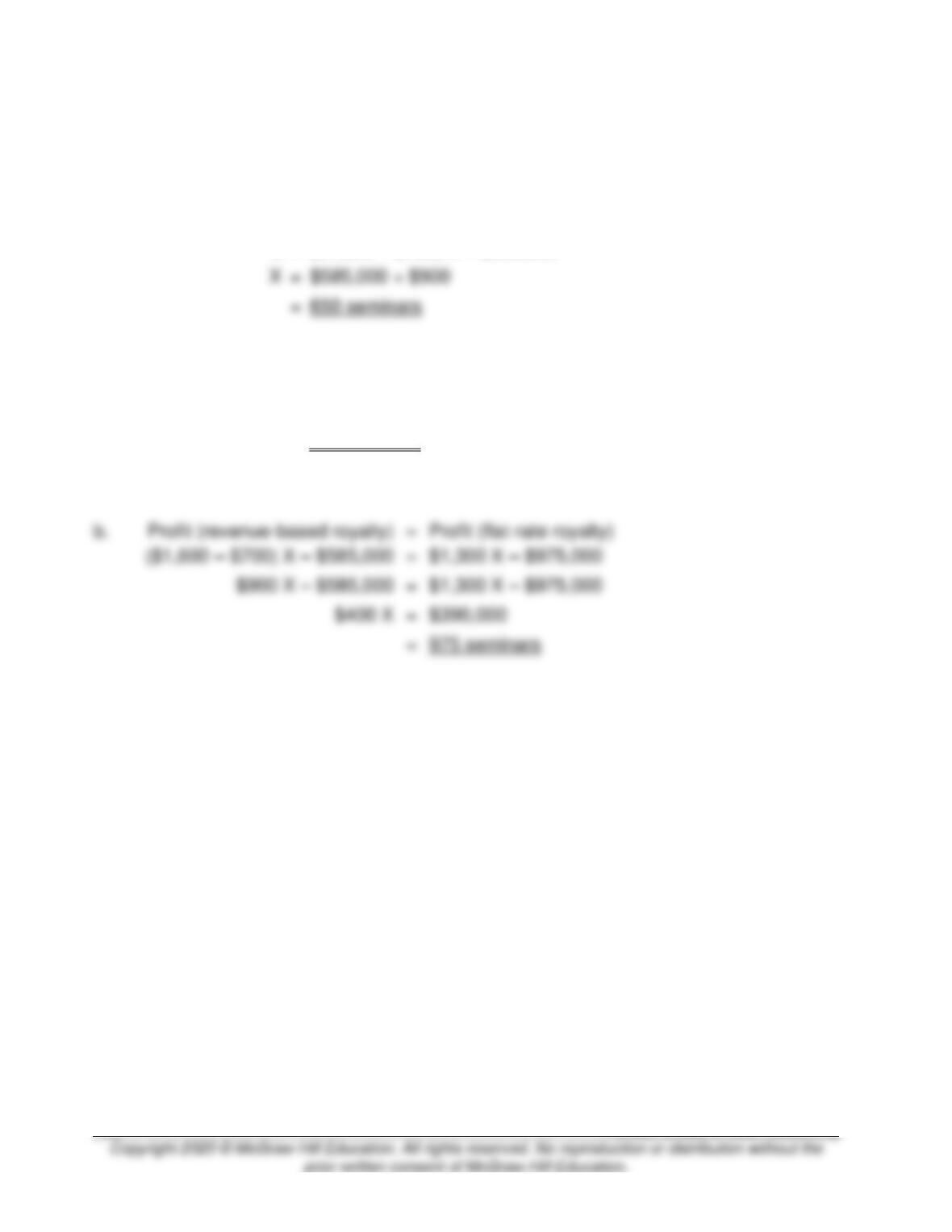
b.
Profit (flat-rate royalty)
$1,300 X – $975,000
$1,300 X – $975,000
$390,000
3-55 (continued).
c.
Operating leverage
=
Contribution margin ÷ Operating profit
1. Revenue-based
=
[($1,600 – $300 – (0.25 $1,600)) X]
÷ [($1,600 – $300 – (0.25 $1,600)) X] – $585,000
=
($900 1,500) ÷ [($900 1,500) – $585,000]
=
$1,350,000 ÷ $765,000
=
1.76
2. Flat-rate
=
[($1,600 – $300) X]
÷ ($1,600 – $300) X] – ($585,000 + $390,000)
=
($1,300 1,500) ÷ [($1,300 1,500) – $975,000]
=
$1,950,000 ÷ $975,000
=
2.00
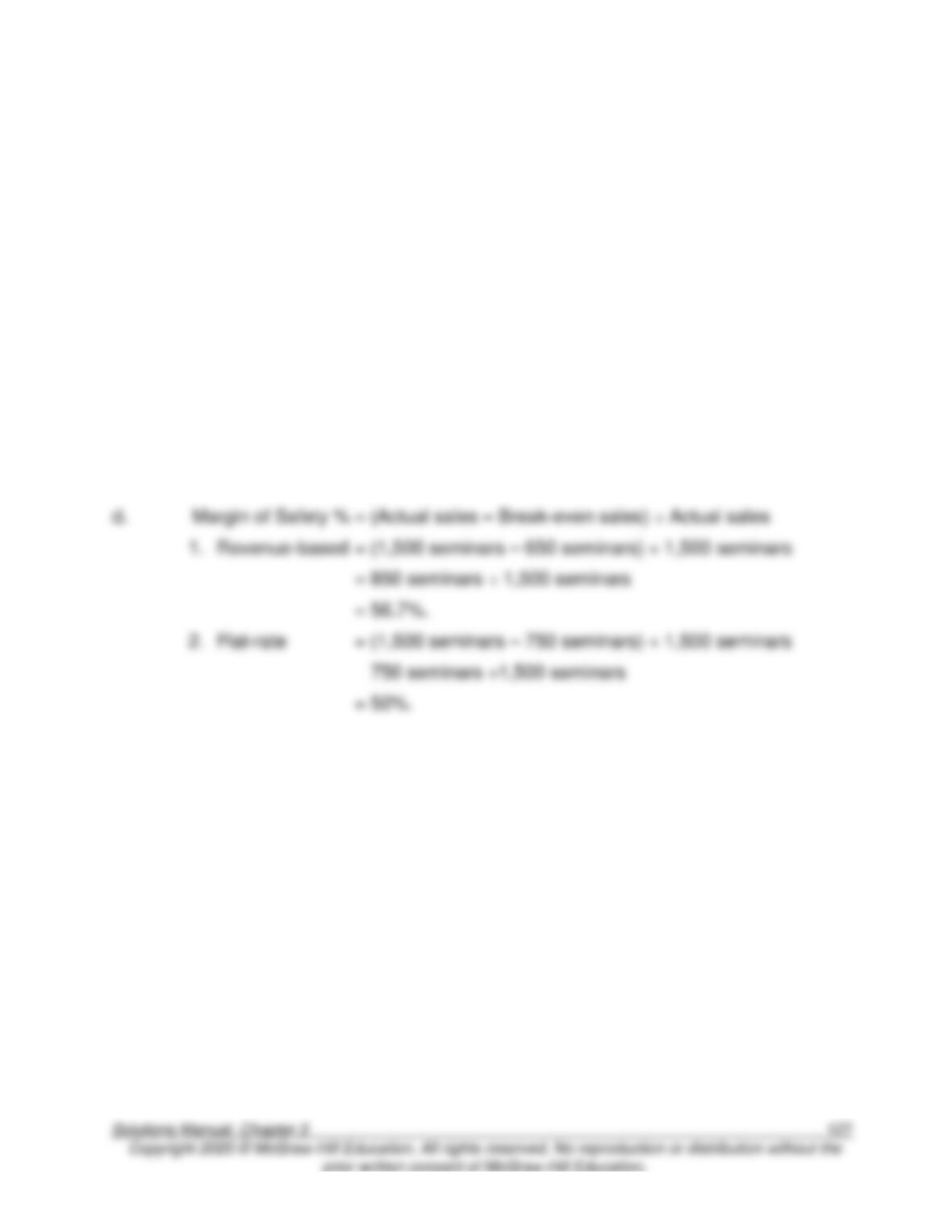
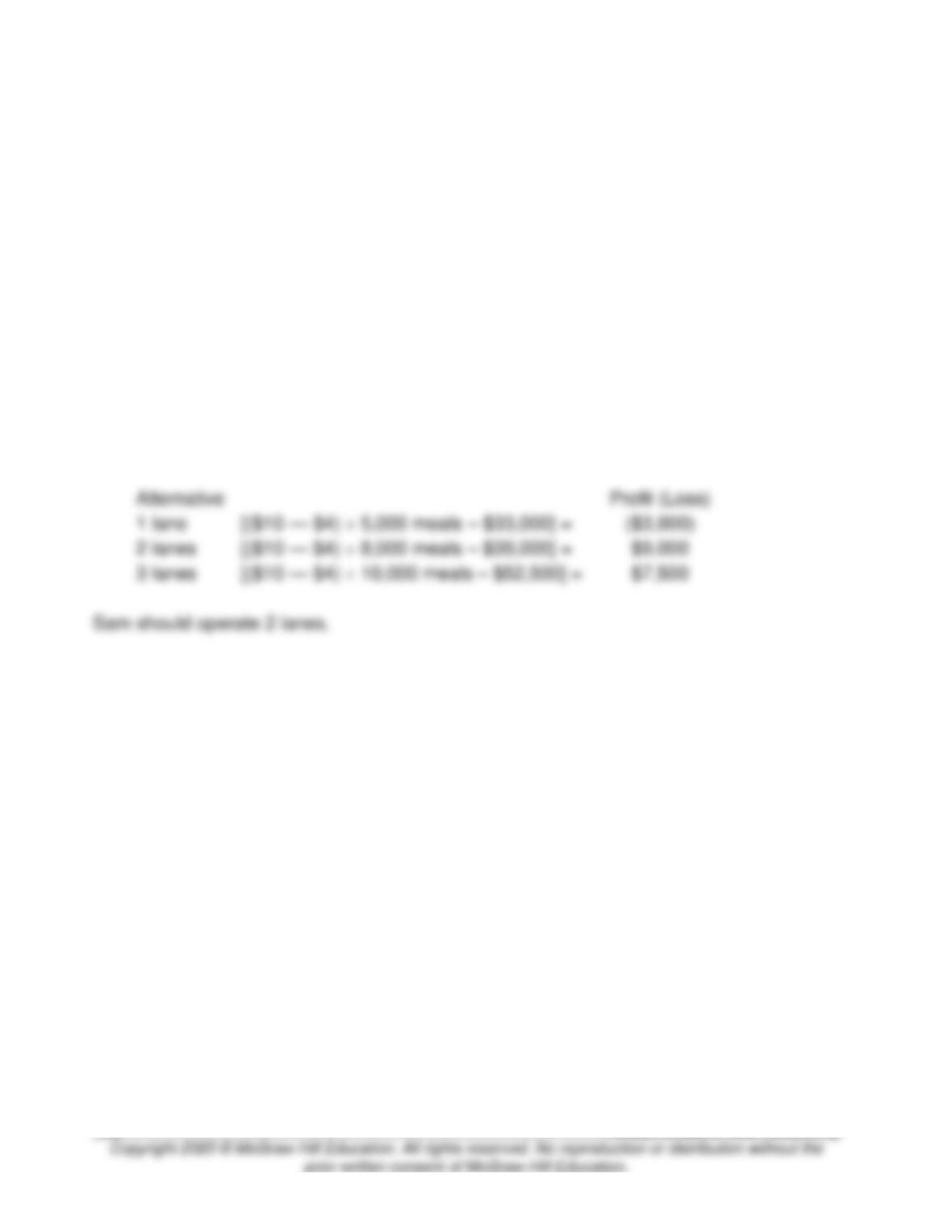
d.
(Actual sales – Break-even sales) ÷ Actual sales
1. Revenue-based
(1,500 seminars – 650 seminars) ÷ 1,500 seminars
850 seminars ÷ 1,500 seminars
56.7%.
750 seminars ÷1,500 seminars
50%.
3-56. (35 min.) Extensions of the CVP Model―Semifixed (Step) Costs: Sam’s
Sushi.
a. There are three possible break-even points (one with each additional lane):
1 lane:
X
=
$33,000 ÷ ($10 – $4)
=
5,500 meals
2 lanes:
X
=
$39,000 ÷ ($10 – $4)
=
6,500 meals
3 lanes:
X
=
$52,500 ÷ ($10 – $4)
=
8,750 meals
The break-even point with one lane is not feasible because it exceeds the maximum
number of meals for one lane.
Therefore, there are two break-even points: 6,500 meals and 8,750 meals.
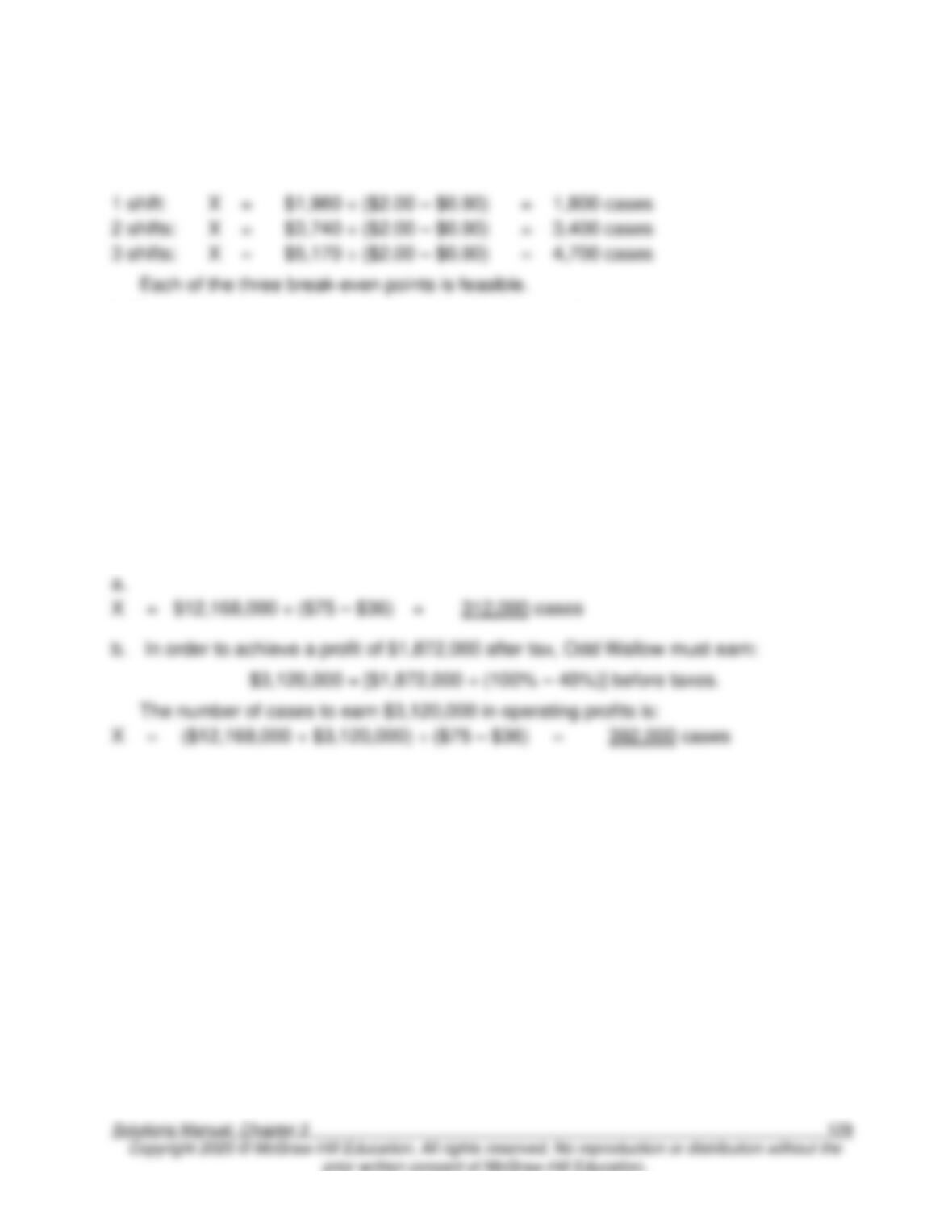
b. To answer this question, we just need to check at the three maximum levels for each
lane alternative:
Alternative
1 lane
[($10 — $4) 5,000 meals – $33,000] =
2 lanes
[($10 — $4) 8,000 meals – $39,000] =
3 lanes
[($10 — $4) 10,000 meals – $52,500] =
3-57. (35 min.) Extensions of the CVP Model―Semifixed (Step) Costs: Cesar’s
Bottlers.
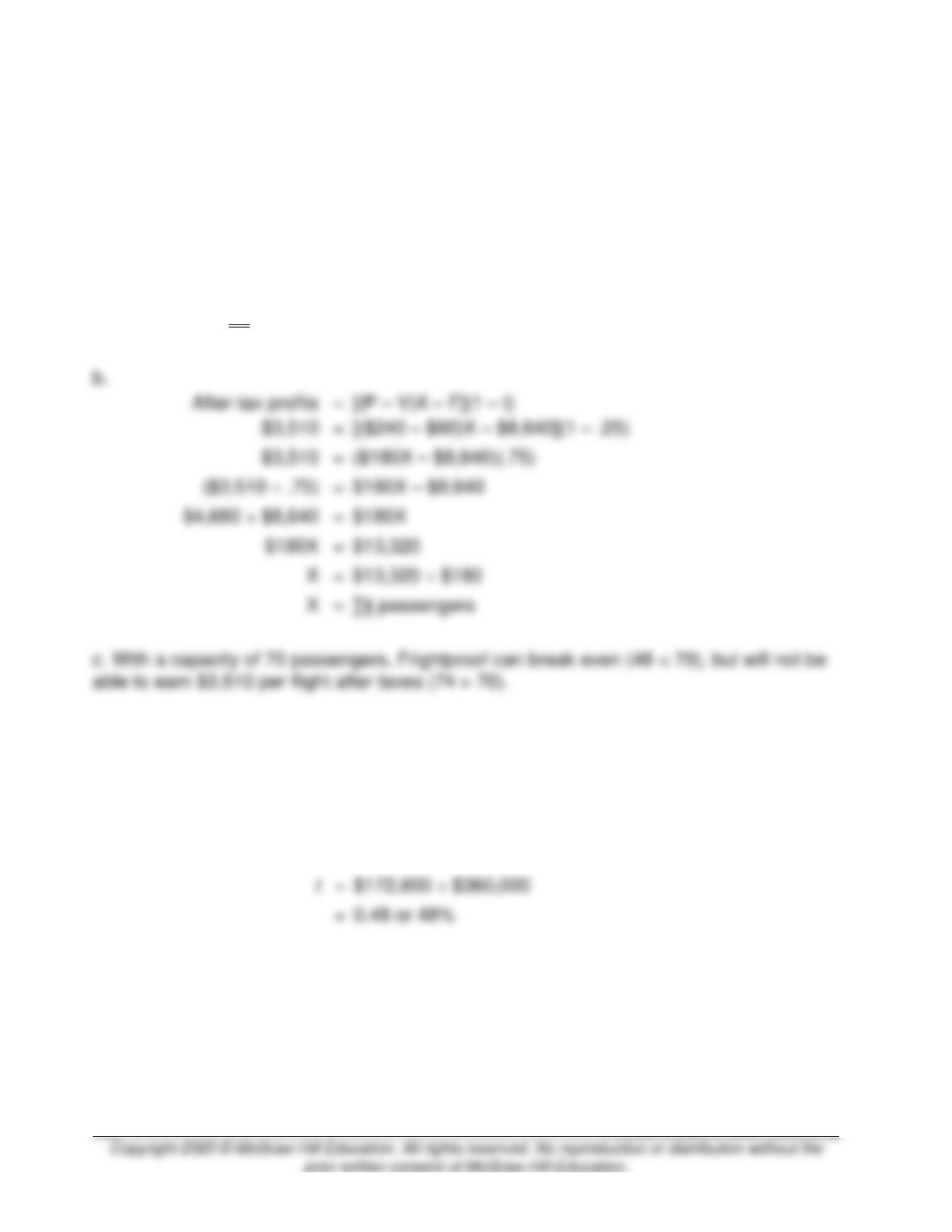
a. There are three possible break-even points (one with each additional shift):
1 shift:
X
1,800 cases
2 shifts:
X
3,400 cases
3 shifts:
X
4,700 cases
b. To answer this question, we just need to check at the three maximum levels for each
lane alternative:
Alternative
Profit
1 shift
[($2.00 – $0.90) 2,000 cases – $1,980] =
$220
2 shifts
[($2.00 – $0.90) 3,600 cases – $3,740] =
$220
3 shifts
[($2.00 – $0.90) 5,000 cases – $5,170] =
$330
Cesar should operate 3 shifts.
3-58. (15 min.) Extensions of the CVP Model—Taxes: Odd Wallow Drinks.
3-59. (20 min.) Extensions of the CVP Model—Taxes: Frightproof Commuter
Airlines.
a.
0
=
(P – V)X – F
0
=
($240 – $60)X – $8,640
$8,640
=
($240 – $60)X
X
=
$8,640 ÷ $180
=
48 passengers
=
[(P – V)X – F](1 – t)
=
[($240 – $60)X – $8,640](1 – .25)
=
($180X – $8,640)(.75)
=
=
$180X
=
$13,320
=
=
74 passengers
3-60. (20 min.) Extensions of the CVP Model—Taxes: Central Co.
After tax profits
=
[(P – V)X – F](1 – t)
$187,200
=
[($13 – $4) 100,000 – $540,000](1 – t)
$187,200
=
$360,000 – $360,000t
$360,000t
=
$172,800
=
$172,800 ÷ $360,000
=
0.48 or 48%
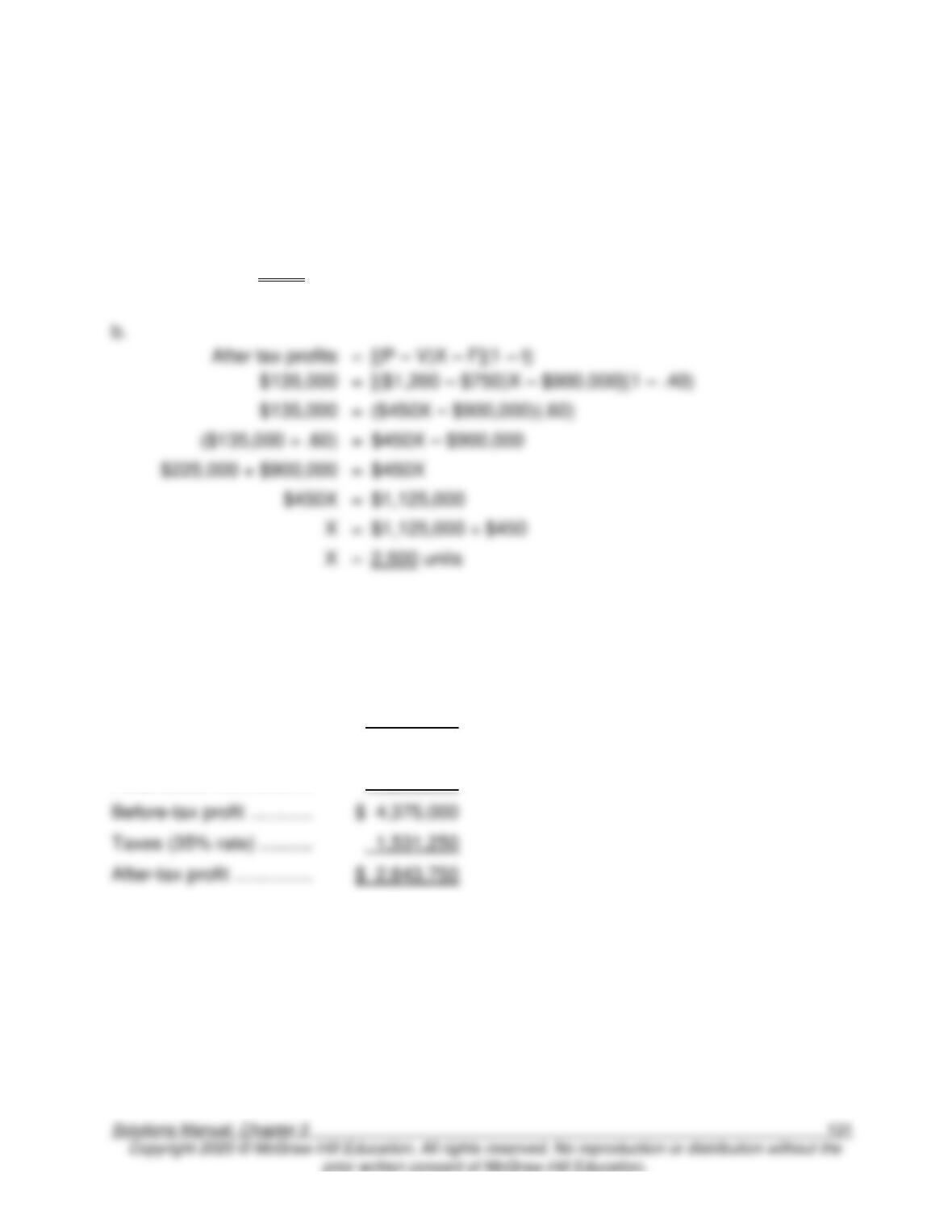
3-61. (20 min.) Extensions of the CVP Model—Taxes: Toys 4 Us.
a.
0
=
(P – V)X – F
0
=
($1,200 – $750)X – $900,000
$900,000
=
($1,200 – $750)X
X
=
$900,000 ÷ $450
=
2,000 units
[(P – V)X – F](1 – t)
=
($450X – $900,000)(.60)
=
=
$450X
=
$1,125,000
=
$1,125,000 ÷ $450
=
3-62. (40 min.) Extensions of the CVP Model—Taxes: Eagle Company.
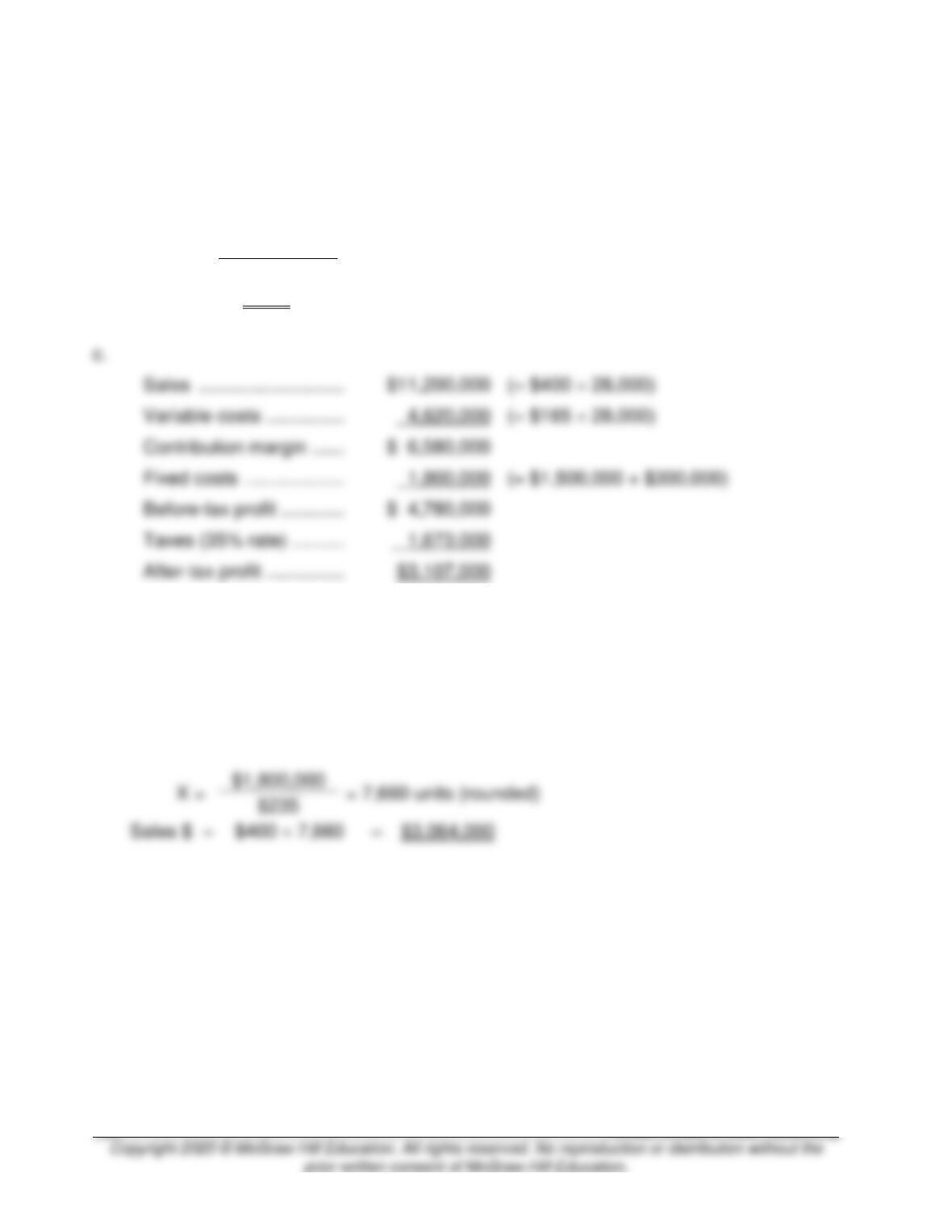
a.
Sales ……………………….
$10,000,000
(= $400 25,000)
Variable costs ……………
4,125,000
(= $165 25,000)
Contribution margin ……
$5,875,000
Fixed costs ……………….
1,500,000
Before-tax profit …………
$ 4,375,000
Taxes (35% rate) ……….
1,531,250
3-62 (continued).
b.
Profit
=
(P – V)X – F
$0
=
($400 – $165)X – $1,500,000
$235X
=
$1,500,000
X =
$1,500,000
$235
X
=
6,383
Units
(rounded)
d.
Profit
=
(P – V)X – F
$0
=
($400 – $165)X – $1,800,000
$235X
=
$1,800,000
X =
$1,800,000