CHAPTER 3
Process Costing
ASSIGNMENT CLASSIFICATION TABLE
Learning Objectives
Questions
Brief
Exercises
Do It!
Exercises
A
Problems
* 1. Discuss the uses of a
process cost system and
how it compares to a job
order system.
1, 2, 3, 4, 5,
20
1
1
* 2. Explain the flow of costs
in a process cost system
and the journal entries to
assign manufacturing
costs.
6, 7
1, 2, 3
2
2, 3, 4
1A
units.
3
10, 11, 13, 14,
5A, 6A
14, 15
units using the FIFO
method.
ASSIGNMENT CHARACTERISTICS TABLE
Problem
Number
Description
Difficulty
Level
Time
Allotted (min.)
1A
Journalize transactions.
Moderate
20–30
2A
Complete four steps necessary to prepare a production
cost report.
Simple
30–40
3A
Complete four steps necessary to prepare a production
cost report.
Simple
30–40
4A
Assign costs and prepare production cost report.
Moderate
20–30
assign costs.
cost report.
costs for processes; prepare production cost report.
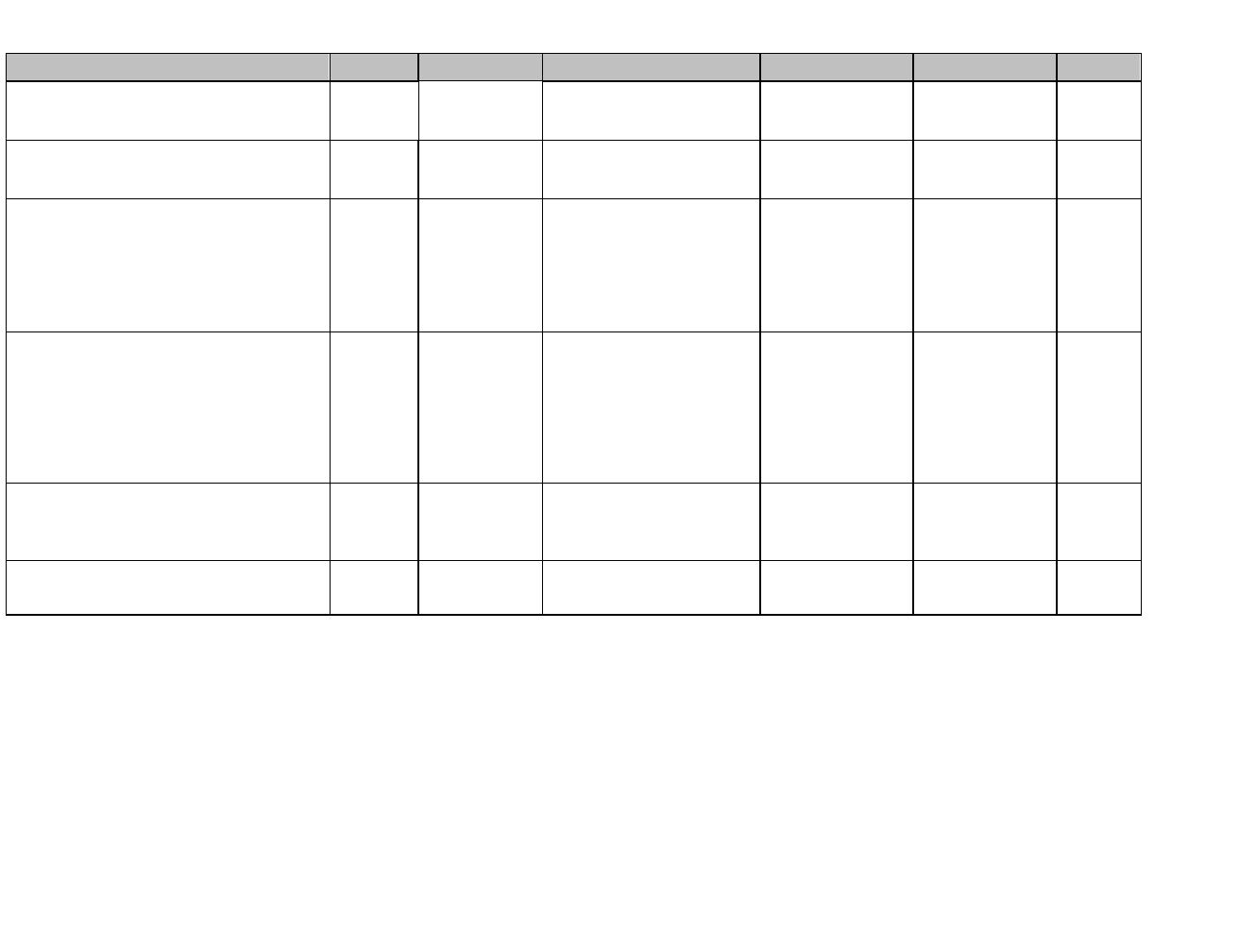
BLOOM’ S TAXONOMY TABLE
Correlation Chart between Bloom’s Taxonomy, Learning Objectives and End–of-Chapter Exercises and Problems
Learning Objective
Knowledge
Comprehension
Application
Analysis
Synthesis
Evaluation
* 1. Discuss the uses of a process cost
system and how it compares to a job
order system.
Q3-1
Q3-2
Q3-3
Q3-4
Q3-5
Q3–20
E3-1
DI3-1
* 2. Explain the flow of costs in a process
cost system and the journal entries to
assign manufacturing costs.
Q3-6
Q3-7
BE3-1
BE3-2
BE3-3
DI3-2
E3-2
E3-3
E3-4
P3-1A
* 3. Compute equivalent units.
Q3–10
Q3–11
Q3–12
Q3–13
BE3-4
BE3-5
DI3-3
E3-3
E3-5
E3-6
E3-7
E3-8
E3-9
E3–10
E3–11
E3–13
E3–14
E3–15
P3–2A
P3–3A
P3-4A
P3-5A
P3–6A
* 4. Complete the four steps to prepare a
production cost report.
Q3-8
Q3–16
Q3–17
Q3–19
Q3-9
Q3–14
Q3–15
Q3–18
BE3-6
BE3-7
BE3-8
BE3-9
DI3-4
E3-3
E3-5
E3-6
E3-7
E3-8
E3-9
E3–10
E3–11
E3–13
E3–14
E3–15
P3–2A
P3-3A
P3–4A
P3–5A
P3–6A
E3–12
*5. Compute equivalent units using the
FIFO method.
Q3–21
Q3–22
BE3-10
BE3-11
BE3-12
E3–16
E3–17
E3–18
E3–19
E3–20
P3–7A
Broadening Your Perspective
BYP3-3
CD-3
BYP3-1
BYP3-2
BYP3-6
BYP3-4
BYP3-5
ANSWERS TO QUESTIONS
1. (a) Process cost.
(b) Process cost.
2. The primary focus of job order cost accounting is on the individual job. In process cost accounting, the
primary focus is on the processes involved in producing homogeneous products.
3. The similarities are: (1) all three manufacturing cost elements—direct materials, direct labor, and
4. The features of process cost accounting are: (1) separate work in process accounts for each
5. Sam is correct. The flow of costs is the same in process cost accounting as in job order cost
accounting. The method of assigning costs, however, is significantly different.
6. (a) (1) Materials are charged to production on the basis of materials requisition slips.
(2) Labor is usually charged to production on the basis of the payroll register or departmental
7. The entry to assign overhead to production is:
July 31 Work in Process—Machining ……………………………………………. 15,000
8. To prepare a production cost report, four steps are followed: (a) compute the physical unit flow,
9. Physical units to be accounted for consist of units in process at the beginning of the period plus
10. Equivalent units of production measure the work done during the period, expressed in fully com-
pleted units.
Questions Chapter 3 (Continued)
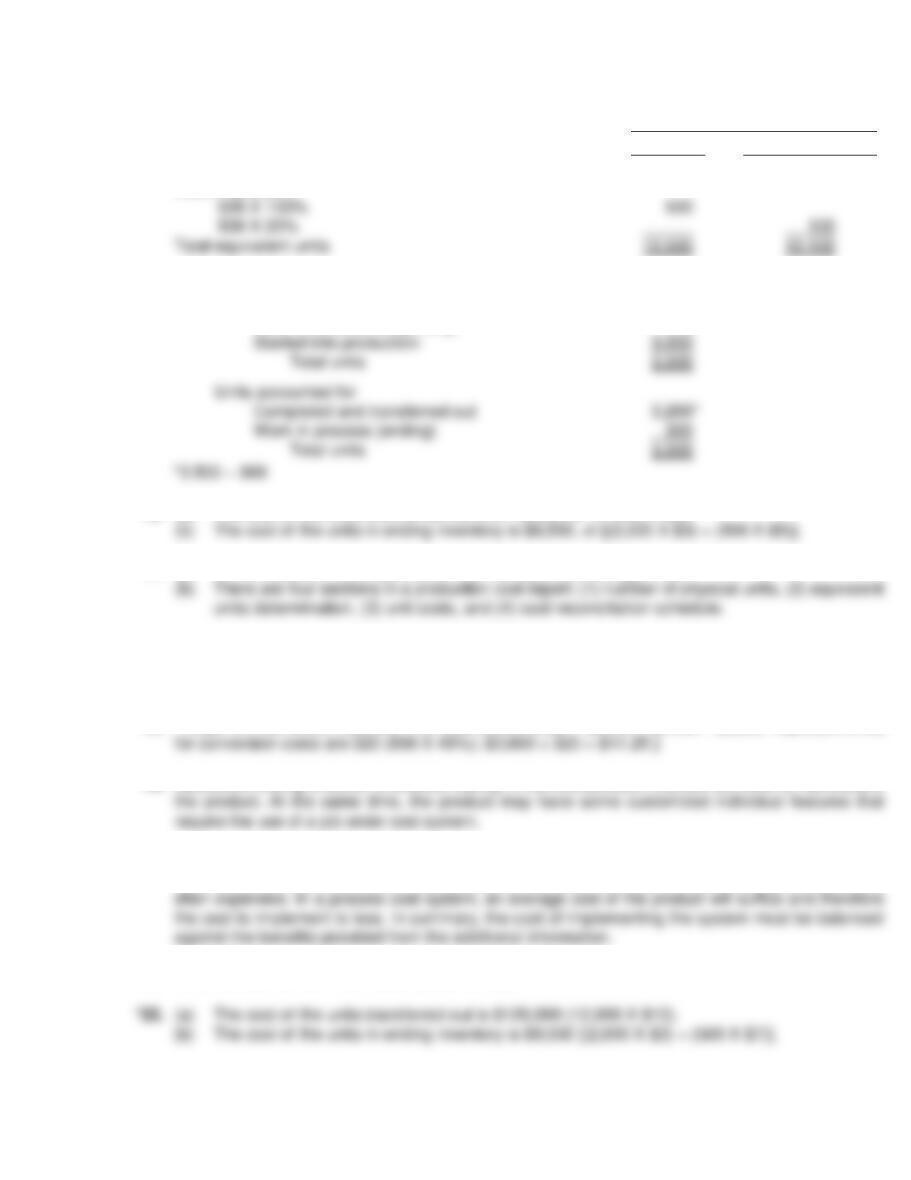
13.
Equivalent Units
Materials
Conversion Costs
Units transferred out
Work in process
12,000
12,000
14.
Units accounted for
Completed and transferred out
Units transferred out were 3,200*
Units to be accounted for
Work in process (beginning)
500
15. (a) The cost of the units transferred out is $112,000, or (14,000 X $8).
16. (a) Ann is incorrect. The report is an internal report for management.
17. The production cost report provides the basis for evaluating: (1) the productivity of a department,
(2) whether unit and total costs are reasonable, and (3) whether current performance is meeting
planned objectives.
18. The per unit conversion cost is $11.25. [Conversion costs = $6,000 – $2,400 = $3,600. Equivalent units
19. Operations costing is similar to process costing in that standardized methods are used to manufacture
20. In deciding which system to use, a cost-benefit tradeoff occurs. In a job order system, detailed
information related to the cost of the product is involved. The cost of implementing this system is
*21. Units transferred out were 2,800 (2,000 + 800).
500 X 100%
500
SOLUTIONS TO BRIEF EXERCISES
BRIEF EXERCISE 3-1
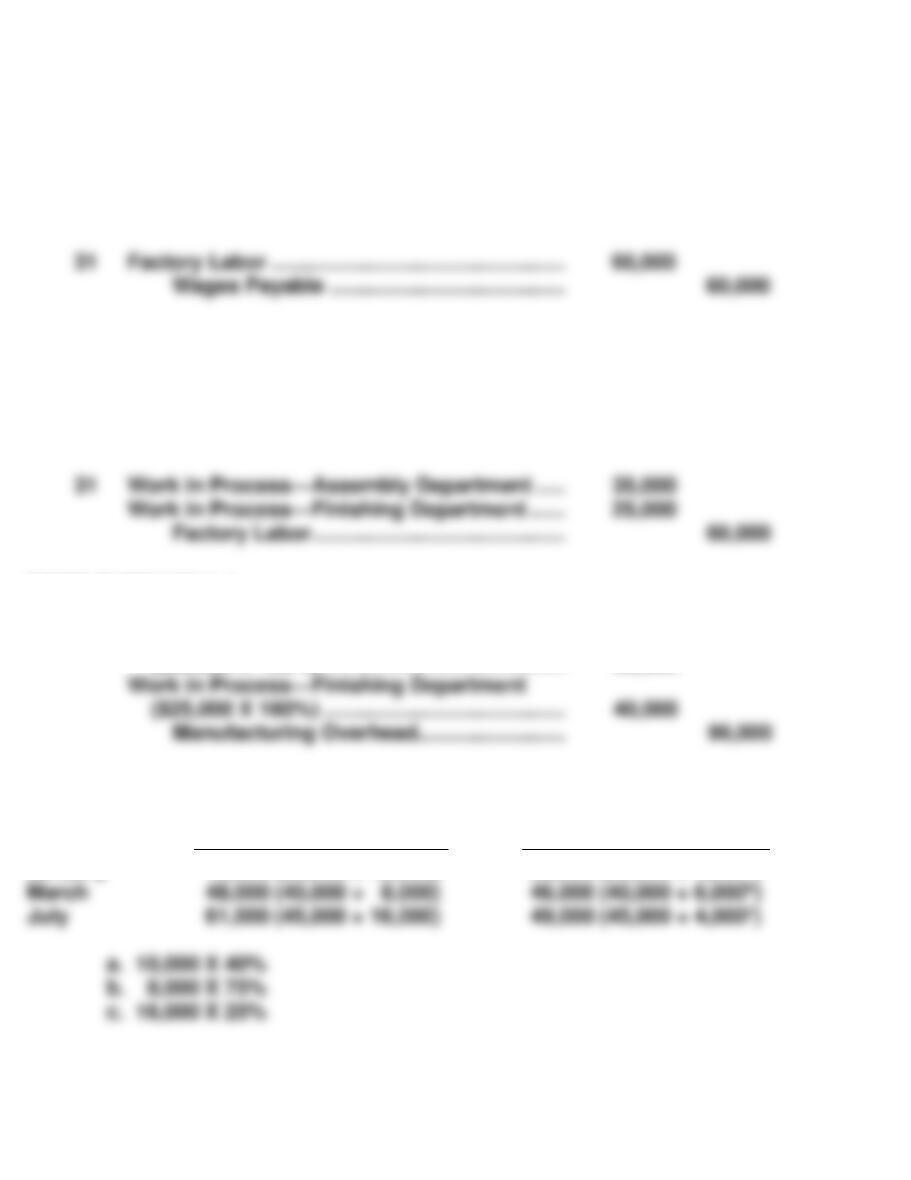
Mar. 31 Raw Materials Inventory …………………………... 50,000
Accounts Payable ……………………………… 50,000
BRIEF EXERCISE 3-2
Mar. 31 Work in Process—Assembly Department ….. 24,000
Work in Process—Finishing Department …… 26,000
Raw Materials Inventory …………………….. 50,000
BRIEF EXERCISE 3-3
Mar. 31 Work in Process—Assembly Department
($35,000 X 160%) ………………………………….. 56,000
BRIEF EXERCISE 3-4
Materials
Conversion Costs
January
45,000 (35,000 + 10,000)
39,000 (35,000 + 4,000a)
BRIEF EXERCISE 3-5
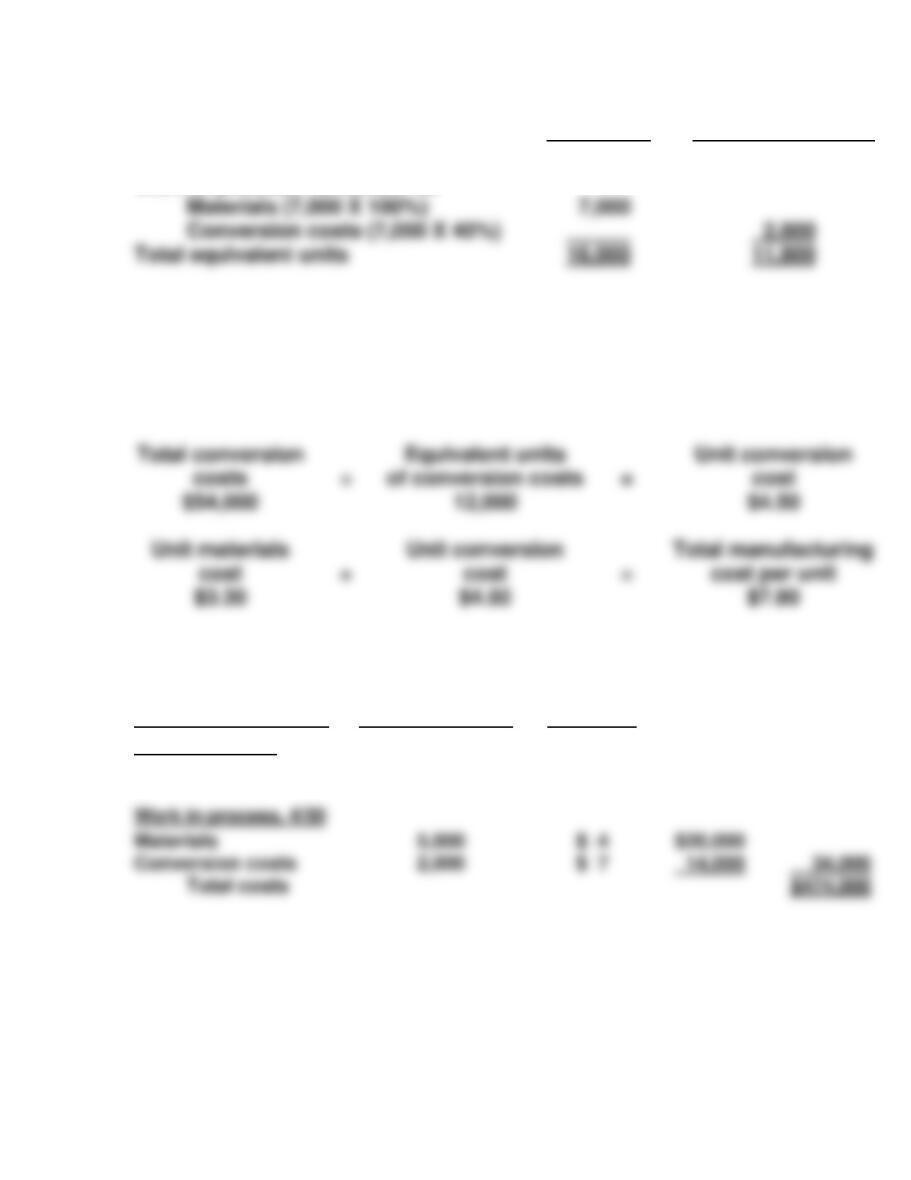
(a)
Materials
(b)
Conversion Costs
Units transferred out
Work in process, November 30
9,000
9,000
BRIEF EXERCISE 3-6
Total materials
costs
$33,000
÷
Equivalent units
of materials
10,000
=
Unit materials
cost
$3.30
costs
÷
=
cost
BRIEF EXERCISE 3-7
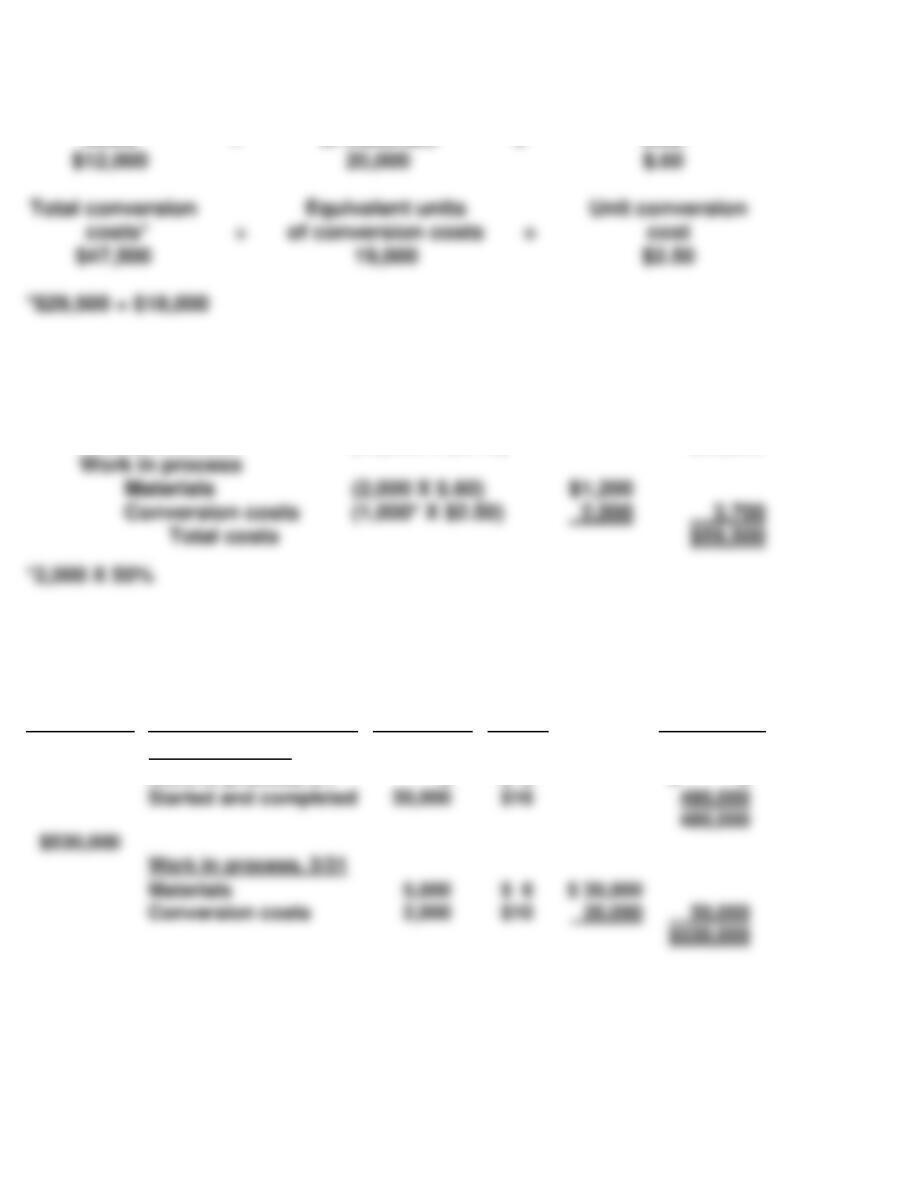
Assignment of Costs
Equivalent Units
Unit Cost
Transferred out
Transferred out
40,000
$11
$440,000
Work in process, 4/30
Total costs
$474,000
BRIEF EXERCISE 3-8
Total materials
costs
÷
Equivalent units
of materials
=
Unit materials
cost
BRIEF EXERCISE 3-9
Costs accounted for
Transferred out
(18,000 X $3.10)
$55,800
*BRIEF EXERCISE 3-10
Costs to Be
Assigned
Assignment of Costs
Equivalent
Units
Unit
Cost
Total Costs
Assigned
Transferred out
Work in process, 3/31
Materials
5,000
$ 6
$ 30,000
Work in process, 3/1
0
$ 0
$ 0
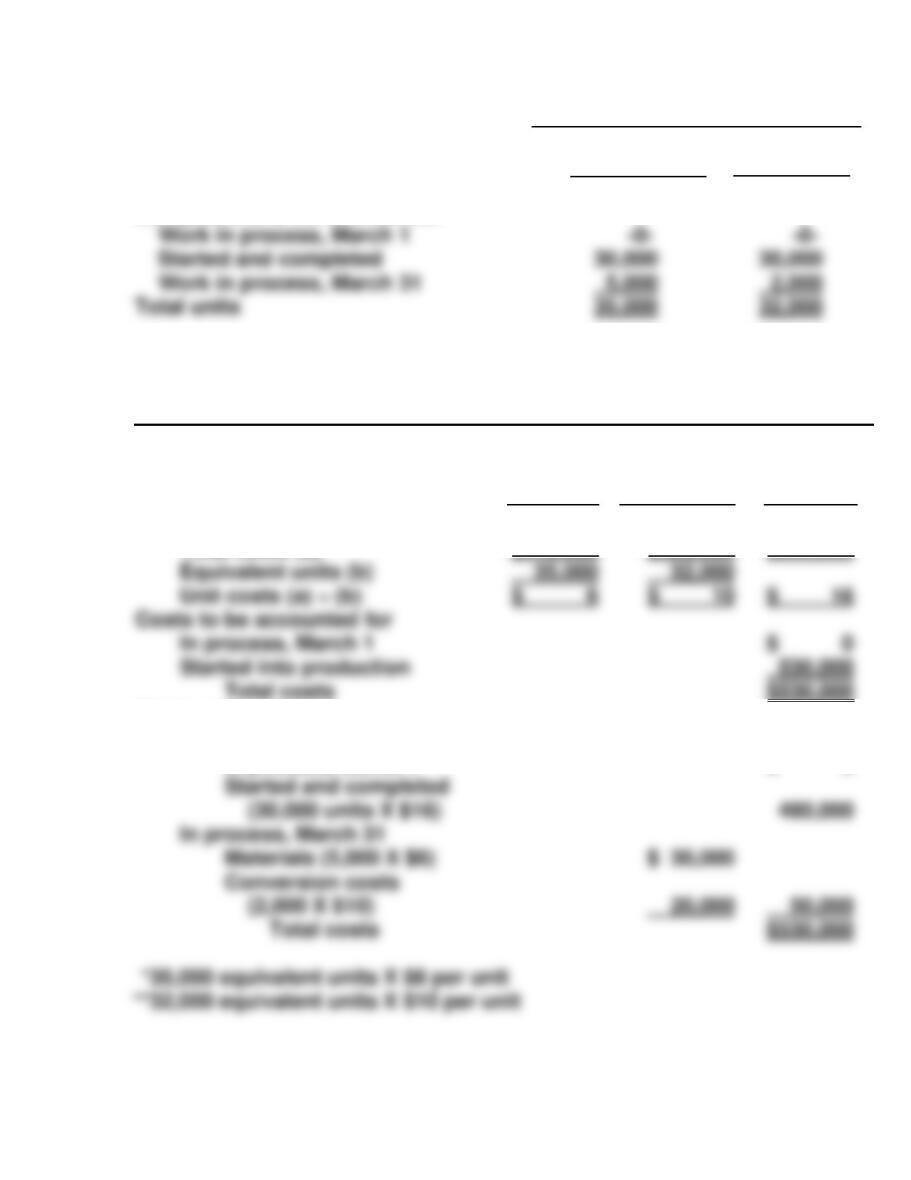
*BRIEF EXERCISE 3-11
Equivalent Units
Materials
Conversion
Costs
Units accounted for
Completed and transferred out
PIX COMPANY
(Partial) Production Cost Report
For the Month Ended March 31
COSTS
Materials
Conversion
Costs
Total
(2,000 X $10)
Unit costs
Total costs (a)
Costs accounted for
Transferred out
In process, March 1
$210,000
*
$320,000
**
$530,000
$ 0
Total units
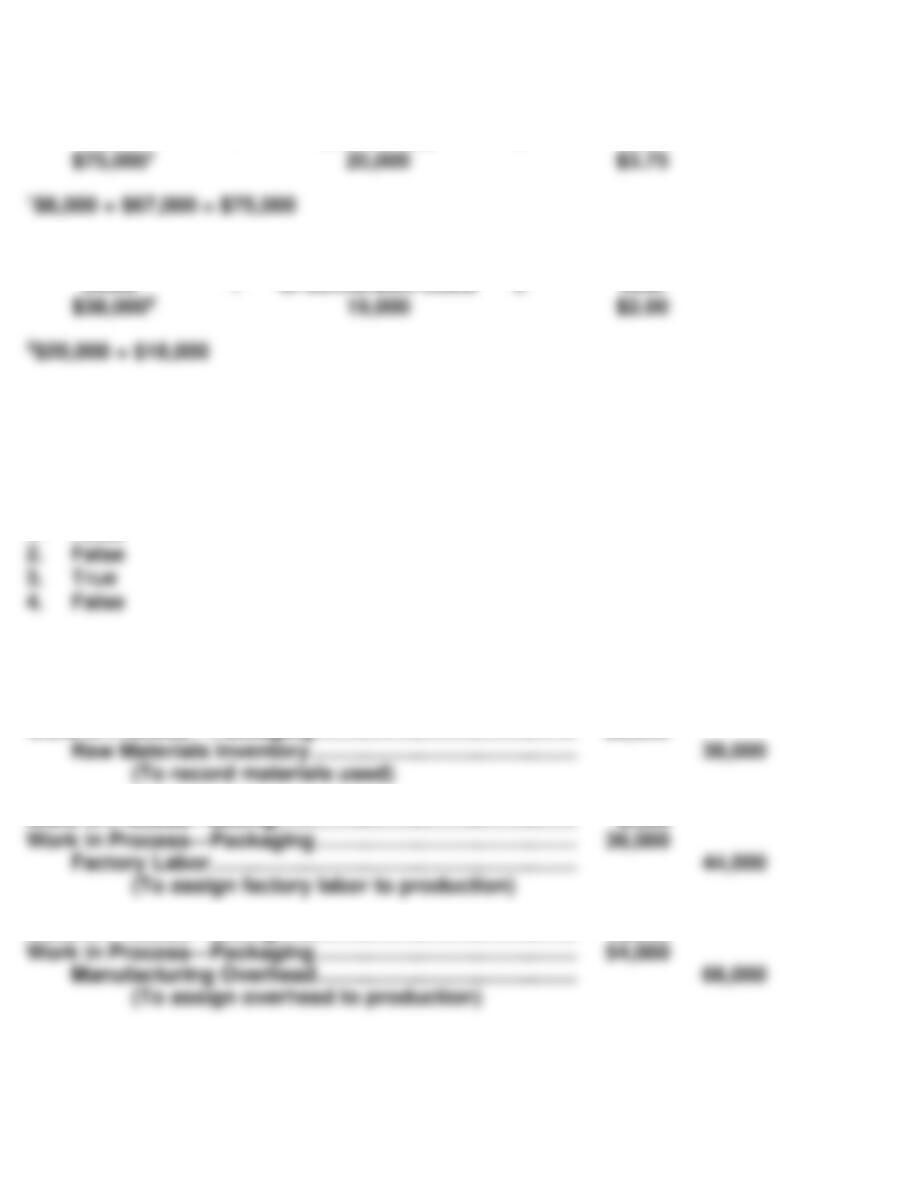
*BRIEF EXERCISE 3-12
Total materials
costs
÷
Equivalent units
of materials
=
Unit materials
cost
Total conversion
Equivalent units
Unit conversion
SOLUTIONS FOR DO IT! REVIEW EXERCISES
DO IT! 3-1
1. False
DO IT! 3-2
Work in Process—Mixing …………………………………………… 10,000
Work in Process—Packaging …………………………………….. 28,000
Work in Process—Mixing …………………………………………… 12,000
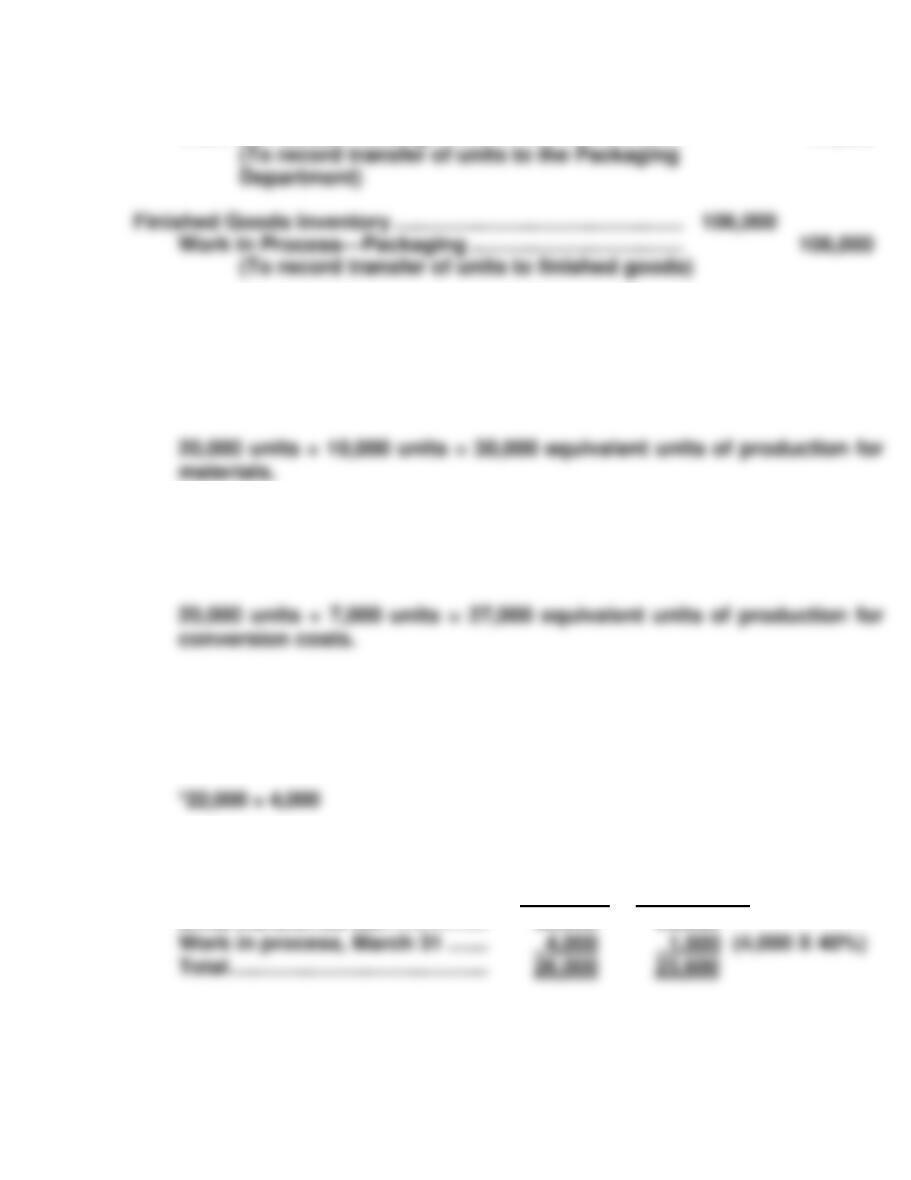
DO IT! 3-2 (Continued)
Work in Process—Packaging …………………………………….. 21,000
Work in Process—Mixing ……………………………………. 21,000
DO IT! 3-3
(a) Since materials are entered at the beginning of the process, the equiva–
lent units of ending work in process are 10,000.
(b) Since ending work in process is only 70% complete as to conversion
costs, the equivalent units of ending work in process for conversion
costs are 7,000 (70% X 10,000 units).
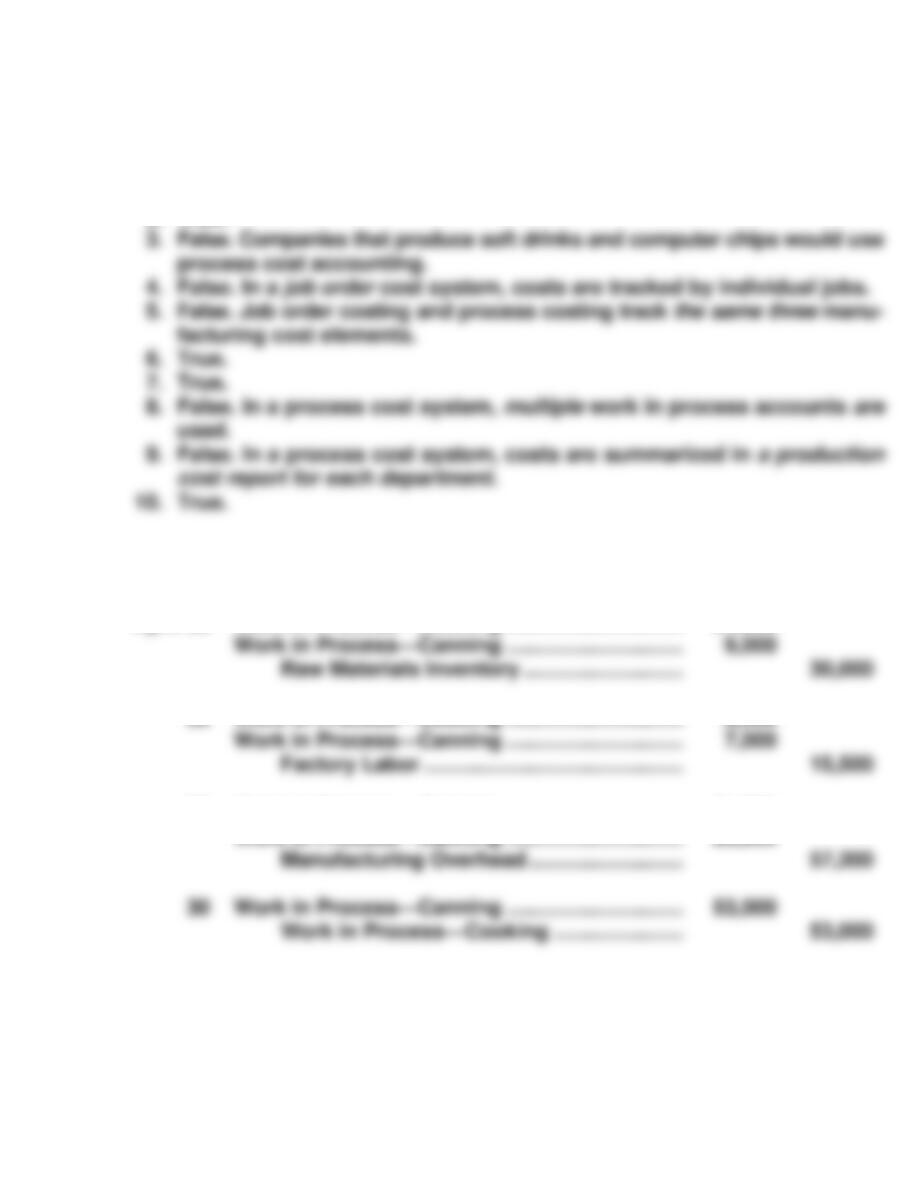
DO IT! 3-4
(a) 0 (Work in process, March 1) + 26,000* (Started into production) = 26,000
(b) Equivalent units of production:
Materials Conversion
Units transferred out …………….. 22,000 22,000

DO IT! 3-4 (Continued)
(c) Cost reconciliation schedule
Costs accounted for
Transferred out (22,000 X $18) ………… $396,000
SOLUTIONS TO EXERCISES
EXERCISE 3-1
1. True.
2. True.
EXERCISE 3-2
April 30 Work in Process—Cooking ………………………… 21,000
30 Work in Process—Cooking ………………………… 8,500
30 Work in Process—Cooking ………………………… 31,500
Work in Process—Canning ………………………… 25,800
EXERCISE 3-3
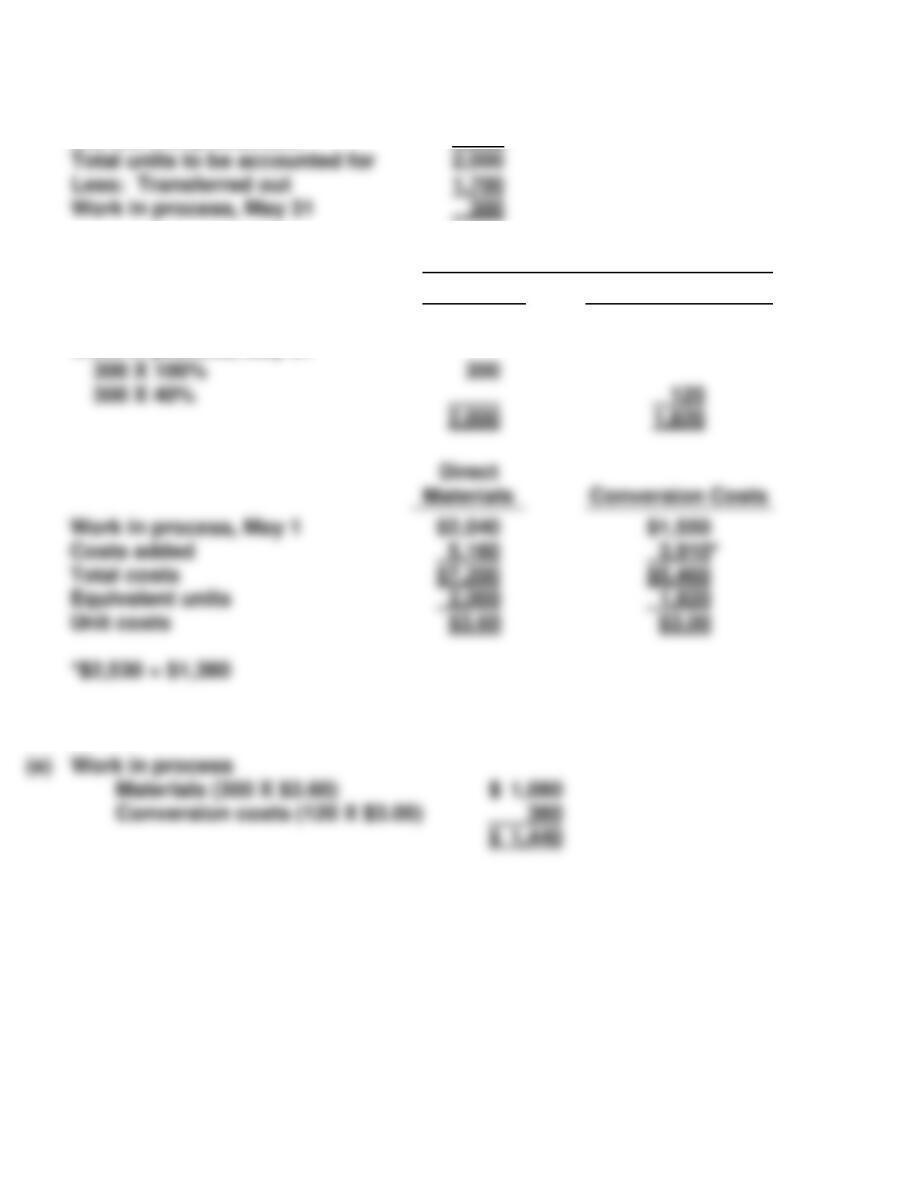
(a) Work in process, May 1 400
Started into production 1,600
(b) and (c)
Equivalent Units
Materials
Conversion Costs
Unit costs
Units transferred out
Work in process, May 31
1,700
1,700
(d) Transferred out (1,700 X $6.60) $11,220
EXERCISE 3-4
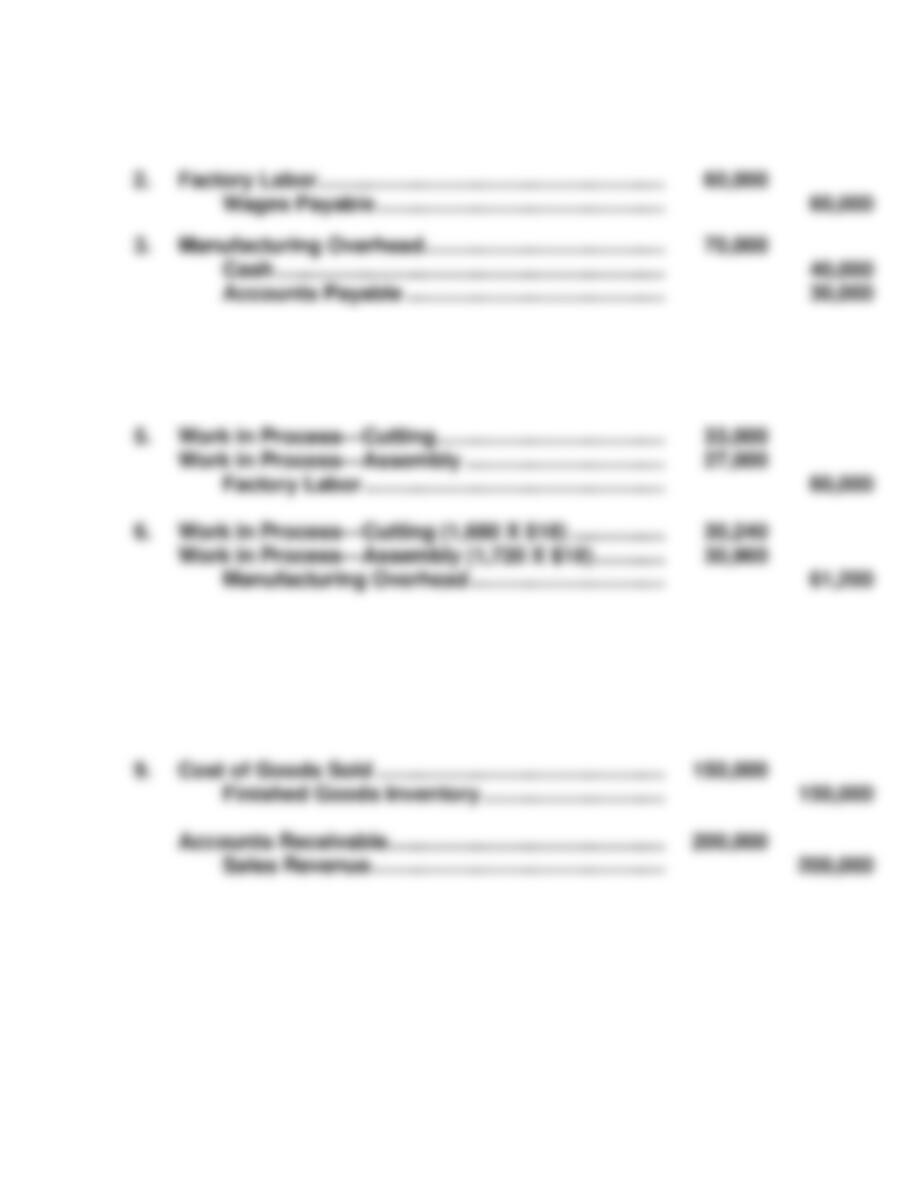
1. Raw Materials Inventory …………………………………… 62,500
Accounts Payable …………………………………….. 62,500
4. Work in Process—Cutting ………………………………… 15,700
Work in Process—Assembly ……………………………. 8,900
Raw Materials Inventory ……………………………. 24,600
7. Work in Process—Assembly ……………………………. 67,600
Work in Process—Cutting …………………………. 67,600
8. Finished Goods Inventory ………………………………… 134,900
Work in Process—Assembly ……………………… 134,900
EXERCISE 3-5
(a)
January
May
Units to be accounted for
Beginning work in process
Started into production
0
13,000
0
21,000
(b)
(1)
Materials
(2)
Conversion Costs
11,500 (10,000 + 1,500)
January
March
13,000 (11,000 + 2,000)
15,000 (12,000 + 3,000)
12,200 (11,000 + 1,200)
12,900 (12,000 + 900)
EXERCISE 3-6
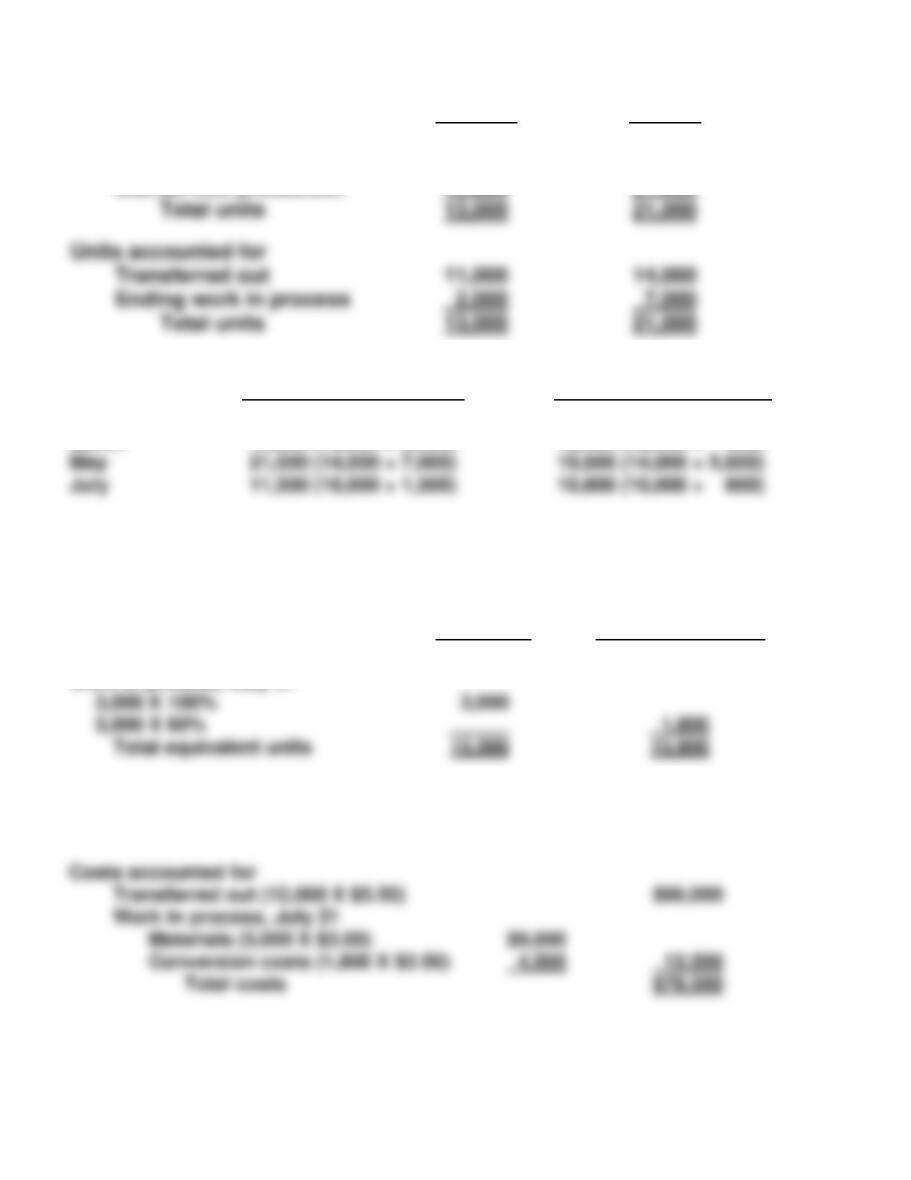
(a)
(1)
Materials
(2)
Conversion Costs
3,000 X 100%
Units transferred out
Work in process, July 31
12,000
12,000
Work in process, July 31
Materials (3,000 X $3.00)
(b) Materials: $45,000 ÷ 15,000 = $3.00
Conversion costs: ($16,200 + $18,300) ÷ 13,800 = $2.50
Total units
EXERCISE 3-7
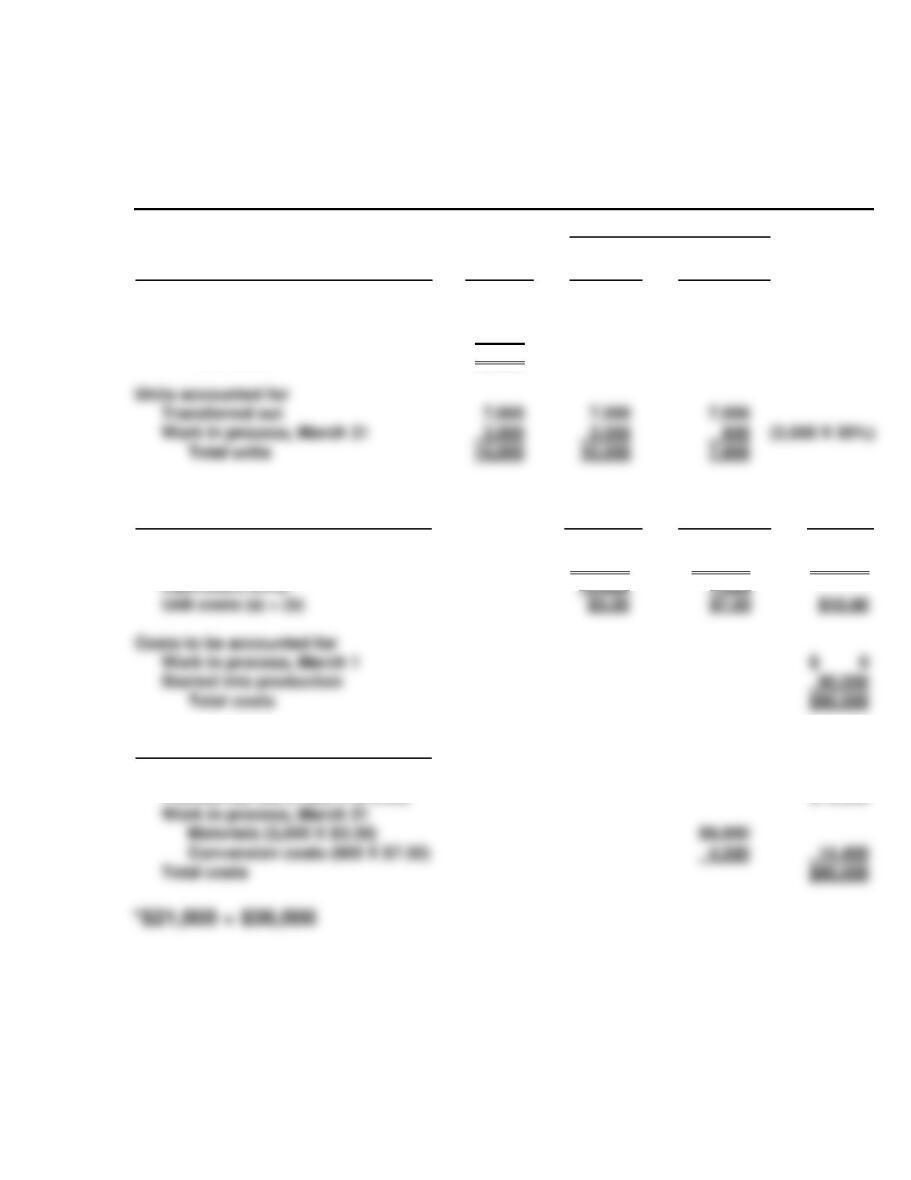
QUIK FURNITURE COMPANY
Sanding Department
Production Cost Report
For the Month Ended March 31, 2017
Equivalent Units
Quantities
Physical
Units
Materials
Conversion
Costs
Units to be accounted for
Work in process, March 1
Started into production
Total units
0
10,000
10,000
Costs
Materials
Conversion
Costs
Total
Started into production
Total costs
Unit costs
Total cost
$33,000
$57,000*
$90,000
Cost Reconciliation Schedule
Total costs
Costs accounted for
Transferred out (7,000 X $10.80)
$75,600
Units accounted for
Transferred out
Work in process, March 31
(3,000 X 20%)
Total units
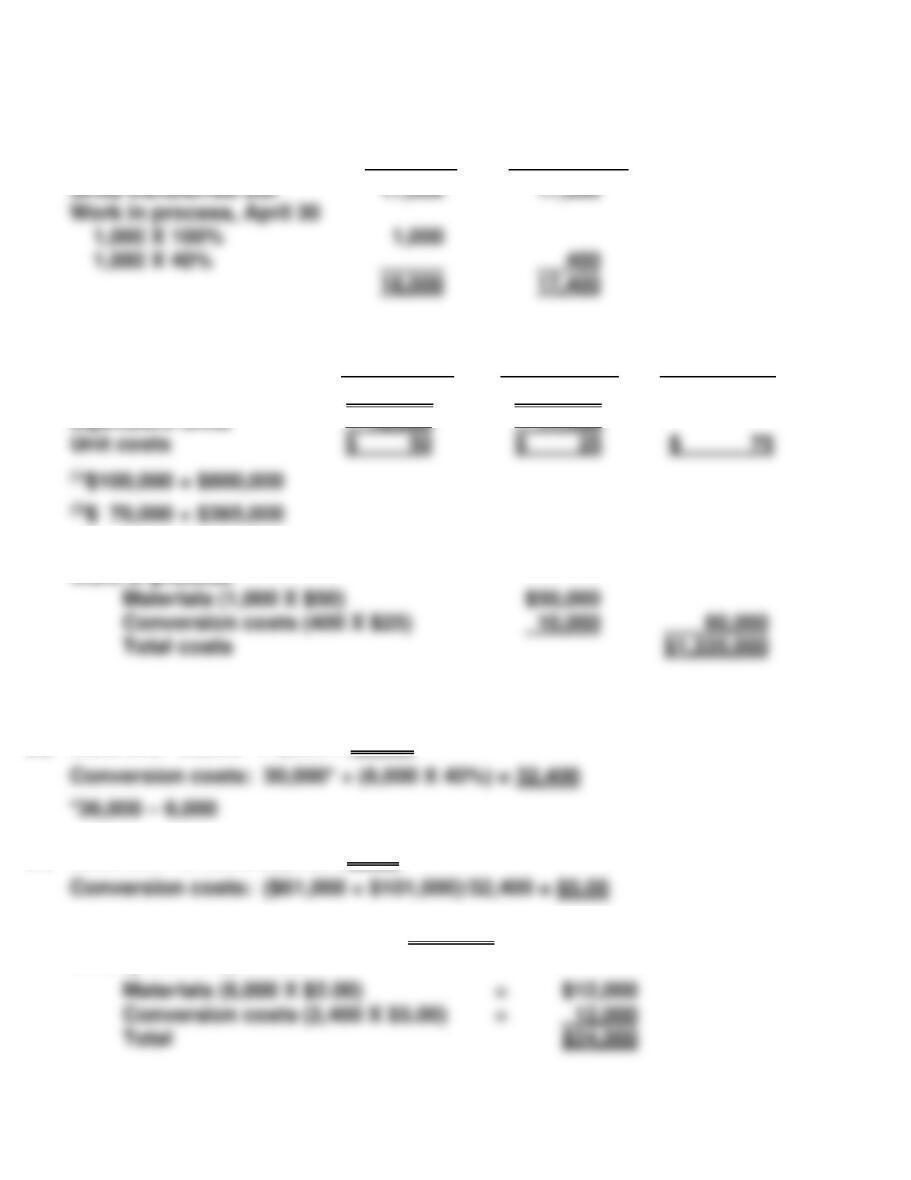
EXERCISE 3-8
(a)
(1)
Materials
(2)
Conversion
Costs
(b)
Materials
Conversion
Costs
Total
Unit costs
Total cost
$900,000(1)
$435,000(2)
$1,335,000
(c)
Materials (1,000 X $50)
Total costs
Transferred out (17,000 X $75)
$1,275,000
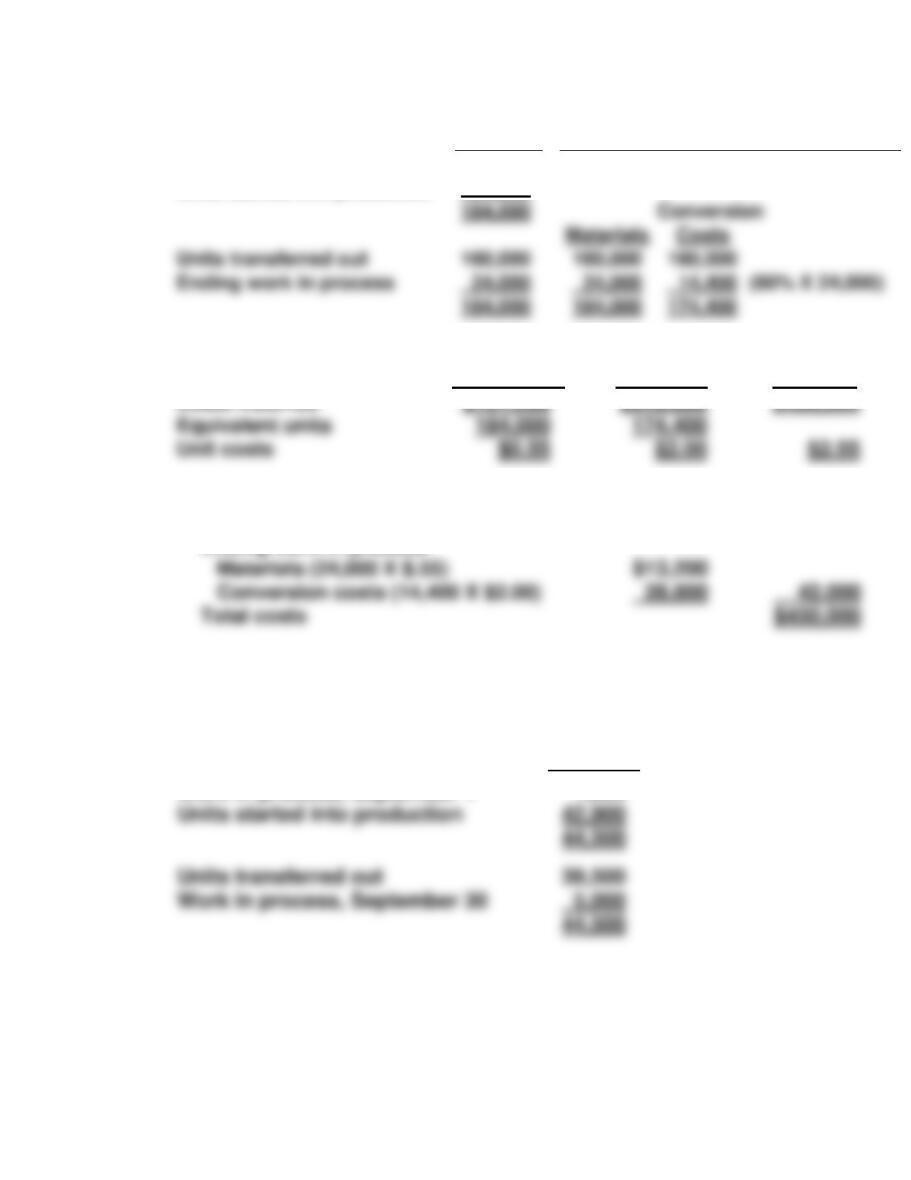
EXERCISE 3-9
(a) Materials: 30,000* + 6,000 = 36,000
(b) Materials: $72,000/36,000 = $2.00
(c) Transferred out: 30,000 X $7.00 = $210,000
Ending work in process:
1,000 X 100%
1,000
EXERCISE 3-10
(a)
Physical
Units
Equivalent Units
Beginning work in process
20,000
Units started into production
164,000
(b)
Conversion
Materials
Costs
Total
Costs incurred
Equivalent units
Unit costs
(c)
Assignment of costs:
Transferred out (160,000 X $2.55)
$408,000
Ending work in process
42,000
EXERCISE 3-11
(a)
Physical
Units
Work in process, September 30
Work in process, September 1
1,600
160,000
160,000
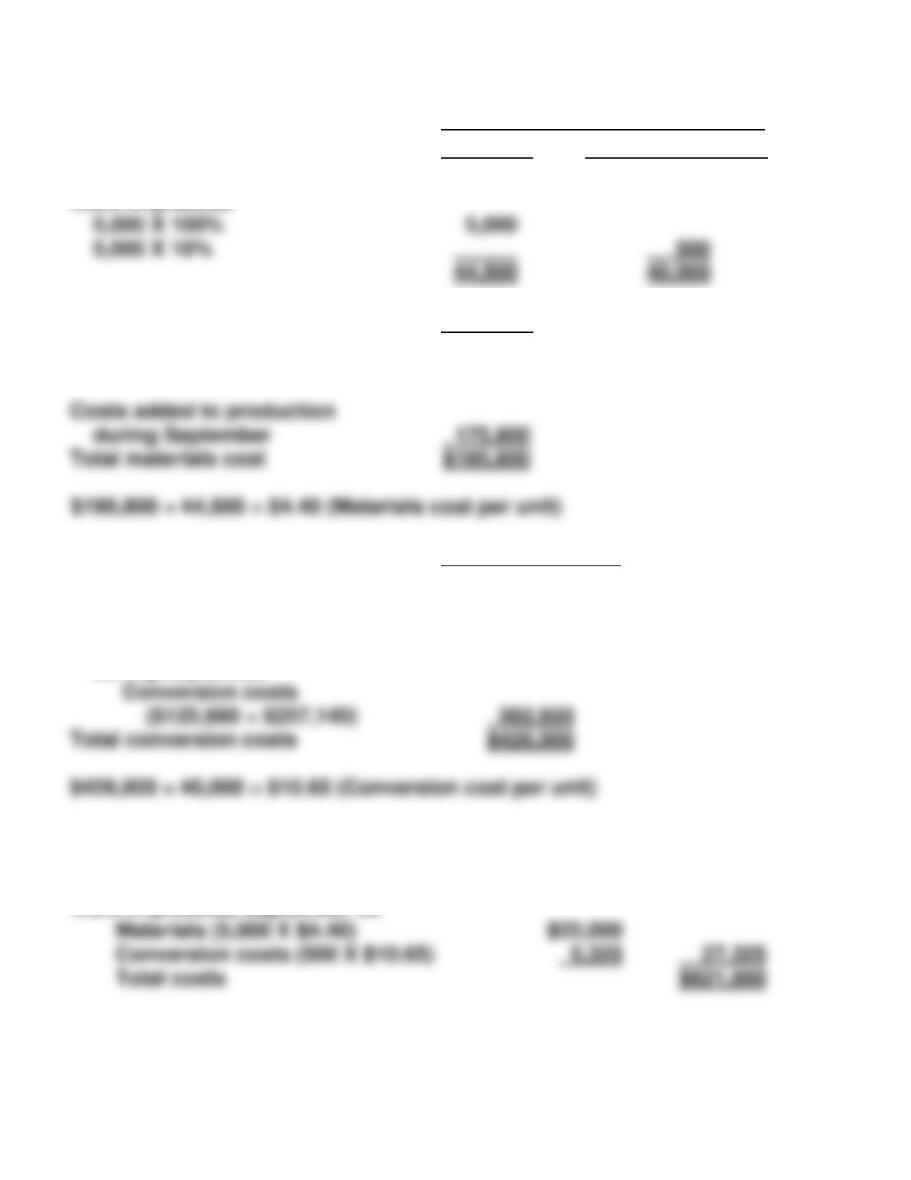
EXERCISE 3-11 (Continued)
Equivalent Units
Materials
Conversion Costs
Units transferred out
39,500
39,500
(b)
Materials
Total materials cost
Work in process, September 1
Direct materials
$ 20,000
Conversion Costs
Total conversion costs
Work in process, September 1
Conversion costs
Costs added to production
during September
$ 43,180
(c) Costs accounted for
Transferred out (39,500 X $15.05) $594,475
Work in process, September 30
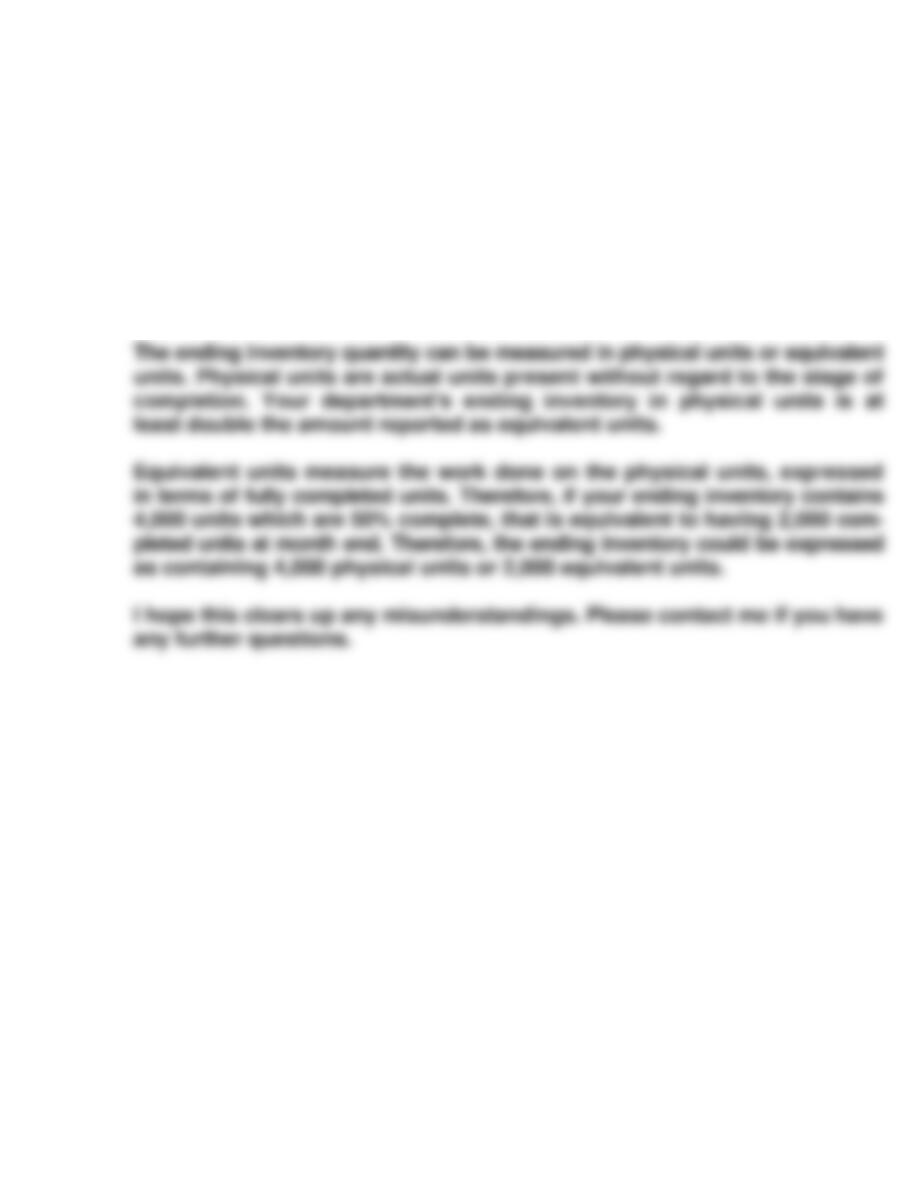
EXERCISE 3-12
To: David Skaros
From: Student
Re: Ending inventory
The reason for any confusion related to your department’s ending inventory
quantity stems from the fact that the quantity can be measured in two different
ways, depending on what the information is used for.
EXERCISE 3-13
HEALTHY COMPANY
Welding Department
Production Cost Report
For the Month Ended February 28, 2017
Equivalent Units
Quantities
Physical
Units
Materials
Conversio
n
Costs
(Step 1)
(Step 2)
Units to be accounted for
Work in process, February 1
Started into production
15,000
51,000
Costs
Materials
Conversion
Costs
Total
Work in process, February 1
Total costs
Unit costs (Step 3)
Total cost
(a)
$198,000(1)
$143,000(2)
$341,000
Cost Reconciliation Schedule (Step 4)
Total costs
Costs accounted for
Transferred out (55,000 X $5.50)
Work in process, February 28
Materials (11,000 X $3.00)
$33,000
$302,500
Units accounted for
Transferred out
Work in process, February 28
(11,000 X 20%)
Total units
EXERCISE 3-14
(a)
Containers in transit, April 1
0
Containers loaded
1,200
Total containers
1,200
Equivalent Units
(b)
Physical
Units
Direct
Materials
Conversion
Costs
Containers off-loaded
850
850
850
Containers in transit, April 30
350
Total equivalent units
*350 x 40% = 140
**350 x 20% = 70
EXERCISE 3-15
(a)
Materials
Conversion
Costs
Applications transferred out
800
800
Work in process, September 30
300*
180**
Equivalent units
1,100
980
(b)
Materials: $5,500 ÷ 1,100 = $5.00
Conversion costs: $25,480* ÷ 980 = $26.00
Costs accounted for:
Transferred out (800 X $31.00)
Work in process, September 30
Materials (300 X $5.00)
Conversion costs (180 X $26.00)
Total costs
Containers off-loaded
850
Containers in transit, April 30
350
Total containers
1,200
*EXERCISE 3-16
Equivalent Units
(a)
Physical
Units
Materials
Conversion
Costs
Applications completed:
Work in process, September 1
100
0
60
(b)
Materials: $4,500 ÷ 1,000 = $4.50
Conversion costs: $21,620* ÷ 940 = $23.00
1,350
Started and completed
700
Work in process, September 30
Total units
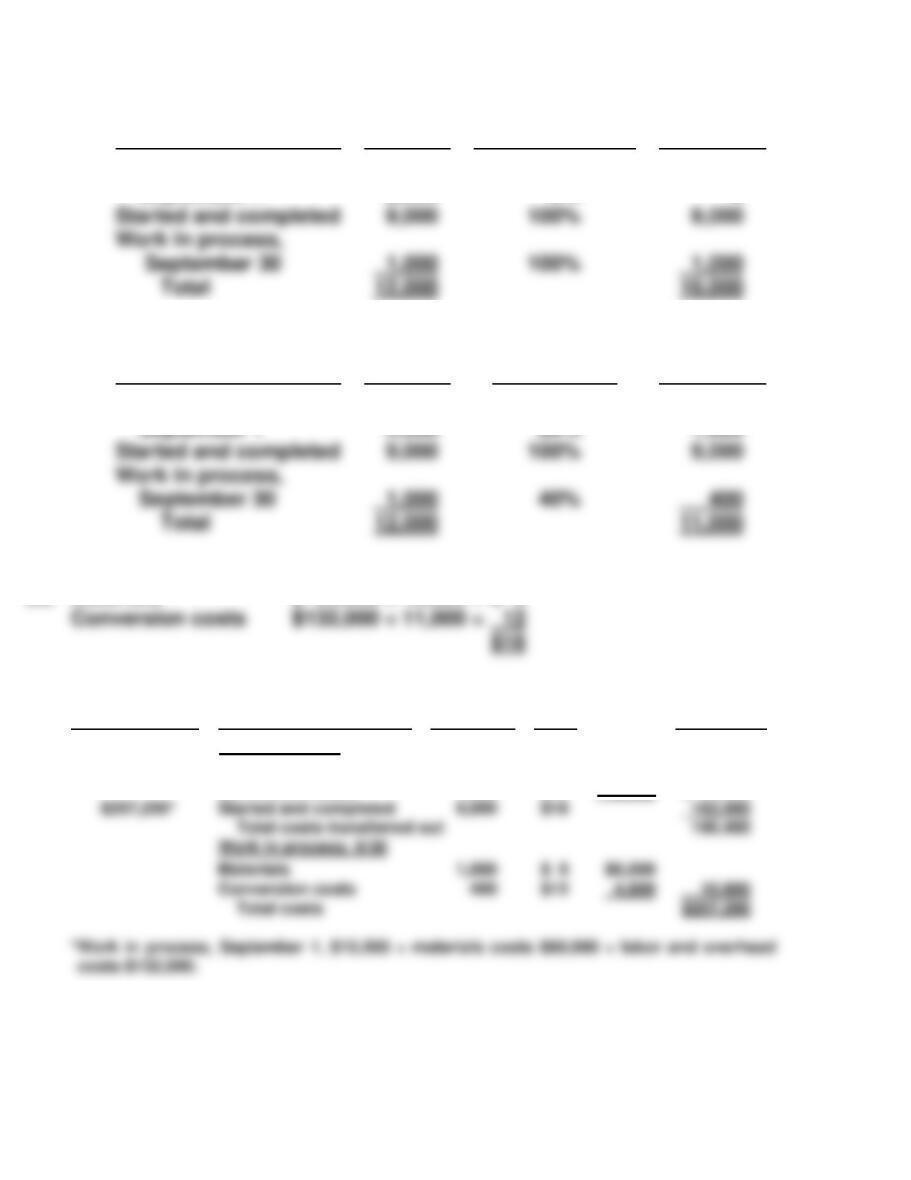
*EXERCISE 3-17
(a) (1) Materials:
Production Data
Physical
Units
Materials Added
This Period
Equivalent
Units
Work in process, August 1
Started and completed
0
10,000
0
100%
0
10,000
(2) Conversion Costs:
Production Data
Physical
Units
Work Added
This Period
Equivalent
Units
Started and completed
Total
Work in process, August 1
0
0
0
(b) Unit costs are:
Materials $45,000 ÷ 12,000 = $3.75
Costs to Be
Assigned
Assignment of Costs
Equivalent
Units
Unit
Cost
Total Costs
Assigned
Total mfg. costs
Transferred out
$74,700 (1)
Work in process, August 1
Started and completed
0
10,000
$ 0
$6.50
$ 0
65,000
$65,000
Work in process, August 31
Work in process, August 31
Total
*EXERCISE 3-18
(a)
(1)
Materials
Physical
Units
Materials Added
This Period
Equivalent
Units
Work in process,
September 1
2,000
Q
0%
0
(2)
Conversion Costs
Physical
Units
Work Added
This Period
Equivalent
Units
September 1
2,000
Work in process,
(b) Materials $ 60,000 ÷ 10,000 = $ 6
(c)
Costs to Be
Assigned
Assignment of Costs
Equivalent
Units
Unit
Cost
Total Costs
Assigned
Total mfg. costs
Transferred out
Started and completed
Total costs transferred out
Total costs
4,800
Work in process, 9/1
Conversion costs
0
1,600
$ 0
$12
$15,200
19,200
$ 34,400
Total
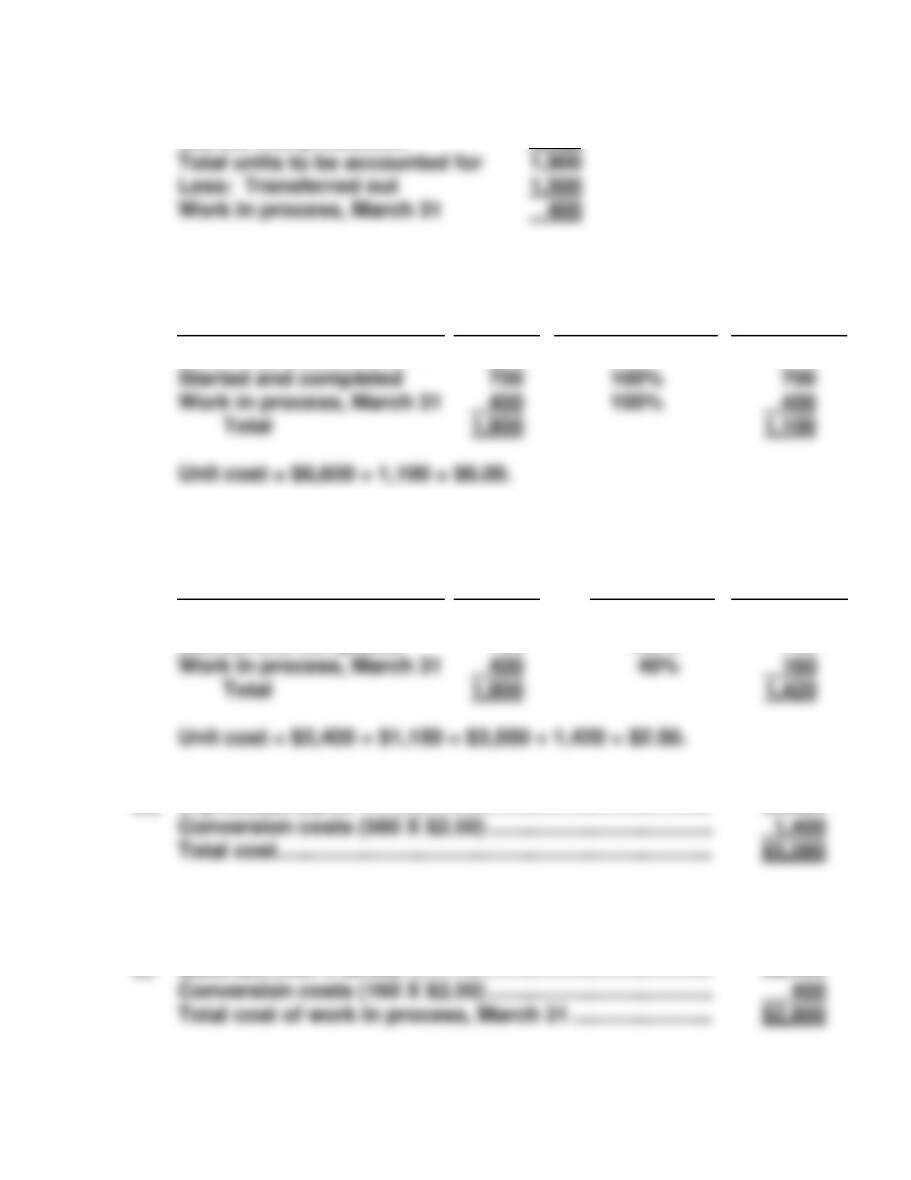
*EXERCISE 3-19
(a) Work in process, March 1 800
Started into production 1,100
(b) Materials:
Production Data
Physical
Units
Materials Added
This Period
Equivalent
Units
Started and completed
Work in process, March 31
Total
700
700
Work in process, March 1
800
%100
0
(c) Conversion costs:
Production Data
Physical
Units
Work Added
This Period
Equivalent
Units
Work in process, March 31
Total
Work in process, March 1
Started and completed
800
700
70%
100%
560
700
(d) In process, March 1 ………………………………………………… $3,680
(e) 700 X ($6.00 + $2.50) = $5,950.
(f) Materials (400 X $6.00) ……………………………………………. $2,400
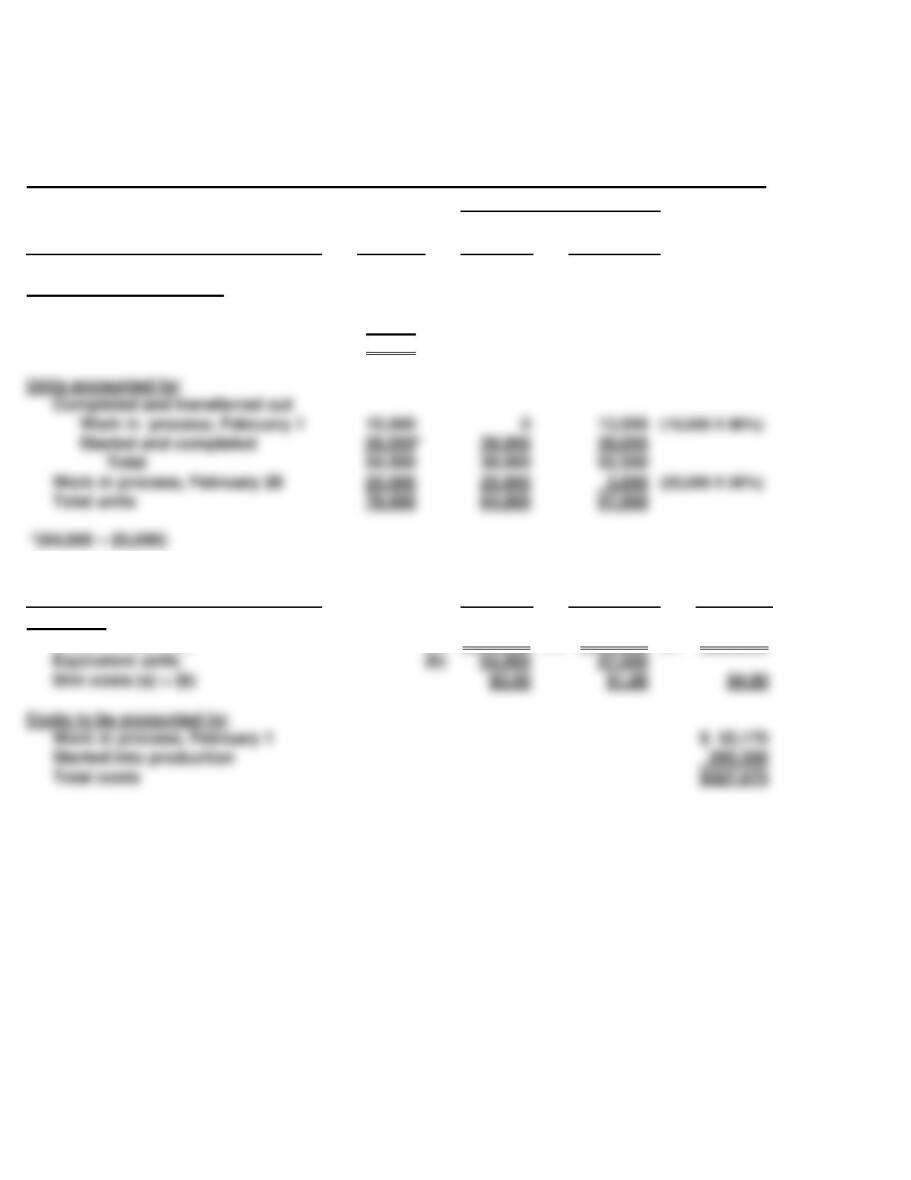
*EXERCISE 3-20
MAJESTIC COMPANY
Welding Department
Production Cost Report
For the Month Ended February 28, 2017
Equivalent Units
Quantities
Physical
Units
Materials
Conversion
Costs
(Step 1)
(Step 2)
Units to be accounted for
Work in process, February 1
Started into production
Total units
15,000
64,000
79,000
Costs
Materials
Conversion
Costs
Total
Started into production
Total costs
$327,675
Unit costs (Step 3)
Costs in February
(a)
$192,000
(1)
$103,500
(2)
$295,500
Units accounted for
Total
Work in process, February 28
Total units
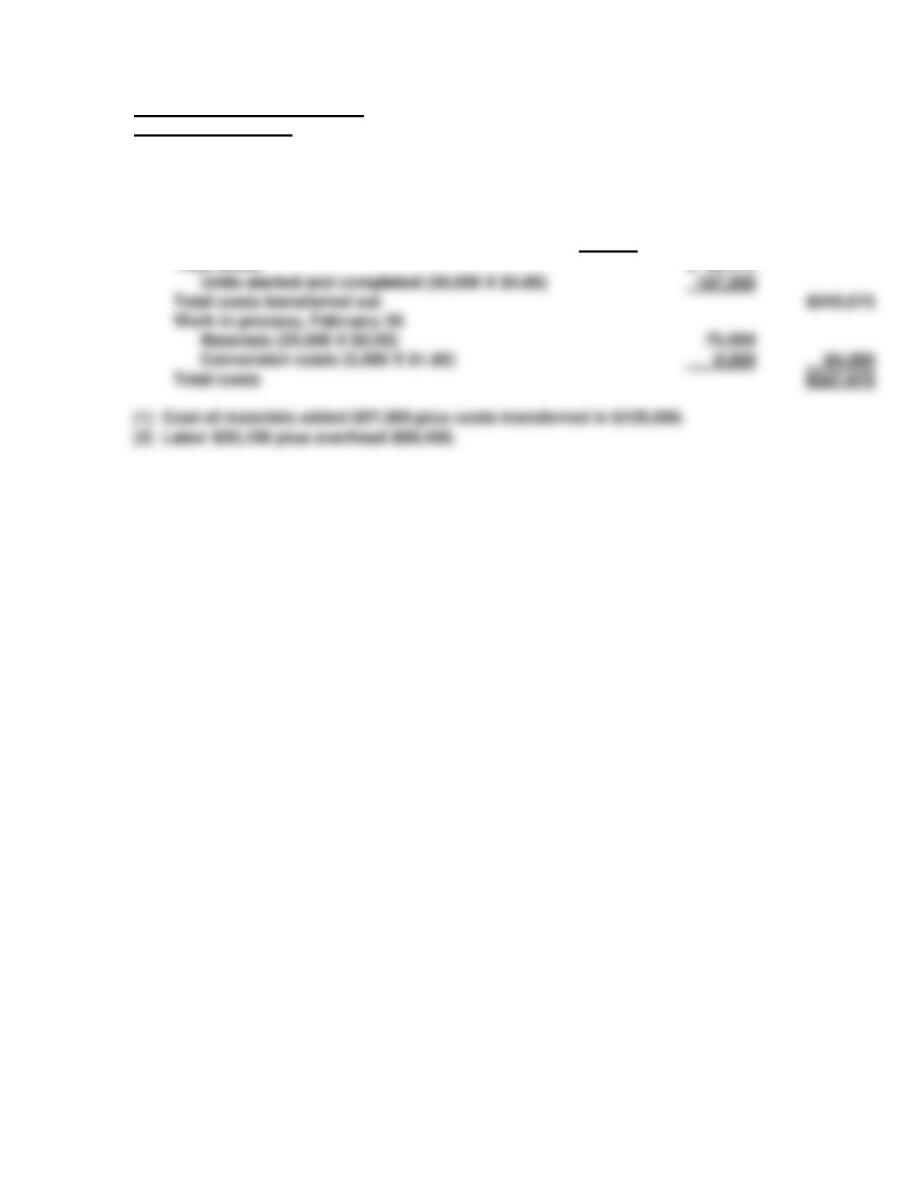
*EXERCISE 3-20 (Continued)
Cost Reconciliation Schedule
Costs accounted for (Step 4)
Transferred out
Work in process, February 1
Costs to complete beginning
work in process
Conversion costs
(13,500 X $1.80)
Total costs
$32,175
24,300
$ 56,475
SOLUTIONS TO PROBLEMS
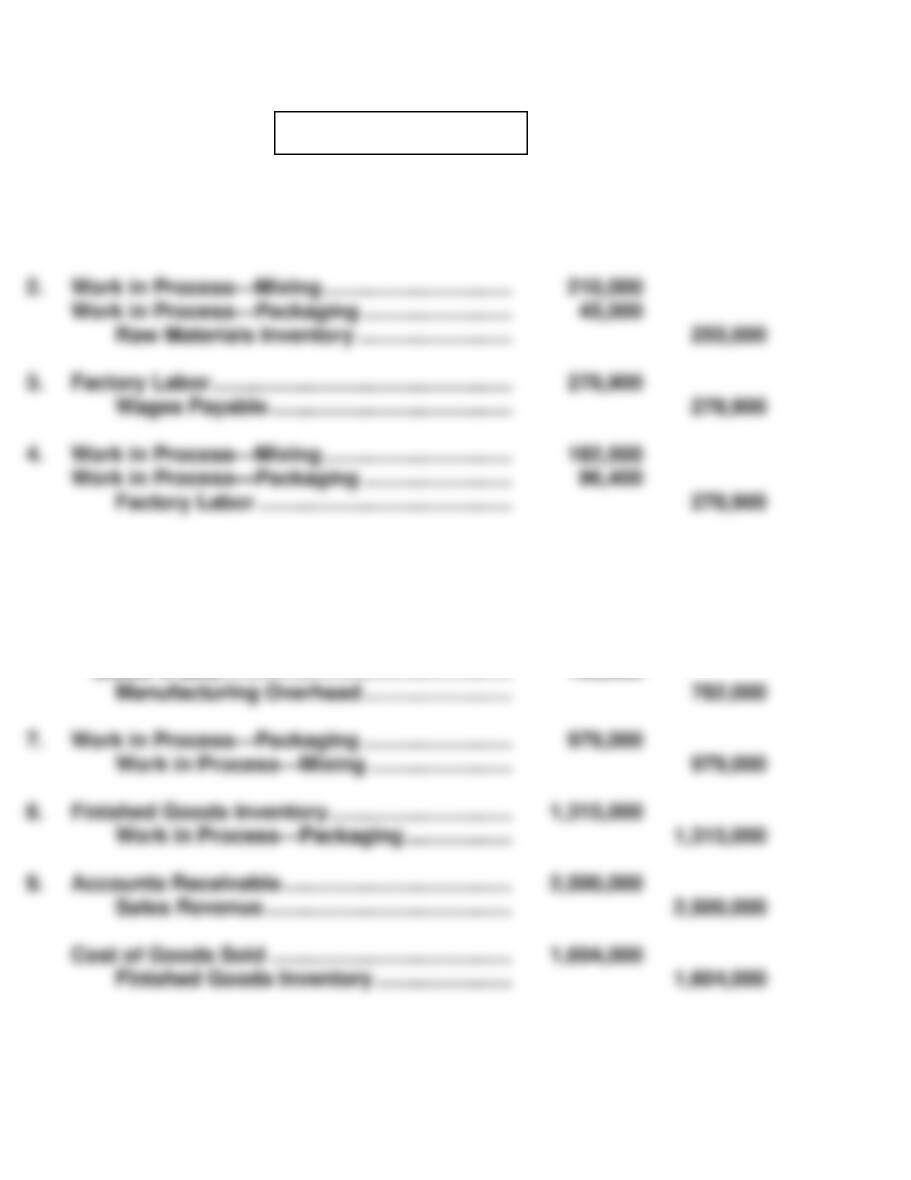
PROBLEM 3-1A
1. Raw Materials Inventory ……………………………. 300,000
Accounts Payable ……………………………… 300,000
5. Manufacturing Overhead …………………………... 810,000
Accounts Payable ……………………………… 810,000
6. Work in Process—Mixing (28,000 X $23) …….. 644,000
Work in Process—Packaging
(6,000 X $23) …………………………………………. 138,000
PROBLEM 3-2A
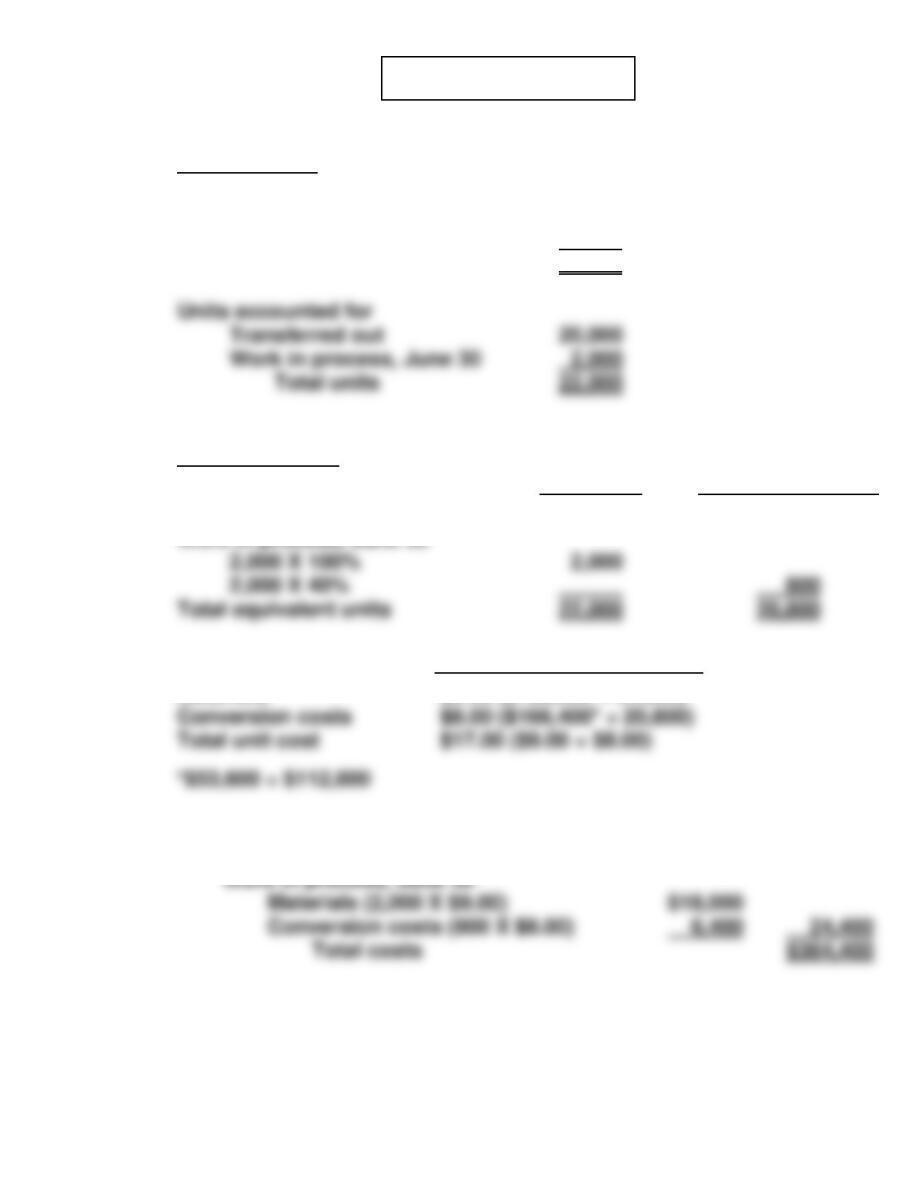
(a)
Physical units
Units to be accounted for
Work in process, June 1
Started into production
Total units
0
22,000
22,000
(b)
Equivalent units
Materials
Conversion Costs
2,000 X 100%
Total equivalent units
Units transferred out
20,000
20,000
(c)
Unit Costs
Total unit cost
Materials
$9.00 ($198,000 ÷ 22,000)
(d) Costs accounted for
Transferred out (20,000 X $17.00) $340,000
Total units
PROBLEM 3-2A (Continued)
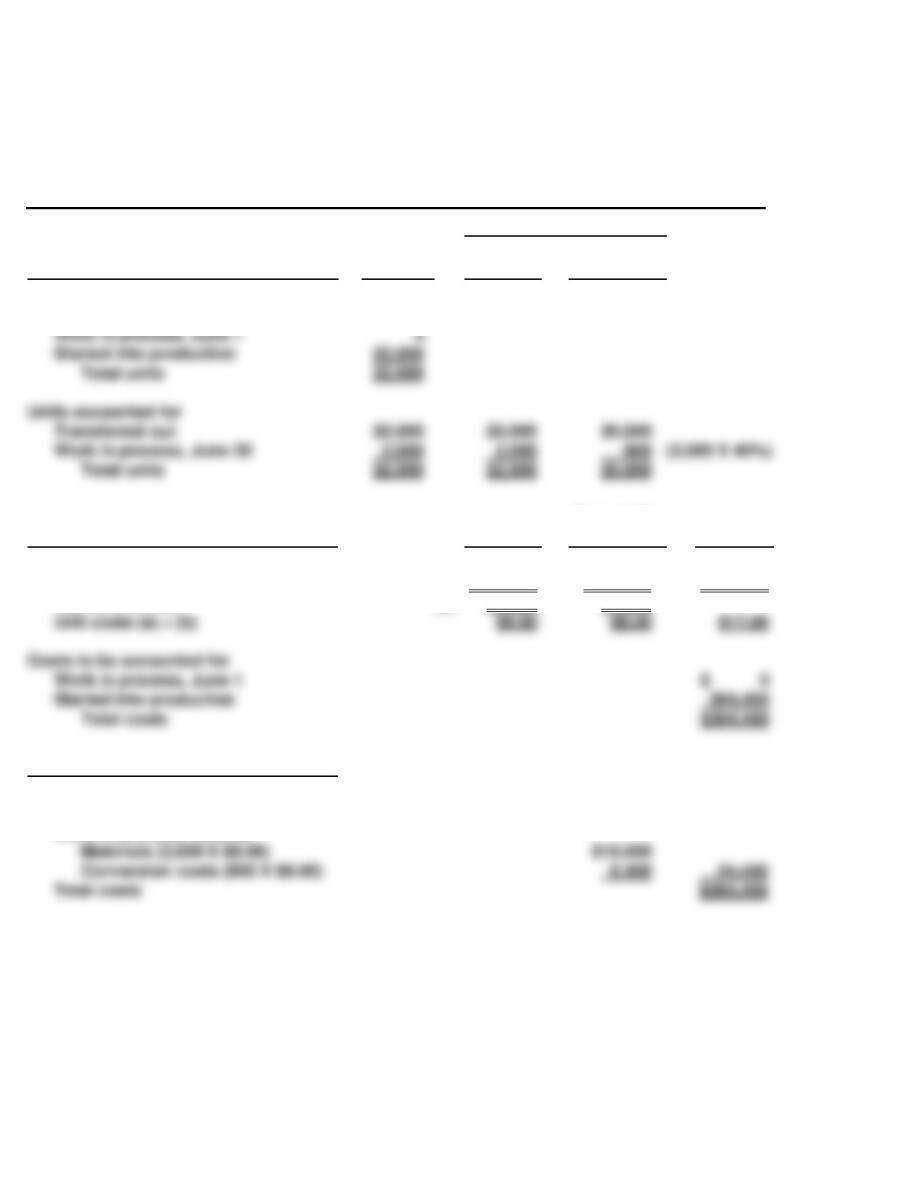
(e) ROSENTHAL COMPANY
Molding Department
Production Cost Report
For the Month Ended June 30, 2017
Equivalent Units
Quantities
Physical
Units
Materials
Conversion
Costs
(Step 1)
(Step 2)
Units to be accounted for
Costs
Materials
Conversion
Costs
Total
Total costs
Unit costs (Step 3)
Total cost
Equivalent units
(a)
(b)
$198,000
22,000
$166,400
20,800
$364,400
Cost Reconciliation Schedule (Step 4)
Total costs
6,400
24,400
Costs accounted for
Transferred out (20,000 X $17.00)
Work in process, June 30
$340,000
Work in process, June 1
Transferred out
Work in process, June 30
(2,000 X 40%)
Total units
PROBLEM 3-3A
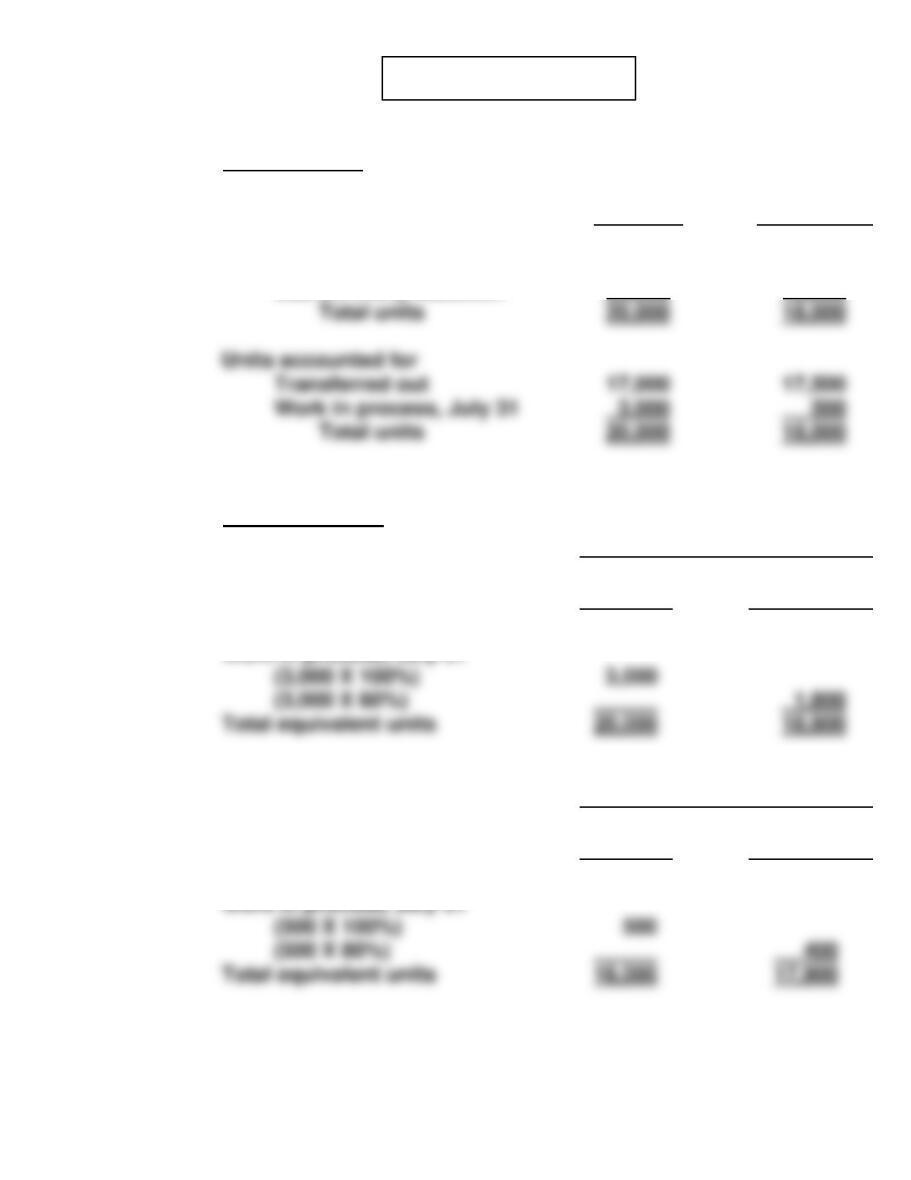
(a) (1) Physical units
T12
Tables
C10
Chairs
Units to be accounted for
Work in process, July 1
Started into production
0
20,000
0
18,000
(2) Equivalent units
T12 Tables
Materials
Conversion
Costs
Units transferred out
Work in process, July 31
17,000
17,000
C10 Chairs
Materials
Conversion
Costs
Work in process, July 31
Units transferred out
17,500
17,500
Work in process, July 31
18,000
PROBLEM 3-3A (Continued)
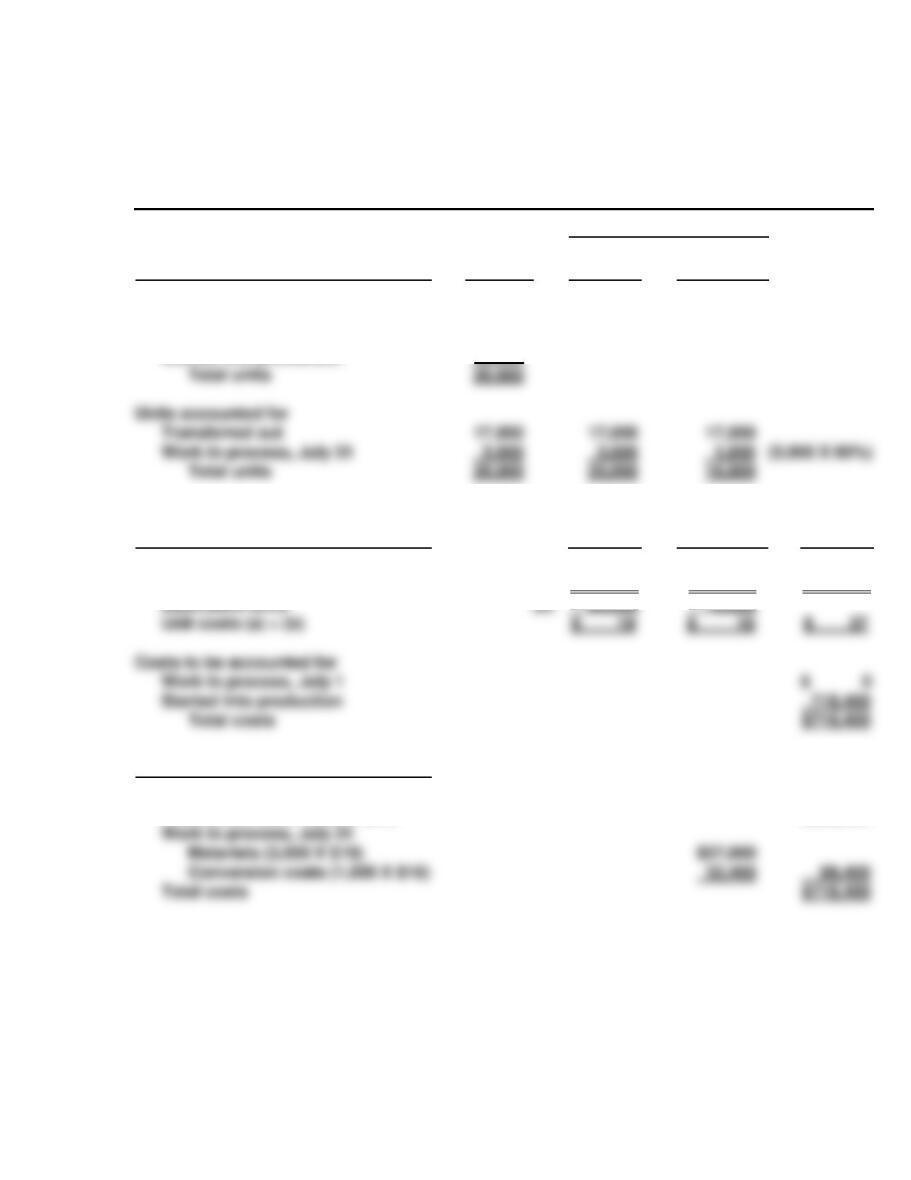
(3) Unit costs
T12
Tables
C10
Chairs
Materials ($380,000 ÷ 20,000)
$19
(4) T12 Tables
Costs accounted for
Transferred out (17,000 X $37) $629,000
C10 Chairs
Costs accounted for
Transferred out (17,500 X $28) $490,000
Work in process
PROBLEM 3-3A (Continued)
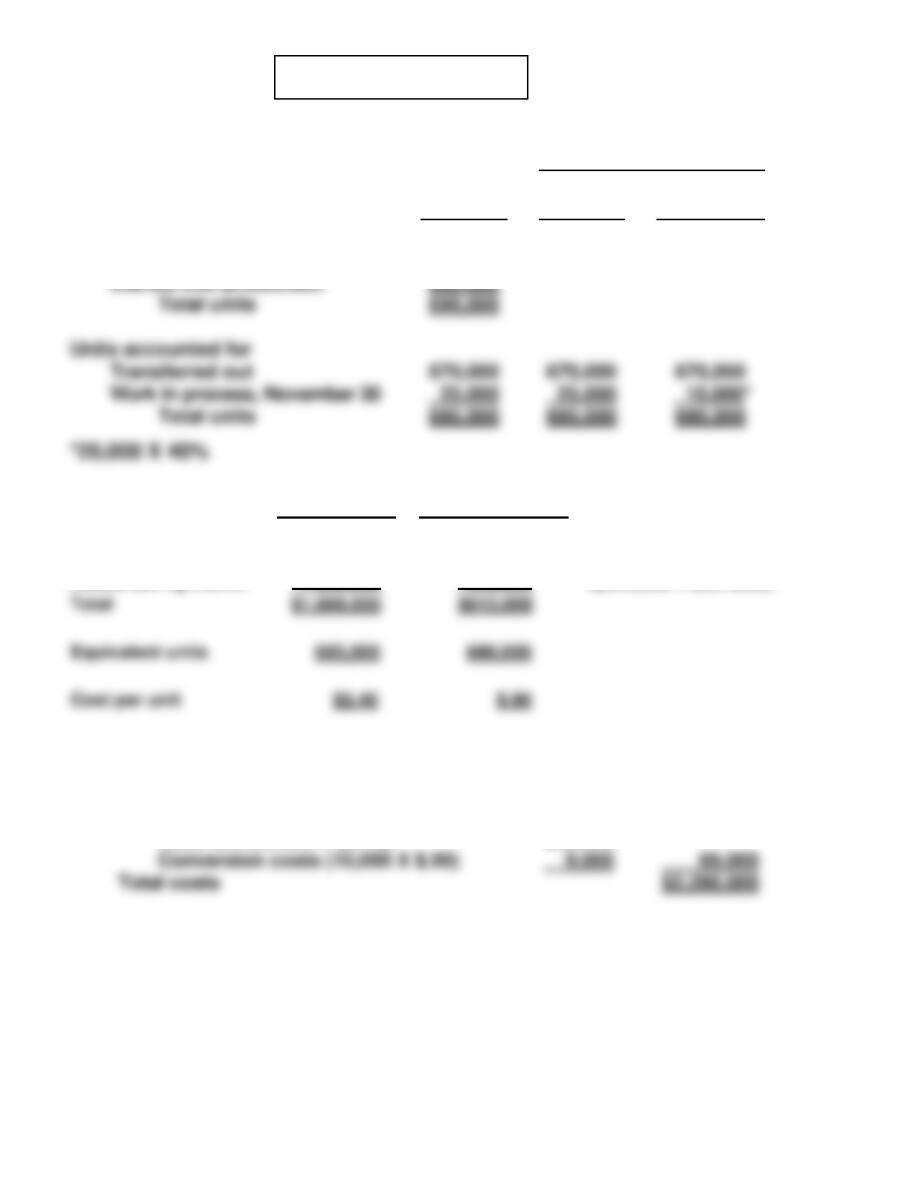
(b) THAKIN INDUSTRIES INC.
Cutting Department—Plant 1
Production Cost Report
For the Month Ended July 31, 2017
Equivalent Units
Quantities
Physical
Units
Materials
Conversion
Costs
(Step 1)
(Step 2)
Units to be accounted for
Work in process, July 1
Started into production
0
20,000
Costs
Materials
Conversion
Costs
Total
Total costs
Unit costs (Step 3)
Total cost
(a)
$380,000
$338,400
$718,400
Cost Reconciliation Schedule (Step 4)
Total costs
Costs accounted for
Transferred out (17,000 X $37)
$629,000
Units accounted for
Transferred out
Work in process, July 31
(3,000 X 60%)
Total units
PROBLEM 3-4A
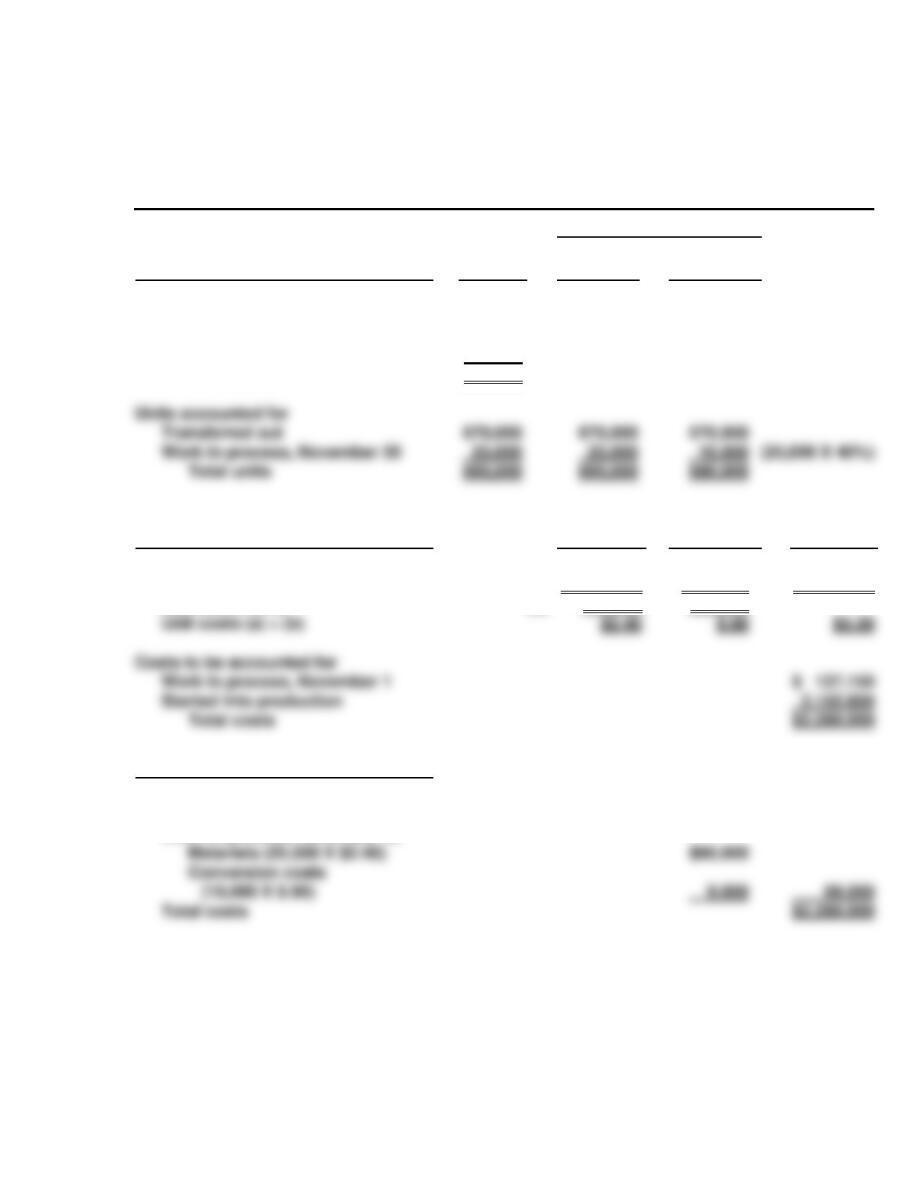
(a)
Equivalent Units
Physical
Units
Materials
Conversion
Costs
Units to be accounted for
Work in process, November 1
35,000
Beginning work in
process
Added during month
Materials cost
$ 79,000
1,589,000
Conversion costs
$ 48,150
563,850
($225,920 + $337,930)
(b)
Total costs
Costs accounted for
Transferred out (670,000 X $3.30)
Work in process, November 30
Materials (25,000 X $2.40)
$60,000
$2,211,000
Total units
Work in process, November 30
Total units
695,000
25,000
695,000
25,000
695,000
PROBLEM 3-4A (Continued)
(c) RIVERA COMPANY
Assembly Department
Production Cost Report
For the Month Ended November 30, 2017
Equivalent Units
Quantities
Physical
Units
Materials
Conversion
Costs
(Step 1)
(Step 2)
Units to be accounted for
Work in process, November 1
Started into production
Total units
35,000
660,000
695,000
Costs
Materials
Conversion
Costs
Total
Costs to be accounted for
Total costs
Unit costs (Step 3)
Total cost
Equivalent units
(a)
(b)
$1,668,000
695,000
$612,000
680,000
$2,280,000
Cost Reconciliation Schedule (Step 4)
(10,000 X $.90)
Total costs
Costs accounted for
Transferred out (670,000 X $3.30)
Work in process, November 30
$2,211,000
Units accounted for
Transferred out
Work in process, November 30
(25,000 X 40%)
Total units
695,000
695,000
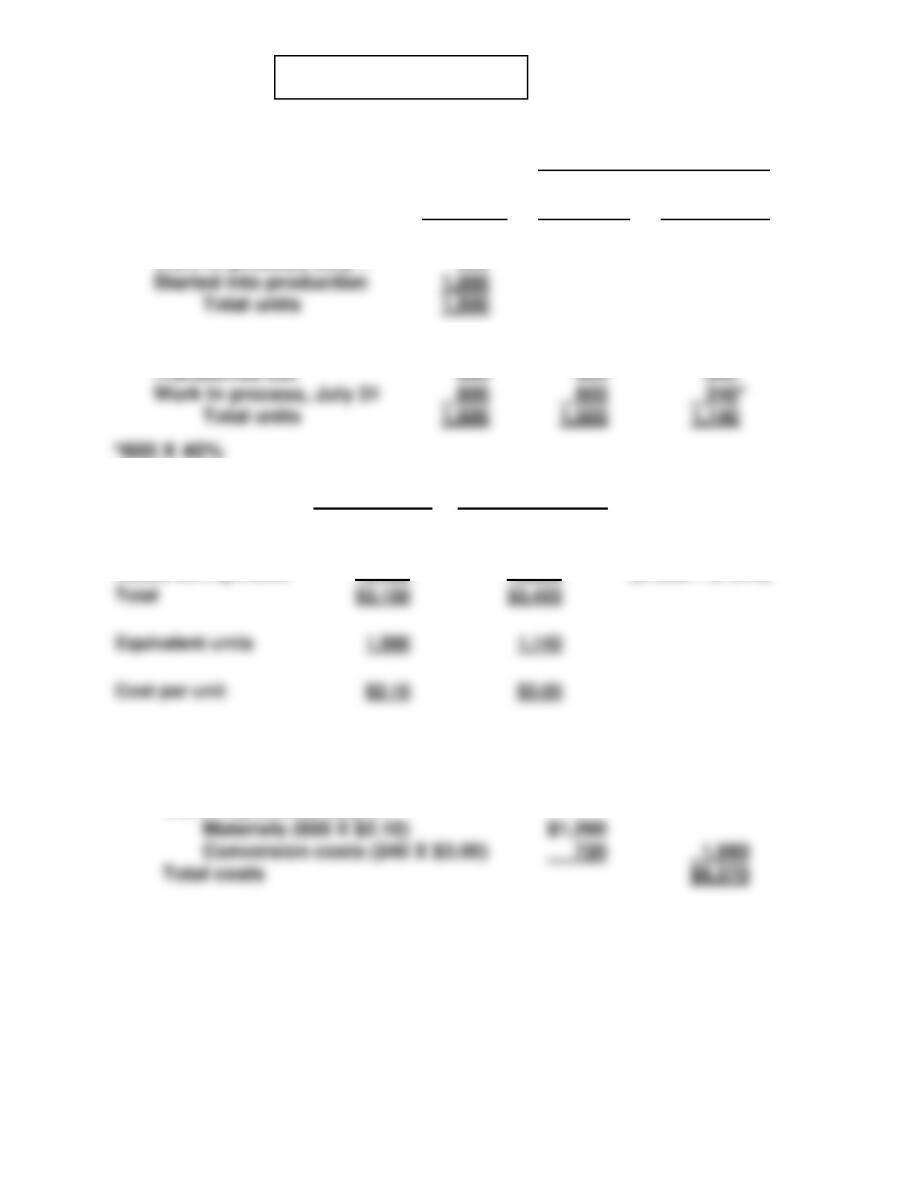
PROBLEM 3-5A
(a)
(1)
Equivalent Units
Physical
Units
Materials
Conversion
Costs
Units to be accounted for
Work in process, July 1
Units accounted for
500
(2)
Beginning work
in process
Added during month
Materials cost
$ 750
2,400
Conversion costs
$ 600
2,820
($1,580 + $1,240)
(3)
Costs accounted for
Transferred out (900 X $5.10)
Work in process, July 31
$4,590
Total units
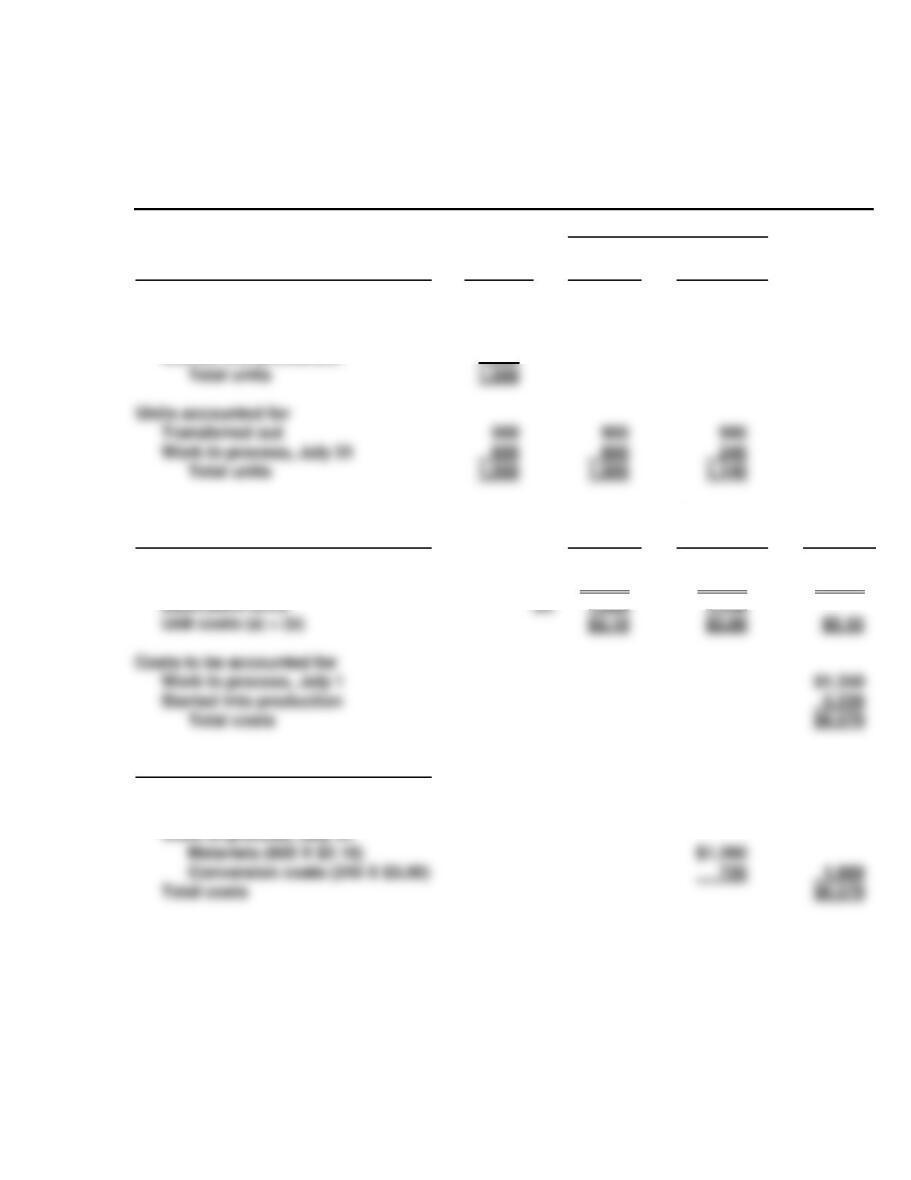
PROBLEM 3-5A (Continued)
(b) POLK COMPANY
Basketball Department
Production Cost Report
For the Month Ended July 31, 2017
Equivalent Units
Quantities
Physical
Units
Materials
Conversion
Costs
(Step 1)
(Step 2)
Units to be accounted for
Work in process, July 1
Started into production
500
1,000
Costs
Materials
Conversion
Costs
Total
Total costs
Unit costs (Step 3)
Total costs
(a)
$3,150
$3,420
$6,570
Cost Reconciliation Schedule (Step 4)
Total costs
Costs accounted for
Transferred out (900 X $5.10)
$4,590
Units accounted for
Total units
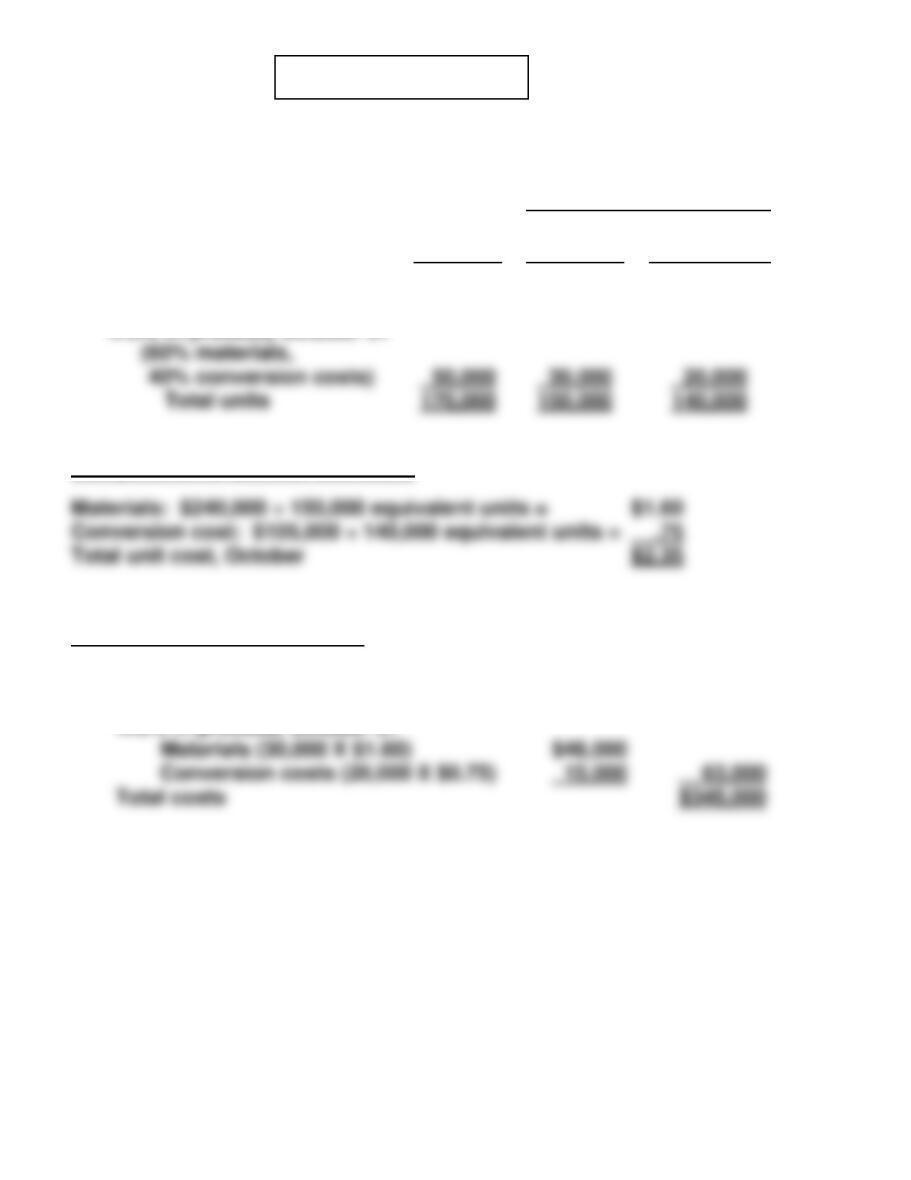
PROBLEM 3-6A
(a) Computation of equivalent units:
Equivalent Units
Physical
Units
Materials
Conversion
Costs
Units accounted for
Transferred out
Work in process, October 31
120,000
120,000
120,000
Computation of October unit costs
(b) Cost Reconciliation Schedule
Costs accounted for
Transferred out (120,000 X $2.35) $282,000
Work in process, October 31
Total units
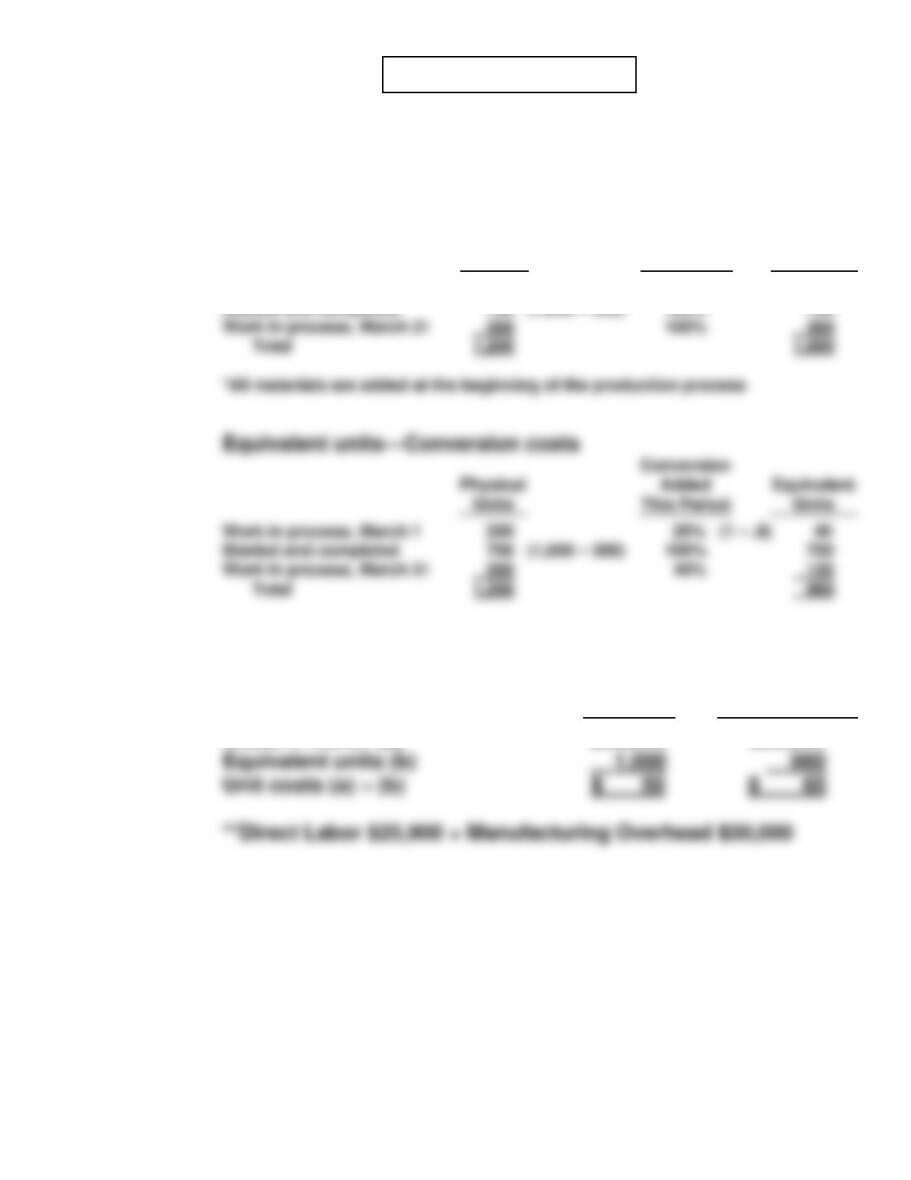
*PROBLEM 3-7A
(a) Bicycles
(1) Equivalent units—Materials
Physical
Units
Materials
Added
This Period
Equivalent
Units
Work in process, March 1
200
* 0%*
0
(2) Unit costs
Materials
Conversion
Costs
Costs in March (a)
$50,000
**$55,900**
Started and completed
Work in process, March 31
Total
Physical
Conversion
Added
Equivalent
Started and completed
Work in process, March 31
*PROBLEM 3-7A (Continued)
(3) Assignment of costs to units transferred out and in process
Costs to Be
Assigned
Assignment of Costs
Equivalent
Units
Unit
Cost
Total Costs
Assigned
Total mfg. costs
Transferred out
***$125,180***
Work in process, March 1
Conversion
40
$ 65
$19,280
2,600
Tricycles
(1) Equivalent units—Materials
Physical
Units
Materials
Added
This Period
Equivalent
Units
Work in process, March 1
100
* 0%*
0
Started and completed
940
Total
60
Equivalent units—Conversion costs
Physical
Units
Conversion
Added
This Period
Equivalent
Units
Work in process, March 1
100
25% (1 – .75) 25
Started and completed
940 (1,000 – 60)
Total
Total costs transferred out
Work in process, March 31
Total costs
*PROBLEM 3-7A (Continued)
(2) Unit costs
Materials
Conversion
Costs
Costs in March (a)
$30,000
$34,300**
(3) Assignment of costs to units transferred out and in process
Costs to Be
Assigned
Assignment of Costs
Equivalent
Units
Unit
Cost
Total Costs
Assigned
Total mfg. costs
Transferred out
***$70,425***
Work in process, March 1
Conversion
25
$35
$ 6,125
875
Equivalent units (b)
*PROBLEM 3-7A (Continued)
(b) OWEN COMPANY
Production Cost Report—Bicycles
For the Month Ended March 31
Equivalent Units
Quantities
Physical
Units
Materials
Conversion
Costs
(Step 1)
(Step 2)
Total units
Units to be accounted for
Work in process, March 1
Units accounted for
Completed and transferred out
Work in process, March 1
200
200
0
40
Costs
Materials
Conversion
Costs
Total
Started and completed (700 X $115)
Work in process, March 31
Total costs
Unit costs (Step 3)
Costs in March (a)
Equivalent units (b)
Cost Reconciliation Schedule (Step 4)
Costs accounted for
Transferred out
Work in process, March 1
Conversion costs to complete
$50,000
1,000
$19,280
$ 55,900
860
$105,900
Started into production
Total units
CD-3 DECISION-MAKING AT CURRENT DESIGNS
CURRENT DESIGNS
Fabrication Department
Production Cost Report
For the Month Ended April 30, 2017
Equivalent Units
Quantities
Physical
Units
Materials
Conversion
Costs
(Step 1)
(Step 2)
Units to be accounted for
Work in process, April 1
Started into production
Total units
30
72
102
Costs
Materials
Conversion
Costs
Total
Total costs
Unit costs (Step 3)
Total cost*
Equivalent units
Unit costs [(a) ÷ (b)]
Cost Reconciliation Schedule (Step 4)
Costs accounted for
Transferred out (67 X $950)
Work in process, April 30
(a) $25,900
(b) 74
$ 350
$48,600
81
$ 600
$74,500
$ 950
$63,650
BYP 3-1 DECISION-MAKING ACROSS THE ORGANIZATION
(a) The unit cost suggests that Joe took the highest total costs and divided
these costs by the units started into production. The highest total costs
BYP 3-1 (Continued)
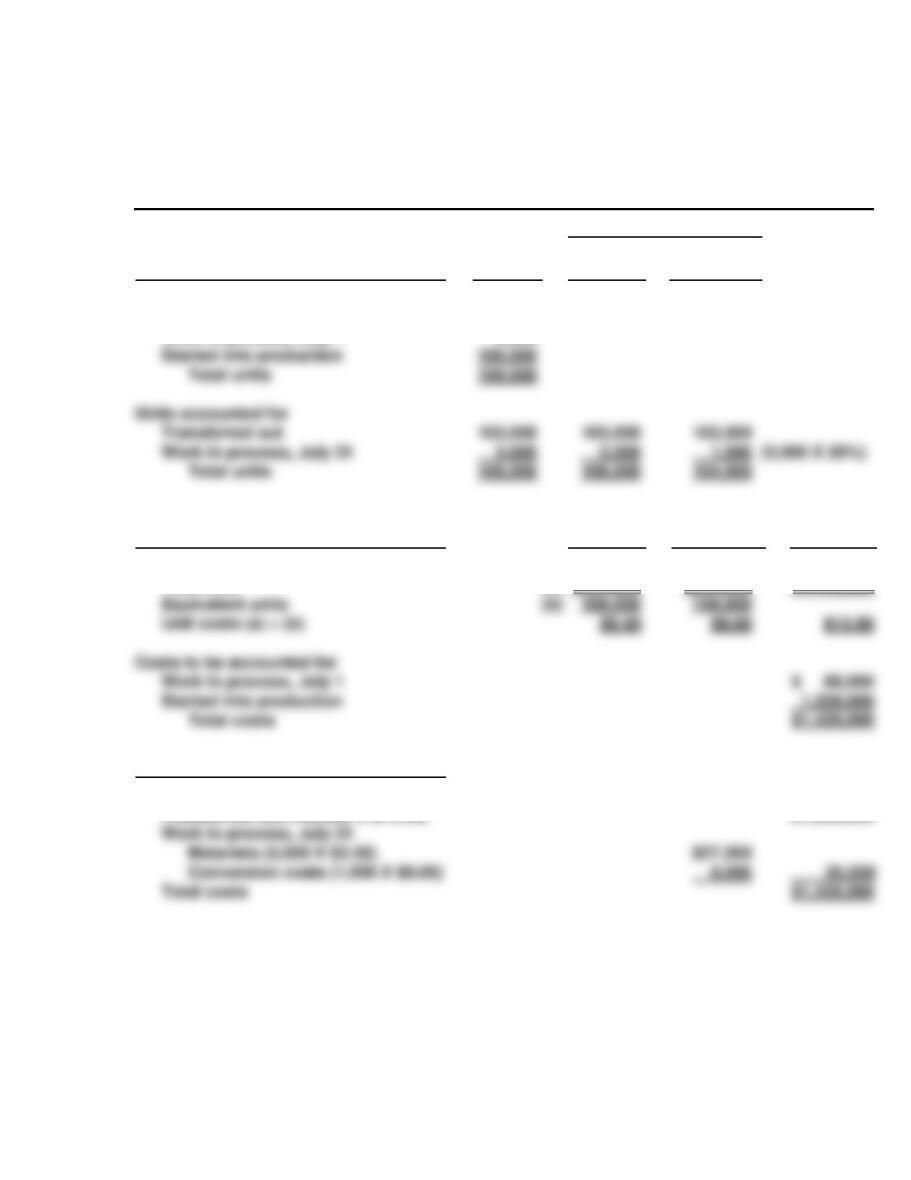
(c) FLORIDA BEACH COMPANY
Mixing Department
Production Cost Report
For the Month Ended July 31, 2017
Equivalent Units
Quantities
Physical
Units
Materials
Conversion
Costs
(Step 1)
(Step 2)
Units to be accounted for
Work in process, July 1
8,000
Costs
Materials
Conversion
Costs
Total
Total costs
Unit costs (Step 3)
Total cost
(a)
$594,000
$832,000
$1,426,000
Cost Reconciliation Schedule (Step 4)
Total costs
$1,426,000
Costs accounted for
Units accounted for
Transferred out
Work in process, July 31
(5,000 X 20%)
Total units
108,000
BYP 3-2 MANAGERIAL ANALYSIS
(a) The unit cost of materials is $150 ($450,000 ÷ 3,000).
(b) The materials cost of the goods transferred out is $375,000 (2,500 X
$150). Conversion costs, therefore, are $225,000 ($600,000 – $375,000),
BYP 3-3 REAL-WORLD FOCUS
(a) The outer shell of the paintballs is made from a mixture that includes
water, sweeteners, food ingredients, and most importantly, gelatin. All
of the ingredients used to make paintballs are food grade, biodegradable
products. The “paint” filling inside a paintball is comprised of the same
inert ingredient used in cough syrup, as well as crayon wax.
After mixing the gelatin and other materials, the mixture is heated, and
(b) Materials: water, sweeteners, food ingredients, gelatin, “cough syrup
material”, crayon wax, and food coloring.
Labor: People would be needed run the various machines.
(c) This would appear to be a perfect situation for the use of process
costing. Paintballs are a high volume product, and the paintballs are
very homogenous. While there may be some differences in various
BYP 3-4 COMMUNICATION ACTIVITY
To: Diane Barone, Regional Sales Manager
From: Student, Accounting Manager
Re: Production Cost Reports
Diane, congratulations again on your promotion! It’s going to be great
working with you. It kind of reminds me of our days at Dairy-Freeze after
school (although this work is more fun, and it certainly pays better!).
BYP 3-4 (Continued)
At the end of the month, we need to record what we finished and what still
remains undone. Equivalent units are the way we measure the amount of
work we have done on our work in process. It’s kind of like comparing the
contents of 4-ounce cups with the contents of 12–ounce cups. It doesn’t
make sense to compare by counting the number of cups you have. You
need to find out how many ounces you have in one set; then you can get a
BYP 3-5 ETHICS CASE
(a) The stakeholders in this situation are:
Jan Wooten, molding department head.
Tony Ferneti quality control inspector.
BYP 3-6 CONSIDERING PEOPLE, PLANET, AND PROFIT
(a) Some of the costs that the company now faces include:
• Monetary damages: The company paid $21.4 million in fines as a
result of an OSHA investigation; $1.6 billion to compensate those
affected by the accident; and $1 billion to repair and update its
refinery (plus an additional $250 million to install safety valves)
• Bad publicity
(b) Some steps that the company could have taken to reduce the environ–
mental failure costs include:
• Install up to date safety equipment
• Increase the frequency and efficacy of inspections