Financial and Managerial Accounting, 8th Edition
CHAPTER 3
ADJUSTING ACCOUNTS FOR FINANCIAL STATEMENTS
Related Assignment Materials
Student Learning
Objectives
Questions
Quick Studies*
Exercises*
Problems*
AA and BTN
Conceptual objectives:
C1. Explain the importance
of periodic reporting
and the role of accrual
accounting.
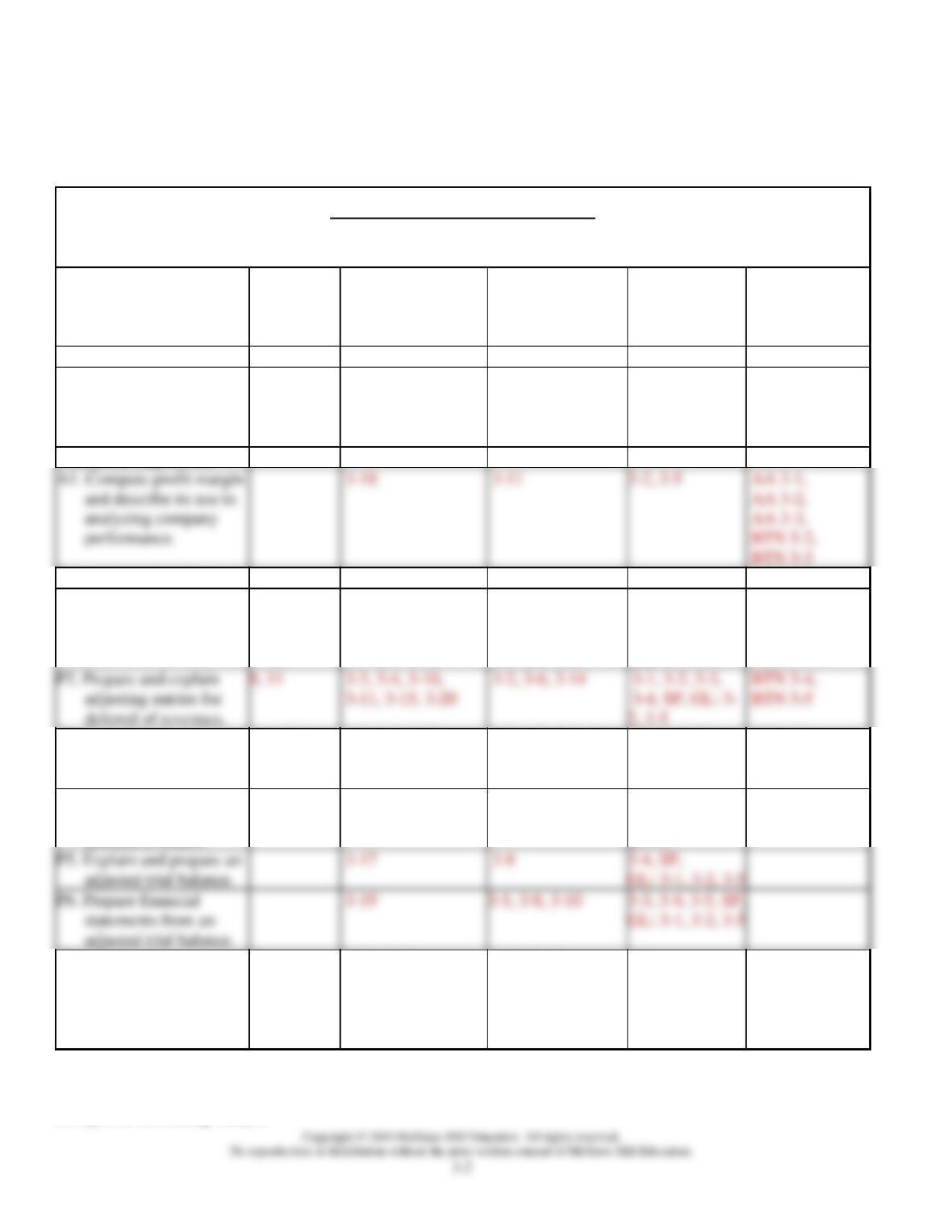
1, 2, 3
3-1, 3-2
3-1
BTN 3-1,
BTN 3-6
Analytical objectives:
A1. Compute profit margin
analyzing company
performance.
3-18
3-11
3-2, 3-5
AA 3-1,
AA 3-3,
BTN 3-2,
Procedural objectives:
P1. Prepare and explain
adjusting entries for
deferral of expenses.
4, 5, 9, 10
3-3, 3-4, 3-5, 3-6, 3-
7, 3-8, 3-9, 3-15,
3-16
3-2, 3-4, 3-6
3-7, 3-14
3-1, 3-2, 3-3, 3-
4, SP,
GL:3-1, 3-2,
3-5
P2. Prepare and explain
adjusting entries for
deferral of revenues.
9, 11
3-3, 3-4, 3-10,
3-11, 3-15, 3-20
3-2, 3-6, 3-14
3-1, 3-2, 3-3,
3-4, SP, GL: 3-
BTN 3-4,
BTN 3-5
BTN 3-1,
BTN 3-4
P3. Prepare and explain
adjusting entries for
accrued expenses.
6, 9, 12
3-3, 3-4, 3-12,
3-13, 3-15, 3-16
3-2, 3-3, 3-5, 3-6,
3-7, 3-9, 3-14
3-1, 3-2, 3-3.
3-4, SP, GL: 3-
2, 3-5
BTN 3-4
P4. Prepare and explain
adjusting entries for
accrued revenues.
adjusted trial balance.
3-17
3-8
3-4, SP,
statements from an
adjusted trial balance.
GL: 3-1, 3-2, 3-5
7, 9
3-3, 3-4, 3-14,
3-15
3-2, 3-7, 3-9
3-14
3-1, 3-2, 3-3,
3-4, SP, GL: 3-
BTN 3-4
P7.A Explain the
alternatives in
accounting for
prepaids. (Appendix
3A)
8
3-21, 3-22
3-12, 3-13
3-6
*See additional information on next page that pertains to these quick studies, exercises, and problems.
SP refers to the Serial Problem
AA refers to Accounting Analysis
Financial and Managerial Accounting, 8th Edition
Copyright © 2019 McGraw-Hill Education. All rights reserved.
No reproduction or distribution without the prior written consent of McGraw-Hill Education.
3-3
BTN refers to Beyond the Numbers
GL refers to General Ledger Problems
Questions with Guided Example videos
Additional Information on Related Assignment Material
See Chapter 1 of the Instructor’s Resource Manual for more information on materials for this text available in
Connect.
Hints/Guided Examples
Please note that the Guided Examples are labeled as “Hints” in Connect assignments. The animated PowerPoints without
the video and audio functions for the Guided Examples are also available in the Connect Instructor Library and Exercise
Presentations. These are indicated in the Related Assignment Materials grid on page 1 in blue bold font.
Need-to-Know Videos
LO
Need–to-Know
Title
Time
Concept Overview Videos
Each video is paired with a Knowledge Check question.
LO
Title
Time
C1
Explain the importance of periodic reporting and the role of accrual accounting.
The Accounting Period
0:45
Annual Reporting Periods
1:17
Accrual Basis versus Cash Basis
1:15
Accrual Basis versus Cash Basis – Accrual Basis Illustration
1:25
Accrual Basis versus Cash Basis – Cash Basis Illustration
1:05
Recognizing Revenues and Expenses
1:19
Compute profit margin and describe its use in analyzing company performance.
Profit Margin
0:46
Profit Margin Illustration
1:37
P1
Prepare and explain adjusting entries for deferral of expenses.
Framework for Adjustments
0:54
Adjusting Entries
0:44
Prepaid (Deferred) Expenses
2:45
Depreciation
3:37
P2
Prepare and explain adjusting entries for deferral of revenues.
Unearned (Deferred) Revenue
3:05
Financial and Managerial Accounting, 8th Edition
3-4
P3
Prepare and explain adjusting entries for accrued expenses.
Accrued Expense
2:48
P4
Prepare and explain adjusting entries for accrued revenues.
Accrued Revenue
2:20
Links to Financial Statements
1:47
P5
Explain and prepare an adjusted trial balance.
Adjusted Trial Balance
1:13
P6
Prepare financial statements from an adjusted trial balance.
Preparing Financial Statements
0:24
Income Statement and Statement of Owner’s Equity
0:08
Balance Sheet
0:19
P7
Explain the alternatives in accounting for prepaids.
Recording Prepaid Expenses
2:21
Recording Prepaid Revenues
2:25
Synopsis of Chapter Revisions
NEW opener—Urban One and entrepreneurial assignment.
Revised learning objectives and chapter preview—each type of adjusting entry is assigned its own learning objective.
Updated “Recognizing Revenues and Expenses” section.
New streamlined “Framework for Adjustments” section.
Continued emphasis of 3-step adjusting process.
Financial and Managerial Accounting, 8th Edition
Chapter Outline
I. Timing and Reporting
A. The Accounting Period
To provide timely information, accounting systems prepare reports at regular intervals.
1. Time period principle assumes that an organization’s activities can be divided into
specific time periods such as a month, a three-month quarter, a six-month interval, or a
year for periodic reporting. Interim and annual financial statements can then be prepared.
B. Accrual Basis versus Cash Basis
3. Accrual basis accounting—uses the adjusting process to recognize revenues when earned
and expenses when incurred with revenues (match the expenses with the revenue). This
means the revenues are recorded when services and products are delivered and expenses
are recorded when incurred (matched with revenues). Accrual basis is consistent with
GAAP. Improves comparability of statements.
C. Recognizing Revenues and Expenses
1. The revenue recognition principle requires that revenue be recorded when goods or
services are provided to customers and at an amount expected to be received from
customers.
2. The expense recognition principle (often called the matching principle) aims to record
expenses in the same period as the revenues recognized as a result of these expenses.
D. Framework for Adjustments—An adjusting entry is recorded to bring an asset or liability
account balance to its proper amount. Adjustments exist for transactions that extend over more
than one period. This entry also updates the related expense or revenue account. The three
steps for making an adjustment are:
3. Record the adjusting entry to get from step 1 to step 2
II. Deferral of Expense
Adjusting Deferral of Expenses
1. Prepaid expenses (including depreciation) are items paid for in advance of receiving their
benefits. Prepaid expenses, also called deferred expenses, are assets. As the assets are
used, their costs become expenses.
4. Common prepaid items are supplies, prepaid insurance, prepaid rent, and depreciation.
3. Adjusting entries for prepaids involves increasing (debiting) expenses and decreasing
(crediting) assets (with the exception of depreciation on plant and equipment).
Depreciation is a special category of prepaid expenses.
B. Adjusting for Depreciation
1. Depreciation is the process of allocating the cost of plant assets over their expected useful
lives.
5. Book value is a term used to describe the asset less its contra asset (accumulated
depreciation).
III. Deferral of Revenue
A. Unearned revenues (also called deferred revenues) are liabilities created by cash received in
advance of providing products or services. The obligation is to provide the service or product.
As they are provided, unearned revenues (liabilities) become earned revenues (revenues).
B. Adjusting entries for unearned revenues involve increasing (crediting) revenues and
decreasing (debiting) unearned revenues.
IV. Accrued Expense
B. Common accrued expenses are salaries, interest, rent, and taxes.
increasing (crediting) liabilities. (The liability is a “payable.”)
V. Accrued Revenue
A. Accrued revenues are revenues earned in a period that are both unrecorded and not yet received in
cash.
B. Accrued revenues commonly result from partially completed jobs or interest earned.
C. Adjusting entries for recording accrued revenues involves increasing (debiting) assets and
increasing (crediting) revenues. (The asset is a “receivable.”)
sheet accounts. Failure to make a necessary adjustment will result in misstatements of amounts on
statement links.)
VI. Trial Balance and Financial Statements
A. Adjusted Trial Balance—A list of accounts and balances prepared after adjusting entries are
recorded and posted to the ledger.
B. Preparing Financial Statements—Prepare financial statements directly from information in the
adjusted trial balance. The following preparation order shows the flow of information from one
statement to another:
1. Income Statement
2. Statement of Retained Earnings
Requires use of net income or loss from previous statement.
3. Balance Sheet
Requires use of ending equity from previous statement.
VII. Closing Process—The closing process occurs at the end of the accounting period after financial
statements are completed.
A Steps in closing process:
1. Identify accounts for closing.
B. Purpose of closing process:
1. To reset revenues, expenses, and dividends account balances to zero at the end of every period
to prepare these accounts for proper measurement in the next period.
2. To summarize a period’s revenue minus expenses.
C. Temporary and Permanent Accounts
D. Recording Closing Entries – the purpose is to transfer the end-of-period balances in revenue,
expense, and dividends accounts to the permanent retained earnings account.
1. Use a new temporary account called Income Summary. The four closing entries are:
a. Close credit balances in revenue (and gain) accounts by debiting the accounts and
crediting Income Summary. This transfers revenue balances to the credit side Income
Summary.
b. Close debit balances in expense (and loss) accounts by crediting the accounts and debiting
Income Summary. This transfers the expense balances to the debit side of Income
2. After all closing entries are posted, all temporary accounts have a zero balance and retained
earnings is up to date.
E. Post-Closing Trial Balance — a list of permanent accounts and their balances after all closing
entries.
1. Verifies that total debits equal total credits for permanent accounts.
2. Verifies that all temporary accounts have zero ending balances.
VIII. Accounting Cycle — steps in preparing financial statements (see Exhibit 3.19).
The ten steps repeated each accounting cycle are as follows:
3-8
4. Prepare unadjusted trial balance
5. Adjust
6. Prepare adjusted trial balance
IX. Classified Balance Sheet – organizes assets and liabilities into important subgroups.
A. Classification Structure
1. One of the classifications is the separation between current and noncurrent assets and
liabilities.
B. Classification Categories
1. Current assets—cash or other assets that are expected to be sold, collected, or used within one
year or the operating cycle, whichever is longer. Examples: cash, short-term investments,
accounts receivable, short-term notes receivable, merchandise inventory, and prepaid
expenses.
3. Plant assets—tangible, long-lived assets that are used to produce or sell goods and services.
Examples: equipment, buildings, land.
4. Intangible assets—long-term resources that benefit business operation. They lack physical
form. Their value comes from the privileges or rights that are granted to or held by the owner.
Examples: goodwill, patents, trademarks, franchises, copyrights.
6. Long-term liabilities—liabilities that are not due to be paid within one year or the operating
cycle of the business. Examples: notes payable, mortgage payable, bonds payable.
X. Decision Analysis: Profit Margin
A. Profit margin is used to evaluate operating results by measuring the ratio of a company’s net income
to sales. Also called return on sales.
B. Calculated as net income divided by net sales revenues.
XI. Decision Analysis: Current Ratio
Financial and Managerial Accounting, 8th Edition
XII. Alternative Accounting for Prepayments (Appendix 3A)
A. Prepaid expenses may originally be recorded with debits to expense accounts instead of assets. If so,
then adjusting entries must transfer the cost of the unused portions from expense accounts to prepaid
XIII. Work Sheet as a Tool (Appendix 3B)
A. The work sheet is an internal document that serves as a useful tool for organizing accounting
information. It is not a required report.
B. Benefits of a Work Sheet: helps in preparing financial statements, reduces risk of errors, links
accounts and adjustments to financial statements, and shows the effect of proposed or “what if”
transactions.
C. Use of a Work Sheet – constructed at the end of a period before the adjusting process. Steps to
prepare a work sheet:
1. Enter Unadjusted Trial Balance in the first two columns.
2. Enter Adjustments in the third and fourth columns. Total columns to verify debit adjustments
equal credit adjustments.
XIV. Reversing Entries (Appendix 3C)
A. Accounting without reversing entries
1. To construct proper entries when the cash receipt/payment occurs in the new accounting period,
the related accrual or deferral adjustment must be recalled and considered.
B. Accounting with reversing entries (an optional step)
1. Linked to asset and liability account balances that arose from the accrual of revenues and
expenses.
2. Purpose is to simplify recordkeeping.
3. They are prepared after closing entries and dated the first day of the new period.

3-10
Chapter 3 Alternate Demonstration Problem #1
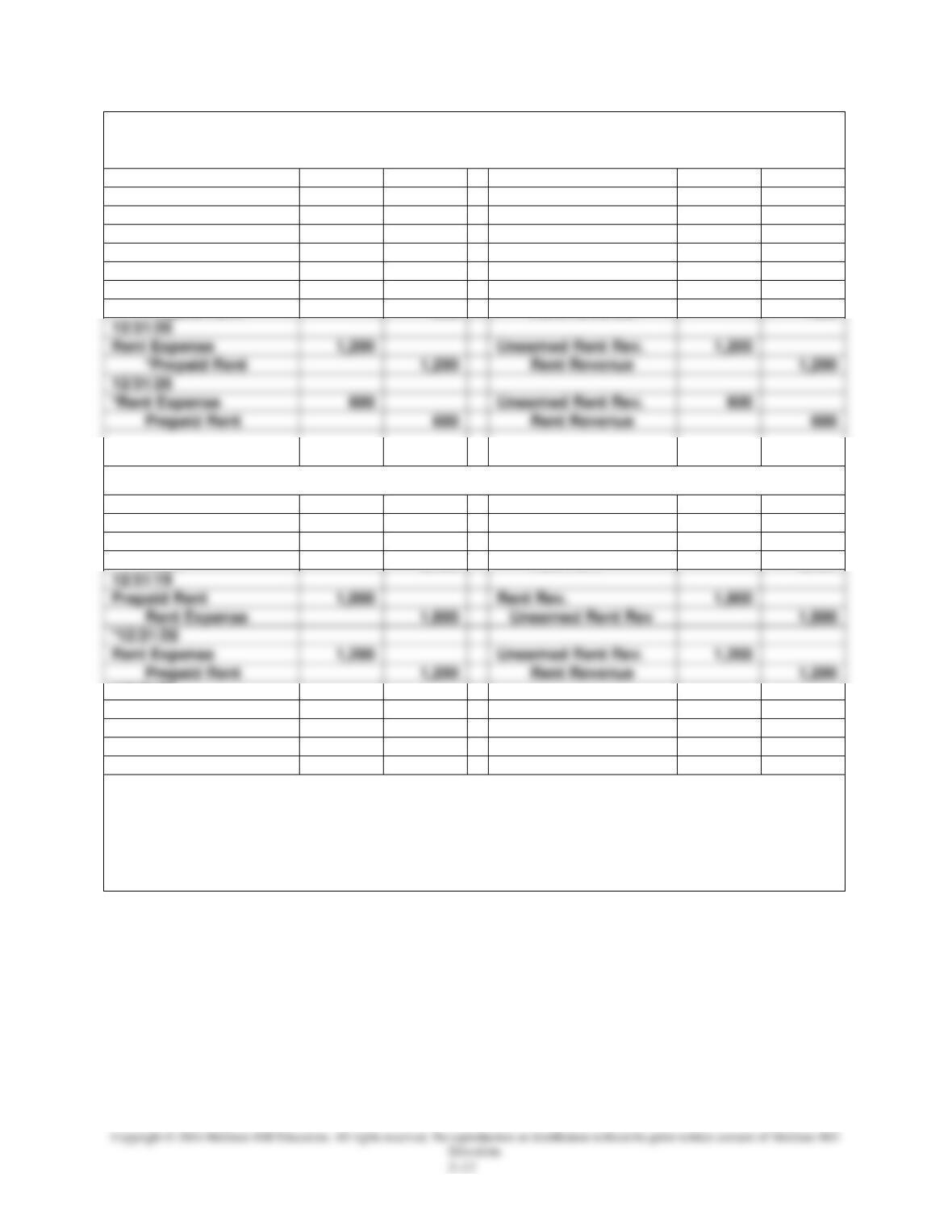
On July 1, 2019, Howard M. Tenant, Inc., rents office space from John Q.
Landlord for two years, starting immediately, at a rate of $100 per month, or
$2,400 in total. The full $2,400 was paid on this date. Record the original
transaction and the appropriate adjusting entries in 2019, 2020, and 2021
from the point of view of Tenant and Landlord.
Financial and Managerial Accounting, 8th Edition
Solution: Chapter 3 Alternate Demonstration Problem #1
Tenant
Landlord
7/1/19
Prepaid Rent
2,400
Cash
2,400
Cash
2,400
Unearned Rent Rev.
2,400
12/31/19
Rent Expense
600
Unearned Rent Rev.
600
Prepaid Rent
600
Rent Revenue
600
12/31/20
Rent Expense
1,200
Unearned Rent Rev.
1,200
*Prepaid Rent
1,200
Rent Revenue
1,200
*Rent Expense
600
Unearned Rent Rev.
600
Prepaid Rent
600
Rent Revenue
600
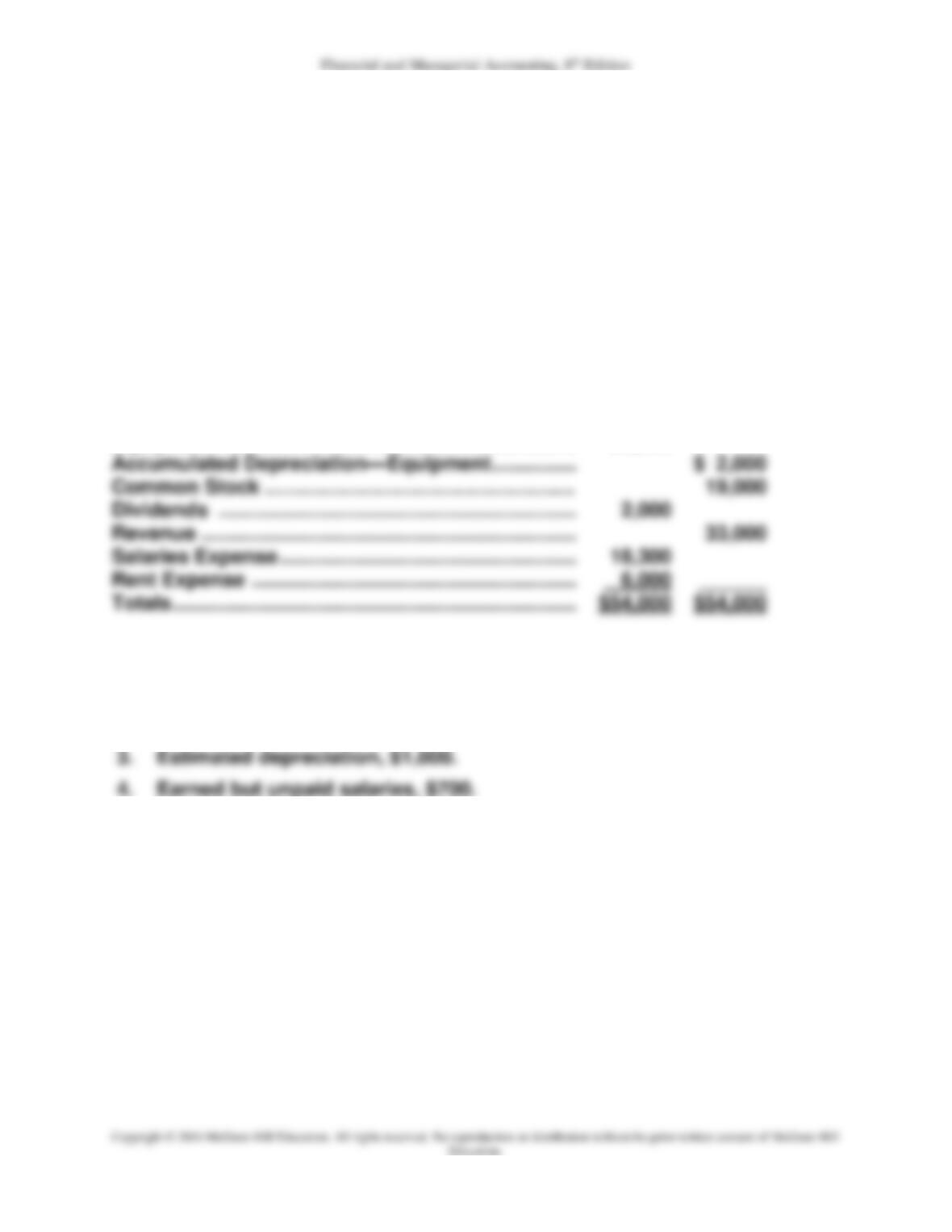
An Alternative Solution (Based on the Appendix)
Tenant
Landlord
7/1/19
Rent Expense
2,400
Cash
2,400
Cash
2,400
Rent Rev.
2,400
12/31/19
Prepaid Rent
1,800
Rent Rev.
1,800
Rent Expense
1,800
1,800
*12/31/20
Rent Expense
1,200
Unearned Rent Rev.
1,200
Prepaid Rent
1,200
Rent Revenue
1,200
*12/31/21
Rent Expense
600
Unearned Rent Rev.
600
Prepaid Rent
600
Rent Revenue
600
*Notice the adjustment is the same in 2020 and 2021 under both
approaches. This is because the adjustment in the appendix alternative
solution places all remaining unexpired/unearned amounts in the
asset/liability accounts to be considered for future adjustment.
3-12
Chapter 3 Alternate Demonstration Problem #2
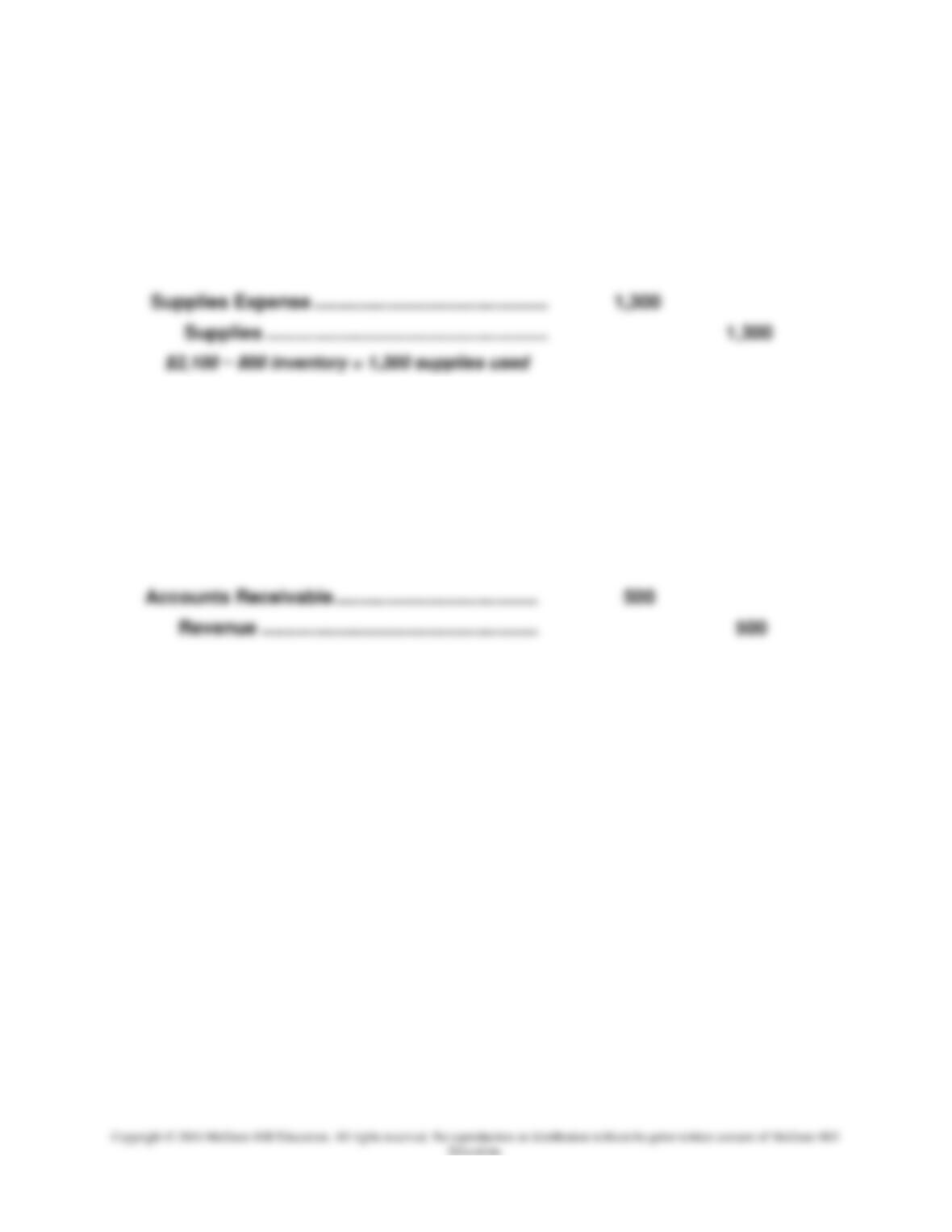
The trial balance of Large Company, Inc., at the end of its annual
accounting period is as follows:
LARGE COMPANY, INC.
Trial Balance
December 31, 2019
Cash ………………………………………………………………..
$ 4,000
Accounts Receivable………………………………..
400
Prepaid Insurance ……………………………………………
1,200
Supplies …………………………………………………………
2,100
Equipment ………………………………………………………
20,000
Accumulated Depreciation—Equipment ……………
$ 2,000
Common Stock ……………………………………….
19,000
Dividends ……………………………………………………….
2,000
Revenue ………………………………………………………….
33,000
Salaries Expense ……………………………………………..
18,300
Totals ………………………………………………………………
$54,000
$54,000
Additional information:
1. Expired insurance, $400.
2. Unused supplies, per inventory, $800.
5. Services completed for a client by year-end but the client has not been
billed for those services, $500
Required: Prepare adjusting entries.
Financial and Managerial Accounting, 8th Edition
3-13
Solution: Chapter 3 Alternate Demonstration Problem #2
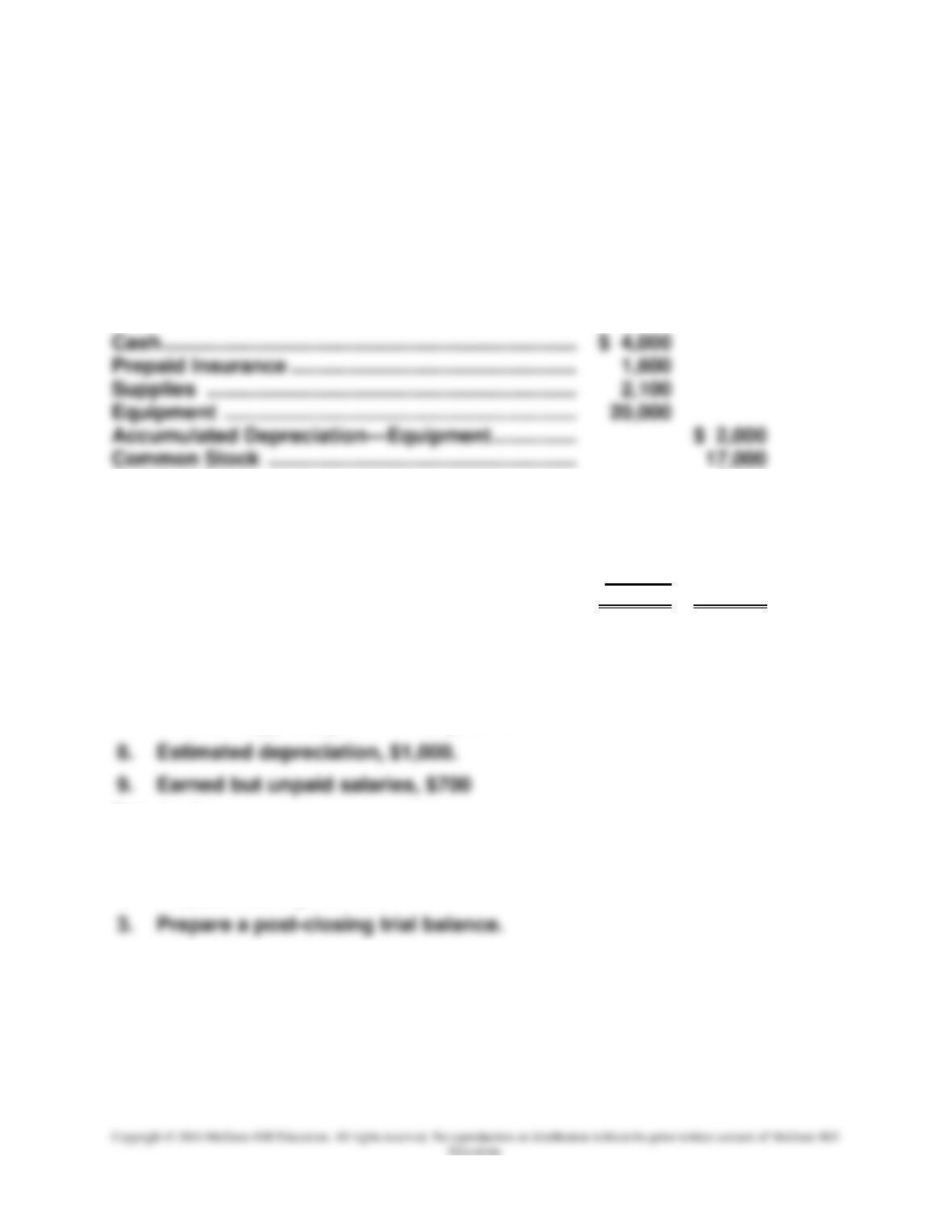
1.
Insurance Expense …………………………………….
400
Prepaid Insurance ………………………………..
400
Supplies Expense ………………………………………
1,300
Supplies ………………………………………………
1,300
Depreciation Expense Equip. ……………………..
1,000
Accumulated Depreciation Equip. …………
1,000
Salaries Expense ……………………………………….
700
Salaries Payable …………………………………..
700
Accounts Receivable …………………………………
500
Revenue ……………………………………………..
500
Financial and Managerial Accounting, 8th Edition
3-14
Chapter 3 Alternate Demonstration Problem #3
The trial balance of Large Company, Inc. at the end of its annual
accounting period is as follows:
LARGE COMPANY, INC.
Trial Balance
December 31, 2019
Cash ………………………………………………………………..
$ 4,000
1,600
Supplies …………………………………………………………
2,100
Equipment ………………………………………………………
20,000
Accumulated Depreciation—Equipment ……………
$ 2,000
Common Stock ……………………………………………….
Retained Earnings
2,000
Dividends ………………………………………………………..
2,000
Revenue ………………………………………………………….
33,000
Salaries Expense ……………………………………………..
18,300
Rent Expense ………………………………………………….
6,000
______
Totals ………………………………………………………………
$54,000
$54,000
Additional information:
6. Expired insurance, $600.
7. Unused supplies, per inventory, $800.
Required
1. Prepare adjusting entries.
2. Prepare closing entries.
Financial and Managerial Accounting, 8th Edition
3-15
Chapter 3 Solution: Alternate Demonstration Problem #3
1.
Insurance Expense …………………………………….
600
Prepaid Insurance ………………………………..
600
Supplies Expense ………………………………………
1,300
Supplies ………………………………………………
1,300
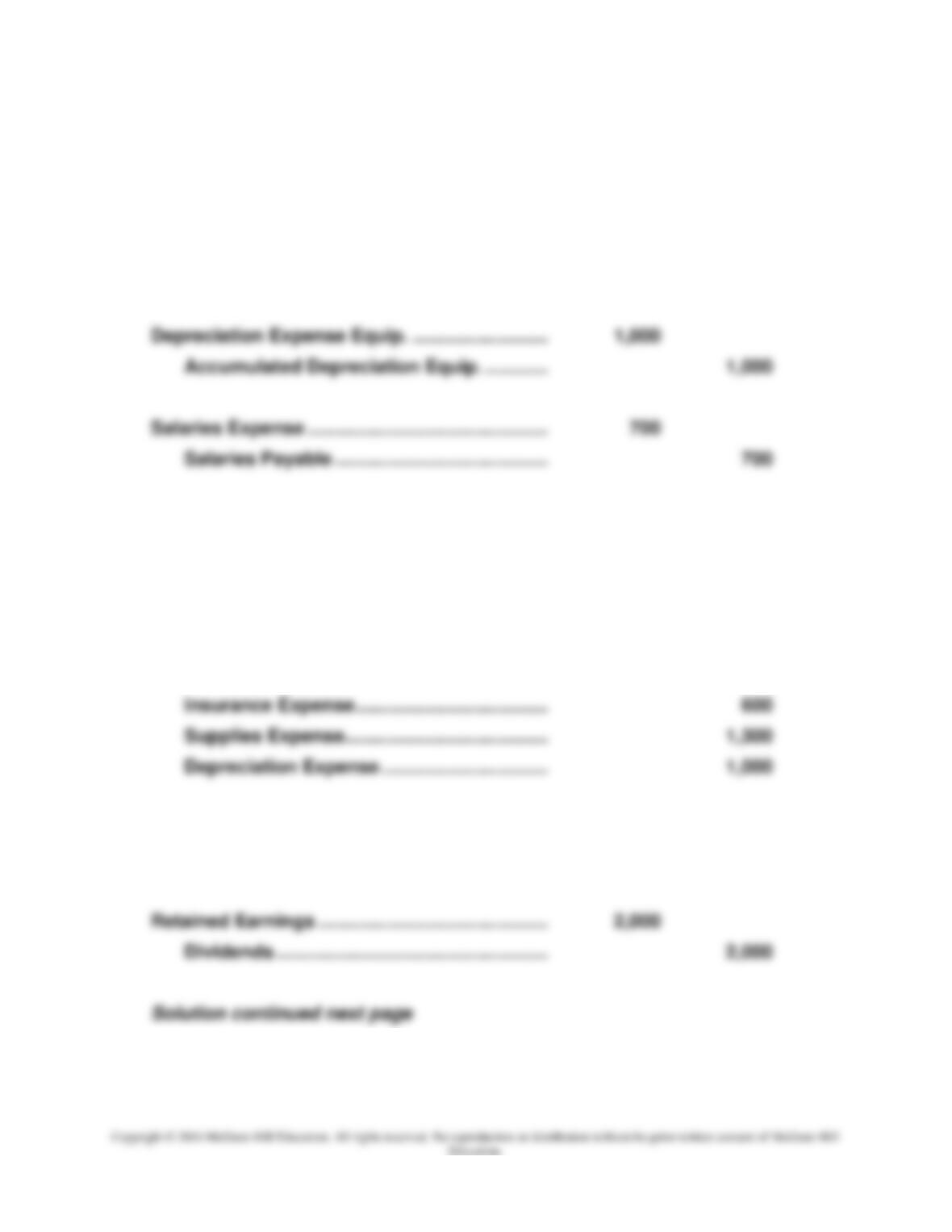
Depreciation Expense Equip. ……………………..
1,000
Salaries Expense ……………………………………….
700
Salaries Payable …………………………………..
700
2.
Revenue …………………………………………………….
33,000
Income Summary …………………………………
33,000
Income Summary ……………………………………….
27,900
Salaries Expense ………………………………….
19,000
Rent Expense ……………………………………….
6,000
Insurance Expense ……………………………….
600
Supplies Expense …………………………………
1,300
Depreciation Expense …………………………..
1,000
Income Summary ……………………………………….
5,100
Retained Earnings ………………………………..
5,100
Retained Earnings ……………………………………..
2,000
Dividends …………………………………………….
2,000
3.
LARGE COMPANY, INC.
Post-Closing Trial Balance
December 31, 2019
Dr.
Cr.
Cash ………………………………………………………….
$4,000
Prepaid Insurance ………………………………………
1,000
Supplies …………………………………………………….
800
Equipment …………………………………………………
20,000
Accumulated Depreciation, Equipment ……….
$ 3,000
Salaries Payable ………………………………………..
700
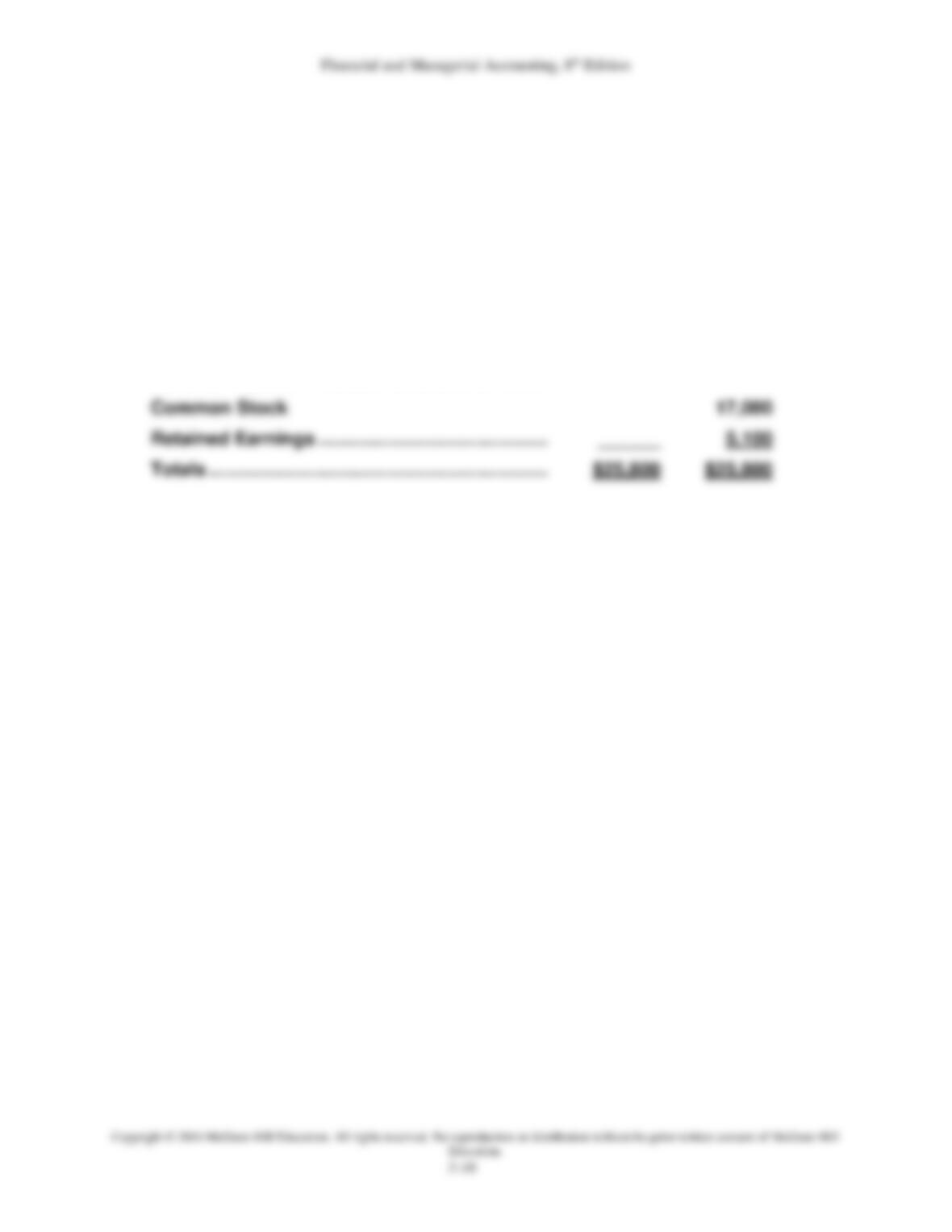
Common Stock
17,000
Retained Earnings ……………………………………..
5,100
Totals ………………………………………………………..