Ethical Obligations and Decision Making in Accounting, 4/e 1
Case 3-8 Accountant takes on Halliburton and Wins!
In 2005, Tony Menendez, a former Ernst & Young LLP auditor and Director of Technical
Accounting and Research Training for Halliburton, blew the whistle on Halliburton’s accounting
practices. The fight cost him nine years of his life. Just a few months later in 2005, Menendez
received an email from Mark McCollum, Halliburton’s chief accounting officer, and a top–
ranking executive at Halliburton, that also went to much of the accounting department. “The
SEC has opened an inquiry into the allegations of Mr. Menendez,” it read. Everyone was to
retain their documents until further notice.”
Nature of Halliburton’s Revenue Transactions in Question
During the months following the “leaked” email, Menendez waited and watched to see if
Halliburton would act on his claims that the company was cooking the books. The issue was
revenue recognition as discussed below.
Halliburton enters into long-term contracts with energy giants like Royal Dutch Shell or BP to
find and exploit huge oil and gas fields. It sells services – the expertise of its geologists and
engineers. Halliburton also builds massive and expensive machinery that its professionals use to
provide those services. Then, the company charges its customers for that equipment, which has
particularly high profit margins. The company’s accountants had been allowing the company to
count the full value of the equipment right away as revenue, sometimes even before it had
Ethical Obligations and Decision Making in Accounting, 4/e 2
Based on Menendez’s claims, Halliburton’s accounting procedures violated generally accepted
accounting principles. For companies to recognize revenue before delivery, “the risks of
ownership must have passed to the buyer,’” the SEC’s staff wrote in a 2003 accounting bulletin.
There also “must be a fixed schedule for delivery of the goods,” and the product “must be
complete and ready for shipment,” among other things.
In other words, Halliburton told employees to recognize revenue even though the company still
owned the product. Ironically, the accelerated revenue for financial statement purposes led to
higher income taxes paid to the IRS.
“The policy in the chart is clearly at odds with generally accepted accounting principles,” said
Charles Mulford, a Georgia Institute of Technology accounting professor, who reviewed the
court records. “It’s very clear cut. It’s not gray.”
Hocus Pocus Accounting- Bill-and-Hold Schemes
The proper accounting for Halliburton’s bill-and-hold transactions was not lost on its external
auditors, KPMG. In fact, in early 2005, KPMG published an article entitled: Bill and Hold
Transactions in the Oilfield Services Industry, which made it clear that oilfield services
companies had to comply with all four of SEC Staff Accounting Bul1etin (SAB 101) to
recognize revenue early. These include:
Ethical Obligations and Decision Making in Accounting, 4/e 3
Menendez’s Complaint to the DOL
Menendez’s allegations are part of a 54-page complaint he filed against Halliburton with a
Department of Labor (DOL) administrative-law judge in Covington, Louisiana, who released the
records to Menendez in response to a Freedom of Information Act request. Menendez claimed
Halliburton retaliated against him in violation of the Sarbanes-Oxley Act’s whistleblower
provisions after he reported his concerns to the SEC and the company’s audit committee.
The Final Verdict is in: Accountant takes on Halliburton
and Wins!
The appeals process went on for three years. In September 2011, the administrative law appeals
panel ruled. It overturned the original trial judge. After five years, Menendez had his first
victory.
Ethical Obligations and Decision Making in Accounting, 4/e 4
Post-Decision Interview about Whistleblowing
In an interview with a reporter, Menendez offered that Halliburton had a whistleblower policy
prior to this incident as required under Sarbanes-Oxley. It was required to be confidential and
Halliburton’s policy promised confidentiality while at the same time discouraging anonymous
complaints on the basis that if you didn’t provide your identity they may not be able to properly
investigate your concern. Menendez added that it was absolutely central to my case and I relied
on this policy but it was Halliburton that blatantly ignored its own policy and betrayed my trust.
The Human Aspect of the Case
Menendez felt he had to leave Halliburton because of the retaliation and how everyone treated
him differently after the email. During the appeals process, as Menendez and his wife waited for
vindication and money got tight, Menendez finally caught a break. Through the accounting
experts he had met during his legal odyssey, he heard that General Motors was looking for a
senior executive.
Ethical Obligations and Decision Making in Accounting, 4/e 5
Exhibit 1
Issues related to the Sarbanes-Oxley Act, SEC, and KPMG
Menendez contacted the audit committee because he believed it was in the best interest of the
employees and shareholders if he made himself available to the committee in their efforts to
investigate the questionable accounting and auditing practices and properly respond to the SEC.
It was discovered that Halliburton did not have in place, as required by Section 301 of SOX, a
process for “(1) the receipt and treatment of complaints received by the issuer regarding
accounting, internal controls, or auditing matters; and (2) the confidential, anonymous
submission of employees of the issuer of concerns regarding questionable accounting or auditing
matters.”
After waiting for the company to take action to no avail, Menendez felt there was no alternative
to blowing the whistle and on November 4, 2005, he contacted the SEC and PCAOB stating in
part:
Ethical Obligations and Decision Making in Accounting, 4/e 6
“As a C.P.A. and the Director of Technical Accounting Research and Training for Halliburton, I
feel it is my duty and obligation to report information that I believe constitutes both a potential
failure by a registered public accounting firm, KPMG, to properly perform an audit and the
potential filing of materially misleading financial information with the SEC by Halliburton.”
Two weeks later, at the agencies’ request, he met with SEC enforcement staff at their Fort Worth
office. On November 30, 2005, he· approached members of top management of Halliburton. On
February 4, 2006, Menendez provided what he believed would be a confidential report to
Halliburton’s audit committee, giving the company yet another opportunity for self-examination.
However, on the morning of February 6, 2006, Menendez’s identity was disclosed to McCollum
and less than an hour after finding out that Menendez had reported the questionable accounting
and auditing practices to the SEC, McCollum distributed information about Menendez’s
investigation and identity.
Questions
1. Describe the inadequacies in the corporate governance system at Halliburton.
According to the facts of the case, Tony Menendez contacted Halliburton’s audit
committee because he believed it was in the best interest of the employees and
shareholders if he made himself available to the committee in its efforts to investigate the
questionable accounting and auditing practices and properly respond to the SEC. It was
discovered that Halliburton did not have in place, as required by Section 301 of the
Sarbanes-Oxley Act (SOX), a process for “(1) the receipt and treatment of complaints
received by the issuer regarding accounting, internal controls, or auditing matters; and (2)
the confidential, anonymous submission of employees of the issuer of concerns regarding
questionable accounting or auditing matters.”
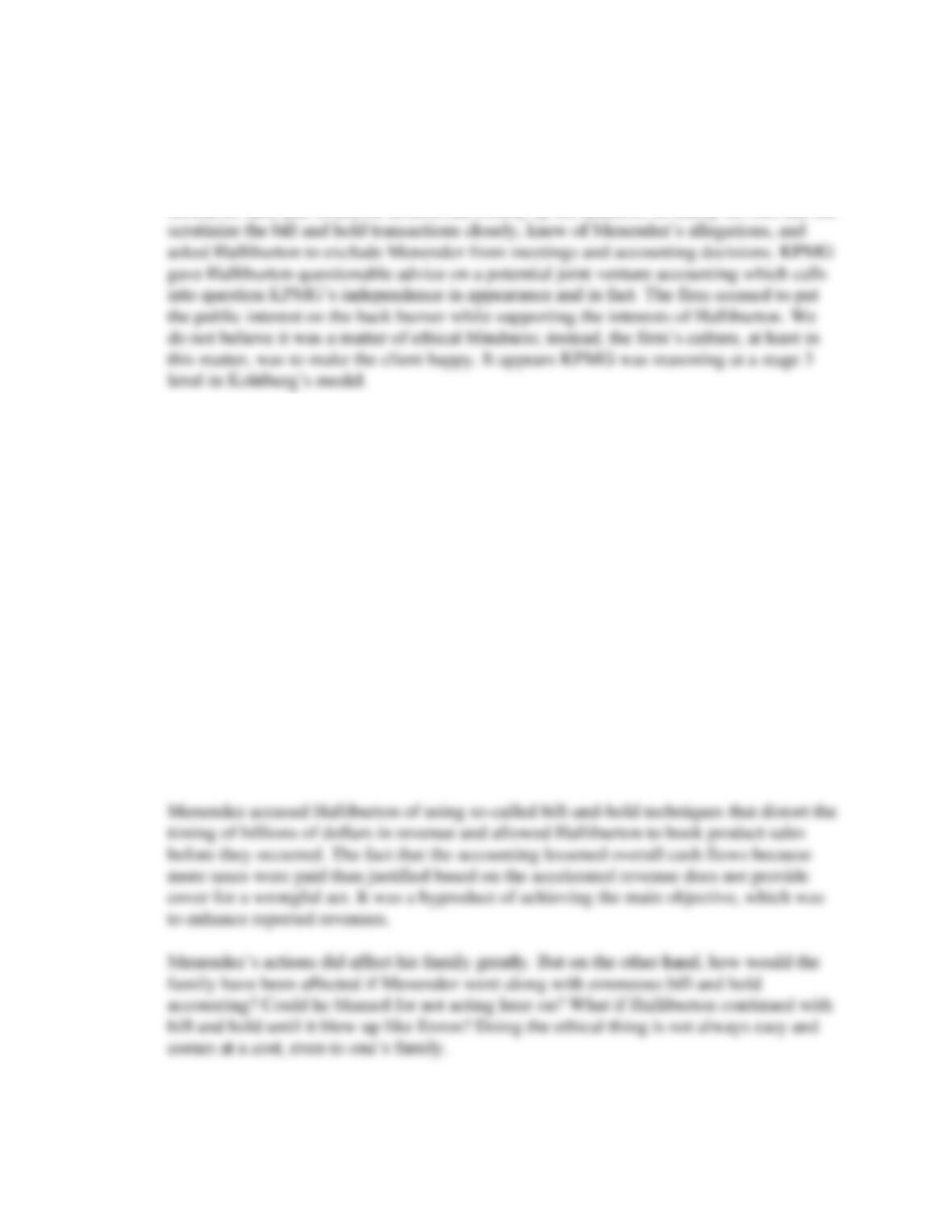
High
HHigh
Organizational
2. Consider the role of KPMG in the case with respect to the accounting and auditing
issues. How did the firms’ actions relate to the ethical and professional expectations
for CPAs by the accounting profession?
High Organizational
Low Personal Ethics
High Organizational
High Personal Ethics
Ethical Obligations and Decision Making in Accounting, 4/e 8
KPMG owes its clients and the public an independent audit performed with honesty,
integrity, objectivity, due care in accordance GAAP and GAAS. KPMG’s training and
guidance on bill-and-hold schemes, particularly in the oilfield services industry, set
criteria that would support Menendez’s analysis. It states that bill and hold transactions
should be rare, and would be scrutinized closely by the auditors. In reality KPMG did not
3. Some critics claim that while Menendez’s actions may have been courageous, he
harmed others along the way. His family was in limbo for many years and had to
deal with the agony of being labeled a whistleblower and disloyal to Halliburton.
The company’s overall revenue did not change; a small amount was merely shifted
to an earlier period. Halliburton didn’t steal any money, they didn’t cheat the IRS,
they didn’t cheat their customers or their employees. In fact, they lessened their
cash flows by paying out taxes earlier than they should have under the rules.
How do you respond to these criticisms?
The bill-and-hold revenue was improperly recorded. Initially, it should have been
recorded as deferred revenue and later transferred to earned revenue when the sale of
equipment was completed. The company’s accountants had been allowing the company
to count the full value of the equipment right away as revenue, sometimes even before it
had assembled the equipment. But the customers could walk away in the middle of the
contracts. Menendez realized that if the equipment were damaged, Halliburton, not the
customer, was on the hook.
Ethical Obligations and Decision Making in Accounting, 4/e 9
Menendez reasoned at the postconventional level. He understood his ethical obligation to
society and the rights of investors to known the truth about Halliburton’s accounting. The
moral intensity of the issue and its personal nature gave him the courage needed to blow
the whistle on the company.