3-1
CHAPTER 3
COST–VOLUME–PROFIT ANALYSIS
NOTATION USED IN CHAPTER 3 SOLUTIONS
SP: Selling price
VCU: Variable cost per unit
CMU: Contribution margin per unit
FC: Fixed costs
TOI: Target operating income
3-1 Cost-volume-profit (CVP) analysis examines the behavior of total revenues, total costs,
and operating income as changes occur in the units sold, selling price, variable cost per unit, or
fixed costs of a product.
3-2 The assumptions underlying the CVP analysis outlined in Chapter 3 are
3-3 Operating income is total revenues from operations for the accounting period minus cost
of goods sold and operating costs (excluding income taxes):
Operating income = Total revenues from operations – Costs of goods sold and operating
costs (excluding income taxes)
Net income is operating income plus nonoperating revenues (such as interest revenue)
minus nonoperating costs (such as interest cost) minus income taxes. Chapter 3 assumes
nonoperating revenues and nonoperating costs are zero. Thus, Chapter 3 computes net income
as:
Net income = Operating income – Income taxes
3-2
3-6 Breakeven analysis denotes the study of the breakeven point, which is often only an
incidental part of the relationship between cost, volume, and profit. Cost-volume-profit
relationship is a more comprehensive term than breakeven analysis.
3-8 An increase in the income tax rate does not affect the breakeven point. Operating income
at the breakeven point is zero, and no income taxes are paid at this point.
3-9 Sensitivity analysis is a “what–if” technique that managers use to examine how an
outcome will change if the original predicted data are not achieved or if an underlying
assumption changes. The advent of the electronic spreadsheet has greatly increased the ability to
explore the effect of alternative assumptions at minimal cost. CVP is one of the most widely
used software applications in the management accounting area.
3-10 Examples include:
Manufacturing––substituting a robotic machine for hourly wage workers
Marketing––changing a sales force compensation plan from a percent of sales dollars to
a fixed salary
Customer service––hiring a subcontractor to do customer repair visits on an annual
retainer basis rather than a per-visit basis
3-13 CVP analysis is always conducted for a specified time horizon. One extreme is a very
short-time horizon. For example, some vacation cruises offer deep price discounts for people
who offer to take any cruise on a day’s notice. One day prior to a cruise, most costs are fixed.
The other extreme is several years. Here, a much higher percentage of total costs typically is
variable.
3-3
CVP itself is not made any less relevant when the time horizon lengthens. What happens
is that many items classified as fixed in the short run may become variable costs with a longer
time horizon.
3-14 A company with multiple products can compute a breakeven point by assuming there is a
constant sales mix of products at different levels of total revenue.
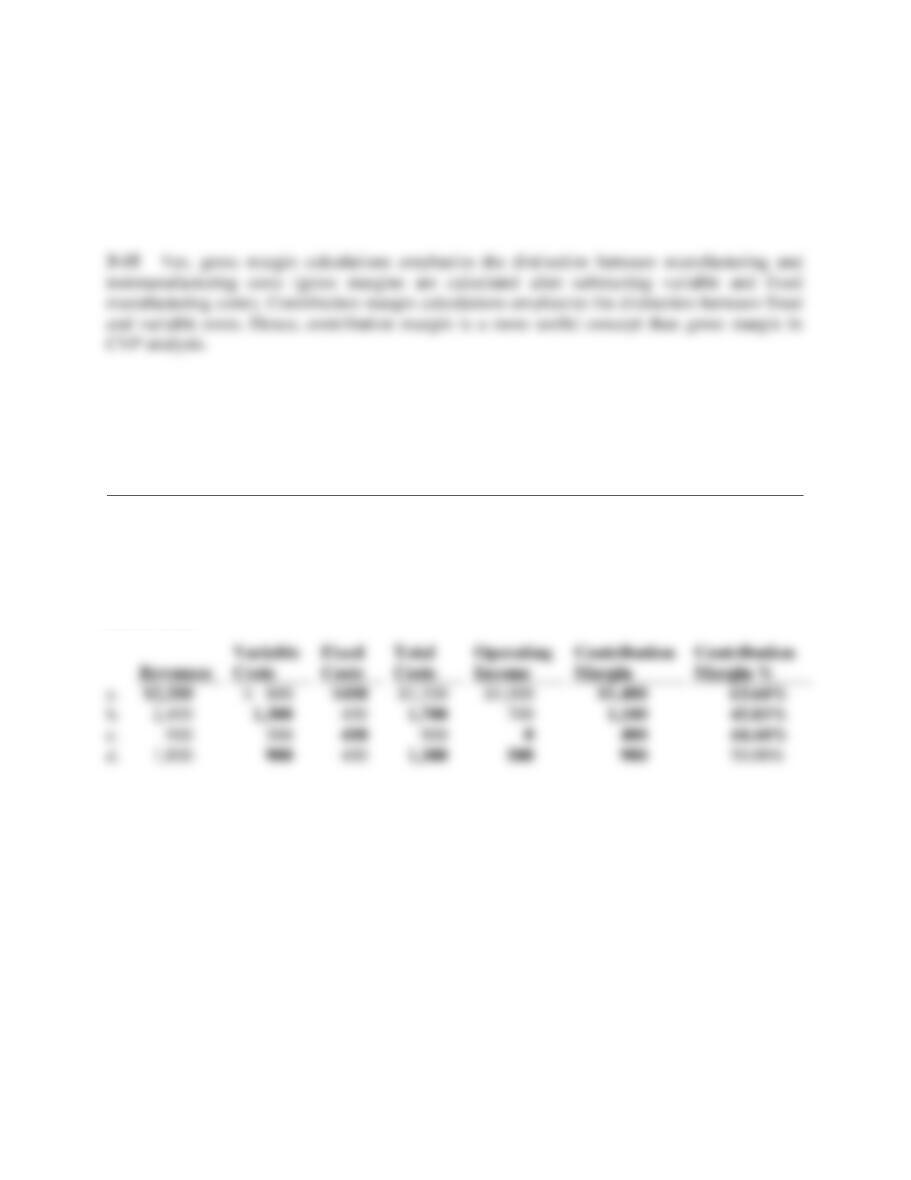
3-16 (10 min.) CVP computations.
Fill in the blanks for each of the following independent cases.
Case
Revenues
Variable
Costs
Fixed Costs
Total Costs
Operating
Income
Contribution
Margin Percentage
a.
$800
$1,200
$1,000
b.
$2,400
$400
$ 700
c.
$ 900
$500
$ 900
d.
$1,800
$400
50%
SOLUTION
3-17 (10–15 min.) CVP computations.
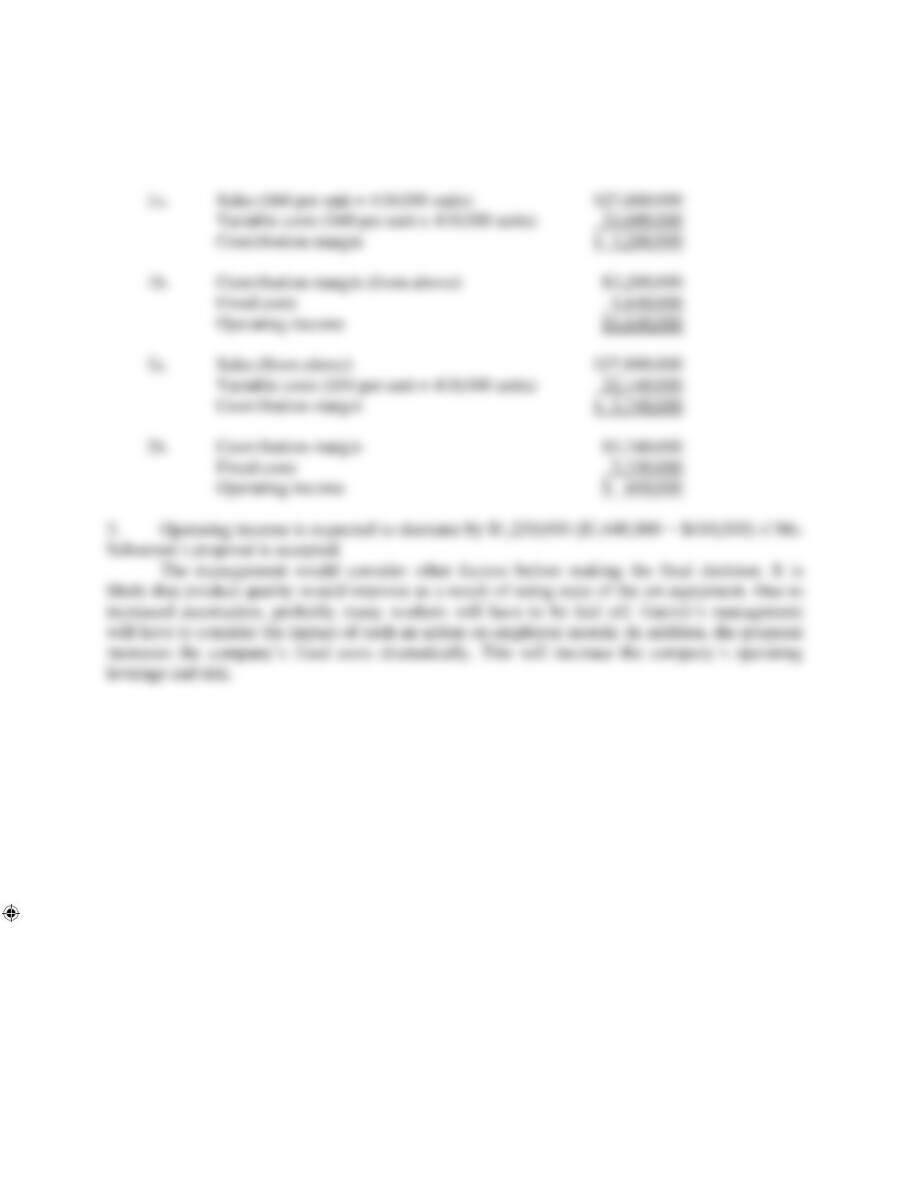
Garrett Manufacturing sold 410,000 units of its product for $68 per unit in 2014. Variable cost
per unit is $60, and total fixed costs are $1,640,000.
Required:
1. Calculate (a) contribution margin and (b) operating income.
2. Garrett’s current manufacturing process is labor intensive. Kate Schoenen, Garrett’s
production manager, has proposed investing in state-of-the-art manufacturing equipment,
which will increase the annual fixed costs to $5,330,000. The variable costs are expected to
decrease to $54 per unit. Garrett expects to maintain the same sales volume and selling price
next year. How would acceptance of Schoenen’s proposal affect your answers to (a) and (b)
in requirement 1?
3-4
3. Should Garrett accept Schoenen’s proposal? Explain.
SOLUTION
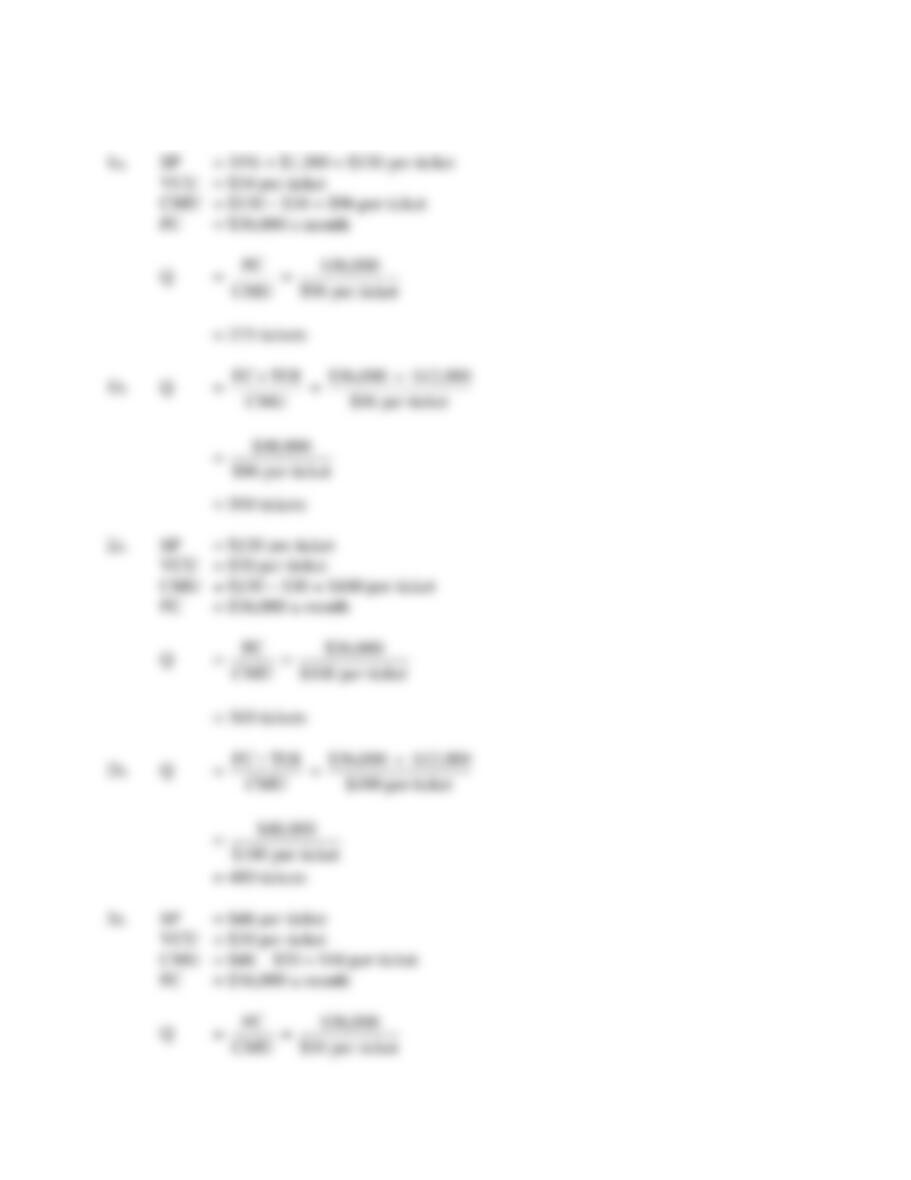
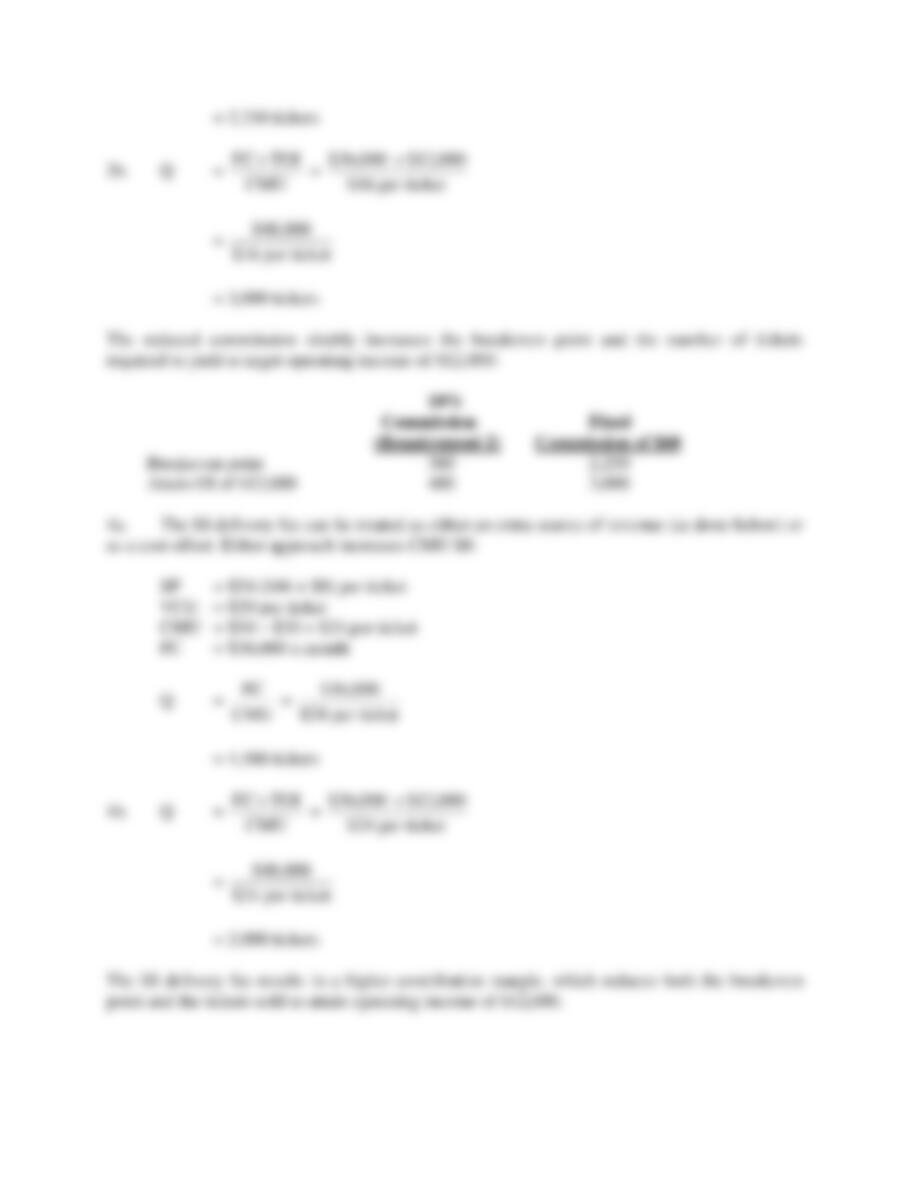
3-18 (35–40 min.) CVP analysis, changing revenues and costs.
Brilliant Travel Agency specializes in flights between Toronto and Jamaica. It books passengers
on Ontario Air. Brilliant’s fixed costs are $36,000 per month. Ontario Air charges passengers
$1,300 per round-trip ticket.
Calculate the number of tickets Brilliant must sell each month to (a) break even and (b) make a
target operating income of $12,000 per month in each of the following independent cases.
Required:
1. Brilliant’s variable costs are $34 per ticket. Ontario Air pays Brilliant 10% commission on
ticket price.
2. Brilliant’s variable costs are $30 per ticket. Ontario Air pays Brilliant 10% commission on
ticket price.
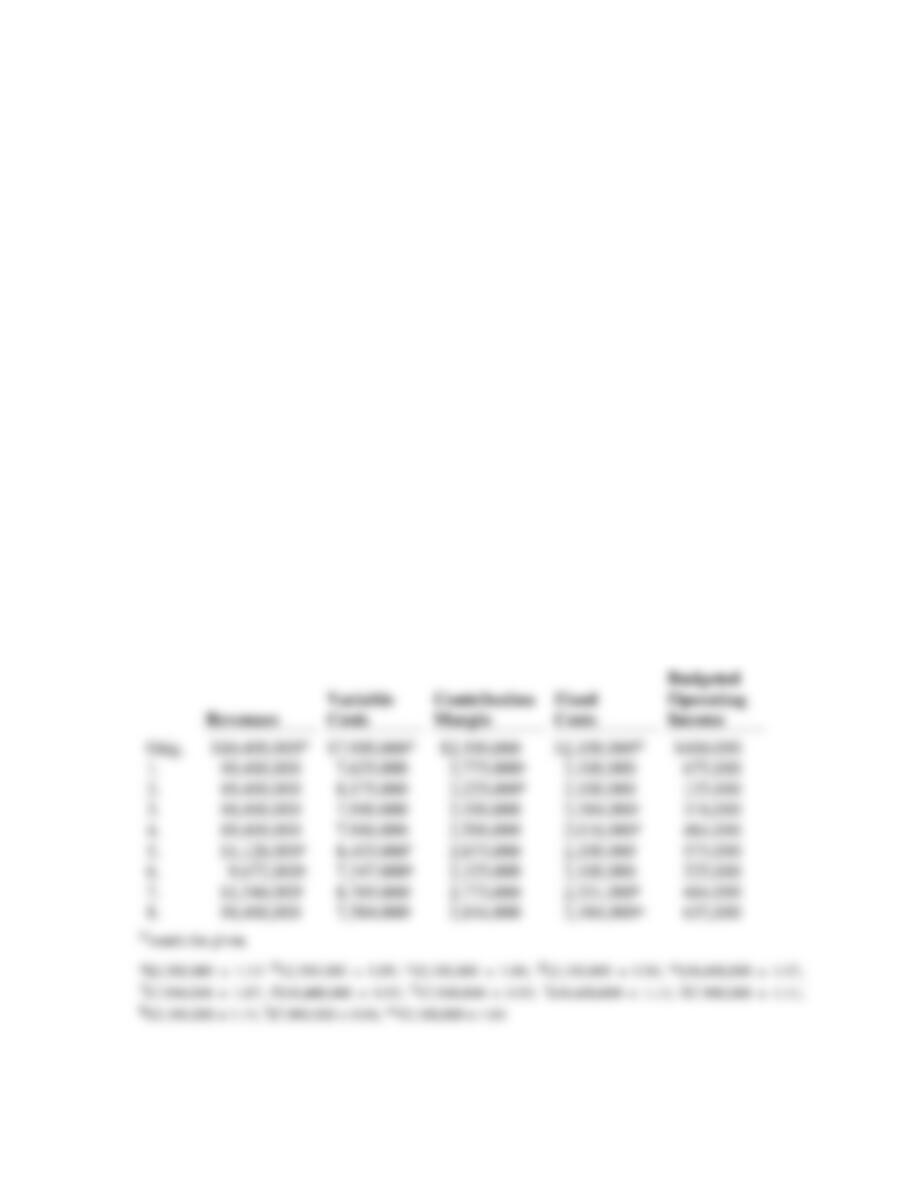
3. Brilliant’s variable costs are $30 per ticket. Ontario Air pays $46 fixed commission per ticket
to Brilliant. Comment on the results.
4. Brilliant’s variable costs are $30 per ticket. It receives $46 commission per ticket from
Ontario Air. It charges its customers a delivery fee of $8 per ticket. Comment on the results.
3-5
SOLUTION
3-6
3-7
3-19 (20 min.) CVP exercises.
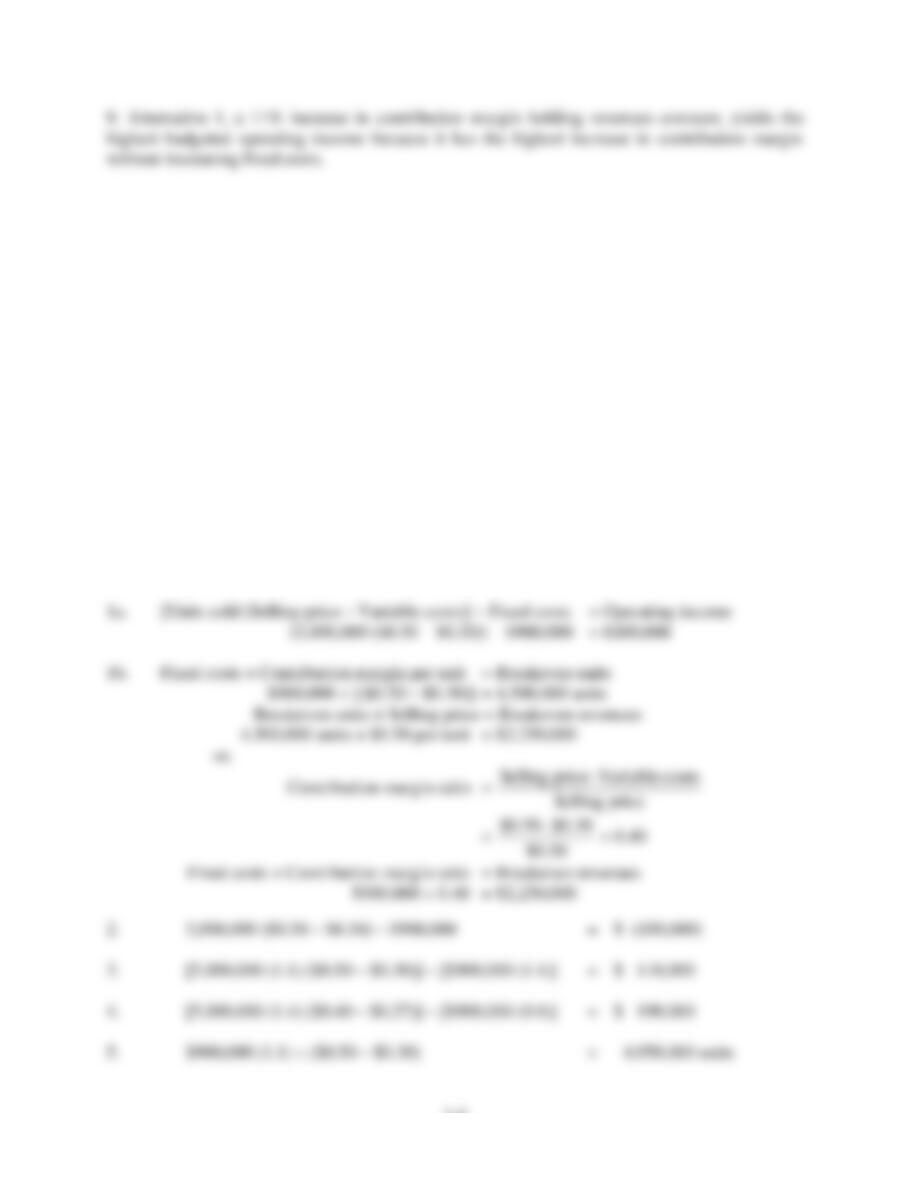
The Incredible Donut owns and operates six doughnut outlets in and around Kansas City. You
are given the following corporate budget data for next year:
Revenues
$10,400,000
Fixed costs
$ 2,100,000
Variable costs
$ 7,900,000
Variable costs change based on the number of doughnuts sold.
Compute the budgeted operating income for each of the following deviations from the original
budget data. (Consider each case independently.)
Required:
1. An 11% increase in contribution margin, holding revenues constant
2. An 11% decrease in contribution margin, holding revenues constant
3. A 4% increase in fixed costs
4. A 4% decrease in fixed costs
5. A 7% increase in units sold
6. A 7% decrease in units sold
7. An 11% increase in fixed costs and a 11% increase in units sold
8. A 4% increase in fixed costs and a 4% decrease in variable costs
9. Which of these alternatives yields the highest budgeted operating income? Explain why this
is the case.
SOLUTION
3-8
3-20 (20 min.) CVP exercises.
The Doral Company manufactures and sells pens. Currently, 5,000,000 units are sold
per year at $0.50 per unit. Fixed costs are $900,000 per year. Variable costs are $0.30 per unit.
Consider each case separately:
Required:
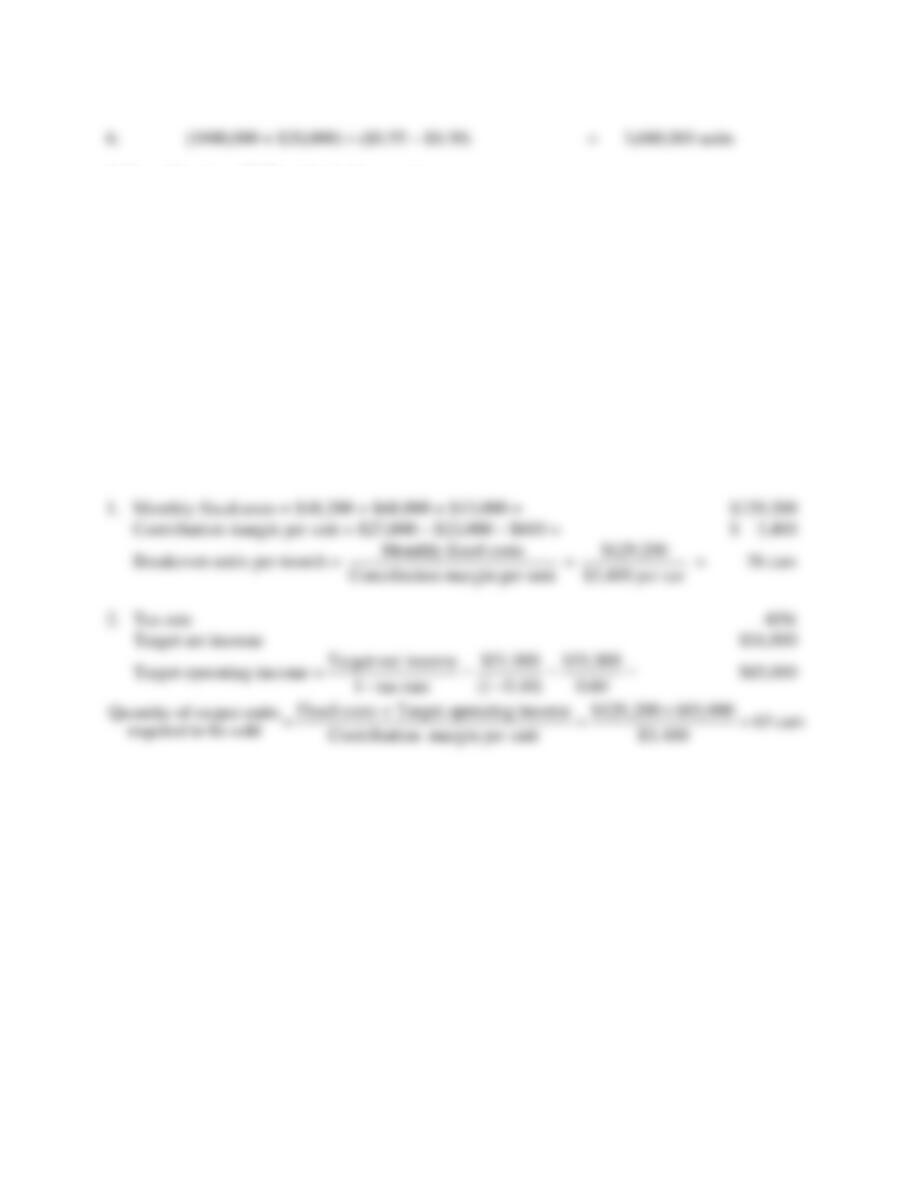
1. a. What is the current annual operating income?
b. What is the present breakeven point in revenues?
Compute the new operating income for each of the following changes:
2. A $0.04 per unit increase in variable costs
3. A 10% increase in fixed costs and a 10% increase in units sold
4. A 20% decrease in fixed costs, a 20% decrease in selling price, a 10% decrease in variable
cost per unit, and a 40% increase in units sold
Compute the new breakeven point in units for each of the following changes:
5. A 10% increase in fixed costs
6. A 10% increase in selling price and a $20,000 increase in fixed costs
SOLUTION
3-9
3-21 (10 min.) CVP analysis, income taxes.
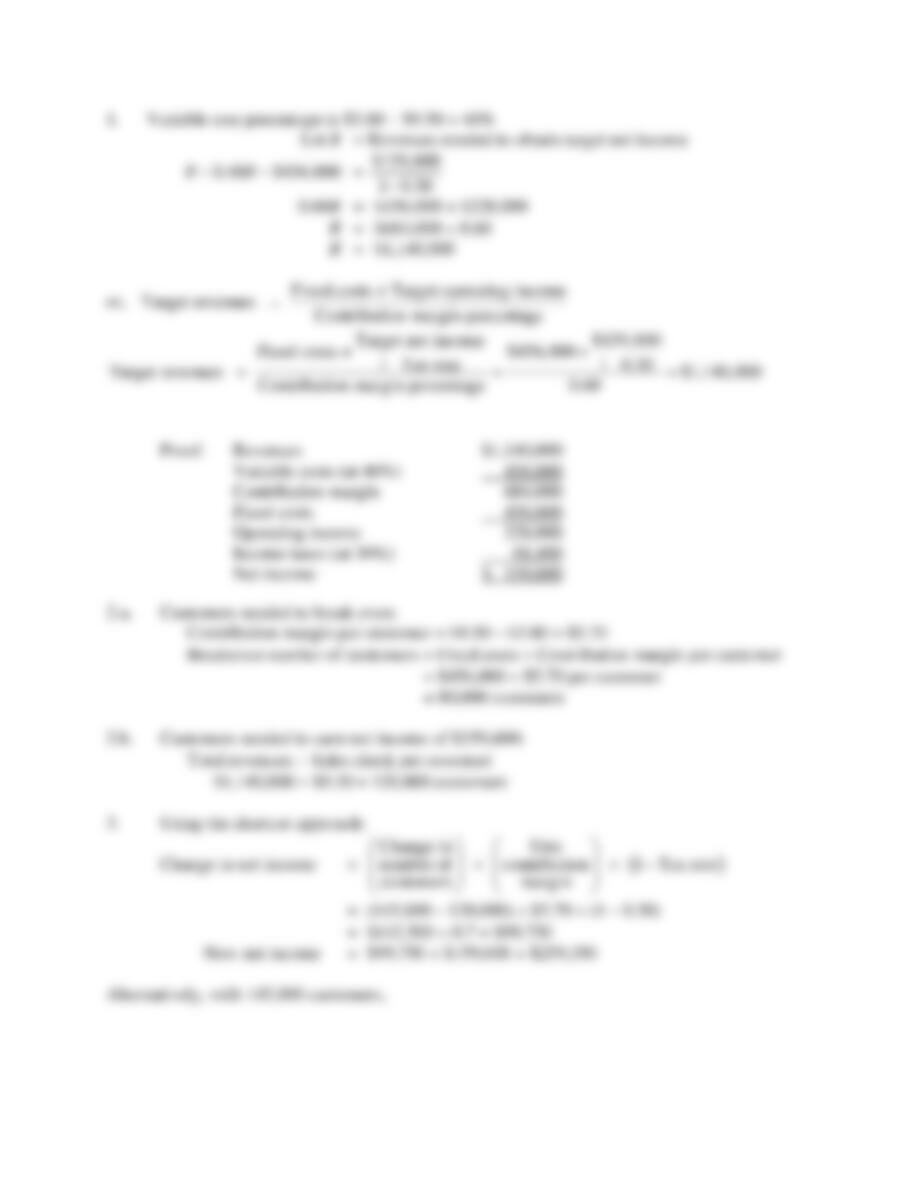
Brooke Motors is a small car dealership. On average, it sells a car for $27,000, which it
purchases from the manufacturer for $23,000. Each month, Brooke Motors pays $48,200 in rent
and utilities and $68,000 for salespeople’s salaries. In addition to their salaries, salespeople are
paid a commission of $600 for each car they sell. Brooke Motors also spends $13,000 each
month for local advertisements. Its tax rate is 40%.
Required:
1. How many cars must Brooke Motors sell each month to break even?
2. Brooke Motors has a target monthly net income of $51,000. What is its target monthly
operating income? How many cars must be sold each month to reach the target monthly net
income of $51,000?
SOLUTION
3-22 (20–25 min.) CVP analysis, income taxes.
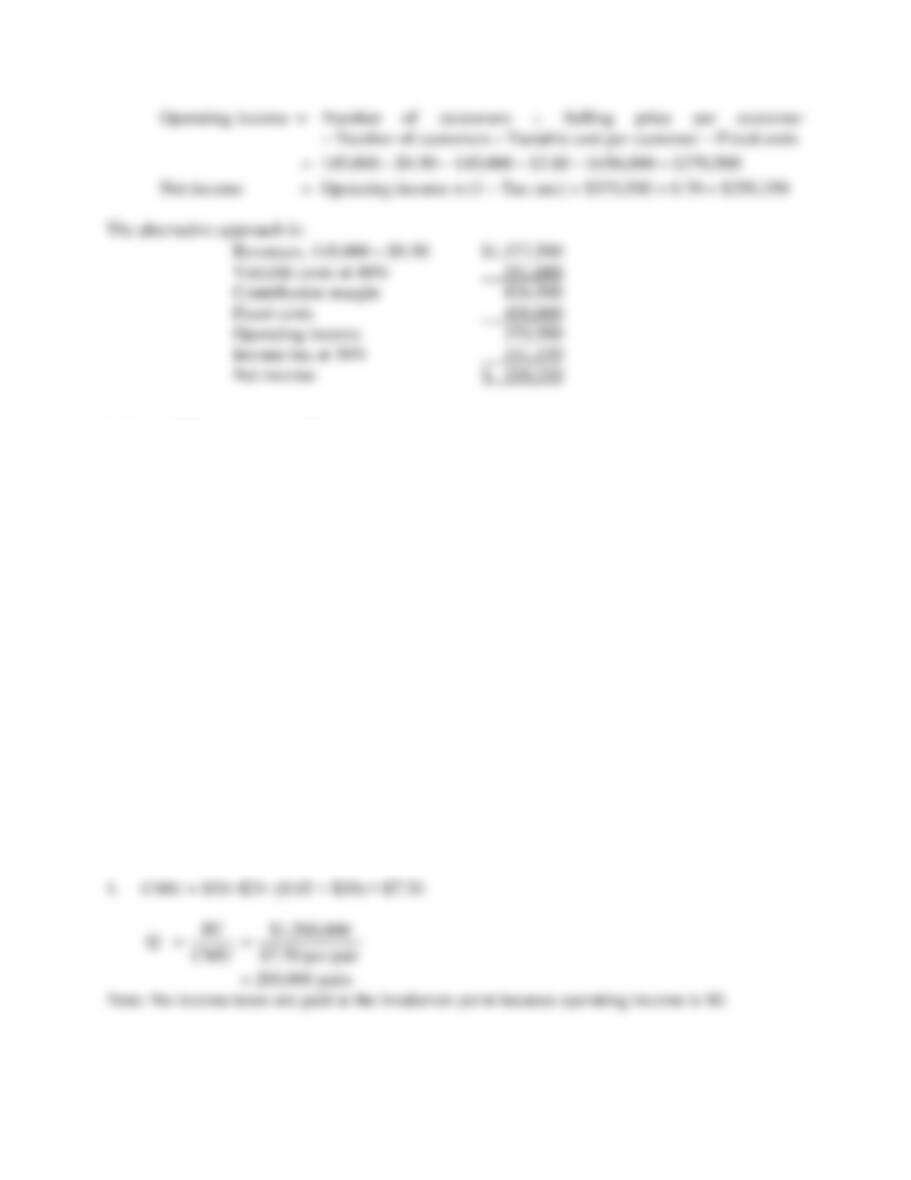
The Swift Meal has two restaurants that are open 24 hours a day. Fixed costs for the two
restaurants together total $456,000 per year. Service varies from a cup of coffee to full meals.
The average sales check per customer is $9.50. The average cost of food and other variable costs
for each customer is $3.80. The income tax rate is 30%. Target net income is $159,600.
Required:
1. Compute the revenues needed to earn the target net income.
2. How many customers are needed to break even? To earn net income of $159,600?
3. Compute net income if the number of customers is 145,000.
SOLUTION
3-10
3-11
3-23 CVP analysis, sensitivity analysis.
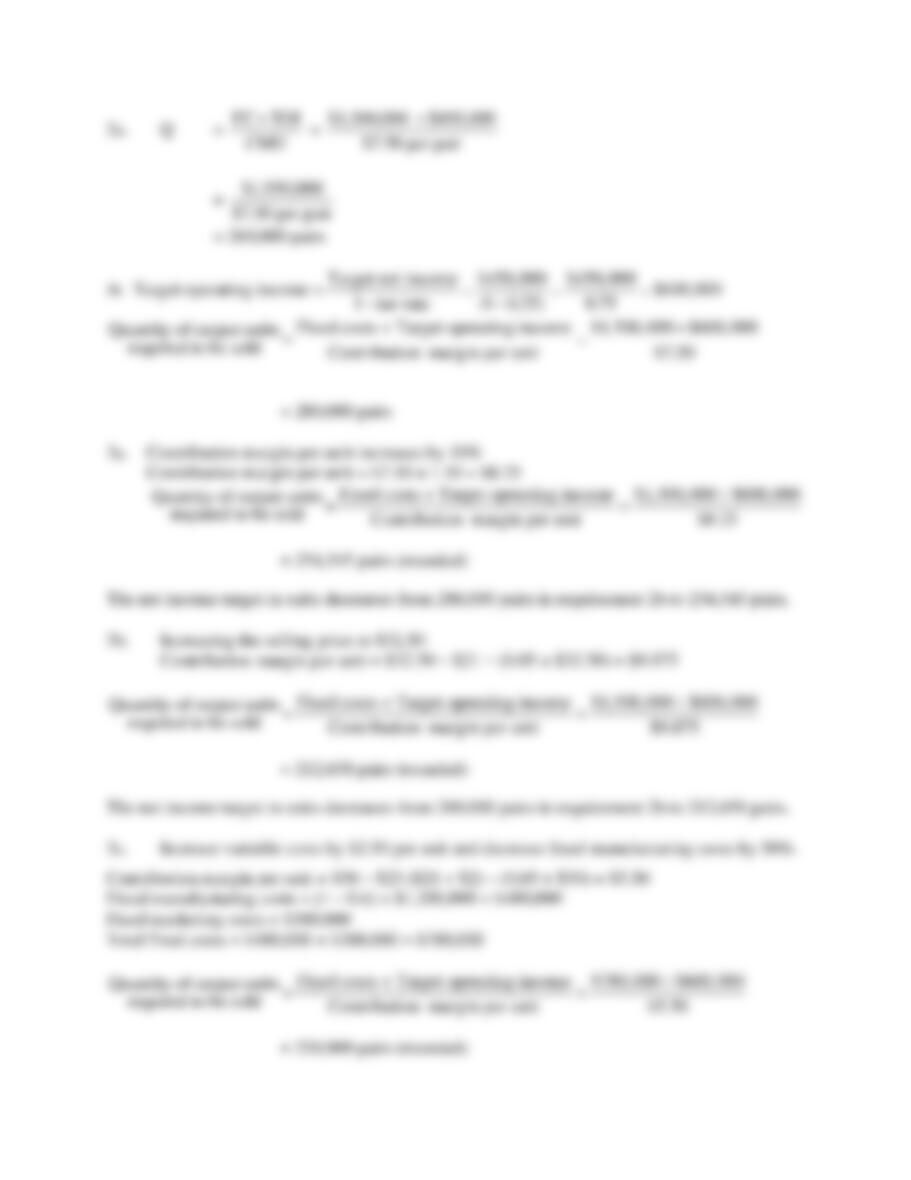
Tuff Kids Jeans Co. sells blue jeans wholesale to major retailers across the country. Each pair of
jeans has a selling price of $30 with $21 in variable costs of goods sold. The company has fixed
manufacturing costs of $1,200,000 and fixed marketing costs of $300,000. Sales commissions
are paid to the wholesale sales reps at 5% of revenues. The company has an income tax rate of
25%.
Required:
1. How many jeans must Tuff Kids sell in order to break even?
2. How many jeans must the company sell in order to reach:
a. a target operating income of $450,000?
b. a net income of $450,000?
3. How many jeans would TuffKids have to sell to earn the net income in part 2b if (consider
each require-ment independently).
a. The contribution margin per unit increases by 10%
b. The selling price is increased to $32.50
c. The company outsources manufacturing to an overseas company increasing variable costs
per unit by $2.00 and saving 60% of fixed manufacturing costs.
SOLUTION
3-12
3-13
3-24 (10 min.) CVP analysis, margin of safety.
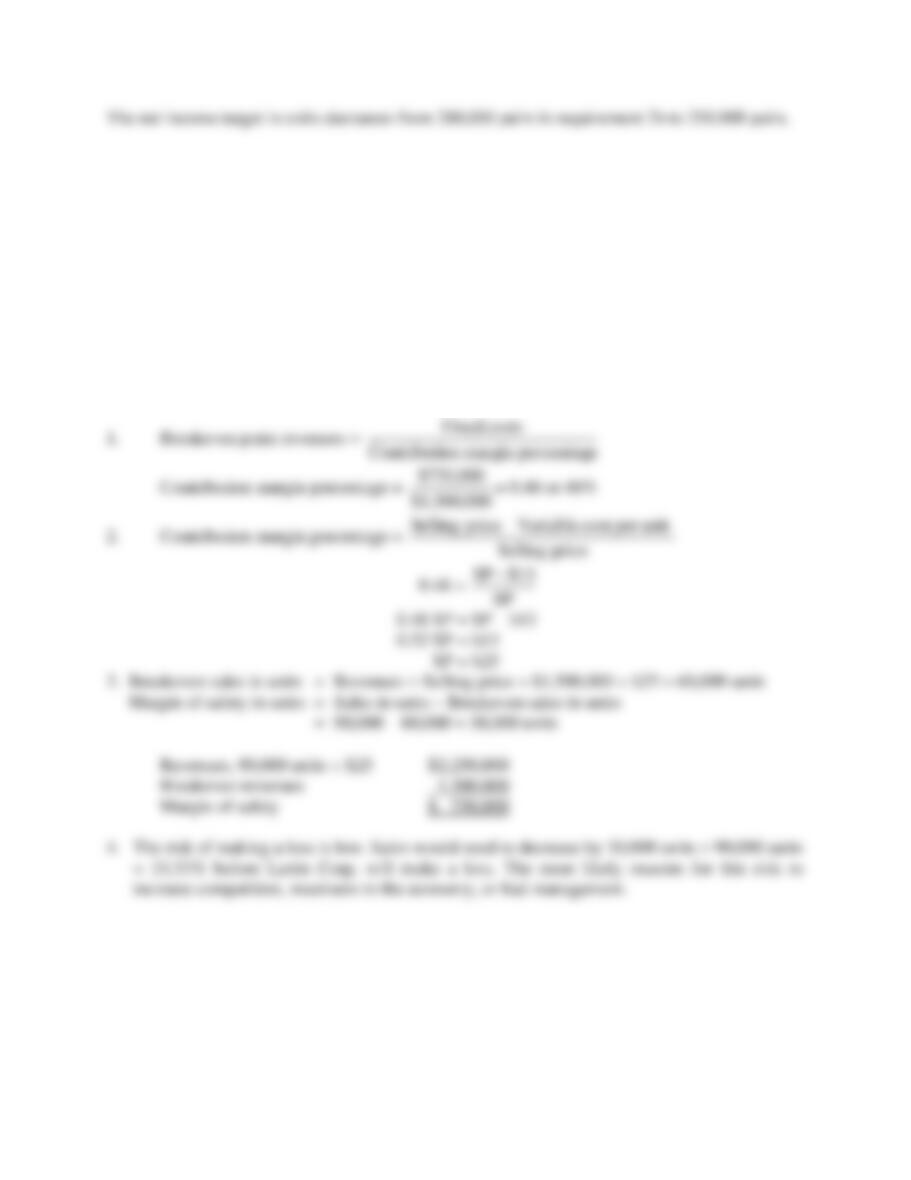
Suppose Lattin Corp.’s breakeven point is revenues of $1,500,000. Fixed costs are $720,000.
Required:
1. Compute the contribution margin percentage.
2. Compute the selling price if variable costs are $13 per unit.
3. Suppose 90,000 units are sold. Compute the margin of safety in units and dollars.
4. What does this tell you about the risk of Lattin making a loss? What are the most likely
reasons for this risk to increase?
SOLUTION
3-25 (25 min.) Operating leverage.
Carmel Rugs is holding a 2-week carpet sale at Jean’s Club, a local warehouse store. Carmel
Rugs plans to sell carpets for $1,000 each. The company will purchase the carpets from a local
distributor for $400 each, with the privilege of returning any unsold units for a full refund. Jean’s
Club has offered Carmel Rugs two payment alternatives for the use of space.
3-14
▪ Option 1: A fixed payment of $17,400 for the sale period
▪ Option 2: 20% of total revenues earned during the sale period
Assume Carmel Rugs will incur no other costs.
Required:
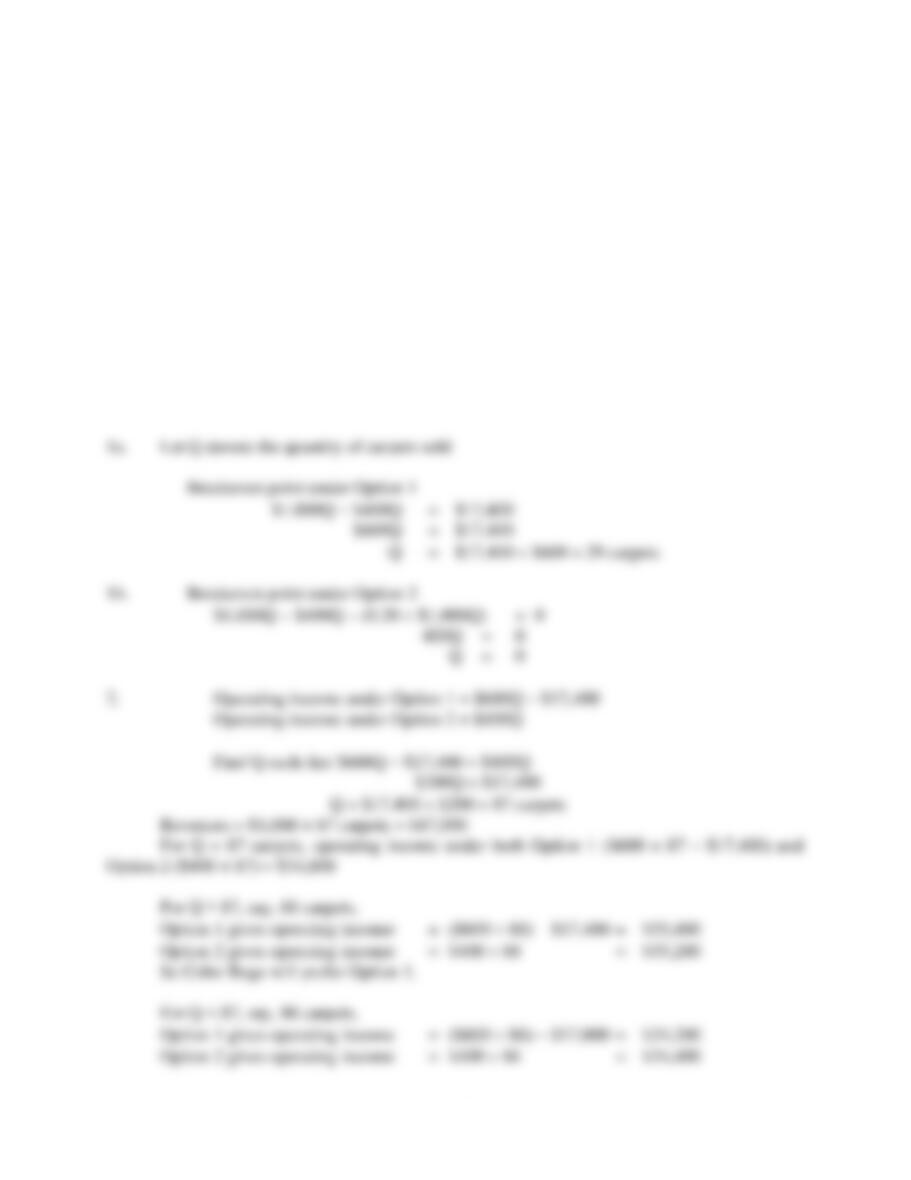
1. Calculate the breakeven point in units for (a) option 1 and (b) option 2.
2. At what level of revenues will Carmel Rugs earn the same operating income under either
option?
a. For what range of unit sales will Carmel Rugs prefer option 1?
b. For what range of unit sales will Carmel Rugs prefer option 2?
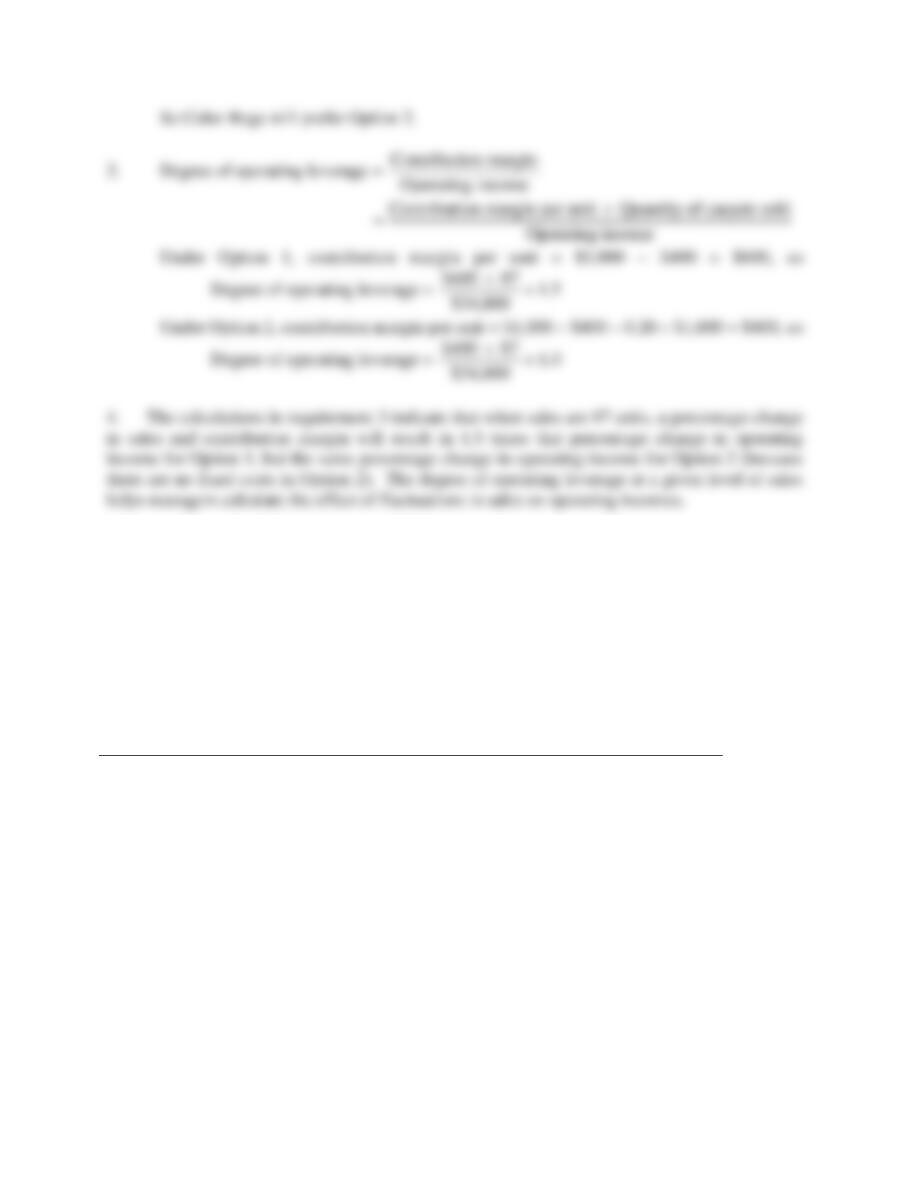
3. Calculate the degree of operating leverage at sales of 87 units for the two rental options.
4. Briefly explain and interpret your answer to requirement 3.
SOLUTION
3-15
3-26 (15 min.) CVP analysis, international cost structure differences.
Plush Decor, Inc., is considering three possible countries for the sole manufacturing site of its
newest area rug: Italy, Spain, and Singapore. All area rugs are to be sold to retail outlets in the
United States for $200 per unit. These retail outlets add their own markup when selling to final
customers. Fixed costs and variable cost per unit (area rug) differ in the three countries.
Country
Sales Price
to Retail
Outlets
Annual
Fixed
Costs
Variable
Manufacturing
Cost per
Area Rug
Variable
Marketing &
Distribution Cost
per Area Rug
Italy
$200.00
$6,386,000
$70.00
$27.00
Spain
200.00
5,043,000
61.00
16.00
Singapore
200.00
12,240,00
84.00
14.00
Required:
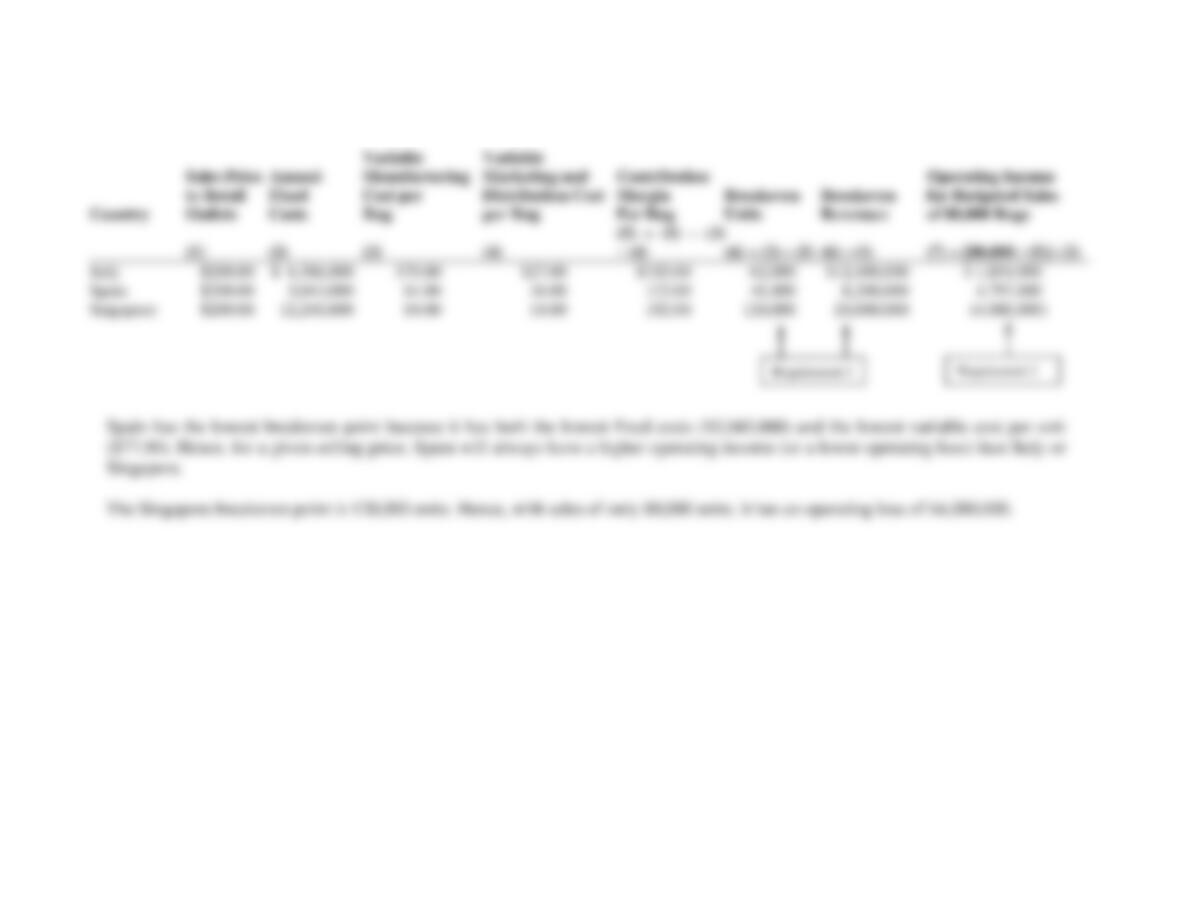
1. Compute the breakeven point for Plush Decor, Inc., in each country in (a) units sold and (b)
revenues.
2. If Plush Decor, Inc., plans to produce and sell 80,000 rugs in 2014, what is the budgeted
operating in-come for each of the three manufacturing locations? Comment on the results.
3-16
SOLUTION
3-17
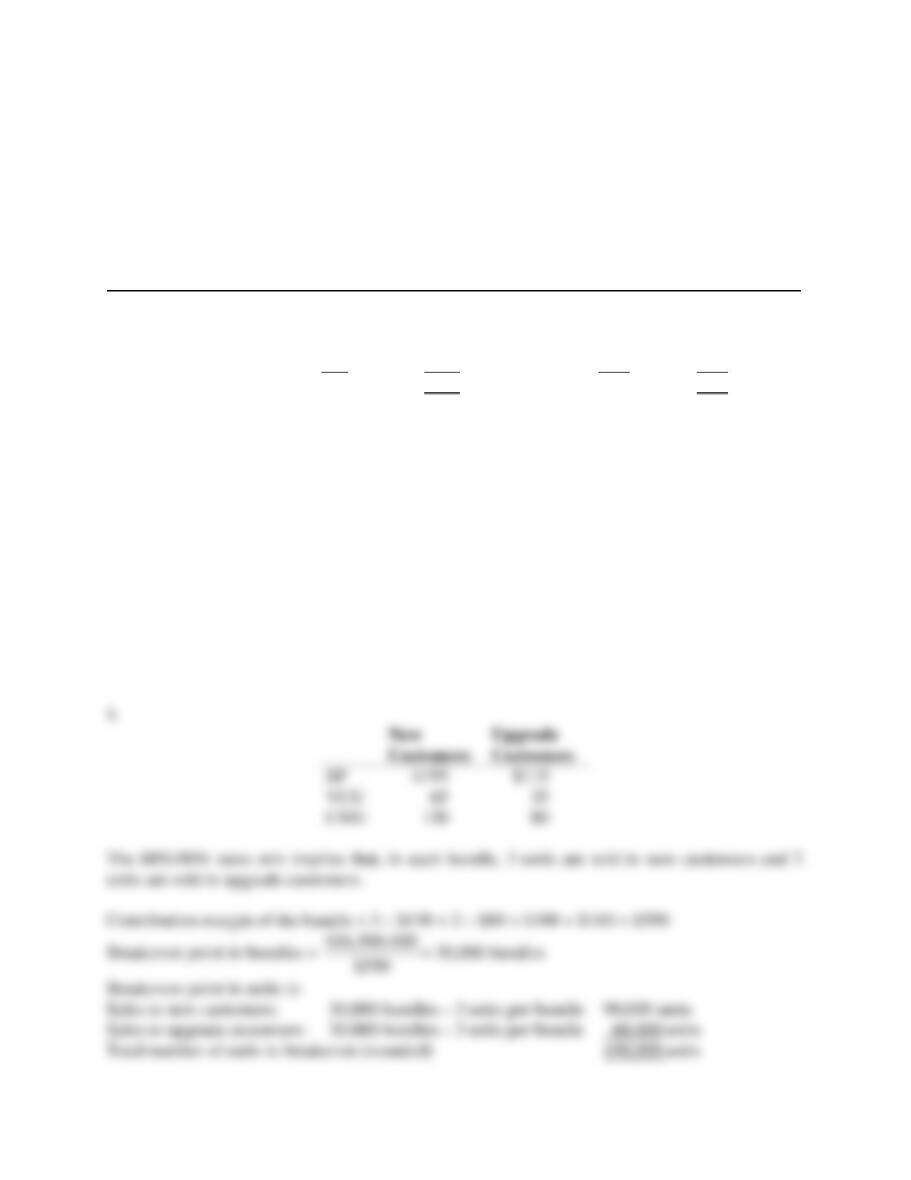
3-27 (30 min.) Sales mix, new and upgrade customers.
Chartz 1-2-3 is a top-selling electronic spreadsheet product. Chartz is about to release version
5.0. It divides its customers into two groups: new customers and upgrade customers (those who
previously purchased Chartz 1-2-3 4.0 or earlier versions). Although the same physical product
is provided to each customer group, sizable differences exist in selling prices and variable
marketing costs:
New Customers Upgrade Customers______
Selling price $195 $115
Variable costs
Manufacturing $15 $15
Marketing 50 65 20 35
Contribution margin $130 $ 80
The fixed costs of Chartz 1-2-3 5.0 are $16,500,000. The planned sales mix in units is 60% new
customers and 40% upgrade customers.
Required:
1. What is the Chartz 1-2-3 5.0 breakeven point in units, assuming that the planned 60%>40%
sales mix is attained?
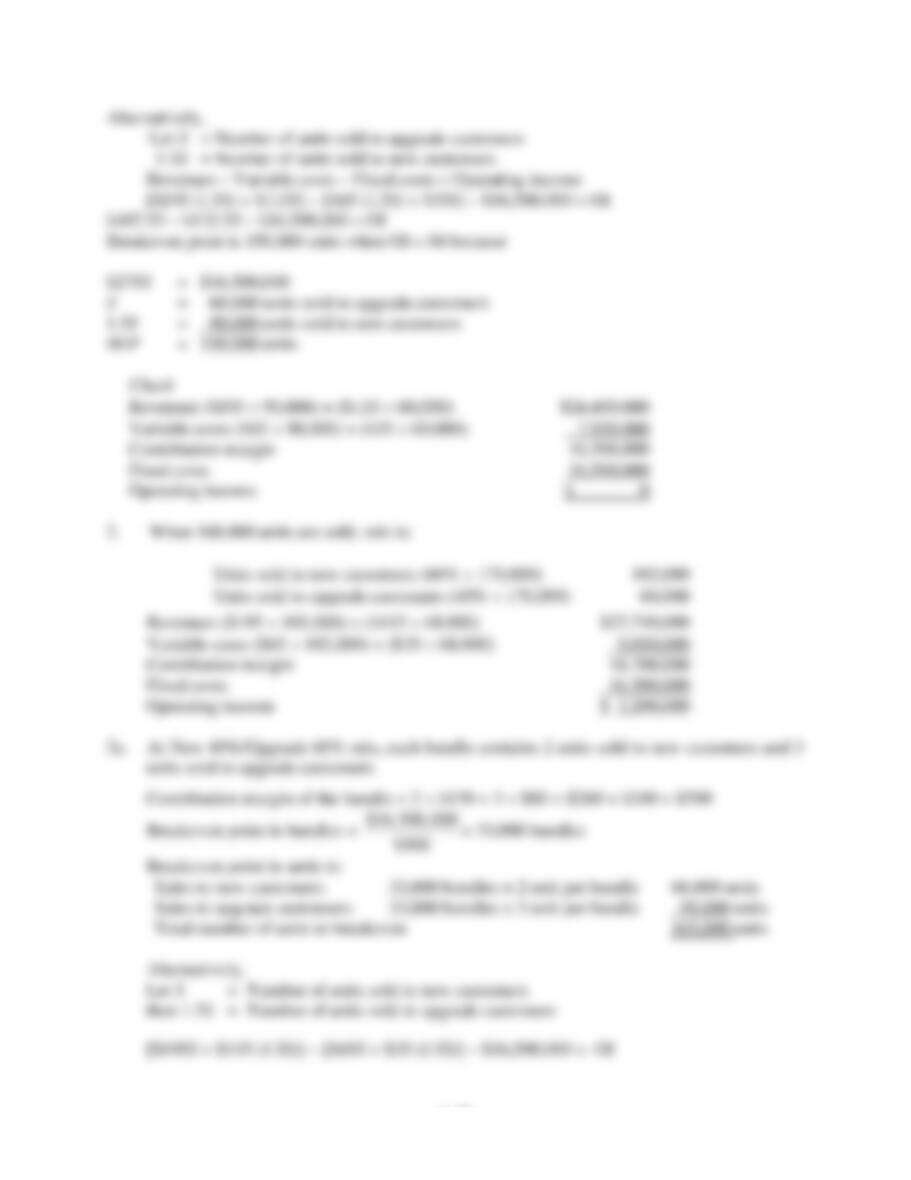
2. If the sales mix is attained, what is the operating income when 170,000 total units are sold?
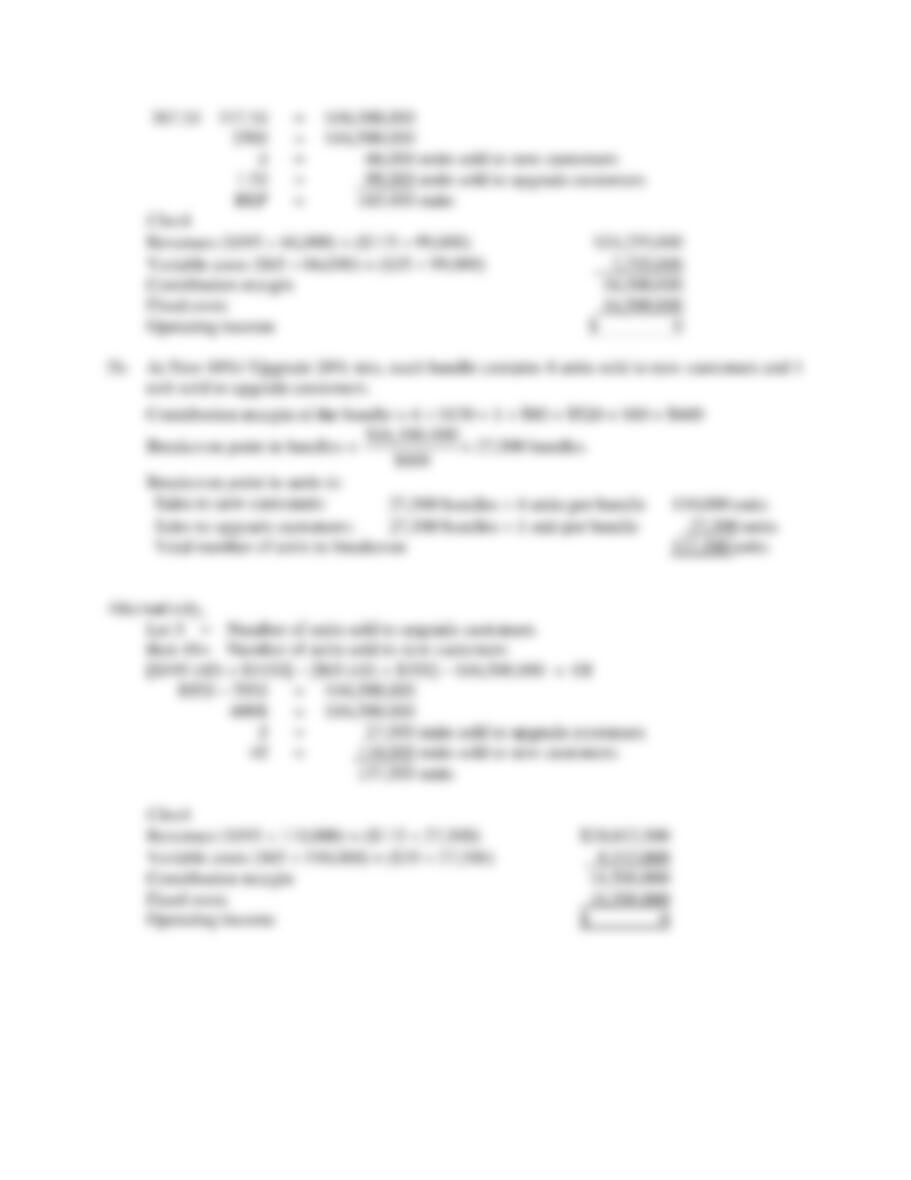
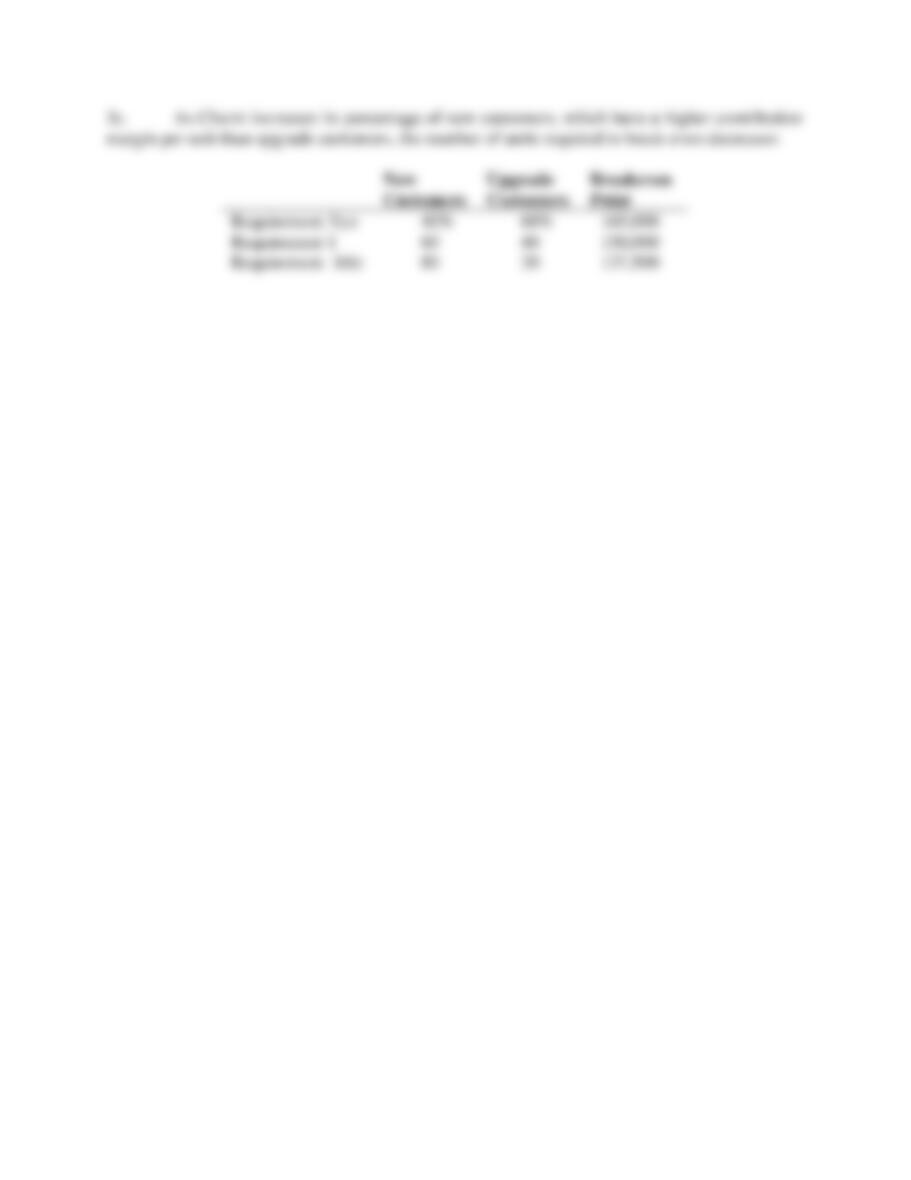
3. Show how the breakeven point in units changes with the following customer mixes:
a. New 40% and upgrade 60%
b. New 80% and upgrade 20%
c. Comment on the results.
SOLUTION
3-18
3-19
3-20