3-1
CHAPTER 3
The Accounting Information System
Learning Objectives
1. Analyze the effect of business transactions on the basic accounting equation.
2. Explain what an account is and how it helps in the recording process.
3. Define debits and credits and explain how they are used to record business transactions.
4. Identify the basic steps in the recording process.
5. Explain what a journal is and how it helps in the recording process.
3-2
Chapter Outline
Learning Objective 1 – Analyze the Effect of Business Transactions on the Basic
Accounting Equation
Accounting Information System
▪ collects and processes transactions.
▪ communicates financial information to decision makers.
▪ Factors that shape the Accounting Information System include:
o nature of the company’s business
o types of transactions
o company size
Accounting Transactions
▪ economic events that require recording in the financial statements
▪ occur when assets, liabilities, or stockholders’ equity items change as a result of
some economic event
TEACHING TIP
Provide students with examples of external events—the purchase of equipment, payment of
Analyzing Transactions—Transaction analysis – the process of identifying the specific
effects of economic events on the accounting equation
▪ The accounting equation must always balance
▪ Each transaction has a dual effect on the equation
TEACHING TIP
Illustrate transaction analysis by going through events 1–11 for Sierra Corporation. These are
the transactions that led to the financial statements shown in Chapter 1.
1. On October 1, cash of $10,000 is invested in the business by investors, in exchange for
$10,000 of Sierra Corporation common stock. Both Cash (an asset) and Common Stock
3-3
3. On October 2, Sierra purchased equipment by paying $5,000 cash to Superior
Equipment Sales Co. An equal increase and decrease in Sierra’s assets occur. Cash
decreases by $5,000 and Equipment increases by $5,000.
4. On October 2, Sierra received a $1,200 cash advance from R. Knox, a client, for guide
services for multi-day trips that are expected to be completed in the future. Both Cash
6. On October 3, Sierra paid its office rent for the month of October in cash, $900. Both
Cash and stockholders equity (Rent Expense) decrease. Expenses decrease
stockholders’ equity.
7. On October 4, Sierra paid $600 for a one-year insurance policy that will expire next year
on September 30. Cash decreases and another asset Prepaid Insurance increases.
Summarize these by using Illustration 3-3: see page 110 in the text.
TEACHING TIP
Students struggle with the difference between Supplies and Supplies Expense. Take time to
explain that supplies are recorded as an asset because they are available for future use.
TEACHING TIP
3-4
Summary of Transactions
▪ Each transaction is analyzed in terms of its effect on assets, liabilities, and
stockholders’ equity.
Learning Objective 2 – Explain What an Account is and How it Helps in the
Recording Process
Account – an individual accounting record of increases and decreases in a specific asset,
liability, or stockholders’ equity item.
▪ An account consists of three parts: (1) the title of the account, (2) a left or debit
side, and (3) a right or a credit side.
▪ In its simplest form it is referred to as a T account because the alignment of the
parts of the account resembles the letter T.
TEACHING TIP
Draw a T account on the board, in Excel or on an overhead transparency and show students
the three parts. Explain to students that we are able to evaluate and record Sierra’s
transactions using the extended balance sheet equation. However, there are only ten
TEACHING TIP
Tell students to use proper account titles in their journal entries and for their T accounts.
They should not use phrases such as ‘paid cash’, ‘bought supplies’, ‘performed services’ as
Learning Objective 3 – Define Debits and Credits and Explain How They are Used
to Record Business Transactions
Debits and Credits—The term debit means left, and credit means right. They DO NOT
mean increase or decrease.
▪ Debit is abbreviated Dr. and credit is abbreviated Cr.
3-5
Debit and Credit Procedures—Each transaction must affect two or more accounts to
keep the basic accounting equation in balance.
▪ Under the double-entry system the equality of debits and credits keeps the
equation balanced.
▪ The two-sided effect of each transaction is recorded in appropriate accounts.
▪ This helps to ensure the accuracy of the recorded amounts and helps to detect errors.
▪ Dr./Cr. Procedures for Assets and Liabilities
▪ The normal balance of an account is on its increase side
o The normal balance for Assets, Dividends, and Expenses is a debit balance.
o The normal balance for Liabilities, Common Stock, and is a credit balance.
▪ Stockholders’ Equity Relationships
o Common stock and retained earnings: in the stockholders’ section of the balance
See Illustration 3-16 on page 116 of the text for a Summary of the debit/credit rules.
TEACHING TIP
Show students how to record transactions in the account using the information for Sierra that
was entered in the extended balance sheet equation.
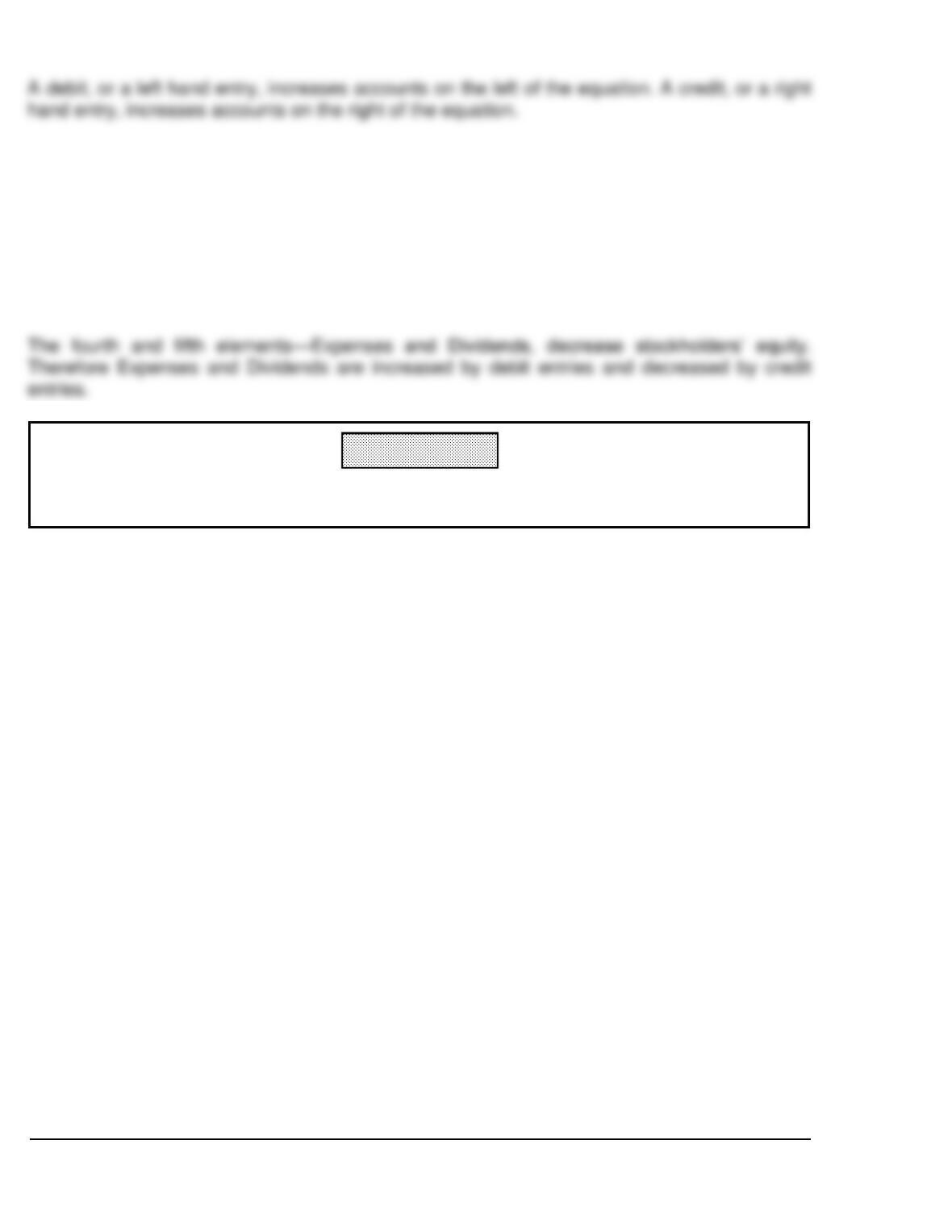
On October 1, cash of $10,000 is invested in the business by investors, in exchange for
$10,000 of Sierra Corporation common stock. Both Cash and Common Stock would increase
by $10,000.
Cash
Common Stock
3-6
Now think of the elements in Stockholders’ Equity. Three of these elements:
Common Stock,
Retained Earnings, and
Revenue
increase stockholders’ equity. Therefore these three accounts—Common Stock, Retained
Earnings, and Revenue are increased by credit entries and decreased by debit entries.
TEACHING TIP
Many students work in banks and have trouble with the rules of debits and credits. Explain
why they view the rules differently.
3-7
Learning Objective 4 – Identify the Basic Steps in the Recording Process
Steps in the Recording Process—The basic steps in the accounting process are used
by most businesses in the recording process. The steps are:
▪ Analyze each transaction in terms of its effect on the accounts. A source
Learning Objective 5 – Explain What A Journal is and How it Helps in the
Recording Process
The Journal—Transactions are initially recorded in chronological order in
journals before they are transferred to the accounts.
▪ The journal shows the debit and credit effects on specific accounts for each
transaction.
▪ Companies may use various types of journals, but every company has the most
basic form of journal, a general journal.
▪ Entering transaction data in the journal is known as journalizing.
▪ The journal makes three significant contributions to the recording process:
○ The journal discloses in one place the complete effect of a transaction.
TEACHING TIP
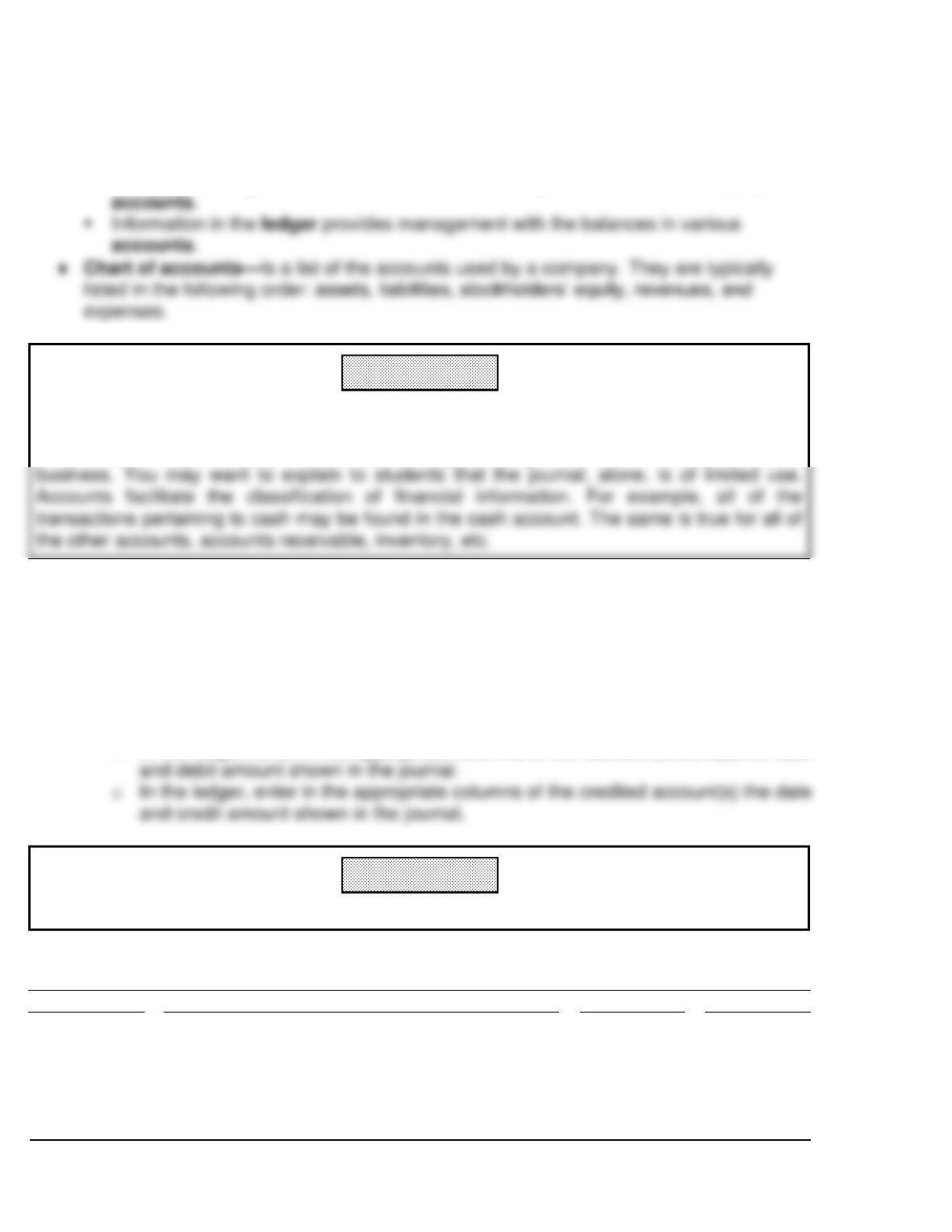
Show students examples of proper journal entries. Return to the example of Sierra. On
October 1, cash of $10,000 is invested in the business by investors, in exchange for $10,000
of Sierra Corporation common stock. Both Cash and Common Stock would increase by
$10,000. This transaction would be recorded in the following manner:
Date
Account Titles and Explanation
Debit
Credit
10/1
Cash ……………………………………………………………
10,000
Common Stock………………………………………..
(Issued stock for cash)
See Illustration 3-18 on page 118 of the text for more examples related to the Sierra
example.
3-8
Learning Objective 6 – Explain What a Ledger is and How it Helps in the
Recording Process
The Ledger—The entire group of accounts maintained by a company is referred to as
the ledger.
▪ The general ledger contains all of the asset, liability and stockholders’ equity
TEACHING TIP
What is a journal? Where have you heard this term before? We typically think of foreign
correspondents keeping journals. Journals are actually diaries. We can think of the journal
used in accounting as a diary that has a chronological listing of the financial transactions of a
the other accounts, accounts receivable, inventory, etc.
Learning Objective 7 – Explain What Posting is and How it Helps in the Recording
Process
Posting—the process of transferring journal entries to the ledger accounts.
▪ Posting accumulates the effects of journal transactions in the individual ledger
accounts. It involves these steps.
o In the ledger, enter in the appropriate columns of the debited account(s) the date
TEACHING TIP
Show journal entries for each of the transactions analyzed earlier.
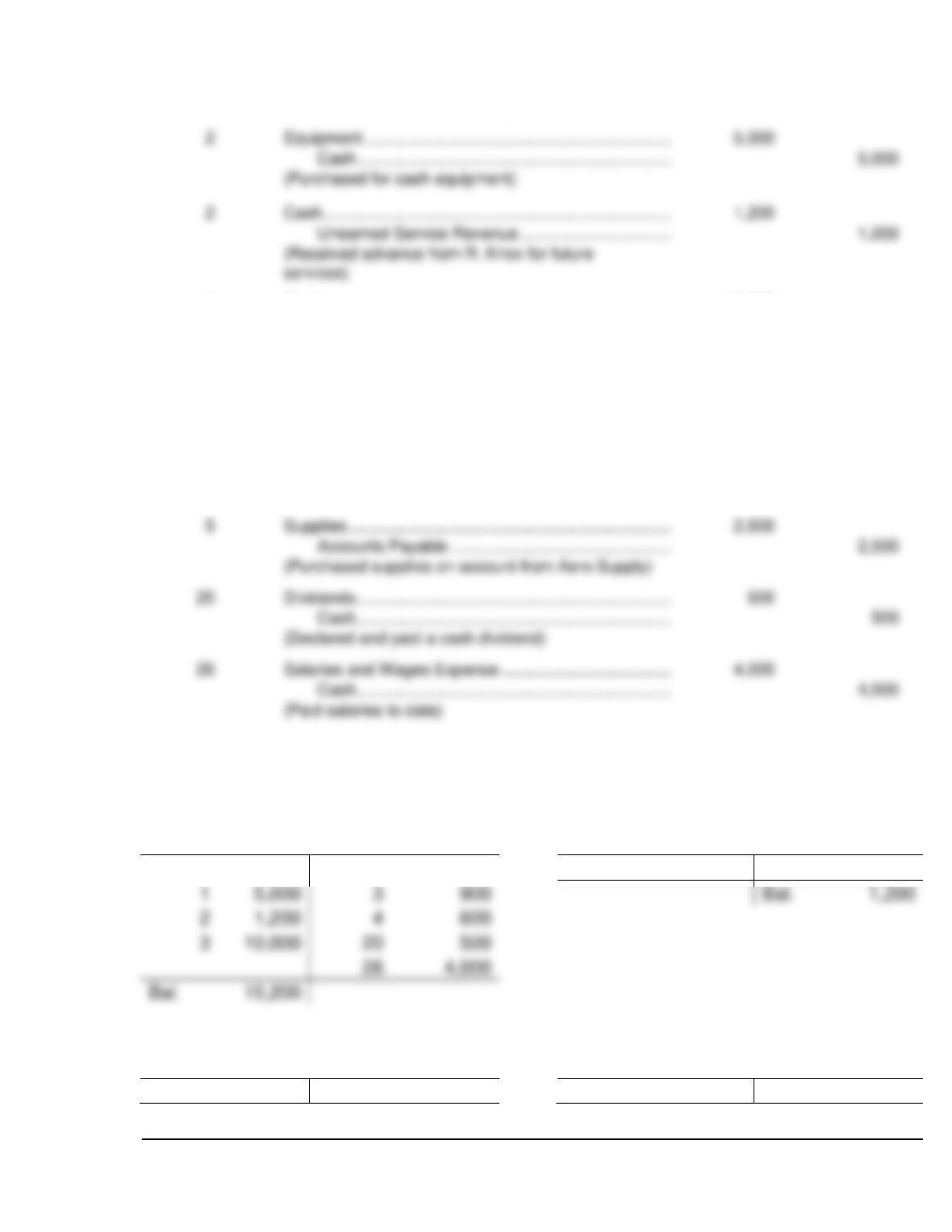
GENERAL JOURNAL
Date
Account Titles and Explanation
Debit
Credit
2014
Oct 1
Cash ………………………………………………………………………..
10,000
Common Stock …………………………………………………..
10,000
(Issued stock for cash)
3-9
1
Cash ………………………………………………………………………..
5,000
Notes Payable ……………………………………………………
5,000
(Issued 3-month, 12% note payable for cash)
2
Equipment ………………………………………………………………..
5,000
Cash …………………………………………………………………
5,000
(Purchased for cash equipment)
2
Cash ………………………………………………………………………..
1,200
Unearned Service Revenue …………………………………
1,200
3
Cash ………………………………………………………………………..
10,000
Service Revenue ………………………………………………..
10,000
(Received cash for services provided)
3
Rent Expense ……………………………………………………….
900
Cash …………………………………………………………………
900
(Paid cash for October office rent)
4
Prepaid Insurance……………………………………………………..
600
Cash …………………………………………………………………
600
(Paid 1-year policy; effective date October 1)
5
Supplies …………………………………………………………………..
2,500
Accounts Payable ………………………………………………
2,500
(Purchased supplies on account from Aero Supply)
Dividends …………………………………………………………………
500
Cash …………………………………………………………………
500
(Declared and paid a cash dividend)
Salaries and Wages Expense …………………………………….
4,000
Cash …………………………………………………………………
4,000
(Paid salaries to date)
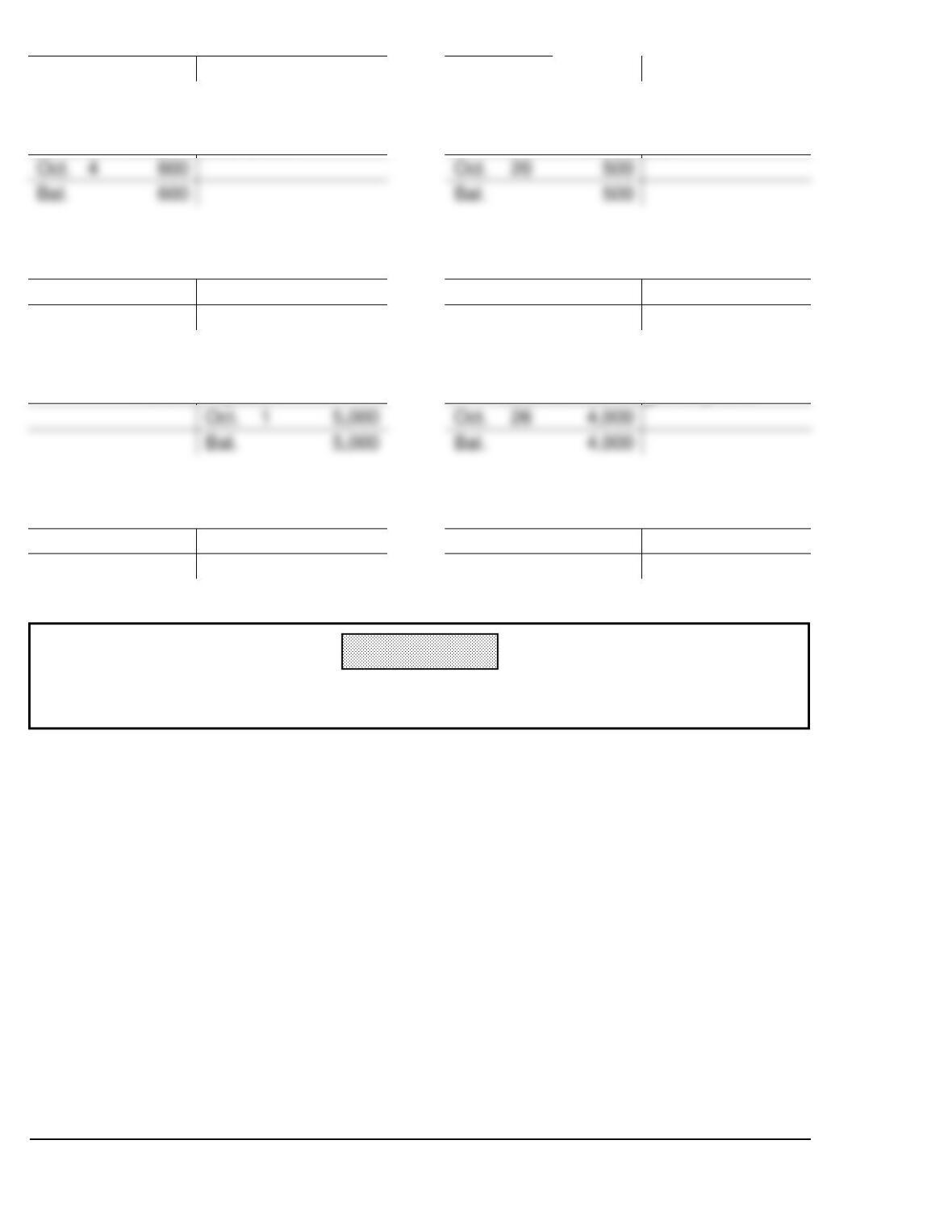
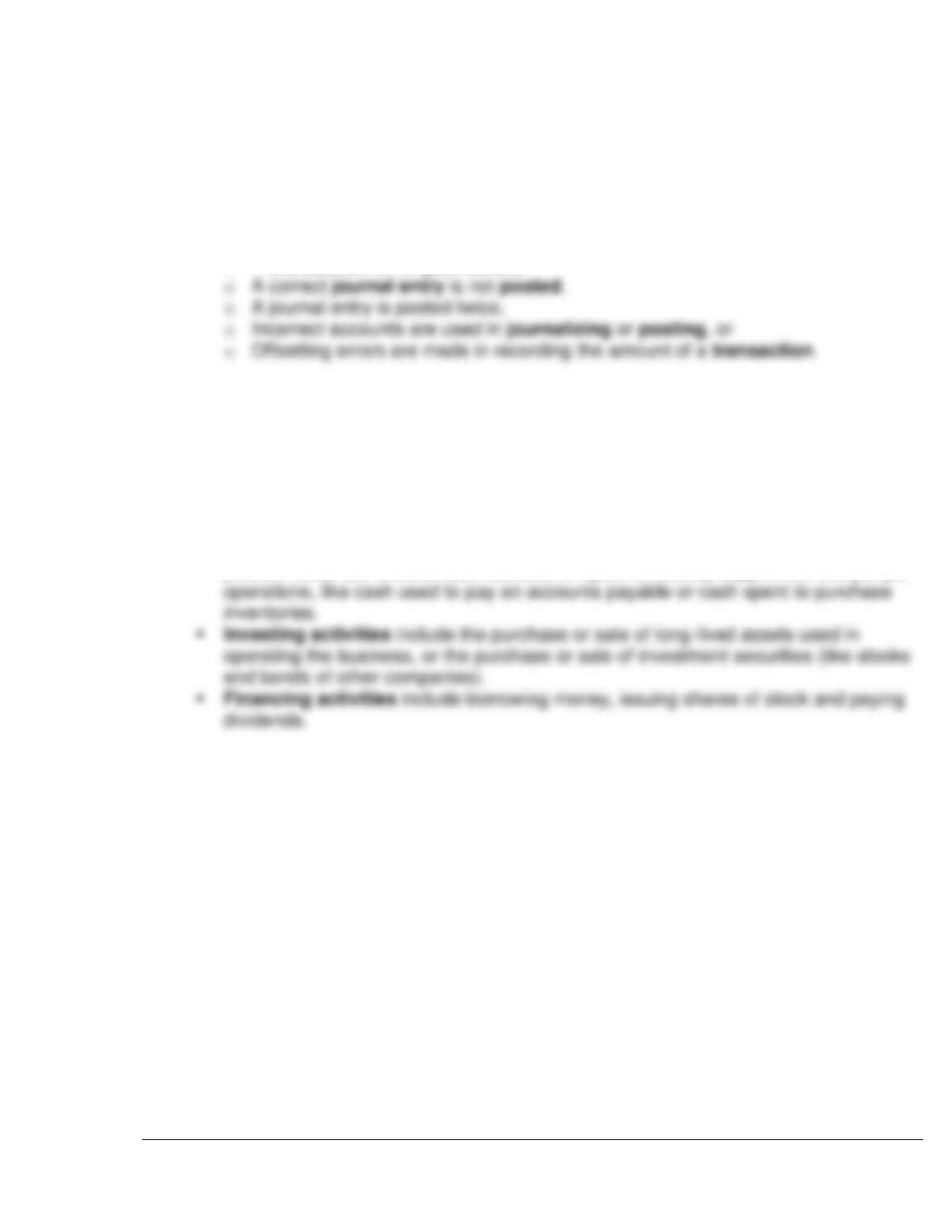
GENERAL LEDGER
Cash
Unearned Service Revenue
Oct. 1
10,000
Oct. 2
5,000
Oct. 2
1,200
1
3
Bal.
2
4
3
10,000
Bal.
15,200
Supplies
Common Stock
Oct. 5
2,500
Oct. 1
10,000
3-10
Bal.
2,500
Bal.
10,000
Prepaid Insurance
Dividends
Oct. 4
Oct. 20
Bal.
600
Bal.
500
Equipment
Service Revenue
Oct. 2
5,000
Oct. 3
10,000
Bal.
5,000
Bal.
10,000
Notes Payable
Salaries and Wages Expense
Oct. 1
Oct. 26
4,000
Bal.
Bal.
4,000
Accounts Payable
Rent Expense
Oct. 5
2,500
Oct. 3
900
Bal.
2,500
Bal.
900
TEACHING TIP
Ask students to compare the information in the General Journal with the information in the
General Ledger. Which is more useful?
3-11
Learning Objective 8 – Explain the Purposes of a Trial Balance
The trial balance—list accounts and their balances on a specific date.The primary purpose
of the trial balance is to prove the mathematical equality of debits and credits after
posting.
A trial balance
▪ uncovers errors in journalizing and posting.
▪ is useful in the preparation of financial statements.
▪ is limited in that it will balance but not uncover errors when:
o A transaction is not journalized.
Learning Objective 9 – Classify Cash Activities as Operating, Investing, or
Financing.
Keeping An Eye On Cash—The Statement of cash flows categorizes the inflows and
outflows of cash during in a given period into three types of activities.
▪ Operating activities are the types of activities the company performs to generate
profits. These can include cash received or spent to directly support the company’s
3-12
IFRS
A Look at IFRS
International companies use the same set of procedures and records to keep track of
transaction data. Thus, the material in Chapter 3 dealing with the account, general rules of
debit and credit, and steps in the recording process—the journal, ledger, and chart of
accounts—is the same under both GAAP and IFRS.
KEY POINTS
• Transaction analysis is the same under IFRS and GAAP but, as you will see in later
chapters, different standards sometimes impact how transactions are recorded.
• Rules for accounting for specific events sometimes differ across countries. For example,
European companies rely less on historical cost and more on fair value than U.S.
• A trial balance under IFRS follows the same format as shown in the textbook.
• As shown in the textbook, dollars signs are typically used only in the trial balance and
the financial statements. The same practice is followed under IFRS, using the currency
of the country that the reporting company is headquartered.
• In February 2010, the SEC expressed a desire to continue working toward a single set
of high-quality standards. In deciding whether the United States should adopt IFRS,
some of the issues the SEC said should be considered are:
▪ Whether IFRS is sufficiently developed and consistent in application.
▪ Whether the IASB is sufficiently independent.
▪ Whether IFRS is established for the benefit of investors.
LOOKING TO THE FUTURE
The basic recording process shown in this textbook is followed by companies across the globe.
It is unlikely to change in the future. The definitional structure of assets, liabilities, equity,
revenues, and expenses may change over time as the IASB and FASB evaluate their overall
conceptual framework for establishing accounting standards.
3-13
Chapter 3 Review
✓ What is the basic accounting equation? How do business transactions effect the basic
accounting equation?
✓ What is an account and how does it help in the recording process?
✓ Define debit and credit and explain how they are used to record business transactions.
✓ What are the basic steps in the recording process?
✓ What is a journal? How does it help in the recording process?
✓ What is a ledger? How does it help in the recording process?