PROBABILITY
22 CHAPTER 3/PROBABILITY
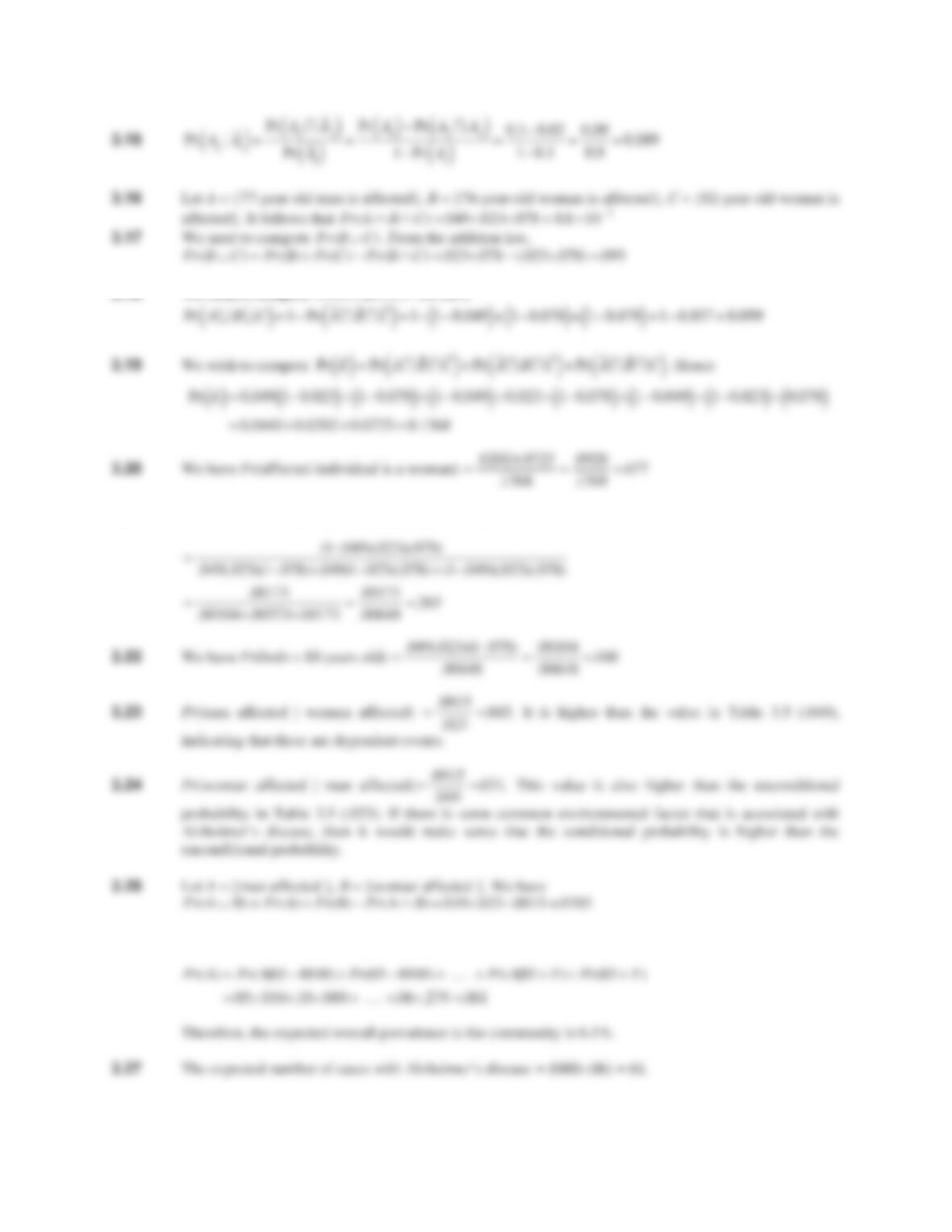
3.18 We wish to compute . We have
3.21 We have Pr(both affected individuals are women)
3.26 Let Pr(A) denote the overall probability of Alzheimer’s disease. We have that
P
r
A
B
C
r
C
r
C
r
r
C
r
C
CHAPTER 3/PROBABILITY 23
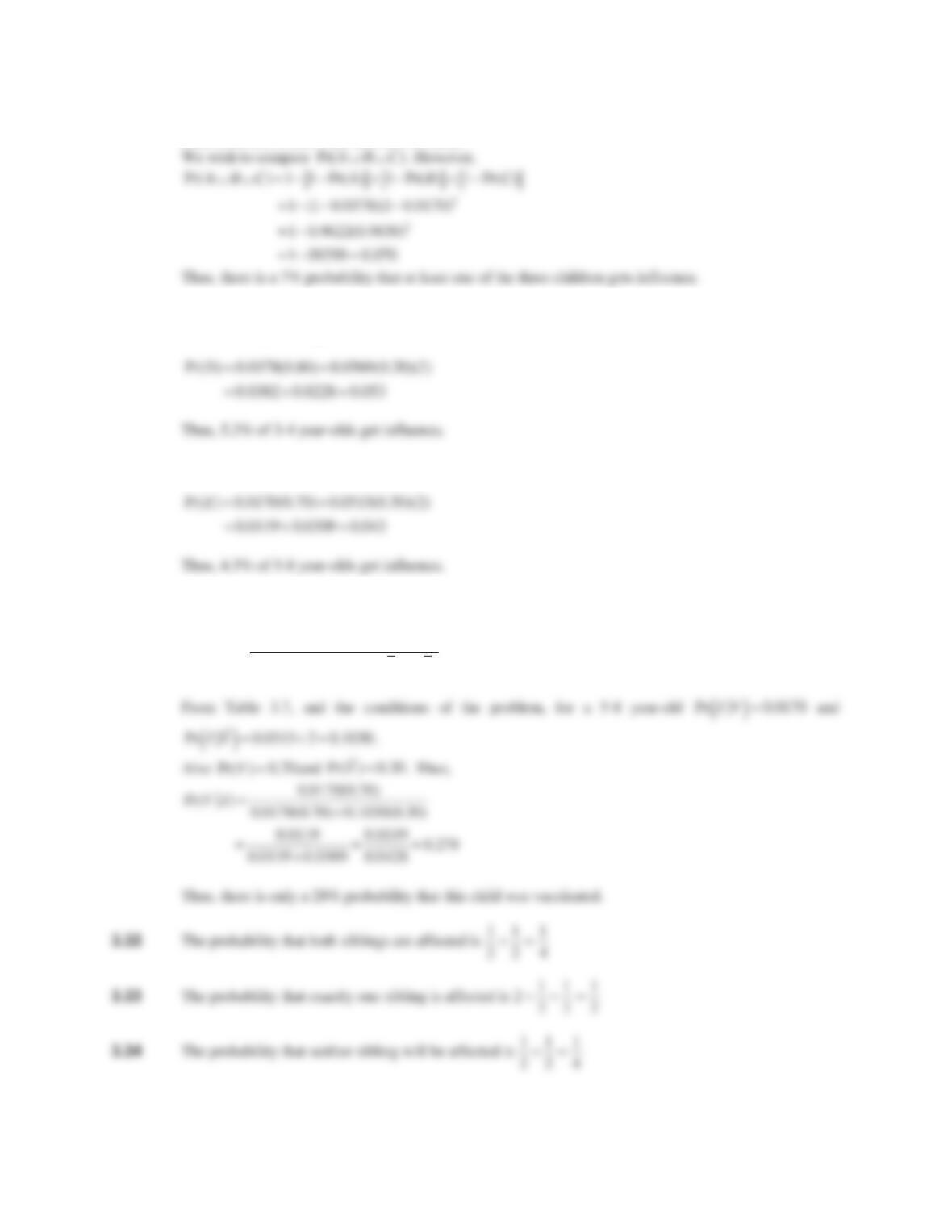
3.28 Let A, B, and C represent influenza status for the 3, 5, and 7 year-old, where A=1 if influenza, A=0
otherwise, and B and C are defined similarly.
3.29 We use the total probability rule.
Let D = 3-4 year-old get influenza. We have:
3.30 Let E = 5-8 year-old get influenza. We have:
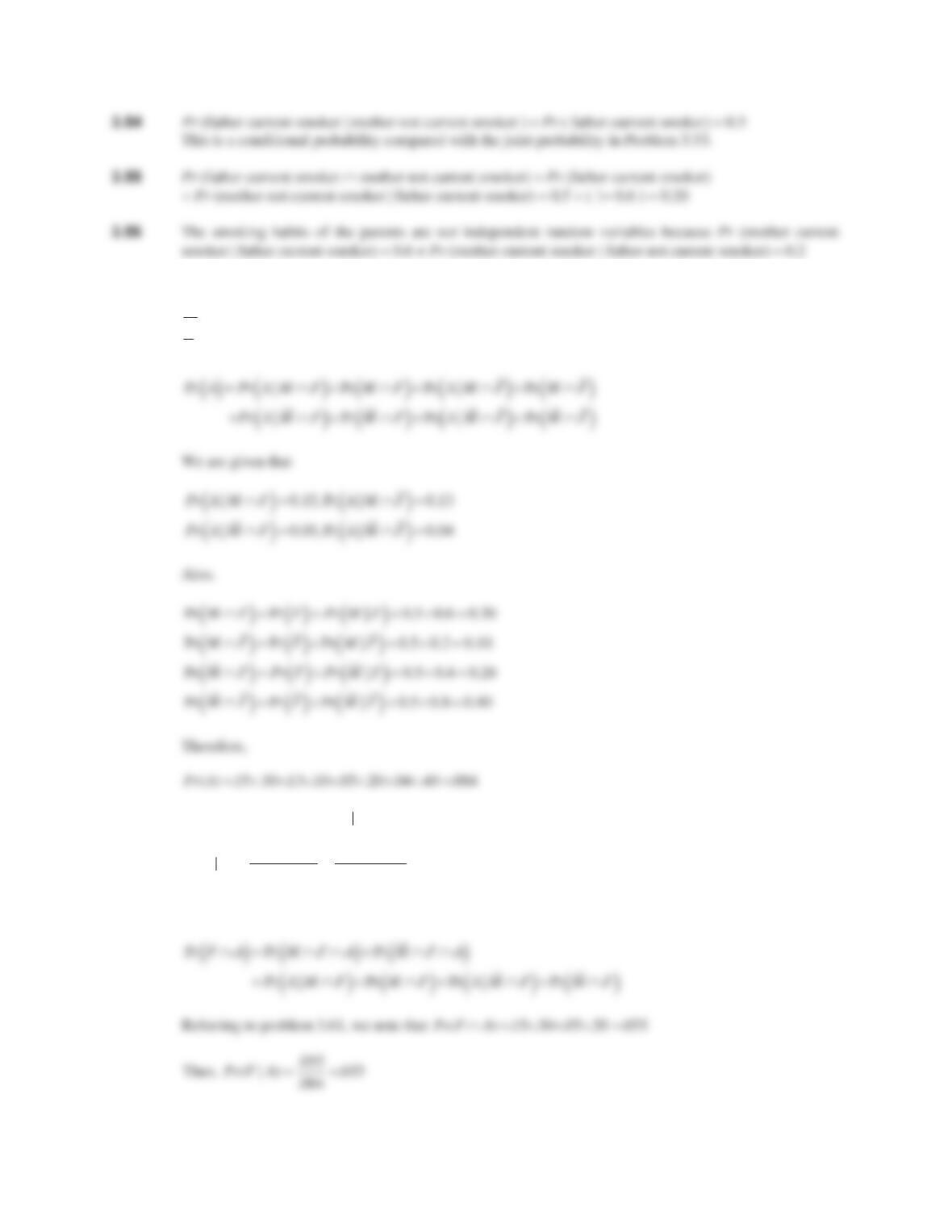
3.31 We use Bayes’ Theorem. Let V = child is vaccinated, and I = child gets influenza. We wish to compute
P
r
(
V
|
I
).
We have: From table
Pr(V|I) Pr(I|V)Pr(V)
Pr(I|V)Pr(V)Pr(I|V)Pr(V)
24 CHAPTER 3/PROBABILITY
3.35 The probability that the younger child is affected should not be influenced by whether or not the older
©
¹
©
¹
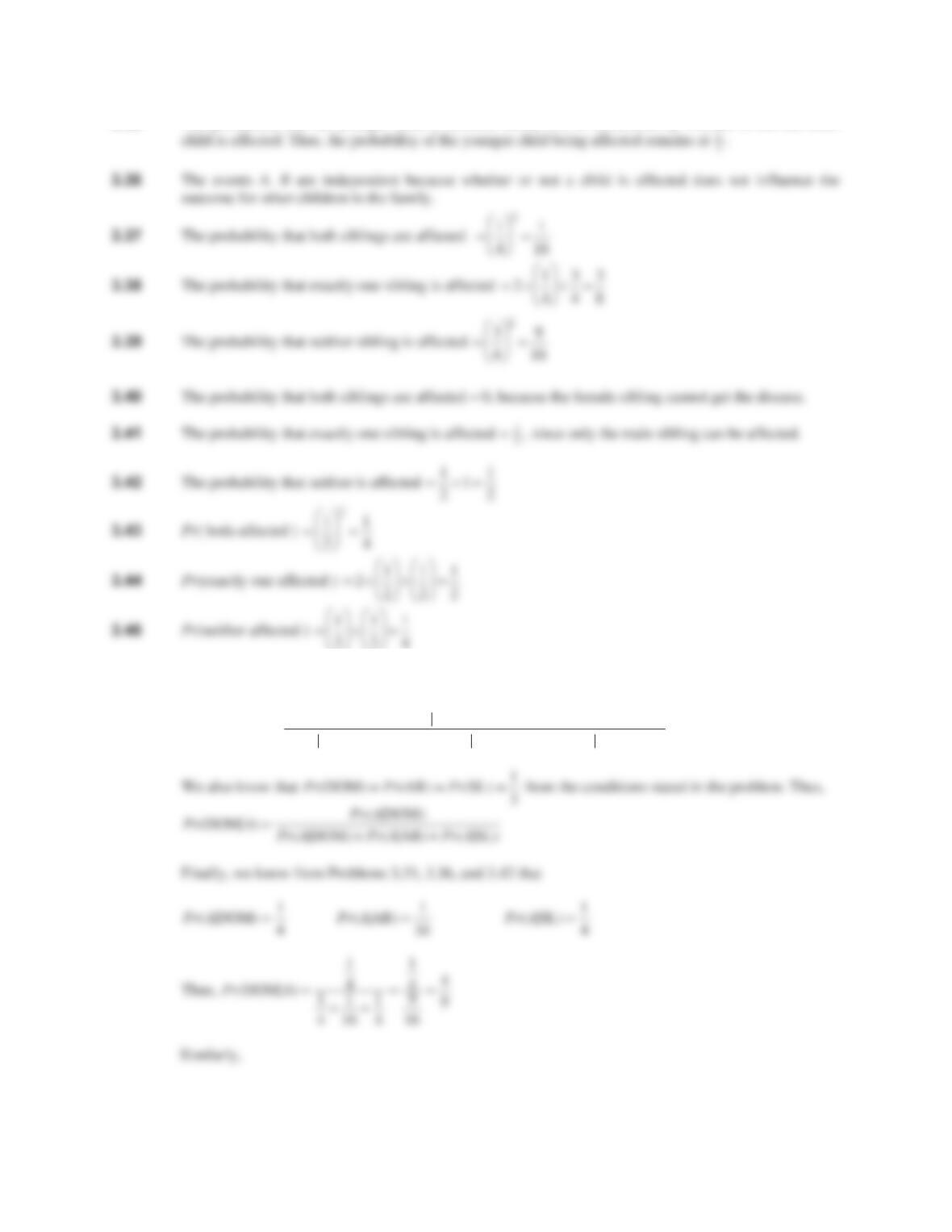
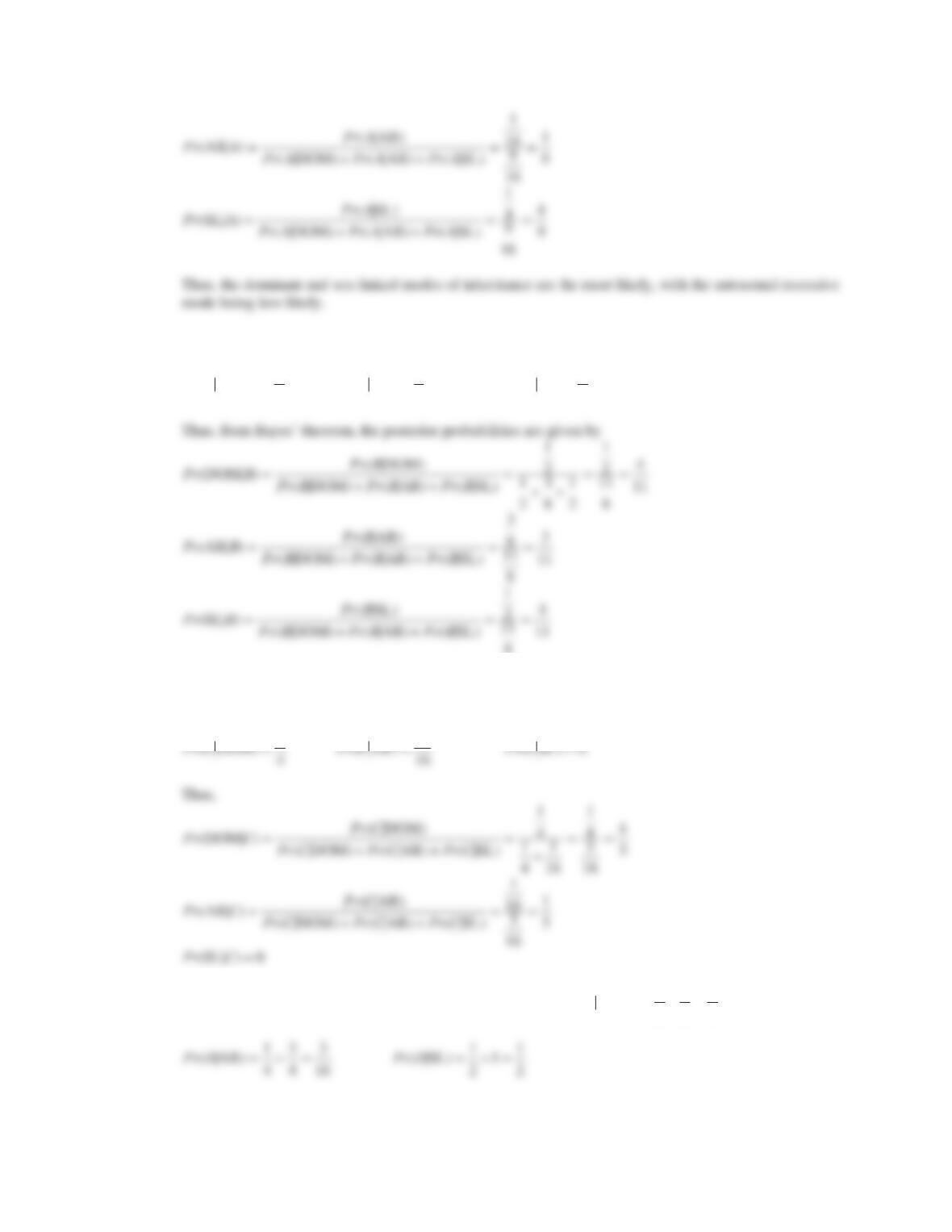
3.46 Bayes’ theorem is used here. Dominant is denoted by DOM, autosomal recessive by AR, and sex-linked
by SL. Let A be the event that two male siblings are affected. The posterior probability is given by
r
A
Pr A P
r
A
P
r
Pr A Pr Pr A Pr Pr A Pr
(DOM ) DOM DOM
DOM DOM AR AR SL SL
_ u
CHAPTER 3/PROBABILITY 25
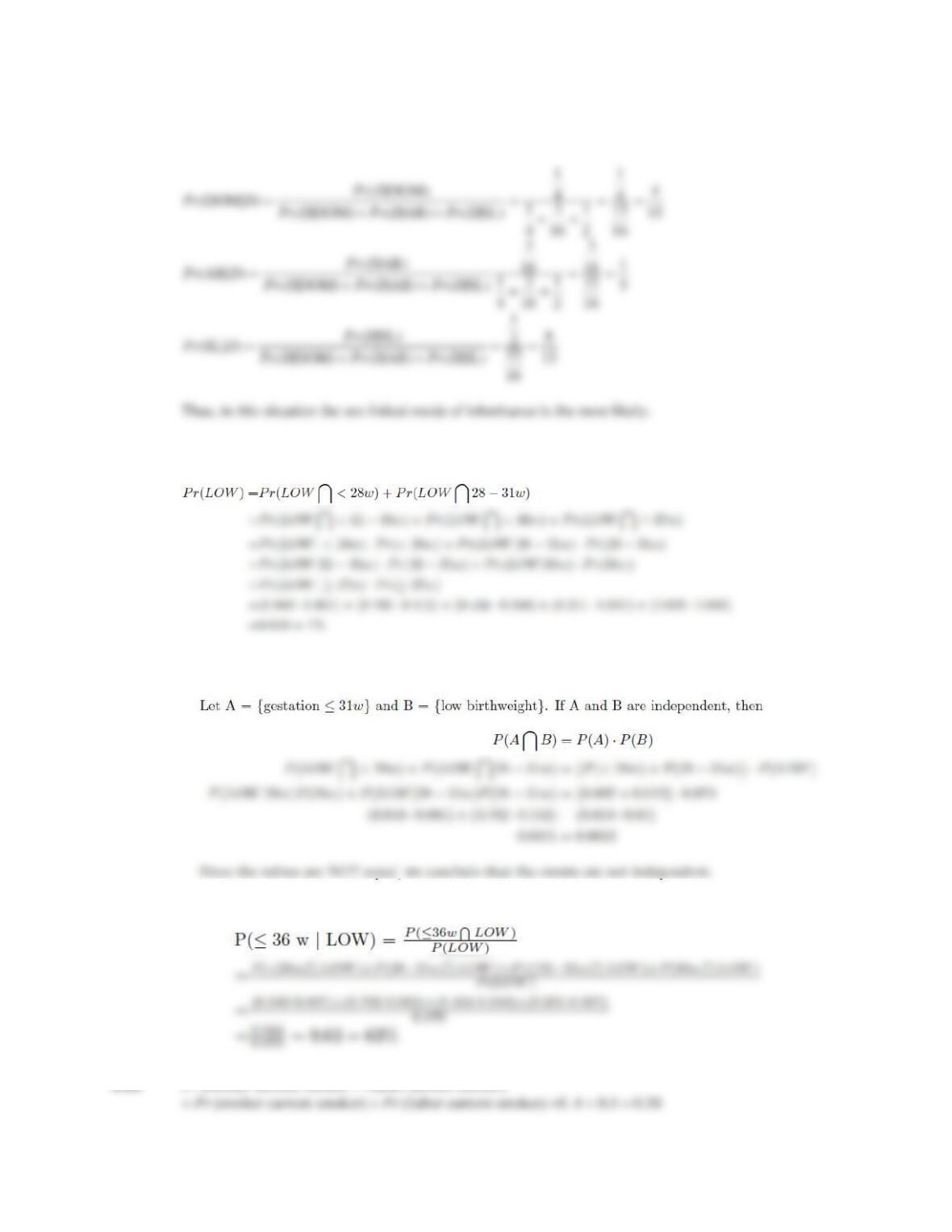
3.47 Let B {exactly one of two male siblings is affected}. From Problems 3.32, 3.37, and 3.43,
8
Here the three genetic types are about equally likely.
3.48 Let C {both one male and one female sibling are affected}. The sex of the siblings is only relevant for
sex-linked disease. Thus, from Problems 3.31, 3.36, and 3.39,
3.49 Let D {male sibling affected, female sibling not affected}.
Pr B DOM
1
2Pr B AR
3
8Pr BSL
1
2
Pr D DOM
u
1
2
1
2
1
4
26 CHAPTER 3/PROBABILITY
Notice that the event D is not the same as the event that exactly one sibling is affected, since we are
specifying which of the two siblings is affected. We have
3.50
3.51
3.52
3.53 Pr (mother current smoker father current smoker)
CHAPTER 3/PROBABILITY 27
3.57 Let A {child has asthma}, M {mother current smoker},
,
r
A
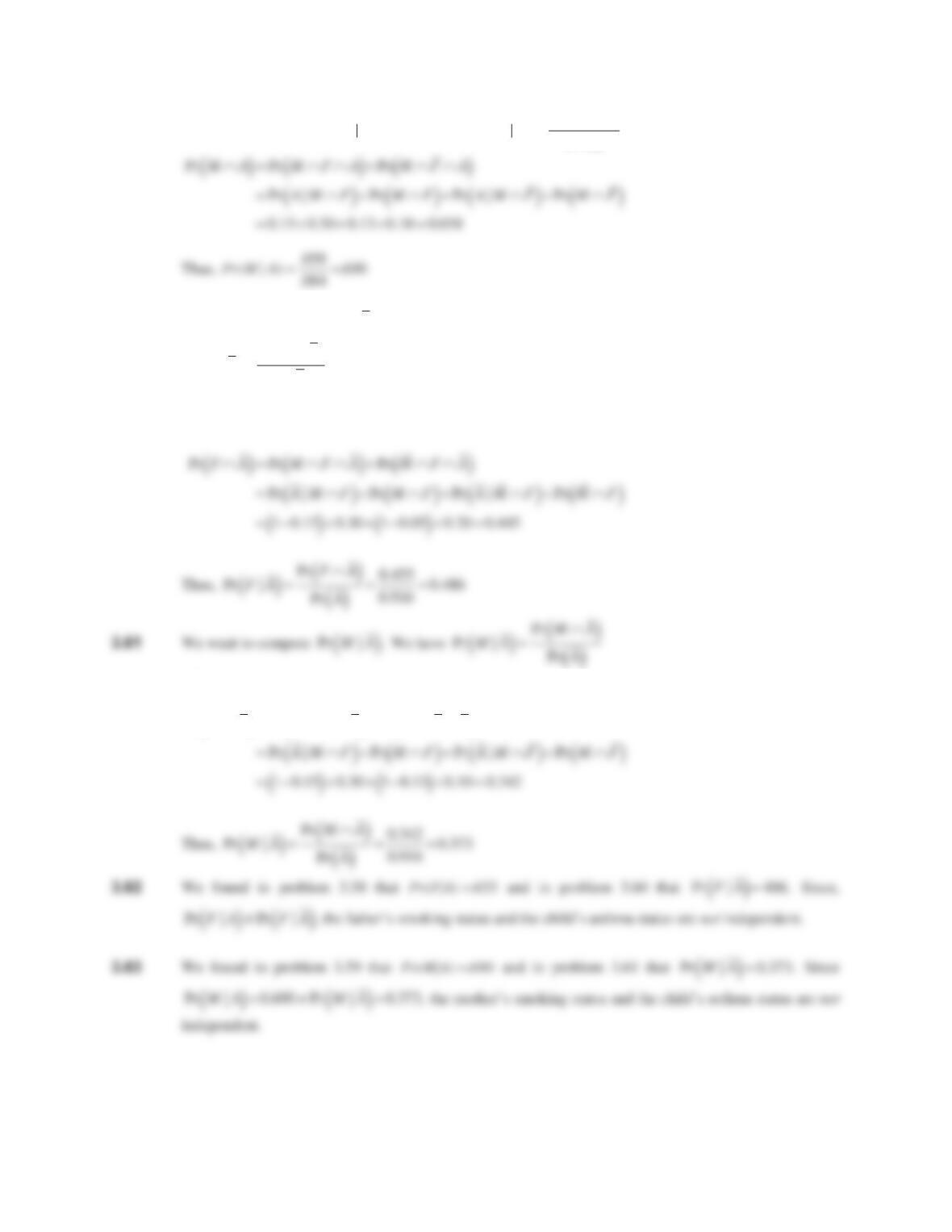
3.58 We want to compute We have from the definition of conditional probability that
Furthermore,
r
F
A
MF = {mother not current smoker} father current smoker},{
FPrA
{father not current smoker} We want We have that..
P
r
F
A
.
Pr F A P
r
F
Pr A
P
r
F
() .
A A
084
28 CHAPTER 3/PROBABILITY
3.59 We want to compute We have that
3.60 We want to compute
Pr F|A
. We have that
Pr F|A
Pr FA
Pr A
where
where
Pr MA
Pr MFA
Pr MFA
P
r
M
A
.Pr M A P
r
M
A
Pr A
where
CHAPTER 3/PROBABILITY 29
3.64 Let
A
5
cotinine dried blood of
t
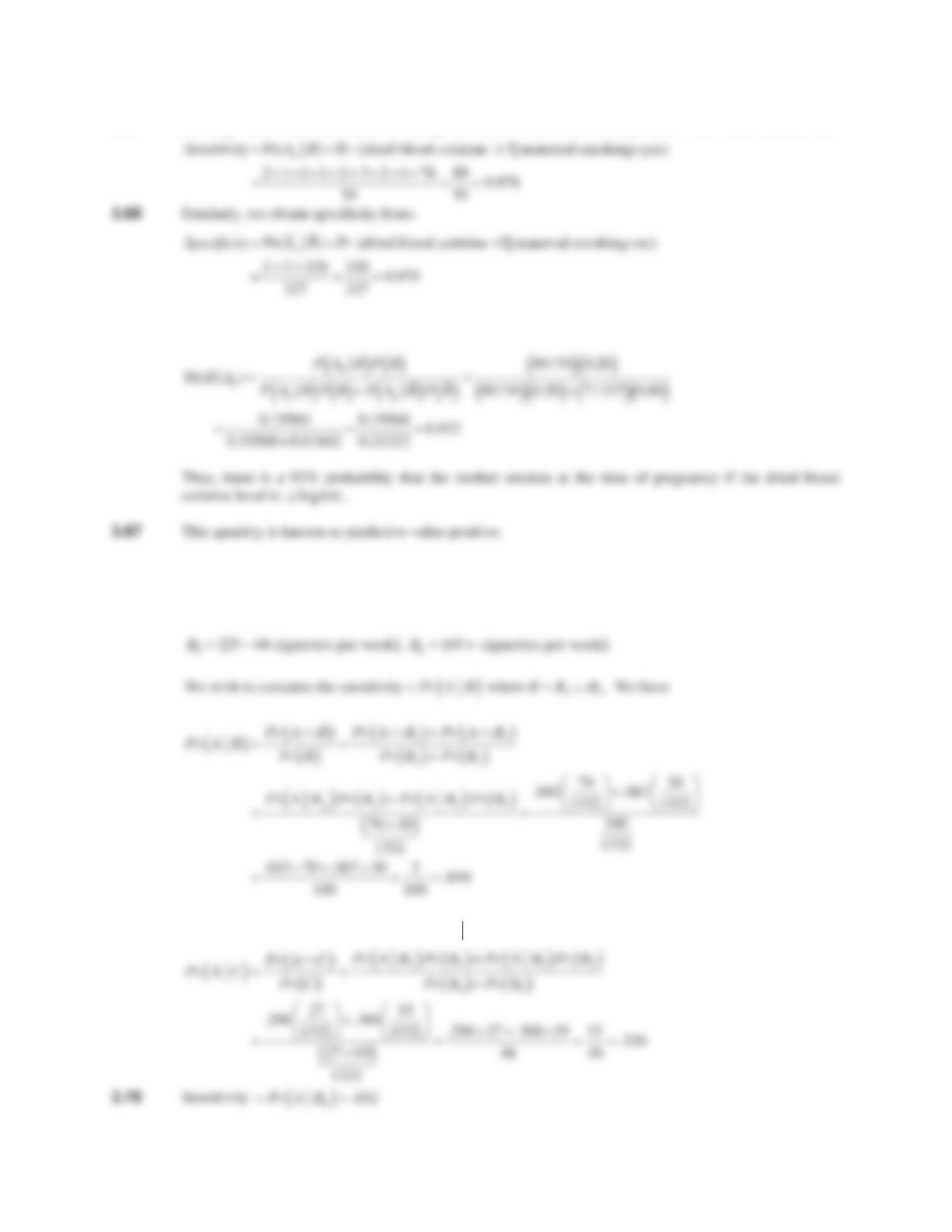
5ng/mL Let B = maternal smoking = yes. From Table 3.9, we have
3.66 From Bayes’ Theorem, we have
3.68
^
`
^
`
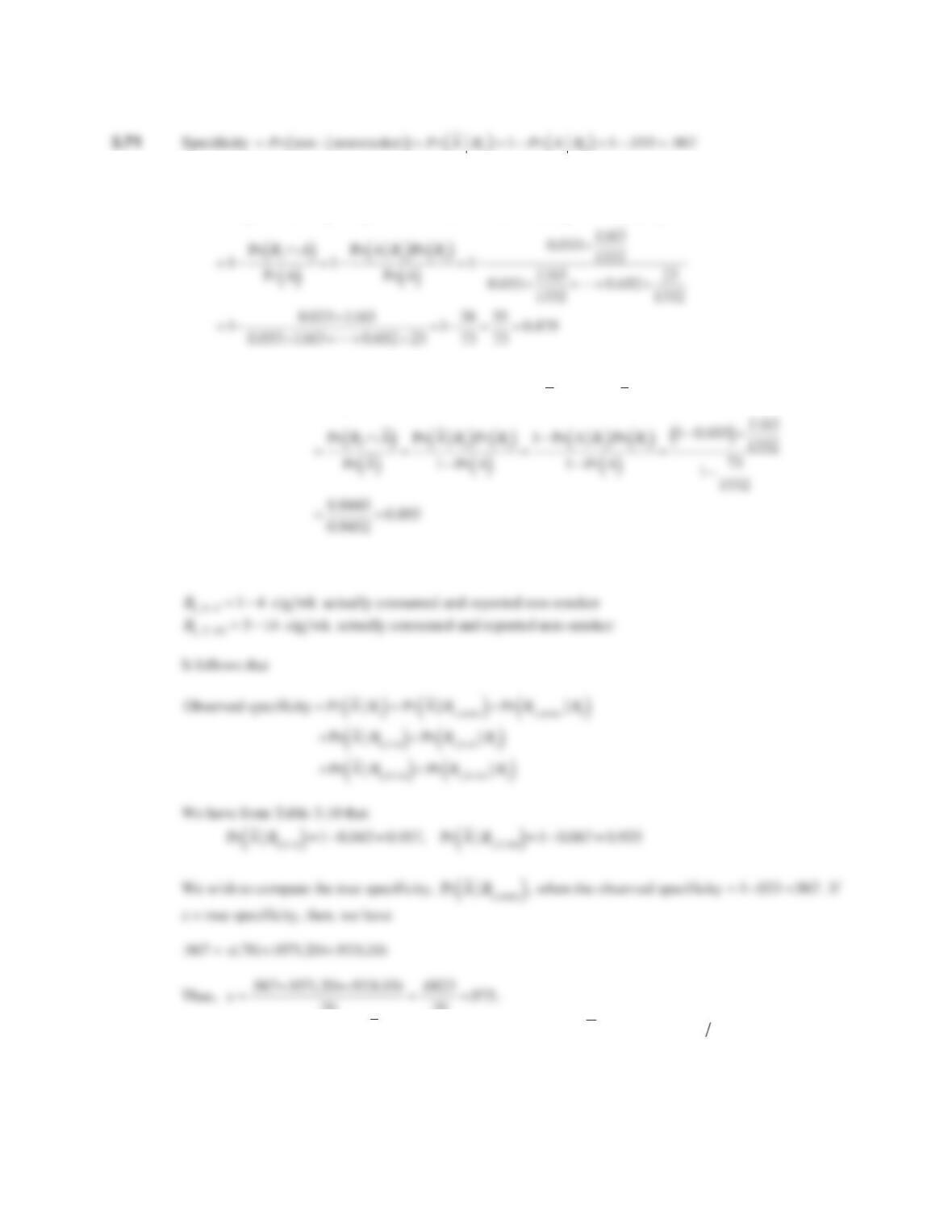
3.69 We wish to compute the sensitivity
45
where .Pr A C C B B We have
Let test + no cigarettes 4 cigarettes per weekAB B
^
`
^
`
^`
,, ,
12
1
BB
34
515
^
`
^
`
14 cigarettes per week 24 cigarettes per week,,
30 CHAPTER 3/PROBABILITY
11
3.72 We have that
PV Pr true + | test+
Pr smoker 1+ cigarettes per day | A
1Pr B
1
|A
3.73 We have that
PV Pr true – | test –
Pr nonsmoker | A
Pr B
1
|A
3.74 Let no cigarettes actually consumed and reported non-smoker
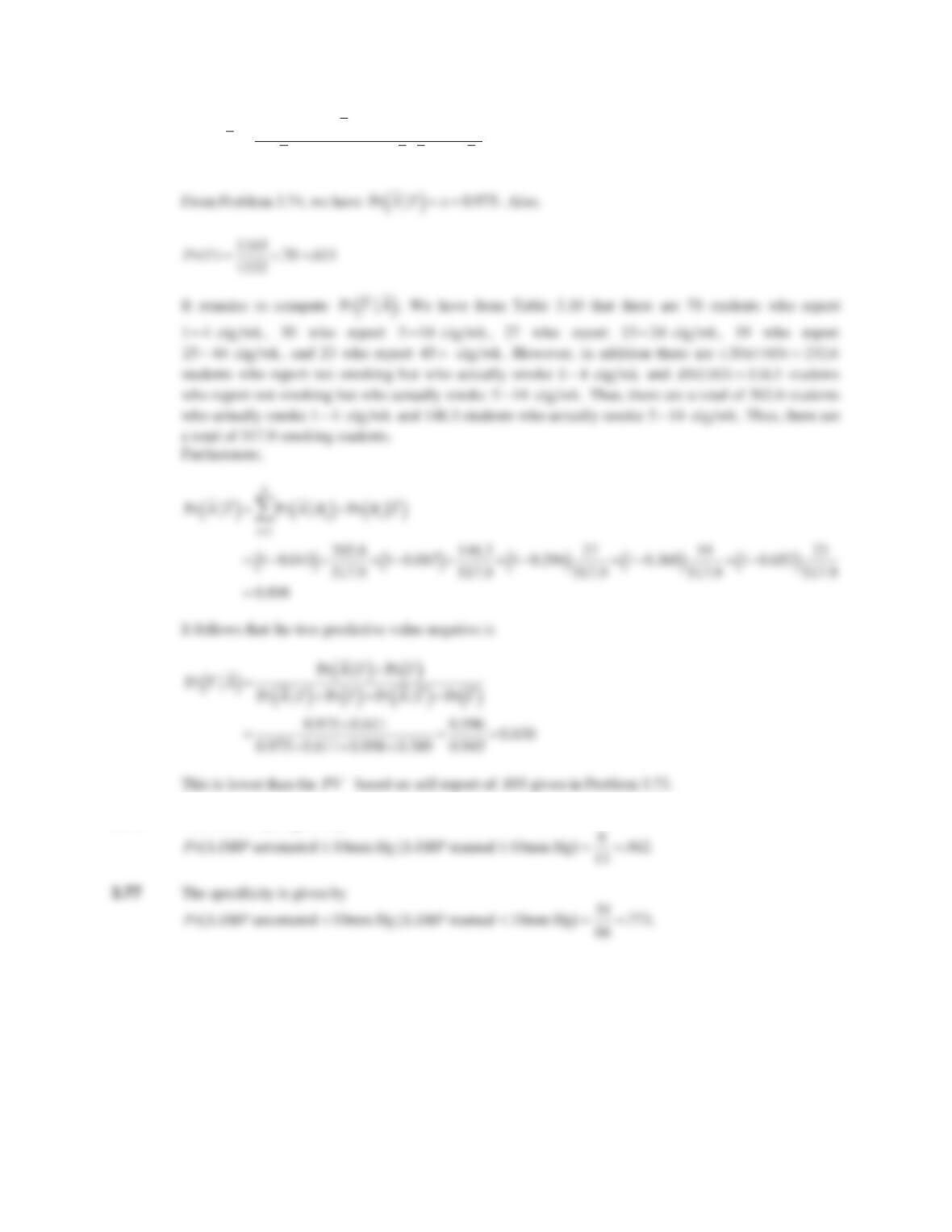
3.75 We wish to compute
Pr T|A
where T = true non-smoker, . We have from
Bayes’ Theorem that
B
1, none
.
..
70
70 975
ASCN 100 g mL
P
CHAPTER 3/PROBABILITY 31
Pr T|A
Pr A|T
uPr T
Pr A|T
uPr T
Pr A|T
uPr T
3.76 The sensitivity is given by