Chapter 3 Process Costing 3-17
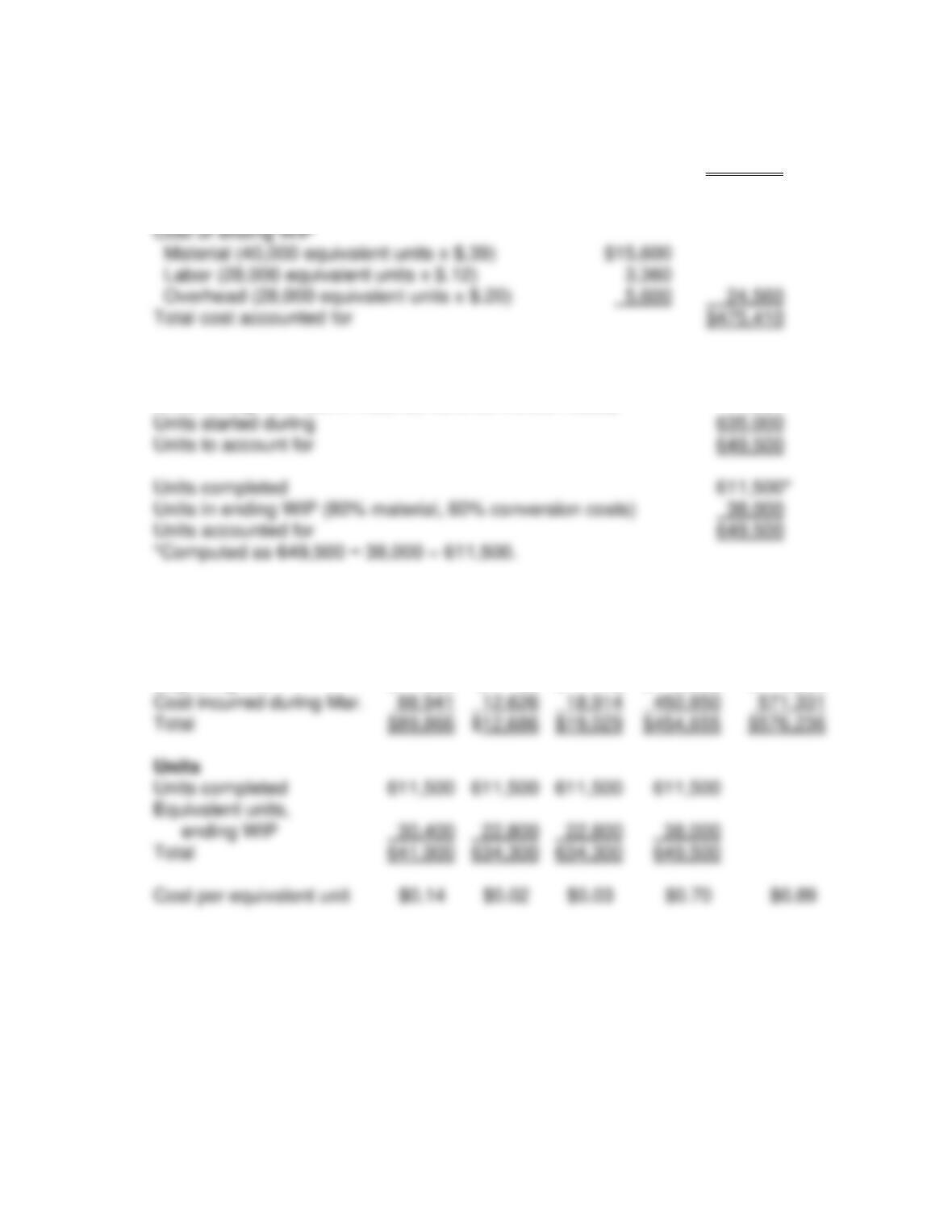
Cost Reconciliation
Total cost to account for $475,410
Cost of completed units (635,000 units $0.71) $ 450,850
Packing Department, Simply Shine Shampoo—March
Unit Reconciliation
Units in Beg. WIP (60% material, 50% conversion costs) 14,500
Cost per Equivalent Unit Calculation
Material Labor Overhead Trans.In Total
Cost
Beginning WIP $ 925 $ 60 $ 115 $ 3,805 $ 4,905
3-18 Jiambalvo Managerial Accounting
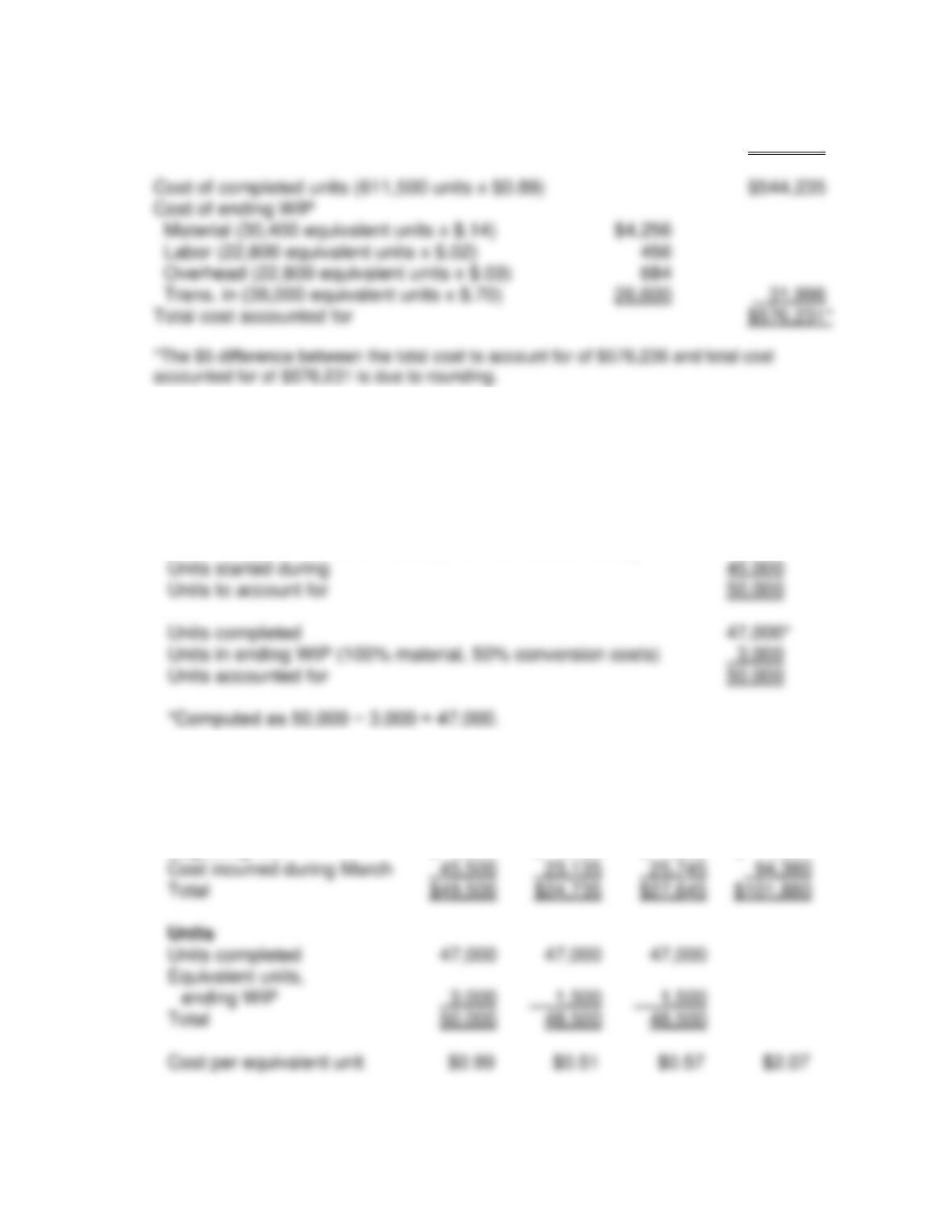
Cost Reconciliation
Total cost to account for $576,236
P10. [LO 2, 3]
Mixing Department, Carnival Caramel Company—March
Unit Reconciliation
Units in beg. WIP (100% material, 70% conversion costs) 5,000
Cost per Equivalent Unit Calculation
Material Labor Overhead Total
Cost
Beginning WIP $ 4,000 $ 1,600 $ 1,900 $ 7,500
Chapter 3 Process Costing 3-19
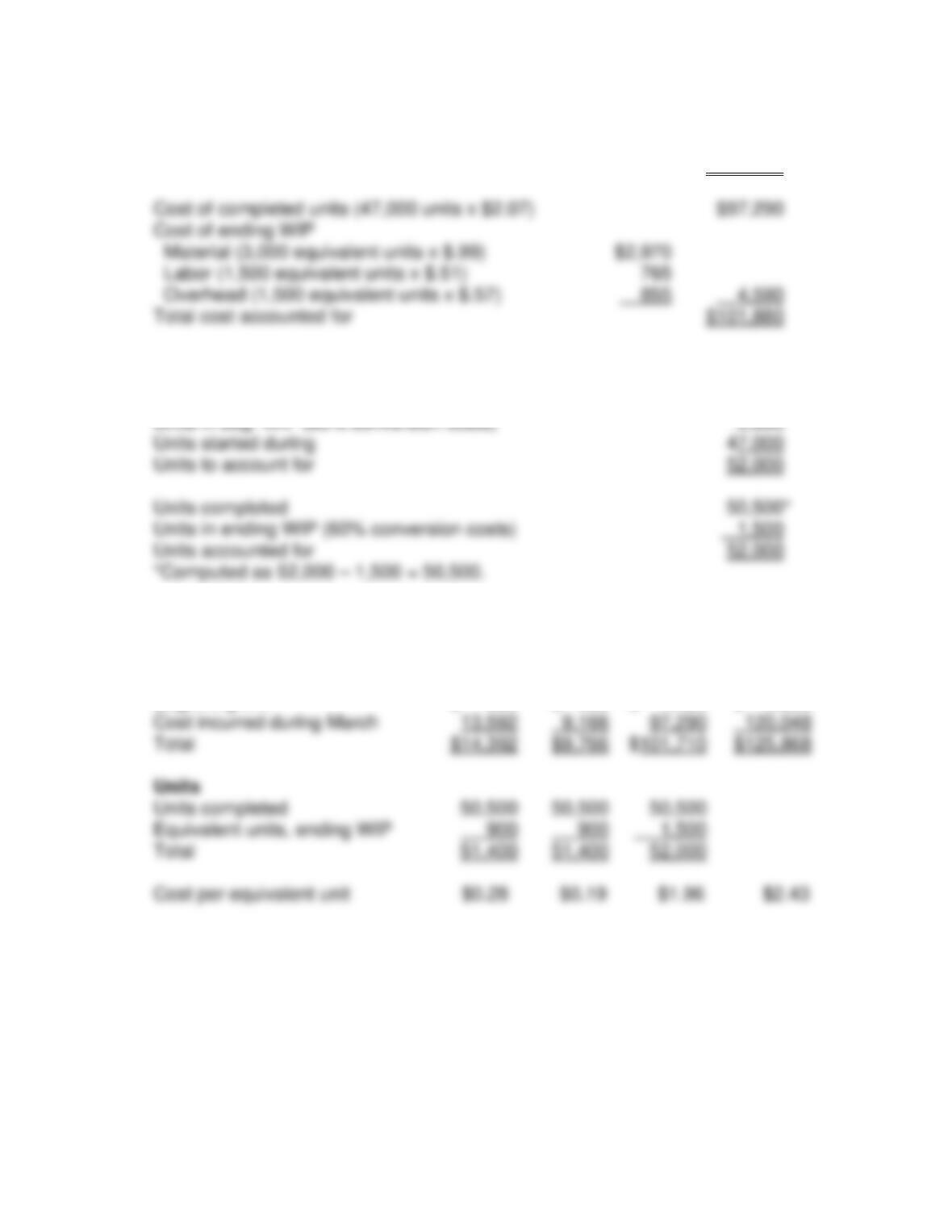
Cost Reconciliation
Total cost to account for $101,880
Shaping Department, Carnival Caramel Company—March
Unit Reconciliation
Cost per Equivalent Unit Calculation
Labor Overhead Trans.In Total
Cost
Beginning WIP $ 800 $ 600 $ 4,420 $ 5,820
3-20 Jiambalvo Managerial Accounting
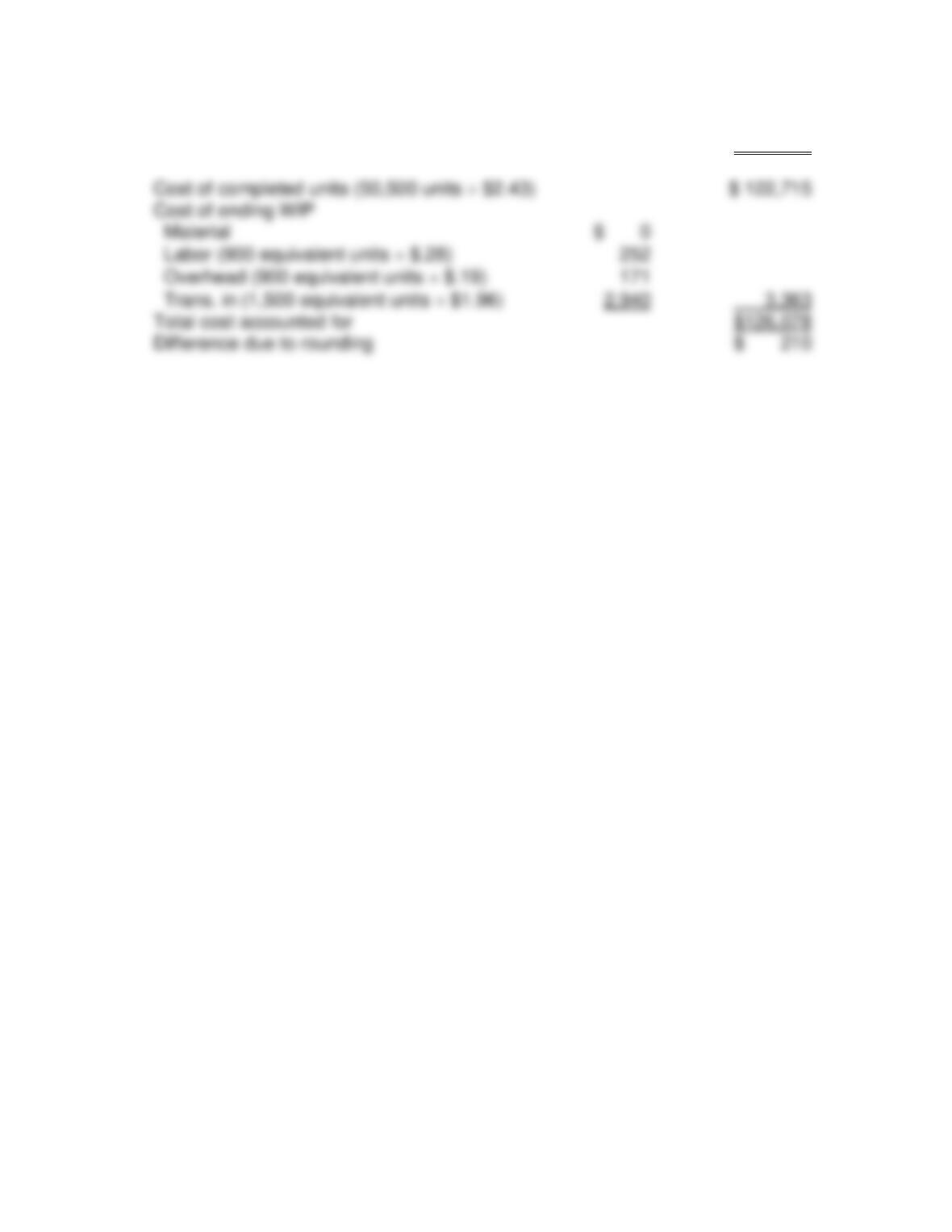
Cost Reconciliation
Total cost to account for $125,868
P11. [LO 2, 3]
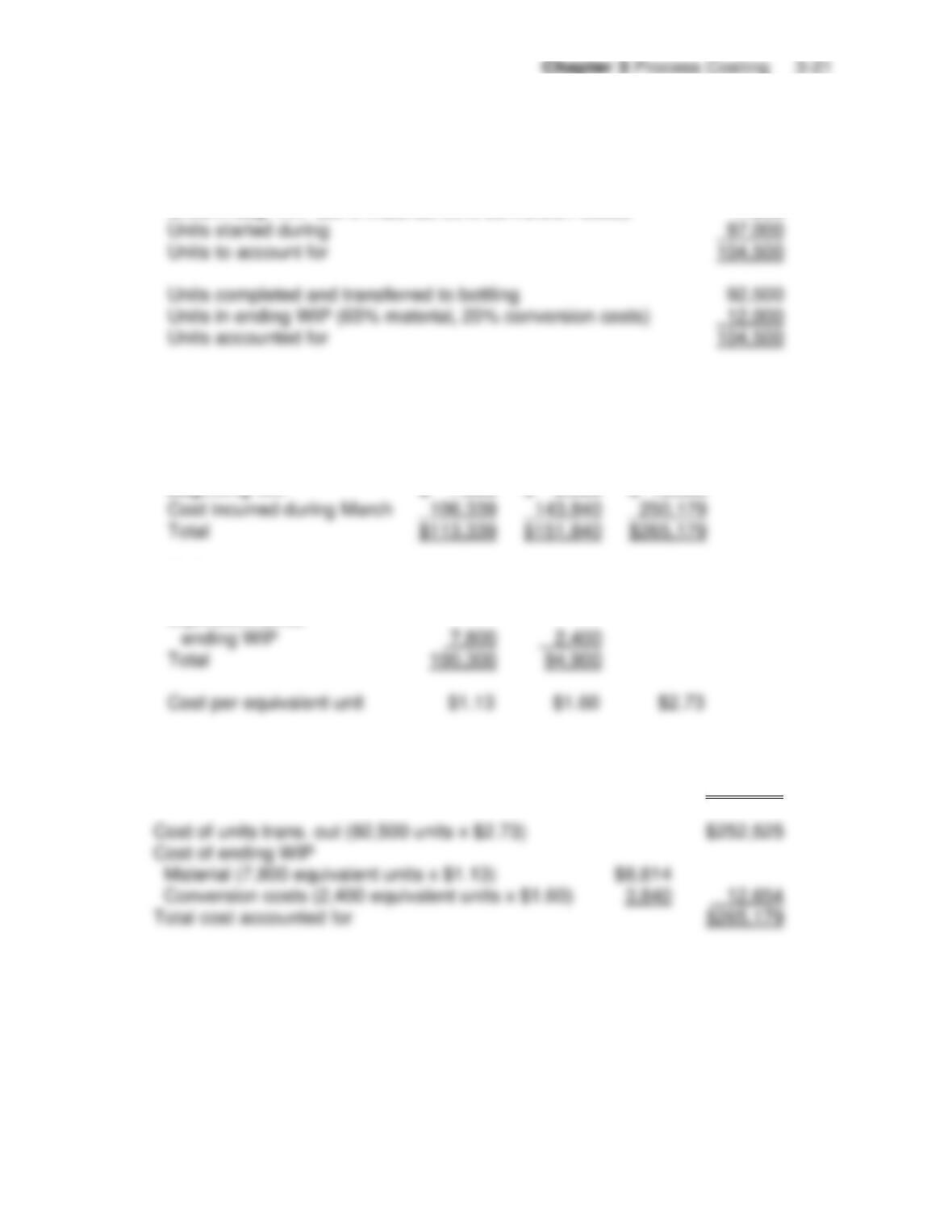
Blending Department, Tropical Sun Ltd.—May
Unit Reconciliation
Units in beg. WIP (80% material, 55% conversion costs) 7,500
Cost per Equivalent Unit Calculation
Material Conversion Total
Cost
Beginning WIP $ 7,000 $ 8,000 $ 15,000
Units
Units completed and trans. out 92,500 92,500
Equivalent units,
Cost Reconciliation
Total cost to account for $265,179
P12. [LO 2, 3]
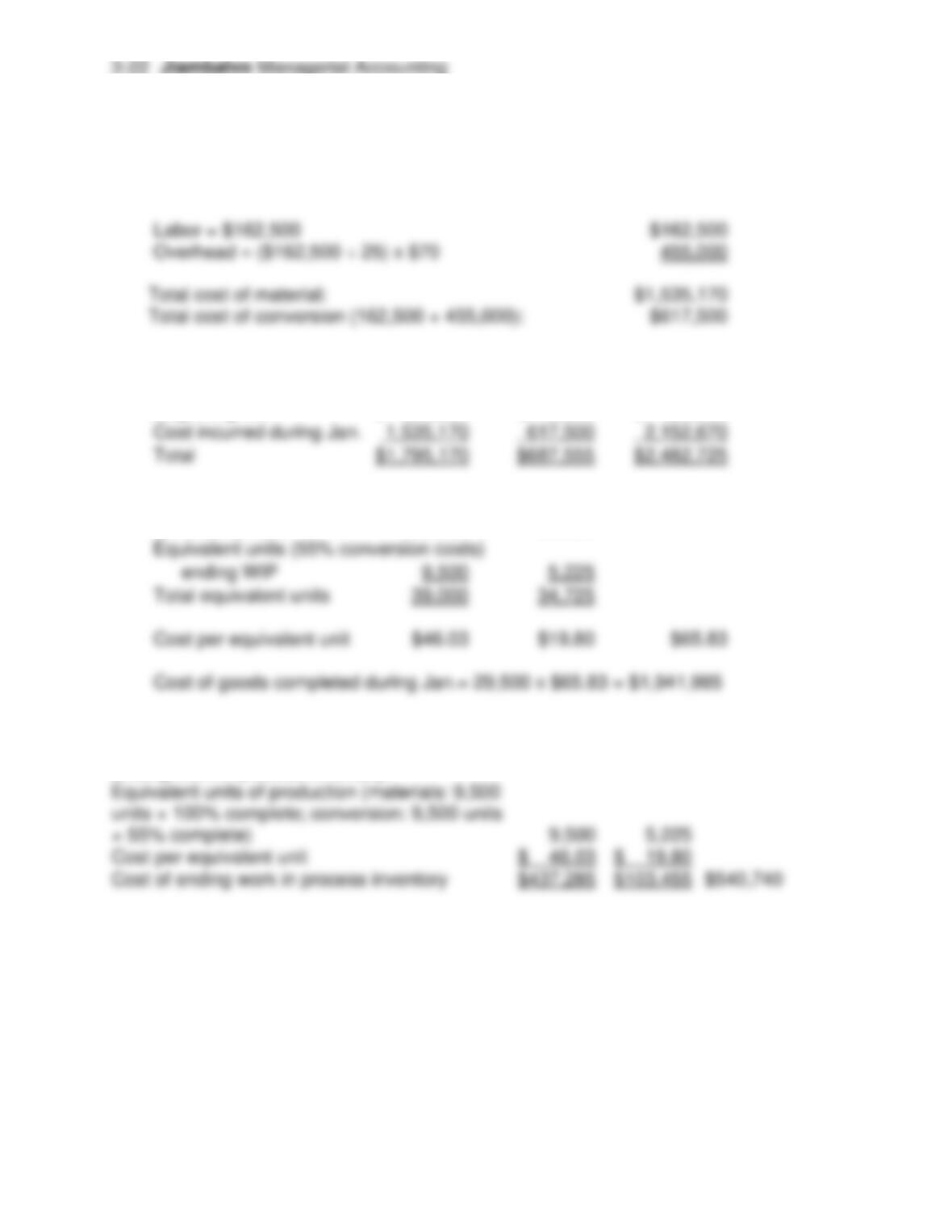
a. Cost incurred in January:
Material = $295,000 + 750,000 + 490,170 $1,535,170
b. Material Conversion Total
Cost
Beginning WIP $ 260,000 $ 70,055 $ 330,055
Units
Units completed 29,500 29,500
c.
Materials
Conversion
Total
Ending work in process inventory:
× 55% complete)
Cost per equivalent unit
Cost of ending work in process inventory
P13. [LO 2, 3]
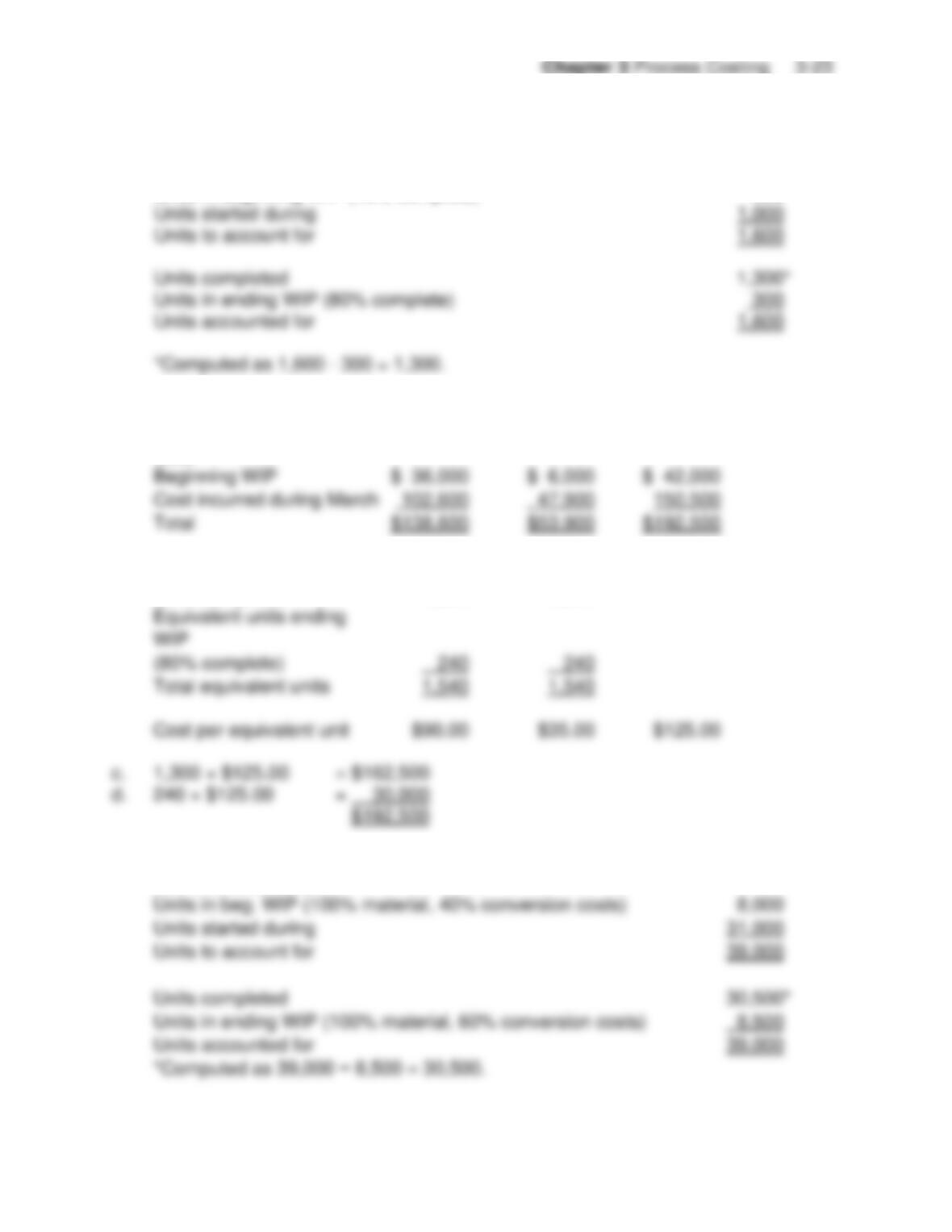
a. Unit Reconciliation
Units in beginning WIP (40% complete) 600
b. Cost per Equivalent Unit Calculation
Labor Overhead Total
Cost
Units
Units completed 1,300 1,300
P14. [LO 2, 3]
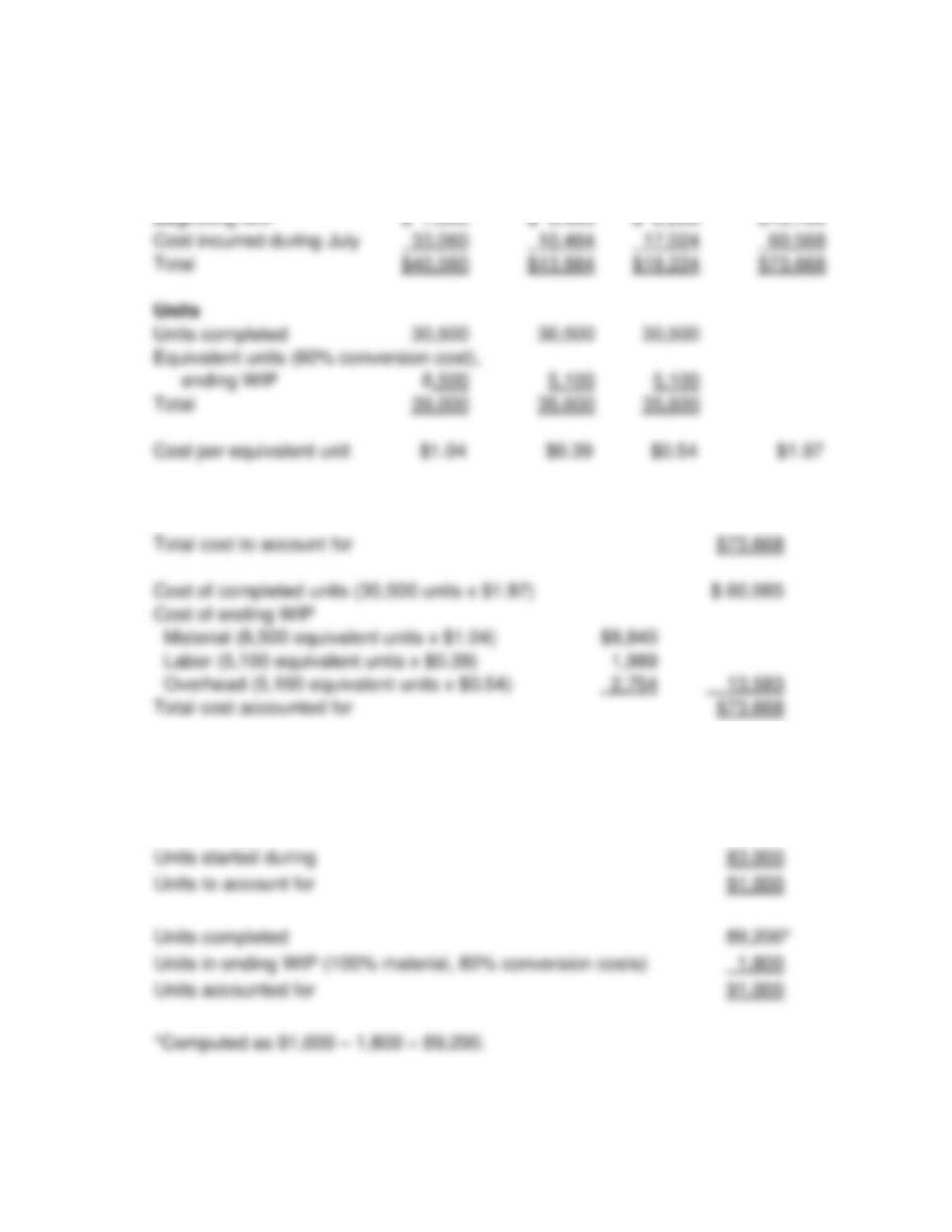
Unit Reconciliation
3-24 Jiambalvo Managerial Accounting
Cost per Equivalent Unit Calculation
Material Labor Overhead Total
Cost
Cost Reconciliation
P15. [LO 2, 3]
a. Unit Reconciliation
Units in beg. WIP (100% material, 70% conversion costs) 8,000
Chapter 3 Process Costing 3-25
Cost per Equivalent Unit Calculation
Material Labor Overhead Total
Cost
Beginning WIP $ 3,000 $ 300 $ 200 $ 3,500
Units
Units completed 89,200 89,200 89,200
Equivalent units ending
WIP
b. Cost of goods completed during May = 89,200 $1.07 = $95,444
c. Cost Reconciliation
P16. [LO 2, 3]
a. Compute Equivalent Units
Material Conversion
3-26 Jiambalvo Managerial Accounting
b. Cost per Equivalent Unit Calculation
Material Conversion Total
Cost
P17. [LO 1]
a. Work in process 144,375
b. Work in process 65,625
Chapter 3 Process Costing 3-27
d. Finished goods inventory 262,500
P18. You get what you measure
a. Equivalent cost per unit will be $0.45 if production is increased to 350,000 units.
b. Increasing the level of production from 300,000,000 units to 350,000,00 units
3-28 Jiambalvo Managerial Accounting
Case 3-1 [LO2, 3]
TECH-TONIC SPORTS DRINK
Summary
Company is considering alternative accounting treatments for the cost of lost units.
Questions to ask students
1. What is the situation facing the Western Beverage Company and their product Tech–
Tonic Sports Drink Syrup?
2. What is the difference in reported profit for the month of April between the two
approaches?
Discussion
I begin the discussion by asking a student to summarize the situation facing Western
Beverage. In April, this company had 300,000 spoiled (lost) units, and the company is
considering two ways to treat the cost of the spoiled units. One approach is to “bury” the
cost in the cost of units completed and the cost of units in process. The second
approach is to calculate the cost of the spoiled units and charge this cost to cost of
goods sold in April.
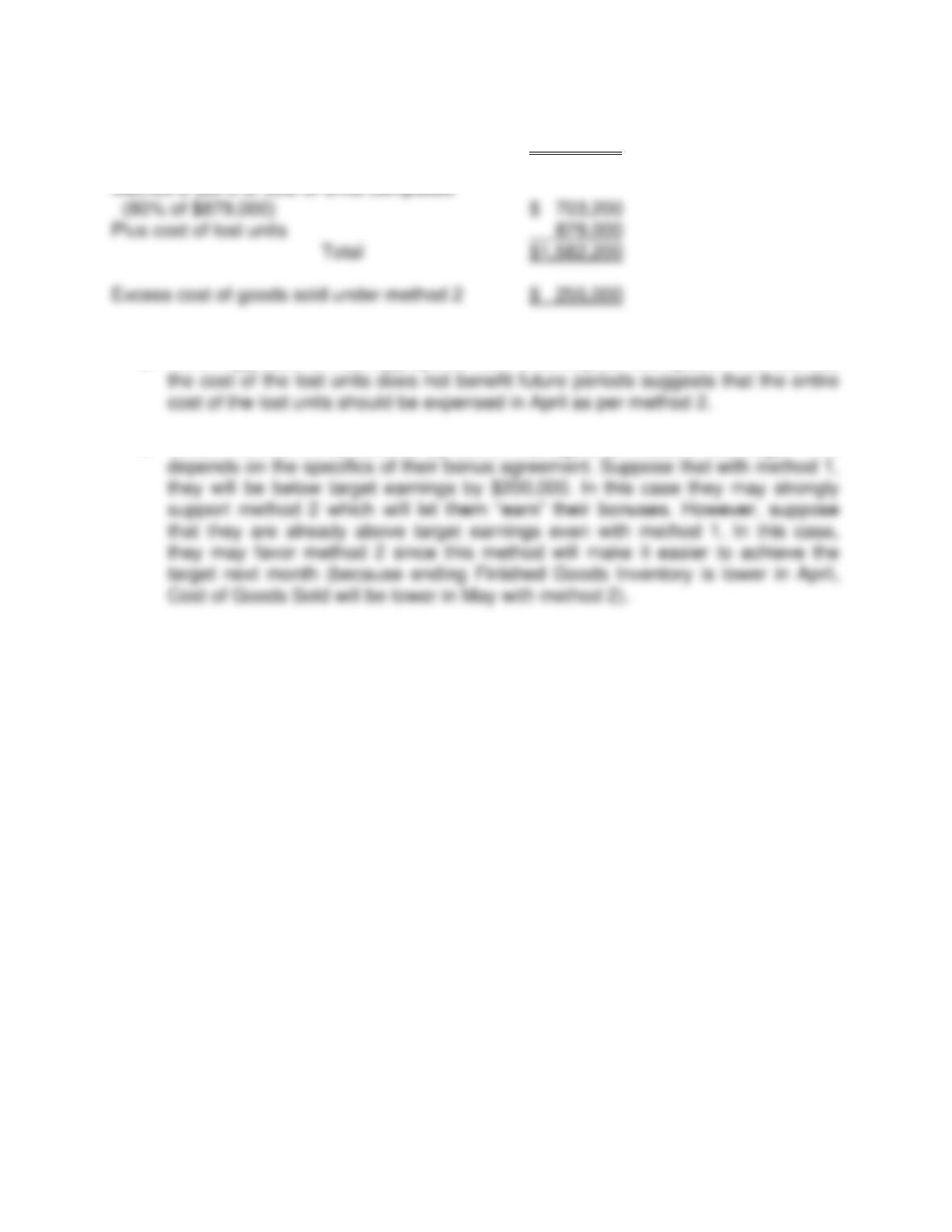
a. What is the difference in reported profit for the month of April between the two
approaches? Recall that 80% of the units completed were sold. Thus, 80% of the
Chapter 3 Process Costing 3-29
Method 1 (80% of cost of units completed
(80% of $1,659,000) $1,327,200
b. Which approach is most appropriate from a conceptual standpoint? The fact that
c. Which method will be favored by Senior managers at Western Beverage? This
Case 3-2. [Decision Making/Incremental Analysis]
JENSEN PVC, INC.
Summary
Company is considering lowering its price below current cost per unit.
Questions to ask students
1. What is the situation facing Jensen PVC?
2. Would decreasing the price be a good decision?
Discussion
I begin the discussion by asking a student to summarize the situation facing Jensen
PVC. The company produces PVC irrigation pipe and, due to weak crop prices, farmers
are cutting back on irrigation projects. With the reduction in output, cost per unit ($0.40
per foot) has increased to the point where it exceeds the current selling price ($0.39 per
foot).
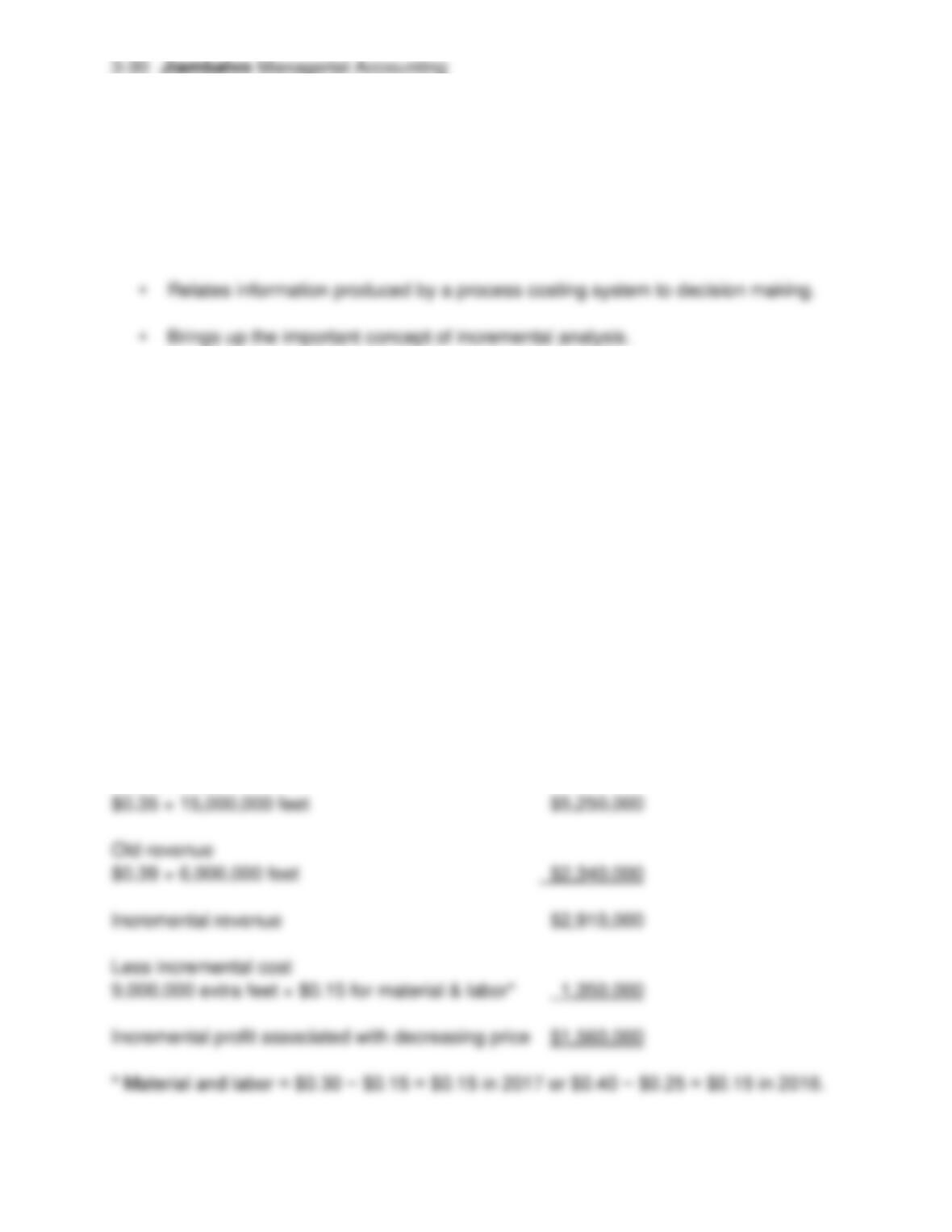
The next question to ask is “Does decreasing the price below current unit cost make
sense?” Hopefully, a student will answer yes and take the class through the following
incremental analysis.
New revenue

Chapter 3 Process Costing 3-31