CHAPTER 3
The Accounting Information System
Learning Objectives
1. Analyze the effect of business transactions on the basic accounting equation.
2. Explain what an account is and how it helps in the recording process.
3. Define debits and credits and explain how they are used to record business transactions.
4. Identify the basic steps in the recording process.
5. Explain what a journal is and how it helps in the recording process.
6. Explain what a ledger is and how it helps in the recording process.
7. Explain what posting is and how it helps in the recording process.
8. Explain the purposes of a trial balance.
9. Classify cash activities as operating, investing, or financing.
Summary of Questions by Learning Objectives and Bloom’s Taxonomy
Item LO BT Item LO BT Item LO BT Item LO BT Item LO BT
Questions
1. 4 C 6. 3 C 11. 3 K 16. 5 K 21. 7 K
2. 1 C 7. 3 C 12. 3 K 17. 5 K 22. 8
A
N
A
Brief Exercises
1. 1 C 4. 3 K 7. 4 C 9. 5
A
P 11. 8
A
P
A
A
A
A
A
Do It! Review Exercises
1. 1 C 2. 2, 3 C 3. 4, 5
A
P4.6, 7
A
P
Exercises
1. 1 C 5. 1
A
P8.5
A
P 12. 5, 8
A
P 15. 8
A
N
A
A
A
A
A
A
A
A
A
A
Problems: Set A
A
A
A
A
A
A
Problems: Set B
1. 1
A
P 5.
5, 6,
6. 5, 6,
7. 8
A
N 9. 8
A
N
A
A
A
ASSIGNMENT CHARACTERISTICS TABLE
Problem
Number
Description
Difficulty
Level
Time
Allotted (min.)
1A Analyze transactions and compute net income. Moderate 40–50
2A Analyze transactions and prepare financial statements. Moderate 40–50
7A Prepare a correct trial balance. Moderate 30–40
8A Journalize transactions, post, and prepare a trial balance. Moderate 40–50
9A Analyze errors and their effects on the trial balance. Moderate 30–40
1B Analyze transactions and compute net income. Moderate 40–50
2B Analyze transactions and prepare financial statements. Moderate 40–50
ANSWERS TO QUESTIONS
1. The system of collecting and processing transaction data and communicating financial informa-
tion to decision makers is known as the accounting information system.
2. Yes, a business can enter into a transaction in which only the left side of the accounting equation
is affected. An example would be a transaction where an increase in one asset is offset by a
3. Accounting transactions are the economic events of the company recorded by accountants because
they affect the basic accounting equation.
(a) The death of a major stockholder of the company is not an accounting transaction as it does not
affect the basic accounting equation.
(b) Supplies purchased on account is an accounting transaction because it affects the basic
4. (a) Decrease assets and decrease stockholders’ equity.
(b) Increase assets and decrease assets.
5. An account consists of three parts: (a) the title, (b) the left or debit side, and (c) the right or credit
side. Because the alignment of these parts resembles the letter T, it is referred to as a T account.
6. Disagree. The terms debit and credit are synonymous with left and right, respectively.
7. Terry is incorrect. The double-entry system merely records the dual (two-sided) effect of a transaction
8. Misty is incorrect. A debit balance only means that debit amounts exceed credit amounts in an
account. Conversely, a credit balance only means that credit amounts are greater than debit amounts
in an account. Thus, a debit or credit balance is neither favorable or unfavorable.
9. (a) Asset accounts are increased by debits and decreased by credits.
Questions Chapter 3 (Continued)
10. (a) Accounts Receivable—debit balance.
(b) Cash—debit balance.
11. (a) Accounts Receivable—asset—debit balance.
12. (a) Debit Supplies and credit Accounts Payable.
13. (a) Cash—both debit and credit entries.
(b) Accounts Receivable—both debit and credit entries.
15. The basic steps in the recording process are:
(1) Analyze each transaction in terms of its effect on the accounts.
17. (a) No, debits and credits should not be recorded directly in the ledger.
(b) The advantages of using the journal are:
(1) It discloses in one place the complete effect of a transaction.
18. (a) Cash …………………………………………………………………………………………….. 12,000
Questions Chapter 3 (Continued)
(c) Supplies ………………………………………………………………………………………. 1,800
Accounts Payable …………………………………………………………………… 1,800
19. (a) The entire group of accounts maintained by a company, including all the asset, liability, and
stockholders’ equity accounts, is referred to collectively as the ledger.
20. A trial balance is a list of accounts and their balances at a given time. The primary purpose of a
trial balance is to prove the mathematical equality of debits and credits after all journalized trans-
21. The proper sequence is as follows:
(b) Accounting transaction occurs.
(c) Information is entered in the journal.

SOLUTIONS TO BRIEF EXERCISES
BRIEF EXERCISE 3-1
Assets Liabilities Stockholders’ Equity
(a)
+
+
NE
BRIEF EXERCISE 3-2
Assets = Liabilities + Stockholders’ Equity
Cash
+
Accounts
Receivable
+
Supplies
=
Accounts
Payable +
Bonds
Payable +
Common
Stock +
Retained
Earnings
(1) +$60,000 +$60,000
BRIEF EXERCISE 3-3
Assets = Liabilities + Stockholders’ Equity
Cash
+
Inventory
+
Equipment =
Accounts
Payable +
Common
Stock +
Retained
Earnings
BRIEF EXERCISE 3-4
Debit
Effect
Credit
Effect
Normal
Balance
(a)
Accounts Payable
Decrease
Increase
Credit
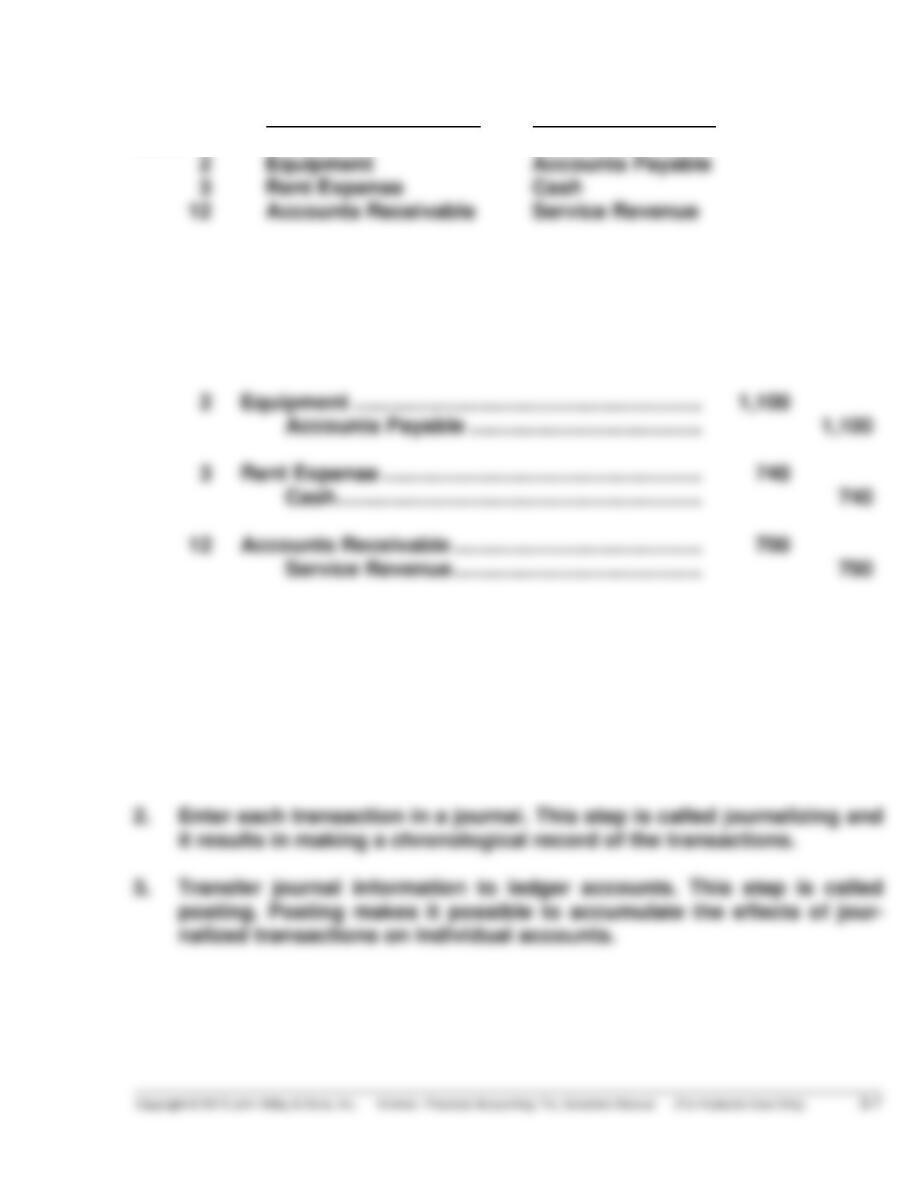
BRIEF EXERCISE 3-5
Account Debited
A
ccount Credited
June 1
Cash
Common Stock
BRIEF EXERCISE 3-6
June 1 Cash ……………………………………………………………. 5,000
Common Stock ……………………………………… 5,000
BRIEF EXERCISE 3-7
The basic steps in the recording process are:
1. Analyze each transaction. In this step, source documents are exam-
ined to determine the effects of the transaction on the accounts.
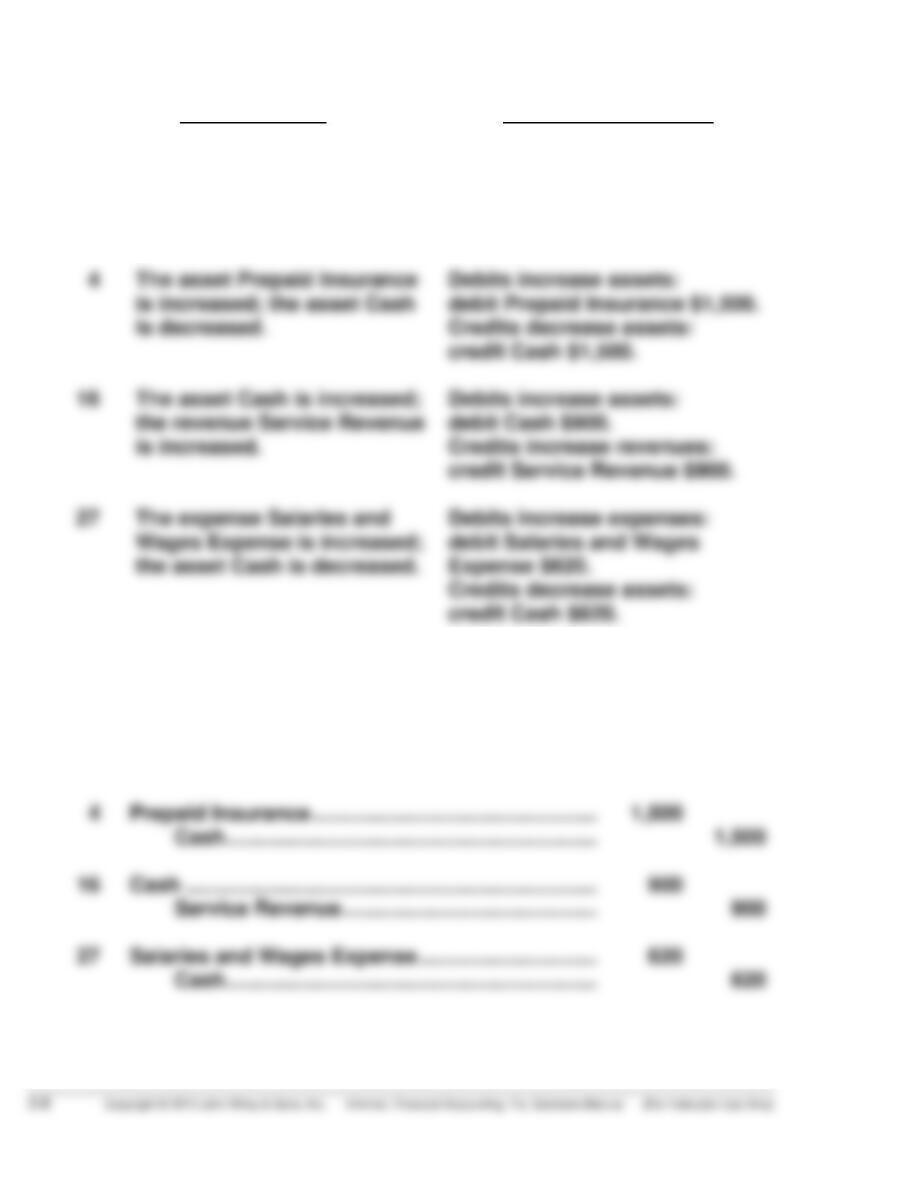
BRIEF EXERCISE 3-8
(a) Basic Analysis (b) Debit-Credit Analysis
Aug. 1
The asset Cash is increased;
the stockholders’ equity
account Common Stock is
increased.
Debits increase assets:
debit Cash $10,000. Credits
increase stockholders’ equity:
credit Common Stock $10,000.
BRIEF EXERCISE 3-9
Aug. 1 Cash …………………………………………………………….. 10,000
Common Stock ………………………………………. 10,000
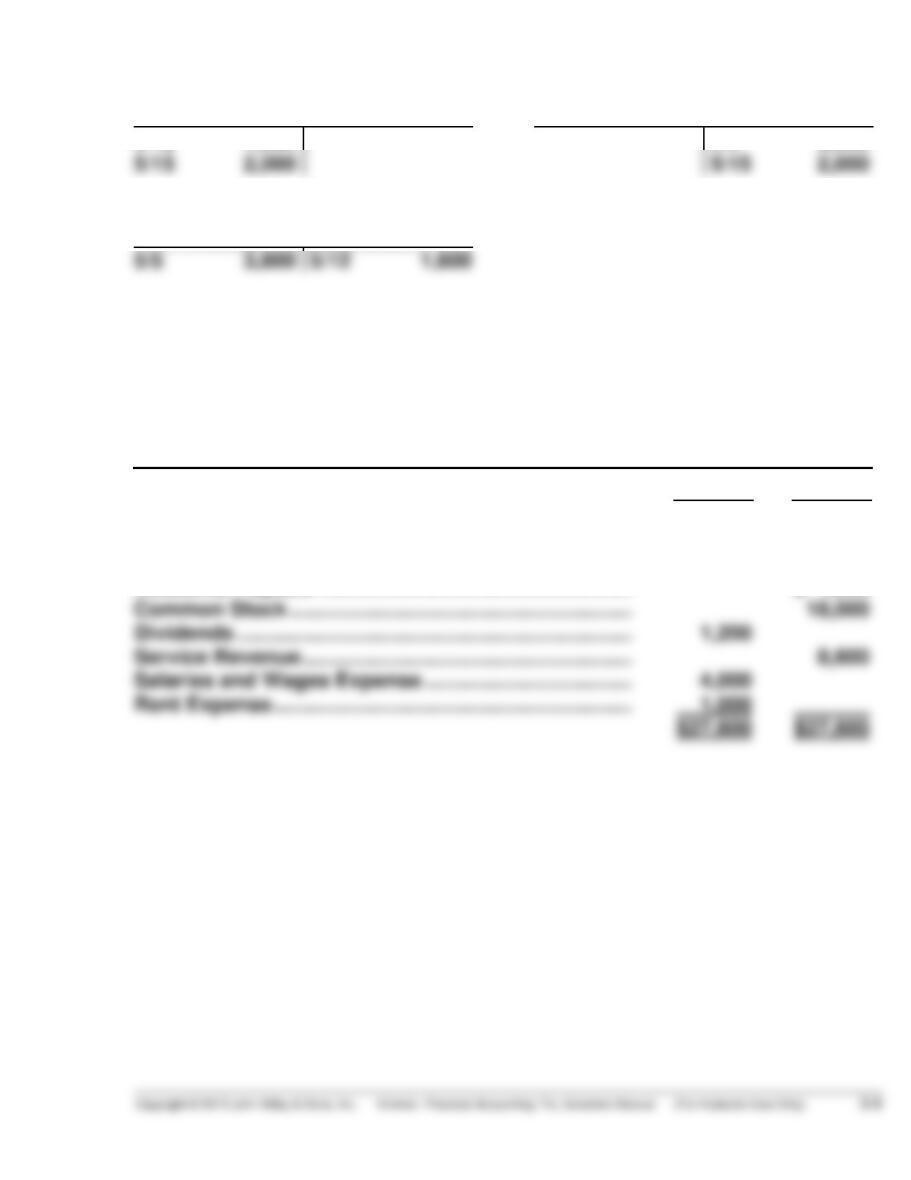
BRIEF EXERCISE 3-10
Cash Service Revenue
5/12 1,600
5/5 3,800
Accounts Receivable
BRIEF EXERCISE 3-11
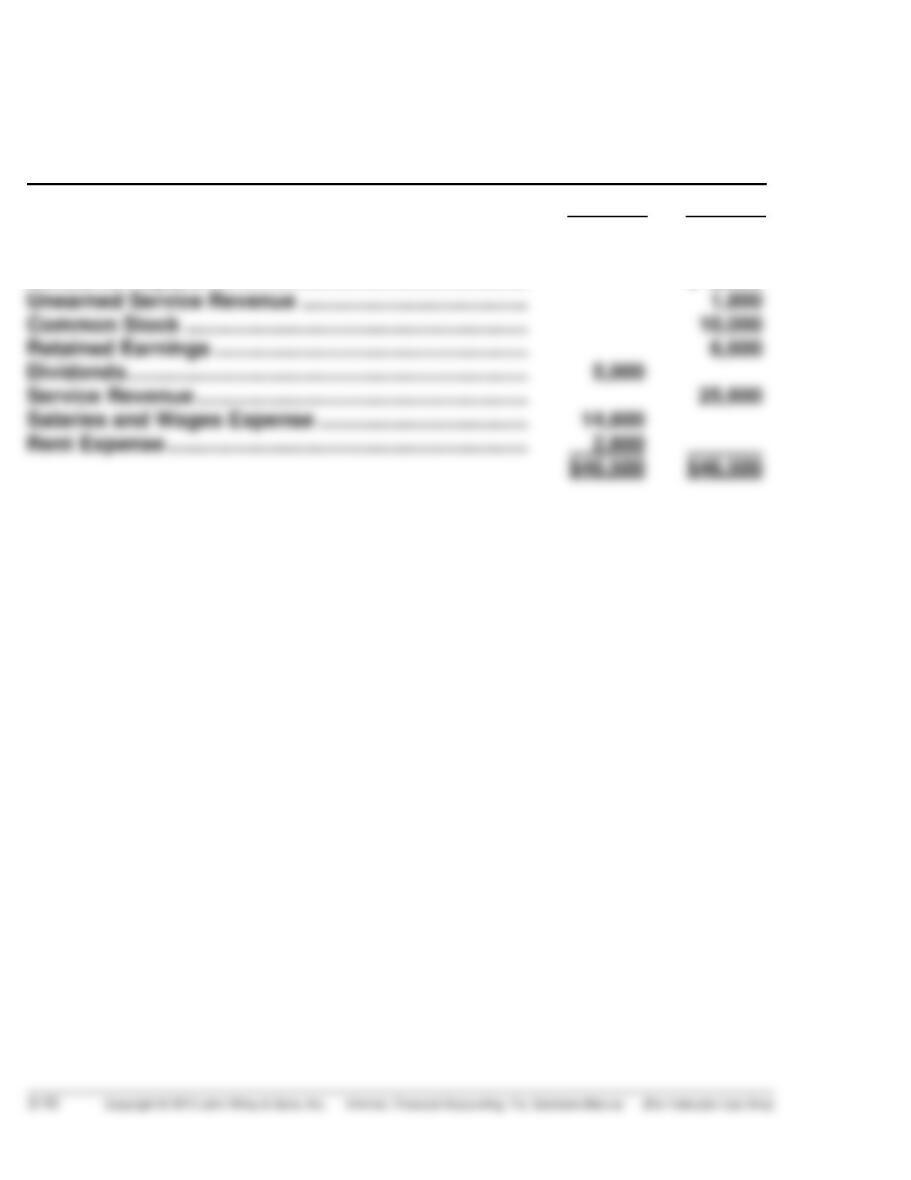
YEAGER COMPANY
Trial Balance
June 30, 2014
Debit Credit
Cash …………………………………………………………………..
Accounts Receivable ………………………………………….
Equipment ………………………………………………………….
Accounts Payable ………………………………………………
$ 5,400
3,000
13,000
$ 1,000
BRIEF EXERCISE 3-12
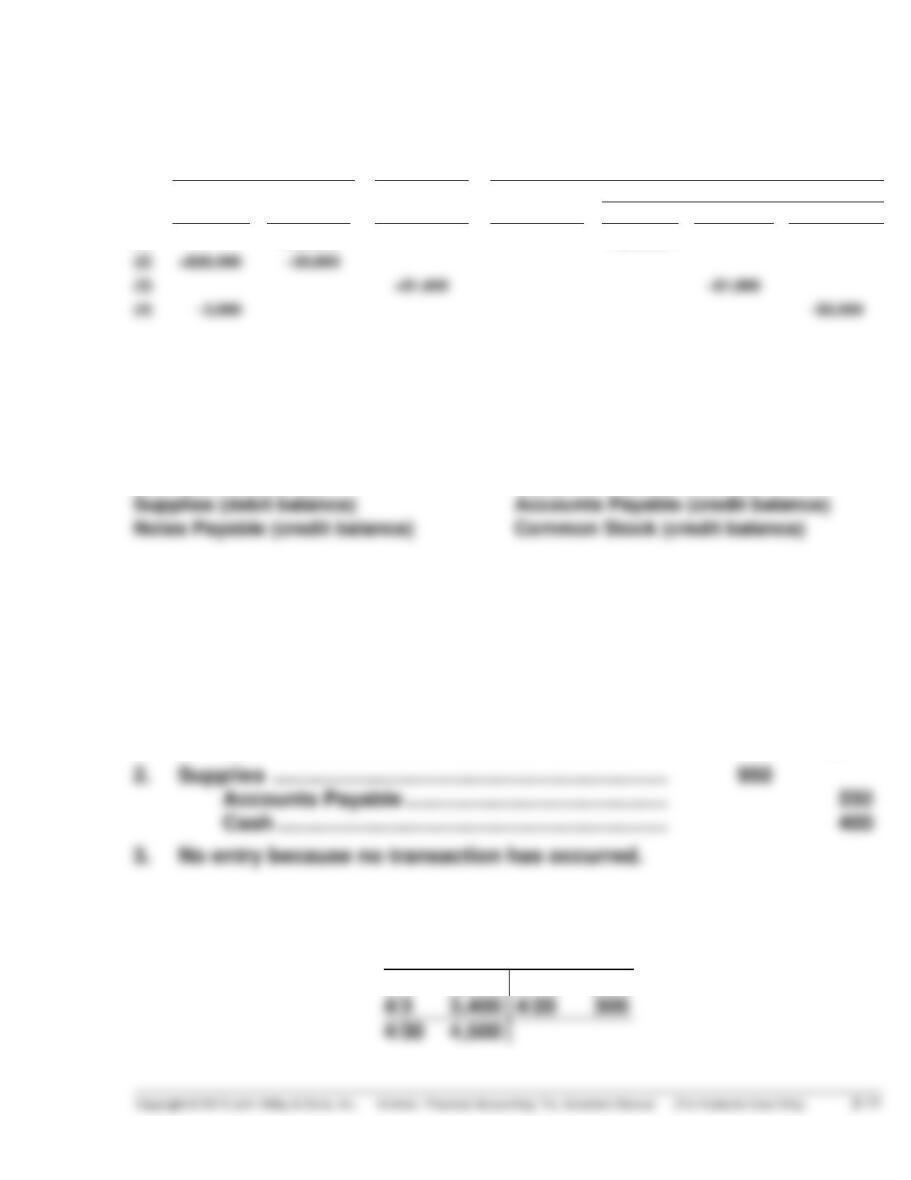
CINELLI COMPANY
Trial Balance
December 31, 2014
Debit Credit
Cash …………………………………………………………………..
Prepaid Insurance ……………………………………………….
Accounts Payable ……………………………………………….
$20,800
3,500
$ 2,500
SOLUTIONS TO DO IT! REVIEW EXERCISES
DO IT! 3-1
Assets = Liabilities + Stockholders’ Equity
Cash
+
Accounts
Receivable
=
Accounts
Payable +
Common
Stock +
Retained Earnings
Revenues – Expenses – Dividends
(1) +$20,000 +$20,000
DO IT! 3-2
Joel would likely need the following accounts in which to record the trans-
actions necessary to ready his photography studio for opening day:
Cash (debit balance) Equipment (debit balance)
DO IT! 3-3
Each transaction that is recorded is entered in the general journal. The
three activities would be recorded as follows:
1. Cash ………………………………………………………………… 8,000
Common Stock ………………………………………….. 8,000
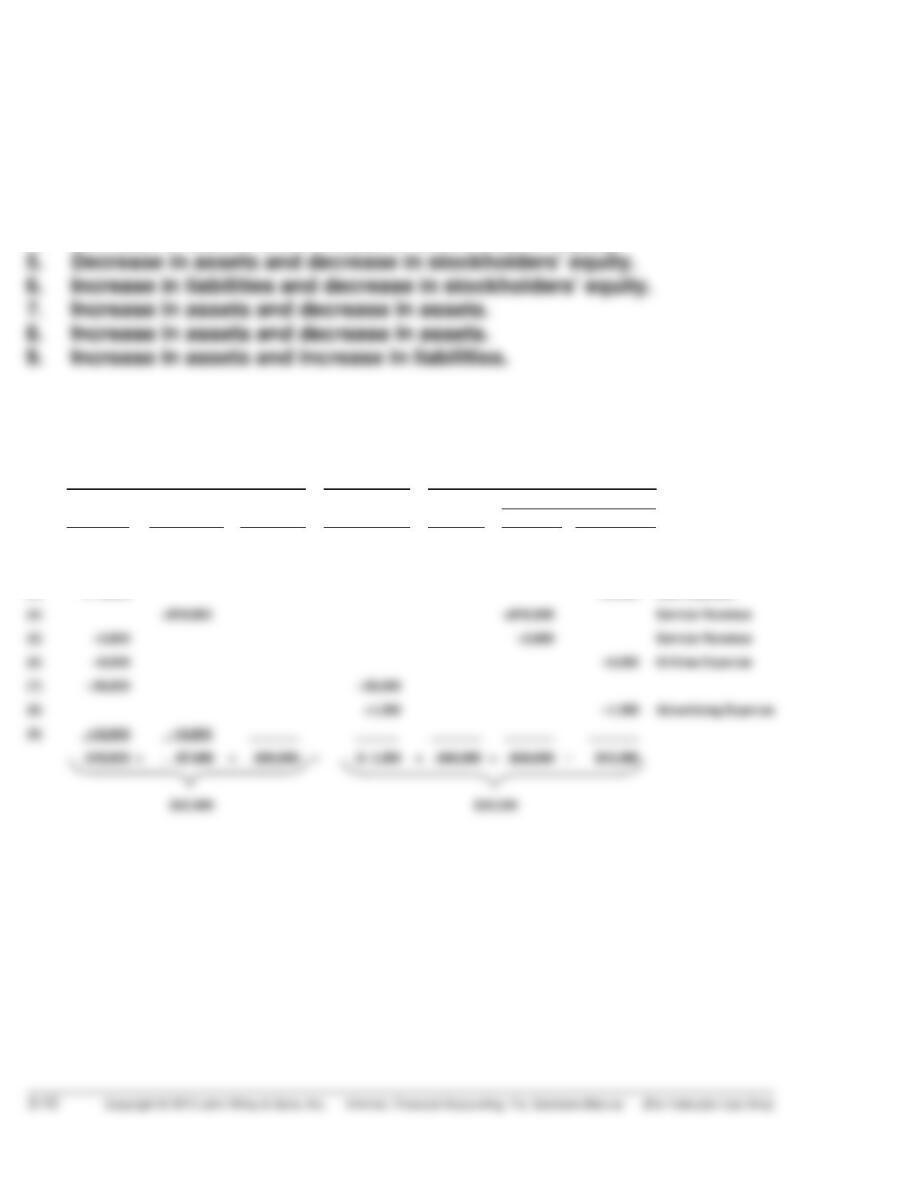
DO IT! 3-4
Cash
4/1 1,900
4/16 500
SOLUTIONS TO EXERCISES
EXERCISE 3-1
1. Increase in assets and increase in stockholders’ equity.
2. Decrease in assets and decrease in stockholders’ equity.
3. Increase in assets and increase in stockholders’ equity.
4. Increase in assets and increase in stockholders’ equity.
EXERCISE 3-2
Assets = Liabilities + Stockholders’ Equity
Cash
+
Accounts
Receivable
+
Equipment
=
Accounts
Payable +
Common
Stock +
Retained Earnings
Revenues – Expenses
(1) +40,000 +$40,000 Issued Stock
(2) +$30,000 +$30,000
(3) –$ 4,000 –$4,000 Rent Expense
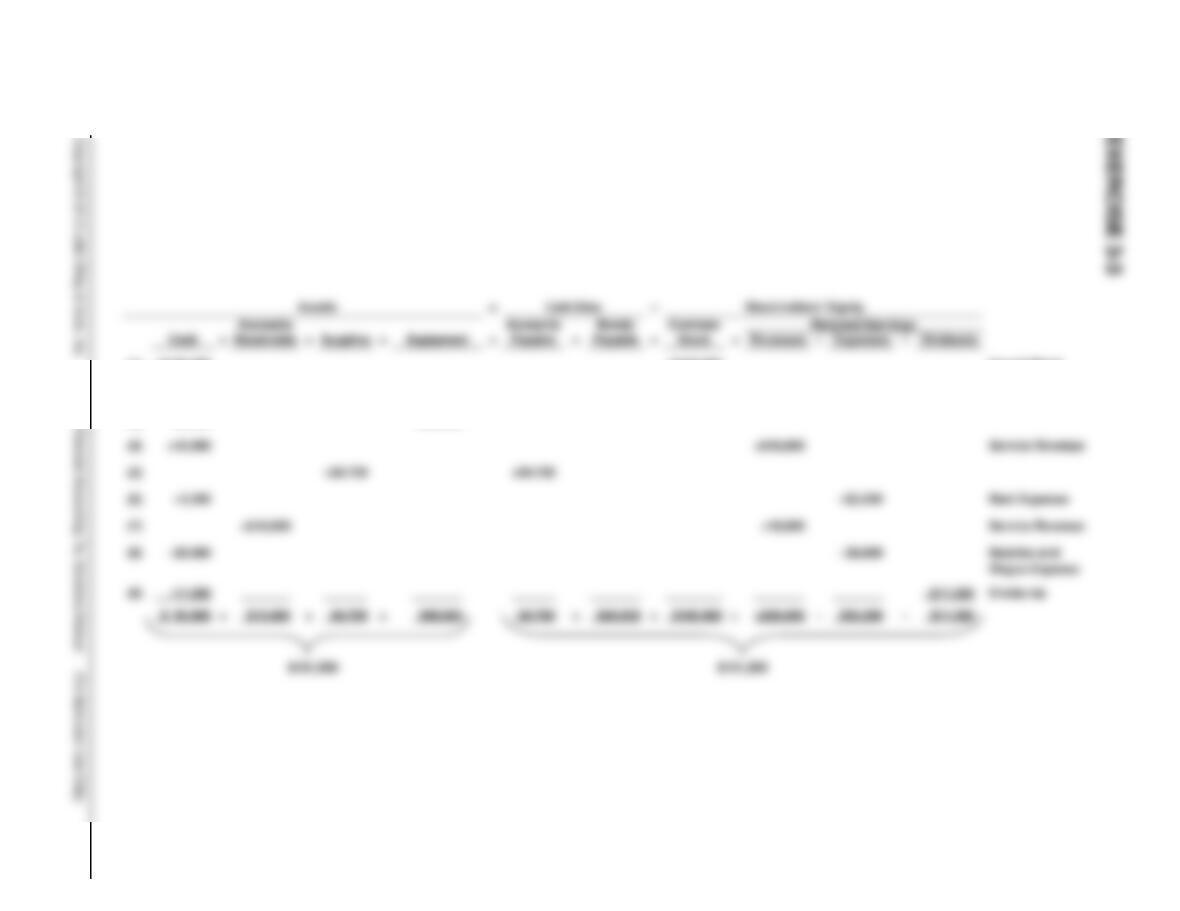
(1) +$100,000 +$100,000 Issued Stock
(2) +45,000 +$45,000
(3) –60,000 +$60,000
Copyright © 2013 John Wiley & Sons, Inc. Kimmel, Financial Accounting, 7e, Solutions Manual (For Instructor Use Only) 3-13
EXERCISE 3-3
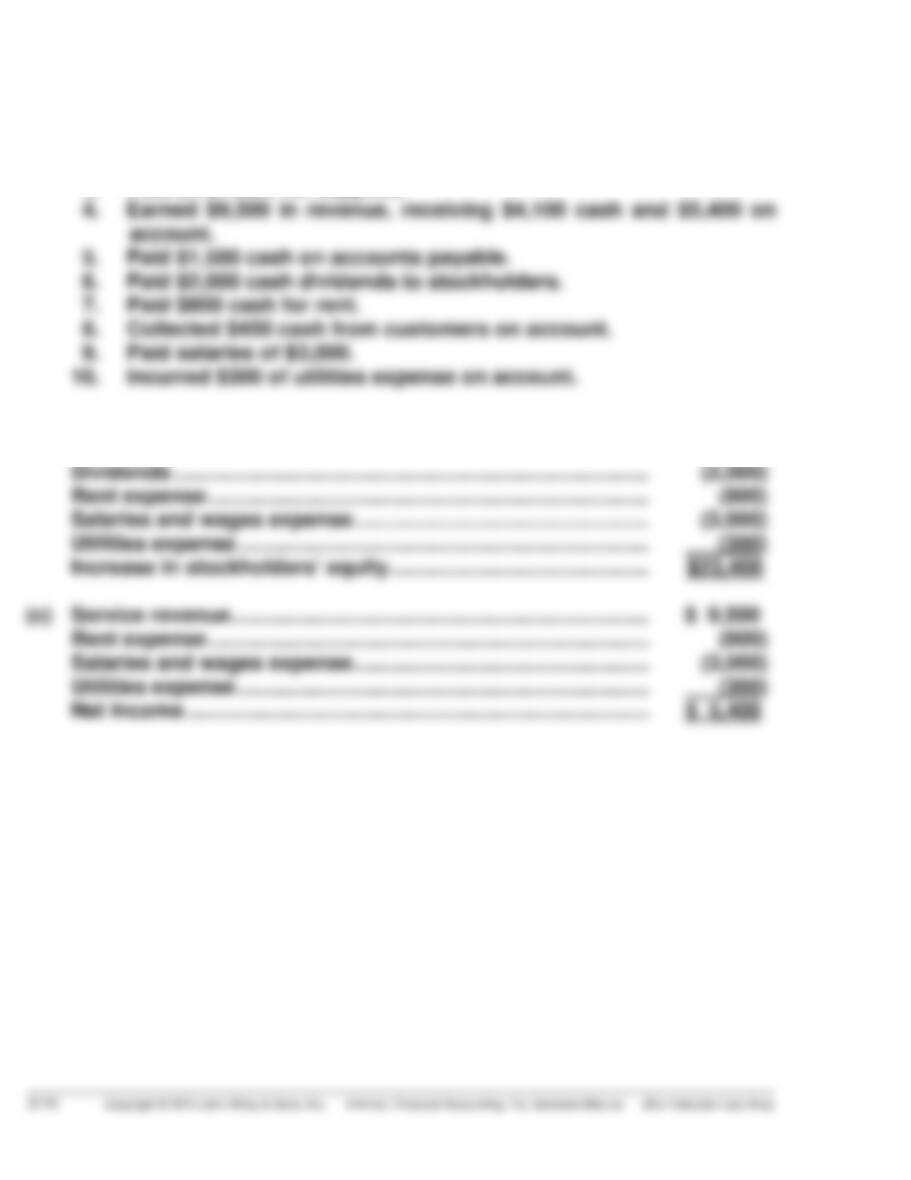
EXERCISE 3-4
(a) 1. Stockholders invested $20,000 cash in the business.
2. Purchased equipment for $5,000, paying $1,000 in cash and the
balance of $4,000 on account.
3. Paid $750 cash for supplies.
(b) Issued common stock…………………………………………………….. $20,000
Service revenue ……………………………………………………………… 9,500
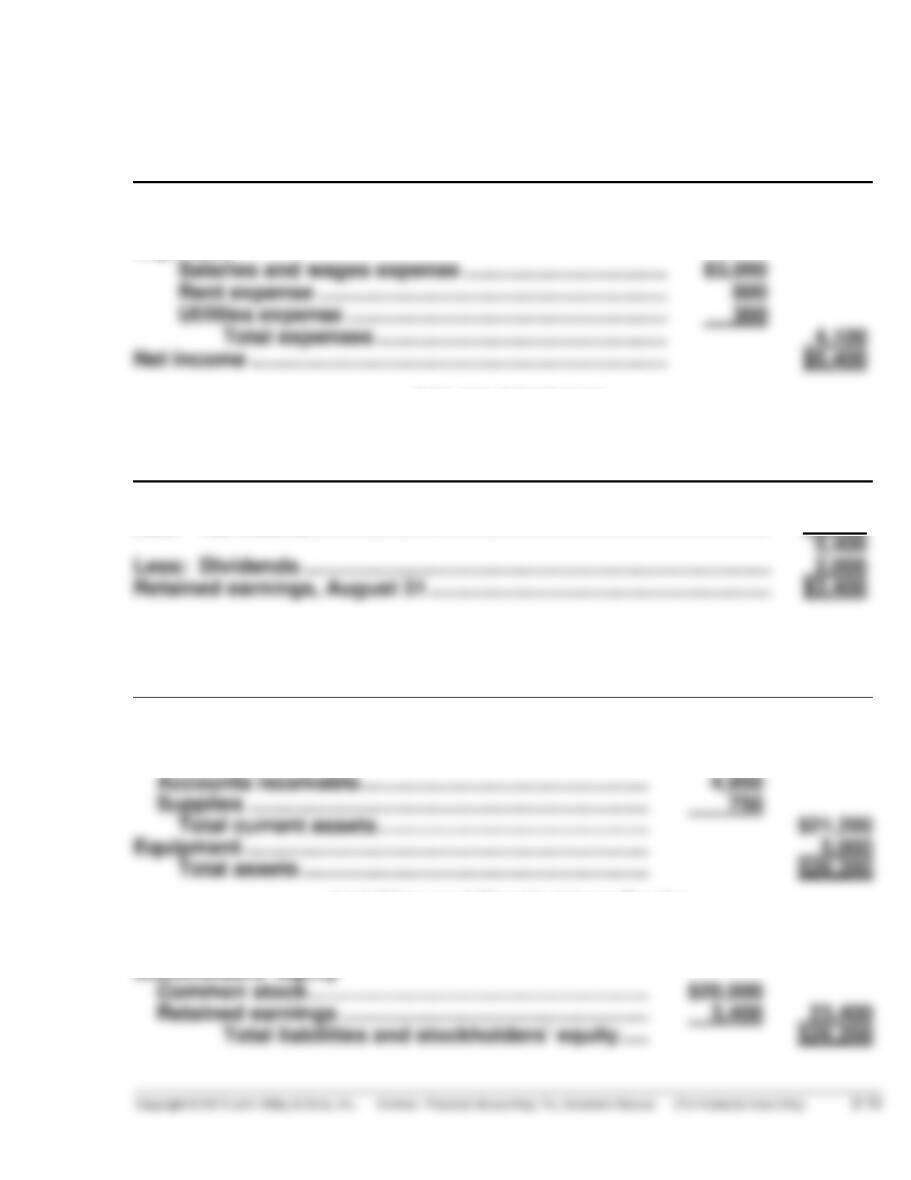
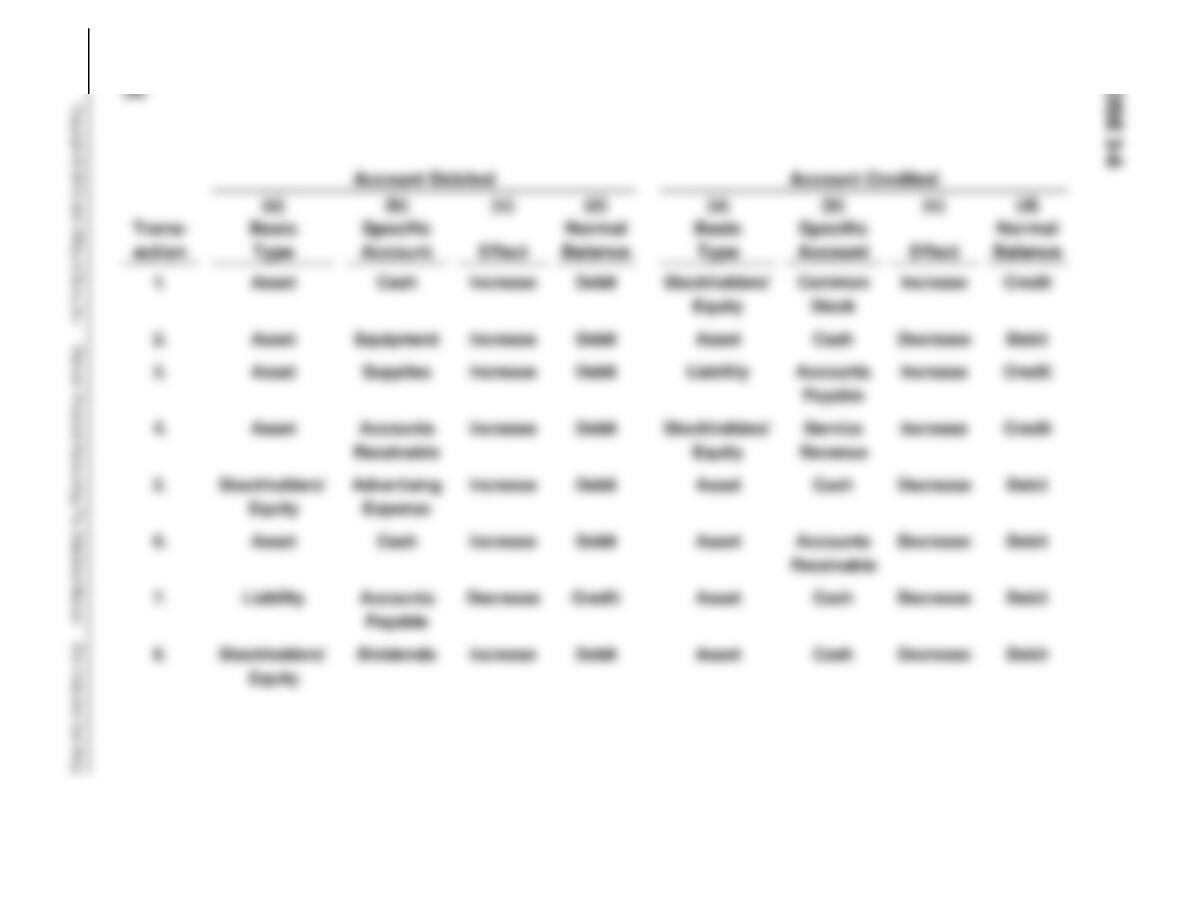
EXERCISE 3-5
COLAW COMPANY
Income Statement
For the Month Ended August 31, 2014
Revenues
Service revenue ……………………………………………….. $9,500
Expenses
COLAW COMPANY
Retained Earnings Statement
For the Month Ended August 31, 2014
Retained earnings, August 1 ……………………………………………………. $ 0
Add: Net income ……………………………………………………………………. 5,400
COLAW COMPANY
Balance Sheet
August 31, 2014
Assets
Current assets
Cash …………………………………………………………………. $15,500
Liabilities and Stockholders’ Equity
Current liabilities
Accounts payable ……………………………………………… $ 2,800
3-16 Copyright © 2013 John Wiley & Sons, Inc. Kimmel, Financial Accounting, 7/e, Solutions Manual (For Instructor Use Only)
EXERCISE 3-6
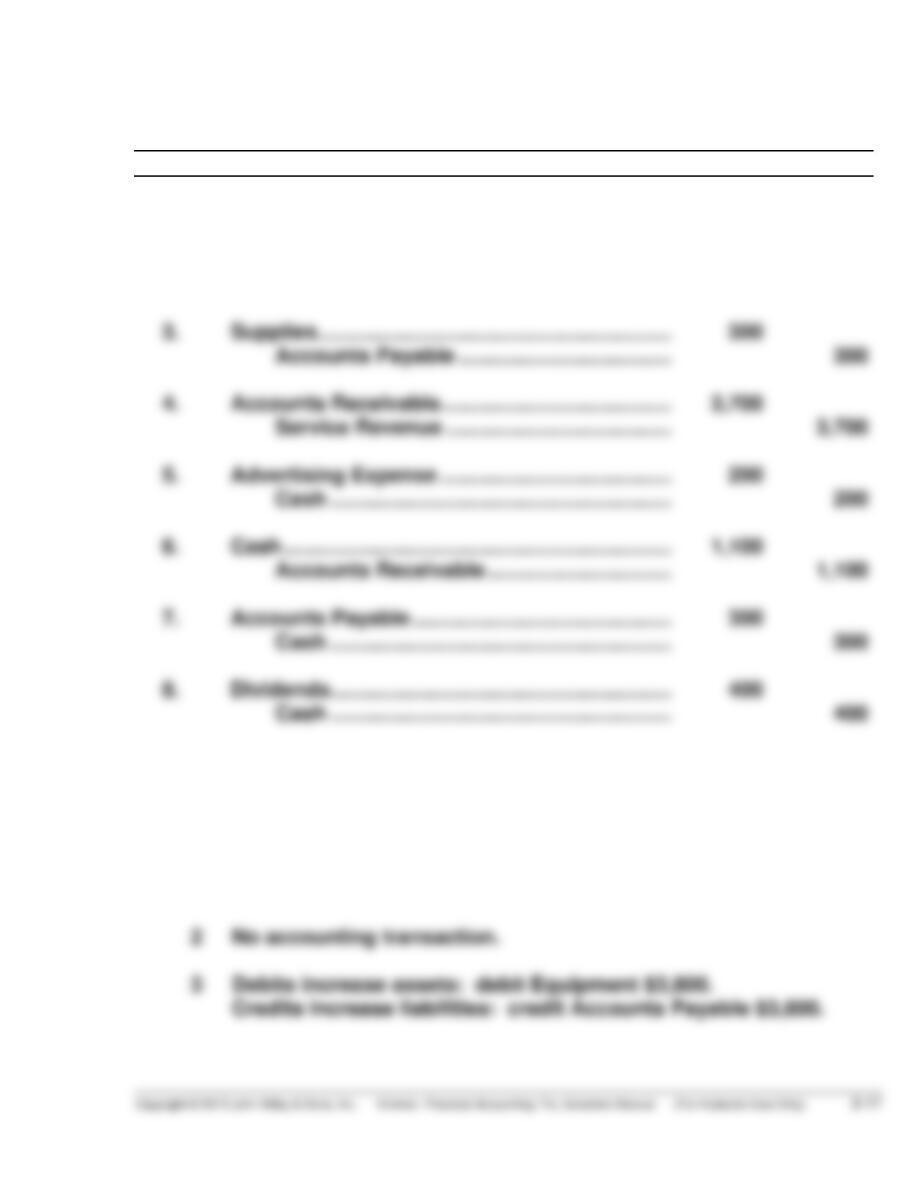
EXERCISE 3-6 (Continued)
(b)
General Journal
Trans. Account Titles Debit Credit
1. Cash …………………………………………………………
.
Common Stock …………………………………..
.
15,000
15,000
2. Equipment ………………………………………………..
.
Cash ………………………………………………….
.
10,000
10,000
.
.
.
.
.
EXERCISE 3-7
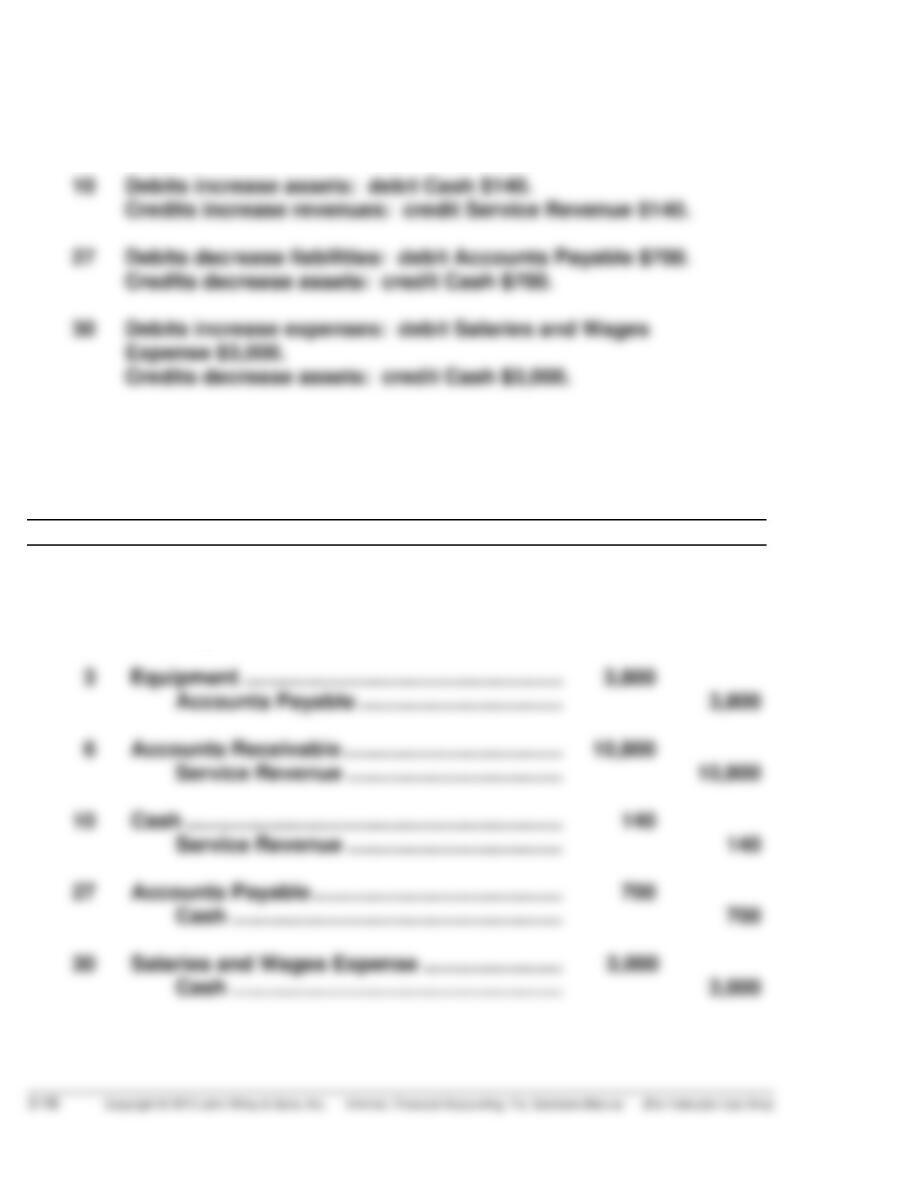
Oct. 1 Debits increase assets: debit Cash $30,000.
Credits increase stockholders’ equity: credit Common Stock
$30,000.
EXERCISE 3-7 (Continued)
Oct. 6 Debits increase assets: debit Accounts Receivable $10,800.
Credits increase revenues: credit Service Revenue $10,800.
EXERCISE 3-8
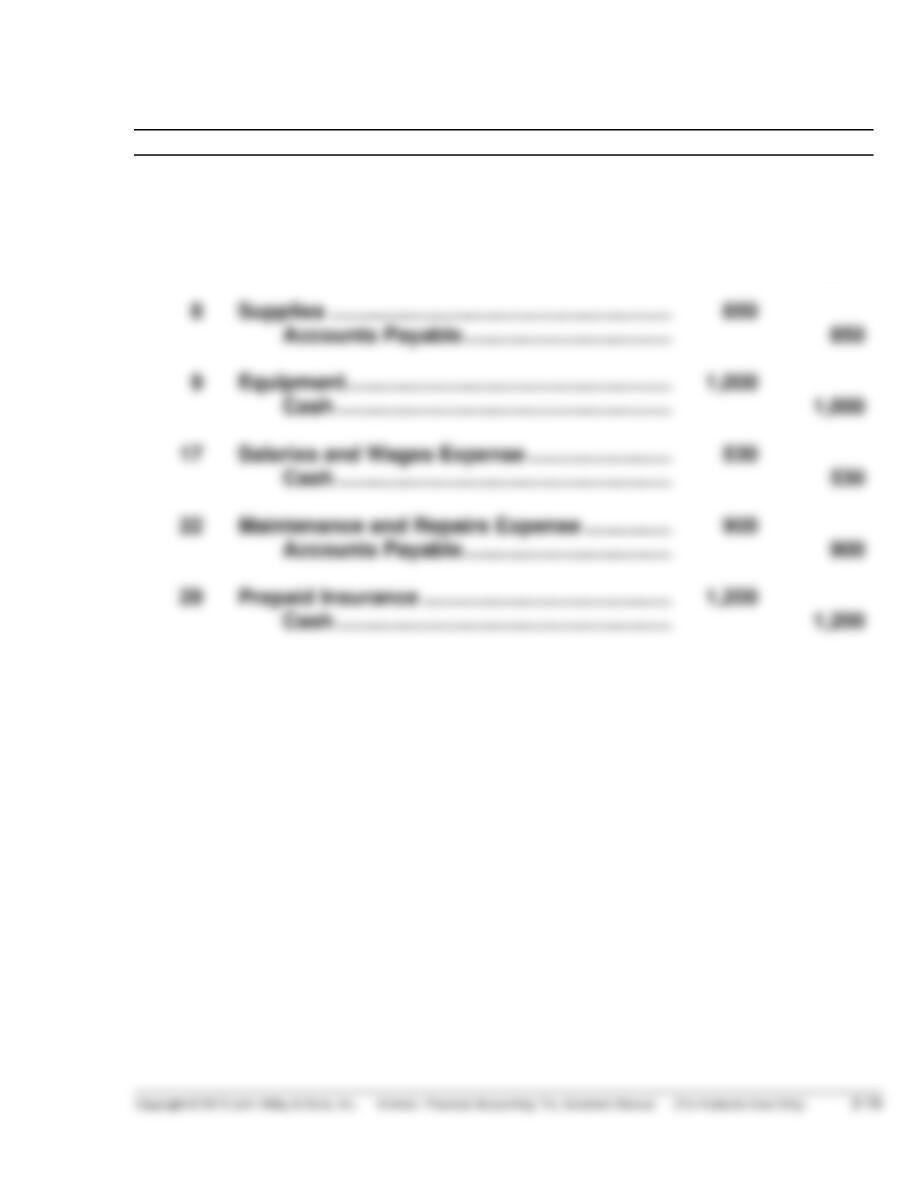
General Journal
Date Account Titles Debit Credit
Oct. 1 Cash ………………………………………………………..
Common Stock ………………………………….
30,000
30,000
2 No entry.
EXERCISE 3-9
General Journal
Date Account Titles Debit Credit
May 4 Accounts Payable ……………………………………
.
Cash …………………………………………………
.
700
700
7 Accounts Receivable ……………………………….
.
Service Revenue ……………………………….
.
6,800
6,800
.
.
.
.
EXERCISE 3-10
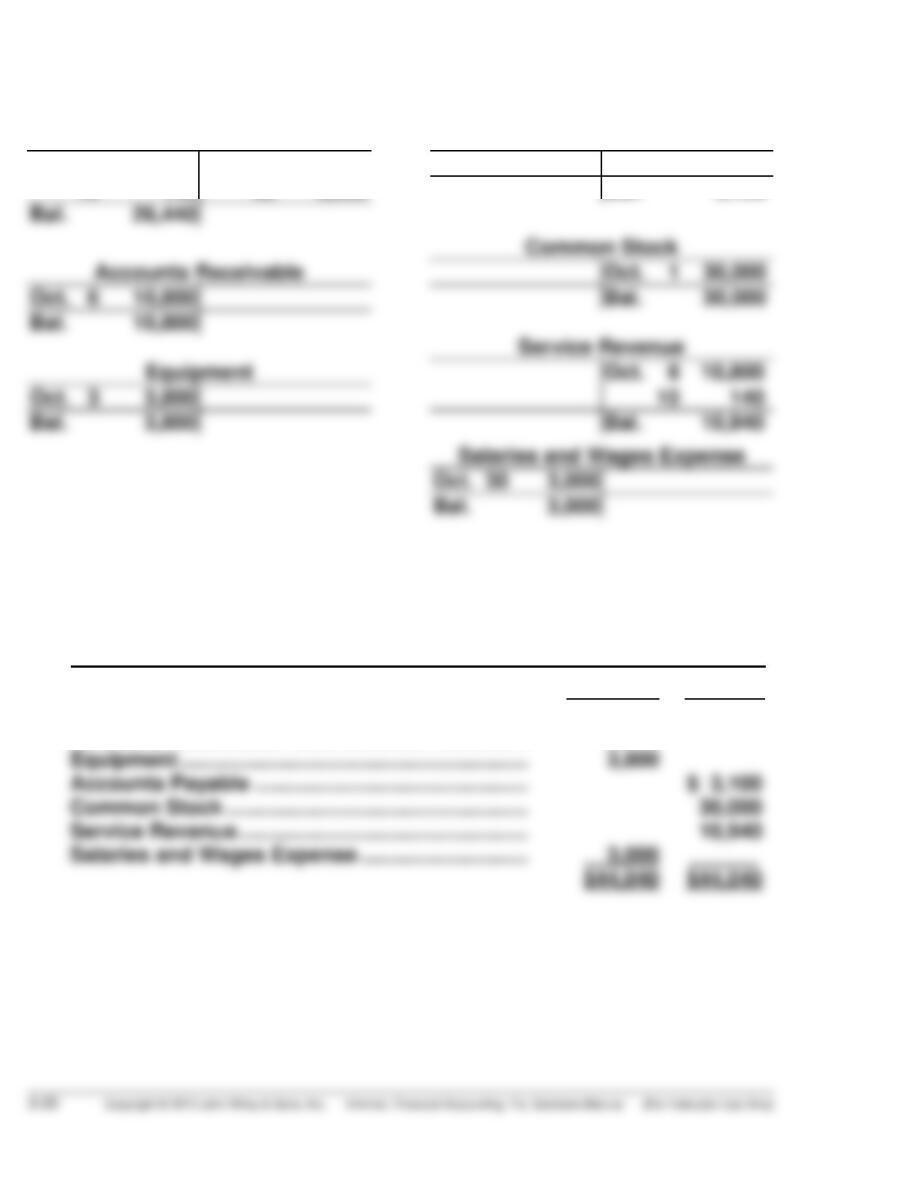
(a)
Cash
A
ccounts Payable
Oct. 1 30,000 Oct. 27 700 Oct. 27 700 Oct. 3 3,800
10 140 30 3,000 Bal. 3,100
(b) CROFOOT REAL ESTATE AGENCY
Trial Balance
October 31, 2014
Debit Credit
Cash …………………………………………………………….
Accounts Receivable ……………………………………
$26,440
10,800