CASES AND PROJECTS
FINANCIAL REPORTING AND ANALYSIS CASES
CP3–1.
1. The largest expense on the income statement for the year ended January 31, 2015,
is the “cost of sales” for $2,128,193,000. As goods were sold throughout the year,
cost of goods sold would be recorded and inventory would be reduced.
Note: Most retailers settle sales in cash at the register and would not have accounts
receivable related to sales unless they had layaway or private credit. For American
Eagle, the accounts receivable on the balance sheet primarily relates to amounts
owed from landlords for their construction allowances for building new American
Eagle stores in malls.
3. Over the life of the business, total earnings will equal total net cash flow. However,
for any given year, the assumption that net earnings is equal to cash inflows is not
4. An income statement or statement of operations reports the financial performance of
a company over a period of time in terms of revenues, gains, expenses, and losses.
A balance sheet or statement of financial position lists the economic resources
owned by an entity and the claims to those resources from creditors and investors at
a point in time. They are linked through retained earnings.
CP3–1. (continued)
Financial Accounting, 9/e 3-55
5. Dollars in thousands:
Fiscal year
ended
Net
Income
÷
Net Sales (or
Operating) Revenues
=
Net Profit Margin
Ratio
1/31/15
$80,322
$3,282,867
0.024 or 2.4%
2/1/14
82,983
3,305,802
0.025 or 2.5%
2/2/13
232,108
3,475,802
0.067 or 6.7%
Fiscal year
ended
Income from
Continuing
Operations
÷
Net Sales (or
Operating)
Revenues
=
Net Profit Margin
Ratio
1/31/15
$88,787
$3,282,867
0.027 or 2.7%
2/1/14
82,983
3,305,802
0.025 or 2.5%
2/2/13
264,098
3,475,802
0.076 or 7.6%
From these results, it appears AEO became less effective at generating sales and/or
CP3-2.
1. Urban Outfitters’ revenue recognition policy for retail store sales is to record
revenues when customers purchase merchandise. Internet, catalog, and wholesale
2. Assuming that $50 million of cost of sales is due to distribution and occupancy costs,
Urban Outfitters purchased $2,145,177 thousand worth of inventory.
Inventory (in thousands)
3. Dollars in thousands:
Year Ended
SG&A Expenses
÷
Net Sales Revenue
=
Percentage
2015
$809,545
$3,323,077
0.244 or 24.4%
2013
Financial Accounting, 9/e 3-57
CP3-2. (continued)
4. Dollars in thousands:
Fiscal year
ended
Net
Income
÷
Net Sales (or
Operating) Revenues
=
Net Profit Margin
Ratio
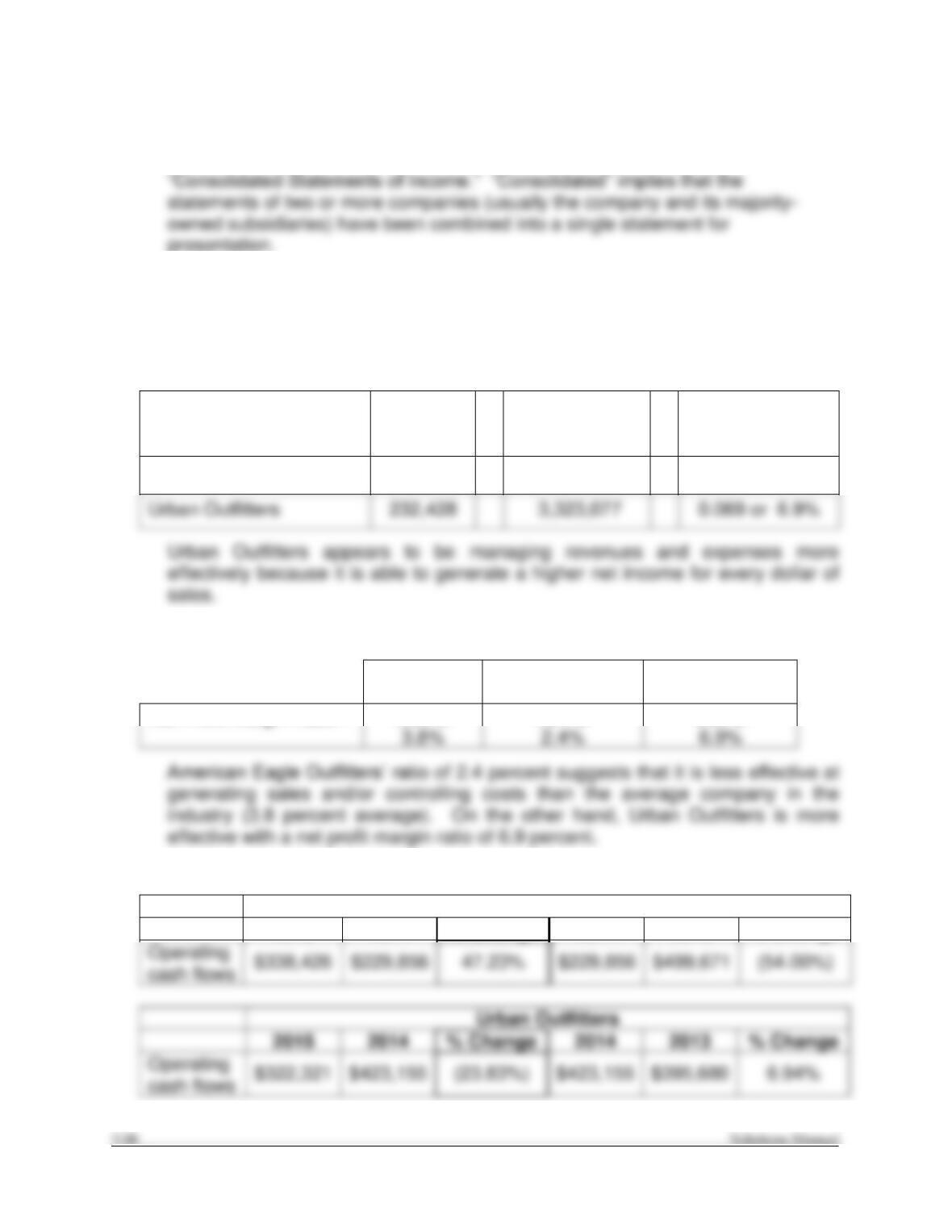
2015
$232,428
$3,323,077
0.069 or 6.9%
2013
CP3–3.
1. American Eagle Outfitters calls its income statement the “Consolidated
Statements of Operations.” Urban Outfitters calls its income statement the
2. Urban Outfitters had the higher net income of $232,428 for the year ended
January 31, 2015, compared to American Eagle Outfitters’ net income of $80,322
for the same year (all dollars in thousands).
3. Dollars in thousands:
For Fiscal Year 2014
Net
Income
÷
Net Sales (or
Operating)
Revenues
=
Net Profit
Margin Ratio
American Eagle Outfitters
$80,322
$3,282,867
0.024 or 2.4%
4. Comparison to industry:
Industry
Average
American Eagle
Outfitters
Urban
Outfitters
Net Profit Margin Ratio =
.038 or
.024 or
.069 or
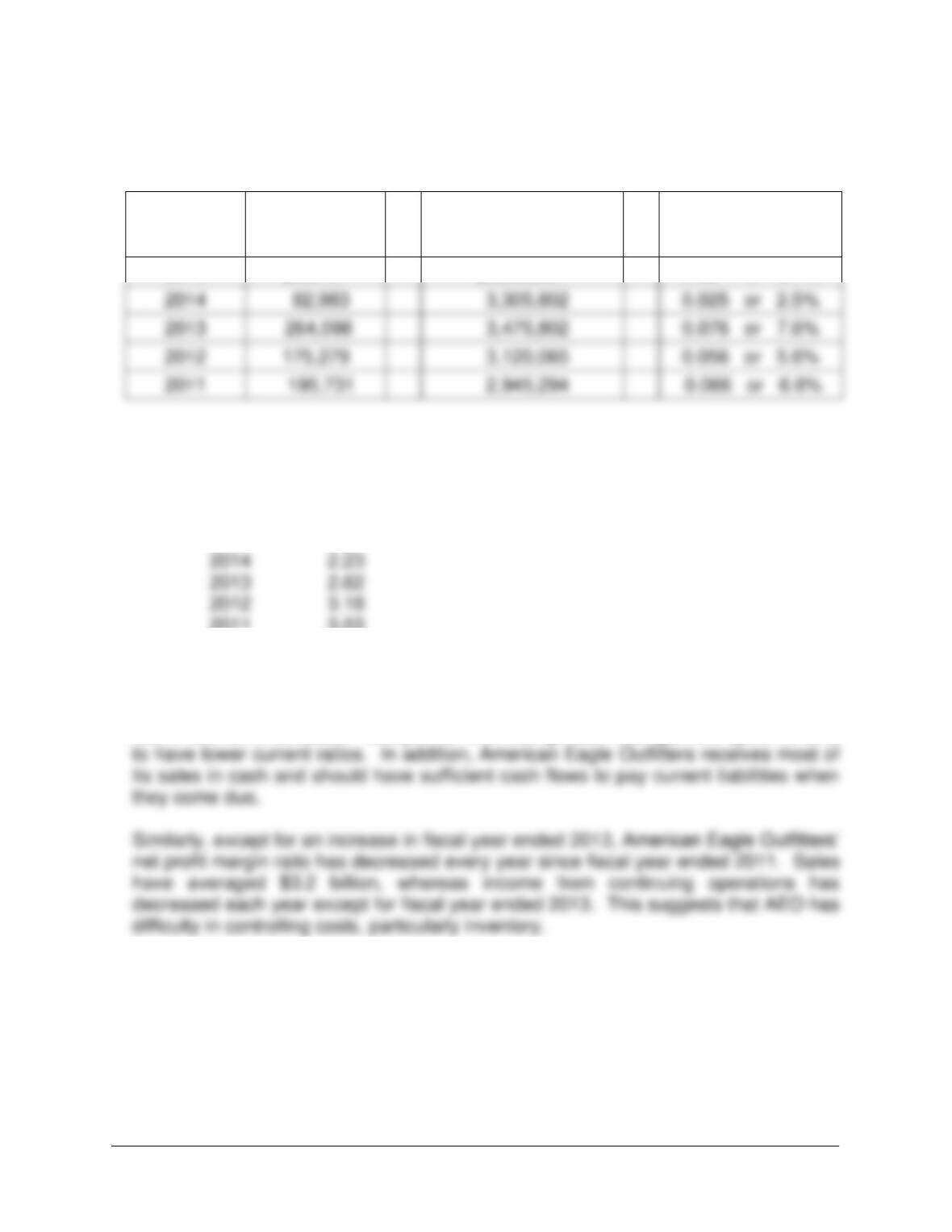
5. Dollars in thousands:
American Eagle Outfitters
2015
2014
% Change
2014
2013
% Change
Operating
2015
2014
% Change
2014
2013
% Change
Financial Accounting, 9/e 3-59
CP3–4.
Req. 1
American Eagle Outfitters (dollars in thousands)
Fiscal year
ended
Income from
Continuing
Operations
÷
Net Sales (or
Operating)
Revenues
=
Net Profit Margin
Ratio
2015
$88,787
$3,282,867
0.027 or 2.7%
Req. 2
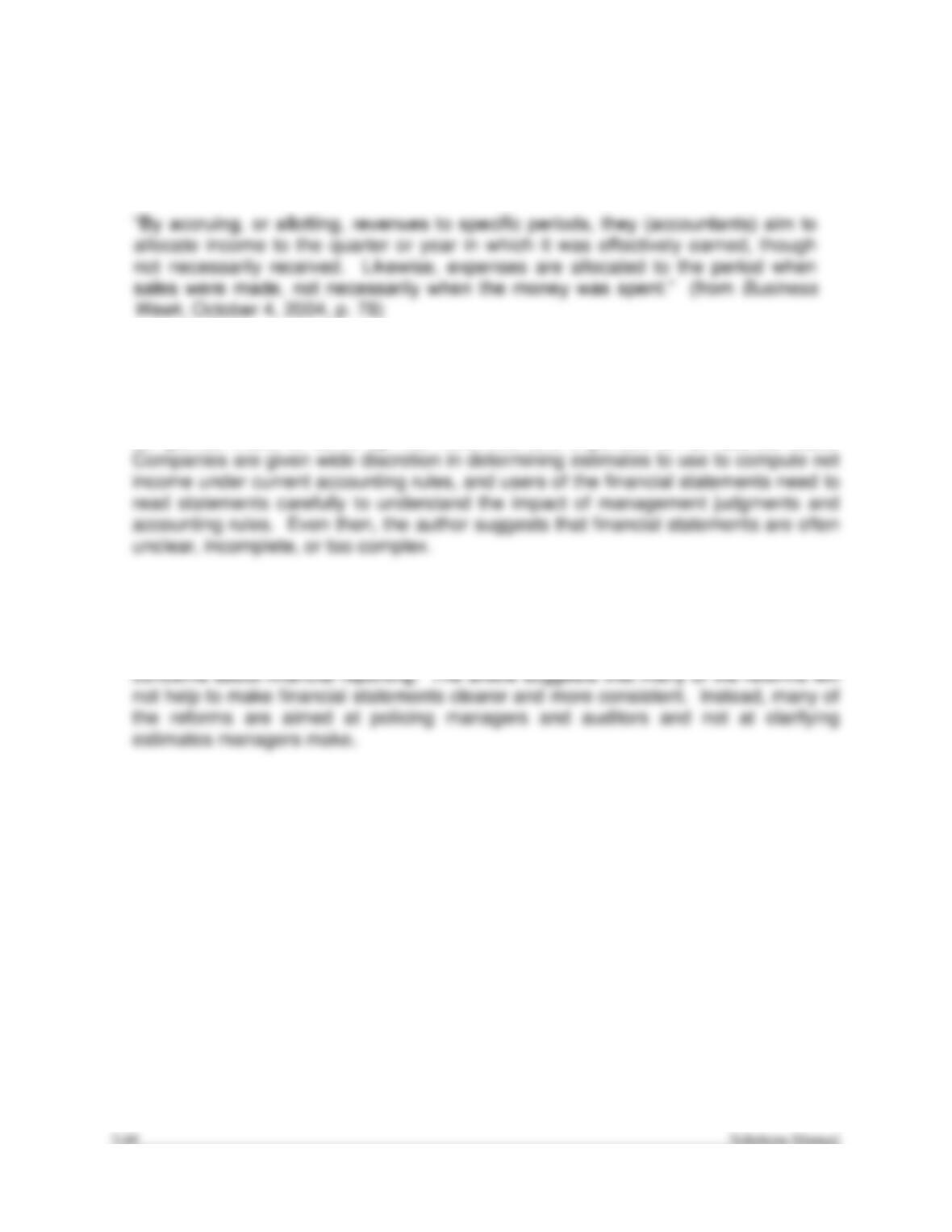
Current ratio reported in American Eagle Outfitters’ 10-K report (Item 6) for fiscal year
ended:
2015
1.94
2014
2013
2012
3.18
2011
3.03
Except for the increase in fiscal year ended 2012, the current ratio has steadily
decreased from 3.01 in fiscal year ended 2011 to 1.94 in fiscal year ended 2015.
American Eagle Outfitters continues to have sufficient liquidity as a cushion against
future economic stresses. Companies with strong cash management systems tend
2013
0.076 or 7.6%
CP3–5.
Req. 1
Accrual accounting is defined in the article as follows:
Req. 2
The author of the article suggests that “fuzzy numbers” result from the judgments
companies make to come up with revenues and expenses on an accrual basis.
Req. 3
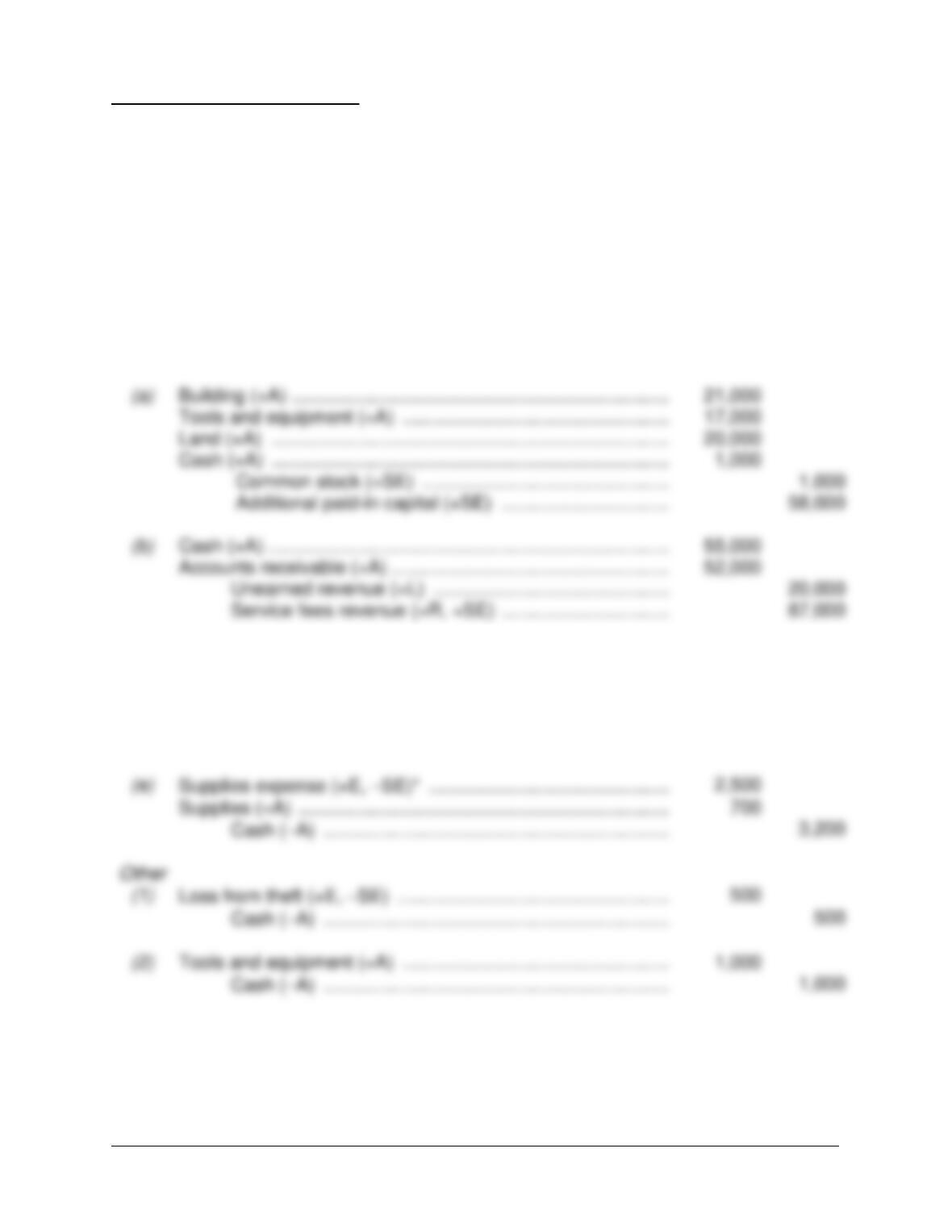
Congress and the SEC have adopted reforms to attempt to address the rising
Financial Accounting, 9/e 3-61
CRITICAL THINKING CASES
CP3–6.
Req. 1
Estela used the cash basis of accounting. We can infer this from his references to
income collected rather than earned, expenses paid rather than incurred, and supplies
purchased rather than used. Accrual accounting should be used because it correctly
assigns revenues and expenses to the accounting period in which they are earned or
incurred.
Req. 2
(c)
No entry (the stock is not owned by the company)
(d)
Operating expenses (+E, −SE) ……………………………………..
61,000
Accounts payable (+L) ………………………………………..
39,000
Cash (−A) …………………………………………………………
22,000
(e)
Supplies expense (+E, −SE)* ……………………………………….
Supplies (+A) ……………………………………………………………..
Cash (−A) …………………………………………………………
(1)
Loss from theft (+E, −SE) …………………………………………….
Cash (−A) …………………………………………………………
(2)
Tools and equipment (+A) ……………………………………………
Cash (−A) …………………………………………………………
* Supplies purchased, $3,200 − Supplies on hand at end of current year, $700 = $2,500
supplies used
(a)
Building (+A) ………………………………………………………………
21,000
Tools and equipment (+A) ……………………………………………
17,000
Land (+A) ………………………………………………………………….
20,000
Cash (+A) ………………………………………………………………….
Additional paid-in capital (+SE) …………………………..
58,000
(b)
Cash (+A) …………………………………………………………………..
55,000
Accounts receivable (+A) ……………………………………………..
52,000
Unearned revenue (+L) ………………………………………
20,000
Service fees revenue (+R, +SE) …………………………..
87,000
CP3–6. (continued)
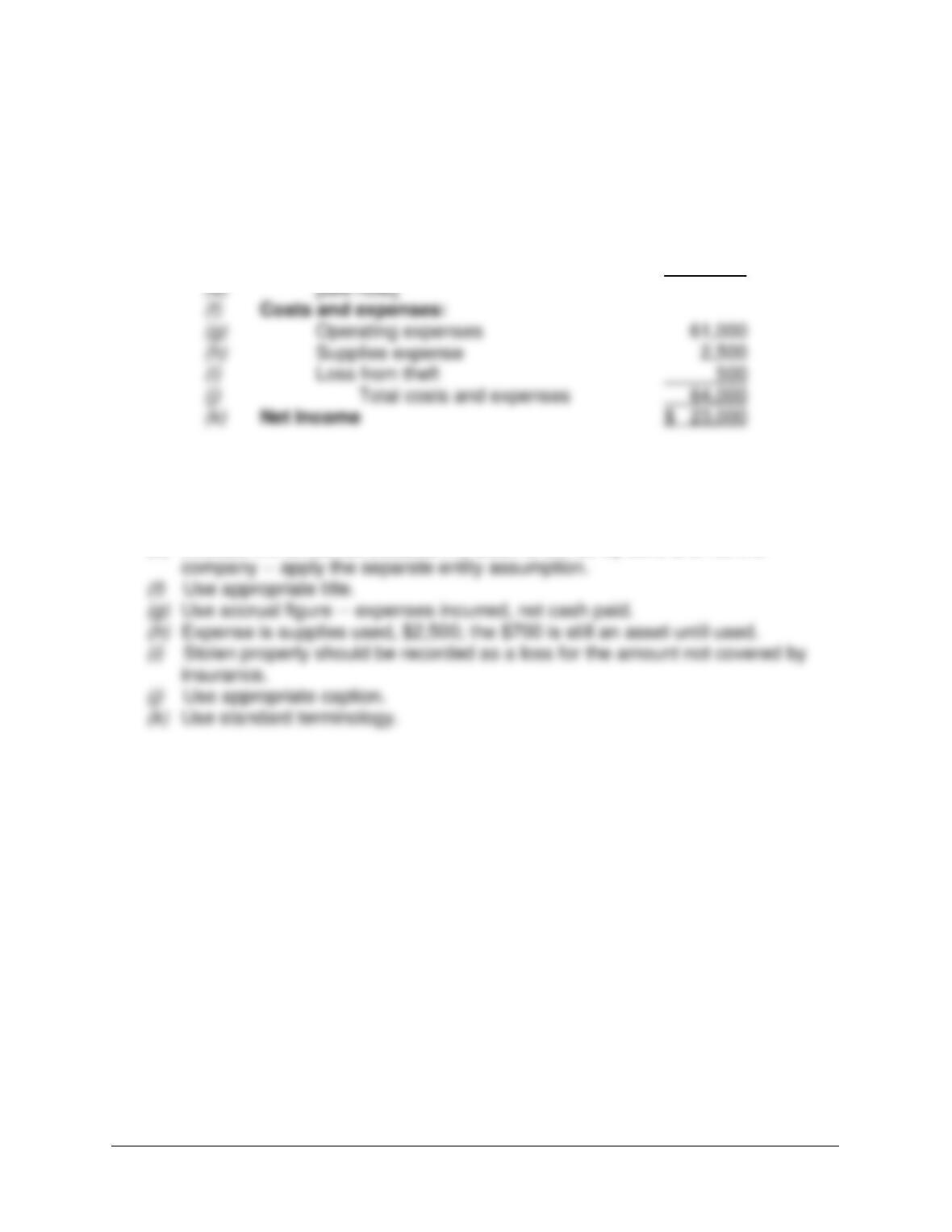
ASSETS:
Cash
Accounts Receivable
Supplies
Beg. 0
(a) 1,000
(b) 55,000
22,000 (d)
3,200 (e)
500 (1)
1,000 (2)
Beg. 0
(b) 52,000
Beg. 0
(e) 700
29,300
52,000
700
Land
21,000
20,000
18,000
39,000
20,000
SHAREHOLDER’S EQUITY:
Common
Stock
Additional Paid-in
Capital
0 Beg.
1,000 (a)
0 Beg.
58,000 (a)
1,000
58,000
87,000 (b)
Beg. 0
87,000
Beg. 0
500
Retained
Earnings
0 Beg.
0
Financial Accounting, 9/e 3-63
CP3–6. (continued)
Req. 3
ESTELA COMPANY
(a)
Income Statement
(b)
For the Year Ended December 31
(c)
Revenues:
(d)
Service fees revenue
$ 87,000
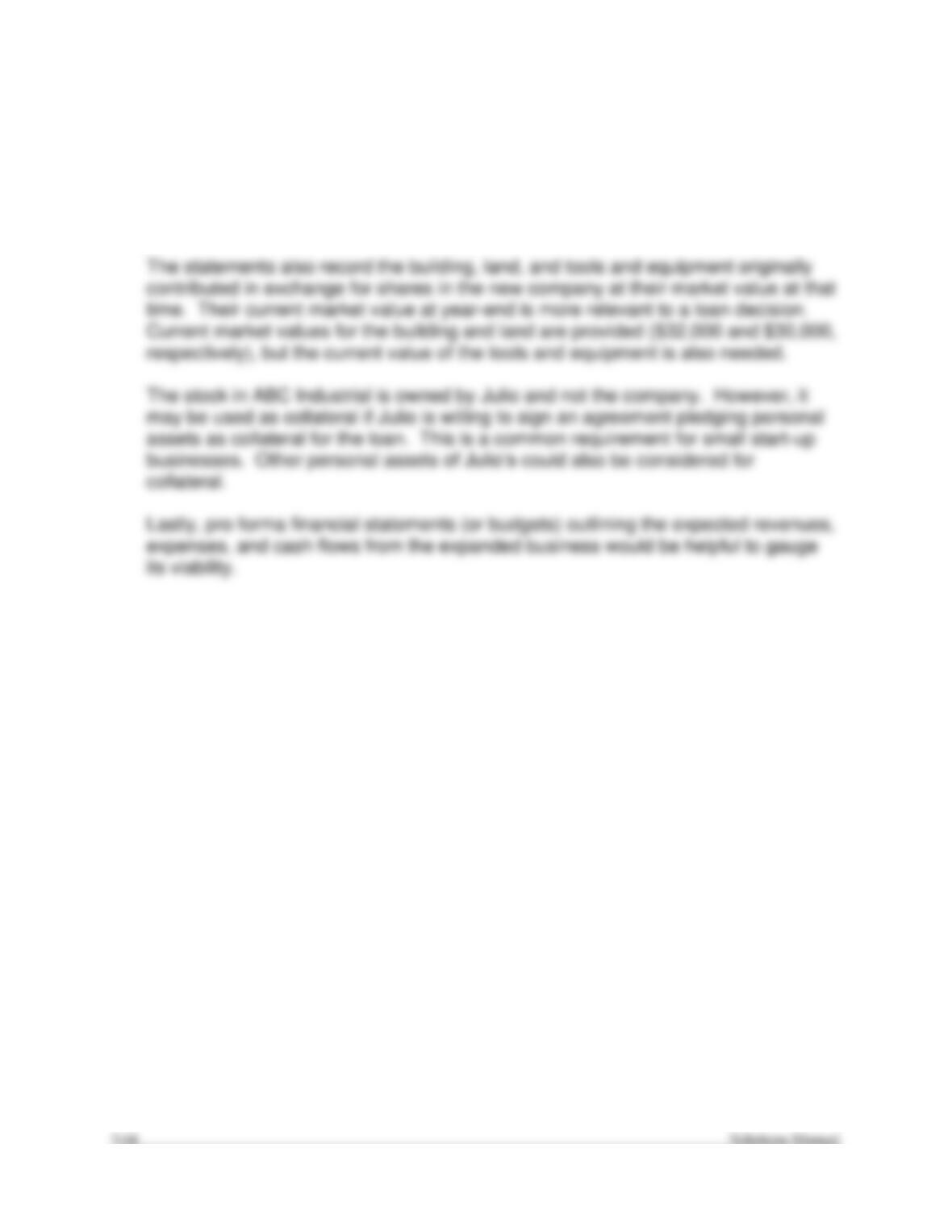
(a) Use the standard title.
(b) Date to indicate time period covered.
(c) Use appropriate title.
(d) Use accrual figure — revenue earned, rather than cash collected.
(e) Exclude the dividends because the stock is owned by Julio and not the
(e)
[see note]
(f)
(g)
(h)
(i)
Loss from theft
500
(j)
Total costs and expenses
(k)
$ 23,000
CP3–6. (continued)
Req. 4
The above statements do not yet take into account most year-end adjustments,
including depreciation and income taxes. The adjusting entry for income taxes is
especially important because of the implication for future cash flows.
Financial Accounting, 9/e 3-65
CP3–6. (continued)
Req. 5
(today’s date)
Dear Mr. Estela:
We regret to inform you that your request for a $100,000 loan has been denied.
We also require that there be sufficient collateral pledged against the loan before we
can consider it. A loan of this size would increase your company’s size by over 70%
of its current asset base. The current market value of the building and land held by
the company are insufficient as collateral. The current value of the tools and
equipment may provide additional collateral, if you provide us with this information.
Your personal investments may also be considered viable collateral if you are willing
to sign an agreement pledging these assets as collateral for the loan. This is a
common requirement for small start-up businesses.
CP3–7.
Req. 1
This type of ethical dilemma occurs quite frequently. The situation is difficult personally
was done). To record the collection as revenue overstates income in the current period.
Req. 2
In the short run, Mr. Lynch would benefit by receiving a larger bonus. You also
benefit in the short run because you would not experience any negative repercussions
Req. 3
In the larger picture, shareholders are harmed by the misleading income figures
by relying on them to purchase stock at inflated prices. In addition, creditors may lend
violation of your integrity.
Req. 4
Managers are agents for shareholders. To act in ways to the benefit of the
FINANCIAL REPORTING AND ANALYSIS TEAM PROJECT
CP3–8.
The solution to this project will depend on the companies and/or accounting periods
selected for analysis.