Measuring Revenues and Expenses 71
Desert Harbor Inn
Statement of Cash Flows
For the Year Ended December 31, 2007
Cash flow from operating activities:
Collected from customers $187,000
Paid to employees ($49,000 − $890) (48,110)
Desert Harbor Inn
Balance Sheet
December 31, 2007
Assets Liabilities and Owners’ Equity
Cash $ 33,590 Wages payable $ 890
Accounts receivable 13,000 Notes payable 21,500
B. From a financial perspective, this appears to be an attractive business.
It generated net income of $112,300 on a beginning–of-the-year Owners’
72 Chapter 3
P3–15 A. Zorditch.com
Income Statement
End of the First Year
Sales revenue ($173,400 + $18,200)* $191,600
Expenses:
Depreciation expense $ 5,700
B. Item Justification of change
1. Money I contributed to firm
This is not an expense. It represents
Owners’ Equity and should be report-
ed on the balance sheet.
A loan is a liability, not an expense.
C. 1. Don’t close the business, especially if the future looks bright.
Measuring Revenues and Expenses 73
P3–16 A.
ASSETS
=
LIABILITIES
+
OWNERS’ EQUITY
Date
Accounts
Cash
Other
Assets
Contributed
Capital
Retained
Earnings
Dec. 31
Interest Expense
–6,250*
B. The imbalance on the balance sheet is exactly equal to the amount of
C. The adjusting entries would affect the balance sheet and income
statement information as follows:
P3–17 A. and B.
Account Balance Be-
fore Adjustment
Adjustments
Account
Balance After
Adjustment
Cash
52,500
52,500
Accounts receivable
35,250
35,250
Supplies
19,200
10,050
Prepaid insurance
Buildings
649,500
Interest Payable
Dec. 31
Insurance Expense
Prepaid Insurance
Dec. 31
Depreciation Expense
Accumulated Depreciation
Dec. 31
Rent Receivable
Rent Revenue
74 Chapter 3
Total assets
1,072,500
1,055,700
Unearned revenues
36,000
(3) –12,000
24,000
Accounts payable
27,900
27,900
Interest payable
6,000
(5) 3,000
9,000
C. The net income earned during the year has not yet been transferred to
retained earnings. This is true for both the unadjusted account balance
column (column 1) and for the adjusted account balance column (col-
umn 3).
D. The closing entries need to be identified. Closing entries have the ef-
E. Net income before adjustments $58,500
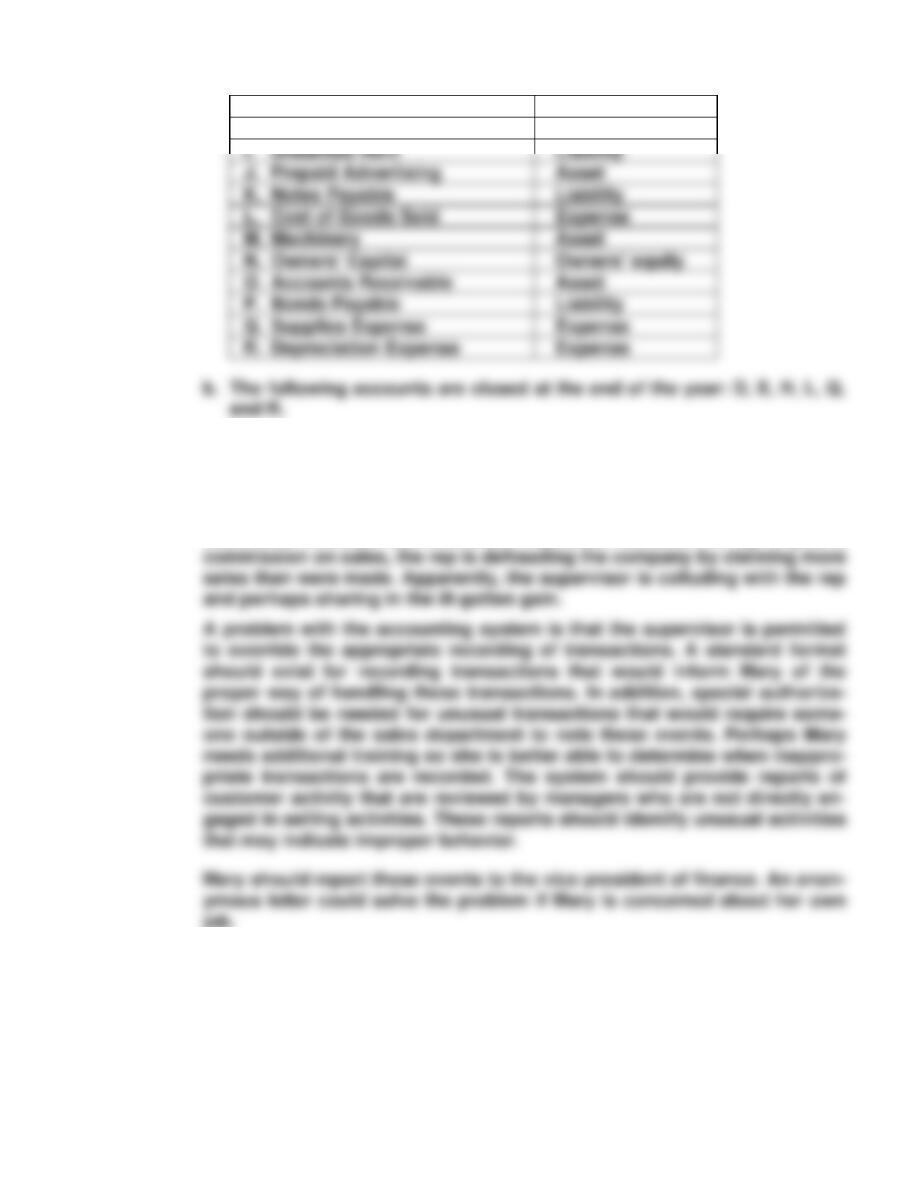
P3–18 a.
Account Type
A. Prepaid Insurance
Asset
B. Retained Earnings
C. Accumulated Depreciation
Asset (negative)
D. Wages Expense
Expense
Wages payable
(1) 4,350
4,350
Notes payable
Common stock
Retained earnings
Rent revenues
(3) 12,000
Wages expense
(1) –4,350
Supplies expense
(4) –9,150
Insurance expense
(2) –1,350
Interest expense
(5) –3,000
Depreciation expense
(6) –6,300
Net income
58,500
46,350
Measuring Revenues and Expenses 75
G. Supplies
Asset
H. Insurance Expense
Expense
P3–19 Mary should be suspicious. The procedures being used permit the sales
rep to receive commissions the rep has not earned. Some of the sales re-
ported for the customer are fictitious. Rather than reducing sales revenue
when the sales are canceled, an expense is recorded. This procedure
overstates revenues and overstates expenses. Because the rep is paid a
P3–20 MEMO
TO: Flora Wiser
FROM: (Student’s Name)
SUBJECT: Processing accounting information
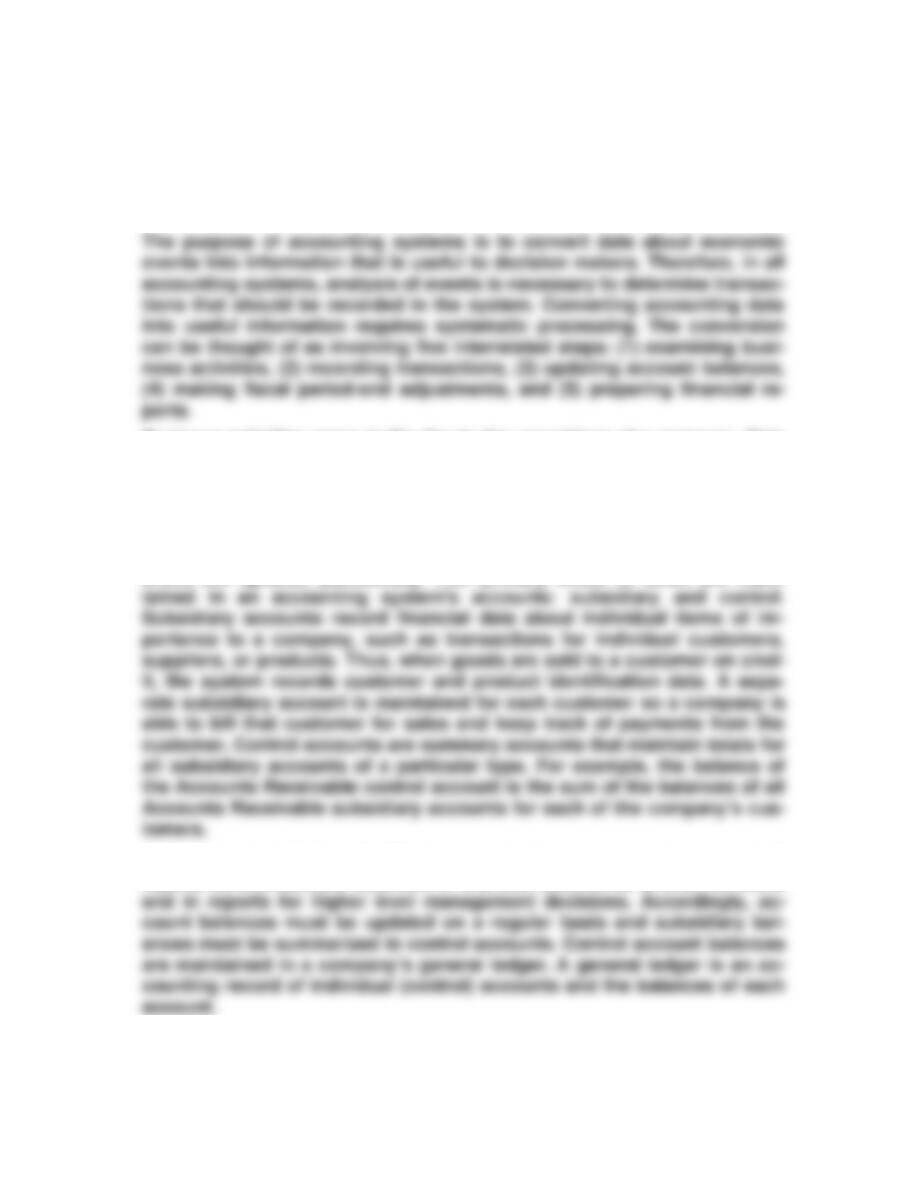
I. Unearned Rent
Liability
Asset
K. Notes Payable
Liability
Expense
Asset
O. Accounts Receivable
Asset
Liability
Q. Supplies Expense
Expense
R. Depreciation Expense
Expense
76 Chapter 3
I have been asked to provide a summary of accounting information pro-
cesses to help you obtain a better understanding of accounting systems
and how they convert data to useful information. In this memo, I will sum-
marize the basic purpose of accounting systems and the processes used
to accomplish this purpose. I will be pleased to meet with you to answer
questions or to discuss other related matters.
Business activities occur in the day-to-day operations of a company. Data
about a company’s business activities are recorded in a company’s infor-
mation system. Some of these data are in the form of financial measures.
These financial measures are recorded in the company’s accounting sys-
tem by identifying specific accounts that are affected by the activities.
Once financial data are recorded in individual accounts, the account bal-
ances are updated periodically. Two primary levels of detail are main-
A company maintains subsidiary accounts for management purposes. It
reports control account balances in financial statements to external users
In addition to updating account balances as transactions occur, an ac-
counting system must adjust these accounts periodically for activities that
Measuring Revenues and Expenses 77
Once all account balances have been updated at the end of a fiscal period,
these balances are used to prepare financial statements. Financial state-
ments are summaries of account balances prepared in specific formats to
P3–22
1
2
3
4
5
6
7
8
9
10
CASES
C3-1
This sales plan has manipulation, distortion, and fraud written all over it. In gen-
eral, very little is favorable. The underlying motivation for each aspect of this plan
appears to be temporary personal enrichment of Flash and his (her?) regional
78 Chapter 3
If these “forced sales” are not reported explicitly as such, creditors and investors
will be misled as to the true amount of this year’s sales and profits. Also, some
distributors have been told they may return these “special” purchases that remain
unsold. At minimum, this is likely to cause unhappiness if returns cannot be
made. This technique cannot be used again next year because distributors will al-
Measuring Revenues and Expenses 79
C3-2
Students will first have to decide what information they wish to provide before an-
alyzing the data in the problem. Based on the chapter discussion, students might
reasonably prepare some or all of the following:
a. Summary of all cash flows
Each of these items is shown below. Because the results of these analyses are so
Interesting questions might include the following:
1. Why are the measurements for net cash flow ($20,950), net cash flow from
operations ($7,950), and net income (loss of $1,610) so different?
2. Did Softech.com have a good first quarter?
3. What are the financial prospects for the second quarter?
a. Summary of Cash Flows:
Purchase of new office furniture $ (500)
80 Chapter 3
b. Summary of Cash Flows Segmented by
Financing, Investing, and Operating Activities
Financing activities:
Loan from bank $ 4,000
c. Net Cash Flow from Operating Activities
Cash receipts:
From accounts receivable $ 6,800
d. Income Statement
Revenues:
Sales $18,000
Expenses:
Measuring Revenues and Expenses 81
e. Balance Sheet
Assets Liabilities and Stockholders’ Equity
Cash $25,190 Accounts payable2 $ 9,450
82 Chapter 3
P3–21
Accounts Accumulated Wages Notes Investment by Retained
Date Cash Receivable Supplies Inventory Equipment Depreciation Payable Payable Owners Earnings
9/30/2007 $ 4,238.72 $ — $ 2,343.28 $235,892.35 $55,650.00 −$12,353.00 $ — $123,452.88 $100,000.00 $62,318.47
10/31/2007 38,246.50
10/31/2007 −27,318.93
The Book Wermz The Book Wermz
Balance Sheet Income Statement
October 31, 2007 For October 2007
Assets Liabilities & Equity Revenues
Measuring Revenues and Expenses 83
P3-21 continued
Service Cost of Supplies Wages Rent Depreciation Interest
Sales Revenues Goods Sold Expense Expense Expense Expense Expense
$ — $ — $ — $ — $ — $ — $ — $ —
84 Chapter 3
COMPREHENSIVE REVIEW 1
a. Favorite Cookie Company
Income Statement
For the Month Ended February 28, 2007
Sales revenue $ 17,160
b.
ASSETS
=
LIABILITIES
+
OWNERS’ EQUITY
Date
Accounts
Cash
Other
Assets
Contributed
Capital
Retained
Earnings
Feb. 28
Retained Earnings
Sales Revenue
Feb. 28
Retained Earnings
Cost of Goods Sold
Wages Expense
1,000
Rent Expense
600
Depreciation Expense
520
Supplies Expense
400
Utilities Expense
220
Interest Expense
200
Ledger
Retained Earnings Sales Revenue
Date
Amount
Balance
Date
Amount
Balance
3,000
17,160
Jan. 31
Feb. 28
0
Feb. 28
5,780
Cost of Goods Sold Wages Expense
Date
Amount
Balance
Date
Amount
Balance
–11,440
–1,000
Feb. 28
Feb. 28
0
Date
Amount
Balance
Date
Amount
Balance
Measuring Revenues and Expenses 85
Supplies Expense Utilities Expense
Date
Amount
Balance
Date
Amount
Balance
c. Favorite Cookie Company
Post-Closing Summary of Account Balances
February 28, 2007
Account Balance
Assets:
Total Assets 50,580
Liabilities:
Accounts Payables 1,400
Owners’ Equity:
Contribution by Owners 10,000
Retained Earnings 5,780
Feb. 28
Feb. 28
Date
Amount
Balance
Feb. 28
86 Chapter 3
d. Favorite Cookie Company
Balance Sheet
At February 28, 2007
Assets
Cash $ 7,740
Accounts receivable 4,100
Liabilities and Owners’ Equity
Accounts payable $ 1,400
Unearned revenue 3,000
Measuring Revenues and Expenses 87
COMPREHENSIVE REVIEW 2
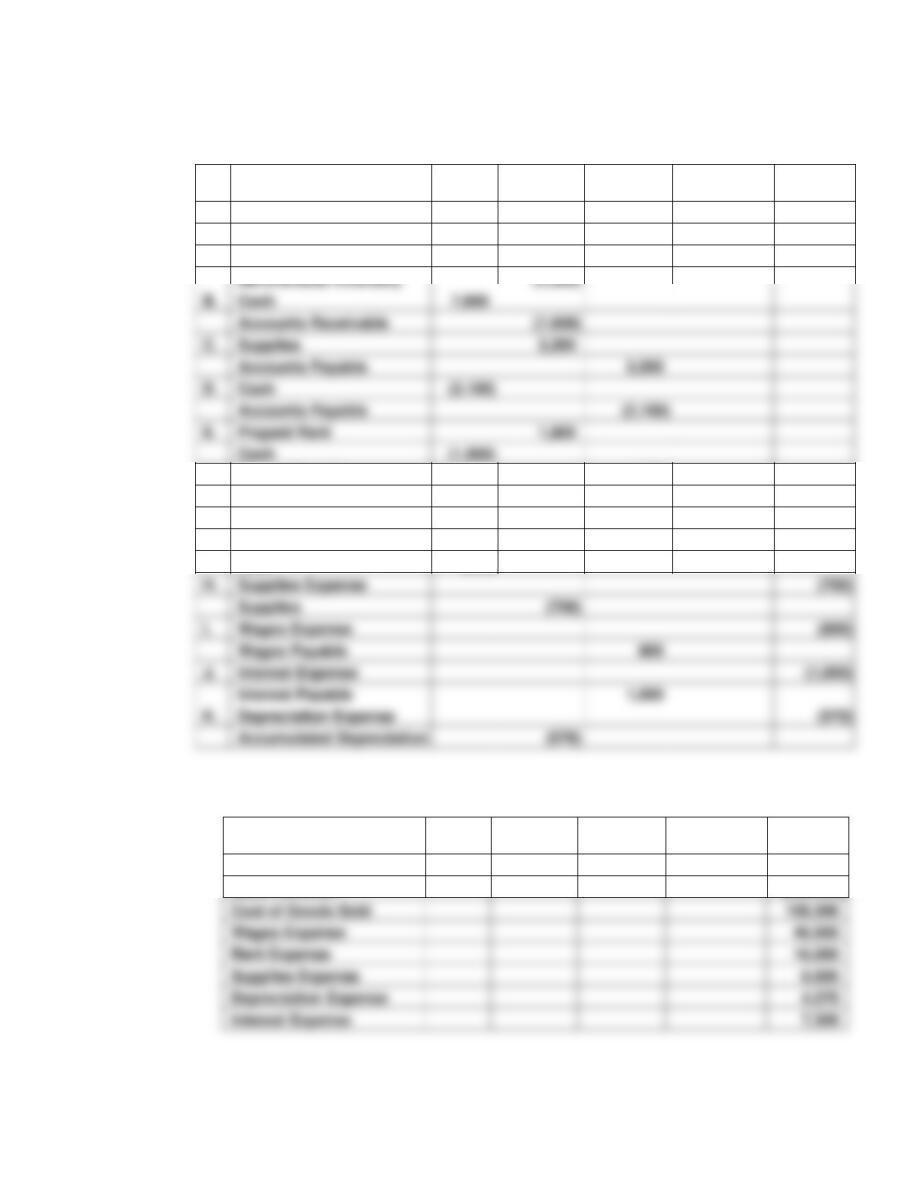
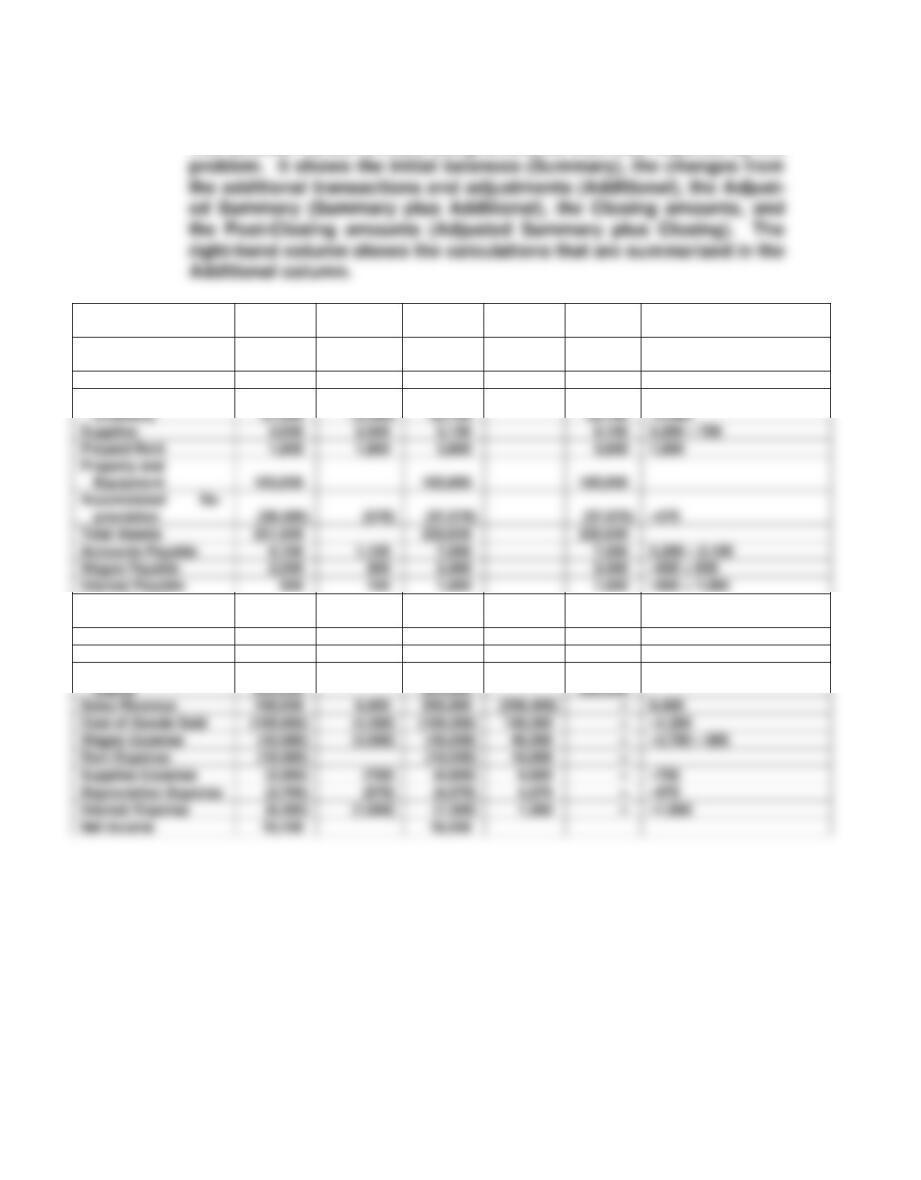
a. Additional Transactions and Adjustments
Accounts
Cash
Other
Assets
Liabilities
Contributed
Capital
Retained
Earnings
A.
Sales Revenue
8,400
Accounts Receivable
8,400
Cost of Goods Sold
(4,300)
F.
Wages Payable
(600)
Wages Expense
(3,700)
Cash
(4,300)
G.
Interest Payable
(900)
Cash
(900)
H.
Supplies Expense
Supplies
Wages Expense
Wages Payable
Interest Expense
(1,000)
Interest Payable
1,000
K.
Depreciation Expense
b. Closing Entries
Accounts
Cash
Other
Assets
Liabilities
Contributed
Capital
Retained
Earnings
Retained Earnings
16,430
Sales Revenue
(206,400)
Cost of Goods Sold
109,300
Wages Expense
46,500
Supplies Expense
6,600
Depreciation Expense
4,270
Merchandise Inventory
B.
Cash
Accounts Receivable
C.
Supplies
3,200
Accounts Payable
3,200
D.
Cash
(2,100)
Accounts Payable
Prepaid Rent
1,800
Cash
(1,800)
88 Chapter 3
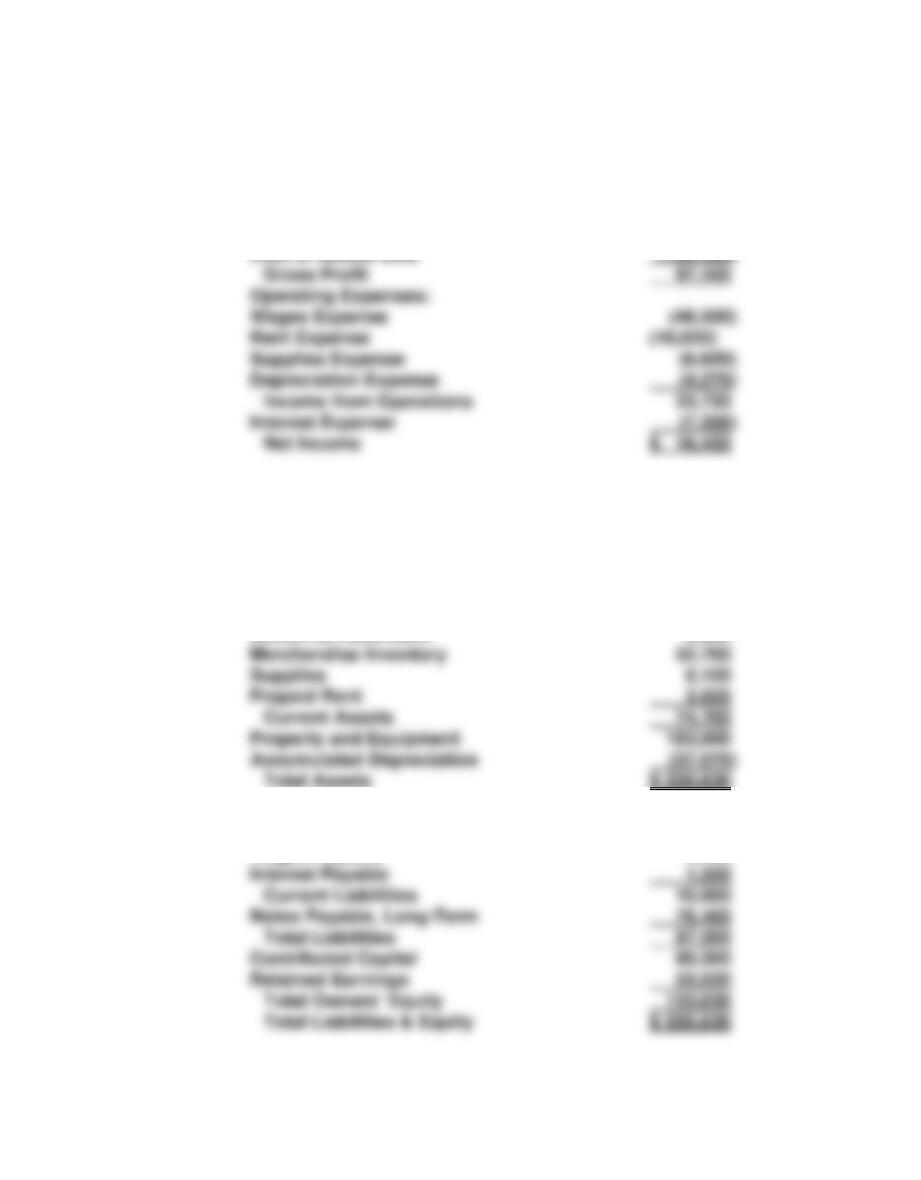
c. Summary of Account Balances
The solution below is more comprehensive than that required by the
Summary
Additional
Adjusted
Summary
Closing
Post-
Closing
Calculations for
Additional Column
Cash
5,000
(1,500)
3,500
3,500
7,600 – 2,100 – 1,800 –
4,300 – 900
Accounts Receivable
8,000
800
8,800
8,800
8,400 – 7,600
Supplies
3,600
6,100
6,100
3,200 – 700
Prepaid Rent
1,800
3,600
3,600
1,800
Property and
Accumulated De-
Total Assets
Accounts Payable
7,200
7,200
3,200 – 2,100
Wages Payable
2,200
200
2,400
2,400
Interest Payable
100
1,000
1,000
Merchandise
Notes Payable,
Long-Term
76,400
76,400
76,400
Contributed Capital
80,000
80,000
80,000
Retained Earnings
37,200
37,200
16,430
53,630
Equity
Sales Revenue
8,400
Cost of Goods Sold
Rent Expense
16,000
Supplies Expense
6,600
Depreciation Expense
4,270
Interest Expense
7,300
Net Income
19,100
16,430
Total Liabilities &
Measuring Revenues and Expenses 89
d. Income Statement and Balance Sheet
Orlando Co.
Income Statement
For the Year Ended October 31, 2007
Sales Revenue $ 206,400
Orlando Co.
Balance Sheet
October 31, 2007
Assets
Cash $ 3,500
Accounts Receivable 8,800
Total Assets $ 220,630
Liabilities & Owners’ Equity
Accounts Payable $ 7,200
Wages Payable 2,400