Problem 3-18A (30 minutes)
1. The activity rates are computed as follows:
Activity Cost Pool
(a)
Estimated
Overhead
Cost
(b)
Expected
Activity
(a) ÷ (b)
Activity Rate
Labor related ………
$35,000
DLHs
per DLH
Material receipts ….
$10,450
receipts
per receipt
Relay assembly ……
relays
per relay
2. Overhead cost is assigned to the products as follows:
Product A
Activity Cost Pool
(a)
Activity
Rate
(b)
Actual
Activity
(a) × (b)
ABC Cost
Labor related …………
$5
per DLH
DLHs
$12,000
Material receipts …….
per receipt
400
receipts
Relay assembly ………
$7
per relay
170
relays
Total ……………………
$89,790
Product B
Activity Cost Pool
(a)
Activity
Rate
(b)
Actual
Activity
(a) × (b)
ABC Cost
Labor related …………
$5
per DLH
500
DLHs
$ 2,500
Material receipts …….
per receipt
208
receipts
General factory ………
$6
per MH
MHs
42,000
Total ……………………
$48,678
Problem 3-18A (continued)
Product C
Activity Cost Pool
(a)
Activity
Rate
(b)
Actual
Activity
(a) × (b)
ABC Cost
Labor related …………
$5
per DLH
3,500
DLHs
$17,500
Total ……………………
$72,962
Product D
Activity Cost Pool
Rate
Activity
ABC Cost
Labor related …………
$5
per DLH
DLHs
Material receipts …….
per receipt
receipts
Total ……………………
$85,020
(a)
Activity
(b)
Actual
(a) × (b)
3. The conventional system would assign 20% (8,000 MHs ÷ 40,000 MHs)
of all overhead costs to Product C. The ABC system would assign 50%
Communicating in Practice (30 minutes)
Date: Current Date
To: Maria Graham
From: Student’s Name
Subject: Overhead Allocation
I understand that you are thinking about purchasing a small manufacturing
company that assembles and packages its many products by hand. The
company currently uses direct labor hours to allocate overhead to its
products, but you plan to introduce automation. You have asked me to
comment on whether this technique should be continued.
Direct labor is an appropriate allocation base for overhead when overhead
Activity-based costing may be the best alternative. In activity-based
costing, overhead costs are allocated based on the activities required to
make the products and the resources that are consumed by these
activities. This technique is more complex than the approach the company
Teamwork In Action
Student answers will vary depending on the operations they observe at the
restaurant they visit and on how they define a unit and products. The
following are only suggestive of the answers that might be offered for a
fast food restaurant that sells hamburgers and beverages:
a.
Unit-level activities
and costs
Facility-level activities
Grilling a burger, assembling a hamburger,
making a milkshake, costs of ingredients,
Ethics Challenge (15 minutes)
Most people would probably feel that the most equitable way to divide the
dinner bill among a group of friends is for each person to pay for the cost
Case (150 minutes)
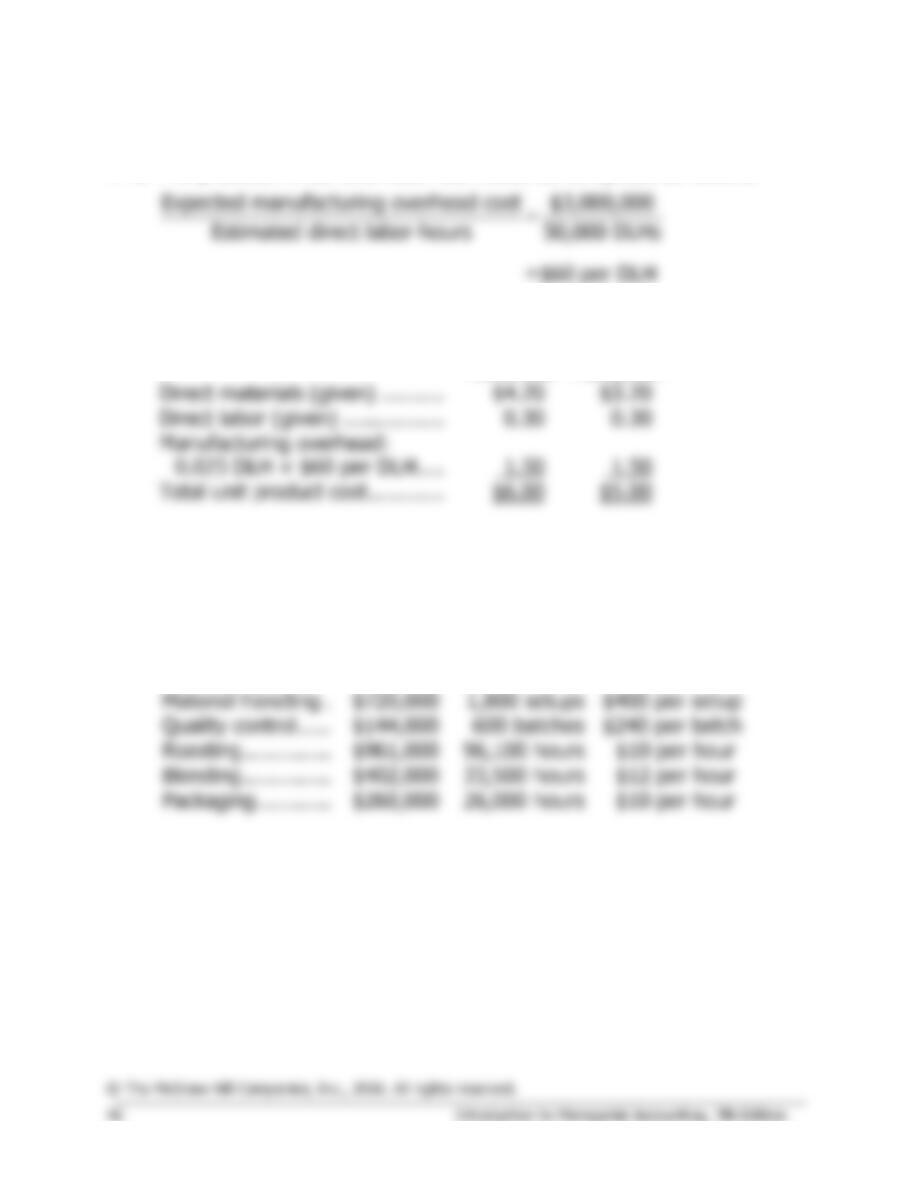
1. a. The predetermined overhead rate would be computed as follows:
b. The unit product cost per pound, using the company’s present costing
system, would be:
Mona Loa
Malaysian
Total unit product cost …………
2. a. Overhead rates by activity:
Activity Center
(a)
Estimated
Overhead
Costs
(b)
Expected
Activity
(a) ÷ (b)
Activity Rate
Purchasing ……….
$513,000
1,710 orders
$300 per order
Material handling .
$720,000
Blending …………..
$402,000
Packaging …………
$260,000
Case (continued)
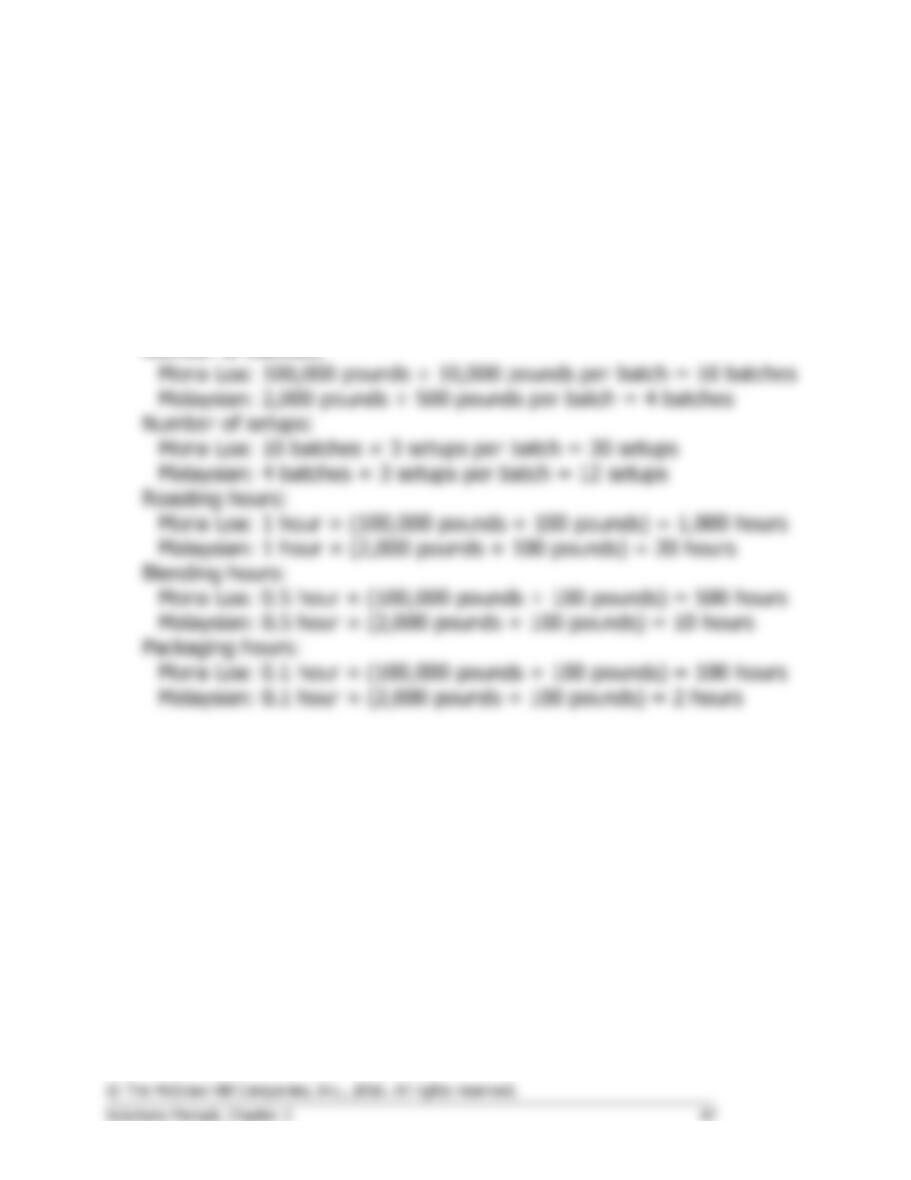
Before we can determine the amount of overhead cost to assign to
the products we must first determine the activity for each of the
products in the six activity centers. The necessary computations
follow:
Number of purchase orders:
Mona Loa: 100,000 pounds ÷ 20,000 pounds per order = 5 orders
Malaysian: 2,000 pounds ÷ 500 pounds per order = 4 orders
Number of batches:
Malaysian: 2,000 pounds ÷ 500 pounds per batch = 4 batches
Number of setups:
Mona Loa: 10 batches × 3 setups per batch = 30 setups
Malaysian: 4 batches × 3 setups per batch = 12 setups
Roasting hours:
Malaysian: 1 hour × (2,000 pounds ÷ 100 pounds) = 20 hours
Blending hours:
Mona Loa: 0.5 hour × (100,000 pounds ÷ 100 pounds) = 500 hours
Malaysian: 0.5 hour × (2,000 pounds ÷ 100 pounds) = 10 hours
Packaging hours:
Malaysian: 0.1 hour × (2,000 pounds ÷ 100 pounds) = 2 hours
Case (continued)
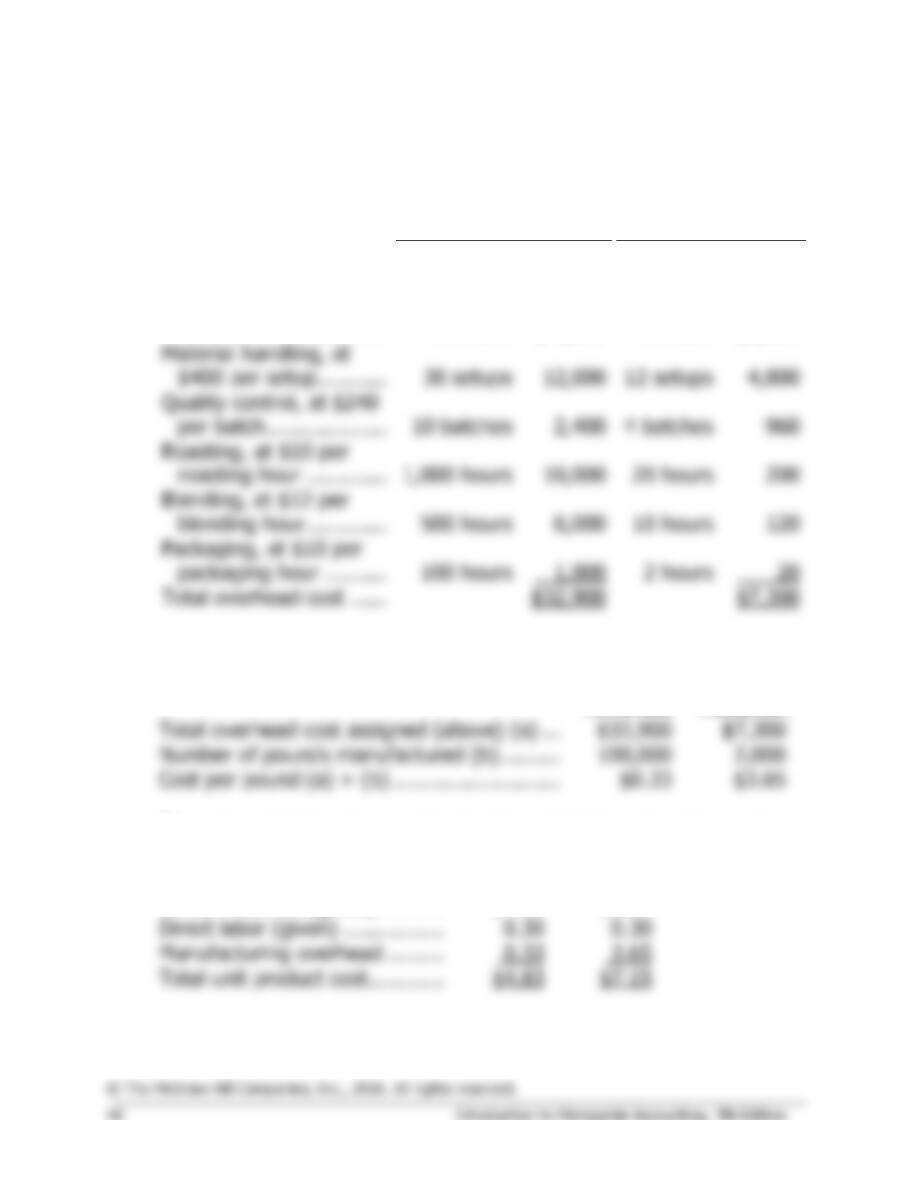
Using the activity figures, manufacturing overhead costs can be
assigned to the two products as follows:
Mona Loa
Malaysian
Expected
Activity
Amount
Expected
Activity
Amount
Purchasing, at $300 per
order …………………….
5 orders
$ 1,500
4 orders
$1,200
Quality control, at $240
per batch ……………….
2,400
Roasting, at $10 per
Blending, at $12 per
blending hour ………….
6,000
Packaging, at $10 per
Total overhead cost ……
b. According to the activity-based costing system, the manufacturing
overhead cost per pound is:
Mona Loa
Malaysian
Total overhead cost assigned (above) (a) …
Number of pounds manufactured (b) ……….
Cost per pound (a) ÷ (b) ………………………
c. The unit product costs according to the activity-based costing system
are:
Mona Loa
Malaysian
Direct materials (given) ……….
$4.20
$3.20
Direct labor (given) …………….
Manufacturing overhead ………
Total unit product cost …………
$4.83
$7.15
Case (continued)
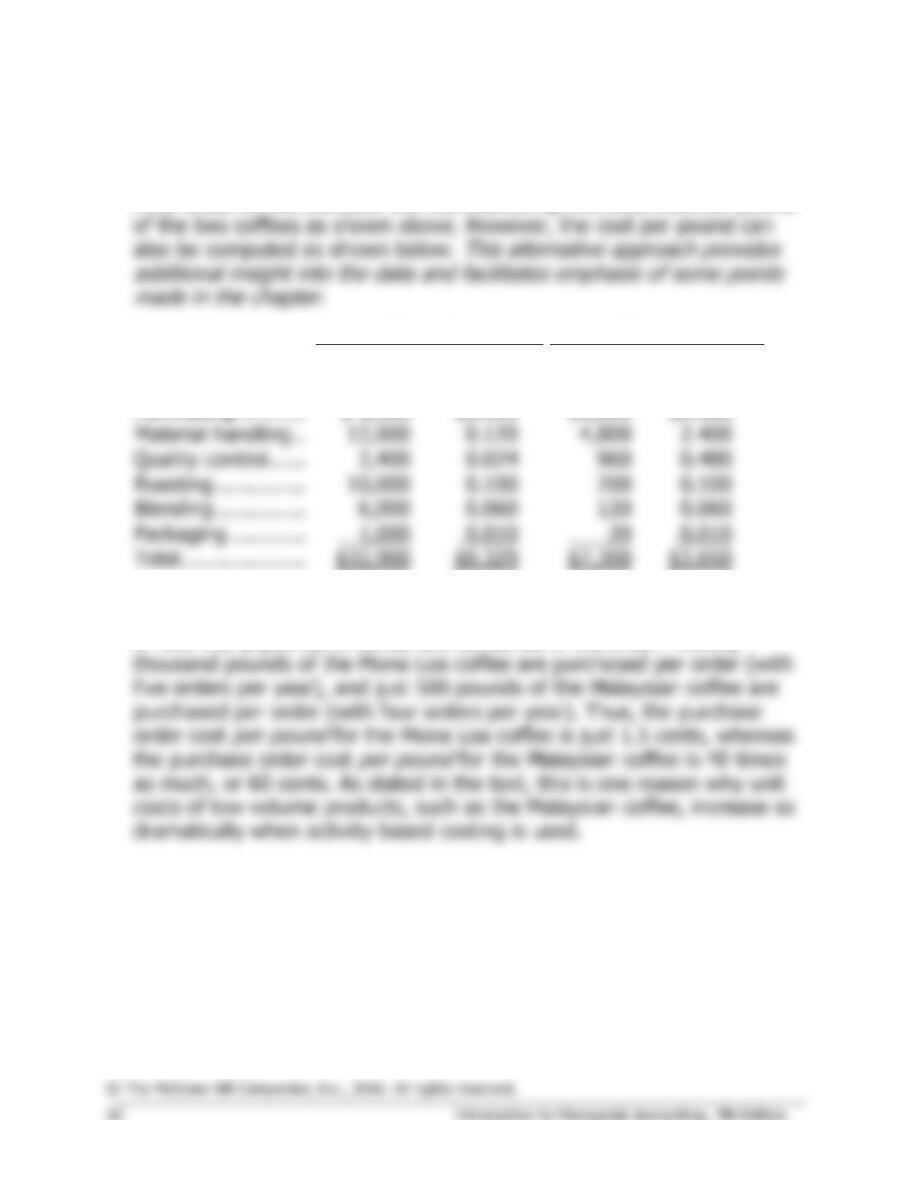
3. MEMO TO THE PRESIDENT: Analysis of CBI’s data shows that several
activities other than direct labor drive the company’s manufacturing
Case (continued)
ALTERNATIVE SOLUTION:
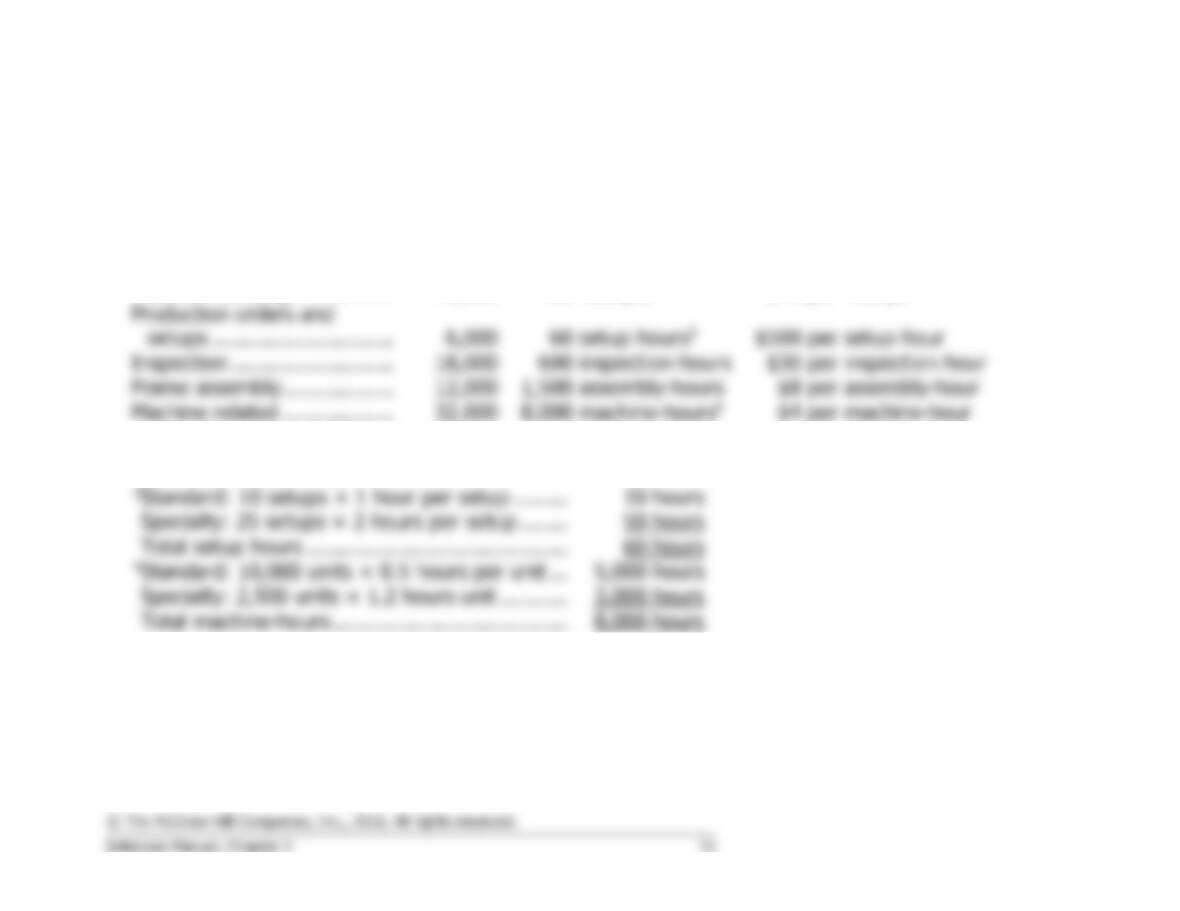
Most students will compute the manufacturing overhead cost per pound
Mona Loa
Malaysian
Total
Per Pound
(÷ 100,000)
Total
Per Pound
(÷ 2,000)
Purchasing ………..
$ 1,500
$0.015
$1,200
$0.600
Material handling ..
12,000
Quality control ……
Packaging …………
Total ………………..
$0.329
$7,300
$3.650
Note particularly how batch size impacts unit cost data. For example,
the cost to the company to process a purchase order is $300, regardless
of how many pounds of coffee are contained in the order. Twenty
Analytical Thinking (150 minutes)
1.
(a)
Estimated
Overhead
Costs
(b)
Expected Activity
(a) ÷ (b)
Activity Rate
Purchasing …………………….
$15,000
300
orders1
$50
per order
Material handling …………….
16,000
400
receipts2
$40
per receipt
Inspection ……………………..
18,000
600
inspection-hours
$30
per inspection-hour
Frame assembly ………………
12,000
assembly-hours
per assembly-hour
Machine related ………………
32,000
machine-hours4
per machine-hour
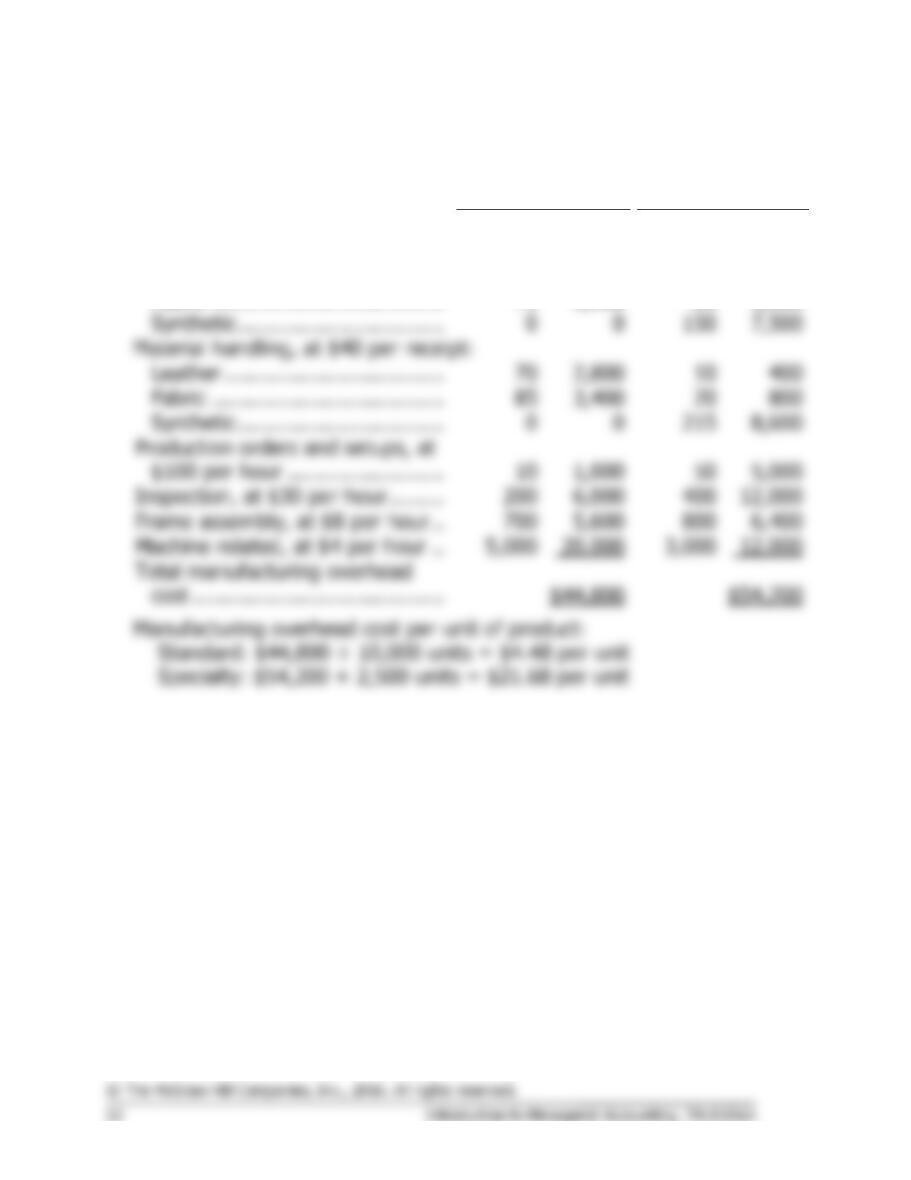
160 + 90 + 150 = 300
280 + 105 + 215 = 400
Total setup hours ……………………………………
4Standard: 10,000 units × 0.5 hours per unit …
Specialty: 2,500 units × 1.2 hours unit ………..
Total machine-hours ………………………………..
Analytical Thinking (continued)
Overhead cost charged to each product:
Standard
Specialty
Activity
Amount
Activity
Amount
Purchasing, at $50 per order:
Leather ……………………………..
50
$ 2,500
10
$ 500
Fabric ……………………………….
70
3,500
20
1,000
Synthetic …………………………...
7,500
Material handling, at $40 per receipt:
Synthetic …………………………...
8,600
10
1,000
50
5,000
Inspection, at $30 per hour………
Frame assembly, at $8 per hour ..
Machine related, at $4 per hour ..
5,000
20,000
12,000