25 Minutes, Medium PROBLEM 26.4
MARENGO
a.
(1)
(3) Net present value, discounted at 15%:
Total present value of 10 annual net cash flows ($80,000 × 5.019) 401,520$
Present value of salvage value due in 10 years ($20,000 × .247) 4,940
Total present value 406,460$
Less: Amount to be invested 400,000
Net present value of proposal 6,460$
(1)
(3) Net present value, discounted at 15%:
Total present value of 10 annual net cash flows ($95,000 × 5.019) 476,805$
Present value of salvage value due in 10 years ($50,000 × .247) 12,350
Total present value 489,155$
Less: Amount to be invested 500,000
Net present value of proposal (10,845)$
b.
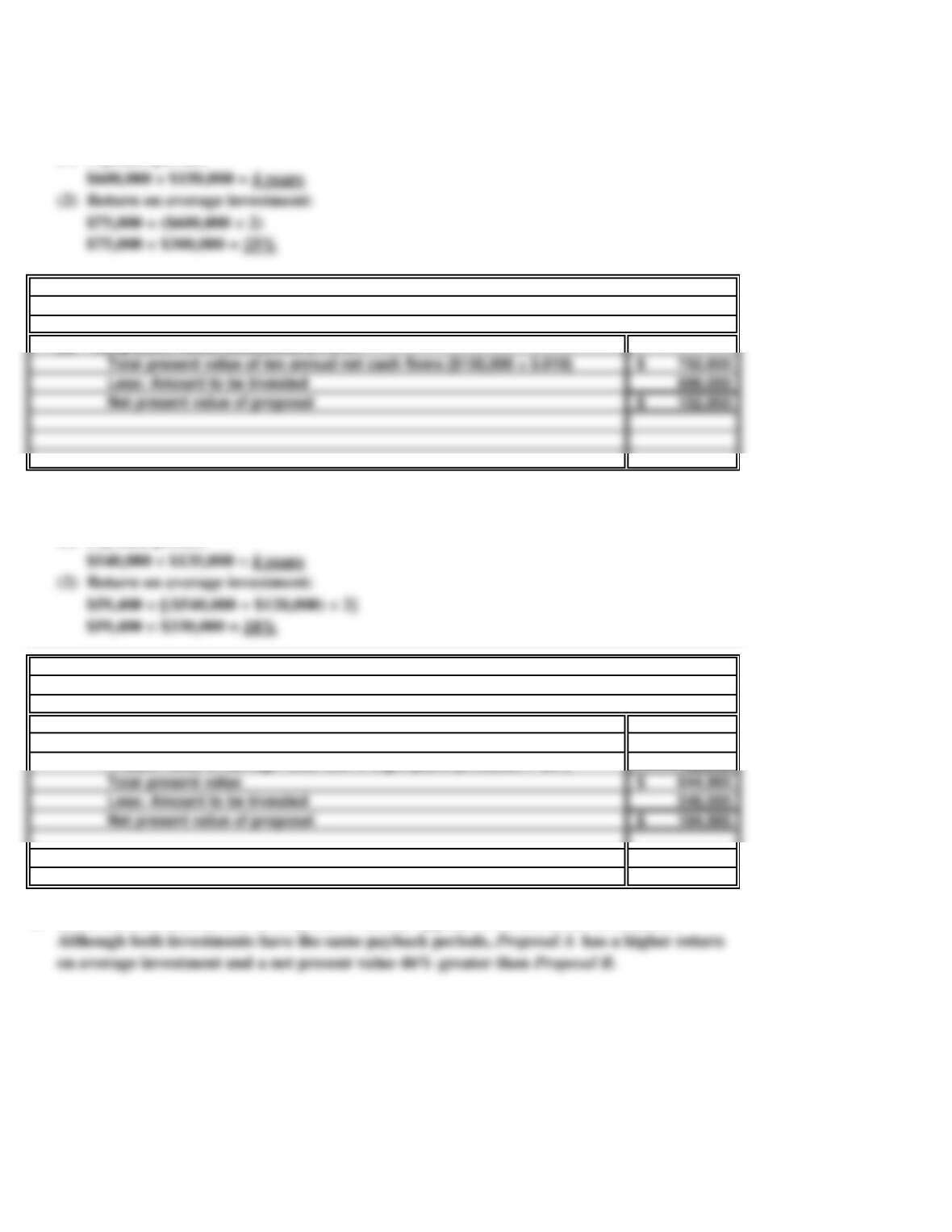
Based upon the above analysis, Proposal A is the only acceptable investment of the two
proposals under consideration. Both proposals have acceptable payback periods (less than
Proposal B
Payback period:
Proposal A
Payback period:
25 Minutes, Medium PROBLEM 26.5A
V.S. YOGURT
a.
(1)
(3) Net present value, discounted at 15%:
Total present value of seven annual net cash flows ($750,000 × 4.160) 3,120,000$
Less: Amount to be invested 3,150,000
Net present value of proposal (30,000)$
(1)
(3) Net present value, discounted at 15%:
Total present value of seven annual net cash flows ($570,000 × 4.160) 2,371,200$
Present value of salvage due in seven years ($400,000 × .376) 150,400
Total present value 2,521,600$
Less: Amount to be invested 2,500,000
Net present value of proposal 21,600$
b.
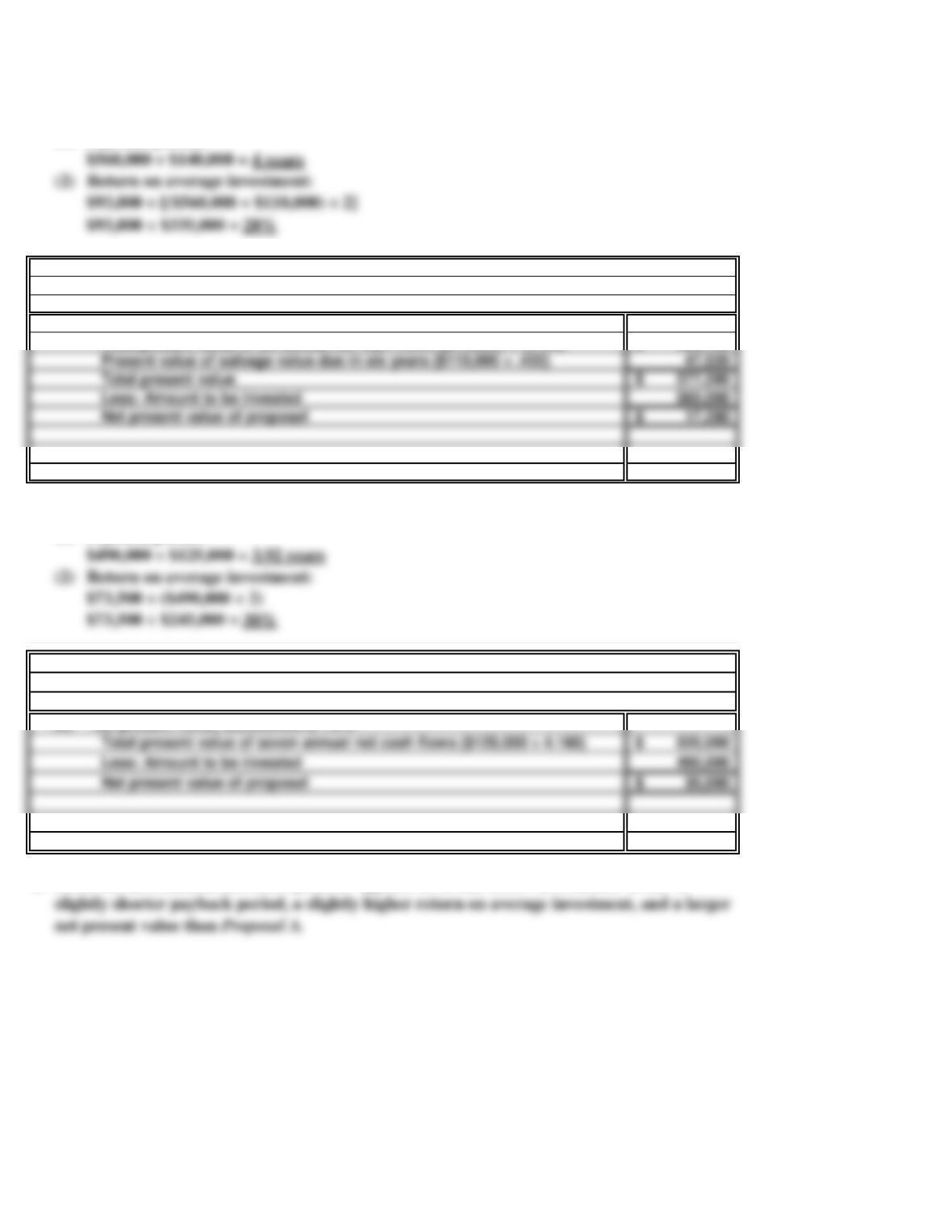
Proposal A
Payback period:
Proposal B
Payback period:
Based on the above analysis, Proposal B is the only acceptable investment of the two
proposals under consideration. Although Proposal A has a slightly shorter payback period
30 Minutes, Strong
PROBLEM 26.6A
PATHWAYS APPLIANCE COMPANY
a.
Estimated sales (12,000 units @ $35) 420,000$
Less estimated incremental costs:
Variable manufacturing costs (12,000 units @ $15) 180,000$
b. Computation of annual net cash flow:
Cash receipts 420,000$
Less cash outlays:
Annual net cash flow 102,000$
c. (1)
(2)
(3) Net present value of project, discounted at 15%:
Total present value of annual cash flows ($102,000 × 2.855) 291,210$
Less: Amount to be invested 240,000
Net present value of project 51,210$
PATHWAYS APPLIANCE COMPANY
Schedule of Estimated Net Income
Payback period:
Return on average investment:
Fixed manufacturing costs (except depreciation) 60,000
Depreciation expense ($240,000 ÷ 4) 60,000
Selling and general expenses 50,000 350,000
Income before income taxes 70,000$
Income taxes expense ($70,000 × 40%) 28,000
Net income 42,000$
40 Minutes, Strong PROBLEM 26.7A
DOCTORS
a.
$1,250,000
$243,750
The supporting calculations for the above payback figure are:
Incremental annual revenue of investment 800,000$
b.
$100,000
Return on average investment:
Payback period:
Amount to Be Invested
Estimated Annual Net Cash Flow
=
= 5.13 years
Less: Incremental annual expenses of investment 700,000
PROBLEM 26.7A
DOCTORS (concluded)
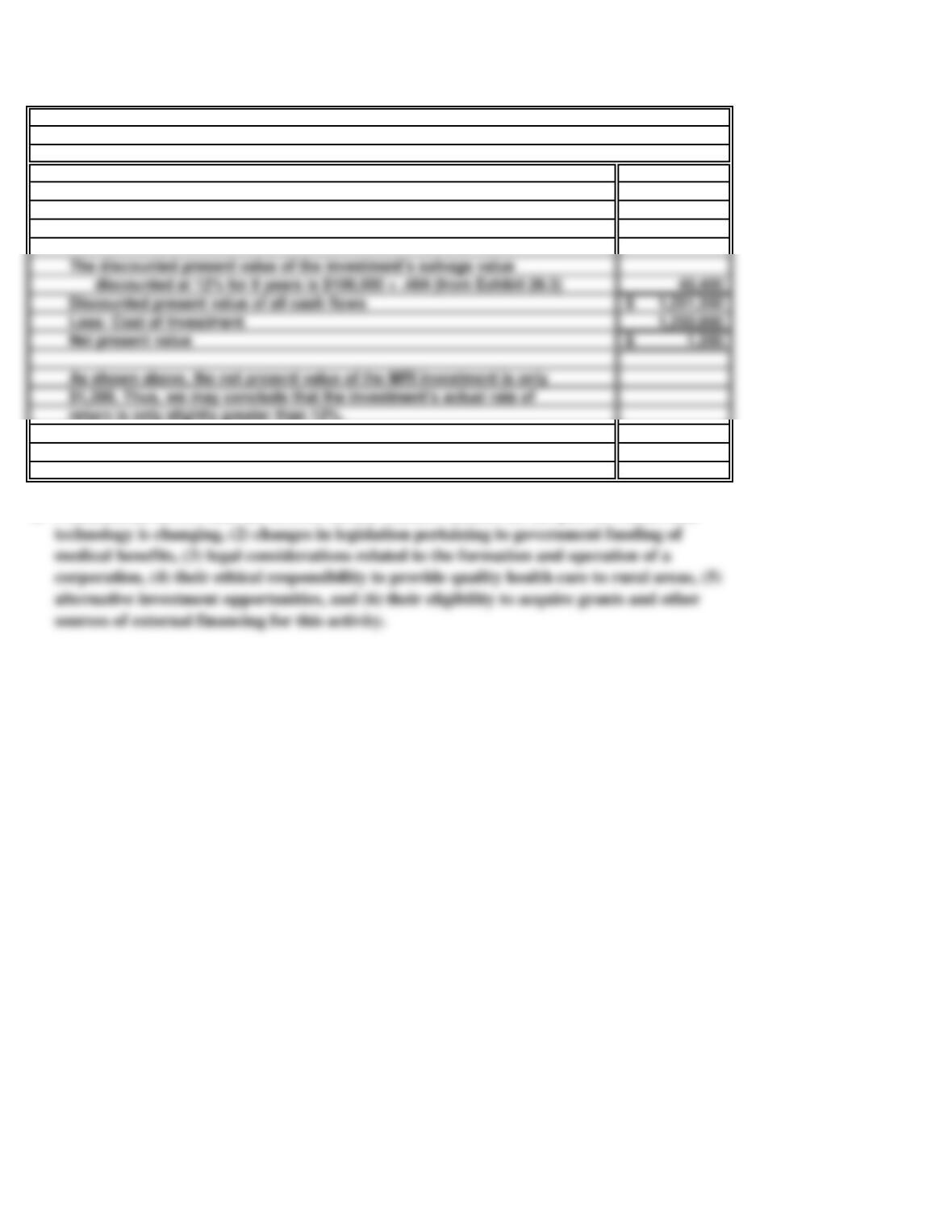
c. Net present value:
The discounted present value of the incremental annual cash flow of
the investment (see part a) discounted at 12% for 8 years is
$243,750 × 4.968 (from Exhibit 26.4) 1,210,950$
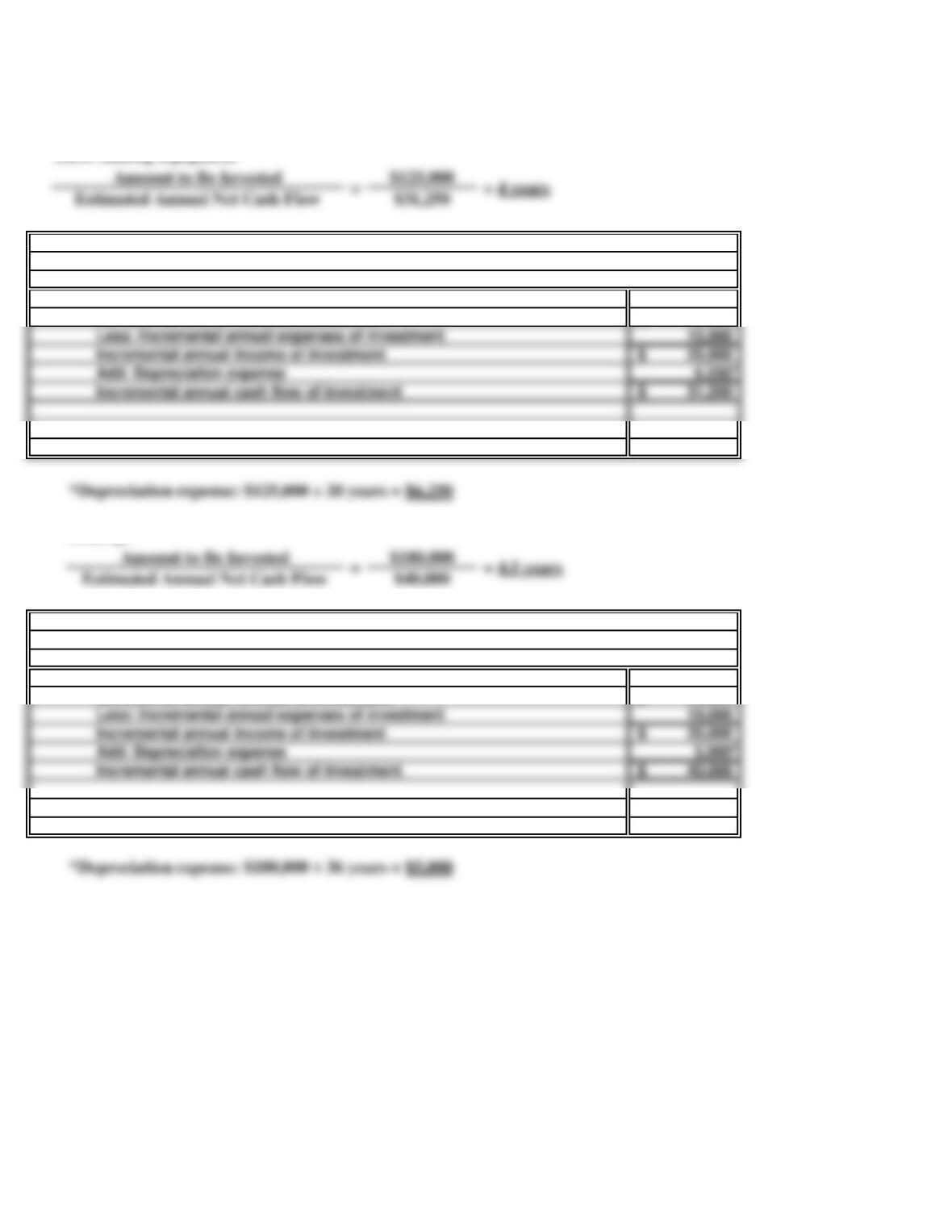
return is only slightly greater than 12%.
d.
Nonfinancial factors that the doctors should consider include (1) the pace at which MRI
Discounted present value of all cash flows 1,251,350$
Less: Cost of investment 1,250,000
Net present value 1,350$
As shown above, the net present value of the MRI investment is only
50 Minutes, Strong PROBLEM 26.8A
JEFFERSON MOUNTAIN
a.
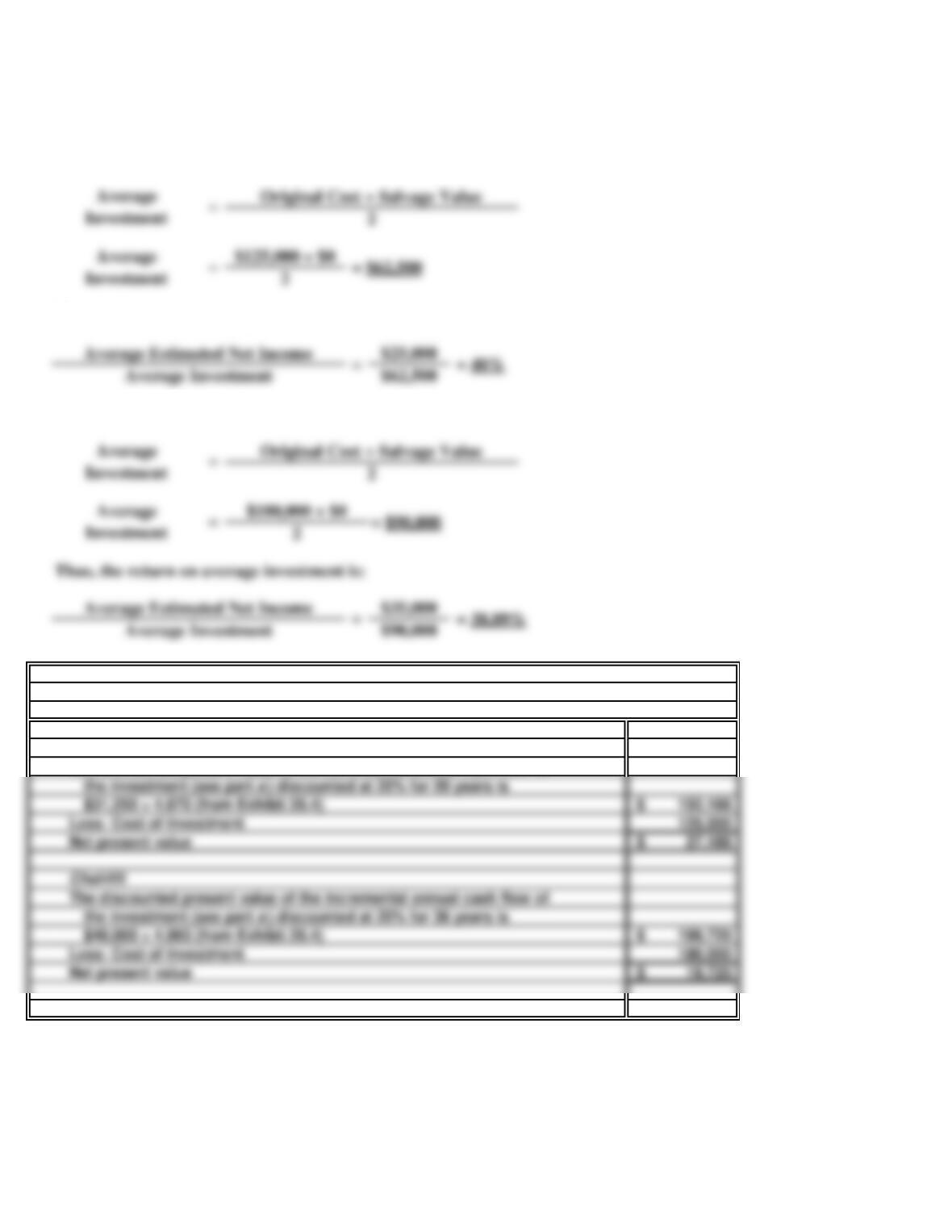
The supporting calculations are:
Incremental annual revenue of investment 40,000$
Less: Incremental annual expenses of investment 15,000
Incremental annual income of investment 25,000$
Add: Depreciation expense 6,250*
Incremental annual cash flow of investment 31,250$
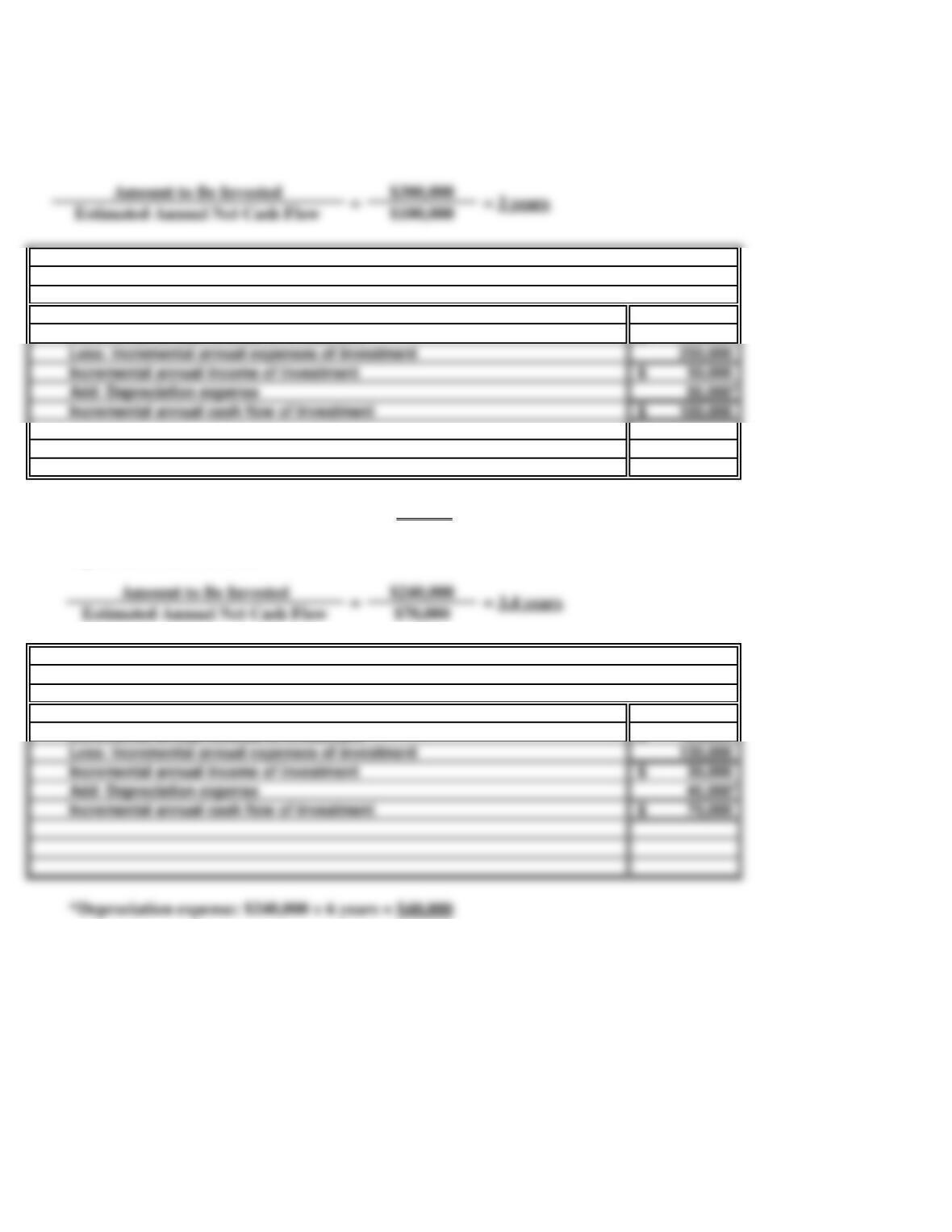
The supporting calculations for the payback period figure are:
Incremental annual revenue of investment 54,000$
Less: Incremental annual expenses of investment 19,000
Incremental annual income of investment 35,000$
Add: Depreciation expense 5,000*
Incremental annual cash flow of investment 40,000$
Chairlift
Payback period:
Snow-Making Equipment
PROBLEM 26.8A
JEFFERSON MOUNTAIN (continued)
b.
Thus, the return on average investment is:
c. Net present value:
Snow-Making Equipment
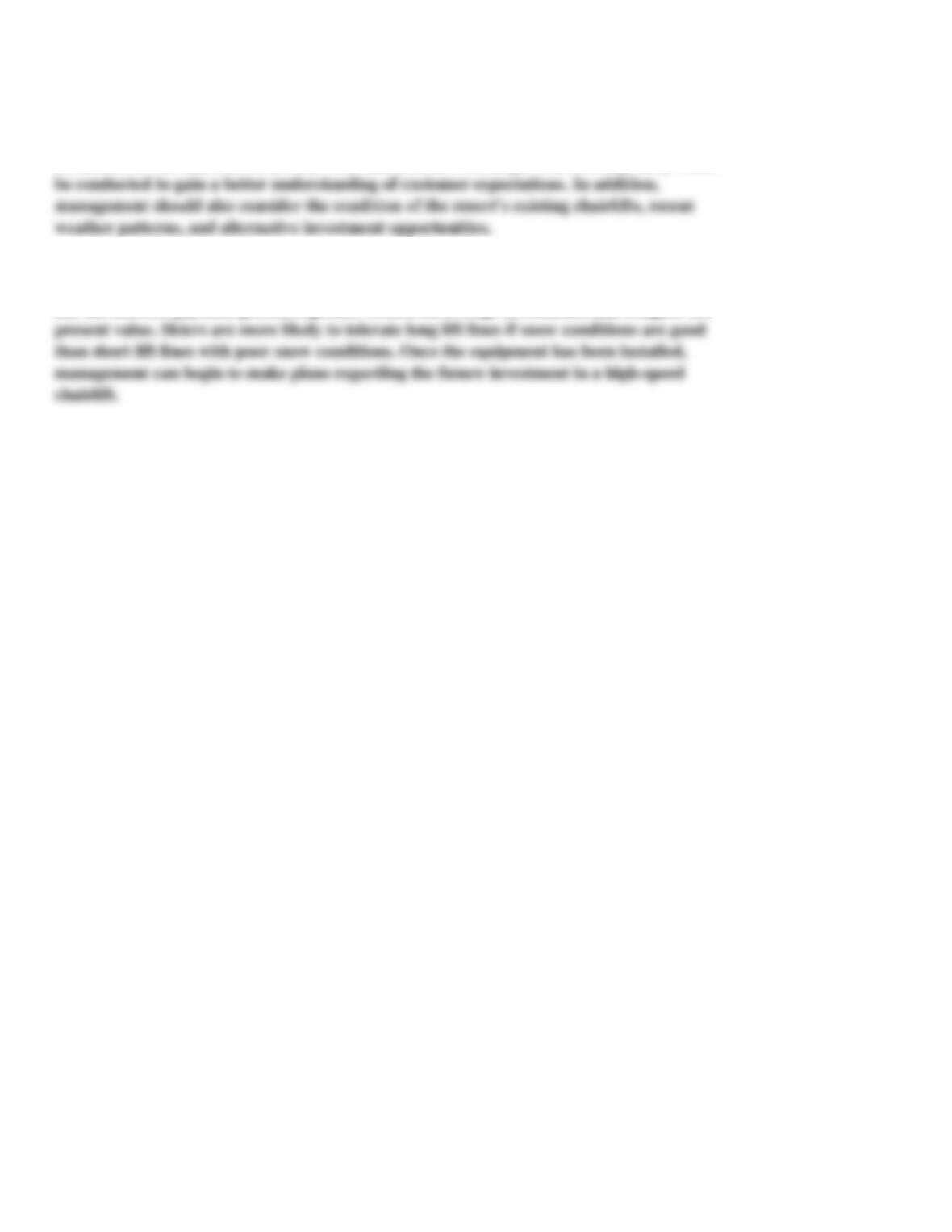
The discounted present value of the incremental annual cash flow of
Less: Cost of investment 125,000
Net present value 27,188$
The discounted present value of the incremental annual cash flow of
Less: Cost of investment 180,000
Net present value 19,720$
Return on average investment:
Snow-Making Equipment
Thus, the return on average investment is:
Chairlift
PROBLEM 26.8A
JEFFERSON MOUNTAIN (concluded)
d.
e.
The management of Jefferson Mountain must decide which investment opportunity will
best serve its customers. Thus, it must try to determine if adequate snow coverage with long
lift lines is better than short lift lines with limited snow coverage. A marketing study could
It is likely that management will elect to invest in snow-making equipment. This investment
has the shortest payback period, a greater return on average investment, and a higher net
45 Minutes, Strong PROBLEM 26.9A
SONIC, INC.
a.
The supporting calculations for the above payback figure are:
Incremental annual revenue of investment 300,000$
Less: Incremental annual expenses of investment 250,000
Add: Depreciation expense 50,000*
Incremental annual cash flow of investment 100,000$
The supporting calculations for the payback figure are:
Incremental annual revenue of investment 160,000$
Less: Incremental annual expenses of investment 130,000
Add: Depreciation expense 40,000*
Incremental annual cash flow of investment 70,000$
Payback period:
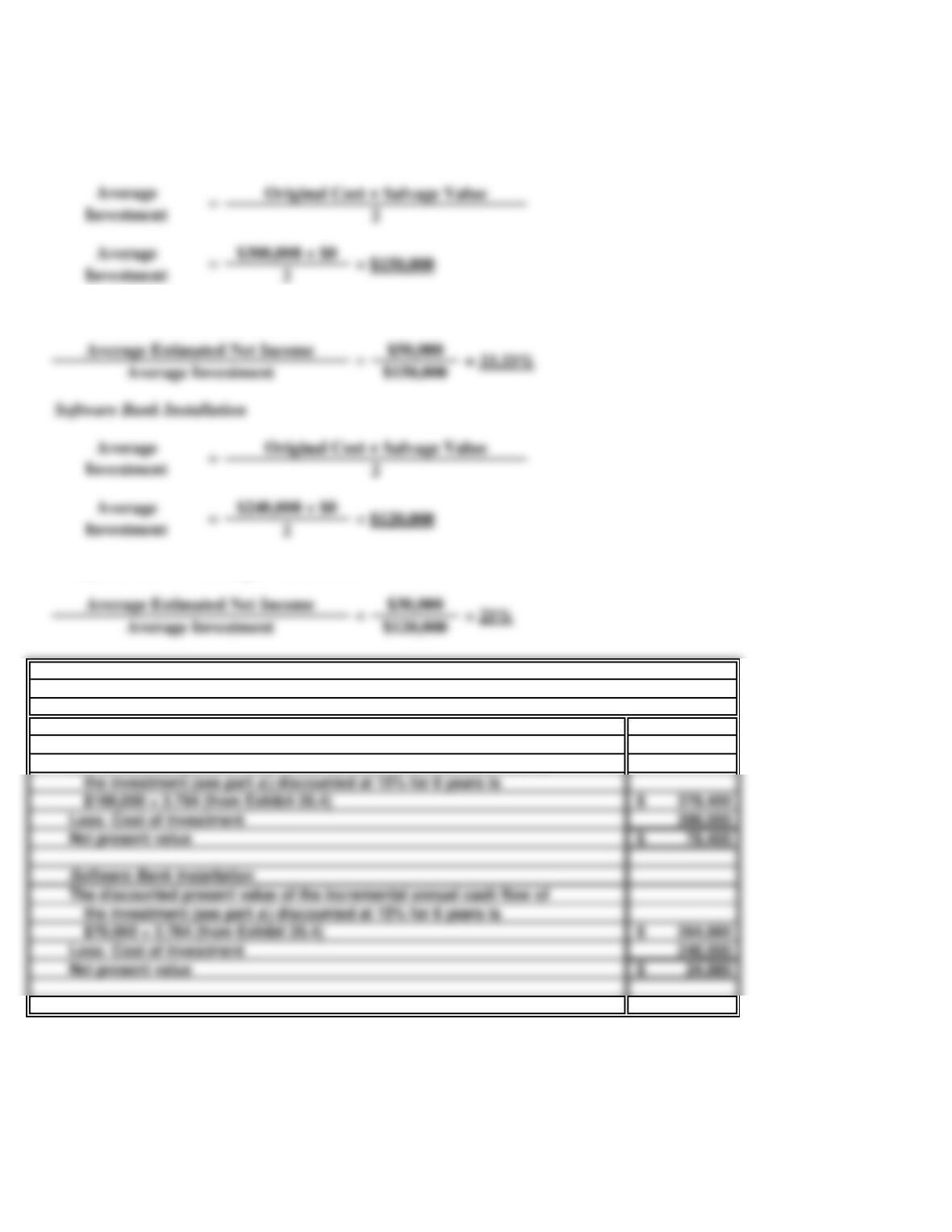
Computer Chip Equipment
Software Bank Installation
*Depreciation expense: $300,000 ÷ 6 years = $50,000
PROBLEM 26.9A
SONIC, INC. (continued)
b.
Software Bank Installation
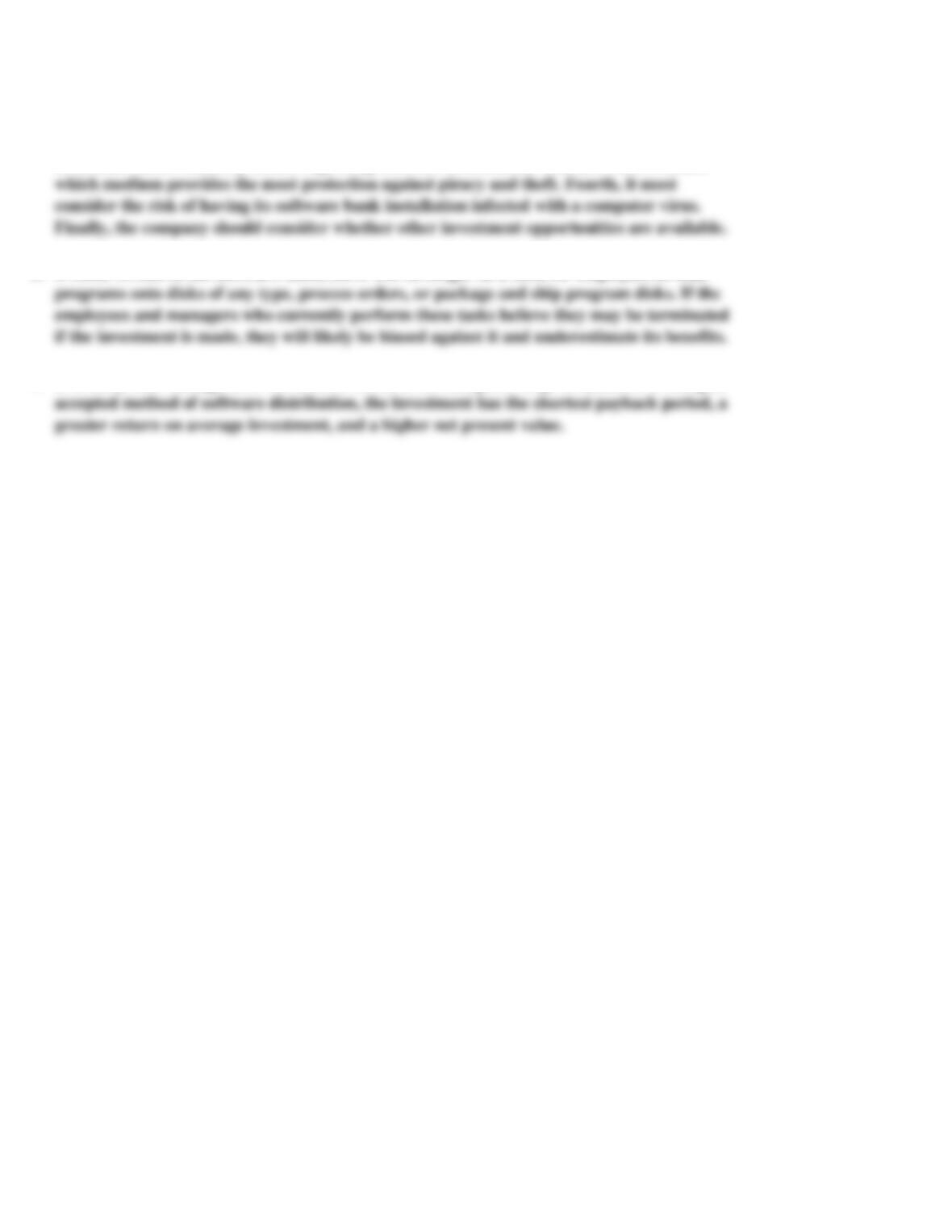
c. Net present value:
Computer Chip Equipment
The discounted present value of the incremental annual cash flow of
Less: Cost of investment 300,000
Net present value 78,400$
Software Bank Installation
The discounted present value of the incremental annual cash flow of
Less: Cost of investment 240,000
Net present value 24,880$
Thus, the return on average investment is:
Thus, the return on average investment is:
Return on average investment:
Computer Chip Equipment
PROBLEM 26.9A
SONIC, INC. (concluded)
d.
e.
f.
There are several nonfinancial considerations worth mentioning. First, the company must
try to determine which medium the customers are most likely to use. Second, it must try to
determine future industry trends regarding software distribution. Third, it must evaluate
If Sonic invests in the software bank, there will no longer be a need for employees to load
It is likely that management will elect to invest in the computer chip. In addition to being an
SOLUTIONS TO PROBLEMS SET B
30 Minutes, Strong PROBLEM 26.1B
MONSTER TOYS
a.
Estimated sales (100,000 units @ $8) 800,000$
Less estimated incremental costs:
Variable manufacturing costs (100,000 units @ $3.00) 300,000$
b. Computation of annual net cash flow:
Cash receipts 800,000$
Less cash outlays:
Annual net cash flow from sale of new product 319,000$
c. (1)
(2)
(3) Net present value of project, discounted at 12%:
Total present value of annual net cash flows ($319,000 × 2.402) 766,238$
Return on average investment:
MONSTER TOYS
Schedule of Estimated Net Income
Payback period:
Fixed manufacturing costs (except depreciation) 60,000
Depreciation expense [($400,000 – $10,000) ÷ 3] 130,000
Selling and general expenses 40,000 530,000
Income before income taxes 270,000$
Income taxes expense ($270,000 × 30%) 81,000
Estimated increase in annual net income 189,000$
PROBLEM 26.2B
VIRGINIA TECHNOLOGY
a.
(1)
(3) Net present value, discounted at 15%:
Net present value of proposal 152,850$
(1)
(2)
Return on average investment:
(3) Net present value, discounted at 15%:
Total present value of eight annual net cash flows ($135,000 × 4.487) 605,745$
Present value of salvage value due in eight years ($120,000 × .327) 39,240
Less: Amount to be invested 540,000
Net present value of proposal 104,985$
b.
From the information above, Proposal A clearly appears to be the better investment.
Payback period:
25 Minutes, Medium
Proposal B
Proposal A
Payback period:
(2)
Return on average investment:
25 Minutes, Medium
PROBLEM 26.3B
JASON EQUIPMENT CO.
a.
(1)
(3) Net present value, discounted at 15%:
Total present value of six annual net cash flows ($140,000 × 3.784) 529,760$
Present value of salvage value due in six years ($110,000 × .432) 47,520
Total present value 577,280$
Less: Amount to be invested 560,000
Net present value of proposal 17,280$
(1)
(2)
$73,500 ÷ $245,000 = 30%
$490,000 ÷ $125,000 = 3.92 years
Return on average investment:
$73,500 ÷ ($490,000 ÷ 2)
(3) Net present value, discounted at 15%:
b.
From the information above, Proposal B appears to be the better investment. It has a
Proposal A
Payback period:
Proposal B
Payback period:
(2)
$560,000 ÷ $140,000 = 4 years
Return on average investment:
$93,800 ÷ $335,000 = 28%
25 Minutes, Medium PROBLEM 26.4B
SAMBA
a.
(1)
(3) Net present value, discounted at 10%:
Total present value of 10 annual net cash flows ($75,000 × 6.145) 460,875$
Present value of salvage value due in 10 years ($10,000 × .386) 3,860
Total present value 464,735$
Less: Amount to be invested 300,000
Net present value of proposal 164,735$
(1)
(2)
$310,000 ÷ $70,000 = 4.4 years
Return on average investment:
($70,000 – $27,000) ÷ [($310,000 + $40,000) ÷ 2]
$43,000 ÷ $175,000 = 24.6%
(3) Net present value, discounted at 10%:
Total present value of 10 annual net cash flows ($70,000 × 6.145) 430,150$
Present value of salvage value due in 10 years ($40,000 × .386) 15,440
Less: Amount to be invested 310,000
Net present value of proposal 135,590$
b.
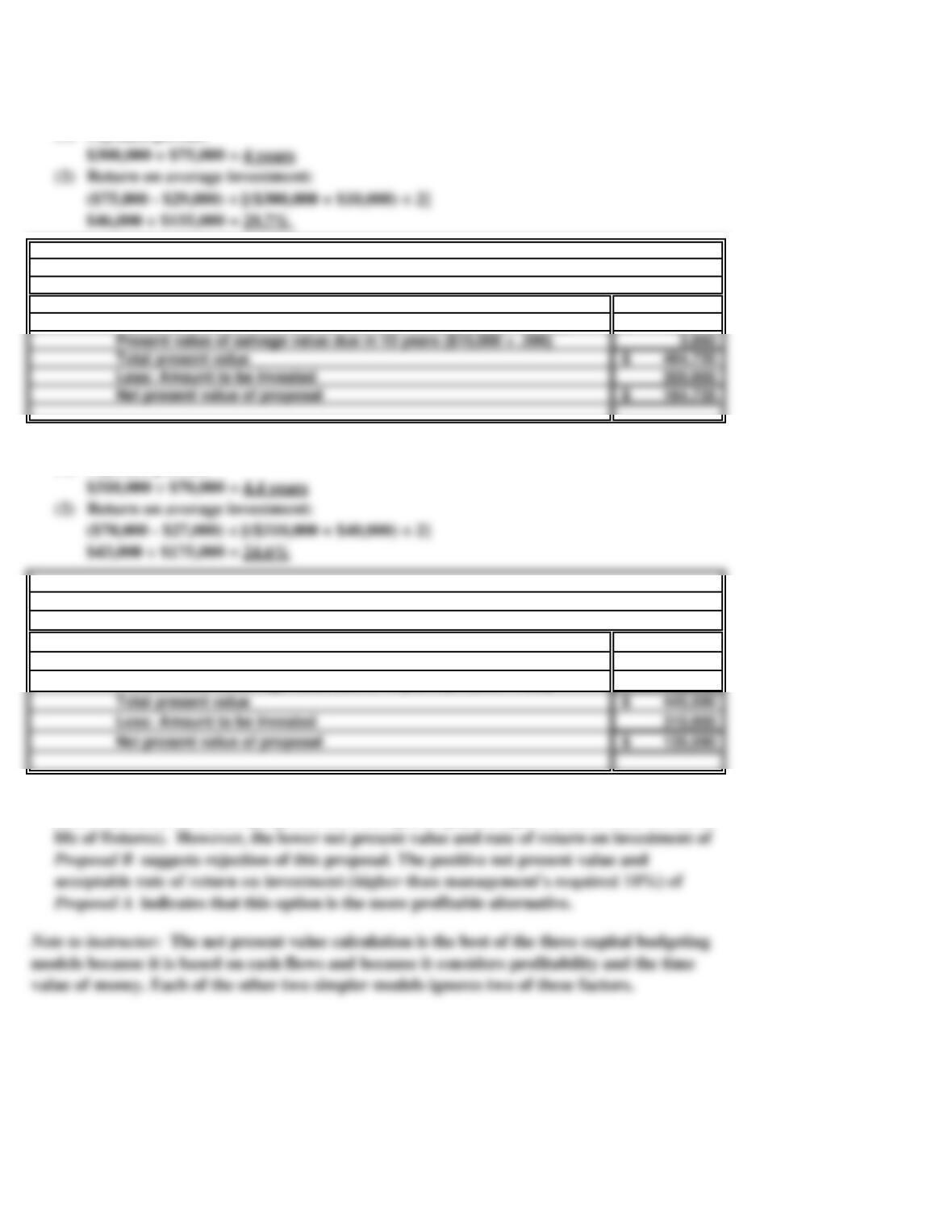
Proposal A
Payback period:
Based upon the above analysis, Proposal A is the best investment of the two proposals
under consideration. Both proposals have acceptable payback periods (less than the useful
Proposal B
Payback period:
($75,000 – $29,000) ÷ [($300,000 + $10,000) ÷ 2]
$46,000 ÷ $155,000 = 29.7%
$300,000 ÷ $75,000 = 4 years