
CHAPTER 26 Capital Investment Analysis
Prob. 26-3B (Concluded)
$400,240
$420,000
*Rounded
3. The computer system upgrade has the largest present value index. Although the
ATM kiosk expansion has the largest net present value, it returns less present
value per dollar invested than does the computer system, as revealed by the
2.
Present value index
of branch office: = 0.95*
Present Value Index = Total Present Value of Net Cash Flow
Amount to Be Invested
CHAPTER 26 Capital Investment Analysis
Prob. 26-4B
1. a. After Hours:
Annual net cash flow (at the end of each of 4 years)……………………
…
$ 320,000
× Present value of an annuity of $1 at 10% for 4 years (Exhibit 5)……
…
3.170
Sun Fun:
Annual net cash flow (at the end of each of 4 years)……………………
…
$290,000
× Present value of an annuity of $1 at 10% for 4 years (Exhibit 5)……
…
3.170
Present value of annual net cash flows……………………………………
…
$919,300
Less amount to be invested…………………………………………………
…
880,730
Net present value………………………………………………………………
…
$ 38,570
b.
Present Value Index =
Total Present Value of Net Cash Flow
Amount to Be Invested
2. Present Value Factor for an Annuity of $1 Amount to Be Invested
Annual Net Cash Flow
a. =
After Hours: $913,600 = 2.855
$320,000
…
…
…

CHAPTER 26 Capital Investment Analysis
Prob. 26-4B (Concluded)
3. The net present value, present value index, and internal rate of return all indicate
that After Hours is a better financial opportunity compared with Sun Fun , although
both investments meet the minimum return criterion of 10%. The present value index
indicates that After Hours had a greater present value per dollar of investment. The
internal rate of return method places all proposals on a common basis. As a result,
CHAPTER 26 Capital Investment Analysis
Prob. 26-5B
1. Net present value analysis:
Wichita:
Annual net cash flow (at the end of each of 6 years)………………………… $ 310,000
× Present value of an annuity of $1 at 20% for 6 years (Exhibit 5)………… 3.326
Present value of annual net cash flows………………………………………… $1,031,060
Less amount to be invested………………………………………………………
…
900,000
Net present value…………………………………………………………………… $ 131,060
Topeka:
Net present value…………………………………………………………………… $ 135,600
2. Net present value analysis:
Wichita Topeka Witchita
1 $ 310,000 $ 400,000 $ 258,230 $ 333,200
2 310,000 400,000 215,140 277,600
3 310,000 400,000 179,490 231,600
3. To: Investment Committee
Both Wichita and Topeka have a positive net present value. This means that both
projects meet our minimum expected return of 20% and would be acceptable
investments. However, if funds are limited and only one of the two projects can be
funded, then the two projects must be compared over equal lives. Thus, the residual
Year
0.833
0.694
0.579
Net Cash FlowNet Cash Flow
Present Value of
$1 at 20%
Value of
Present
Topeka
…
CHAPTER 26 Capital Investment Analysis
Prob. 26-6B
1. Proposal A: 3-year, 6-month cash payback period, as follows:
Net Cash Cumulative
Year Flow Net Cash Flows
1 $200,000 $200,000
2 200,000 400,000
*The cash flow required is $80,000 out of $160,000 in Year 4. Thus, 1/2 of 12 months
is 6 months.
Proposal B: 4-year cash payback period, as follows:
Net Cash Cumulative
Year Flow Net Cash Flows
1 $90,000 $ 90,000
2 90,000 180,000
Proposal C: 2-year cash payback period, as follows:
Net Cash Cumulative
Year Flow Net Cash Flows
1 $55,000 $ 55,000
2 53,000 108,000
Proposal D: 2-year, 3-month cash payback period, as follows:
Net Cash Cumulative
Year Flow Net Cash Flows
CHAPTER 26 Capital Investment Analysis
Prob. 26-6B (Continued)
2. Proposal A: 14.1% average rate of return, determined as follows:
$48,000
$340,000
Proposal B: 2.5% average rate of return, determined as follows:
$4,000
$160,000
=
=
2.5%
14.1% (rounded)
($680,000 + $0) ÷ 2
$240,000 ÷ 5
=
($320,000 + $0) ÷ 2
$20,000 ÷ 5
=
CHAPTER 26 Capital Investment Analysis
Prob. 26-6B (Continued)
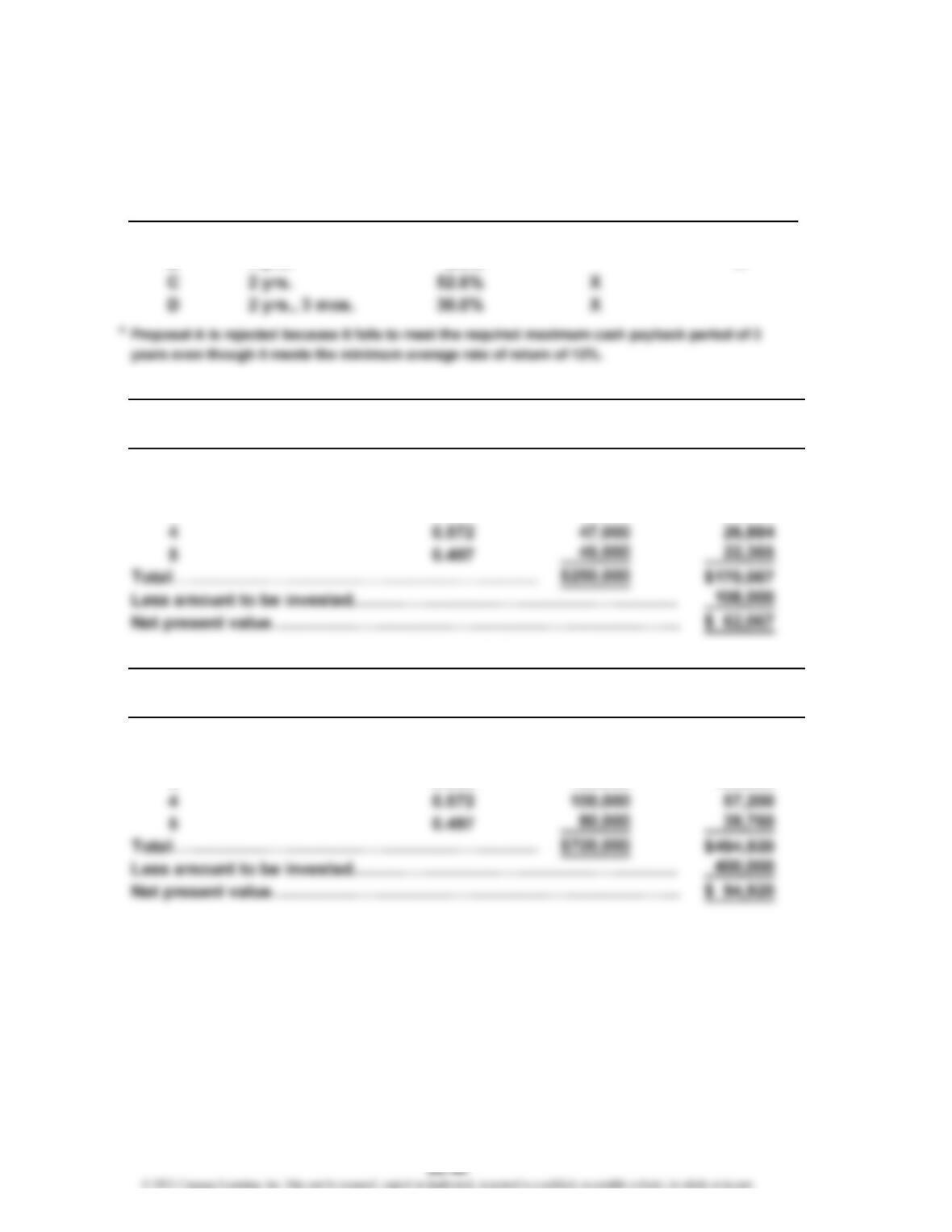
3. Of the four proposed investments, only Proposals C and D meet the company’s
requirements, as the following table indicates:
Cash Paybac
k
Average Rate Accept fo
r
Proposal Period of Return Further Analysis Reject
A 3 yrs., 6 mos. 14.1% X*
4.
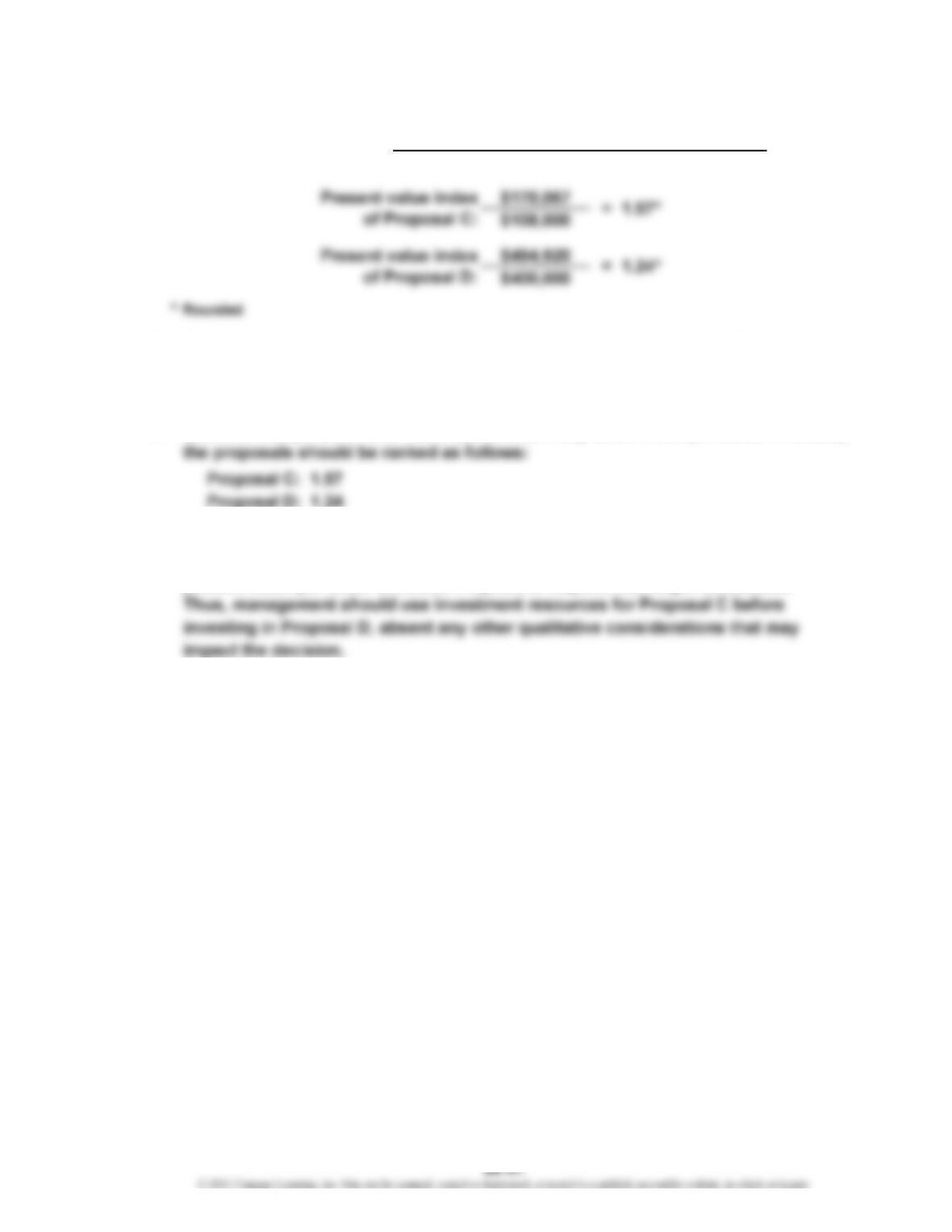
Present Value Net Cash Present Value of
Year of $1 at 15% Flow Net Cash Flow
1 0.870 $ 55,000 $ 47,850
2 0.756 53,000 40,068
3 0.658 50,000 32,900
Present Value Net Cash Present Value of
Year of $1 at 15% Flow Net Cash Flow
1 0.870 $180,000 $156,600
2 0.756 180,000 136,080
3 0.658 160,000 105,280
Proposal C
Proposal D
CHAPTER 26 Capital Investment Analysis
Prob. 26-6B (Concluded)
6. Based on the net present value, the proposals should be ranked as follows:
Proposal D: $94,920
Proposal C: $62,067
7. Based on the present value index (the amount of present value per dollar invested),
8. The present value indexes indicate that although Proposal D has the larger net
present value, it is not as attractive as Proposal C in terms of the amount of
present value per dollar invested. Proposal D requires the larger investment.
5.
Present Value Index =
Total Present Value of Net Cash Flow
Amount to Be Invested

CHAPTER 26 Capital Investment Analysis
CP 26-1
The plant manager wants a project to be accepted and places pressure on the analyst
to come up with the “right numbers.” Jerrod is right when he states that the net present
value analysis has many assumptions and room for interpretation. Many analysts use
this room for interpretation to work the numbers until they satisfy the minimum return
(hurdle) rate. In fact, some analysts state that they start with the hurdle rate and work
back into the numbers. Clearly, this is not what should be expected of Danielle.
by countering his argument. For example, Danielle might point out that it is by no means
clear that more storage space translates into more sales. In fact, it is probably just the
opposite. More storage space means that more product waits a long time before being
shipped to the customer. This means that the customer is guaranteed to receive dated
product that may be inferior to product that was recently produced. More warehouse
space is counter to a just-in-time orientation. Danielle is really trying to prevent the plant
manager from going down the wrong path. Jerrod needs to work on his systems so
that he doesn’t need the warehouse space.
This very difficult issue revolves around the nature of ethical dilemmas. Danielle has
brief tenure with the organization. She has very little organizational clout and could
easily find her career short-circuited by crossing Jerrod. It might be tempting for
Danielle to slide on this one—after all, who would know? If the project is eventually a
failure, it’s unlikely that the decision would come back to haunt Danielle. Much time will
have passed, and Danielle will likely be in another job in the company. The decision to
confront Jerrod has immediate repercussions. This is the heart of real-world ethical
dilemmas. The dilemma occurs when the ethical decision has grave short-term
consequences (Jerrod short-circuits Danielle’s career) and few seemingly long-term
CASES & PROJECTS

CHAPTER 26 Capital Investment Analysis
CP 26-2
This activity could be assigned individually or in groups. This activity has the student(s)
perform a capital investment analysis for a desktop computer, using information
available to them on the Internet and from a local business. The actual answer depends
on the numbers determined by the student(s). Have a number of students (or groups
provide their answers to the class and note the variation (or lack thereof) between the
various analyses. Use this to show that there are often many answers to even simple
problems, depending on the assumptions (e.g., what is considered a “mid-range”
computer) and underlying data (e.g., rental rate). Below is a sample answer based on
our own data and assumptions:
Assumed hourly rental rate………………………………………………
…
$8 per hour
Semester cost (40 hours × $8)…………………………………………… $320
CP 26-3
Memo
To: Tom Greene
From: Ima Student
Re: Effect of Exchange Rate Changes on Internal Rate of Return
I have reviewed the impact of possible exchange rate changes on the company’s internal
rate of return and determined that the impact will be significantly different depending on
where the product is ultimately sold. If the product is sold locally, it is likely that the
internal rate of return on the new plant will decline because all net cash flows are
incurred in the local economy. This is because the cash profits earned on the plant will
be less in U.S. dollars as a result of the devaluation. For example, if the product sold for
If, however, the plant produced for export only, then the expenses would be incurred in
local currency, while the revenues would be earned in U.S. dollars. This could work in
favor of the project because the expenses in U.S. dollar terms would decline. For
CHAPTER 26 Capital Investment Analysis
CP 26-4
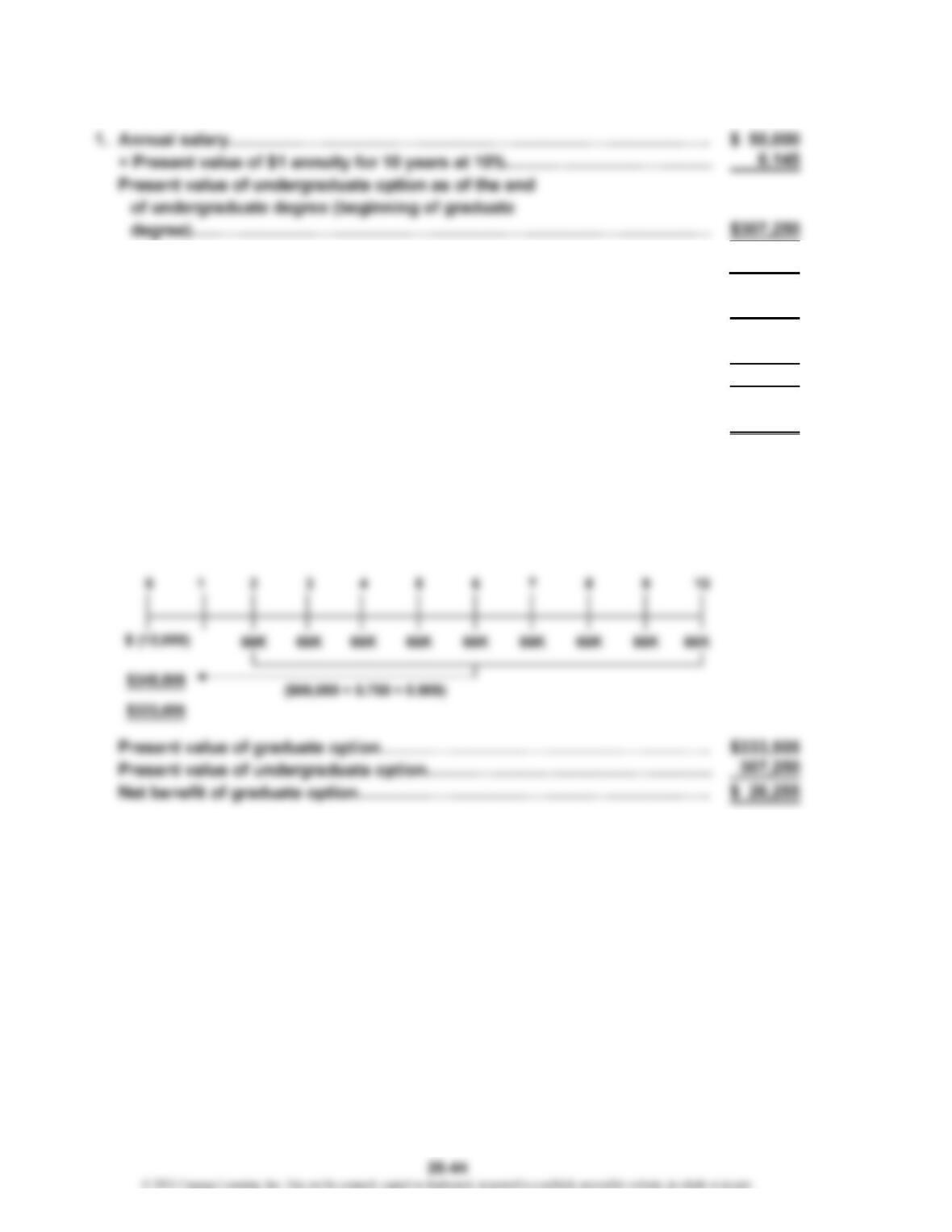
2. Annual tuition at the beginning of graduate year………………………………
…
$ (12,000)
Annual salary…………………………………………………………………………
…
$ 66,000
× Present value of $1 annuity for 9 years at 10%………………………………
…
5.759
Present value salary to end of graduate year……………………………………
…
$380,094
× Present value of $1 for 1 year at 10%……………………………………………
…
0.909
Present value of salary at the beginning of graduate year……………………
…
$345,505
Present value of graduate option at the beginning of
graduate year (salary less tuition)………………………………………………
…
$333,505
Note: The present values of parts (1) and (2) must both be determined as of the
beginning of the graduate year in order to be compared. Thus, the present value
of the salary at the end of graduate school must be brought back 1 period to
the beginning of the graduate year, since this salary stream is delayed by 1 year
of schooling. The timeline below shows the computation.
…
Note to Instructors: This solution accounts for the opportunity cost of graduate
school in terms of lost earnings during the graduate year. To maintain simplicity,
the solution does not account for likely growth in earnings over time or income tax
effects. In addition, the undergraduate tuition and opportunity cost to obtain the
undergraduate degree are treated as sunk costs relative to the decision to attend
graduate school and, thus, are not relevant to the analysis.
…

CHAPTER 26 Capital Investment Analysis
CP 26-5
In all three companies, the executives indicate that financial investment analysis
plays a minor role in the selection of projects. The reason is that all three companies
deal with products that have highly uncertain future cash flows. Thus, any attempt
at a financial investment analysis could be highly suspect. Instead, these managers
CP 26-6
a. All cash flows assumed to occur at the end of the year. All amounts are
2018 cash flow: in millions
Gross ticket sales……………………………………………………………
…
$ 420
Production cost………………………………………………………………
…
(340)
…
(90)
Net
p
resent value:
Present Value Net Cash Present Value of
Year of $1 at 20% Flow Net Cash Flow
2018 0.833 $(10) $ (8)
2019 0.694 60 42
2020 0.579 20 12
2021 0.482 10 5
Net present value……………………………………………………………
…
$51