Problem 25-3B (Continued)
Part 3
NET PRESENT VALUE OF ASSET USING STRAIGHT-LINE DEPRECIATION
Present
Present
Net Cash
Value of
Value of Net
Flows
1 at 10%
Cash Flows
Year 1 …………………………………………………..
$ 8,400
0.9091
$ 7,636
Year 2 …………………………………………………..
0.8264
Year 3 …………………………………………………..
0.7513
Year 4 …………………………………………………..
0.6830
Year 5 …………………………………………………..
0.6209
$55,200
$40,041
Part 4
NET PRESENT VALUE OF ASSET USING MACRS DEPRECIATION
Present
Present
Net Cash
Value of
Value of Net
Flows
1 at 10%
Cash Flows
Year 1 …………………………………………………..
$ 9,600
0.9091
$ 8,727
Year 2 …………………………………………………..
0.8264
Year 3 …………………………………………………..
0.7513
Year 4 …………………………………………………..
0.6830
Year 5 …………………………………………………..
0.6209
Year 6 …………………………………………………..
0.5645
$55,199
$40,635
Part 5
Analysis: The net present value using MACRS depreciation is greater than the
net present value using straight-line depreciation because the cash flows are
1539
Problem 25-4B (45 minutes)
WINDMIRE COMPANY
COMPARATIVE INCOME STATEMENTS
(1)
(2)
(3)
Normal
New
Volume
Business
Combined
Sales ……………………………………………………
$1,200,000
$172,000
$1,372,000
Costs and expenses
Total costs and expenses …………………….
Supporting computations
Normal direct material cost ……………………………………………..
$384,000
Units of output ………………………………………………………………..
300,000
Cost per unit …………………………………………………………………..
$ 1.28
New business volume ……………………………………………………..
Normal direct labor cost ………………………………………………….
$ 96,000
Cost per unit …………………………………………………………………..
$ 0.32
Overtime per unit (50%) …………………………………………………..
0.16
New business volume ……………………………………………………..
Fixed overhead (25%) ……………………………………………………..
Variable overhead ……………………………………………………….
$216,000
Units of output ………………………………………………………………..
300,000
Cost per unit …………………………………………………………………..
1540
Problem 25-5B (55 minutes)
Part 1
Product R
Product T
Selling price per unit ……………………………………………..
$ 60
$ 80
Variable costs per unit …………………………………………..
Machine hours to produce 1 unit …………………………..
Part 2
Sales Mix Recommendation To the extent allowed by production and
market constraints, the company should produce as much of Product R as
possible. With a single shift yielding 176 hours per month (8 x 22), the
company can produce these units of Product R:
1541
Problem 25-5B (Continued)
Part 3
Sales Mix Recommendation with Second Shift If the second shift is added,
the maximum possible output of R will double:
However, this level of output exceeds the company’s market constraint of
550 units of Product R per month. This means the company should produce
550 units of Product R, and commit the remainder of the productive capacity
to Product T. This is computed as follows:
= 550 units per month
Hours per unit ………………………………………………………….
Hours used for Product R …………………………………………
The output of Product T with 132 production hours is
Contribution Margin at This Sales Mix
Units
Contr./unit
Total
Less extra shift costs ……………………………………
Total contribution margin …………………………..
1542
Problem 25-5B (Continued)
Part 4
Sales Mix Recommendation By incurring additional marketing cost, the
company can relax the market constraint for sales of Product R up to the
point where 675 units can be sold. This means the company can produce
675 units of Product R, and commit the remainder of its productive capacity
to Product T. These computations are:
= 675 units per month
Hours per unit ………………………………………………………….
The output of Product T with 82 production hours is
Contribution Margin with This Sales Mix
Units
Contr./unit
Total
Less extra shift costs ……………………………………
Less extra marketing costs …………………………..
Total contribution margin …………………………..
1543
Problem 25-6B (60 minutes)
Part 1
ESME COMPANY
Analysis of Expenses under Elimination of Department Z
Total
Eliminated
Continuing
Expenses
Expenses
Expenses
Cost of goods sold ……………………………………….
$586,400
$125,100
$461,300
Direct expenses
Allocated expenses
1544
Problem 25-6B (Continued)
Part 2
ESME COMPANY
Forecasted Annual Income Statement
Under Plan to Eliminate Department Z
Operating expenses
Advertising ……………………………………………………………………………..
27,000
Depreciation of store equipment ……………………………………………..
21,000
21,000
Insurance expense ………………………………………………………………….
* Office salary reassignment
Total
Sales
Office
Salaries
Salaries
Salary
1545
Problem 25-6B (Continued)
Part 3
ESME COMPANY
Reconciliation of Combined Income with Forecasted Income
ANALYSIS
Wild, Shaw, Chiappetta, FAP 23e Solutions Manual: Chapter 25
1546
SERIAL PROBLEM — SP 25
Serial Problem, Business Solutions (50 minutes)
COMPUTING NET CASH FLOWS FROM NET INCOME
Net income
Cash flows
*Average investment
Depreciation* ……………………………………………………….
Net income ……………………………………………………….
Wild, Shaw, Chiappetta, FAP 23e Solutions Manual: Chapter 25
1547
Reporting in Action — BTN 25-1
1. The internal rate of return (given here as 10%) is the rate which yields a
net present value of zero for an investment. The annuity factor for 10
periods and a discount rate of 10% is 6.1446. This means we can solve
for the amount of annual cash flows as follows:
Wild, Shaw, Chiappetta, FAP 23e Solutions Manual: Chapter 25
1548
Comparative Analysis — BTN 25-2
1. Answer depends on the newspaper selected and its price for advertising
2. If we assume that the average product of Apple and Google sells for
around $400, then the contribution margin per product is about $80 (using
3.
MEMORANDUM
TO:
FROM:
DATE:
SUBJECT:
Wild, Shaw, Chiappetta, FAP 23e Solutions Manual: Chapter 25
Ethics Challenge — BTN 25-3
1. Present value of $100 to be received in 10 years assuming a 12% discount
2. We need to be concerned about any project with expected long-term cash
inflows. This is especially the case if the larger cash inflows are expected
Communicating in Practice — BTN 25-4
Instructor note: Answers will vary, but responses should address the questions
asked and include some discussion of the following points for each method.
Payback Period
Accounting Rate
of Return
Net Present
Value
Internal Rate
of Return
Measurement
basis
• Cash flows
• Accrual income
• Cash flows
• Profitability
• Cash flows
• Profitability
Limitations
• Ignores time
• Ignores time
• Difficult to
• Ignores
Wild, Shaw, Chiappetta, FAP 23e Solutions Manual: Chapter 25
1550
Taking It to the Net — BTN 25-5
2. Business processes typically outsourced payroll, employee benefits
3. Companies who outsource their business processes are able to recruit
more labor at lower prices than they otherwise could. This enables these
Teamwork in Action — BTN 25-6
Instructor note: Answers will vary across students. Yet the examples, while
different, should capture similar qualitative factors.
SAMPLE SOLUTION
Project: Investment in an improved baggage handling system.
The new, improved baggage handling system is expected to increase both
customer satisfaction and likelihood of repeat business.
Qualitative Factors
• Competition has a new, more efficient and effective system.
• Need to replace old system.
Wild, Shaw, Chiappetta, FAP 23e Solutions Manual: Chapter 25
1551
Entrepreneurial Decision — BTN 25-7
1. Caron could use payback period, accounting rate of return, net present
2. For these tools, Caron needs estimates of how much the manufacturing
facility and warehouse will cost, both upfront and for recurring (e.g.
3.
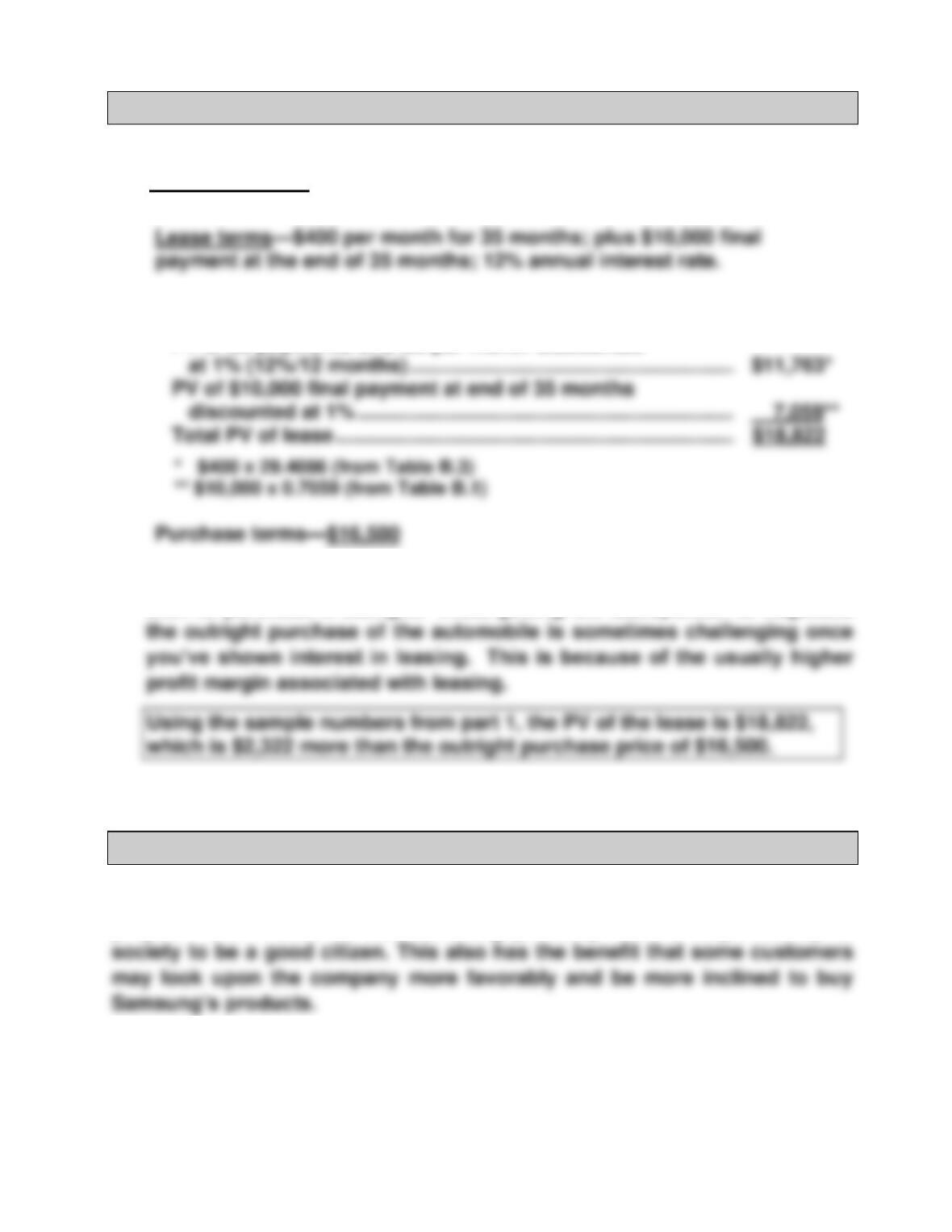
Payback Period
Accounting Rate
of Return
Net Present
Value
Internal Rate
of Return
Advantages
• Easy to
understand
• Easy to
understand
• Reflects
time value
of money
• Reflects
time value
of money
Disadvantages
• Ignores time
value of money
• Ignores time
value of
money
• Difficult to
compare
dissimilar
• Ignores
varying
risk levels
Wild, Shaw, Chiappetta, FAP 23e Solutions Manual: Chapter 25
1552
Hitting the Road — BTN 25-8
1. Answers will vary among students.
Sample Example
For illustrative purposes, one sample solution would appear as follows:
To compute the present value of the lease payments
PV of $10,000 final payment at end of 35 months
PV of 35 payments of $400 per month discounted
2. In most cases the students will find it more costly to lease an automobile
than to purchase it outright. Also, getting the salesperson to negotiate
Global Decision — BTN 25-9
There are probably several reasons why Samsung would take on this
project. One reason is that Samsung probably feels a responsibility to
payment at the end of 35 months; 12% annual interest rate.