Chapter 25
Manufacturing Accounting
Chapter Overview
This chapter introduces the specialized accounting concepts and techniques required to properly record,
report, and control the operations of a manufacturing company. The financial accounting procedures
discussed in earlier chapters are still valid in a manufacturing company, but they are supplemented by the
accounting reports presented in this chapter. The first report covered in this chapter is the cost of goods
manufactured schedule. Manufacturing expenses are divided into raw materials or materials directly
Learning Objectives
After studying Chapter 25, your students should gain proficiency in the following:
2. Journalize Entries to Record Flow of Manufacturing Costs.
3. Prepare a Worksheet for a Manufacturing Company.
Chapter 25 Assignment Grid
Estimated Level
Learning Time in of
Assignment Topic(s) Objective(s) Minutes Difficulty
Discussion Questions and Critical Thinking/Ethical Case
1 Manufacturing Costs 1 5 Easy
2 Direct Labor 1 5 Easy
3 Inventory Categories 1 5 Easy
11 Ethical Case 1 5 Easy
Concept Checks
1 Manufacturing Costs 1 10 Easy
2 Raw Materials 1 10 Easy
Exercises (Set A)
25A-1 Manufacturing Costs 1 10 Easy
25A-2 Raw Materials 1 10 Easy
25A-3 Manufacturing Costs 1 20 Medium
Exercises (Set B)
25B-1 Manufacturing Costs 1 10 Easy
25B-2 Raw Materials 1 10 Easy
Problems (Set A)
25A-1 Cost of Goods Manufactured 1 30 Medium
25A-2 Manufacturing Journal Entries 2 50 Hard
25A-3 Worksheet 3 60 Hard
Problems (Set B)
25B-1 Cost of Goods Manufactured 1 30 Medium
Financial Report Problem
Reading Amazon’s Annual Report 1 10 Easy
Learning Unit 25-1: Cost of Goods Manufactured and the Income
Statement
Summary: In a manufacturing environment it is necessary to separate the manufacturing costs from selling
and administrative expenses. Manufacturing costs such as product costs, inventory costs, and gross profit
come from the manufacturing process. All the costs incurred in the manufacturing of a product are
manufacturing costs. In addition, it is necessary to allocate a portion of the nonmanufacturing costs such as
accounting, personnel, purchasing, and data processing departments each month based on their contribution
to manufacturing. The manufacturing costs are divided into three elements: raw material, direct labor, and
manufacturing overhead.
Raw material (or direct material) includes all the items of prime material that will become a part of the
product. Direct labor includes the wages of those personnel whose efforts directly change the quality or
characteristics of the products. Manufacturing overhead consists of all other manufacturing costs not
included in raw material or direct labor. Manufacturing overhead includes many diverse items such as
The work-in-process inventory represents the cost of the products being processed (the step before
becoming finished goods) and includes the raw material, direct labor, and the manufacturing overhead costs
incurred at the time of the inventory.
The finished goods inventory consists of the manufacturing cost of the products that have been completed
and are awaiting shipment to customers.
The schedule of cost of goods manufactured (Figure 25.2) is the calculation of all the costs associated
with the production of the finished goods.
• The first step in preparing the cost of goods manufactured is the calculation of the raw material cost
for the month. If the accounting department has its records on a computer, the raw material cost
Key Concepts: Raw material, direct labor, manufacturing overhead.
Lecture Outline:
1. Elements of manufacturing costs:
a. Raw Materials – materials that will become a part of the product or will change the quality or
characteristics of the product.
b. Direct Labor – the wages of the individuals whose efforts directly change the quality or
characteristics of the products.
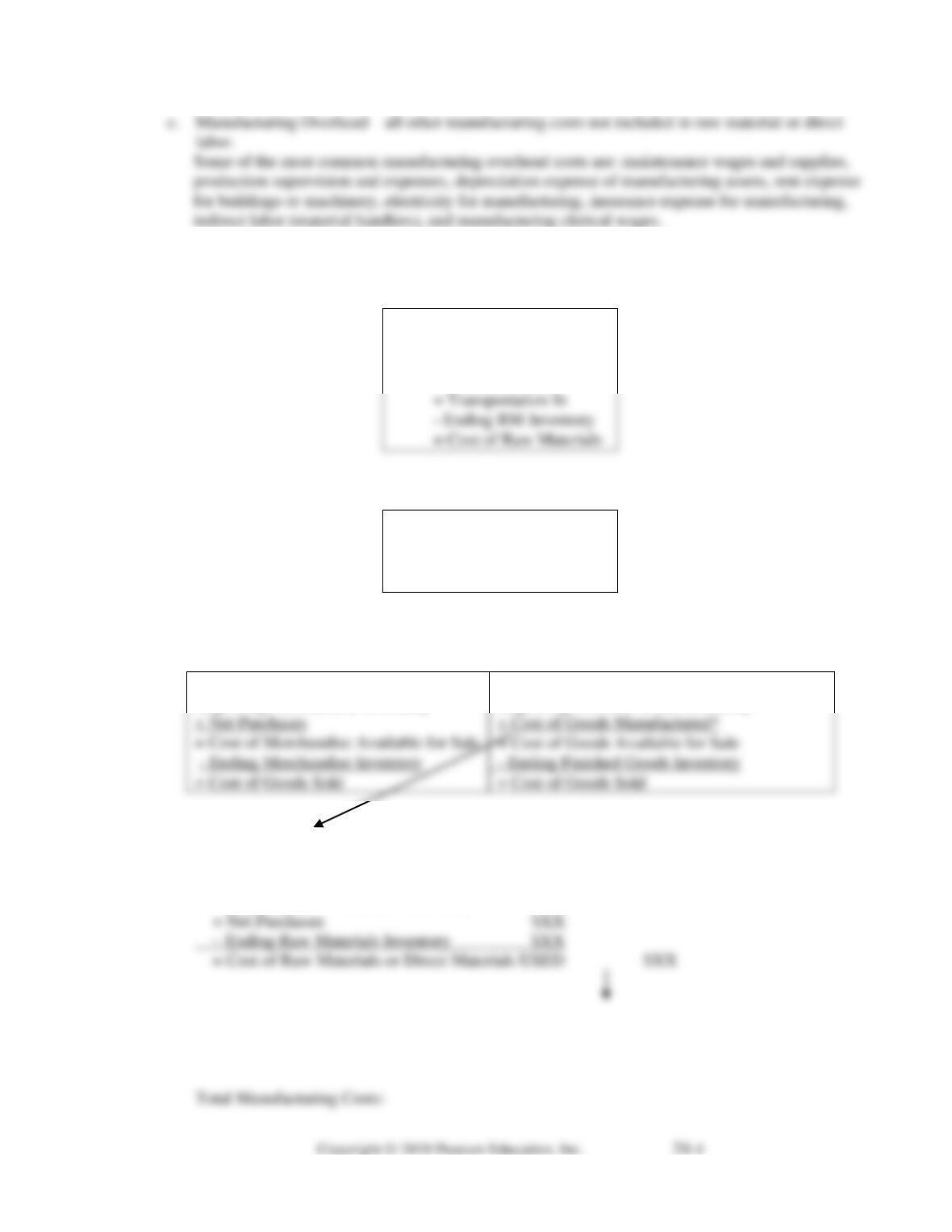
2. Three manufacturing inventories: Raw Materials, Work-in-Process, and Finished Goods.
a. Raw Materials Inventory is the cost of the items of raw material being held for production plus the
freight costs.
Raw Material (RM)
Beginning RM Inventory
+ Net Purchases
b. Work-in-Process Inventory: the cost of the products being processed and includes: raw material
USED, direct labor, and estimated overhead costs. .
Cost of raw material USED
+ Direct Labor
+ Factory Overhead
= Work-in-Process Inventory
c. Finished Goods Inventory consists of the manufacturing cost of the products that have been
completed and are awaiting shipment to consumers.
3. Cost of goods sold:
Merchandising Company
Manufacturing Company
Beginning Merchandise Inventory
Beginning Finished Goods Inventory
+ Net Purchases
+ Cost of Goods Manufactured*
= Cost of Goods Sold
= Cost of Goods Sold
4. The *cost of goods manufactured replaces the purchases of the merchandise company statement and is
calculated separately (See Figure 25.2)
Cost of Goods Manufactured:
Cost of Raw Materials:
Beginning Raw Materials Inventory $XX
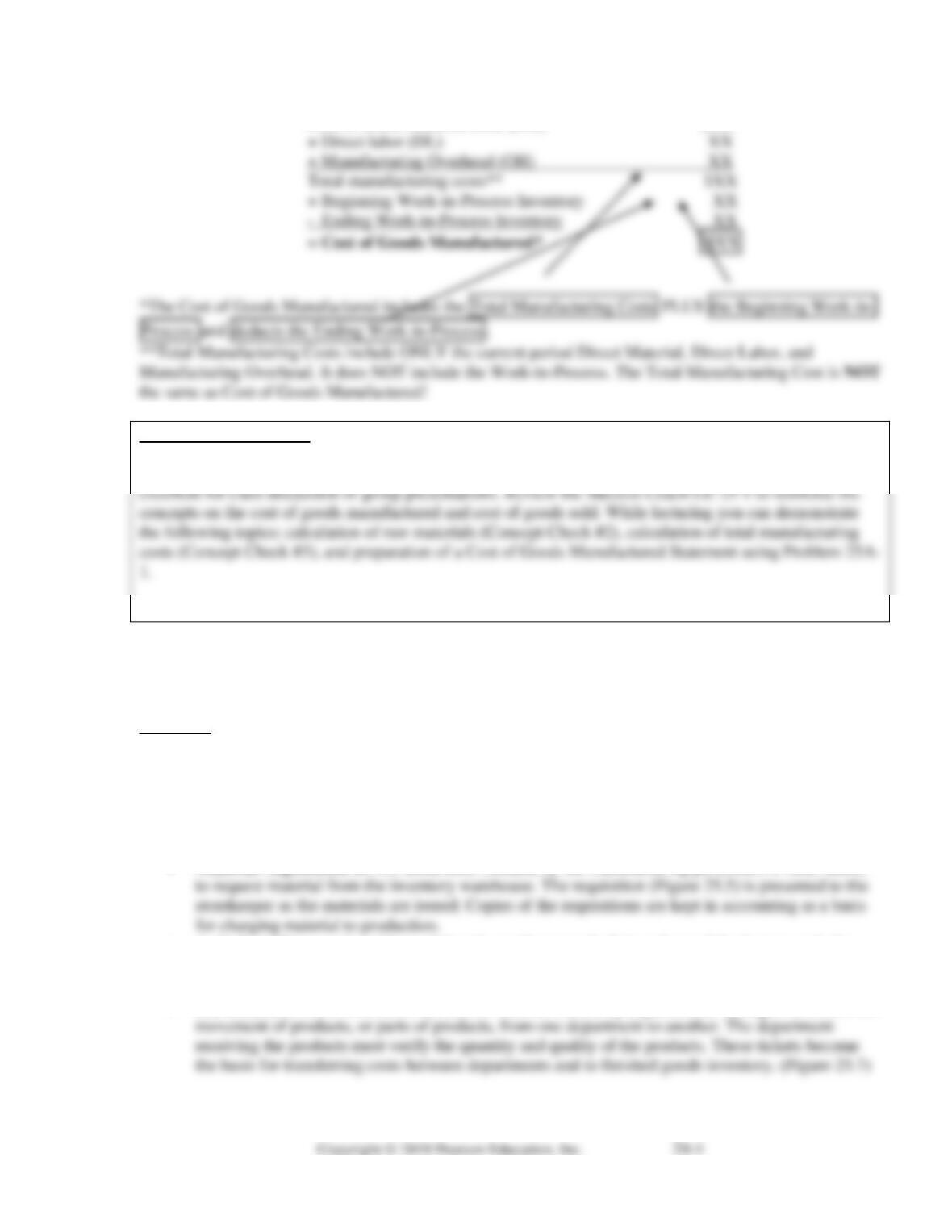
Cost of Direct Material used (DM) $XX
Teaching Tips/Strategy: Use Discussion Questions #1 – #3 to distinguish between a service or retail
business and a manufacturing business. Illustrate or/and demonstrate the differences between the total
manufacturing cost and the cost of goods manufacturing calculations. Exercises #25A-1 – #25A-3 are
Use the “Ten-Minute Quiz” questions #1, #2, #3, #4, and #5 to reinforce the learning concepts.
Learning Unit 25-2: Journalizing the Flow of Costs for a
Manufacturing Company
Summary: As the raw material, direct labor, and overhead are charged into the manufacturing process, they
must be recorded in the journal entry. The issuance of material from the warehouse, the assignment of labor
to departments, and the movement of the products through the process must be reported to the cost
accountants as the basis for journal entries. The supporting documents are:
• Receiving reports are prepared by the receiving department to acknowledge receipt of all material
and supplies from vendors. (Figure 25.4) The accounting copy becomes a part of the vendor
payment voucher, along with the purchase order and the vendor invoice.
• Material requisitions are the documents initiated by the manufacturing personnel, or other users,
• A clock card is a card used by each hourly employee to clock in and out of the factory each day
(Figure 25.6). The cards are collected each week by the payroll department and become a basis for
the payroll check and for charging labor to production.
• Lot tickets, or move tickets, are documents that are written by departmental managers to reflect the
• A labor distribution report is a by-product of the payroll that has been allocated to the categories
The Overhead Application is an estimate of the application necessary to produce an item. Some overhead
accounts, such as electricity, supervision, and depreciation, are not known until the end of the month. For
this reason, an overhead rate must be established as a basis for applying the overhead. Several methods help
Key Concepts: Receiving report, material requisition, clock card, lot ticket, labor distribution report, bill of
lading.
Lecture Outline:
Review the Flow of Costs (Figure 25.10) and Journal Entries (Figure 25-11)
Source documents – the required data submitted to the cost accountants through various source documents
to create required journal entries.
1. Receiving report: (Figure 25.4)
2. Material requisitions (documents): (Figure 25.5)
a. initiated by the manufacturing personnel,
b. request material from the inventory warehouse.
3. Clock card: (Figure 25.6)
4. Lot tickets: (Figure 25.7)
a. move tickets
b. documents are prepared to show the movement of materials or products between
departments.
c. Journal Entry:
5. Labor distribution report: (Figure 25.8)
a. a report issued by the payroll department to categorize employees,
b. includes all types of labor incurred during the week.
c. Journal entry for Direct Labor:
6. Bill of lading: (Figure 25.9)
a. formal document issued to the carrier of the finished product,
b. the basis for charging the cost of the products from the finished goods inventory to the
cost of goods sold.
c. Journal Entry:
7. Overhead Application:
a. overhead application is based on machine hours, direct labors or labor cost,
b. overhead accumulated needs to be applied to the work-in-process inventory. The
allocation method selected by management should be one that most accurately reflects
the cost apportionment.
8. The flow of manufacturing costs (Figure 25.10)
a. illustrates the movement of material, labor, and overhead through the operation.
Teaching Tips/Strategy: Analyze and compare all three inventory accounts, Contrast the difference on
each account. Use Discussion Question #3 to explain the accounts characteristics and their impact on the
flow of goods. Consider demonstrating the flow of materials on a factory floor by explaining via graph the
Learning Unit 25-3: Preparing a Worksheet for a Manufacturing
Company
Summary: In past chapters we viewed worksheets for a service company. We now examine and
explain the preparation of a worksheet for a manufacturing company (Figure 25.15). The calculations
and theory are the same but the accounts are different.
Key Concepts: None
Lecture Outline:
The formula for cost of goods manufactured: beginning inventory + purchases – ending inventory is a
constant in manufacturing accounting. With income being a credit balance, placing the ending inventory in
the credit column and placing the beginning inventory in the debit column has the effect of adding ending
inventory and subtracting beginning inventory.
1. Key points to look at on the worksheet (Figure 25.15)
a. New set of columns for the statement of cost of goods manufactured.
b. Raw materials inventory and work-in–process inventory.
c. Finished goods inventory is not listed on the statement of cost of goods manufactured.
i) Beginning balance is listed in the debit column of the income statement.
2. Reports prepared from the worksheet:
a. Cost of Goods Manufactured (See Figure 25.16)
b. Income Statement (See Figure 25.17)
c. Balance Sheet (See Figure 25.18) – note: raw materials, work-in–process, and finished goods
inventories are listed as current assets
Teaching Tips/Strategy: The optimal way to integrate the concept and maintain the retention of the

Name Date Section
CHAPTER 25
TEN-MINUTE QUIZ
Circle the letter of the best response.
1. Both direct materials and indirect materials are included in:
a. raw materials inventory b. manufacturing overhead
c. work-in-process inventory d. overhead allocation
2. Manufacturing employees whose work can be physically traced to the finished product have their
labor classified as:
a. manufacturing overhead b. indirect materials
c. direct labor d. indirect labor
3. Which of the following is not manufacturing overhead?
a. direct labor b. indirect labor
c. indirect materials d. depreciation
4. Manufacturing costs include:
a. raw materials and overhead b. raw materials, direct labor, and overhead
c. direct labor and overhead d. direct labor and raw materials
5. Which of the following is not a direct material?
a. plastic used in windshield wipers b. glass used in a mirror
c. wooden pegs in a chair assembly d. oil used to lubricate parts
6. A company has the following information:
Beginning work-in-process inventory $ 75,000
Beginning raw materials inventory 33,000
Net purchases 120,000
Ending raw materials inventory 35,000
Direct labor 37,000
Overhead 22,000
Ending work-in–process inventory 70,000
What is the cost of raw materials?
a. $118,000 b. $177,000
c. $188,000 d. $172,000
7. A company has the following information:
Beginning work-in-process inventory $75,000
Beginning raw materials inventory 33,000
Net purchases 120,000
Ending raw materials inventory 35,000
Direct labor 37,000
Overhead 22,000
Ending work-in–process inventory 70,000
How much is the total manufacturing cost?
a. $118,000
b. $177,000

c. $188,000
d. $172,000
8. A company has the following information:
Beginning work-in-process inventory $75,000
Beginning raw materials inventory 33,000
Net purchases 120,000
Ending raw materials inventory 35,000
Direct labor 37,000
Overhead 22,000
Ending work-in–process inventory 70,000
How much is the cost of goods manufactured?
a. $118,000 b. $177,000
c. $188,000 d. $182,000
9. What is the entry to allocate $25,000 of labor to overhead?
a. Payroll expense XX
Overhead – Control XX
b. Payroll expense XX
Work-in-process XX
c. Overhead – Control XX
Payroll expense XX
d. Work-in-process inv. XX
Overhead – Control XX
10. What is the entry to allocate $25,000 of overhead to inventory?
a. Payroll expense XX
Overhead – Control XX
b. Payroll expense XX
Work-in-process XX
c. Overhead – Control XX
Payroll expense XX
d. Work-in-process inv. XX
Overhead – Control XX

Answer Key to Chapter 25 Quiz