1503
Exercise 25-11 (25 minutes)
a.
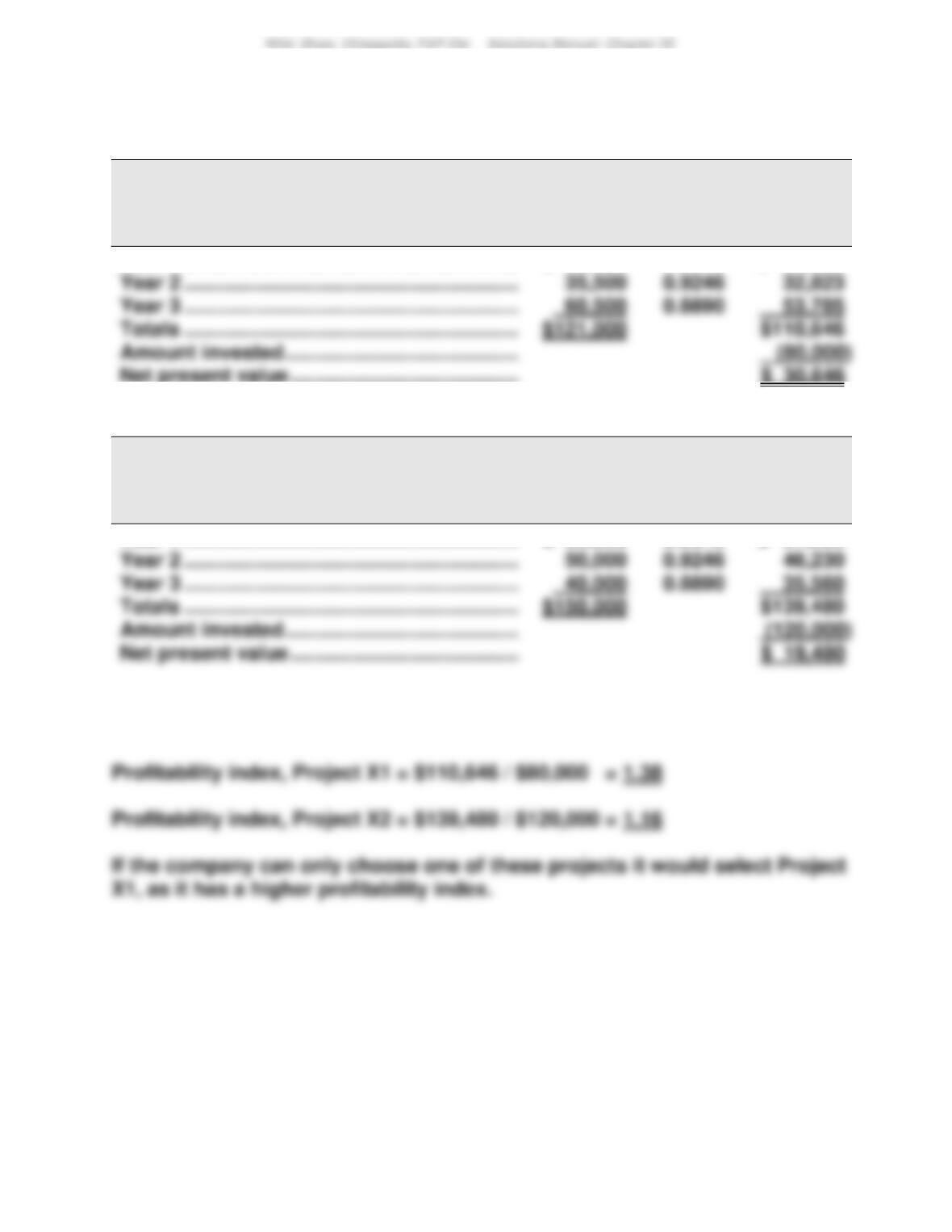
Project X1
Net Cash
Flows
Present
Value of
1 at 4%
Present
Value of
Net Cash
Flows
Year 1 ……………………………………………………….
$ 25,000
0.9615
$ 24,038
Year 2 ……………………………………………………….
0.9246
Year 3 ……………………………………………………….
$121,000
Net present value ………………………………………….
$ 30,646
Project X2
Net Cash
Flows
Present
Value of
1 at 4%
Present
Value of
Net Cash
Flows
Year 1 ……………………………………………………….
$ 60,000
0.9615
$ 57,690
Year 2 ……………………………………………………….
0.9246
Year 3 ……………………………………………………….
Net present value ………………………………………….
$ 19,480
b.
1504
Exercise 25-12 (25 minutes)
a.
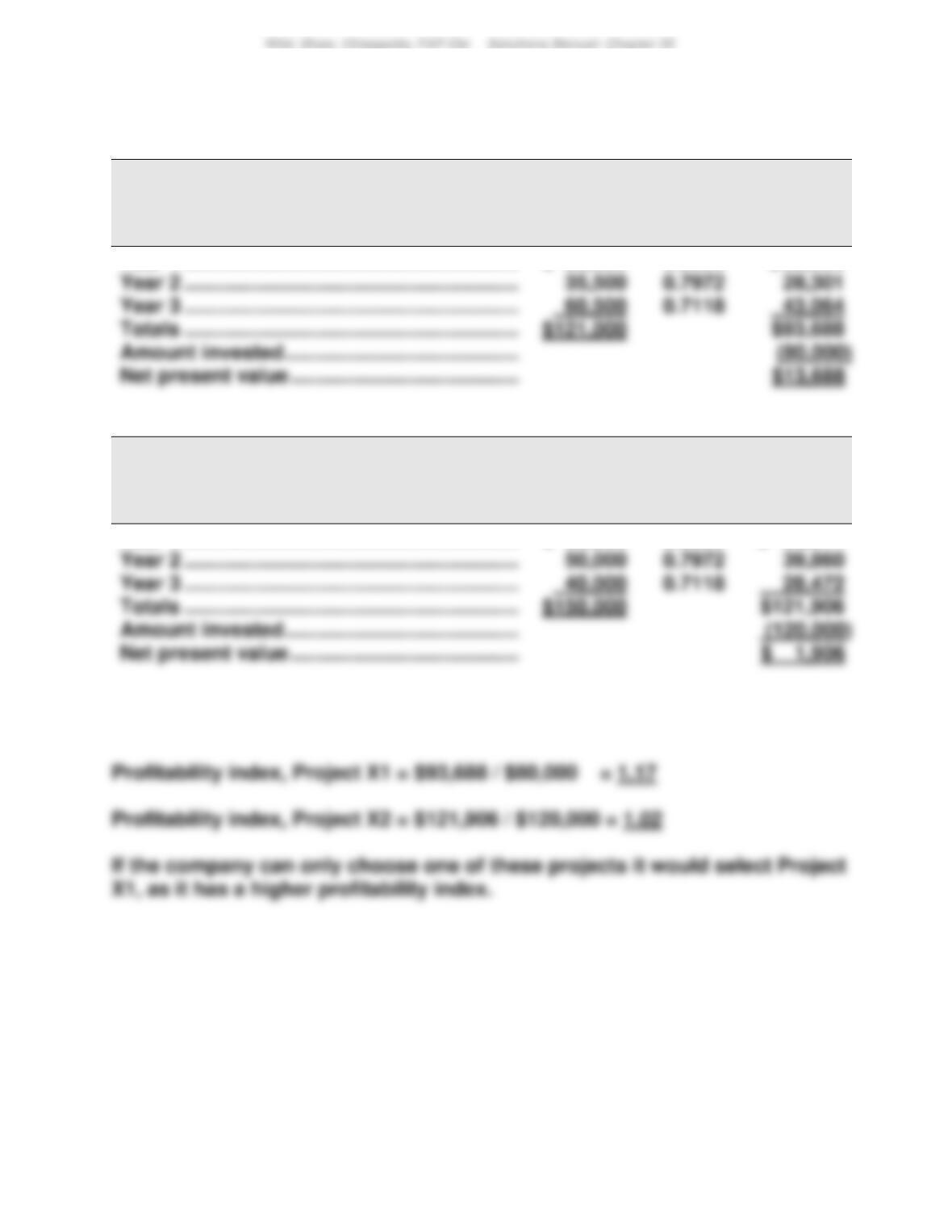
Project X1
Net Cash
Flows
Present
Value of
1 at 12%
Present
Value of
Net Cash
Flows
Year 1 ……………………………………………………….
$ 25,000
0.8929
$ 22,323
Year 2 ……………………………………………………….
0.7972
Year 3 ……………………………………………………….
0.7118
Project X2
Net Cash
Flows
Present
Value of
1 at 4%
Present
Value of
Net Cash
Flows
Year 1 ……………………………………………………….
$ 60,000
0.8929
$ 53,574
Year 2 ……………………………………………………….
0.7972
Year 3 ……………………………………………………….
0.7118
b.
1505
Exercise 25-13 (20 minutes)
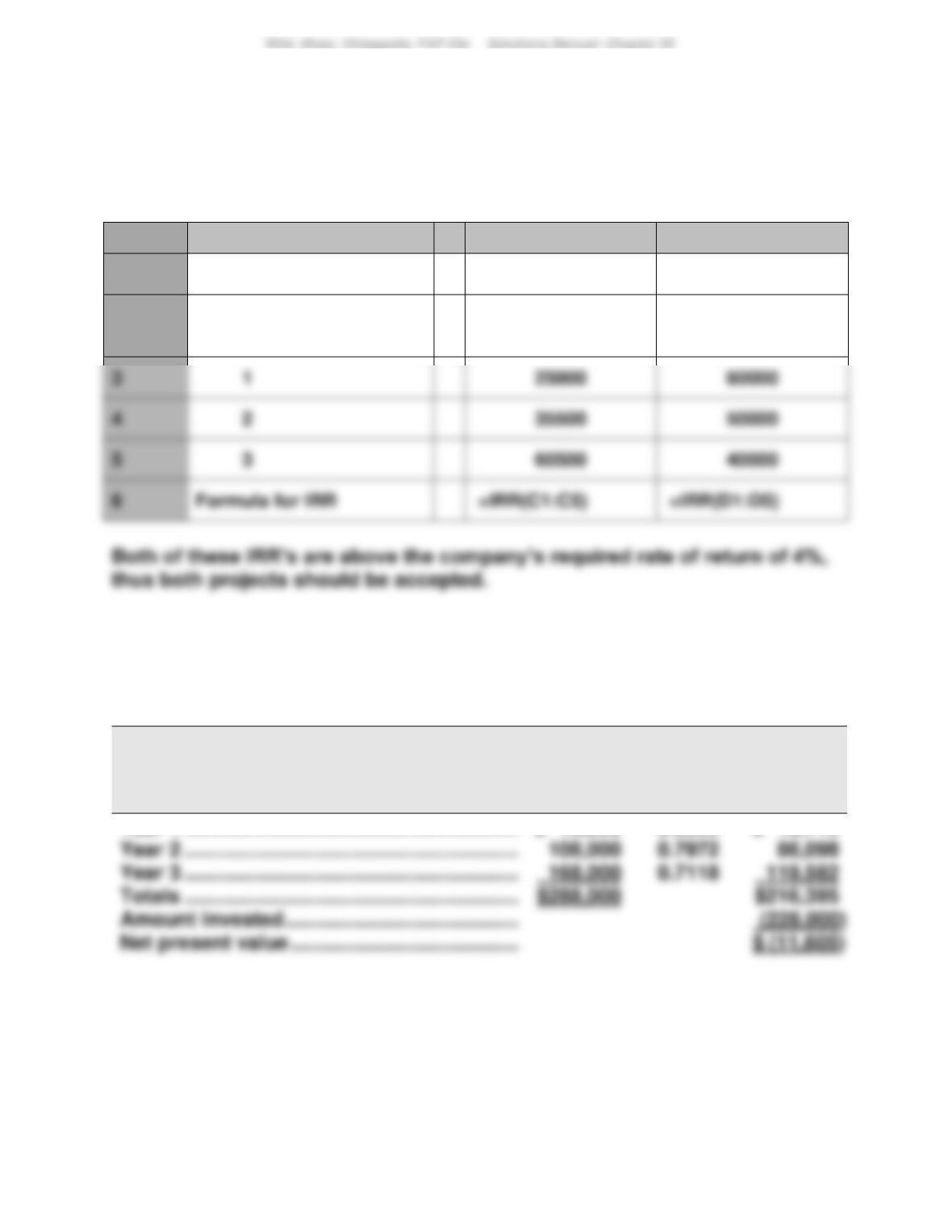
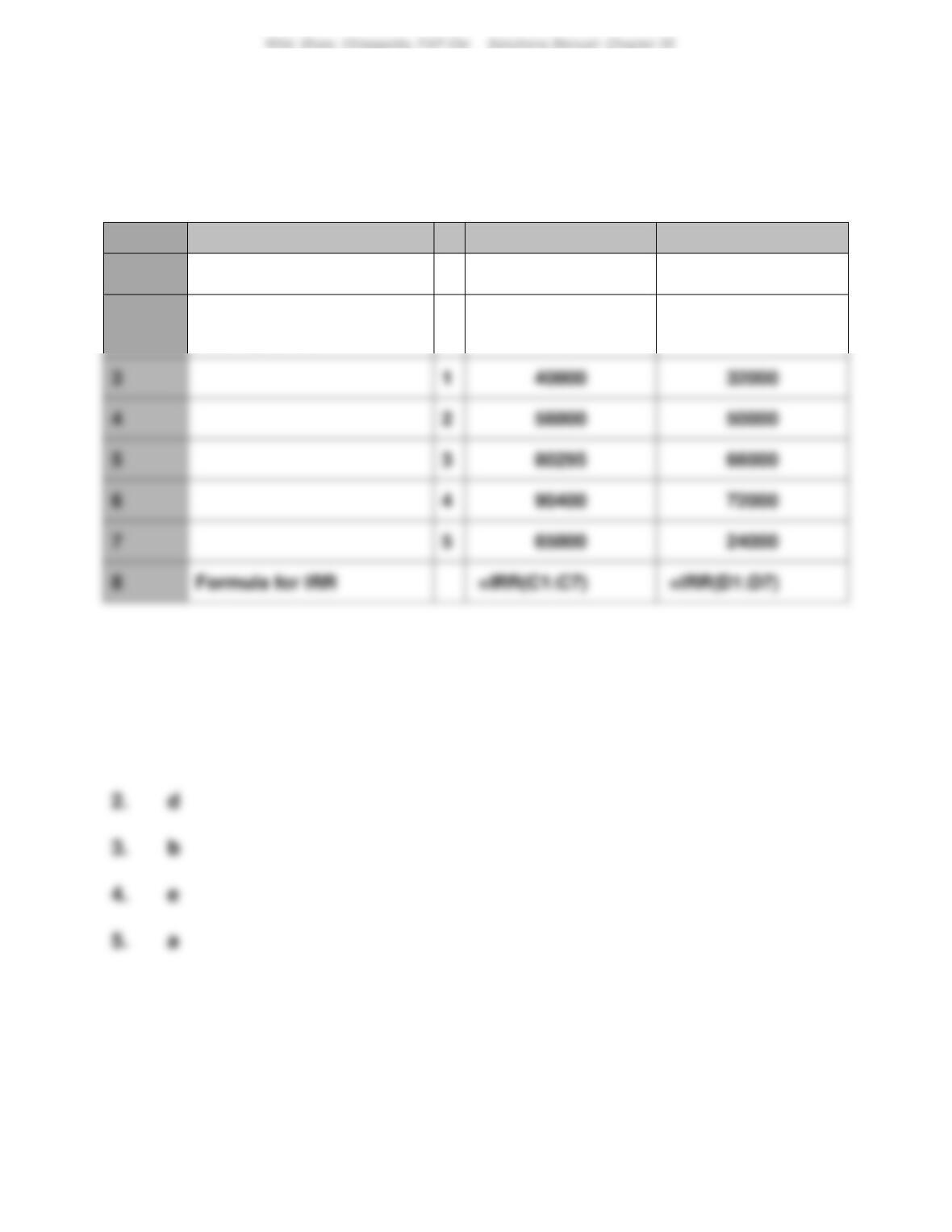
Using Excel, Project X1 (X2) has an internal rate of return of 20.34% (12.99%).
Project X1 Project X2
A
B
C
D
1
Initial investment
-80000
–120000
2
Annual cash flows,
end of period
4
2
5
3
6
Formula for IRR
Exercise 25-14 (35 minutes)
1.
PROJECT C1
Net Cash
Flows
Present
Value of
1 at 12%
Present
Value of
Net Cash
Flows
Year 1 ……………………………………………………….
$ 12,000
0.8929
$ 10,715
Year 2 ……………………………………………………….
0.7972
Year 3 ……………………………………………………….
0.7118
1506
Exercise 25-14 (continued)
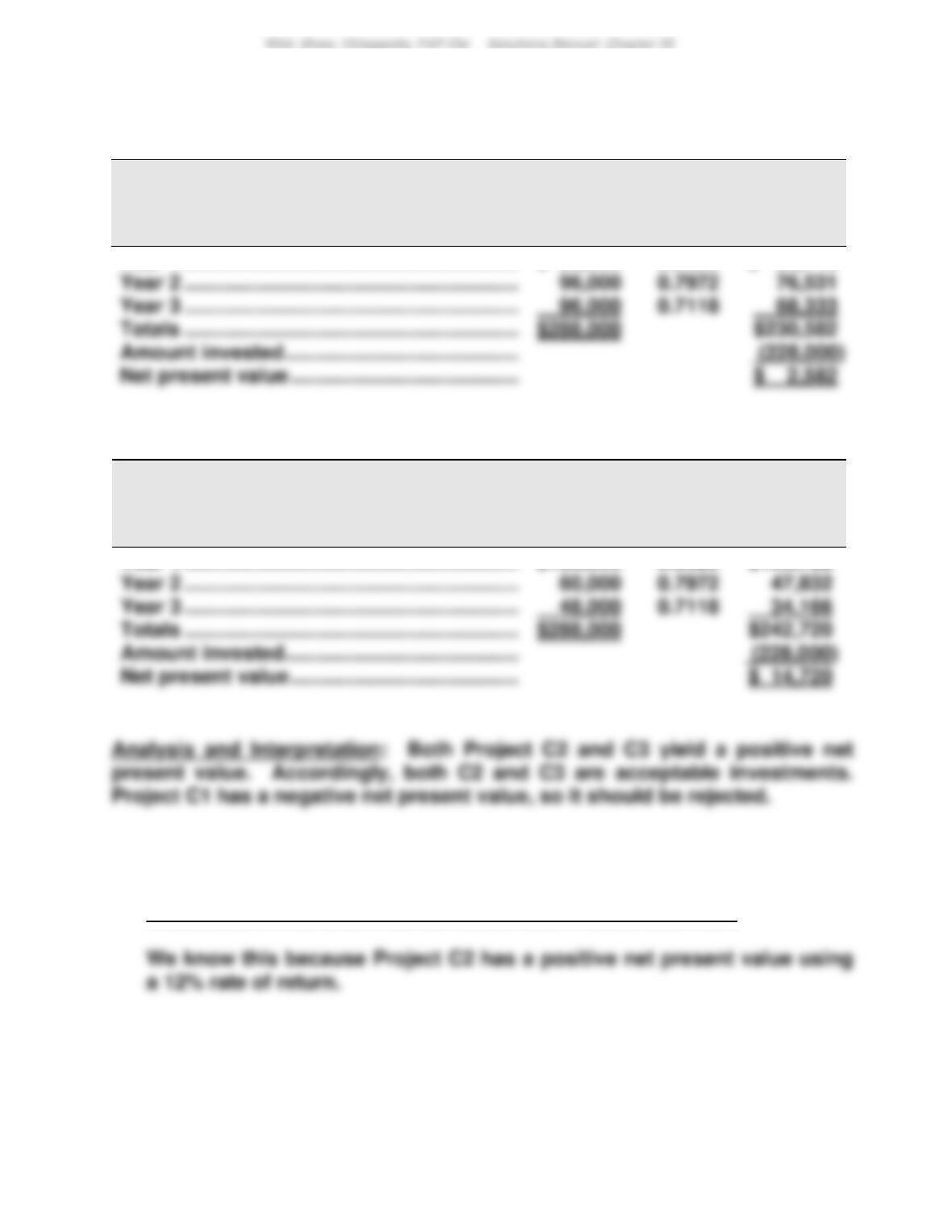
PROJECT C2
Net Cash
Flows
Present
Value of
1 at 12%
Present
Value of
Net Cash
Flows
Year 1 ……………………………………………………….
$ 96,000
0.8929
$ 85,718
Year 2 ……………………………………………………….
0.7972
Year 3 ……………………………………………………….
0.7118
$288,000
PROJECT C3
Net Cash
Flows
Present
Value of
1 at 12%
Present
Value of
Net Cash
Flows
Year 1 ……………………………………………………….
$180,000
0.8929
$160,722
Year 2 ……………………………………………………….
0.7972
Year 3 ……………………………………………………….
0.7118
$288,000
$242,720
2. INTERNAL RATE OF RETURN VS. NET PRESENT VALUE FOR C2
Project C2 will have an internal rate of return higher than 12%.
1507
Exercise 25-15A (20 minutes)
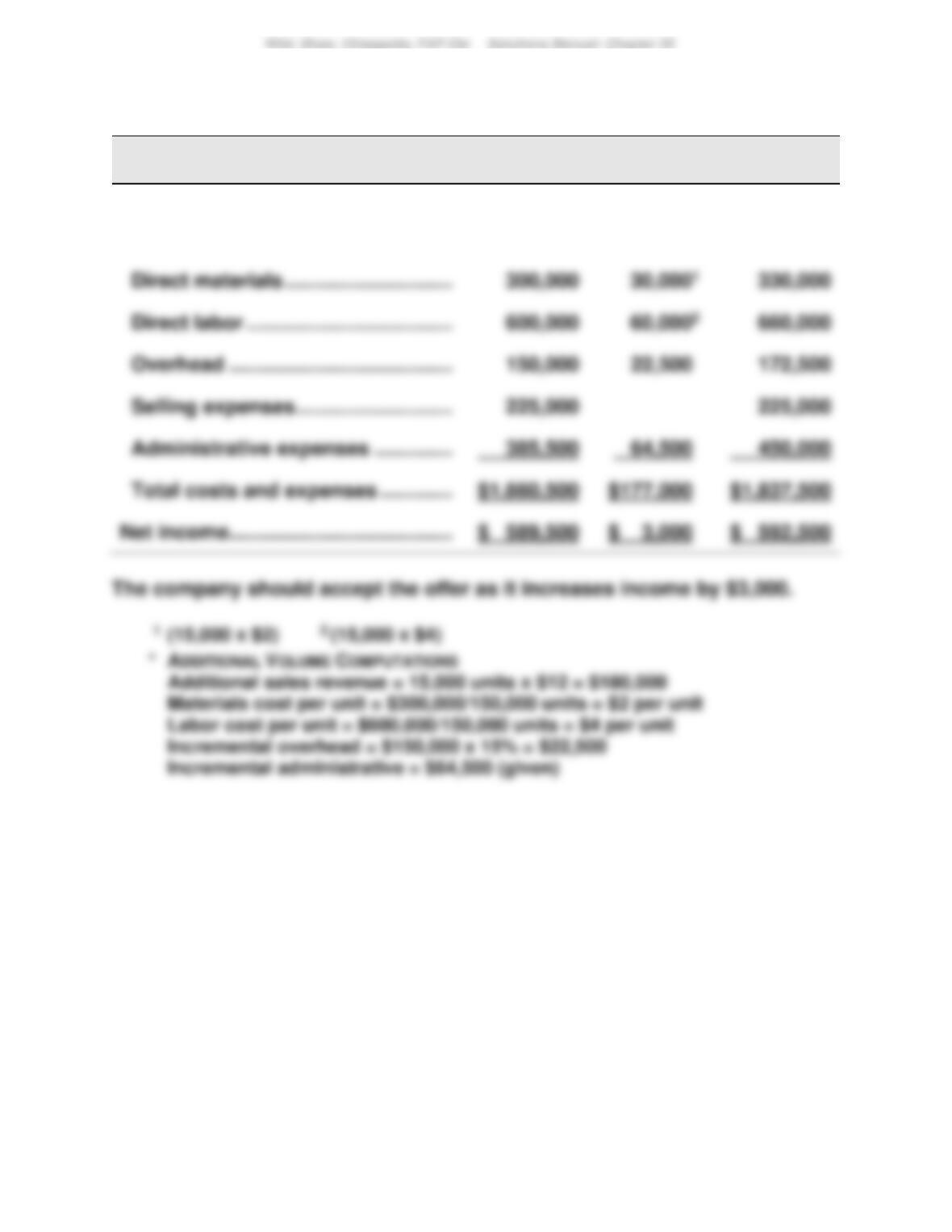
Using Excel, Project A (B) has an internal rate of return of 26.96 (35.00%).
Project A Project B
A
B
C
D
1
Initial investment
-160000
-105000
2
Annual cash flows,
end of period
4
2
5
3
6
4
7
5
8
Formula for IRR
Exercise 25-16 (10 minutes)
1. c
1508
Exercise 25-17 (25 minutes)
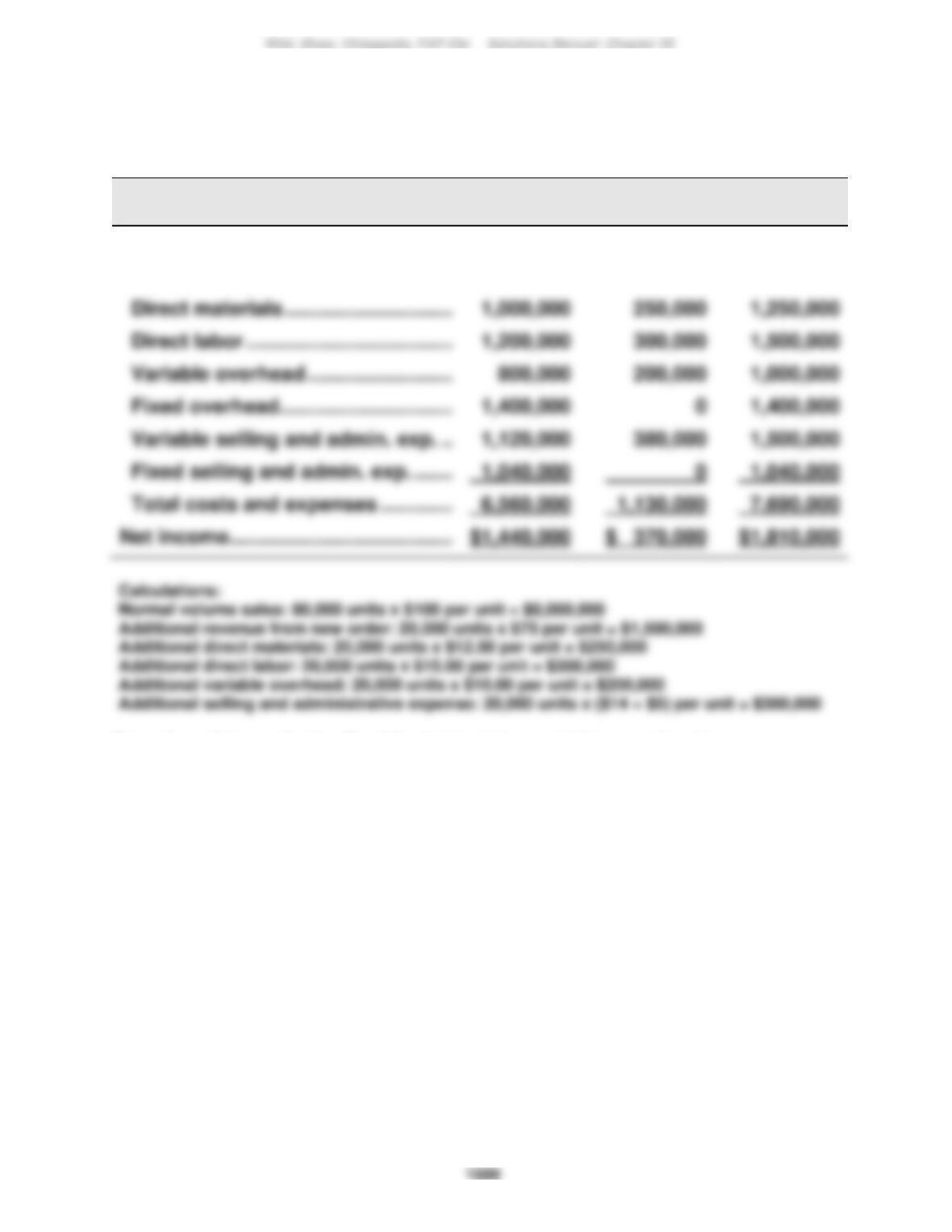
Normal
Additional
Combined
Volume
Volume*
Total
Sales …………………………………………..
$2,250,000
$180,000
$2,430,000
Costs and expenses
Exercise 25-18 (20 minutes)
Part 1
Normal
Additional
Combined
Volume
Volume
Total
Sales …………………………………………..
$8,000,000
$1,500,000
$9,500,000
Costs and expenses
1,200,000
1,400,000
0
Based on this analysis, Goshford should accept the new business.
Part 2
Other factors that Goshford should consider before deciding whether to
accept the new business are:
• Will regular customers demand a reduction in their selling price if they
hear of the sale to the new customer?
• Will the new customer expect to receive the special price for future sales?
• If Goshford accepts the new business, it will be operating at full capacity.
Can they maintain that full capacity without any defects?
• What will happen to regular sales if they cannot meet current customers’
expectations because of this order?
1510
Exercise 25-19 (20 minutes)
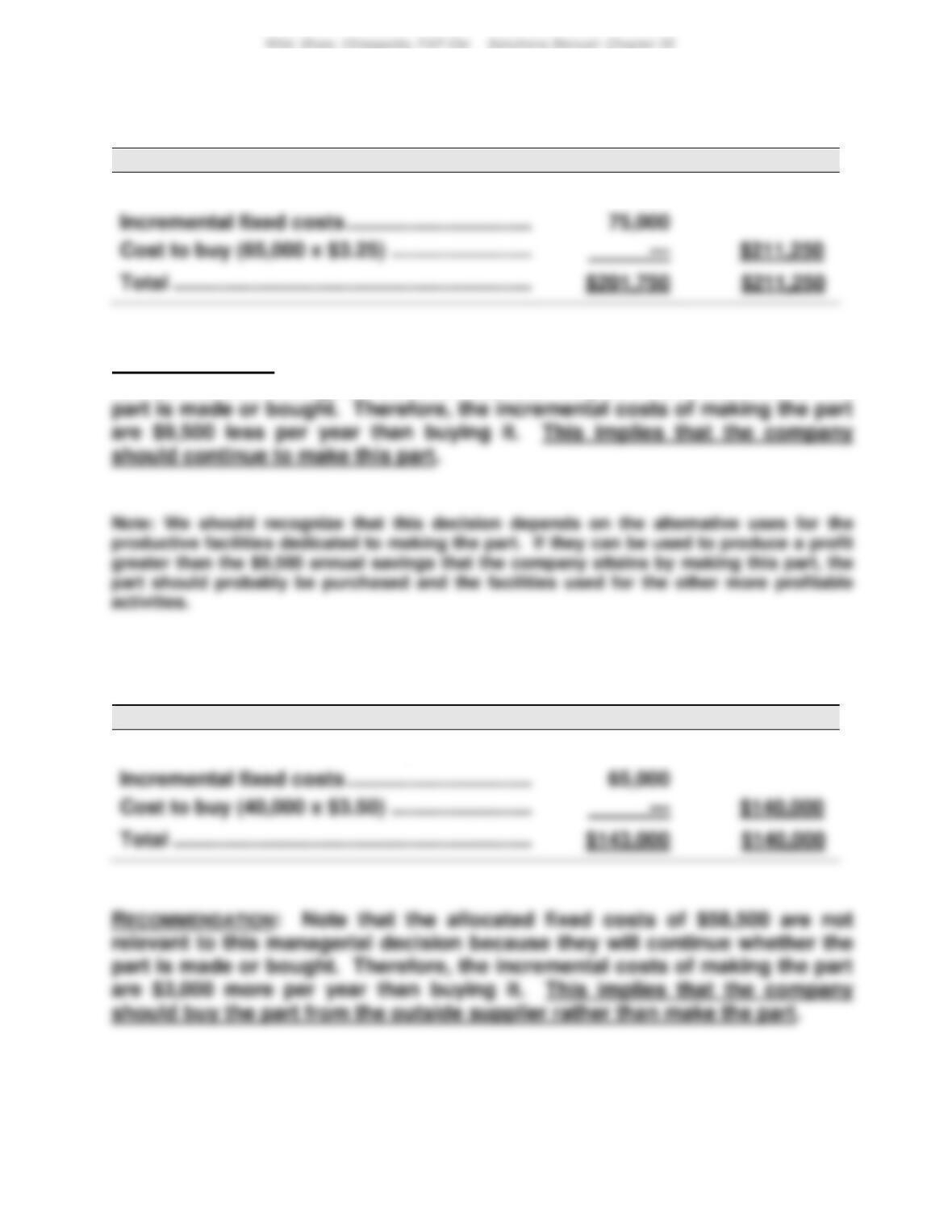
Make
Buy
Variable costs (65,000 x $1.95) ………………………
$126,750
—-
RECOMMENDATION: Note that the allocated fixed costs of $62,000 are not
relevant to this managerial decision because they will continue whether the
Exercise 25–20 (20 minutes)
Make
Buy
Variable costs (40,000 x $1.95) ………………………
$ 78,000
—-
1511
Exercise 25–21 (15 minutes)
Scrap
Rework
Sale of scrapped/reworked units …………………..
$44,000
$187,000
(1) The incremental income from selling as scrap is $44,000 (22,000 x $2.00).
Exercise 25-22 (15 minutes)
INCREMENTAL REVENUE AND COST OF ADDITIONAL PROCESSING
Revenue if processed further (7,000 x $25) ………………………………………..
$175,000
Incremental revenue …………………………………………………………………………
1512
Exercise 25-23 (25 minutes)
Sell as is
Process
further
Incremental revenue ……………………………………..
$700,000
$1,372,000*
Product B ……………………………………………………………………
$105
Product C ……………………………………………………………………
ALTERNATE SOLUTION FORMAT
Net income (loss) from processed products
Revenue if processed further…………………………………………
$1,372,000
Less: Additional costs of processing…………………………...
RECOMMENDATION: This analysis shows that the company will be better off by
Exercise 25-24 (30 minutes)
Preliminary computations
Contribution margin per hour
Product TLX
Product MTV
Selling price per unit ………………………………………….
$15.00
$ 9.50
Variable costs per unit ……………………………………….
Machine-hours to produce 1 unit ………………………..
0.50
Contribution margin per machine-hour
1513
Exercise 25-24 (continued)
1. FOR PRODUCT TLX
Maximum sales ……………………………………………………….
4,700
units
Hours needed per unit ……………………………………………………
0.50
hours
Hours needed per unit ……………………………………………………
0.20
2. CONTRIBUTION MARGIN FROM THE RECOMMENDED SALES MIX
Units
Contribution
per Unit
Total
Total ……………………………………………
1514
Exercise 25-25 (30 minutes)
1. DEPARTMENTS WITH EXPECTED NET LOSSES ELIMINATED
Total
M
N
O
P
T
Sales…………………………..
$119,000
$63,000
$ 0
$56,000
$ 0
$ 0
Expenses
2. DEPARTMENTS WITH LESS SALES THAN AVOIDABLE EXPENSES ELIMINATED
Total
M
N
O
P
T
Sales…………………………..
$161,000
$63,000
$ 0
$56,000
$42,000
$ 0
Expenses
0
1515
Exercise 25–26 (20 minutes)
ALTERNATIVE A: INCREASE OR (DECREASE) IN NET INCOME
Cost to buy new machine ……………………………………………………….
$(115,000)
Reduction in variable manufacturing costs* …………………………..
ALTERNATIVE B: INCREASE OR (DECREASE) IN NET INCOME
Cost to buy new machine ……………………………………………………….
$(125,000)
Reduction in variable manufacturing costs** …………………………..
Exercise 25-27 (15 minutes)
1. Recovery time computation
2. The advantage of break-even time is that it considers the time value of
3. When (1) the interest rate is very low, 1% for example, and (2) the
Exercise 25-28 (20 minutes)
1516
(1)
Total
Costs
Direct materials ($100 x 10,000) …………………….
$ 1,000,000
(2) Markup percentage = Target profit/Total cost
(3)
Per Unit
Total cost ……………………………………………………..
Total variable cost ………………………………………..
Exercise 25-29 (20 minutes)
(1) Variable cost per unit
Variable Cost
Per Unit
Direct materials …………………………………………….
$ 70
(3) Selling price using variable cost method
Per Unit
Wild, Shaw, Chiappetta, FAP 23e Solutions Manual: Chapter 25
1518
PROBLEM SET A
Problem 25-1A (50 minutes)
Part 1
Part 2
Net
Net Cash
Income
Flow
Expected annual sales of new product ………………
$1,840,000
$1,840,000
Expected costs of new product
Income before taxes ………………………………………….
Part 3
1519
Problem 25-1A (Continued)
Part 4
Part 5
Present Value of Net Cash Flows
Present
Present
Net Cash
Value of
Value of Net
Flows
1 at 7%
Cash Flows
Year 1 ………………………………………………….
$168,900
0.9346
$ 157,853.94
Year 2 ………………………………………………….
0.8734
Year 3 ………………………………………………….
0.8163
Year 4* …………………………………………………
0.7629
1520
Problem 25-2A (55 minutes)
Part 1
PROJECT Y
Net income ……………………………………………………….……………………..
$ 56,000
$143,500
PROJECT Z
Net income ……………………………………………………….……………………..
$ 36,400
$153,067
Part 2
PROJECT Y
PROJECT Z
1521
Problem 25-2A (Continued)
Part 3
PROJECT Y
PROJECT Z
1522
Problem 25-2A (Continued)
Part 4
PROJECT Y
Present Value of Net Cash Flows
Present
Present
Value of
Value of
Net Cash
Flows
1 at 8%
Annuity
Net Cash
Flows
PROJECT Z
Present Value of Net Cash Flows
Present
Present
Value of
Value of
Net Cash
Flows
1 at 8%
Annuity
Net Cash
Flows
Part 5
Recommendation to management is to pursue Project Y. This is because