CHAPTER 24
Full Disclosure in Financial Reporting
ASSIGNMENT CLASSIFICATION TABLE (BY TOPIC)
Topics
Questions
Brief
Exercises
Exercises
Problems
Concepts
for Analysis
* 1. The disclosure principle; type
of disclosure.
2, 3
1, 2, 3
* 2. Role of notes that accompany
financial statements.
1, 4, 5
1, 2
1, 2, 3, 4
* 3. Subsequent events.
6
3
1, 2
1
4, 12
* 4. Segment reporting; diversified
firms.
7, 8, 9,
10, 11
4, 5, 6, 7
3
2
5, 6, 7
* 5. Discussion and analysis.
12, 13
* 6. Interim reporting.
8, 9
* 8. Earnings forecasts.
20, 21
10
*9. Interpretation of ratios.
22, 23, 24
4, 5, 6
5
*10. Impact of transactions on ratios.
8
4, 5, 6
3
13
*11. Liquidity ratios.
8
4, 5, 6
3, 5
*12. Profitability ratios.
28
4, 5, 6
3, 5
*13. Coverage ratios.
4, 5, 6
*14. Activity ratios.
25, 26
8, 9
4, 5, 6
3
*15. Comprehensive ratio problems.
4, 5, 6
3, 5
*16. Percentage analysis.
24, 27
3, 4
ASSIGNMENT CLASSIFICATION TABLE (BY LEARNING OBJECTIVE)
Learning Objectives
Questions
Brief
Exercises
Exercises
Problems
Concepts
for
Analysis
1. Review the full disclosure
principle and describe
how it is implemented.
1, 2, 3
1, 2
1, 2, 3
segments, and interim
reporting.
2. Discuss the disclosure
requirements for related party
2, 3, 4, 5, 6,
7, 8, 9, 10,
3, 4, 5, 6, 7
1, 2, 3
1, 2
1, 2, 3, 4, 5,
6, 7, 8, 9,
responsibilities for the financial
3. Identify the major disclosures
in the auditor’s report and
12, 13, 18
reporting and financial
4. Identify reporting issues
19, 20, 21
10, 11
*5. Describe the approach to
22, 23
and describe their
calculation.
*6. Identify major analytic ratios
24, 25, 26
8, 9
4, 5, 6
3, 5
13
*7. Explain the limitations of ratio
analysis.
28
*8. Describe techniques of
comparative analysis.
24, 27
3
*9. Describe techniques of
percentage analysis.
25, 27
4
ASSIGNMENT CHARACTERISTICS TABLE
Item
Description
Level of
Difficulty
Time
(minutes)
E24.1
Post-balance-sheet events.
Moderate
10–15
E24.2
Post-balance-sheet events.
Moderate
10–15
E24.3
Segmented reporting.
Moderate
*E24.4
Ratio computation and analysis; liquidity.
Simple
20–30
*E24.5
Analysis of given ratios.
Moderate
20–30
*E24.6
Ratio analysis.
Moderate
30–40
P24.1
Subsequent events.
Difficult
40–50
P24.2
Segmented reporting.
Moderate
24–30
*P24.3
Ratio computations and additional analysis.
Moderate
35–45
*P24.4
Horizontal and vertical analysis.
Moderate
40–60
*P24.5
Dividend policy analysis.
Difficult
40–50
CA24.1
General disclosures; inventories; property, plant,
and equipment.
Simple
10–20
CA24.2
Disclosures required in various situations.
Moderate
20–25
CA24.3
Disclosures, conditional and contingent liabilities.
Simple
24–30
CA24.4
Post-balance-sheet events.
Moderate
20–25
CA24.5
Segment reporting.
Moderate
30–35
CA24.6
Segment reporting—theory.
Simple
20–25
CA24.7
Segment reporting—theory.
Moderate
24–30
CA24.8
Interim reporting.
Simple
20–25
CA24.9
Treatment of various interim reporting situations.
Moderate
30–35
CA24.10
Financial forecasts.
Moderate
24–30
CA24.11
Disclosure of estimates.
Moderate
15–20
CA24.12
Reporting of subsequent events.
Simple
10–15
Effect of transactions on financial statements and ratios.
Moderate
24–35
ANSWERS TO QUESTIONS
1. As indicated in the text, the major advantages are: (1) additional information pertinent to specific
financial statements can be explained in qualitative terms, or supplementary data of a quantitative
2. The full disclosure principle in accounting calls for reporting in financial statements any financial
facts significant enough to influence the judgment of an informed reader. Disclosure has increased
3. The benefit of reconciling the effective tax rate and the federal statutory rate is that an investor can
determine the actual taxes paid by the enterprise. Such a determination is particularly important if
4. (a) The increased likelihood that the company will suffer a costly strike requires no disclosure in
the financial statements. The possibility of a strike is an inherent risk of many businesses. It,
along with the risks of war, recession, etc., is in the category of general news.
5. Transactions between related parties are disclosed to ensure that the users of the financial state-
ments understand the basic nature of some of the transactions. Because it is often difficult to
6. “Subsequent events” are of two types:
(1) Those which affect the financial statements directly and should be recognized therein through
appropriate adjustments.
Questions Chapter 24 (Continued)
(e) Neither adjustment nor disclosure necessary.
7. Diversified companies are enterprises whose activities are segmented into unrelated industries. The
accounting problems related to diversified companies are: (1) the problem of defining a segment
8. After the company decides on the segments for possible disclosure, a quantitative test is made to
determine whether the segment is significant enough to warrant actual disclosure. A segment is
identified as a reportable segment if it satisfies one or more of the following tests.
(a) Its revenue (including both sales to unaffiliated customers and intersegment sales or transfers)
In applying these tests, two additional factors must be considered. First, segment data must explain
a significant portion of the company’s business. Specifically, the segmented results must equal or
exceed 75% of the combined sales to unaffiliated customers for the entire enterprise. This test
prevents a company from providing limited information on only a few segments and lumping all
the rest into one category.
9. GAAP requires that a company report:
(a) General information about its operating segments.
10. An operating segment is a component of an enterprise:
(a) That engages in business activities from which it earns revenues and incurs expenses.
(b) Whose operating results are regularly reviewed by the company’s chief operating decision
Questions Chapter 24 (Continued)
11. One of the major reasons for not providing segment information is that competitors will then be
able to determine the profitable segments and enter that product line themselves. If this occurs
12. The management discussion and analysis section covers three financial aspects of an enterprise’s
business—liquidity, capital resources, and results of operations. It requires management to highlight
13. Management has the primary responsibility for the preparation, integrity, and objectivity of the com–
14. Interim reports are unaudited financial statements normally prepared four times a year. Interim
15. The accounting problems related to the presentation of interim data are as follows:
(a) The difficulty of allocating costs, such as income taxes, pensions, etc., to the proper quarter.
16. The problem when a LIFO base is used for quarterly reporting is that the LIFO base might be
reduced in a given quarter, but for the year, this base is not reduced. If the inventory base will be
17. One suggestion has been to normalize the fixed nonmanufacturing costs on the basis of predicted
sales. The problem with this method is that future sales are unknown and hence a great deal of
Questions Chapter 24 (Continued)
18. The CPA expresses a “clean” or unqualified opinion when the client’s financial statements present
fairly the client’s financial position and results of operations on the basis of an examination made
in accordance with generally accepted auditing standards, and the statements are in conformity
19. Fraudulent financial reporting is intentional or reckless conduct, whether by act or omission, that
results in materially misleading financial statements. Fraudulent financial reporting can involve
many factors and take many forms. It may entail gross and deliberate distortion of corporate records,
such as inventory count tags, or falsified transactions, such as fictitious sales or orders. It may entail
the misapplication of accounting principles. Company employees at any level may be involved, from
Fraudulent financial reporting usually occurs as the result of certain environmental, institutional,
or individual forces and opportunities. These forces and opportunities add pressures and incentives
that encourage individuals and companies to engage in fraudulent financial reporting and are present
to some degree in all companies. If the right combustible mixture of forces and opportunities is
present, fraudulent financial reporting may occur.
A frequent incentive for fraudulent financial reporting that improves the company’s financial appear–
ance is the desire to obtain a higher price from a stock or debt offering or to meet the expectations of
investors. Another incentive may be the desire to postpone dealing with financial difficulties and
thus avoid, for example, violating a restrictive debt covenant. Other times the incentive is personal
gain: additional compensation, promotion, or escape from penalty for poor performance.
Questions Chapter 24 (Continued)
Opportunities for fraudulent financial reporting are present when the fraud is easier to commit and
when detection is less likely. Frequently these opportunities arise from:
The absence of a board of directors or audit committee that vigilantly oversees the financial
reporting process.
20. Arguments against providing earnings projections:
(a) No one can foretell the future. Therefore, forecasts, while conveying an impression of
precision about the future, will nevertheless inevitably be wrong.
21. Arguments for providing earnings forecasts are:
(a) Investment decisions are based on future expectations; therefore, information about the future
*22. It has been said that “everything is relative,” and this is certainly true of financial statement data.
The chief significance of financial statement data is not so much in the absolute amounts
presented but in their relative significance; that is, in the conclusions reached after comparing
*23. Your friend should be advised that in order to interpret adequately and to evaluate financial statement
data, an individual must:
(a) Understand the nature and limitations of accounting.
Questions Chapter 24 (Continued)
*24. Percentage analysis consists of reducing a series of related amounts to a series of percentages
of a given base while ratio analysis is the computation of a specific ratio of one figure to another
*25. Cost of goods sold is used for two reasons: first, cost must be used rather than retail value
because the average inventory figures are on a cost basis. Second, since measurement of the
*26. The relationship of asset turnover to the rate of return on assets is as follows:
Sales
Average Total Assets
X
Net Income
Sales
=
Net Income
Average Total Assets
*27. (a) Common-size analysis is reduction of all dollar amounts in the financial statements to a
percentage of a base amount.
*28. Some believe that the FASB should not be involved in developing standards related to the
presentation of ratios. A basic concern expressed by this group is: how far should the FASB go?
That is, where does financial reporting end and financial analysis begin? Furthermore, we know
SOLUTIONS TO BRIEF EXERCISES
BRIEF EXERCISE 24.1
The reader should recognize that the firm has an annual obligation for lease
payments of approximately $5,711,000 for the next three years. In certain
BRIEF EXERCISE 24.2
The reader should recognize that there are dilutive securities outstanding,
which may have an effect on earnings per share. In addition, the purchase
BRIEF EXERCISE 24.3
Net income will decrease by $10,000 ($160,000 – $170,000) as a result of the
adjustment of the liability. The settlement of the liability is the type of sub-
BRIEF EXERCISE 24.4
It should be emphasized that because a company discloses its segmental
results, this does not diminish the necessity for providing consolidated results
BRIEF EXERCISE 24.5
$600 + $650 + $250 + $275 + $225 + $200 + $700 = $2,900 = total revenue.
BRIEF EXERCISE 24.6
$90 + $25 + $50 + $34 + $150 = $349 = total profits of profitable segments.
BRIEF EXERCISE 24.7
$500 + $550 + $250 + $400 + $200 + $150 + $475 = $2,525 = total assets.
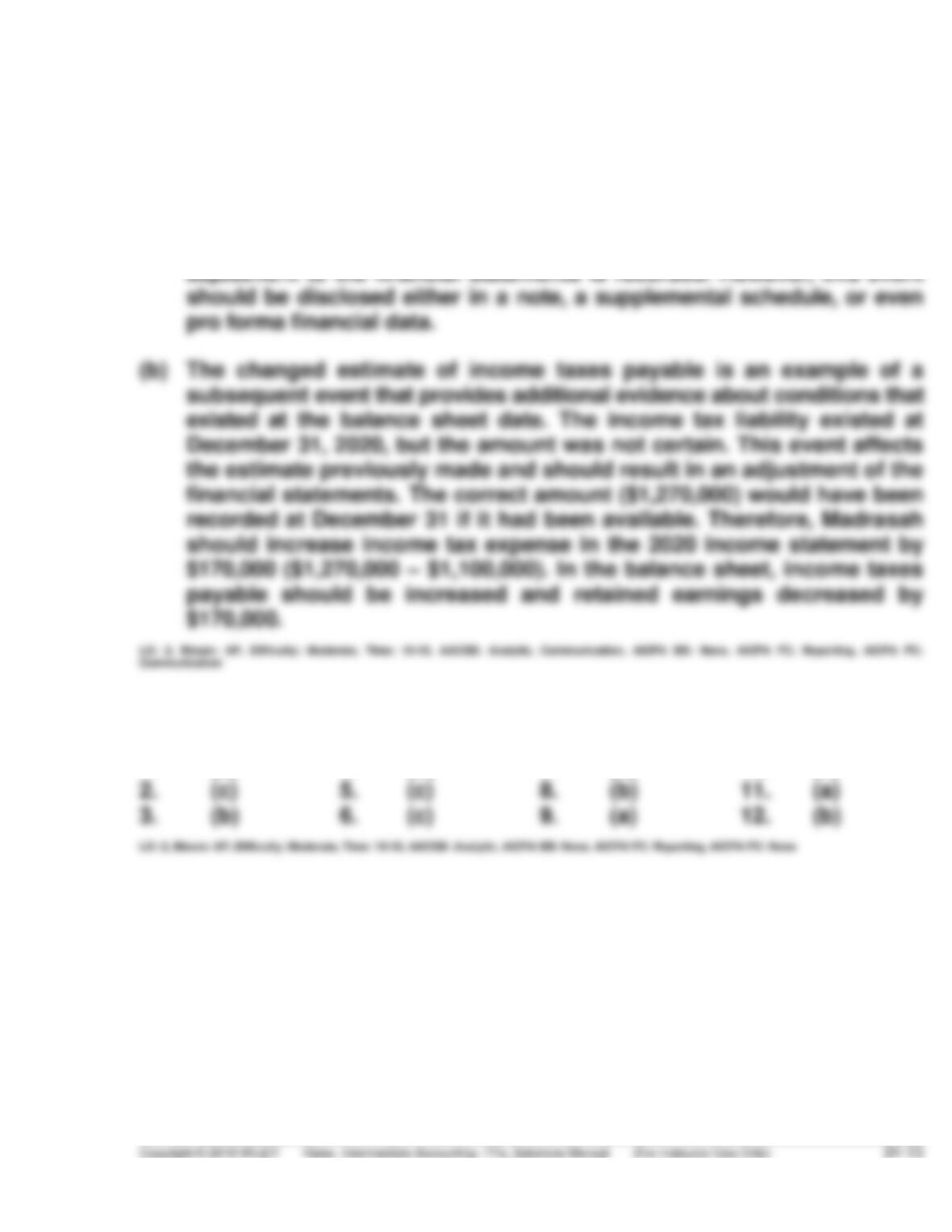
*BRIEF EXERCISE 24.8
(a) X + $500,000 = 5X
$500,000 = 4X
$125,000 = Current liabilities
*BRIEF EXERCISE 24.9
Cost of Goods Sold
= Inventory Turnover
Average Inventory
= 9
Average Inventory
SOLUTIONS TO EXERCISES
EXERCISE 24.1 (10–15 minutes)
(a) The issuance of common stock is an example of a subsequent event
that provides evidence about conditions that did not exist at the
balance sheet date but arose subsequent to that date. Therefore, no
EXERCISE 24-2 (10–15 minutes)
1.
(a)
4.
(b)
7.
(c)
10.
(c)
3.
(b)
6.
(c)
9.
(a)
12.
(b)
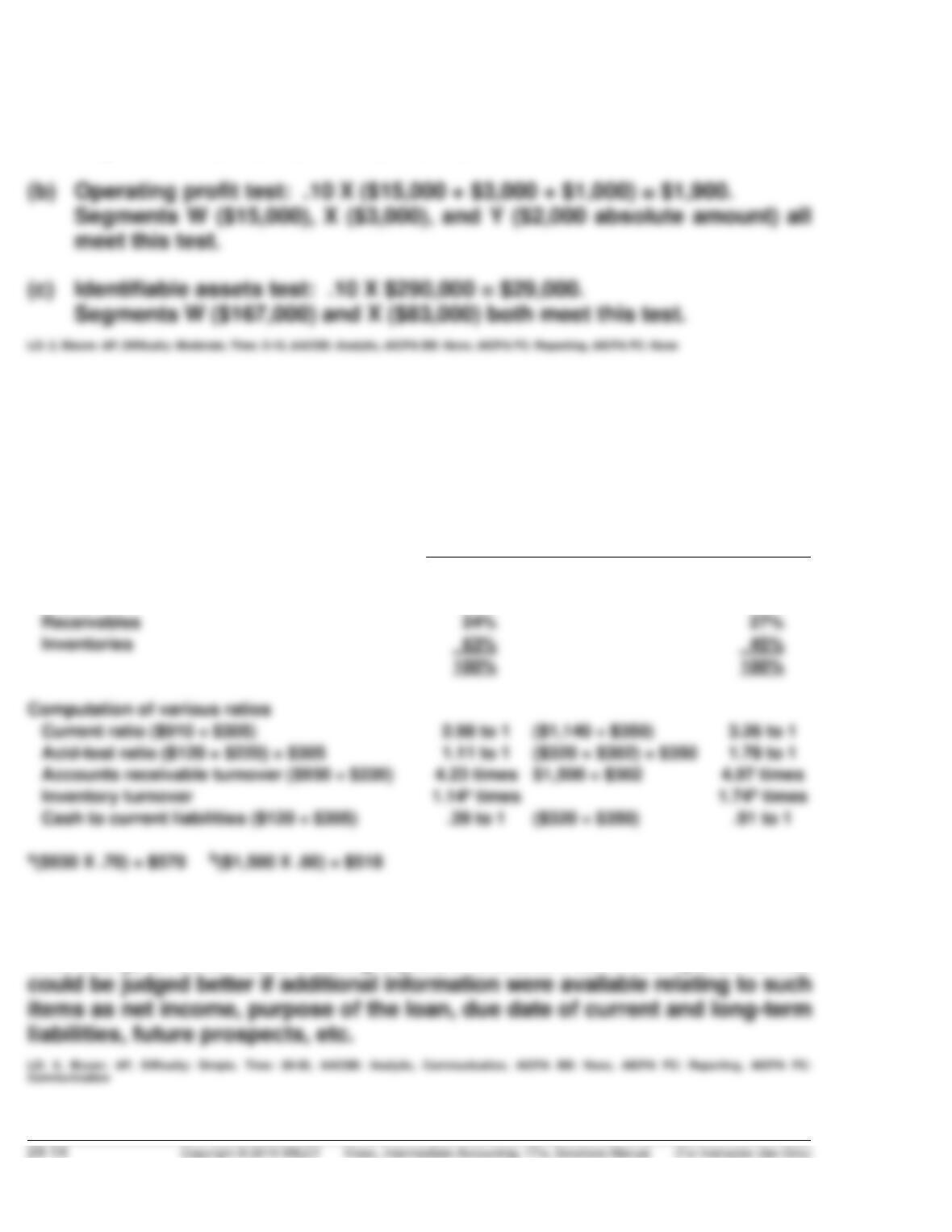
EXERCISE 24.3 (5–10 minutes)
(a) Revenue test: .10 X $102,000 = $10,200.
Segments W ($60,000) and Y ($23,000) both meet this test.
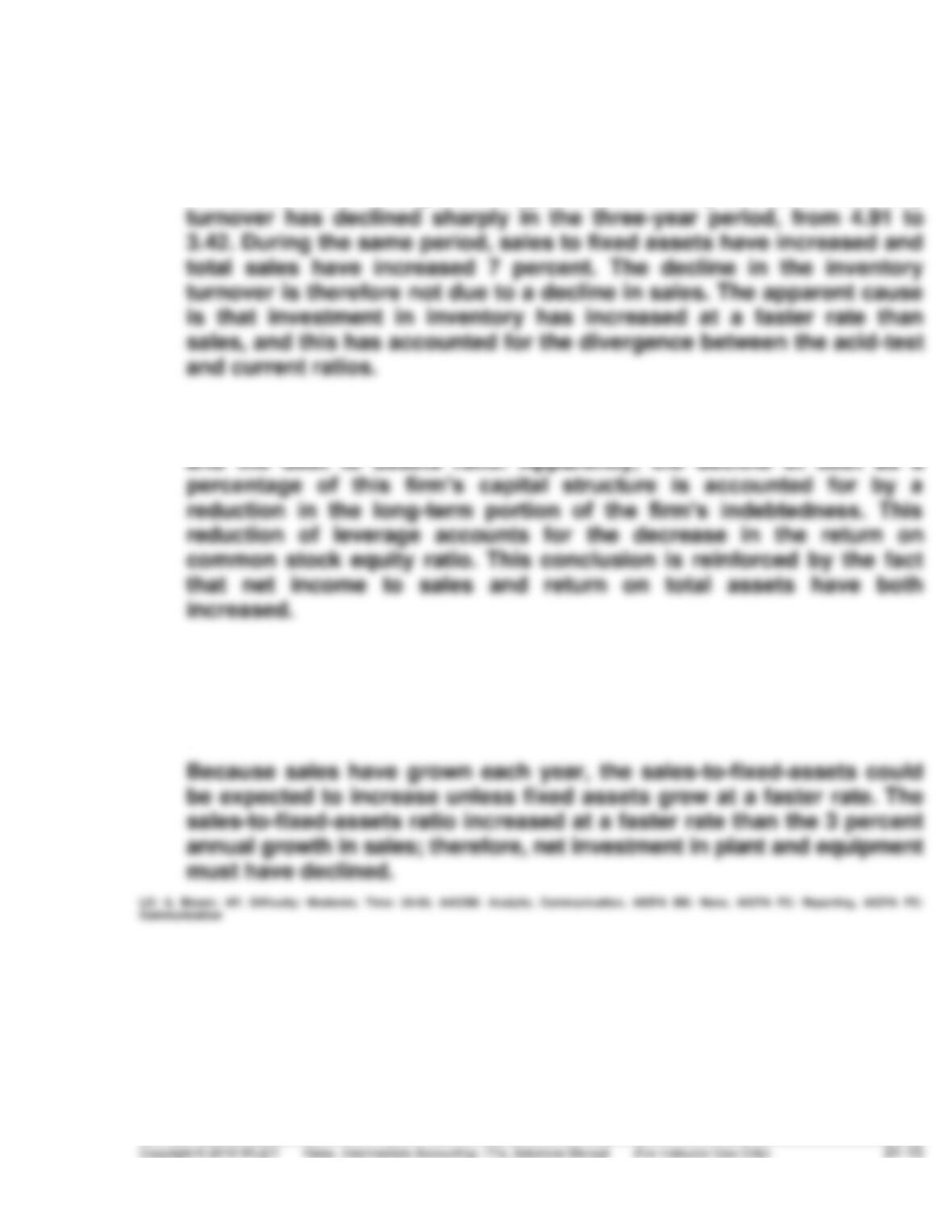
*EXERCISE 24.4 (20–30 minutes)
Computations are given below which furnish some basis of comparison of
the two companies:
Toulouse
Co.
Lautrec
Co.
Composition of current assets
Cash
13%
28%
Receivables
24%
27%
Inventories
Computation of various ratios
Current ratio ($910 ÷ $305)
($1,140 ÷ $350)
Acid-test ratio ($120 + $220) ÷ $305
($320 + $302) ÷ $350
Accounts receivable turnover ($930 ÷ $220)
4.23 times
$1,500 ÷ $302
4.97 times
Inventory turnover
Cash to current liabilities ($120 ÷ $305)
($320 ÷ $350)
Lautrec Co. appears to be a better short-term credit risk than Toulouse Co.
Analysis of various liquidity ratios demonstrates that Lautrec Co. is stronger
financially, all other factors being equal, in the short-term. Comparative risk
*EXERCISE 24.5 (20–30 minutes)
(a) The acid-test ratio is the current ratio with the subtraction of inventory
and prepaid expenses (generally insignificant relative to inventory) from
current assets. Any divergence in trend between these two ratios
would therefore be dependent upon the inventory account. Inventory
(b) Financial leverage has definitely declined during the three-year period.
This is shown by the steady drop in the long-term debt to assets ratio,
(c) The company’s net investment in plant and equipment has decreased
during the three-year period 2018–2020. This conclusion is reached by
using the sales-to-fixed-assets (fixed asset turnover) and sales-as-a-
percent-of–2018-sales ratios.
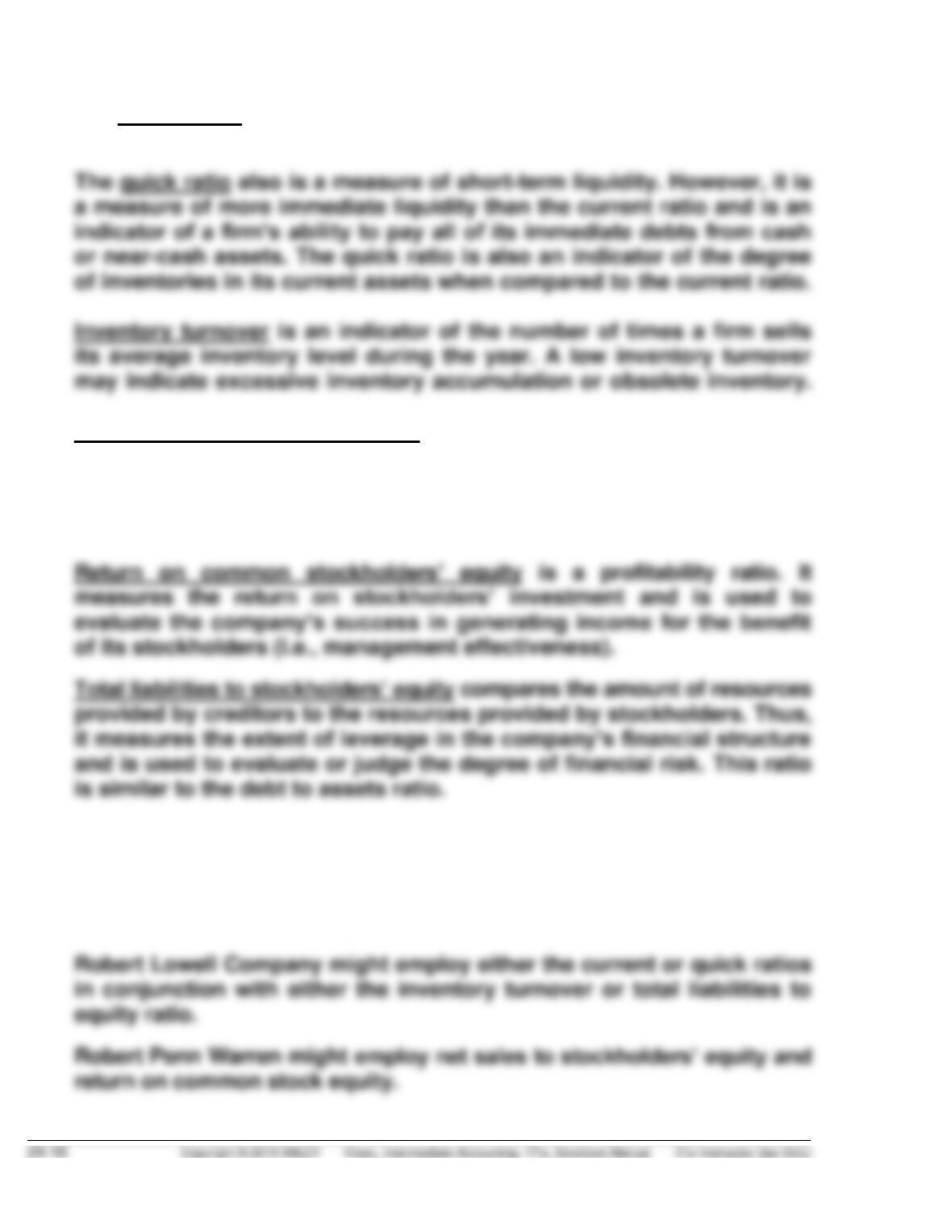
*EXERCISE 24.6 (30–40 minutes)
(a) The current ratio measures overall short-term liquidity and is an indicator
of the short-term debt-paying ability of the firm.
Net sales to stockholders’ equity is an activity ratio that measures the
number of times the stockholders’ equity was turned over in sales
volume. This ratio could also be referred to as a net asset turnover ratio
that measures net asset management. Thus, it is a measure of
operational efficiency. This ratio is similar to asset turnover.
(b) The two ratios that each of the four entities would specifically use to
examine Edna Millay Inc. are as follows:
Archibald MacLeish Bank might employ the current or quick ratio and
the total liabilities to equity ratio.
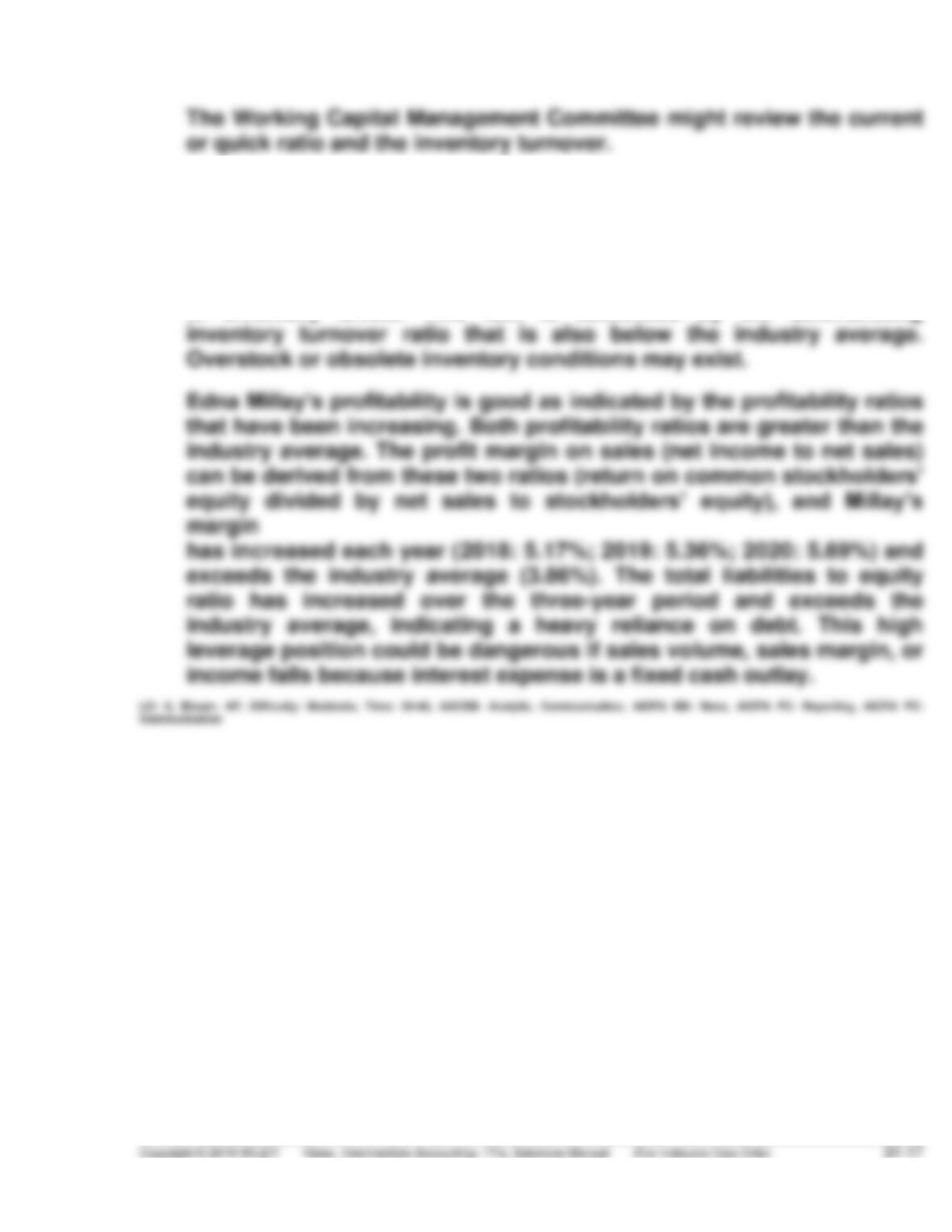
*EXERCISE 24.6 (Continued)
(c) Edna Millay Inc. appears to have a strong liquidity position as
evidenced by the current and quick ratios that have been improving
over the three-year period. In addition, the current ratio is greater than
the industry average and the quick ratio is just slightly below.
However, the increase in the current ratio could be due to an increase
in inventory levels. This fact is confirmed by the deteriorating

TIME AND PURPOSE OF PROBLEMS
Problem 24.1 (Time 40–50 minutes)
Problem 24.2 (Time 24–30 minutes)
Purpose—to provide the student with an understanding of the rules for segment reporting. The student
*Problem 24.3 (Time 35–45 minutes)
Purpose—to provide the student with an understanding of certain key ratios. In addition, the student is
*Problem 24.4 (Time 40–60 minutes)
Purpose—to provide the student with an understanding of the conceptual merits in the presentation of
*Problem 24.5 (Time 40–50 minutes)
Purpose—to provide the student with a situation in which ratio analysis is used in a decision concerning
payment of dividends.
SOLUTIONS TO PROBLEMS
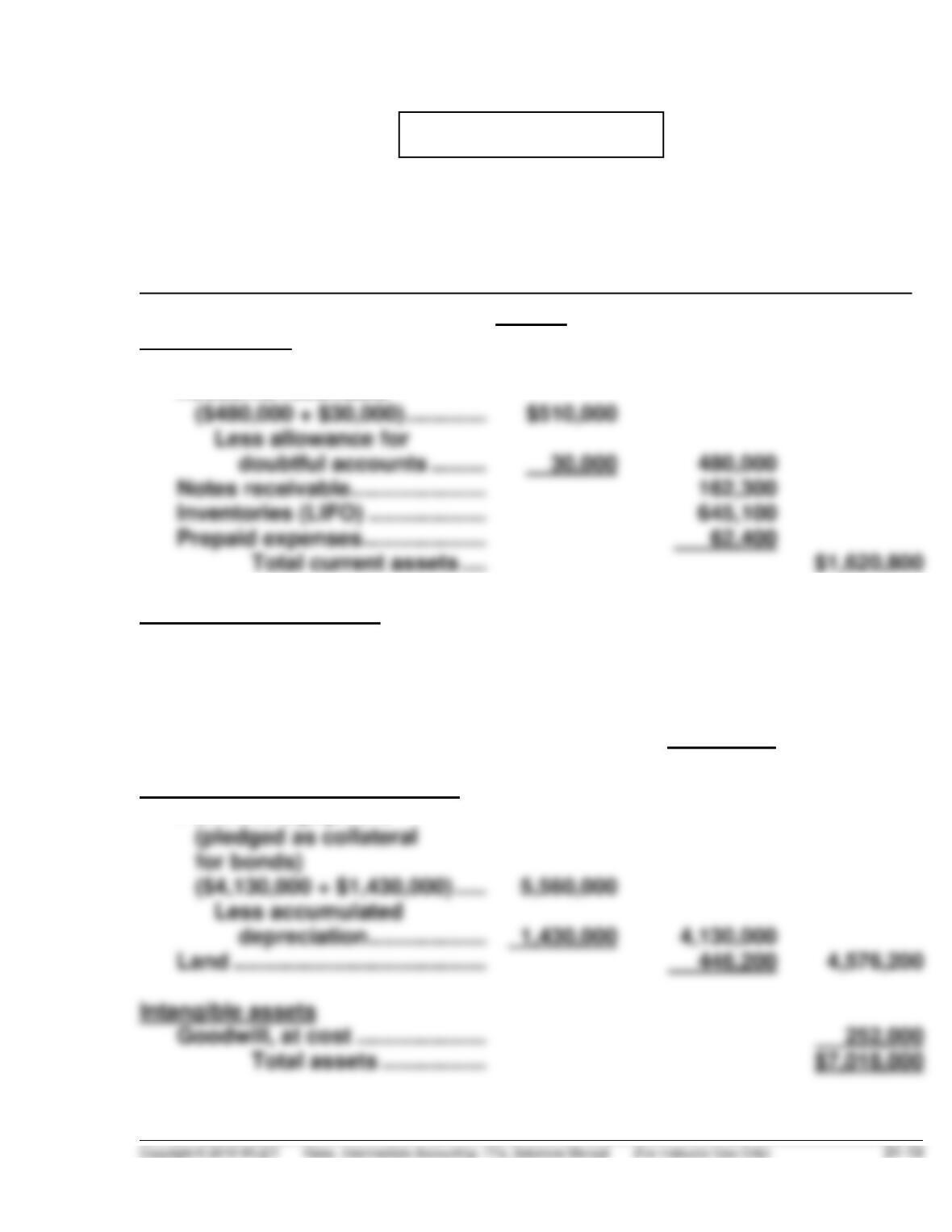
PROBLEM 24.1
ALMADEN CORPORATION
Balance Sheet
December 31, 2020
Assets
Current assets
Cash ($571,000 – $300,000) …. $ 271,000
Accounts receivable
Long-term investments
Investments in land …………….. 185,000
Cash surrender value of
life insurance policy …………. 84,000
Cash restricted for plant
expansion ……………………….. 300,000 569,000
Property, plant, and equipment
Plant and equipment
PROBLEM 24.1 (Continued)
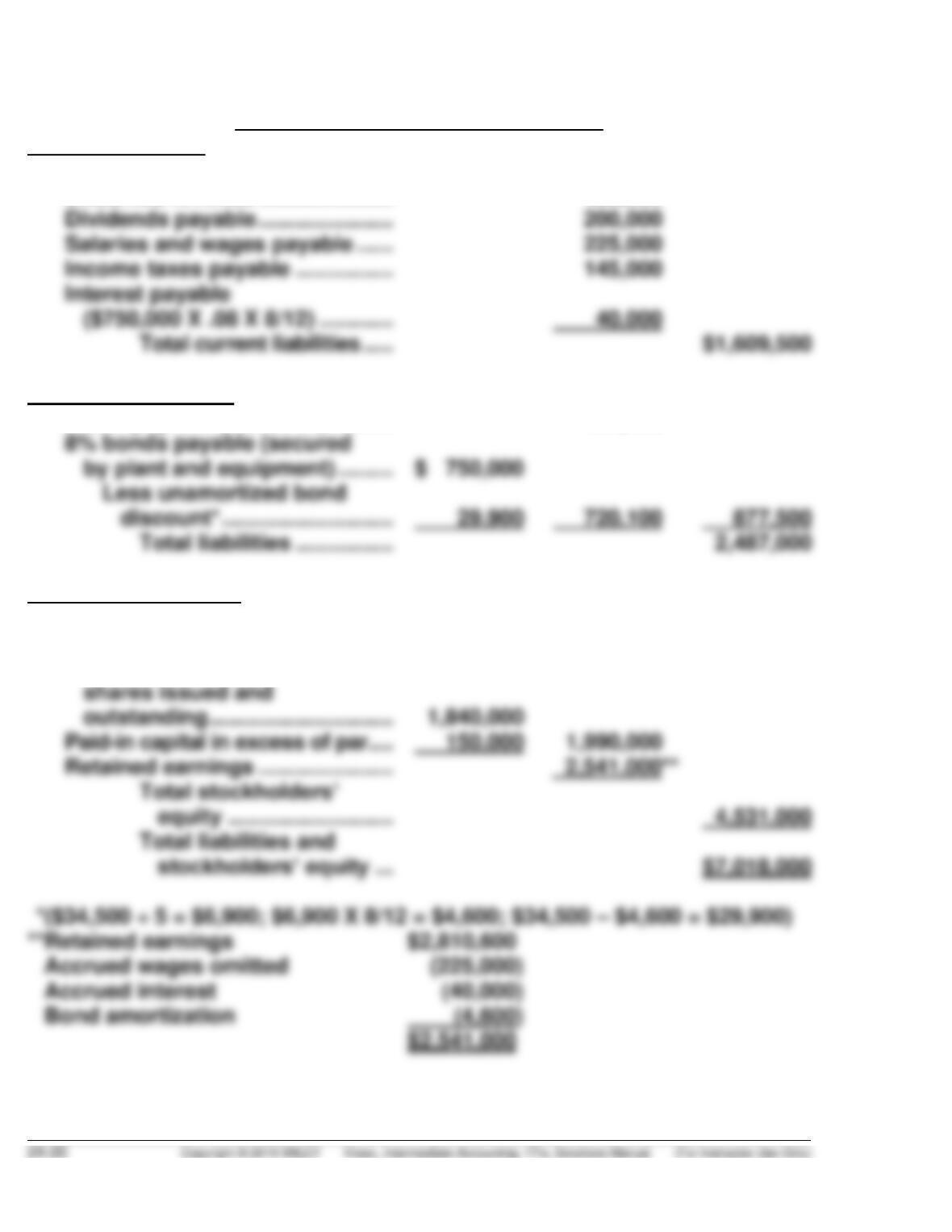
Liabilities and Stockholders’ Equity
Current liabilities
Accounts payable ………………….. $ 510,000
Unearned revenue …………………. 489,500
Long-term liabilities
Notes payable (due 2023) ………. 157,400
Stockholders’ equity
Common stock, par value
$10 per share; authorized
200,000 shares; 184,000