
Financial and Managerial Accounting, 9th Edition
24-1
CHAPTER 24
CAPITAL BUDGETING AND INVESTMENT ANALYSIS
Related Assignment Materials
Student Learning Objectives
Discussion
Questions
Quick
Studies*
Exercises*
Problems*
AA, DA and BTN
Analytical objectives:
Procedural objectives:
P1. Compute payback period and
describe its use.
1, 2, 3, 4, 5,
12
24-1, 24–2,
24-3, 24-4
24-1, 24-2,
24-3, 24-4,
24–6, 24-9,
24-16
24-1, 24-2,
24-3, 24-5
SP
BTN 24-2, BTN 24–3,
BTN 24-4
explain its use.
24-19, 24–20,
24-21, 24–22
*See additional information on next page that pertains to these quick studies, exercises and problems.
SP refers to the Serial Problem
AA refers to Accounting Analysis
Additional Information on Related Assignment Material
Connect
Available on the instructor’s course-specific website) repeats all numerical Quick Studies, all Exercises and Problems Set
A. Connect also provides algorithmic versions for Quick Study, Exercises and Problems. It allows instructors to monitor,
promote, and assess student learning. It can be used in practice, homework, or exam mode.

Financial and Managerial Accounting, 9th Edition
24-2
• End-of-Chapter Assignments
• General Ledger
Need-to-Know Videos
LO
Need–to-Know
Title
Time
P1
24-1
Payback Period
1:45
P2
24-2
Accounting Rate of Return
0:42
P3
24-3
Net Present Value
2:37
P4
24-4
Internal Rate of Return
1:39
Evaluating Investments
Concept Overview Videos
LO
Title
Time
A1
Analyze a capital investment project using break-even time.
Break-even Time
1:17
P1
Compute payback period and describe its use.
Capital Budgeting Process
1:53
Payback Period with Equal Cash Flows
0:54
Payback Period with Unequal Cash Flows
1:30
Evaluating Payback Period
0:59
P2
Compute accounting rate of return and explain its use.
Accounting Rate of Return
0:57
Evaluating Accounting Rate of Return
0:18
P3
Compute net present value and describe its use.
Net Present Value
1:34
Net Present Value Decision Rule
0:23
Unequal Cash Flows
0:44
Investments with Salvage Value
0:46
Comparing Projects
1:29
P4
Compute internal rate of return and explain its use.
Internal Rate of Return
1:18
Synopsis of Chapter Revision
NEW opener – Gecko Robotics and entrepreneurial assignment.
Removed income taxes and pretax income for clarity.
Simplified Payback Period with numbers not requiring rounding.
Simplified Payback Period with Unequal cash flows from 8 to 5 years.

Financial and Managerial Accounting, 9th Edition
24-3
Postponed coverage of accelerated depreciation, inflation, and capital rationing in NPV to advanced courses.
Revised IRR to simplify calculations, limit rounding, and work with App B present value tables.
Financial and Managerial Accounting, 9th Edition
24-4
Chapter Outline
I. Capital budgeting – process of analyzing alternative long-term investments and deciding which assets to
acquire or sell
A. An objective of capital budgeting decisions is to earn a satisfactory return on investment.
B. The process begins when a manager submits a proposal for a new investment in a plant asset. A capital
D. Capital Investment Cash Flows: Managers use several methods to evaluate capital budgeting decisions.
Most methods use expected future cash outflows and inflows.
1. Investment begins with initial cash outflow to buy the asset.
II. Payback Period with Equal Cash Flows⎯method to evaluate investment decisions by measuring the
expected amount of time to recover the initial investment amount.
A. Managers prefer assets with shorter payback periods to reduce risk of an unprofitable investment.
1. To compute payback period, exclude all non-cash revenue and expenses from computation.
Depreciation is a non-cash expense, so it is not included.
B. Payback Period with Unequal Cash Flows
1. When annual cash flows are unequal, payback period is computed using the cumulative net cash
flows (starting with the negative cash flow resulting from the initial investment).
III. Accounting Rate of Return
1. Investment’s annual income divided by the average amount investment in it.
2. Computed as:
3. Compute the average investment:
Financial and Managerial Accounting, 9th Edition
24-5
4. Evaluating Accounting Rate of Return – strength is it is easy to compute. Two weaknesses:
IV. Net Present Value.
A. Net Present Value applies the time value of money to future cash inflows and cash outflows of a project
to assess its desirability.
1. Time value of money can be solved using tables in Appendix B, Excel or a financial calculator.
2. NPV is the discounted future net cash flows from the investment at the required rate of return minus
the initial investment.
a. The required rate of return, also called the hurdle rate, is the average rate the company must pay
3. Net Present Value Decision Rule
a. Net Present Value = PV of cash flows – Amount Invested
4. Annuity Assumption: when annual net cash flows are equal in amount, NPV calculation can
be simplified.
b. Use the present value of an annuity of $1 table may be used
5. Applying Annuity Assumption to Strategic Plans – NPV analysis can be used to help assess the
value of strategic plans such as whether to automate a production process to possibly reduce labor
costs..
6. NPV: With Unequal Cash Flows — NPV analysis can also be used when net cash flows are unequal.
(Use procedures and decision-rules above.)
V. Internal Rate of Return
1. IRR is the discount rate that yields a NPV of zero.
Financial and Managerial Accounting, 9th Edition
24-6
2. Two-step process (equal cash flows)
a. Step 1: Compute the present value factor for the investment by dividing the initial investment
by annual net cash flows.
b. Step 2: Identify rate (IRR) yielding the PV factor.
3. IRR: Unequal Cash Flows — it is best to use a calculator or spreadsheet software to compute IRR.
4. IRR Decision Rule. Compare IRR to a predetermined hurdle rate (minimum acceptable rate of
VI. Comparing Capital Budgeting Methods (Exhibit 24.12)
1. Payback period is simplest method.
2. Accounting rate of return is simple but not commonly used in practice.
3. Net Present Value (NPV):
4. Internal Rate of Return (IRR):
a. Considers all cash flows from a project.
VII. Break-Even Time –measure of the expected time until the present value of net cash flows from an
investment equals the initial investment.
A. Overcomes the payback period’s limitation of ignoring the time value of money.
VIII. Using Excel to Compute Internal Rate of Return (Appendix) IRR calculations for unequal annual cash
flows can be made easier by using Excel. Examples shown in Chapter 26 Appendix.
Financial and Managerial Accounting, 9th Edition
24-7
Chapter 24 Alternate Demo Problem
A company is planning to buy a new machine at a cost of $200,000. The machine is
expected to last 10 years and have $0 salvage value at the end of its useful life. Straight-
Required:
1. Calculate the payback period on the investment in new machinery.
Financial and Managerial Accounting, 9th Edition
24-8
Chapter 24 Alternative Demo Problem: Solution
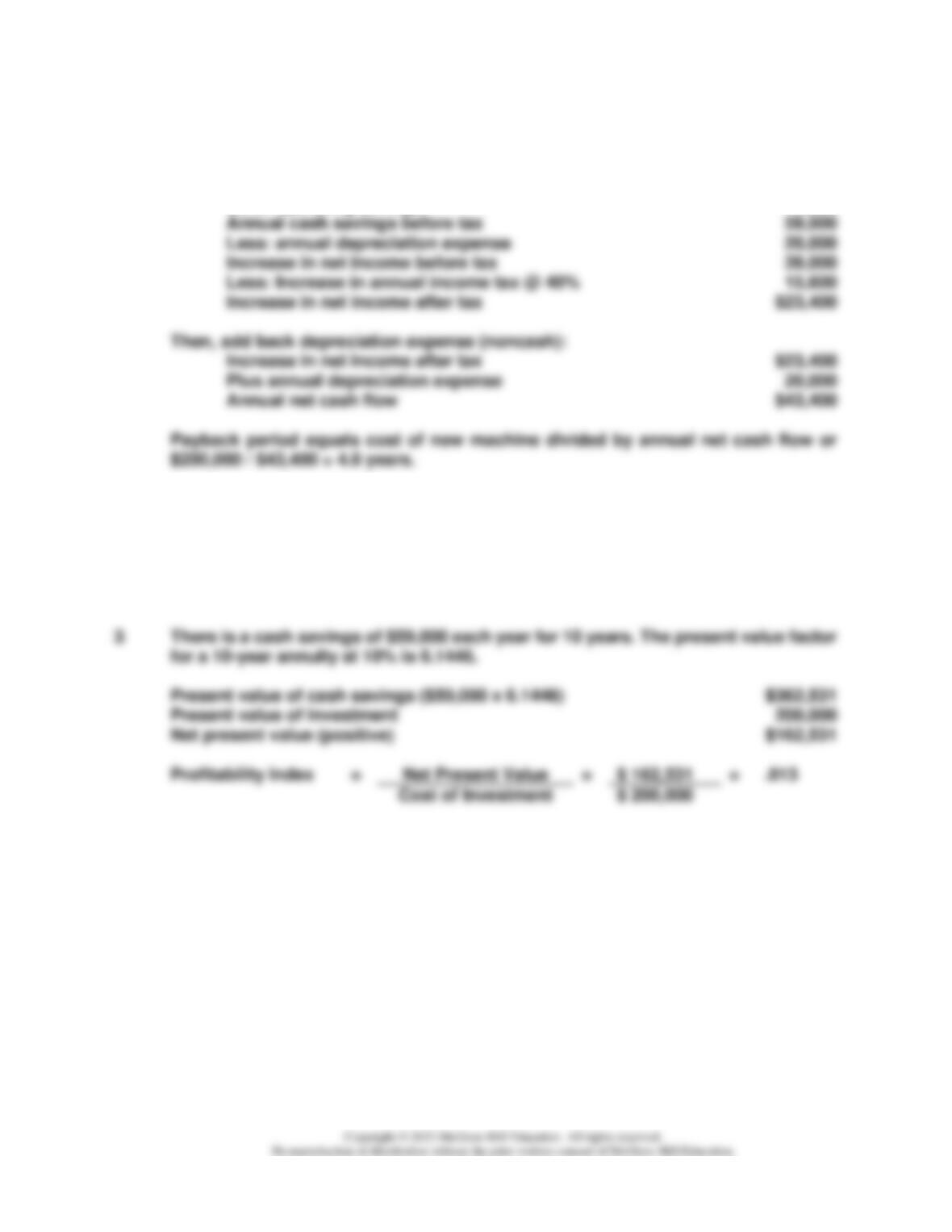
First, calculate annual net cash flow:
Determine increase in after-tax net income:
Labor savings: 10,000 hours @ $5.50 per hour
$55,000
Other operating savings
4,000
Annual cash savings before tax
Less: annual depreciation expense
Increase in net income before tax
Less: Increase in annual income tax @ 40%
Increase in net income after tax
Then, add back depreciation expense (noncash):
Increase in net income after tax
$23,400
Plus annual depreciation expense
Annual net cash flow
Payback period equals cost of new machine divided by annual net cash flow or
$200,000 / $43,400 = 4.6 years.
2.
The rate of return on average investment equals the increase in net income after
tax divided by the amount of the average investment.
The average investment would be $200,000 / 2, or $100,000.
Rate of return on average investment = $23,400 / $100,000 = 23.4%
for a 10-year annuity at 10% is 6.1446.
Present value of cash savings ($59,000 x 6.1446)
Present value of investment
200,000
Net present value (positive)
Profitability Index
=
=
$ 162,531
=
.813
$ 200,000