PROBLEM 24.1 (Continued)
Additional comments:
1. The information related to the competitor should be disclosed because
this innovation may have a significant effect on the company. The value
of the inventory is overstated because of the need to reduce selling
prices. This factor along with the net realizable value of the inventory
should be disclosed.
5. The fact that the gain on sale of certain plant assets was credited directly
to retained earnings has no effect on the balance sheet presentation.
6. Technically, the plant and equipment account should be separately dis-
closed and depreciation computed on each item individually. However,
the information to divide the accounts was not given in this problem.
7. Interest payable on the bonds ($750,000 X .08 X 8/12 = $40,000) was
8. Since the loss from heavy damage was caused by a fire after the balance
sheet date, this event does not reflect conditions existing at that date.
PROBLEM 24.2
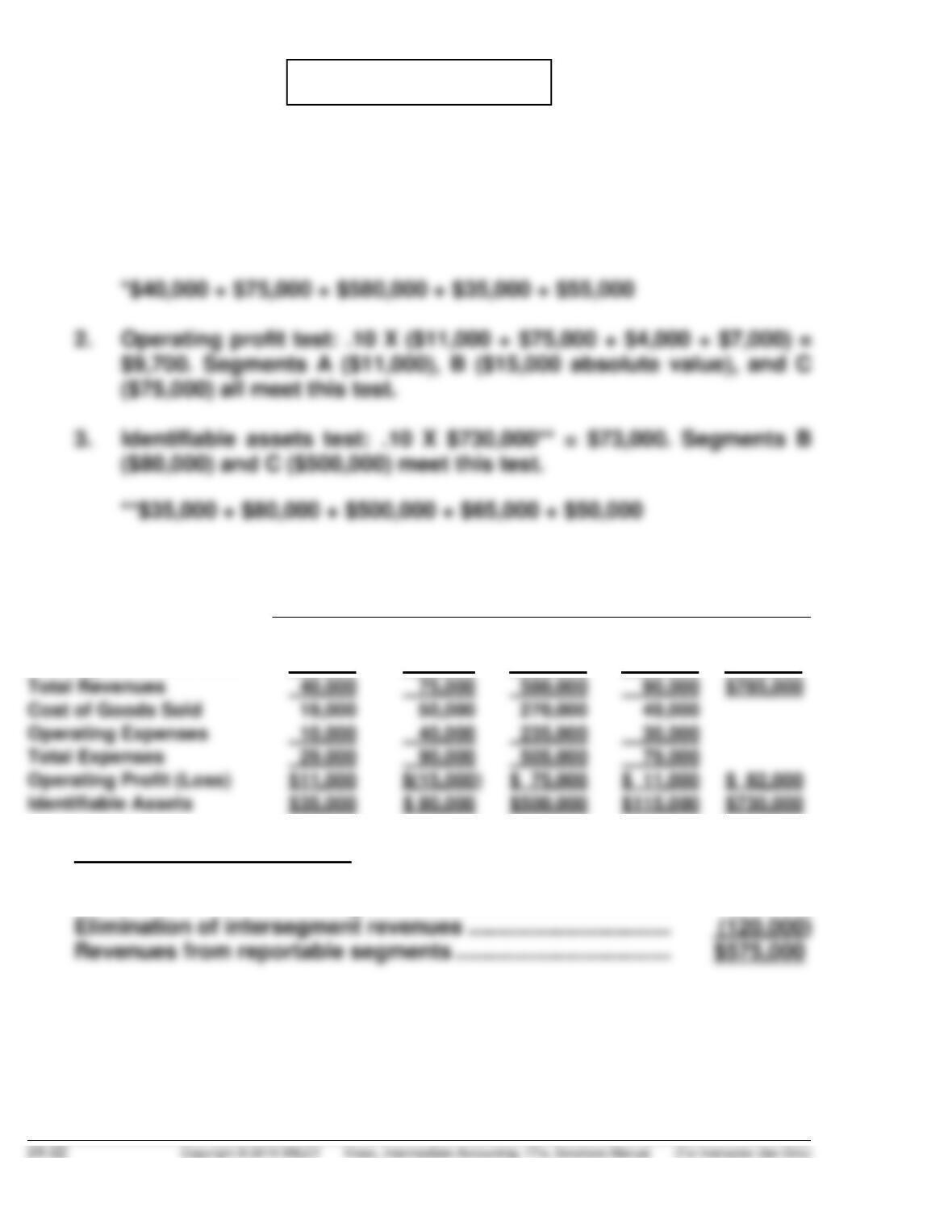
(a) Determination of reportable segments:
1. Revenue test: .10 X $785,000* = $78,500. Only Segment C ($580,000)
meets this test.
(b) Disclosures required by GAAP:
A
B
C
Other
Totals
External Revenues
$40,000
$ 55,000
$480,000
$ 90,000
$665,000
Intersegment Revenues
20,000
100,000
120,000
Total Revenues
75,000
580,000
90,000
$785,000
Cost of Goods Sold
Operating Expenses
40,000
235,000
30,000
Total Expenses
90,000
505,000
79,000
Operating Profit (Loss)
$11,000
$ 75,000
$ 11,000
$ 82,000
Identifiable Assets
$35,000
$ 80,000
$500,000
$115,000
$730,000
Reconciliation of revenues
Total segment revenues ……………………………………………….. $785,000
Revenues of immaterial segments ………………………………… (90,000)
PROBLEM 24.2 (Continued)
Reconciliation of profit or loss
Total segment operating profit ……………………………………… $ 82,000
Profits of immaterial segments ……………………………………… (11,000)
*PROBLEM 24.3
(a) BRADBURN CORPORATION
Ratio Analysis
1.
Current ratio =
Current assets
Current liabilities
2020:
$320,000
= 2.02 to 1
2021:
$403,000
= 2.46 to 1
$158,500
$164,000
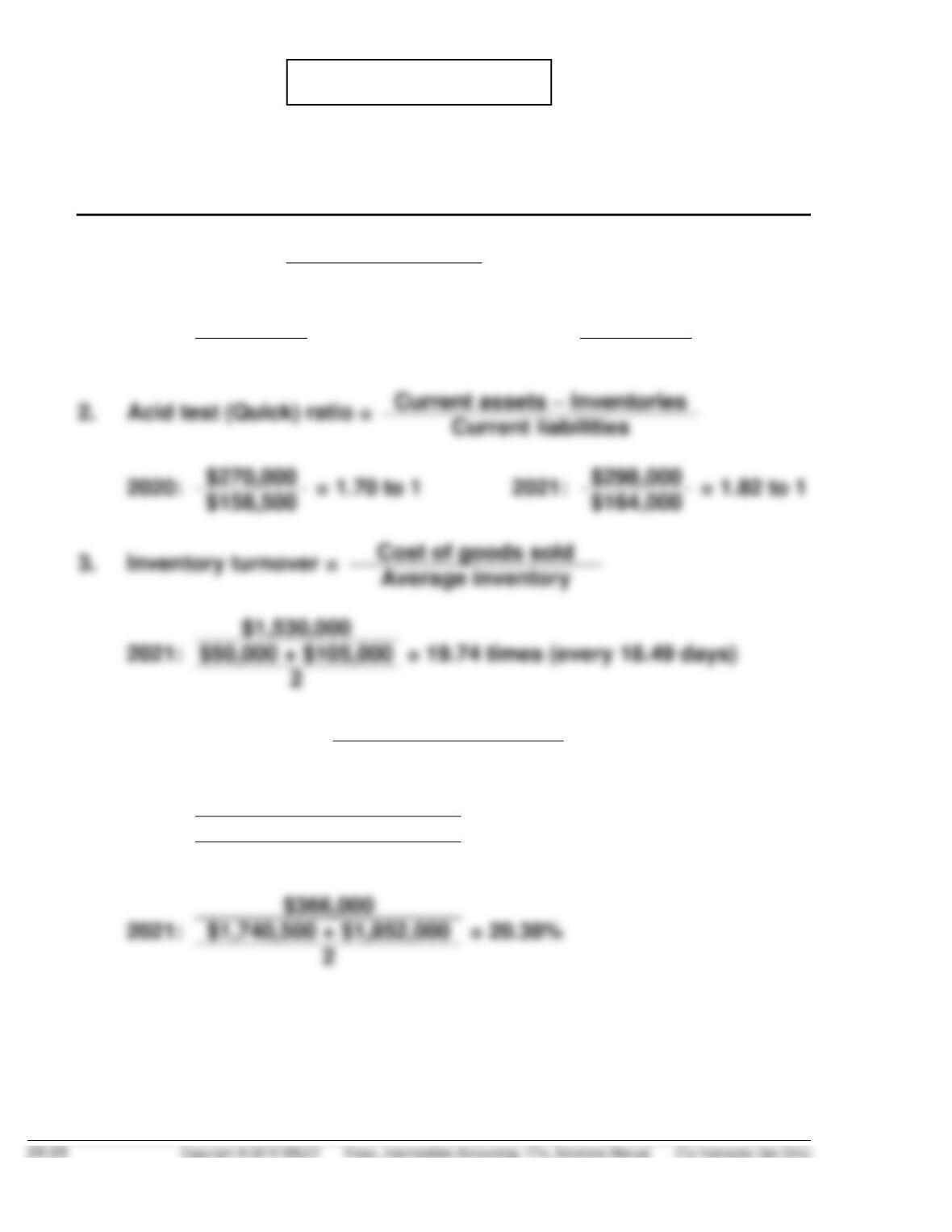
2.
Acid test (Quick) ratio =
2020:
$270,000
= 1.70 to 1
2021:
$298,000
= 1.82 to 1
$158,500
$164,000
3.
Inventory turnover =
= 19.74 times (every 18.49 days)
4.
Return on assets =
Net income
Average total assets
$297,000
2020:
$1,688,500 + $1,740,500
= 17.32%
2
$366,000
= 20.38%
2
*PROBLEM 24.3 (Continued)
5.
Percent Changes
Amounts
Percent Increase
(000s omitted)
2021
2020
Sales revenue
$3,000
$2,700
$300
= 11.11%
$2,700
Cost of goods sold
$105
$195
$297
(b) Other financial reports and financial analyses that might be helpful to
the commercial loan officer of Topeka National Bank include:
1. The Statement of Cash Flows would highlight the amount of cash
provided by operating activities, the other sources of cash, and the
(c) Bradburn Corporation should be able to finance the plant expansion
from internally generated funds as shown in the calculations presented
on the next page.
*PROBLEM 24.3 (Continued)
(000 omitted)
2021
2022
2023
Sales revenue
$3,000.0
$3,333.3
$3,703.6
Cost of goods sold
1,530.0
1,642.8
1,763.8
Gross margin
1,470.0
1,690.5
1,939.8
Operating expenses
860.0
1,045.5
Income before income taxes
Income taxes (40%)
244.0
296.9
357.7
Net income
$ 366.0
Add: Depreciation
Deduct: Dividends
Note repayment
(6.0)
Funds available for plant expansion
Plant expansion
Excess funds
Assumptions:
Sales revenue increases at a rate
of 11.11%.
Depreciation remains constant at
$102,500.
(d) Topeka National Bank should probably grant the extension of the loan,
if it is really required, because the projected cash flows for 2022 and
2023 indicate that an adequate amount of cash will be generated from
operations to finance the plant expansion and repay the loan. In actu–
*PROBLEM 24.4
(a) GILMOUR COMPANY
Comparative Balance Sheet
December 31, 2021 and 2020
December 31
Assets
2021
2020
Cash
$ 180,000
5.39%
$ 275,000
9.87%
Accounts receivable (net)
220,000
6.59
155,000
5.57
Short-term Investments
270,000
8.08
150,000
5.39
Inventories
31.74
980,000
35.18
Prepaid expenses
.75
.90
Plant and equipment
77.39
70.02
Accumulated depreciation
(1,000,000)
(29.94)
(26.93)
Total
100.00%
Liabilities and
Stockholders’ Equity
Accounts payable
$ 50,000
1.50%
$ 75,000
2.69%
Accrued expenses
170,000
5.09
7.18
Bonds payable
450,000
13.47
6.82
Common stock
62.87
63.56
Retained earnings
Total
100.00%
*PROBLEM 24.4 (Continued)
(b) GILMOUR COMPANY
Comparative Balance Sheet
December 31, 2021 and 2020
December 31
Increase or (Decrease)
Assets
2021
2020
$ Change
% Change
Cash
$ 180,000
$ 275,000
$ (95,000)
(34.55)
Accounts receivable (net)
220,000
155,000
65,000
41.94
Short-term investments
270,000
150,000
80.00
Inventories
980,000
80,000
8.16
Prepaid expenses
0
Plant and equipment
32.56
Accumulated depreciation
33.33
Total
$ 3,340,000
19.93%
Liabilities and
Stockholders’ Equity
Accounts payable
$ 50,000
$ 75,000
$ (25,000)
(33.33)
Accrued expenses
200,000
(15.00)
Bonds payable
190,000
136.84
Capital stock
18.64
Retained earnings
3.64
Total
(c) The component percentage (common-size) balance sheet makes easier
analysis possible. It actually reduces total assets and total liabilities
and stockholders’ equity to a common base. Thus, the statement is
simplified into figures that can be more readily grasped. It can also
(d) A statement such as that in part (b) is a good analysis and breakdown
of the total change in assets and liabilities and stockholders’ equity.
The statement breaks down the 19.93% increase and makes it easier
*PROBLEM 24.5
(a) In establishing a dividend policy, the following are factors that should
be taken into consideration:
1. The expansion plans or goals of the organization and the need for
monies to finance new activities.
4. The earnings ability and stability of the company—past and future.
5. The ability of the organization to maintain a given dividend in future
years. To offer a dividend this year that cannot be maintained
may be harmful. It could also be harmful to establish a policy
seeming to call for increasing dividends over the years in the event
the increase could not be kept up.
10. The tax situation of the company.
11. Legal restrictions, such as a restrictive covenant in a bond indenture.
*PROBLEM 24.5 (Continued)
(b)
2021
2020
2019
2018
2017
Return on assets
$2,400
$1,400
$800
$700
$250
$22,000
$19,000
$11,500
$4,200
$3,000
10.9%
7.4%
7.0%
16.7%
8.3%
Profit margin on sales
$2,400
$1,400
$800
$700
$250
$6,000
$4,000
12.0%
8.8%
5.7%
11.7%
6.3%
Earnings per share
$2,400
$1,400
$800
$700
$250
20
$35.00
Price-earnings ratio
$9
$6
$4
$1.20
$.70
$.40
7.5 times
8.6 times
10 times
Current ratio
$8,000
$6,000
$3,000
$1,200
$1,000
$2,800
$1,800
$700
$600
(c) While the return on assets, profit margin on sales, and earnings per
share have been increasing, the market price of the shares has not
given full recognition to these increases. This suggests that market

*PROBLEM 24.5 (Continued)
A dividend in the range of 12¢ to 36¢ being 10% to 30% of earnings per
share for 2021, would appear to be reasonable. Cash required would be
TIME AND PURPOSE OF CONCEPTS FOR ANALYSIS
CA 24.1 (Time 10–20 minutes)
Purpose—to provide the student with an understanding of the necessary information that must be
CA 24.2 (Time 20–25 minutes)
Purpose—to provide the student with an understanding of the necessary information that should be
CA 24.3 (Time 24–30 minutes)
Purpose—to provide the student with an understanding of the types of disclosures that are necessitated
CA 24.4 (Time 20–25 minutes)
Purpose—to provide the student with an understanding of the proper accounting for subsequent event
CA 24.5 (Time 30–35 minutes)
Purpose—to provide the student with an understanding of segment reporting requirements, including
CA 24.6 (Time 20–25 minutes)
Purpose—to provide the student with an understanding of segment reporting. The case explores why a
CA 24.7 (Time 24–30 minutes)
Purpose—to provide the student with an understanding of the concepts underlying the applications of
CA 24.8 (Time 20–25 minutes)
Purpose—to provide the student with an understanding of the applications and requirements of interim
Time and Purpose of Concepts for Analysis (Continued)
CA 24.9 (Time 30–35 minutes)
Purpose—to provide the student with an understanding of the concepts of interim reporting and its
CA 24.10 (Time 24–30 minutes)
Purpose—to provide the student with an understanding of the conceptual merits underlying the prepara-
CA 24.11 (Time 15–20 minutes)
Purpose—to provide the student with an understanding of an ethical dilemma that may arise in the
CA 24.12 (Time 10–15 minutes)
Purpose—to provide the student with an understanding of an ethical dilemma that may arise in the
*CA 24.13 (Time 24–35 minutes)
Purpose—to provide the student with an understanding of the effects which various transactions have
SOLUTIONS TO CONCEPTS FOR ANALYSIS
CA 24.1
Koch Corporation must disclose the following information regarding inventories:
1. The dollar amount assigned to inventory.
The following information must be disclosed for property, plant, and equipment:
1. The balance of major classes of depreciable assets (assets classified by nature or function).
CA 24.2
Item 1
The staff auditor reviewing the loan agreement misinterpreted its requirements. Retained earnings are
restricted in the amount of $420,000, which was the balance of retained earnings at the date of the
Item 2
Unless cumulative preferred dividends are involved, no recommendation by the CPA is required. Common
stock dividend policy is understood by readers of financial statements to be discretionary on the part of
the board of directors. The company need not commit itself to a prospective common stock dividend policy
Item 3
A competitive development of this nature normally is considered to be the type of subsequent event that
provides evidence with respect to a condition that did not exist at the date of the balance sheet. In some
circumstances, the auditor might conclude that Ace’s poor competitive situation was evident at year–
CA 24.2 (Continued)
Item 4
The lease agreement with Wichita National Bank meets the criteria for a finance lease because it con-
tains a bargain purchase option (a 25-year-life building can be purchased at the end of 10 years for $1).
Additionally, unless the fair value of the building is considerably greater than its $2,400,000 cost, the
CA 24.3
Situation 1
When a company sells a product subject to a warranty, it is probable that there will be expenses
incurred in future accounting periods relating to revenues recognized in the current period. As such, a
liability has been incurred to honor the warranty at the same date as the recognition of the revenue.
Situation 2
Even though: (1) there is a probable loss on the contract, (2) the amount of the loss can be reasonably
estimated and (3) the likelihood of the loss was discovered prior to the issuance of the financial state–
of the probable loss or a range into which the loss will probably fall.
Situation 3
The fact that a company chooses to self-insure the contingency of injury to others caused by its vehicles
is not enough of a basis to accrue a loss contingency that has not occurred at the date of the financial
CA 24.4
1. The financial statements should be adjusted for the expected loss pertaining to the remaining
2. Report the fire loss in a footnote to the balance sheet and refer to it in connection with the income
statement, since earnings power is presumably affected.
4. If this event is of the second type, which provides evidence with respect to conditions that did not
exist at December 31, 2020, then appropriate disclosures should indicate that:
(a) Recovery of costs invested in plant and inventory is in doubt.
5. Adjust the inventory figure as of December 31, 2020, as required by a market price of $2.00
instead of $1.40, applying the lower–of-cost-or–market principle. The actual quotation was a transitory
error and no purchases had been made at this quotation.
CA 24.5
To: Anthony Reese, Accountant
From: Student
Date: Current date
Subject: Determination of reportable segments for Winsor Corporation International.
I have analyzed the segment information that you gave me and determined that the funeral, the
CA 24.5 (Continued)
Second, a segment is considered significant enough to be reported separately if its absolute operating
profit or operating loss is 10% or more of the greater, in absolute amount of: (a) the combined operating
profit of all segments without an operating loss or (b) the combined operating loss of all segments that
incurred a loss. Combined operating profit for all profitable segments totals $96,000. Both the funeral and
the cemetery segments have operating profits exceeding 10% of total profits whereas the real estate
segment’s operating loss in absolute amount is greater than 10 percent of total profits. Thus, all three
must be separately reported.
CA 24.6
(a) Some companies such as H. J. Heinz have only one dominant product or service and therefore it
is impossible to provide segmented data in a meaningful fashion. Dominant means that a given
segment has 90% of all the sales, profit and identifiable assets of the company. In this case,
CA 24.7
(a) Financial reporting for segments of a business enterprise involves reporting financial information
on a less-than-total enterprise basis. These segments may be defined along organizational lines,
(b) The reasons for requiring financial data to be reported by segments include the following:
1. They would provide more detailed disclosure of information needed by investors, creditors,
and other users of financial statements.
CA 24.7 (Continued)
2. Appraisers can evaluate major segments of a business enterprise before considering the
business in its entirety.
(c) The possible disadvantages of requiring financial data to be reported by segments include the
following:
1. They could be misinterpreted due to the public’s general lack of appreciation of the limitations
of the somewhat arbitrary bases for most allocations of common costs.
2. They may disguise the interdependence of all the segments.
(d) The accounting difficulties inherent in segment reporting include the following:
1. The transfer prices must be determined. Transfer prices are those charged when one segment
deals with another segment of the same enterprise. Various possible transfer prices exist,
and the company must select one.
2. The computation of segment net income must be defined. The net income may be merely a
contribution margin, that is, sales less variable costs, or a more conventional measure of net
3. The treatment of segment information in interim financial reports must be established.
4. The method of presenting segment information in financial statements must be established.
CA 24.7 (Continued)
CA 24.8
(a) 1. The company should report its quarterly results as if each interim period is an integral part
of the annual period, although the discrete approach is used for some items.
2. The company’s revenue and expenses would be reported as follows on its quarterly report
prepared for the first quarter of the 2020–2021 fiscal year:
Sales revenue ………………………………………………………………………………. $60,000,000
(b) The financial information to be disclosed to its stockholders in its quarterly reports as a minimum
include:
1. Sales revenue or gross revenues, provision for income taxes, extraordinary items and net
CA 24.9
(a) Acceptable. The use of gross profit rates to estimate the cost of goods sold is acceptable for
interim reporting purposes as long as the method and rates utilized are reasonable. The
CA 24.9 (Continued)
(d) Not acceptable. Gains on the sale of investments would not be deferred if they occurred at year–
end. Consequently, they should not be deferred to future interim periods but should be reported
in the quarter the gain was realized.
(e) Acceptable. The annual audit fee is an expense that benefits the company’s entire year. Com–
CA 24.10
(a) Arguments for requiring published forecasts:
1. Investment decisions are based on future expectations; therefore, information about the
future would facilitate better decisions.
(c) An enterprise’s concerns about preparing a forecast are as follows:
1. No one can foretell the future. Therefore, forecasts, while conveying an impression of precision
about the future, will inevitably be wrong.