Wild and Shaw, Financial & Managerial Accounting 9e Solutions Manual: Chapter 24
1443
Chapter 24
Capital Budgeting and
Investment Analysis
QUICK STUDIES
Quick Study 24-1 (5 minutes)
Payback period = $27,000 / $9,000 = 3.0 years
Quick Study 24-3 (10 minutes)
a. Investment A. Investment A’s payback period of 3.5 years would be
preferred over Investment B’s longer payback period of 4.0 years.
b. No. An investment with a shorter payback period will not always be
1444
Quick Study 24-4 (5 minutes)
4.5 years.
Explanation. The cumulative net cash flow changes from negative to
Quick Study 24-5 (5 minutes)
Project A.
Explanation. The company will choose Project A because of its higher
Quick Study 24-6 (5 minutes)
Accounting rate of return = $20,000 / [($280,000 + $30,000)/2] = 12.9%
Quick Study 24-8 (10 minutes)
a. A and B are accepted. The company is said to invest in all positive net
present value projects, so both A and B will be chosen.
Wild and Shaw, Financial & Managerial Accounting 9e Solutions Manual: Chapter 24
1445
Quick Study 24-9 (10 minutes)
a.
Potential Projects
Project A
Project B
Project C
Present value of net cash flows ……
$10,832
$11,876
$ 9,870
Quick Study 24-10 (10 minutes)
a.
Net Cash
Flows
Present Value of
Annuity at 9%
Present Value of Net
Cash Flows
Years 1-6 ………………
$16,000
4.4859
$71,774
Quick Study 24-11 (15 minutes)
a.
Year
Net Cash
Flows
Present Value
of 1 at 12%*
Present Value of
Net Cash Flows
1 ……………………………..
$ 8,000
0.8929
$ 7,143
2 ……………………………..
0.7972
3 ……………………………..
0.7118
Totals ……………………..
(25,000)
b. Rejected. The project should be rejected because its net present value is
negative.
Quick Study 24-12 (10 minutes)
a.
A
B
Present value of net cash flows ……………………………….
$19,902
$20,800
Present value of net cash flow from salvage value ……
Total ……………………………………………………………………….
b. A. Machine A will be chosen as it has the higher net present value.
Quick Study 24-13 (10 minutes)
a. B and C are accepted. A profitability index greater than one indicates a
positive net present value. The company should invest in all positive net
Quick Study 24–14 (10 minutes)
a.
Net Cash
Flows
Present Value of an
Annuity at 10%*
Present Value of
Net Cash Flows
Years 1-4 ……………………
$9,000
3.1699
$28,529
b. Yes, make investment. Because NPV of $1,529 is greater than zero,
Pena should make the investment.
Quick Study 24-15 (10 minutes)
Net Cash
Flows
Present Value of
an Annuity at 8%
Present Value of
Net Cash Flows
Years 1-3 ……………………
$21,000
2.5771*
$54,119
1447
Quick Study 24–16 (15 minutes)
Flows
at 10%*
Net Cash Flows
Years 1-7 ………………..
$10,000
4.8684
Year 7 salvage ………..
0.5132
Totals …………………….
Net Cash
Present Value
Present Value of
4.8684 = Present value of an annuity of 1, where n = 7, i = 10% (from Table B.3)
Quick Study 24-17 (15 minutes)
Net Cash
Flows
Present Value
at 15%*
Present Value of
Net Cash Flows
Years 1-3 ………………….
$14,950
2.2832
$ 34,134
Year 3 salvage ………….
6,000
0.6575
Totals ………………………
0.6575 = Present value of 1, where n = 3, i = 15% (from Table B.1)
Quick Study 24-18 (10 minutes)
a.
Project 1
Project 2
Present value of net cash flows ……..
$1,100,000
$6,000,000
b. Project 1.
Explanation: Higher values of the profitability index suggest a project
with a higher return; so, the company should select Project 1.
1448
Quick Study 24-19 (15 minutes)
Net Cash
Flows
Present Value
of 1 at 12%*
Present Value of
Net Cash Flows
Year 1 …………………………..
$100,000
0.8929
$ 89,290
Year 2 …………………………..
0.7972
Year 3 …………………………..
0.7118
Quick Study 24–20 (15 minutes)
Net Cash
Flows
Present Value
of 1 at 12%*
Present Value of
Net Cash Flows
Year 1 …………………………..
$100,000
0.8929
$ 89,290
Year 2 …………………………..
0.7972
Year 3 …………………………..
0.7118
0.7118
Quick Study 24-21 (10 minutes)
a. X and Z are accepted. The company should invest in all projects with
internal rates of return above the hurdle rate of 12%, so both X and Z will
be chosen.
Wild and Shaw, Financial & Managerial Accounting 9e Solutions Manual: Chapter 24
Quick Study 24-22 (10 minutes)
Searching the “Periods = 3” row in Table B.3 for a present value factor
of 2.2832 shows that the internal rate of return is 15%.
Quick Study 24-23 (10 minutes)
b. Yes. Because 12% is greater than the hurdle rate of 10%, the company
should make the investment.
Quick Study 24–24 (10 minutes)
Year
Present Value of Net Cash
Flows per Year
Cumulative Present Value
of Net Cash Flows
$(100,000)
$(100,000)
1
36,364
(63,636)
2
33,056
(30,580)
3
25,116
4
27,320
5
24,836
3.2 years.
Explanation: The break-even time occurs during Year 4 at 0.2 of the way
1450
EXERCISES
Exercise 24-1 (20 minutes)
a.
Project 1 Project 2
Annual Amounts
Income
Cash
Flow
Income
Cash
Flow
Sales of new product ………………….
$100,000
$100,000
$80,000
$80,000
Expenses
b.
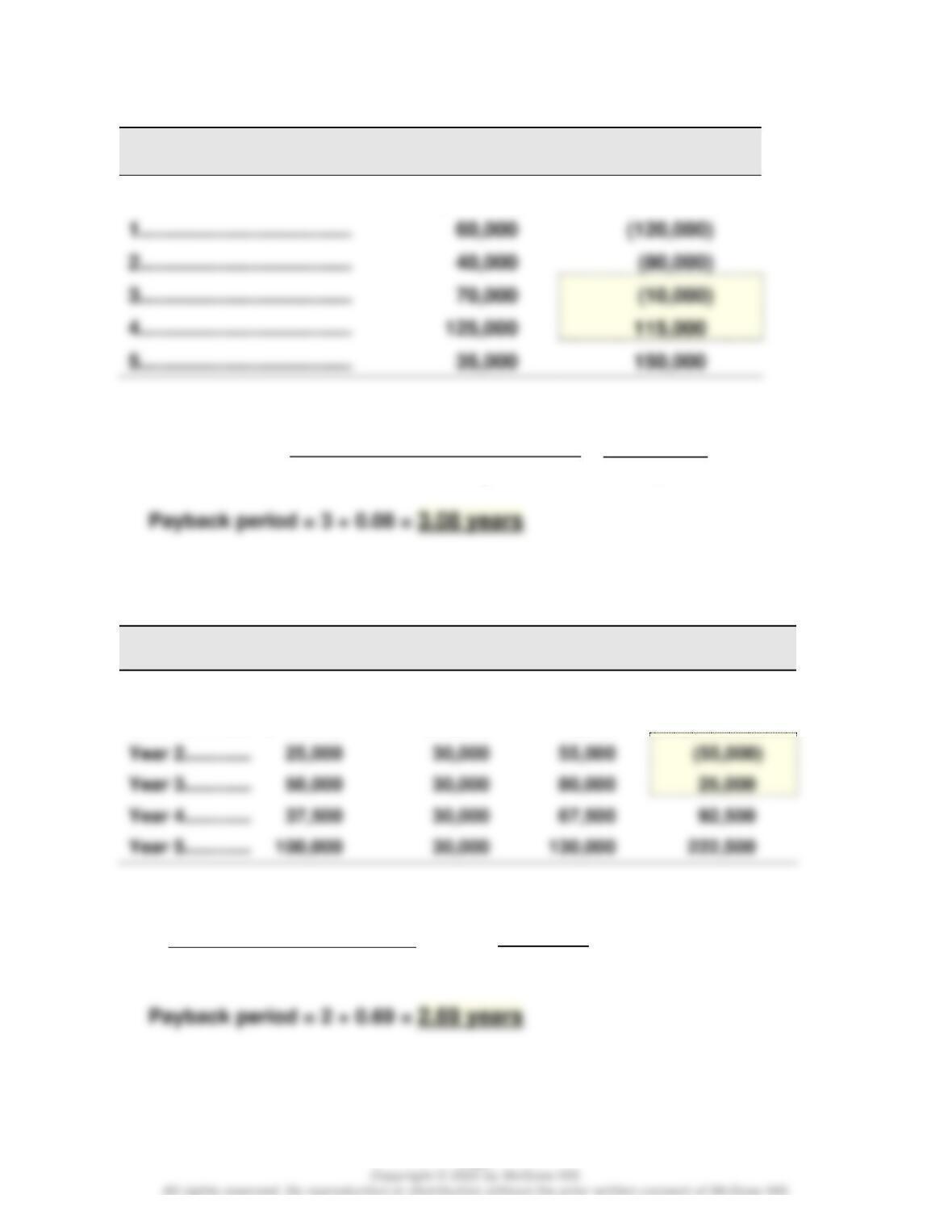
Payback period, Project 1 = $140,000 = 5.0 years
$28,000
Exercise 24-2 (15 minutes)
a.
Annual Amounts
Income
Cash Flow
Sales of new product (10,000 x $10) ……………………….
$100,000
$100,000
Expenses
Materials, labor, and overhead (except depreciation) …
45,000
45,000
Wild and Shaw, Financial & Managerial Accounting 9e Solutions Manual: Chapter 24
1451
Exercise 24-3 (10 minutes)
Net Cash
Cumulative
Year
Flows
Cash Flows
Initial investment ……….
$(180,000)
$(180,000)
1………………………………..
2………………………………..
3………………………………..
4………………………………..
Payback occurs at this point in year 4:
Part of year = = = 0.08
Exercise 24-4 (15 minutes)
ANALYSIS OF MACHINE INVESTMENT
Income
Depreciation
Net Cash
Flow
Cumulative
Net Cash Flow
Initial invest. …
$(150,000)
$(150,000)
Year 1…………..
$ 10,000
$30,000
40,000
(110,000)
Year 2…………..
(55,000)
Year 3…………..
Year 4…………..
67,500
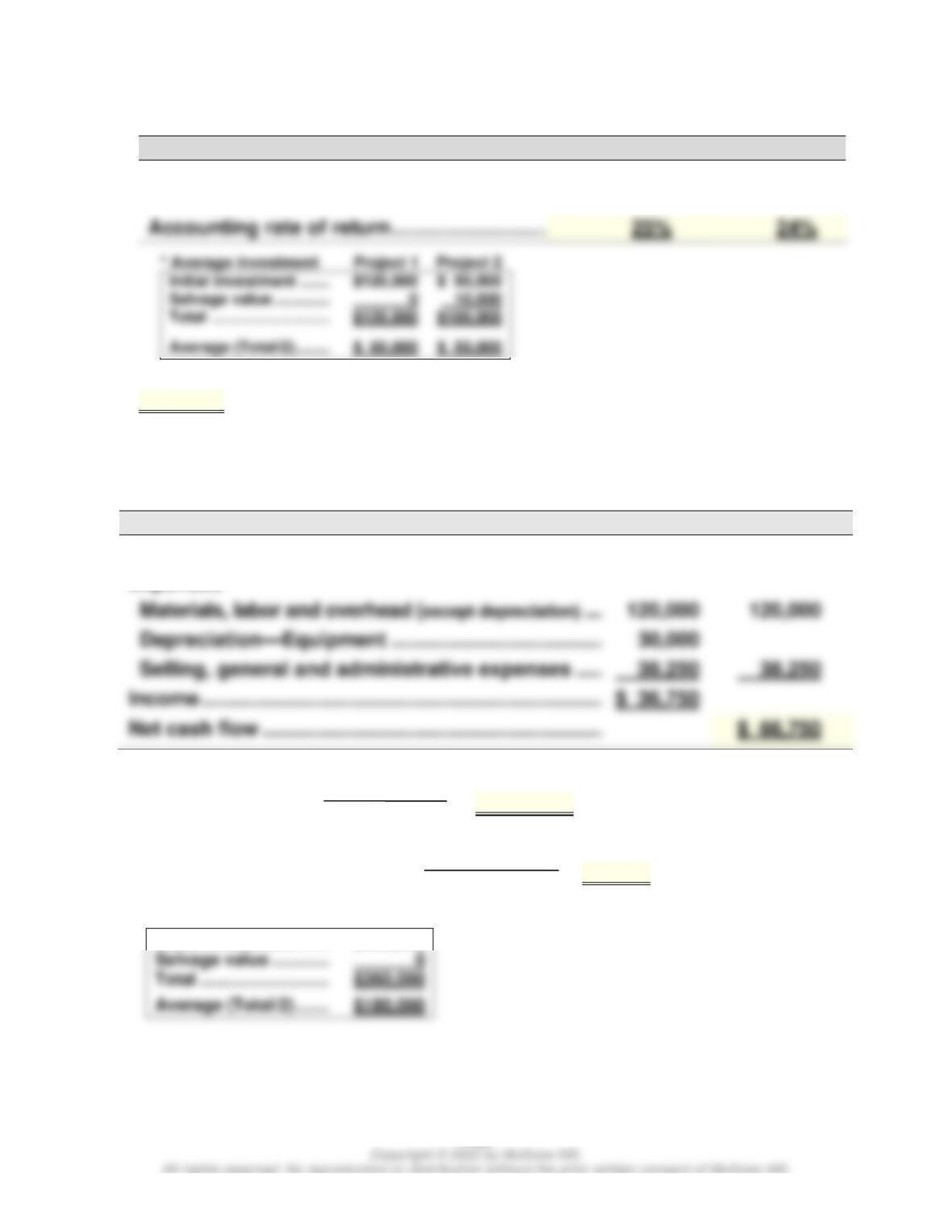
Payback occurs at this point in year 3:
= = 0.69 (rounded)
Amount paid back in year 4
Net cash flow in year 4
$10,000
$125,000
Amount paid back in year 3
Net cash flows in year 3
$55,000
$80,000
1452
Exercise 24-5 (15 minutes)
a.
Project 1
Project 2
Annual income ………………………………………..
$15,000
$12,000
Average investment* ……………………………….
$60,000
$50,000
b. Project 1. Based on accounting rate of return, Project 1 is preferred.
Exercise 24-6 (20 minutes)
a.
Annual Results from Investment
Income
Cash Flow
Sales of new product …………………………………………
$225,000
$225,000
Expenses
b. Payback period = = 5.39 years (rounded)
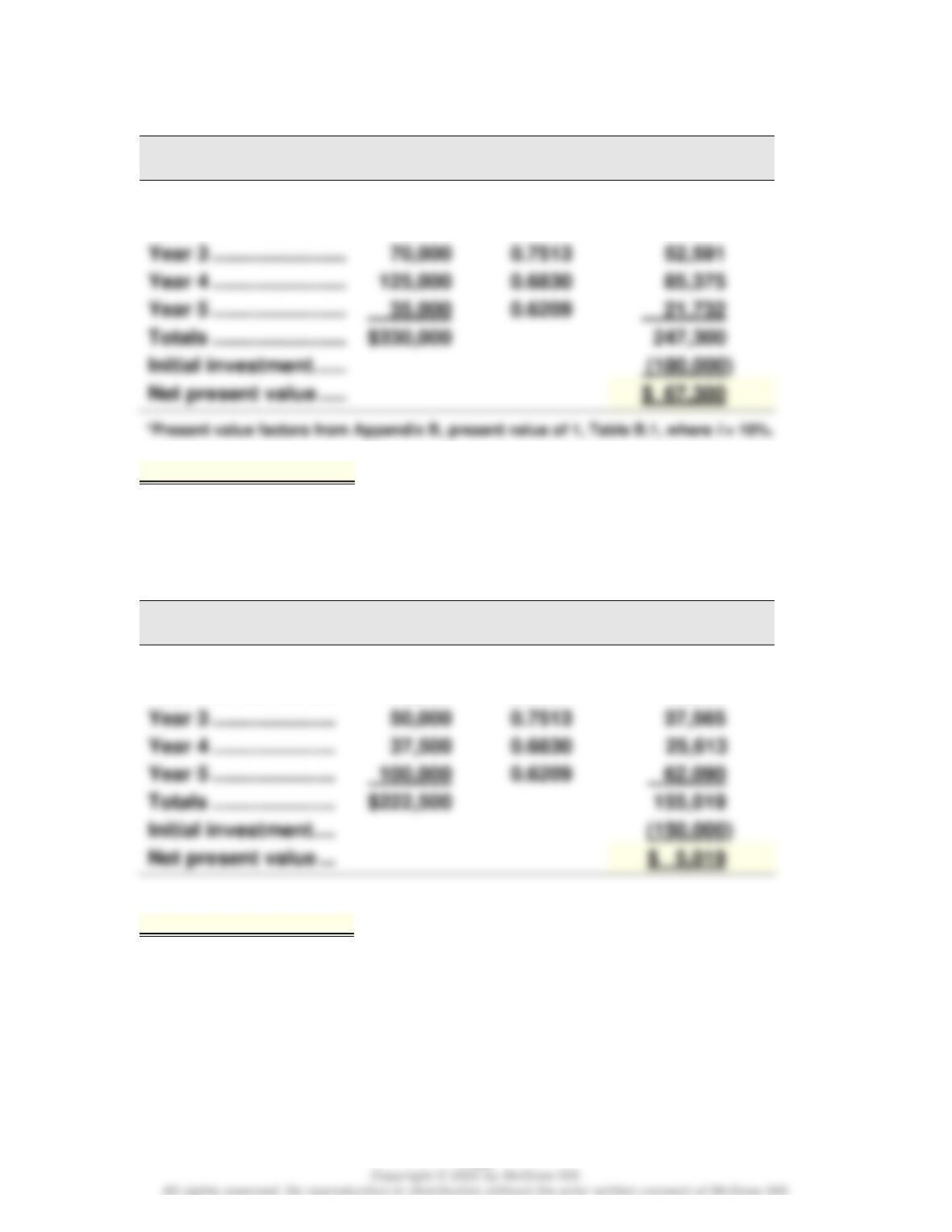
c. Accounting rate of return = = 20.42%
*Average investment
Initial investment …….
$360,000
$360,000
$66,750
$36,750
$180,000*
Wild and Shaw, Financial & Managerial Accounting 9e Solutions Manual: Chapter 24
1453
Exercise 24-7 (20 minutes)
a.
Net Cash
Flows
Present Value
of 1 at 10%*
Present Value of
Net Cash Flows
Year 1 ……………………
$ 60,000
0.9091
$ 54,546
Year 2 ……………………
40,000
0.8264
33,056
Year 3 ……………………
70,000
0.7513
52,591
Year 4 ……………………
0.6830
85,375
Year 5 ……………………
0.6209
b. Accept the investment. The investment should be accepted because its
net present value is positive.
Exercise 24-8 (15 minutes)
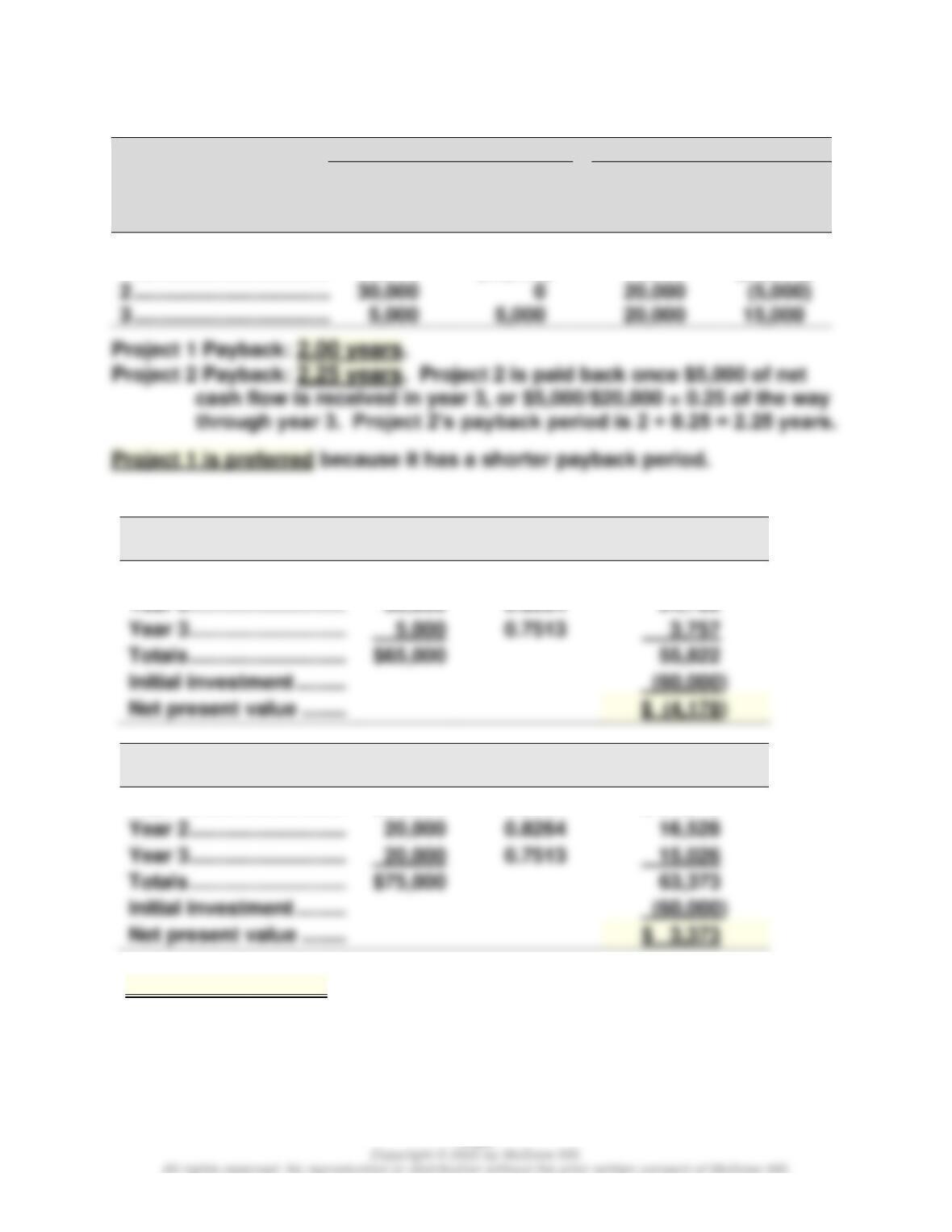
a.
Net Cash
Flows
Present Value
of 1 at 10%
Present Value of
Net Cash Flows
Year 1 ………………….
$ 10,000
0.9091
$ 9,091
Year 2 ………………….
25,000
0.8264
20,660
Year 3 ………………….
50,000
0.7513
37,565
Year 4 ………………….
37,500
0.6830
Year 5 ………………….
0.6209
b. Purchase the machine. The machinery should be purchased because its
net present value is positive.
1454
Exercise 24-9 (20 minutes)
a.
Project 1 Project 2
Year
Net Cash
Flows
Cumulative
Net Cash
Flows
Net Cash
Flows
Cumulative
Net Cash
Flows
Initial investment………
$(60,000)
$(60,000)
$(60,000)
$(60,000)
1 ………………………………
30,000
(30,000)
35,000
(25,000)
2 ………………………………
20,000
(5,000)
3 ………………………………
b.
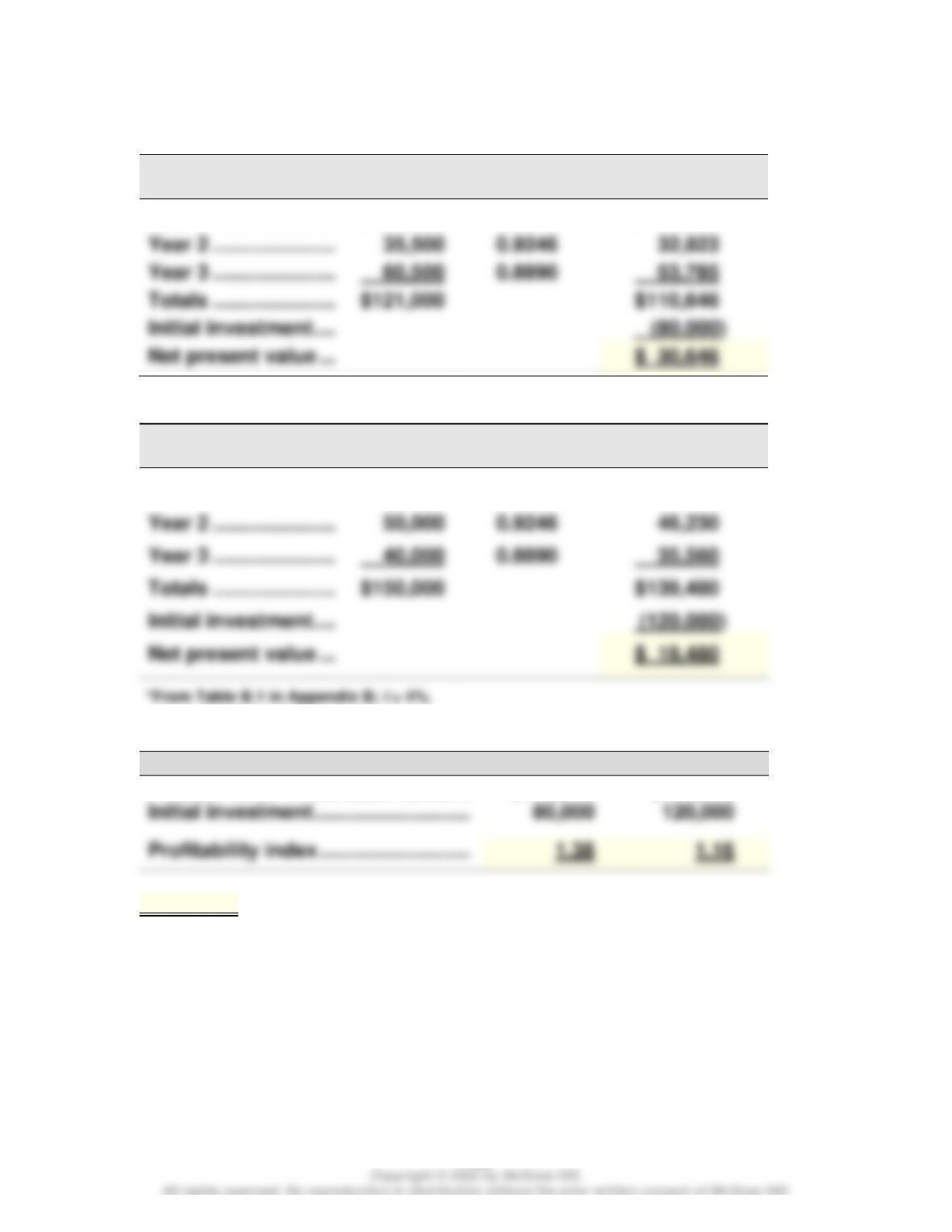
Project 1
Net Cash
Flows
Present Value
of 1 at 10%
Present Value of
Net Cash Flows
Year 1 ……………………….
$30,000
0.9091
$ 27,273
Year 3 ……………………….
0.7513
3,757
Totals ……………………….
Initial investment ………
Project 2
Net Cash
Flows
Present Value
of 1 at 10%
Present Value of
Net Cash Flows
Year 1 ……………………….
$35,000
0.9091
$ 31,819
Year 3 ……………………….
0.7513
Totals ……………………….
Initial investment ………
Project 2 is preferred because it has the higher (and positive) NPV.
Wild and Shaw, Financial & Managerial Accounting 9e Solutions Manual: Chapter 24
1455
Exercise 24-10 (25 minutes)
a.
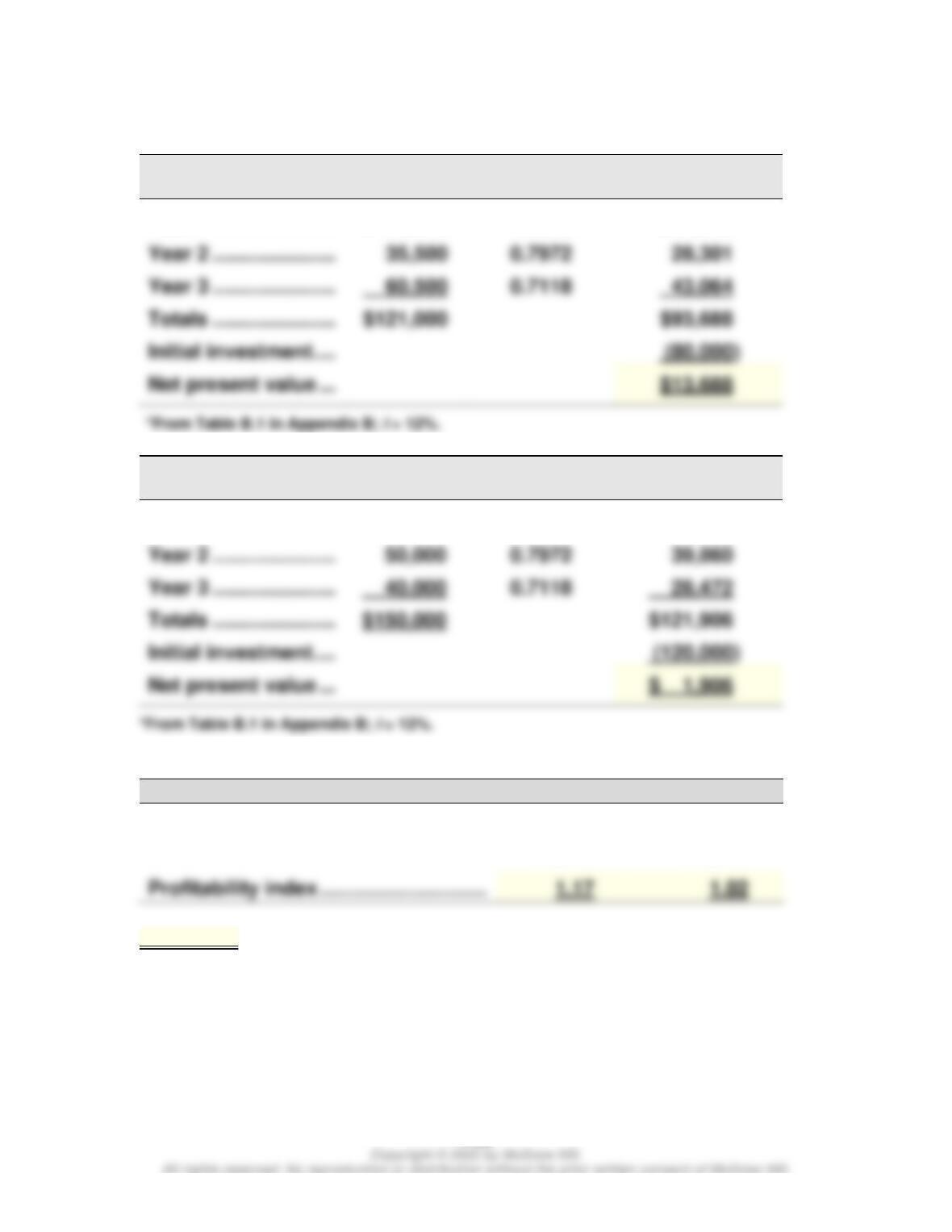
Project X1
Net Cash
Flows
Present Value
of 1 at 4%*
Present Value of
Net Cash Flows
Year 1 ………………….
$ 25,000
0.9615
$ 24,038
Year 2 ………………….
0.9246
Year 3 ………………….
Totals ………………….
Project X2
Net Cash
Flows
Present Value
of 1 at 4%*
Present Value of
Net Cash Flows
Year 1 ………………….
$ 60,000
0.9615
$ 57,690
Year 2 ………………….
0.9246
Year 3 ………………….
Totals ………………….
b.
Project X1
Project X2
Present value of net cash flows …
$110,646
$139,480
c. Project X1. If the company can choose only one project, it should
choose Project X1 because it has a higher profitability index.
1456
Exercise 24-11 (25 minutes)
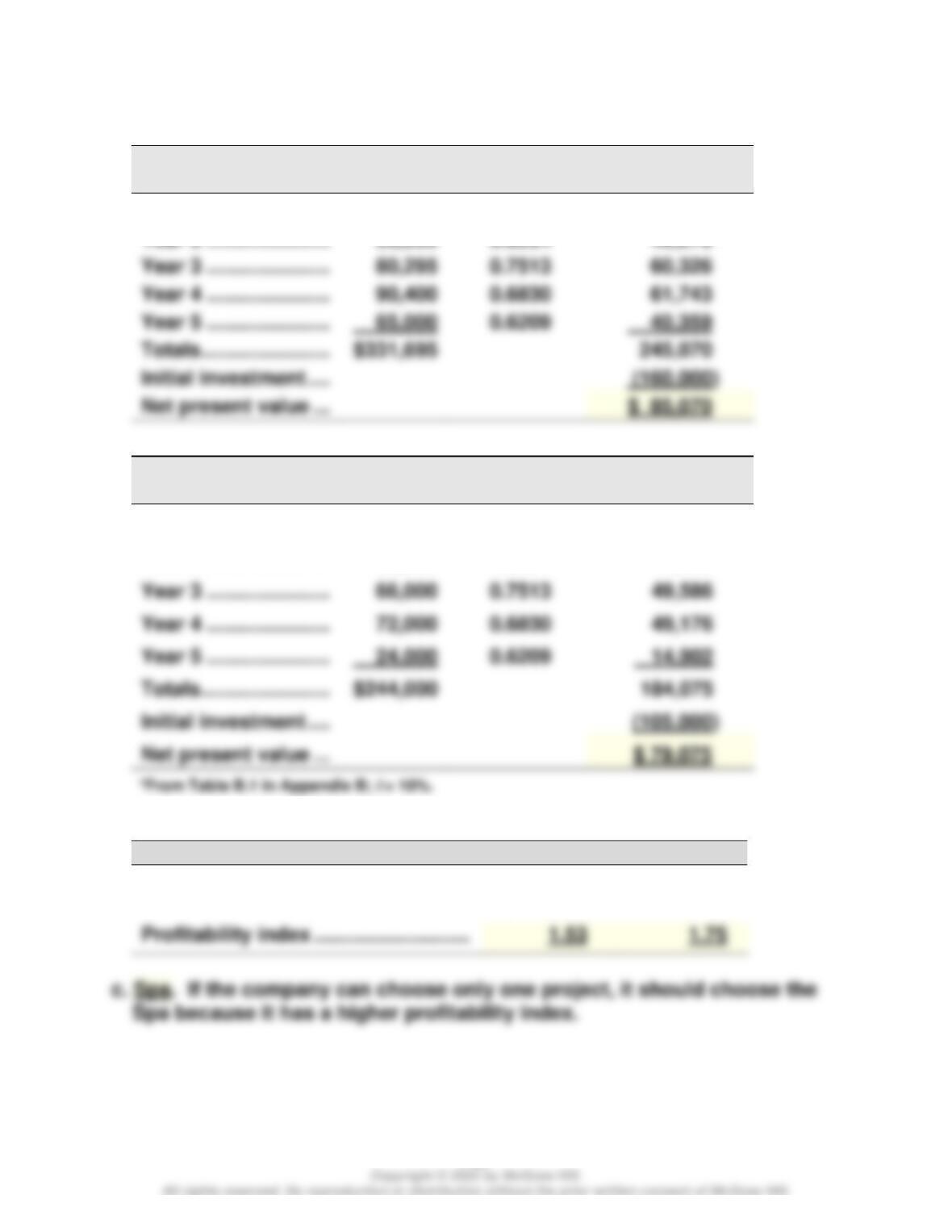
a.
Project X1
Net Cash
Flows
Present Value
of 1 at 12%*
Present Value of
Net Cash Flows
Year 1 ………………….
$ 25,000
0.8929
$ 22,323
Year 2 ………………….
0.7972
Year 3 ………………….
0.7118
Project X2
Net Cash
Flows
Present Value
of 1 at 12%*
Present Value of
Net Cash Flows
Year 1 ………………….
$ 60,000
0.8929
$ 53,574
Year 2 ………………….
0.7972
Year 3 ………………….
0.7118
b.
Project X1
Project X2
Present value of net cash flows ……
$93,688
$121,906
Initial investment………………………….
80,000
120,000
c. Project X1. If the company can choose only one project, it should
choose Project X1 because it has a higher profitability index.
Wild and Shaw, Financial & Managerial Accounting 9e Solutions Manual: Chapter 24
1457
Exercise 24-12 (25 minutes)
a.
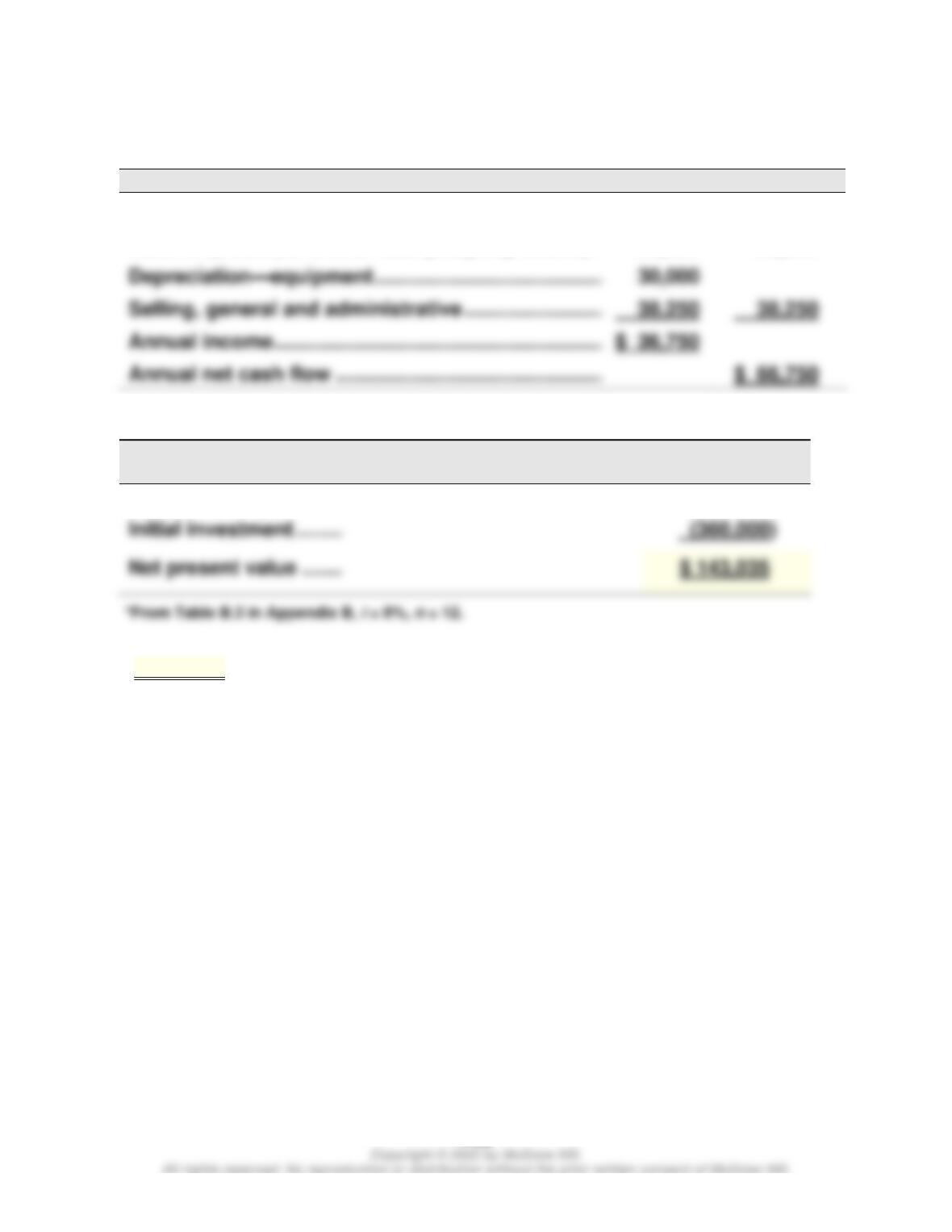
POOL
Net Cash
Flows
Present Value
of 1 at 10%*
Present Value of
Net Cash Flows
Year 1 ………………….
$ 40,000
0.9091
$ 36,364
Year 2 ………………….
56,000
0.8264
46,278
Year 3 ………………….
80,295
0.7513
60,326
Year 4 ………………….
90,400
0.6830
61,743
Year 5 ………………….
0.6209
Totals …………………..
$331,695
SPA
Net Cash
Flows
Present Value
of 1 at 10%*
Present Value of
Net Cash Flows
Year 1 ………………….
$ 32,000
0.9091
$ 29,091
Year 2 ………………….
50,000
0.8264
41,320
Year 3 ………………….
66,000
0.7513
49,586
Year 4 ………………….
72,000
0.6830
49,176
Year 5 ………………….
0.6209
Totals …………………..
$244,000
b.
POOL
SPA
Present value of net cash flows…..
$245,070
$184,075
Initial investment ………………………..
$160,000
$105,000
1458
Exercise 24-13 (15 minutes)
a.
Income
Cash Flow
Sales …………………………………………………………………
$225,000
$225,000
Materials, labor, and overhead (except depreciation) ..
120,000
120,000
Annual Net
Cash Flows
Present Value of
Annuity at 8%*
Present Value of
Net Cash Flows
Years 1 through 12 …….
$ 66,750
7.5361
$ 503,035
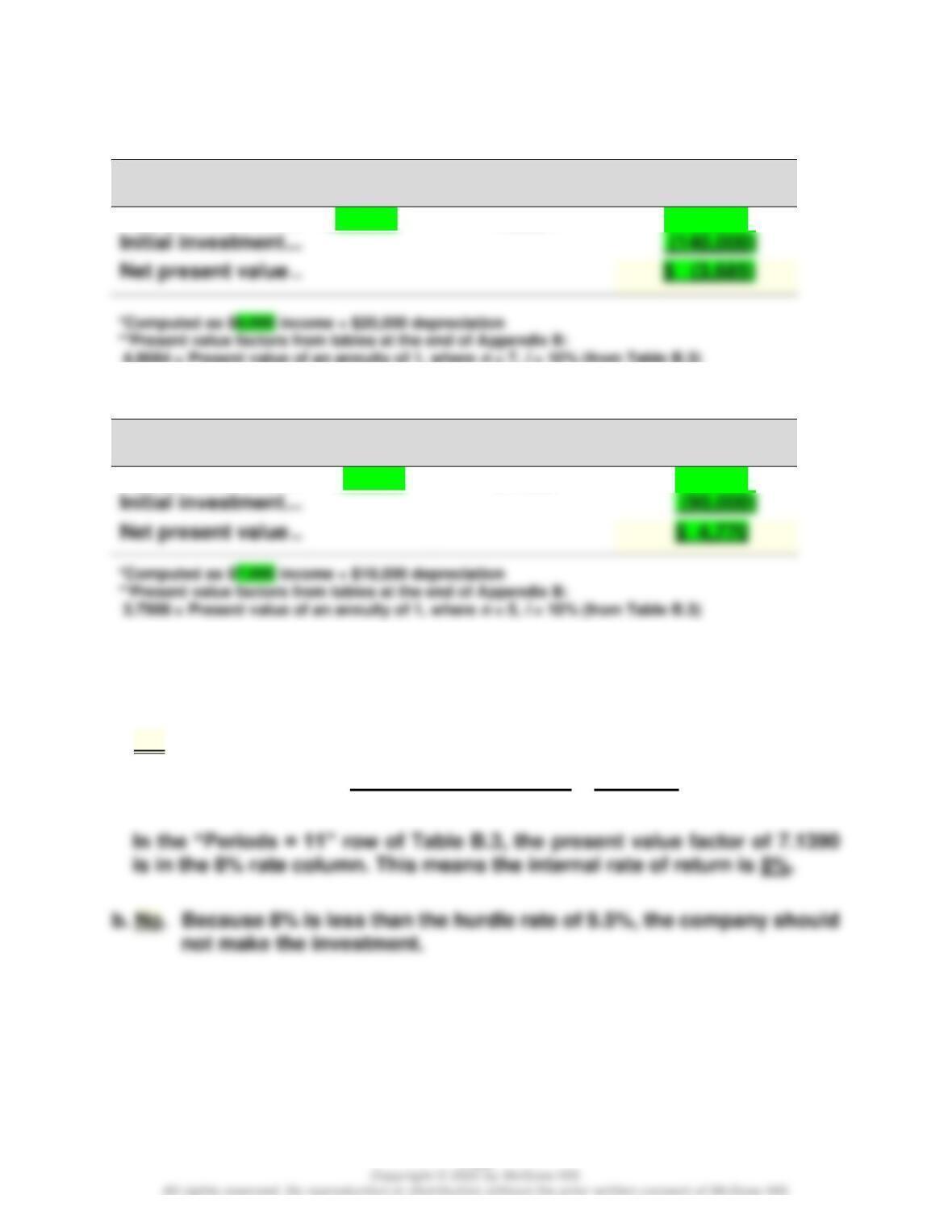
b. Accepted. The project should be accepted because its net present value
is positive.
Wild and Shaw, Financial & Managerial Accounting 9e Solutions Manual: Chapter 24
1459
Exercise 24-14 (15 minutes)
Project 1
Net Cash
Flows
Present Value of
Annuity at 10%**
Present Value of
Net Cash Flows
Years 1-7 …………….
$28,000*
4.8684
$136,315
4.8684 = Present value of an annuity of 1, where n = 7, i = 10% (from Table B.3)
Project 2
Net Cash
Flows*
Present Value of
Annuity at 10%**
Present Value of
Net Cash Flows
Years 1-5 …………….
$25,000
3.7908
$94,770
Exercise 24-15 (15 minutes)
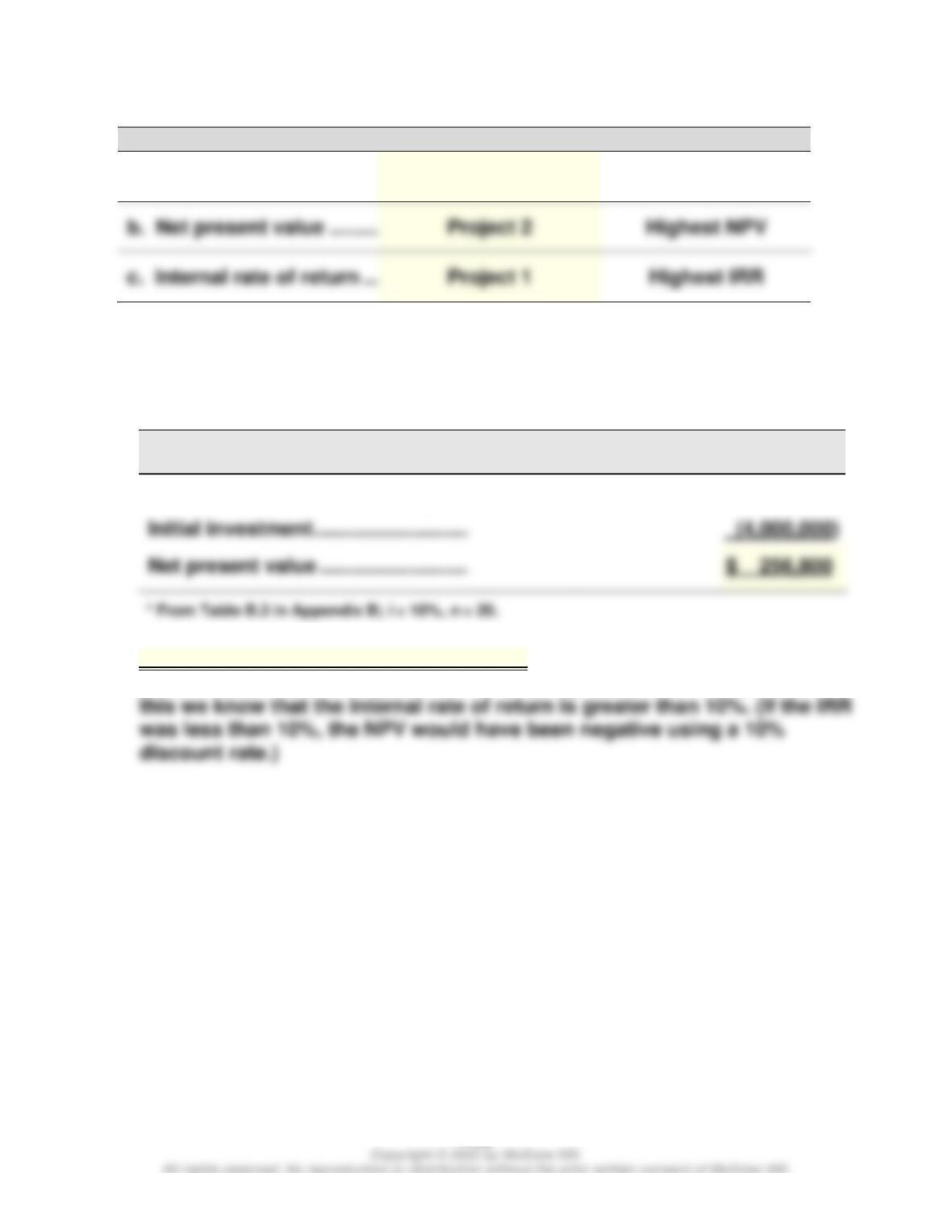
a. 8%.
Present value factor = Initial investment = $214,170 = 7.139
Annual net cash flows $30,000
1460
Exercise 24-16 (10 minutes)
Preferred Investment
Reason
a. Payback period ……………..
Project 3
Shortest payback
Project 1
Exercise 24-17 (10 minutes)
a.
Annual Net
Cash Flows
P.V. of Annuity
at 10%*
P.V. of Net
Cash Flows
Years 1-20 direct labor savings ….
$ 500,000
8.5136
$ 4,256,800
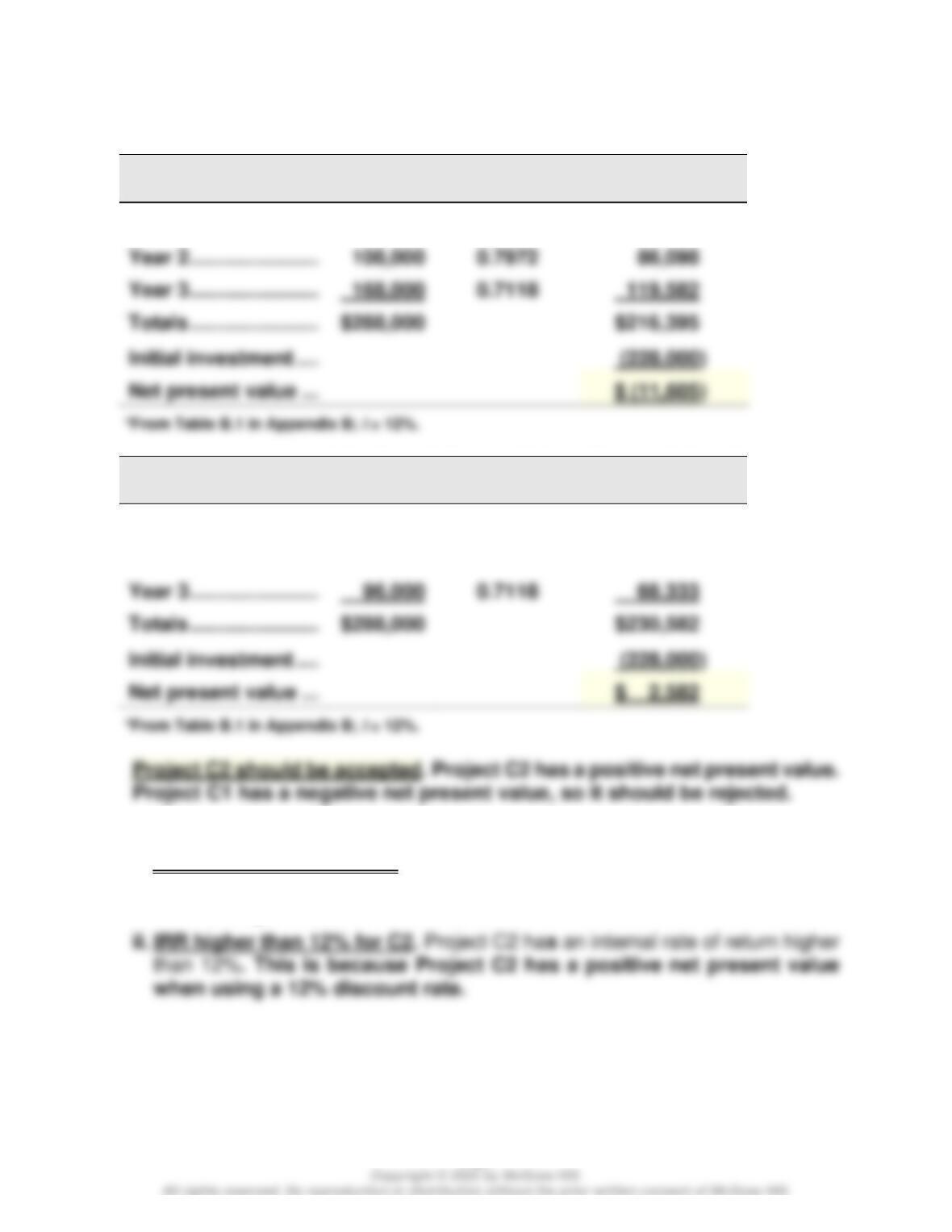
b. Internal rate of return is higher than 10%. The project has a positive net
present value when computed with a 10% required rate of return. From
Wild and Shaw, Financial & Managerial Accounting 9e Solutions Manual: Chapter 24
1461
Exercise 24-18 (20 minutes)
a.
PROJECT C1
Net Cash
Flows
Present Value
of 1 at 12%*
Present Value of
Net Cash Flows
Year 1 …………………..
$ 12,000
0.8929
$ 10,715
Year 2 …………………..
0.7972
86,098
Year 3 …………………..
168,000
0.7118
PROJECT C2
Net Cash
Flows
Present Value
of 1 at 12%*
Present Value of
Net Cash Flows
Year 1 …………………..
$ 96,000
0.8929
$ 85,718
Year 2 …………………..
96,000
0.7972
76,531
Year 3 …………………..
0.7118
b.
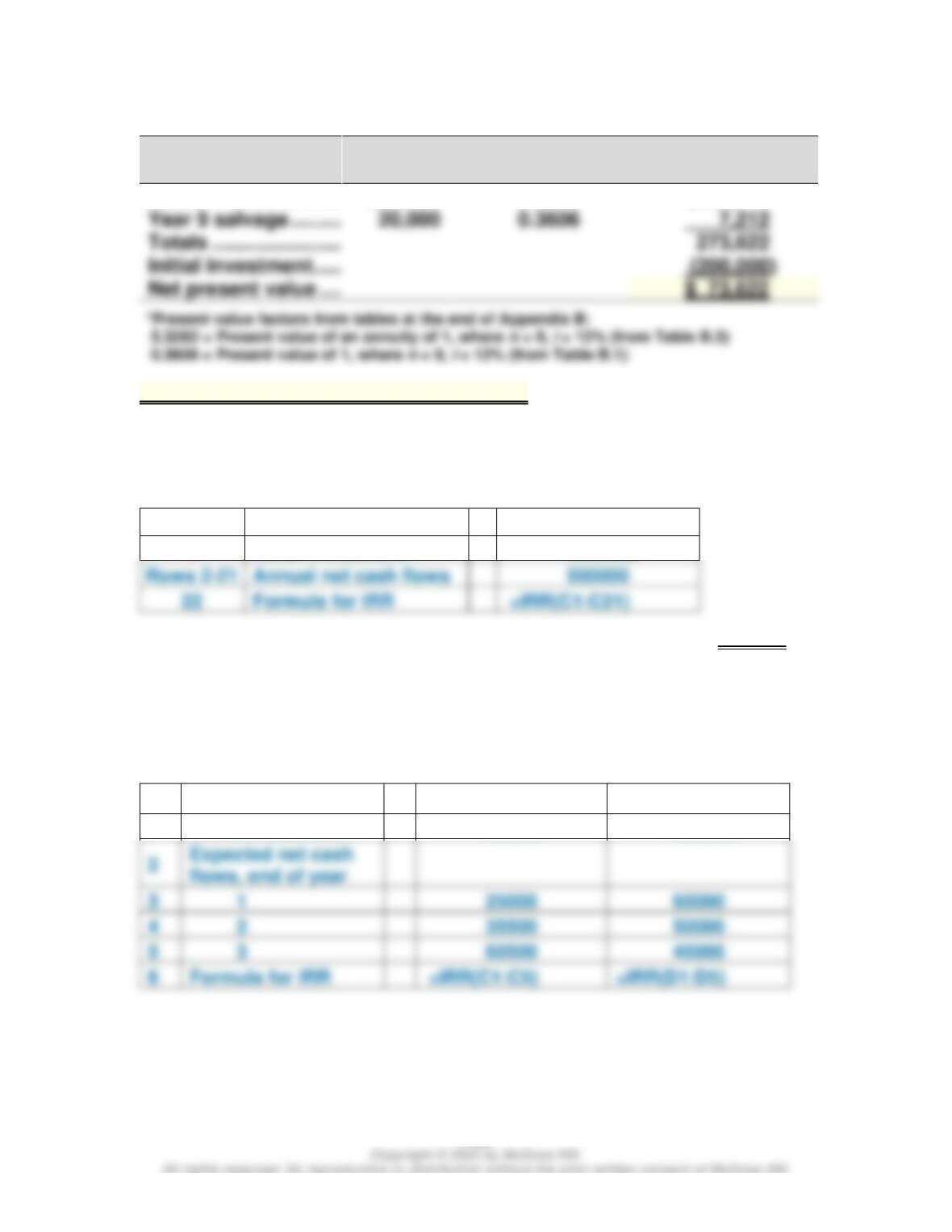
i. IRR lower than 12% for C1. Project C1 has an internal rate of return lower
than 12%. This is because Project C1 has a negative net present value
when using a 12% discount rate.
1462
Exercise 24-19 (15 minutes)
a.
Net Cash
Flows
Present Value
at 12%*
Present Value of
Net Cash Flows
Years 1-9 ……………….
$50,000
5.3282
$266,410
Year 9 salvage ……….
0.3606
Totals ……………………
Net present value …..
$ 73,622
b. Internal rate of return is higher than 12%. Because the NPV is positive
when using a 12% discount rate, we know that the internal rate of return
is greater than 12%.
Exercise 24–20A (20 minutes)
A
B
C
1
Initial investment
-4000000
Annual net cash flows
Formula for IRR
Using Excel, the investment has an internal rate of return of 10.93%.
Exercise 24–21A (20 minutes)
a. Using Excel, Project X1 and X2 have an internal rate of return of 20.34%
and 12.99%, respectively.
Project X1 Project X2
A
B
C
D
1
Initial Investment
-80000
-120000
flows, end of year
3
1
4
2
5
3
6
Formula for IRR
=IRR(D1:D5)
b. Both of these IRR’s are above the company’s required rate of return of
4%. This means both projects would be accepted.