CHAPTER 24 Performance Evaluation for Decentralized Operations
Prob. 24–3B
1.
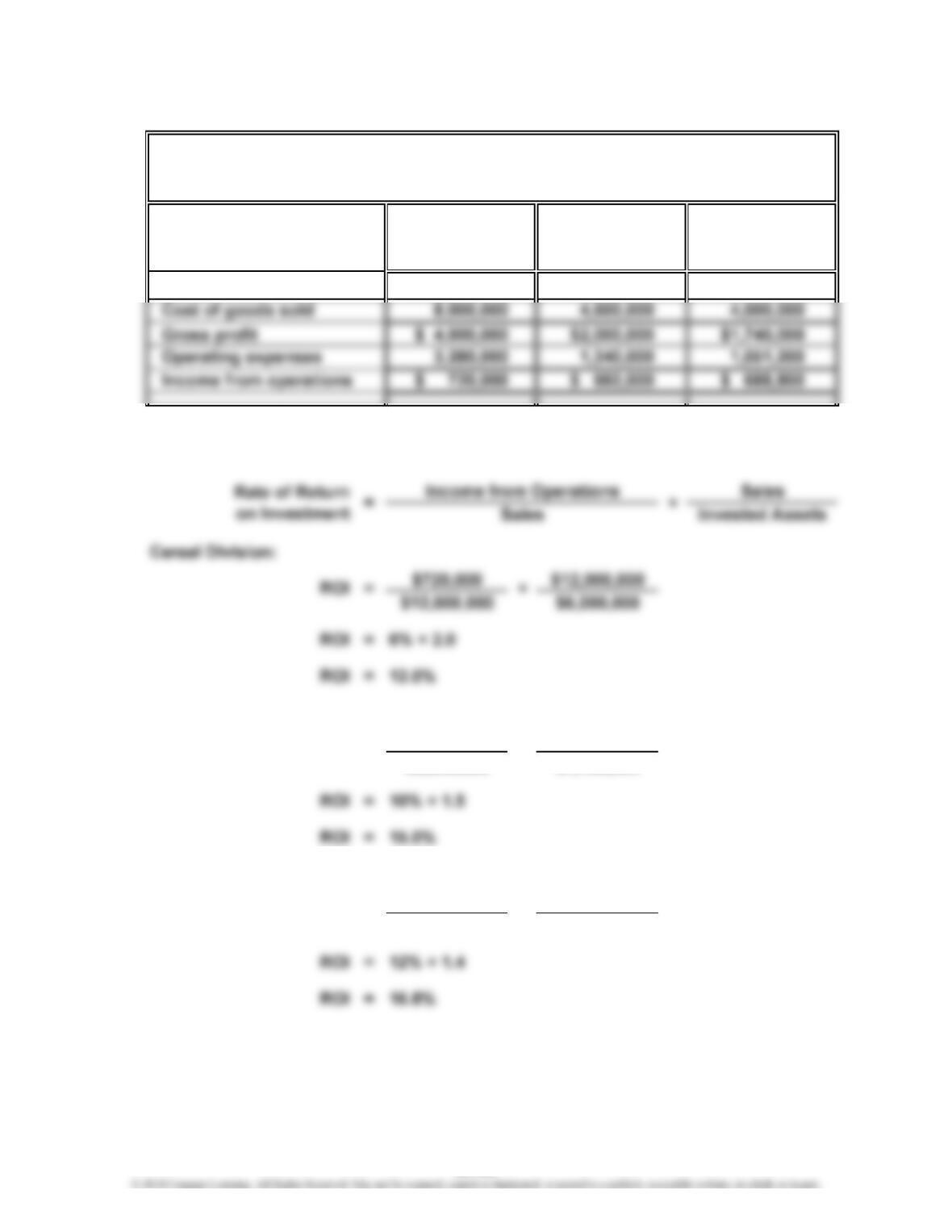
Sales
Snack Cake Division:
$660,000 $6,600,000
$6,600,000 $4,400,000
Retail Bakeries Division:
$688,800 $5,740,000
$5,740,000 $4,100,000
Division Division Division
$12,000,000 $6,600,000 $5,740,000
THE WHOLE EARTH FOOD COMPANY
Divisional Income Statements
For the Year Ended June 30, 2014
Cereal Snack Cake
Retail
Bakeries
2. Rate of Return
on Investment = Profit Margin × Investment Turnover
ROI =
ROI = ×
×
24-36

CHAPTER 24 Performance Evaluation for Decentralized Operations
Prob. 24–3B (Concluded)
3. Per dollar of invested assets, the Retail Bakeries Division is the most profitable
of the three divisions. Assuming that the rates of return on investments do not
24-37
CHAPTER 24 Performance Evaluation for Decentralized Operations
Prob. 24–4B
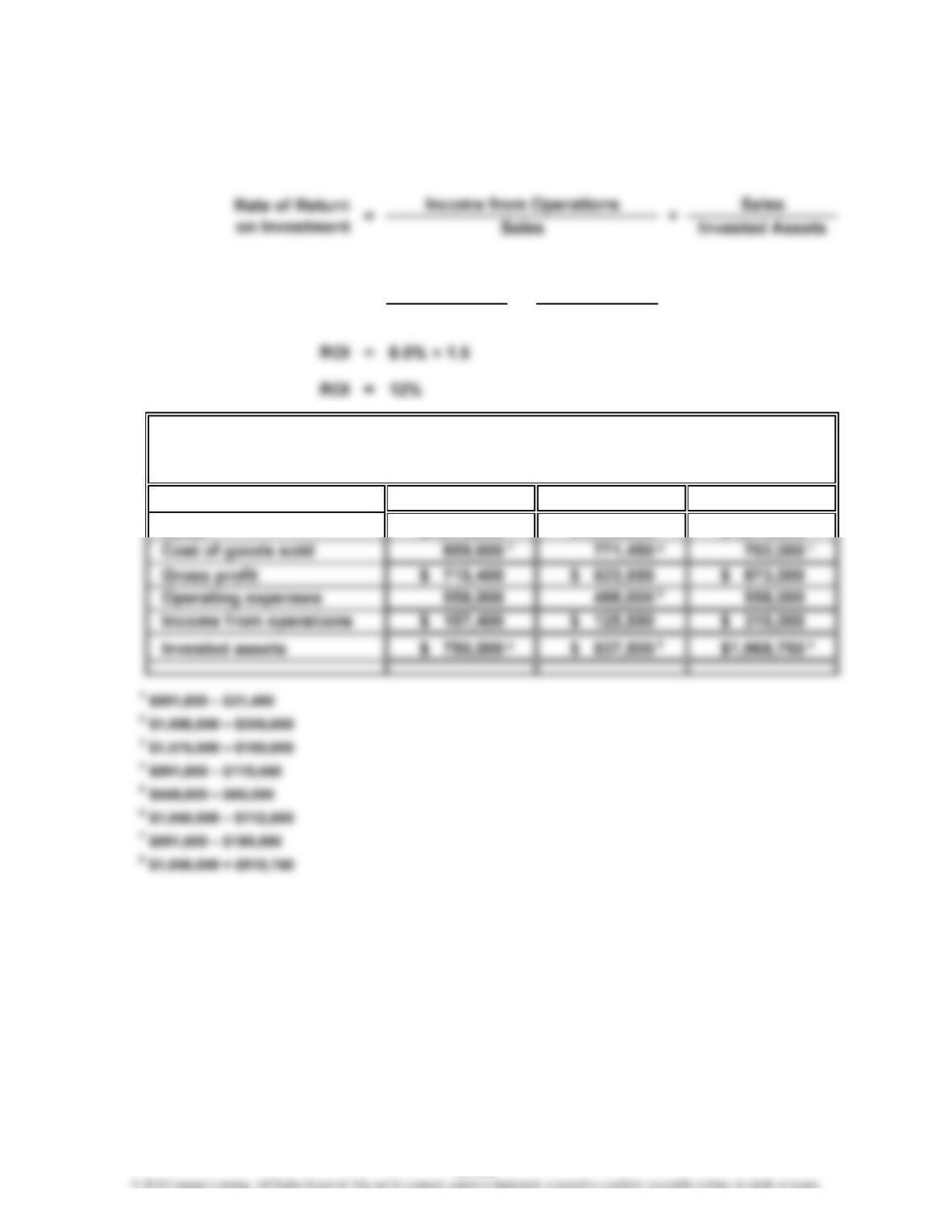
Electronics Division:
$126,000 $1,575,000
$1,575,000 $1,050,000
2.
Sales
1. =
$1,395,000
×
Proposal 1
For the Year Ended December 31, 2014
Proposal 2
Profit Margin × Investment Turnover
GIHLBI INDUSTRIES INC.—ELECTRONICS DIVISION
Estimated Income Statements
Rate of Return
on Investment
ROI =
$1,575,000
Proposal 3
$1,575,000
3
24-38
CHAPTER 24 Performance Evaluation for Decentralized Operations
Prob. 24–4B (Concluded)
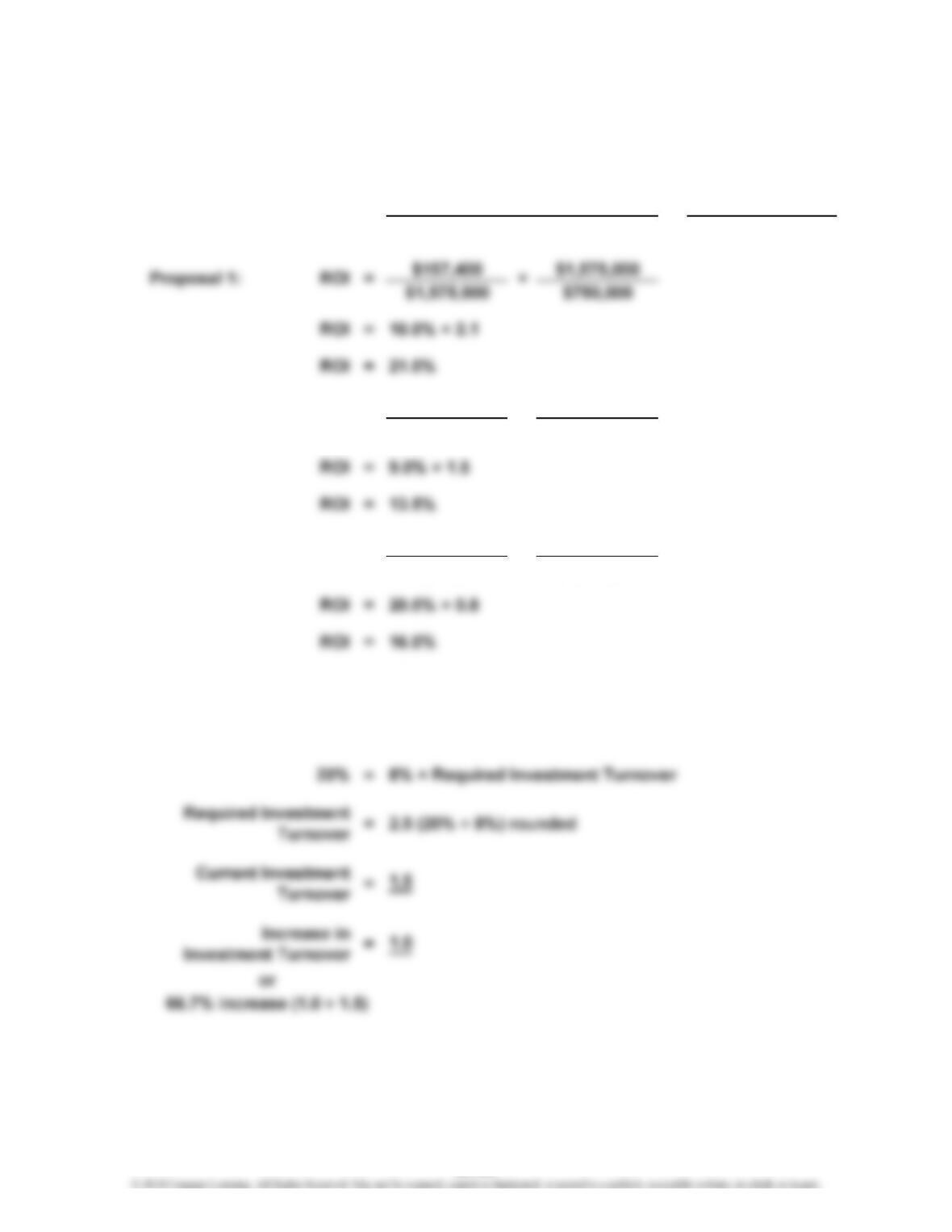
$125,550 $1,395,000
$1,395,000 $937,500
$315,000 $1,575,000
$1,575,000 $1,968,750
4. Proposal 1 would yield a rate of return on investment of 21.0%.
5.
Proposal 2:
Proposal 3:
ROI =
Rate of Return
on Investment
Rate of Return
on Investment
Rate of Return
on Investment
= Profit Margin × Required Investment Turnover
Invested Assets
×
×
= ×
Sales
Income from Operations
3. = Profit Margin × Investment Turnover
ROI =
Sales
24-39
CHAPTER 24 Performance Evaluation for Decentralized Operations
Prob. 24–5B
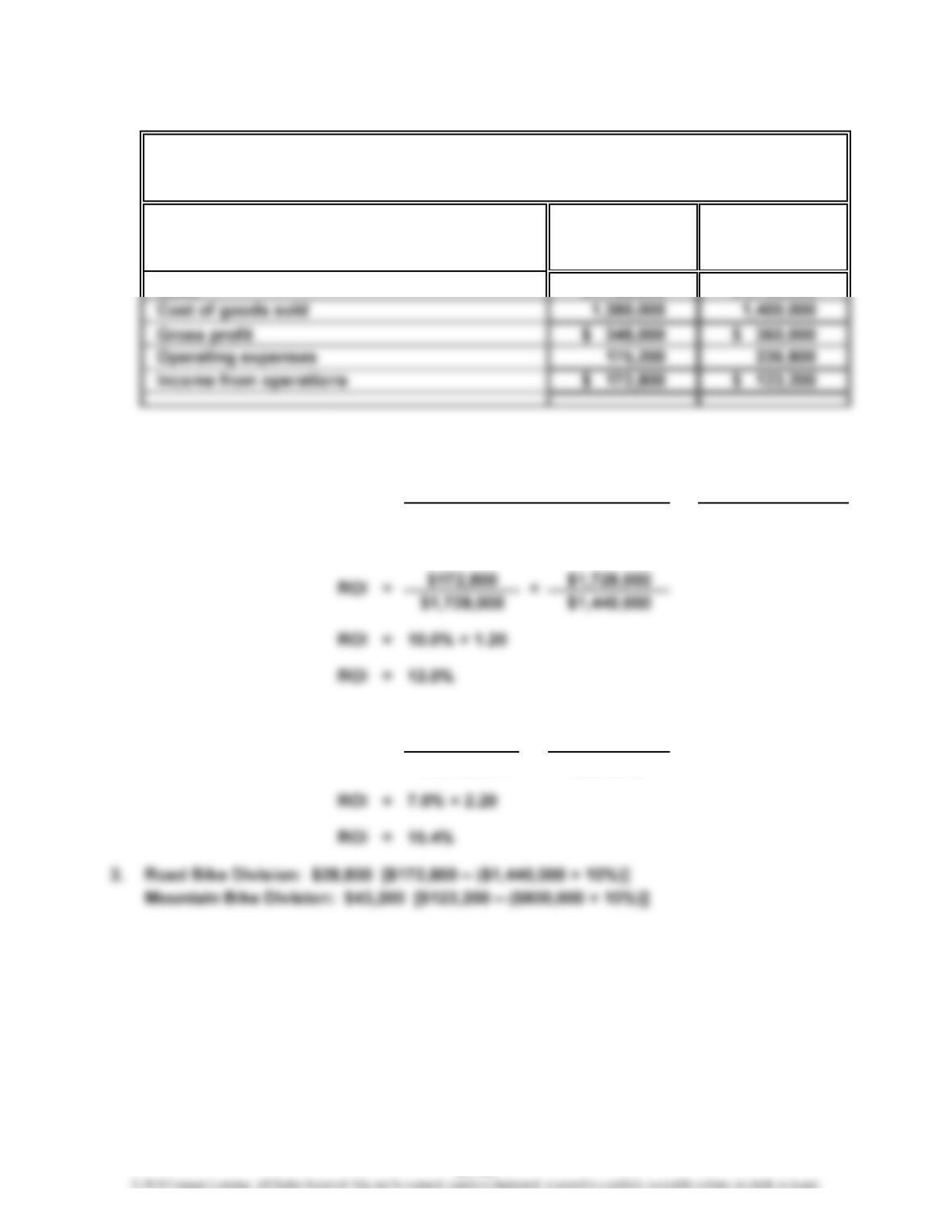
1.
Sales
Road Bike Division:
Mountain Bike Division:
$123,200 $1,760,000
$1,760,000 $800,000
Invested Assets
=SalesIncome from Operations
ROI = ×
×
Sales
Rate of Return
on Investment
Division Division
2. = Profit Margin × Investment Turnover
Rate of Return
on Investment
$1,728,000
$1,760,000
FREE RIDE BIKE COMPANY
Divisional Income Statements
For the Year Ended December 31, 2014
BikeBike
Road Mountain
24-40
CHAPTER 24 Performance Evaluation for Decentralized Operations
Prob. 24–5B (Concluded)
4. On the basis of income from operations, the Road Bike Division generated
$49,600 ($172,800 – $123,200) more income from operations than did the Mountain
Bike Division. However, income from operations does not consider the amount of
24-41
CHAPTER 24 Performance Evaluation for Decentralized Operations
Prob. 24–6B
1. No. When unused capacity exists in the supplying division (the Semiconductors
2. The Semiconductors Division’s income from operations would increase by
$45,240:
Increase in Semiconductors Variable
(Supplying) Division’s Transfer Cost Units
Income from Operations = Price – per Unit × Transferred
of the increases in the division incomes from operations.
24-42
3.
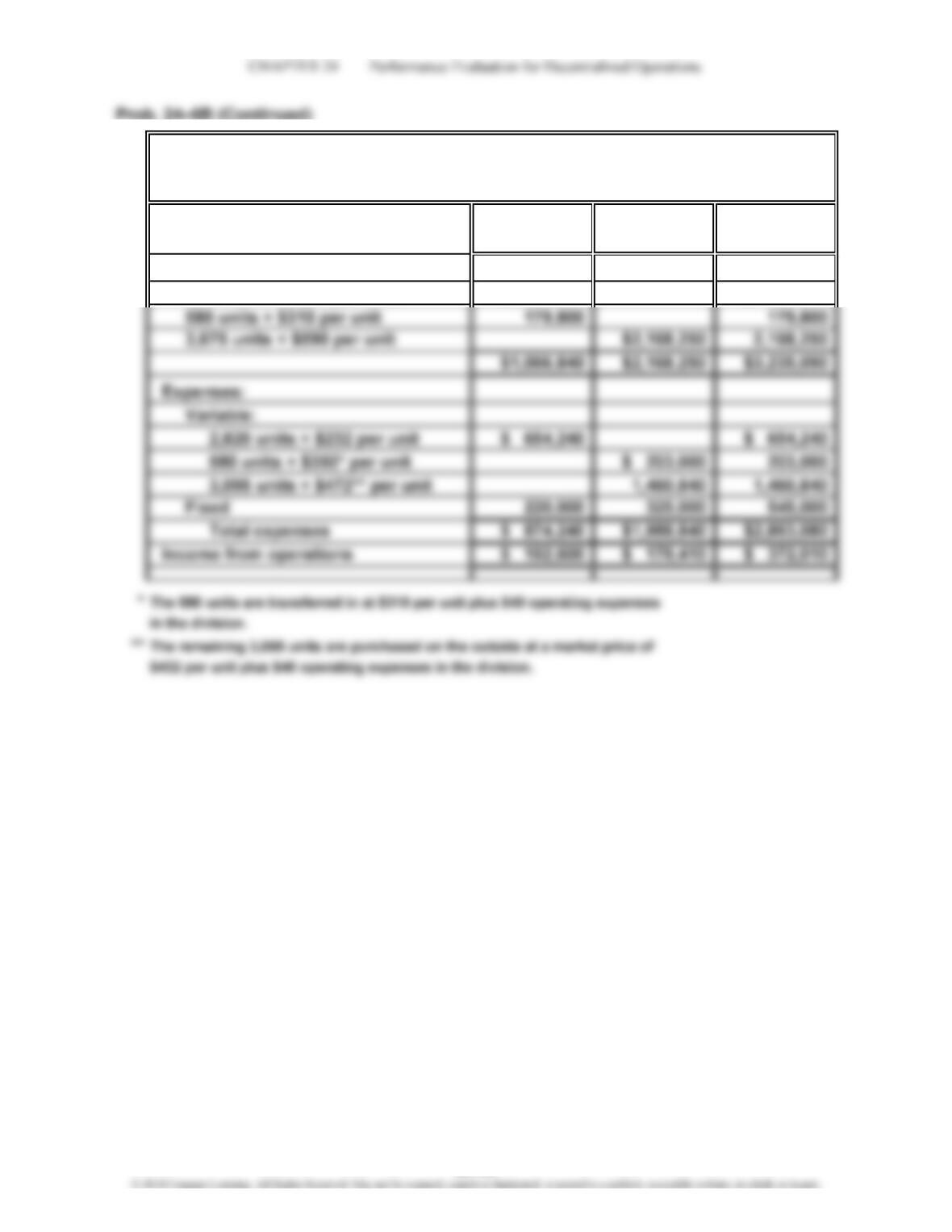
Semi- Navigational
conductors Systems Total
Sales:
2,240 units × $396 per unit $ 887,040 $ 887,040
EXOPLEX INDUSTRIES INC.
Divisional Income Statements
For the Year Ended December 31, 2014
24-43
CHAPTER 24 Performance Evaluation for Decentralized Operations
Prob. 24–6B (Concluded)
4. The Semiconductors Division’s income from operations would increase by
$62,640:
Increase in Semiconductors Variable
(Supplying) Division’s Transfer Cost Units
Income from Operations = Price – per Unit × Transferred
By selling to the Navigational Systems Division, the Semiconductors Division
earns $108 per unit on these sales.
The Navigational Systems Division’s income from operations would increase
by $53,360:
Increase in Navigational Systems
(Purchasing) Division’s Market Transfer Units
Income from Operations = Price – Price × Transferred
Exoplex Industries Inc.’s total income from operations would increase by the
same amount as in (2), $116,000:
5. a. Any transfer price greater than the Semiconductors Division’s variable
expenses per unit of $232 but less than the market price of $432 would be
acceptable.
24-44
CHAPTER 24 Performance Evaluation for Decentralized Operations
CP 24–1
This scenario is a negotiation between two divisions. Dave is not behaving
unethically by attempting to get a better price from the Semiconductor Division than
from the market. He is not behaving unethically because he refuses market price. This
may not seem “fair,” but price negotiation is a very typical business activity and is part of
CASES & PROJECTS
24-45
CHAPTER 24 Performance Evaluation for Decentralized Operations
CP 24–2
The Customer Service Department head is responsible for the quantity of service, but
not the source of the service (i.e., not the price). Most accountants would hold the
department head responsible for the cost by transferring the cost of the brochures to
24-46
CHAPTER 24 Performance Evaluation for Decentralized Operations
CP 24–3
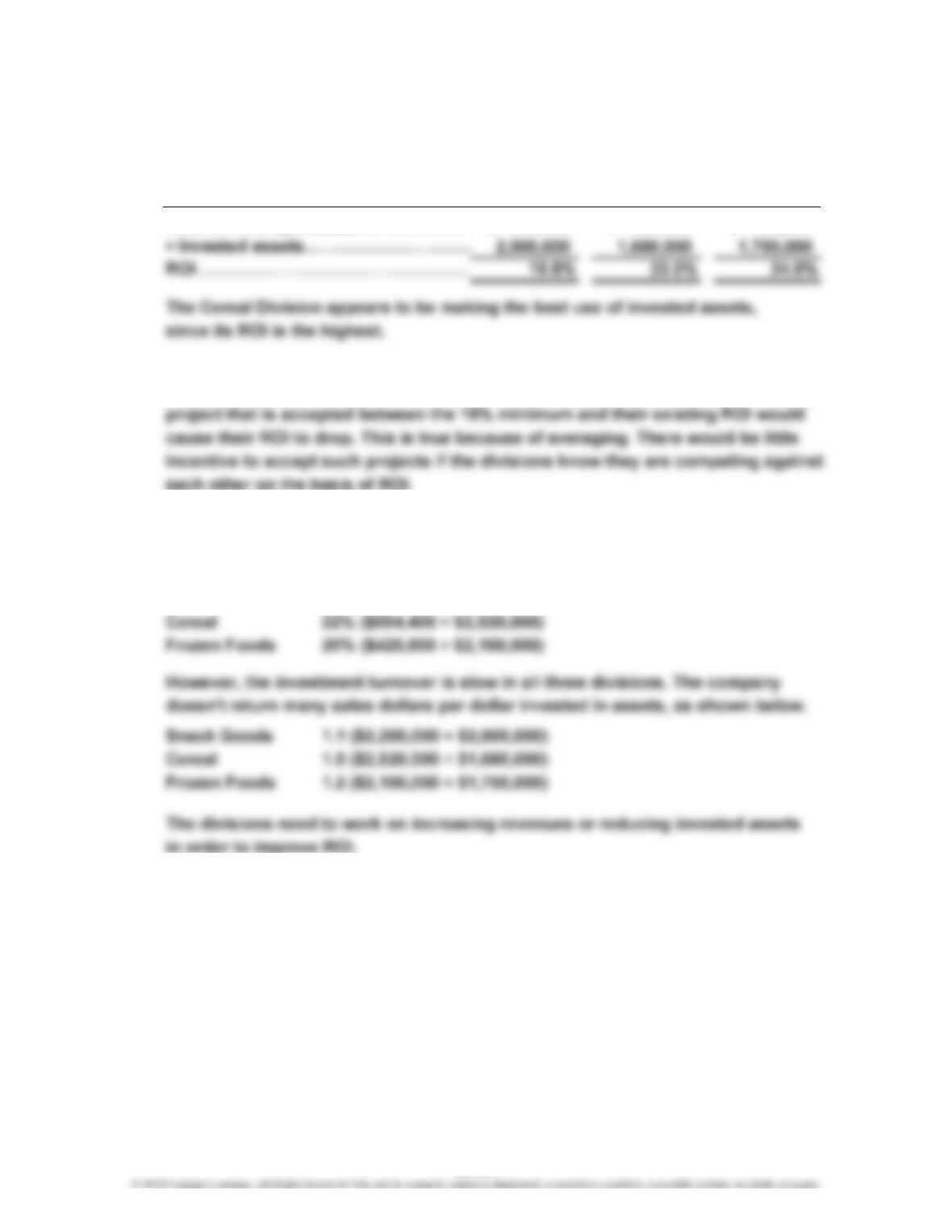
1. The rate of return on invested assets is computed as follows:
Snack Frozen
Goods Cereal Foods
Income from operations………………
…
$ 396,000 $ 554,400 $ 420,000
2. Not all projects that have greater than a 19% rate of return would be accepted.
This is because all three divisions have an ROI that is greater than 19%. Thus, any
3. There are two approaches to improving ROI: (1) improving the profit margin or
(2) improving the investment turnover. For all three divisions, the profit margin
is excellent:
Snack Goods 18% ($396,000 ÷ $2,200,000)
24-47
CHAPTER 24 Performance Evaluation for Decentralized Operations
CP 24–4
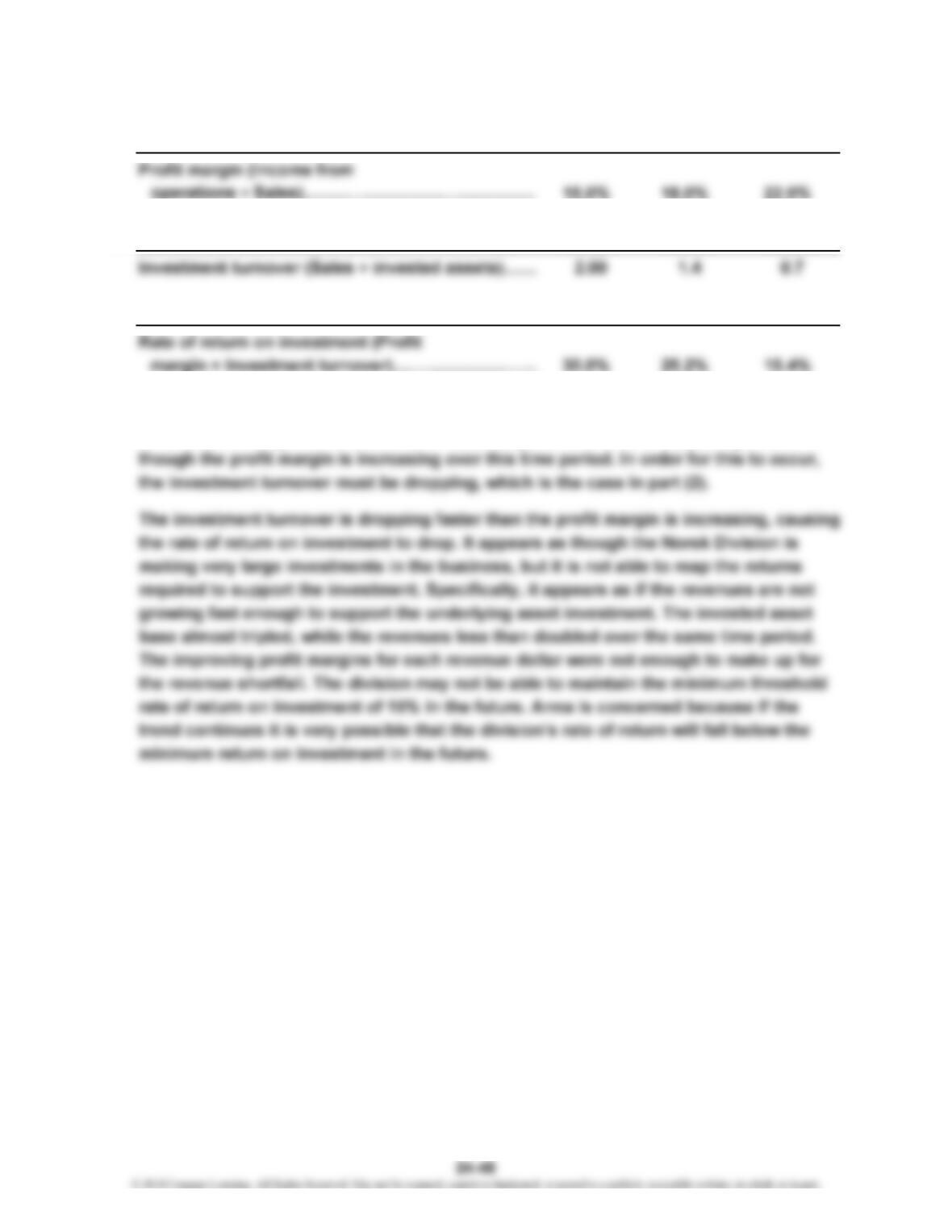
1. 2012 2013 2014
2. 2012 2013 2014
3. 2012 2013 2014
4. Anna is concerned about the Norsk Division because the return on investment appears
to be deteriorating over the 2012–2014 operating periods. This is happening even
CP 24–5
or
or
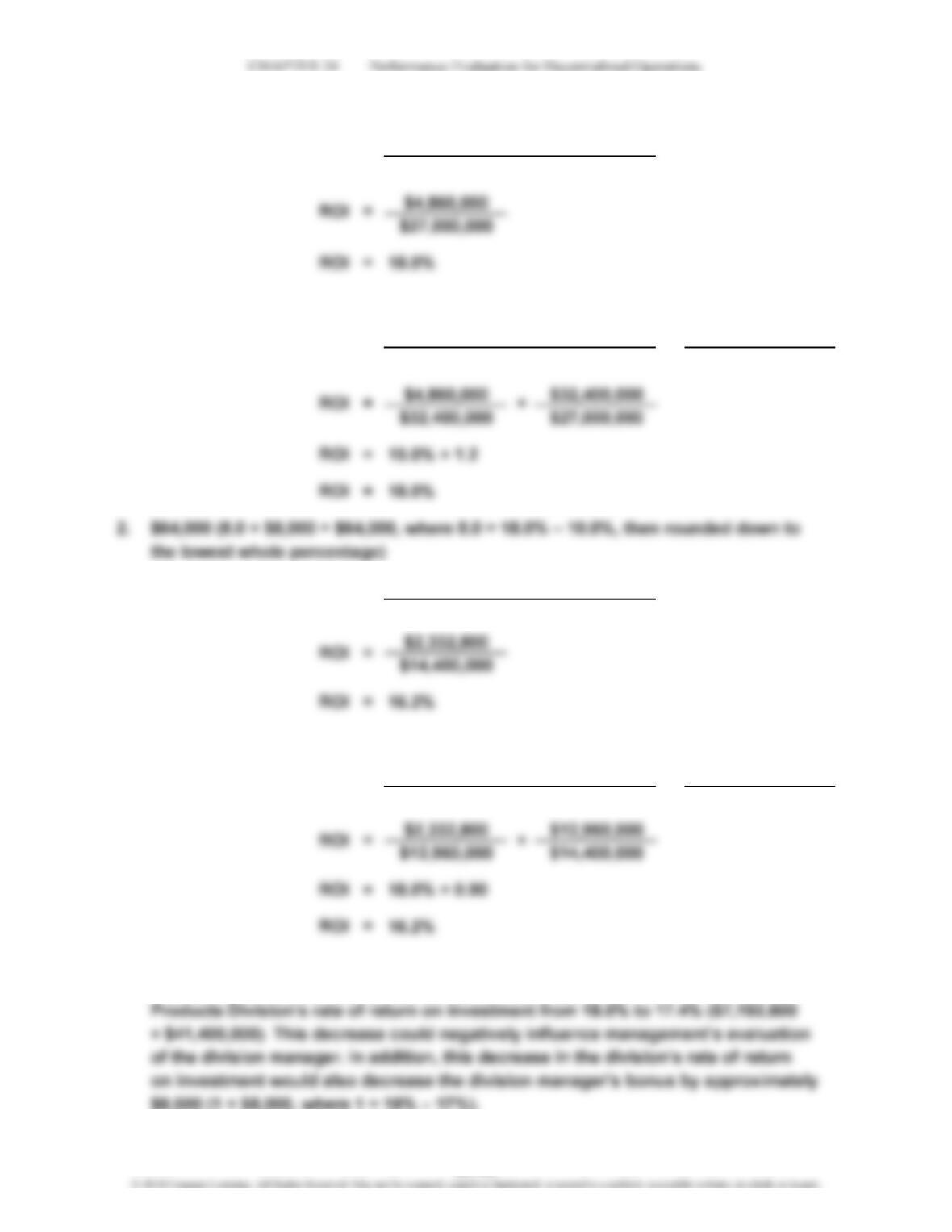
4. Even though the addition of the new product line would increase the overall
company rate of return on investment, its addition would decrease the Specialty
Income from Operations × Sales
Sales Invested Assets
Rate of Return
on Investment =
3. Rate of Return
on Investment =Income from Operations
Invested Assets
1. =Invested Assets
Income from Operations
Rate of Return
on Investment
Sales
Invested Assets
Income from Operations ×
Sales
Rate of Return
on Investment =
24-49
CHAPTER 24 Performance Evaluation for Decentralized Operations
CP 24–5 (Concluded)
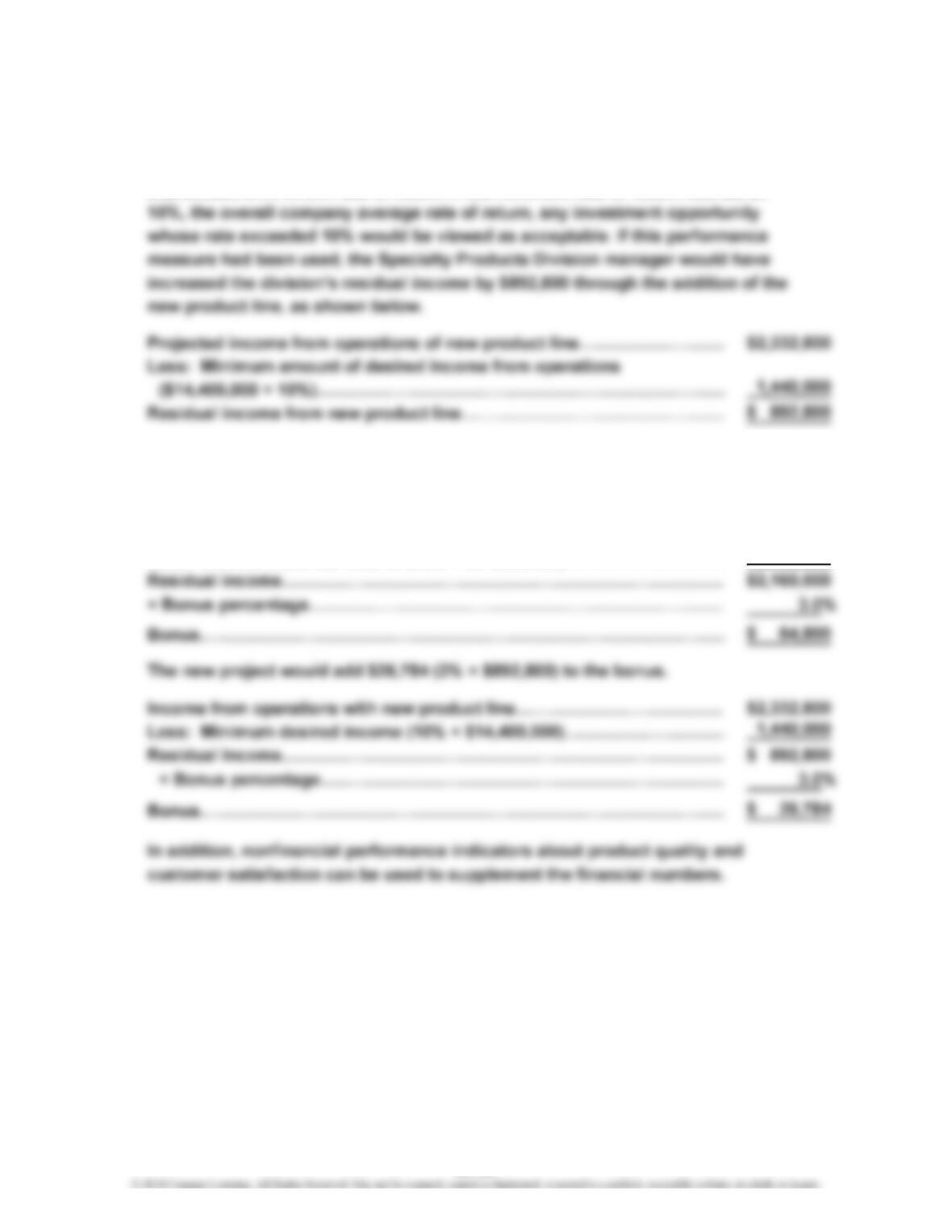
5. Use of residual income as a performance measure and as the basis for granting
bonuses would motivate division managers to accept investment opportunities
that exceed a minimum rate of return. If the minimum rate of return was set at
The manager’s bonus could then be calculated as a percent of residual income. In
this case, a bonus equal to 3% of residual income would achieve a bonus similar
to the initial plan:
Income from operations…………………………………………………………… $4,860,000
Less: Minimum desired income (10% × $27,000,000)………………………
…
2,700,000
…
24-50