Problem 24-2B (Continued)
Part 4
PROJECT A
Present Value of Net Cash Flows
Present
Present
Value of
Value of
Net Cash
Flows
1 at 8%
Annuity
Net Cash
Flows
Years 1-4 ……………………………………………….
3.3121
$330,879
Net present value …………………………………..
$ 90,879
PROJECT B
Present Value of Net Cash Flows
Present
Present
Value of
Value of
Net Cash
Flows
1 at 8%
Annuity
Net Cash
Flows
Years 1-3 ……………………………………………….
$105,900
2.5771
$272,915
Amount invested ……………………………………
(240,000)
Net present value …………………………………..
$ 32,915
Problem 24-3B (60 minutes)
Part 1
RESULTS USING STRAIGHT-LINE DEPRECIATION
(a)
Income
Before
Deprec.
(b)
Straight–
Line
Deprec.
(c)
Taxable
Income
(a) – (b)
(d)
40%
Income
Taxes
(e)
Net Cash
Flows
(a) – (d)
Year 1 ……………………….
$3,000
$3,600
$8,400
Year 3 ……………………….
12,000
6,000
6,000
2,400
9,600
Year 4 ……………………….
12,000
6,000
6,000
2,400
9,600
Year 5 ……………………….
12,000
6,000
6,000
2,400
9,600
Year 6 ……………………….
12,000
3,000
9,000
3,600
8,400
Part 2
RESULTS USING MACRS DEPRECIATION
(a)
Income
Before
Deprec.
(b)
MACRS
Deprec.
(c)
Taxable
Income
(a) – (b)
(d)
40%
Income
Taxes
(e)
Net Cash
Flows
(a) – (d)
Year 1 ……………………….
$12,000
$6,000
$ 6,000
$2,400
$ 9,600
Year 2 ……………………….
12,000
9,600
2,400
960
11,040
Year 3 ……………………….
12,000
5,760
6,240
2,496
9,504
Year 4 ……………………….
12,000
3,456
8,544
3,418
8,582
Year 5 ……………………….
12,000
3,456
8,544
3,418
8,582
Year 6 ……………………….
12,000
1,728
10,272
4,109
7,891
Problem 24-3B (Continued)
Part 3
NET PRESENT VALUE OF ASSET USING STRAIGHT-LINE DEPRECIATION
Present
Present
Net Cash
Value of
Value of Net
Flows
1 at 10%
Cash Flows
Year 1 …………………………………………………..
$ 8,400
0.9091
$ 7,636
Year 2 …………………………………………………..
9,600
0.8264
7,933
Year 3 …………………………………………………..
9,600
0.7513
7,212
Year 4 …………………………………………………..
9,600
0.6830
6,557
Year 5 …………………………………………………..
9,600
0.6209
5,961
Totals …………………………………………………..
$55,200
$40,041
Part 4
NET PRESENT VALUE OF ASSET USING MACRS DEPRECIATION
Present
Present
Net Cash
Value of
Value of Net
Flows
1 at 10%
Cash Flows
Year 1 …………………………………………………..
$ 9,600
0.9091
$ 8,727
Year 2 …………………………………………………..
11,040
0.8264
9,123
Year 3 …………………………………………………..
9,504
0.7513
7,140
Year 4 …………………………………………………..
8,582
0.6830
5,862
Year 5 …………………………………………………..
8,582
0.6209
5,329
Year 6 …………………………………………………..
7,891
0.5645
4,454
Totals …………………………………………………..
$55,199
$40,635
Amount invested …………………………………..
(30,000)
Net present value ………………………………….
$10,635
Part 5
Analysis: The net present value using MACRS depreciation is greater than the
net present value using straight-line depreciation because the cash flows are
larger in the earlier years of the asset’s life under MACRS depreciation. They
are larger because the depreciation deductions are larger, resulting in less
income taxes paid in the earlier years.
Problem 24-4B (45 minutes)
Part 1
Alternative 1: Keep the old freezer and have it repaired
Item
Period
Cash Flow
Present
Value Factor
at 10%
Present
Value of
Cash Flows
Revenues …………………………..
1 – 8
$63,000
5.3349
$ 336,099
Operating costs………………….
1 – 8
(55,000)
5.3349
(293,420)
Salvage value …………………….
8
3,000
0.4665
1,400
Total ………………………………….
44,079
Cost of repair ……………………..
(50,000)
Net present value ……………….
$ (5,921)
*Note that the cost of the old freezer is irrelevant because it is a sunk cost.
Part 2
Alternative 2: Sell the old freezer and buy a new one
Item
Period
Cash Flow
Present
Value Factor
at 10%
Present
Value of
Cash Flows
Part 3
Archer should sell the old freezer and buy a new one. The operating costs
of the old freezer are so much higher than that of the new freezer, even
after the old freezer has been repaired. Keeping the old freezer has a
negative net present value, and although the initial cash outlay is more to
buy the new freezer, it is the better investment.
Problem 24-5B (40 minutes)
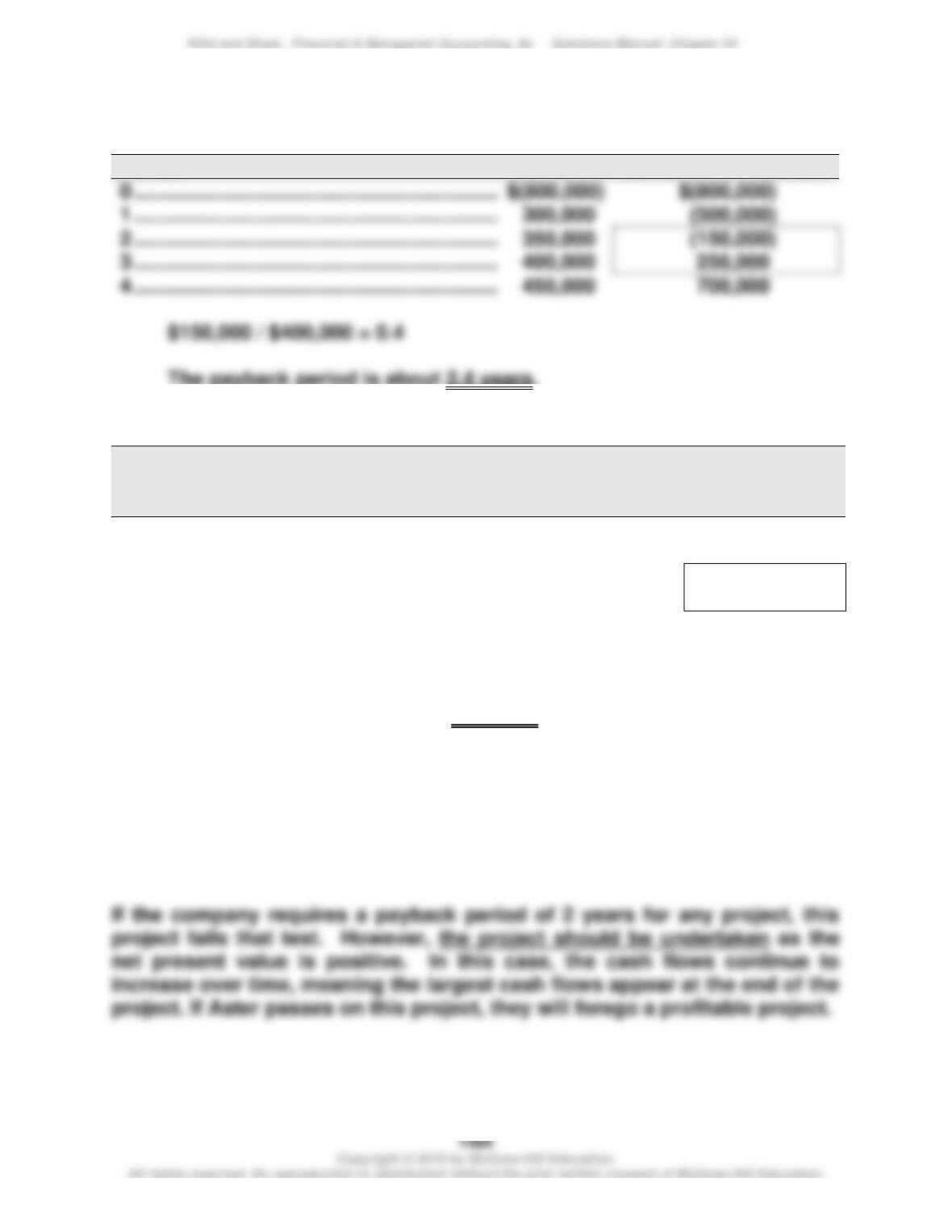
Part 1: Payback period
Period
Cash flow
Cumulative cash flow
0 …………………………………………………………………..
1 …………………………………………………………………..
2 …………………………………………………………………..
3 …………………………………………………………………..
4 …………………………………………………………………..
The payback period is about 2.4 years.
Part 2: Break-even time
Period
Cash Flow
Present Value
of 1 at 10%
Present Value
of Cash Flows
Cumulative
Present Value
of Cash Flows
0 ……………….
$(800,000)
1.0000
$(800,000)
$(800,000)
1 ……………….
300,000
0.9091
272,730
(527,270)
2 ……………….
350,000
0.8264
289,240
(238,030)
3 ……………….
400,000
0.7513
300,520
62,490
4 ……………….
450,000
0.6830
307,350
369,840
$238,030 / $300,520 = 0.8
The break-even time is about 2.8 years.
Part 3: Net present value
From the chart in part 2, we can see that the net present value of the
investment is $369,840.
Part 4
Problem 24-6B (40 minutes)
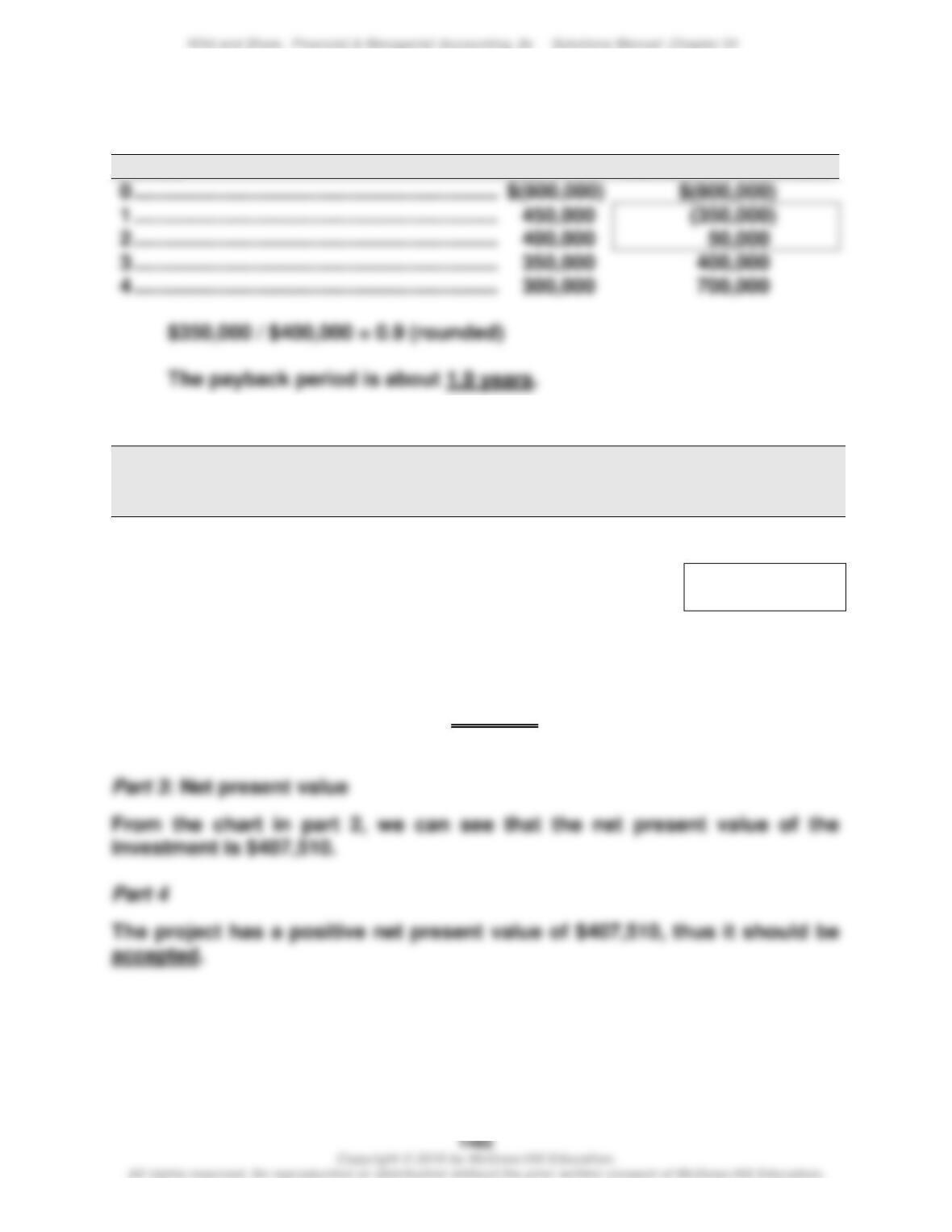
Part 1: Payback period
Period
Cash flow
Cumulative cash flow
0 …………………………………………………………………..
1 …………………………………………………………………..
2 …………………………………………………………………..
3 …………………………………………………………………..
4 …………………………………………………………………..
Part 2: Break-even time
Period
Cash Flow
Present Value
of 1 at 10%
Present Value
of Cash Flows
Cumulative
Present Value
of Cash Flows
0 ……………….
$(800,000)
1.0000
$(800,000)
$(800,000)
1 ……………….
450,000
0.9091
409,095
(390,905)
2 ……………….
400,000
0.8264
330,560
(60,345)
3 ……………….
350,000
0.7513
262,955
202,610
4 ……………….
300,000
0.6830
204,900
407,510
$60,345 / $262,955 = 0.2 (rounded)
The break-even time is about 2.2 years.
SERIAL PROBLEM — SP 24
Serial Problem, Business Solutions (50 minutes)
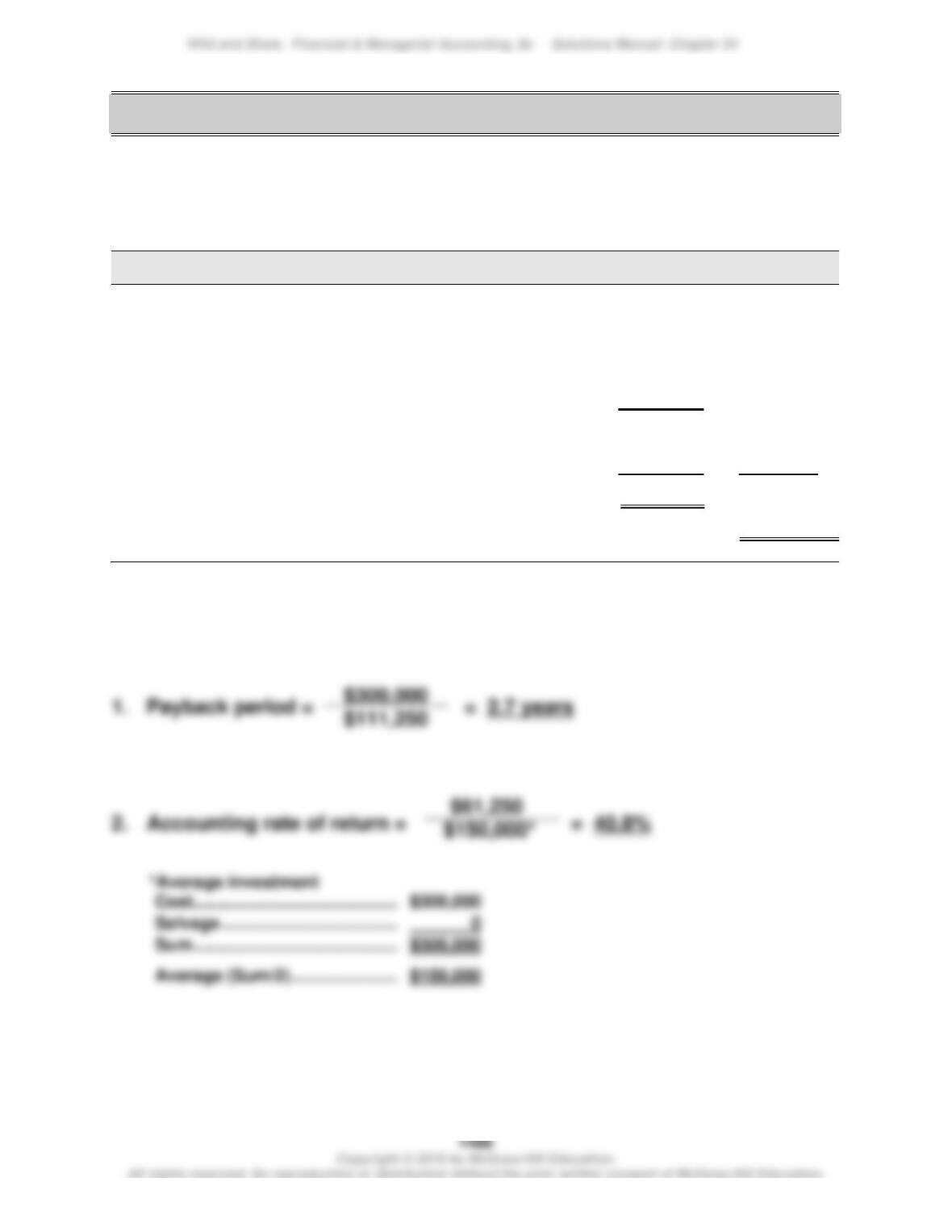
COMPUTING NET CASH FLOWS FROM NET INCOME
Net income
Cash flows
Sales ……………………………………………………………………..
$375,000
$375,000
Materials, labor & overhead ……………………………………
(200,000)
(200,000)
Depreciation* ……………………………………………………….
(50,000)
Selling and administrative ……………………………………..
(37,500)
(37,500)
Pretax income ……………………………………………………….
87,500
Income taxes (30%) ……………………………………………….
(26,250)
(26,250)
Net income ……………………………………………………….
$ 61,250
Net cash flows ……………………………………………………….
$111,250**
* Depreciation expense = $300,000 / 6 years = $50,000
** This equals the net income plus the depreciation expense ($61,250 + $50,000 = $111,250).
Company Analysis — AA 24-1
1. The internal rate of return (given here as 10%) is the rate which yields a
net present value of zero for an investment. The annuity factor for 10
periods and a discount rate of 10% is 6.1446. This means we can solve
for the amount of annual cash flows as follows:
$2.12 billion = Annual cash flows x 6.1446
Annual cash flows = $2.12 billion / 6.1446
Annual cash flows = $345,018,390 per year
For Apple’s initial investment of $2.12 billion to provide an internal rate
of return of 10% over 10 years, the investment must generate cash flows
of $345,018,390 per year for 10 years.
Comparative Analysis — AA 24-2
1. We know that the present value equals the annual cash flows times the
present value of an annuity factor for 7 periods, 15%. This means:
2. From its statement of cash flows (investing section), Google invested
$13,184 (millions) in capital assets in 2017.
3. Google invested more in capital assets in 2017 than Apple.
Global Analysis — AA 24-3
1. From its statement of cash flows for the year ended December 31, 2017,
Samsung invested 42,792,234 (in millions of Korean won) in acquisitions
of property, plant, and equipment in 2017.
Ethics Challenge — BTN 24-1
1. Present value of $100 to be received in 10 years assuming a 12%
discount rate is approximately $32. This is computed as $100 x 0.322.
2. We need to be concerned about any project with expected long-term
cash inflows. This is especially the case if the larger cash inflows are
expected later rather than sooner in the asset’s life. This concern is tied
to the riskiness of long-term predictions and the likely biases of
Communicating in Practice — BTN 24-2
Instructor note: Answers will vary, but responses should address the questions
asked and include some discussion of the following points for each method.
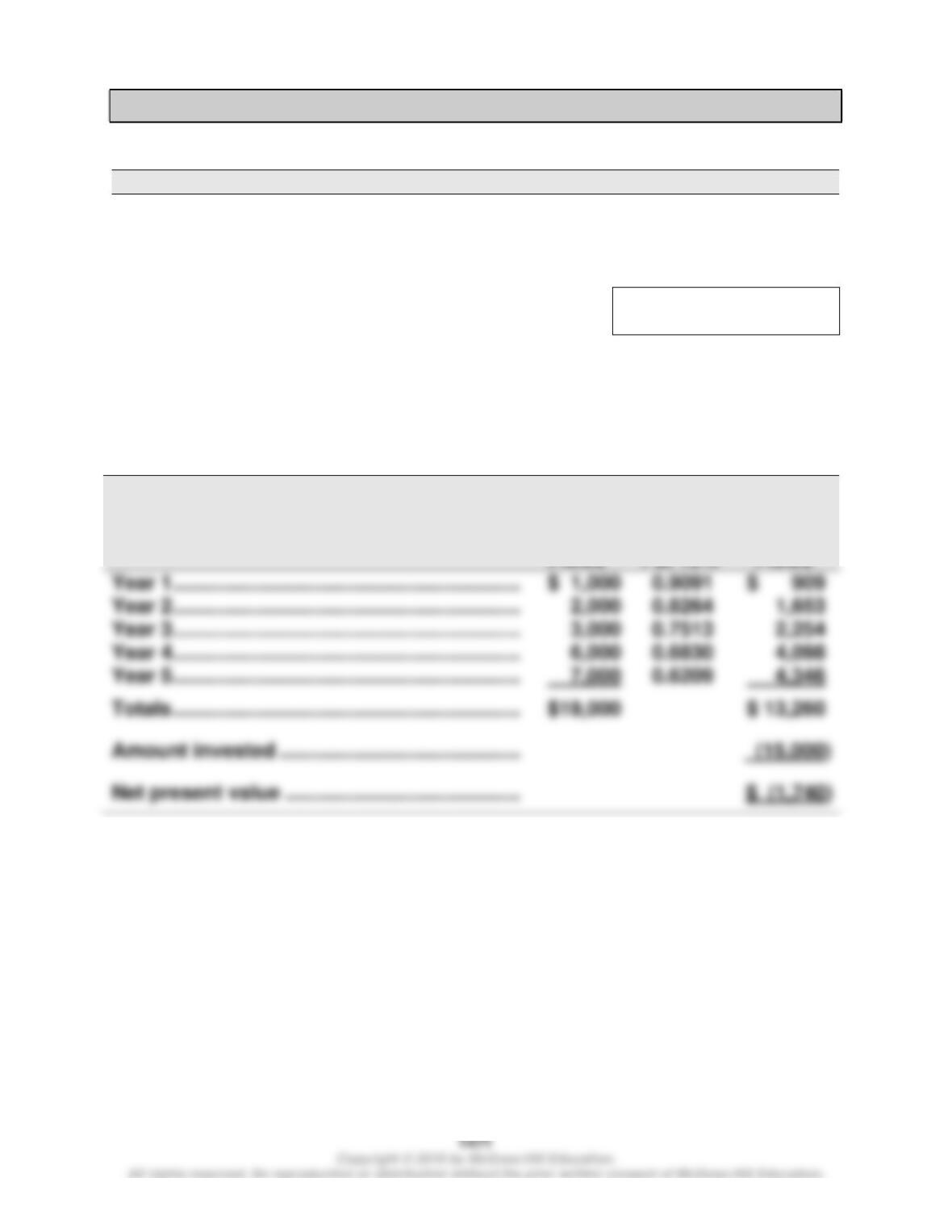
Payback Period
Accounting Rate
of Return
Net Present
Value
Internal Rate
of Return
Measurement
basis
• Cash flows
• Accrual income
• Cash flows
• Profitability
• Cash flows
• Profitability
Measurement
unit
• Periods
• Percent
• Dollars
• Percent
of project
Wild and Shaw, Financial & Managerial Accounting, 8e Solutions Manual: Chapter 24
Taking It to the Net — BTN 24-3
Period
Cash flow
Cumulative cash flow
0 …………………………………………………………………..
$(15,000)
$(15,000)
1 …………………………………………………………………..
1,000
(14,000)
2 …………………………………………………………………..
2,000
(12,000)
3 …………………………………………………………………..
3,000
(9,000)
4 …………………………………………………………………..
6,000
(3,000)
5 …………………………………………………………………..
7,000
4,000
$3,000/$7,000 = 0.43
The project has a payback period of 4.43 years, about 1.77 years more
than payback period for the original cash flows provided on the website.
Present
Present
Value of
Net Cash
1 at 10%
1,653
2,254
4,098
Value of
Net Cash
The investment with the revised cash flows now has a negative net present
value of $(1,740), as opposed to the positive net present value of $563
using the original cash flows provided on the website.
This analysis shows that receiving cash flows from an investment sooner
is more desirable rather than receiving them later.
Wild and Shaw, Financial & Managerial Accounting, 8e Solutions Manual: Chapter 24
Teamwork in Action — BTN 24-4
Instructor note: Answers will vary across students. Yet the examples, while
different, should capture similar qualitative factors.
SAMPLE SOLUTION
Project: Investment in an improved baggage handling system.
The new, improved baggage handling system is expected to increase both
customer satisfaction and likelihood of repeat business.
Qualitative Factors
• Competition has a new, more efficient and effective system.
• Need to replace old system.
Entrepreneurial Decision — BTN 24-5
1. Marco could use payback period, accounting rate of return, net present
value, and internal rate of return to evaluate whether this new
manufacturing facility and warehouse would be a good investment.
3.
Payback Period
Accounting Rate
of Return
Net Present
Value
Internal Rate
of Return
Advantages
• Easy to
understand
• Allows
comparison of
projects
• Easy to
understand
• Allows
comparison of
projects
• Reflects
time value
of money
• Reflects
different
risk levels
over
project’s life
• Reflects
time value
of money
• Allows
compari-
sons of
dissimilar
projects
Hitting the Road — BTN 24-6
1. Answers will vary among students.
Sample Example
For illustrative purposes, one sample solution would appear as follows:
Lease terms—$400 per month for 35 months; plus $10,000 final
payment at the end of 35 months; 12% annual interest rate.
To compute the present value of the lease payments
PV of 35 payments of $400 per month discounted
at 1% (12%/12 months) ……………………………………………………….
$11,763*
PV of $10,000 final payment at end of 35 months
discounted at 1% ………………………………………………………………….
7,059**
Total PV of lease ……………………………………………………………………..
$18,822
* $400 x 29.4086 (from Table B.3)
** $10,000 x 0.7059 (from Table B.1)
Purchase terms—$16,500