CHAPTER 24 Decentralized Operations
Prob. 24-3B (Concluded)
3. Per dollar of invested assets, the Electronic Brokerage Division is the most
profitable of the three divisions. Assuming that the return on investments do not
change in the future, an expansion of the Electronic Brokerage Division will return
24.0 cents (24.0%) on each dollar of invested assets, while the Mutual Fund and
Investment Banking divisions will return only 22.4 cents (22.4%) and 21.6 cents
(21.6%), respectively. Thus, when faced with limited funds for expansion,
management should consider an expansion of the Electronic Brokerage Division
CHAPTER 24 Decentralized Operations
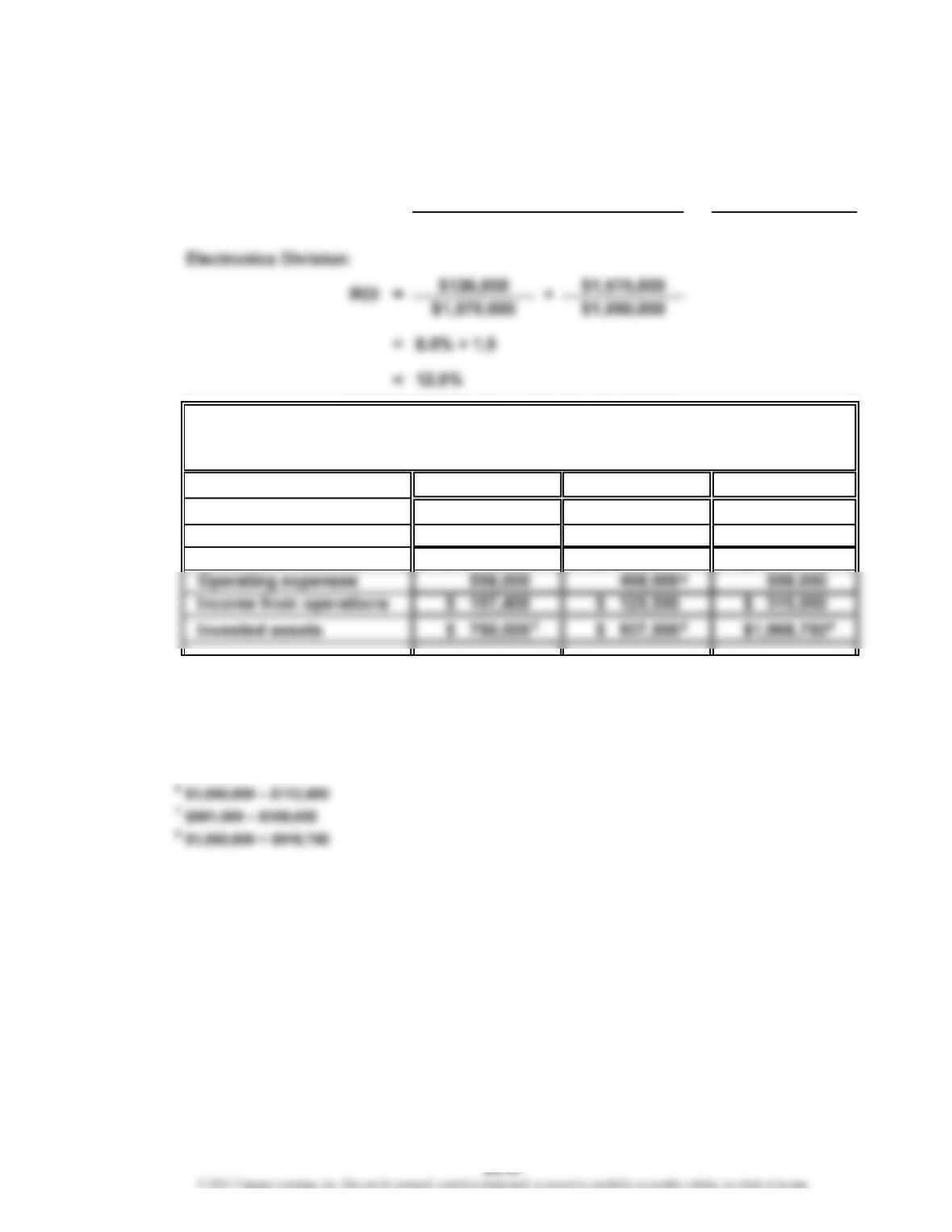
Prob. 24-4B
2.
Sales
Cost of goods sold
Gross profit
1
$891,000 – $31,400
2
$1,050,000 – $300,000
3
$1,575,000 – $180,000
4
$891,000 – $119,550
5
$558,000 – $60,000
Return on
Investment (ROI)
Return on
Investment (ROI)
Sales
=
859,600
$ 873,000
Proposal 1
For the Year Ended December 31
Proposal 2
$ 715,400
Gihbli Industries Inc.—Electronics Division
Estimated Income Statements
$1,575,000
Proposal 3
$1,575,000
1. =
771,450 702,000
$1,395,000
$ 623,550
Sales
Income from Operations ×
Profit Margin × Investment Turnover
Invested Assets
1
3
4
7
CHAPTER 24 Decentralized Operations
Prob. 24-4B (Concluded)
$125,550 $1,395,000
$1,395,000 $937,500
= 9.0% × 1.5
= 13.5%
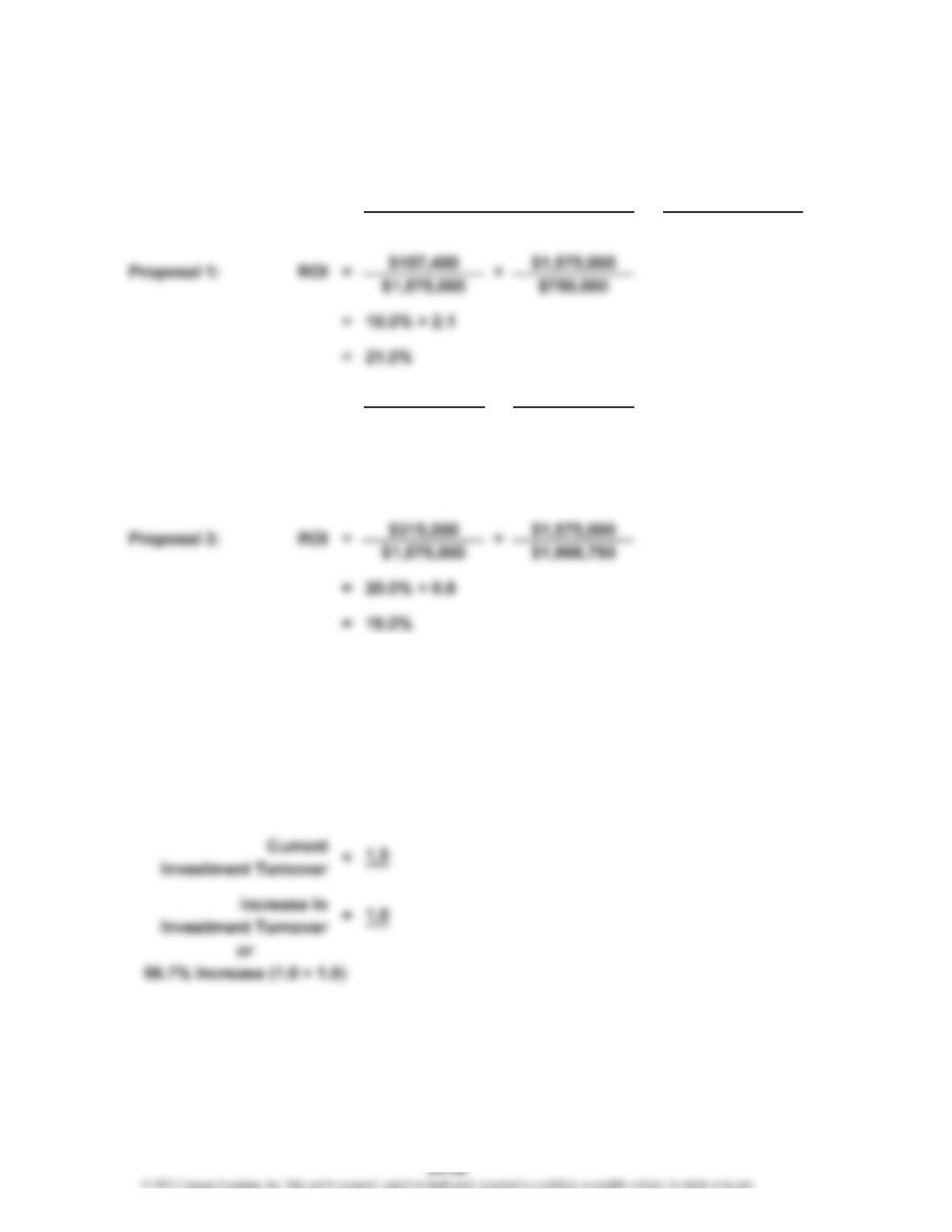
4. Proposal 1 would yield a rate of return on investment of 21.0%.
5.
=
Return on
Investment (ROI)
Return on
Investment (ROI)
Return on
Required
3. = Profit Margin × Investment Turnover
8% × Required Investment Turnover
Sales
20%
Profit Margin × Required Investment Turnover
=
= ×
Sales
×
Income from Operations
Invested Assets
2.5 (20% ÷ 8%) rounded
ROI =
=
Proposal 2:
Investment (ROI)
Investment Turnover
CHAPTER 24 Decentralized Operations
Prob. 24-5B
1.
Sales
Mountain Bike Division:
$123,200 $1,760,000
$1,760,000 $800,000
= 7.0% × 2.2
= 15.4%
$1,760,000
Free Ride Bike Company
Divisional Income Statements
For the Year Ended December 31, 20Y7
BikeBike
Road Mountain
Division Division
$1,728,000
2. = Profit Margin × Investment Turnover
ROI = ×
Invested Assets
=
Return on
Investment (ROI)
Return on
Investment (ROI)
SalesIncome from Operations ×
Sales
CHAPTER 24 Decentralized Operations
Prob. 24-5B (Concluded)
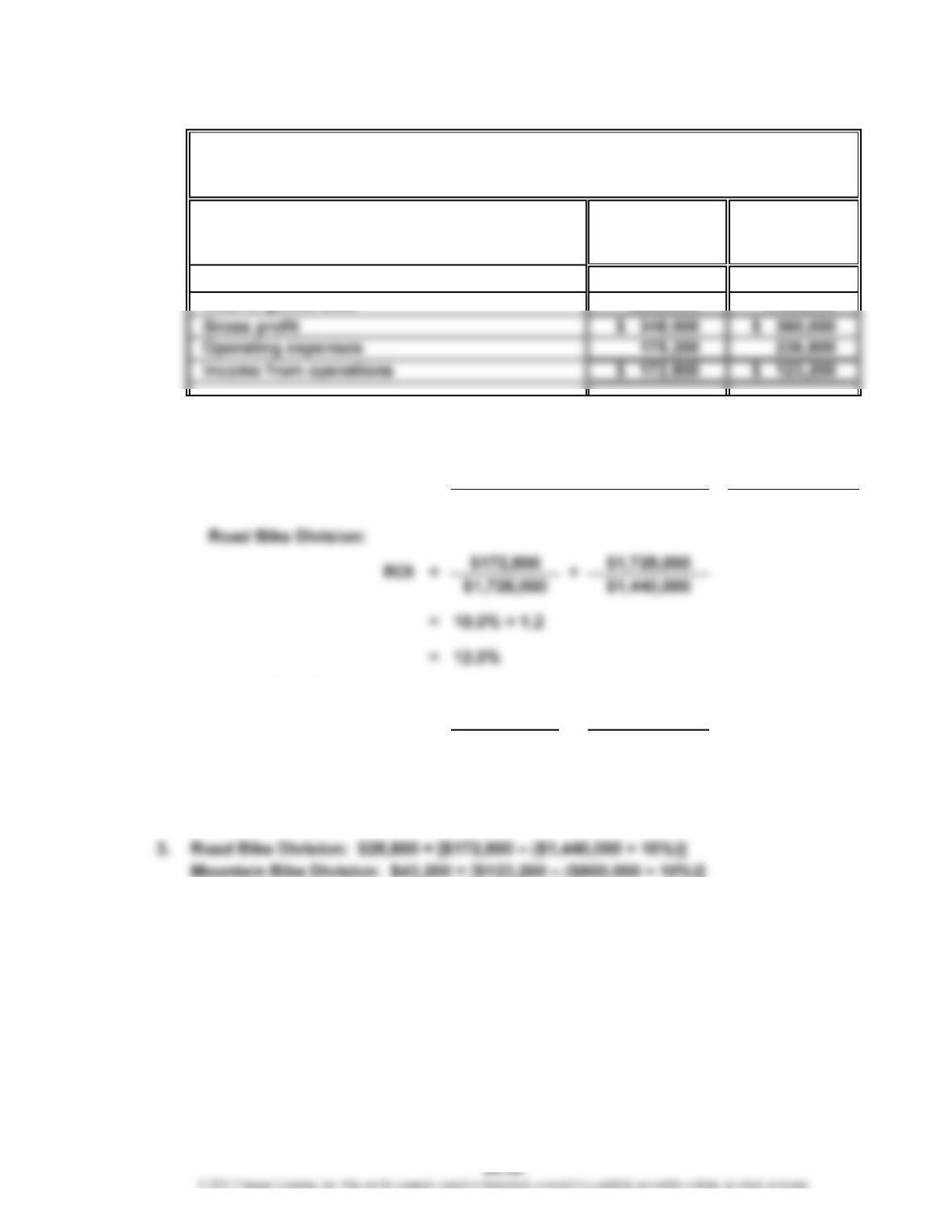
4. On the basis of income from operations, the Road Bike Division generated
$49,600 ($172,800 – $123,200) more income from operations than did the Mountain
Bike Division. However, income from operations does not consider the amount of
invested assets in each division. On the basis of the return on investment, the
Road Bike Division earned 12.0 cents (12.0%) on each dollar of invested assets, while
the Mountain Bike Division earned 15.4 cents (15.4%) on each dollar of invested
assets. Although the profit margin of the Road Bike Division exceeds the Mountain
CHAPTER 24 Decentralized Operations
Prob. 24-6B
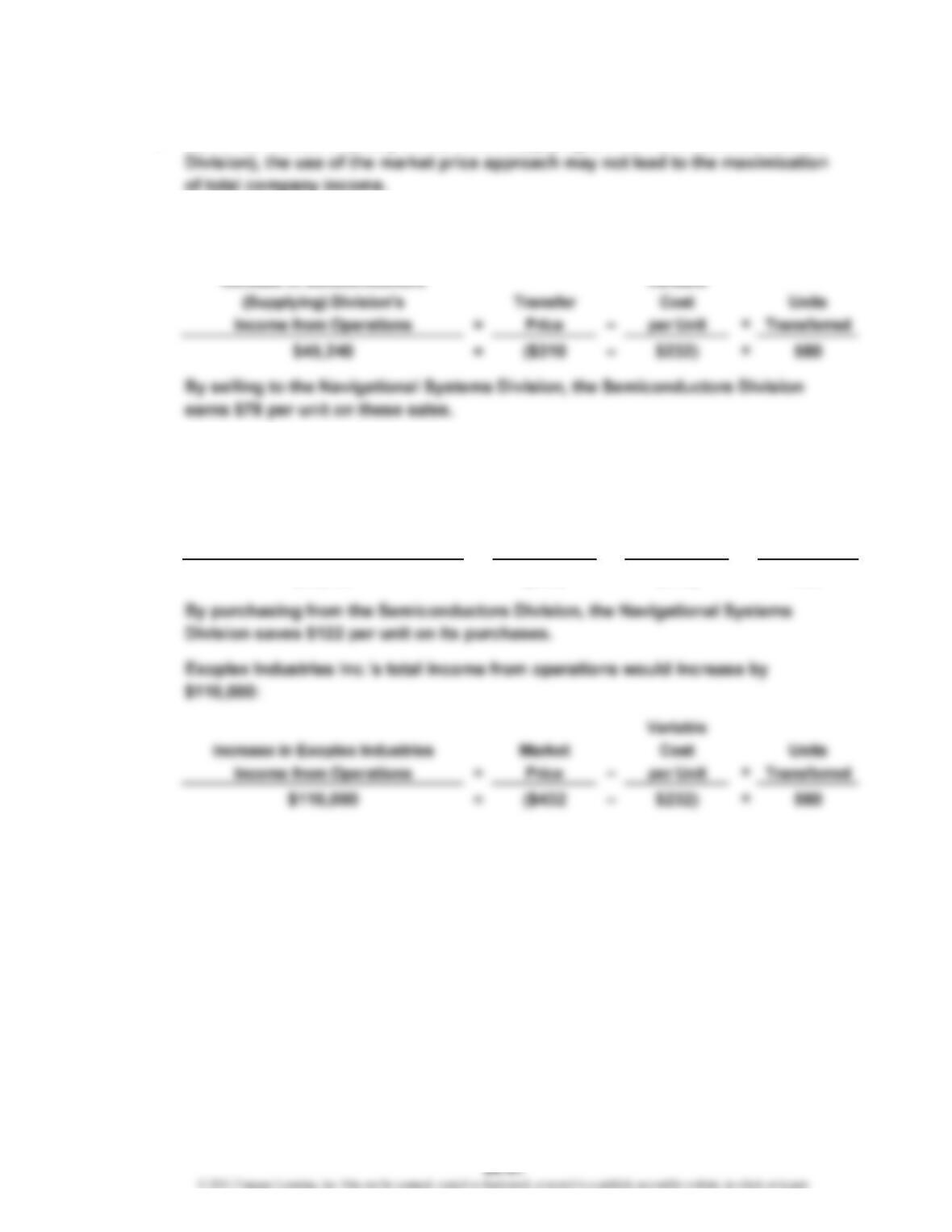
1. No. When unused capacity exists in the supplying division (the Semiconductors
2. The Semiconductors Division’s income from operations would increase by
$45,240:
The Navigational Systems Division’s income from operations would increase
by $70,760:
Increase in Navigational Systems
(Purchasing) Division’s Market Transfer Units
Income from Operations = Price – Price × Transferred
$70,760 =($432 –$310) × 580
The increase in total company income from operations is also equal to the sum
of the increases in the division incomes from operations.
CHAPTER 24 Decentralized Operations
Prob. 24-6B (Continued)
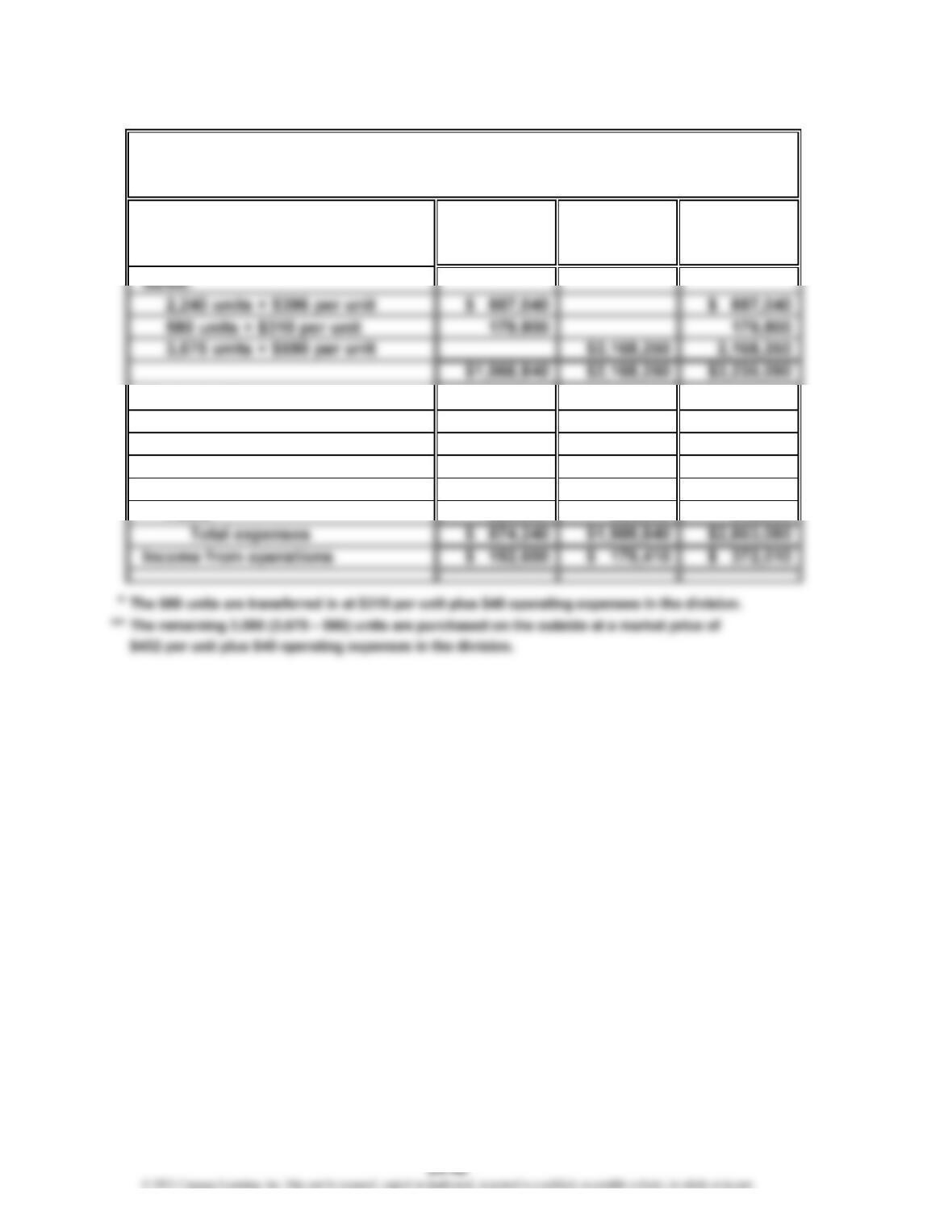
3.
Semi- Navigational
conductors Systems
Division Division Total
Expenses:
Variable:
2,820 units × $232 per unit $ 654,240 $ 654,240
580 units × $350* per unit $ 203,000 203,000
3,095 units × $472** per unit 1,460,840 1,460,840
Exoplex Industries Inc.
Divisional Income Statements
For the Year Ended December 31, 20Y8
CHAPTER 24 Decentralized Operations
Prob. 24-6B (Concluded)
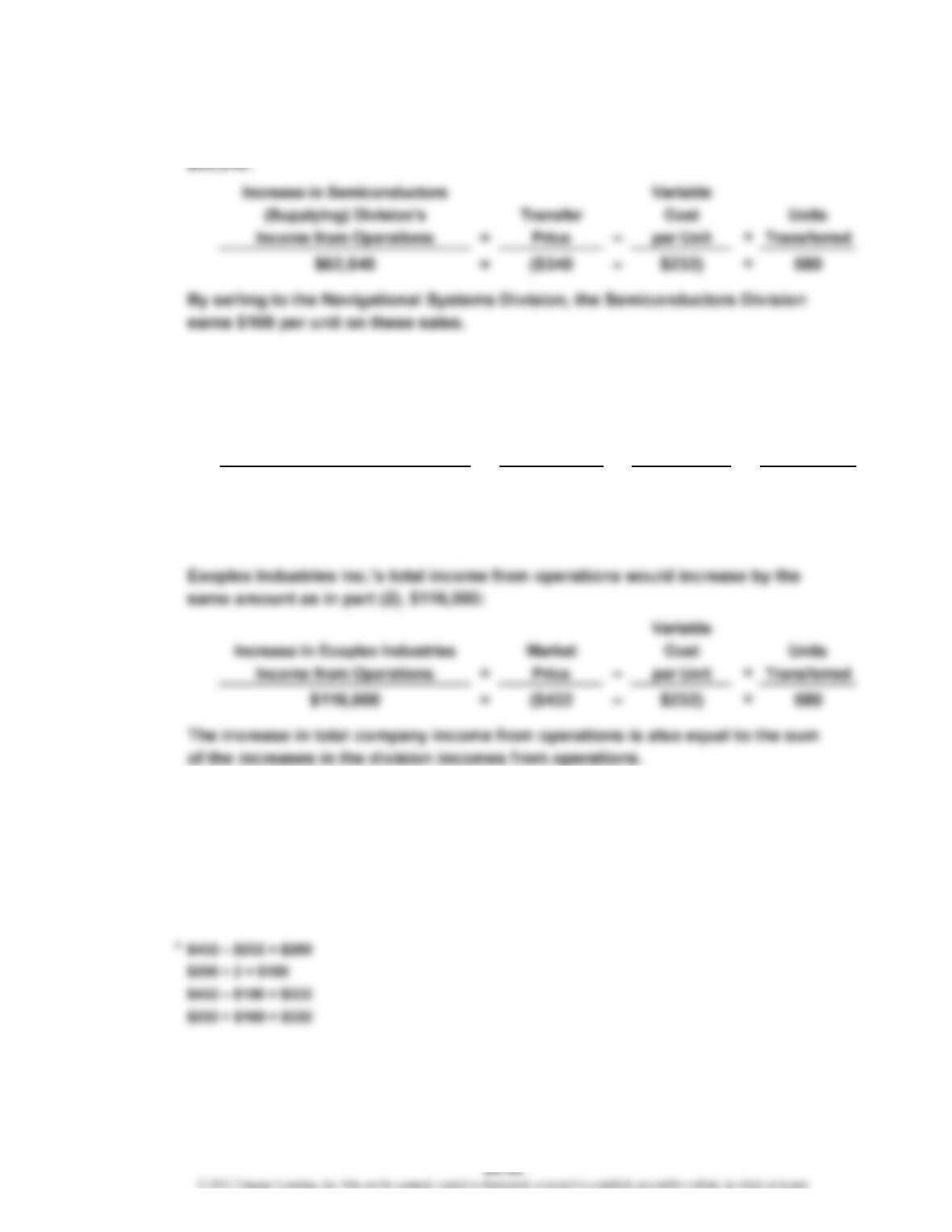
4. The Semiconductors Division’s income from operations would increase by
The Navigational Systems Division’s income from operations would increase
by $53,360:
Increase in Navigational Systems
(Purchasing) Division’s Market Transfer Units
Income from Operations = Price – Price × Transferred
$53,360 =($432 –$340) × 580
By purchasing from the Semiconductors Division, the Navigational Systems
Division saves $92 per unit on its purchases.
5. a. Any transfer price greater than the Semiconductors Division’s variable
expenses per unit of $232 but less than the market price of $432 would be
acceptable.
b. If the division managers cannot agree on a transfer price, a price of $332*
would be the best compromise. In this way, each division’s income from
operations would increase by $58,000.
CHAPTER 24 Decentralized Operations
CP 24-1
This scenario is a negotiation between two divisions. Dave is not behaving unethically
by attempting to get a better price from the Semiconductor Division than from the
market. He is not behaving unethically because he refuses market price. This may not
seem “fair,” but price negotiation is a very typical business activity and is part of
Dave’s job. It would be unethical only if the X-ray Division refused to deal with the
Because the X-ray Division has overall profit responsibility and authority, this means
that the X-ray Division has the choice of purchasing from the inside or the outside. The
X-ray Division should have incentives to purchase from the inside in order to maximize
overall corporate income. This means that the transfer price should be set below
market price in order to give Dave an incentive to purchase from the Semiconductor
Division. Howard’s refusal to budge on market price will likely hurt the Semiconductor
CASES & PROJECTS
CHAPTER 24 Decentralized Operations
CP 24-2
Examples of balanced scorecard metrics employed by Mobil’s North America
Marketing and Refining are provided below.
Custome
r
Internal
Innovation Service Process Financial
Employee survey Market share New product Return on capital
return on employed (ROCE)
investment (ROI)
Personal balanced Mystery shopper New product Cash flow
scorecard rating acceptance rate
Strategic Dealer gross Dealer quality Net margin rank
competency profit growth score vs. competition
availability
CP 24-3
Memo
To: Tom Yang
From: Ima Student
Re: Norsk Division Financial Performance
The Norsk Division’s revenues, gross profit, and income from operations have
increased significantly from 20Y6 to 20Y8. While these increases indicate that the
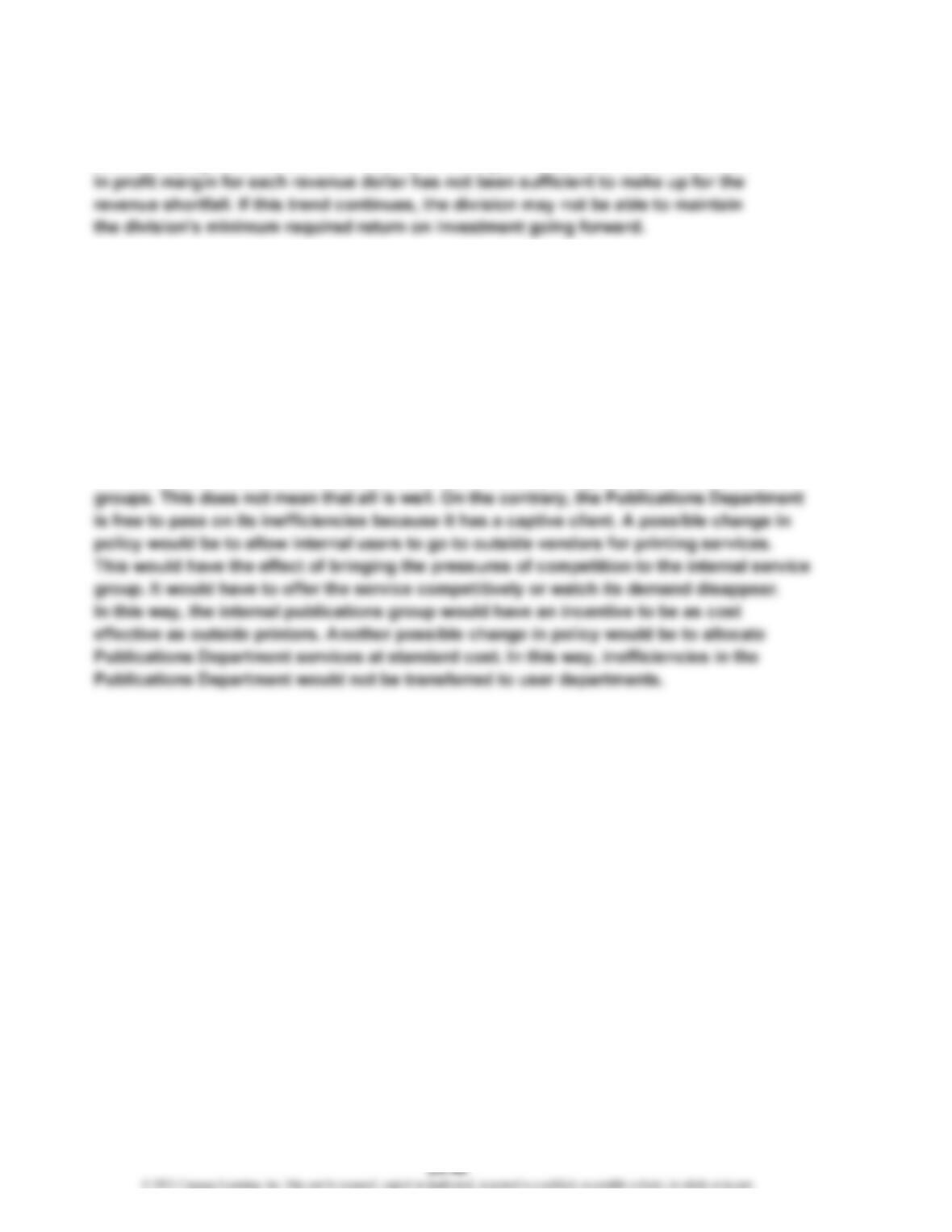
division is growing profitability, return on investment is falling. The division’s
profit margin, investment turnover, and return on investment are as follows:
Mobil North America Marketing and Refining
Balanced Scorecard Dimension
CHAPTER 24 Decentralized Operations
CP 24-3 (Concluded)
revenue has not even doubled. Revenues are not growing fast enough to support
the underlying asset investment. While profit margins have improved, the increase
CP 24-4
The Customer Service Department head is responsible for the quantity of service but
not the source of the service (i.e., not the price). Most accountants would hold the
department head responsible for the cost by transferring the cost of the brochures to
the Customer Service Department, even though the price is 25% higher than could be
obtained from the outside. This may not seem fair, but it does control the use of internal
services to some degree. If there were no internal transfer price, departments would
view the Publications Department as a “free good.” This would likely result in an
overdemand for the service because there would be no pricing discipline on the user
CHAPTER 24 Decentralized Operations
CP 24-5
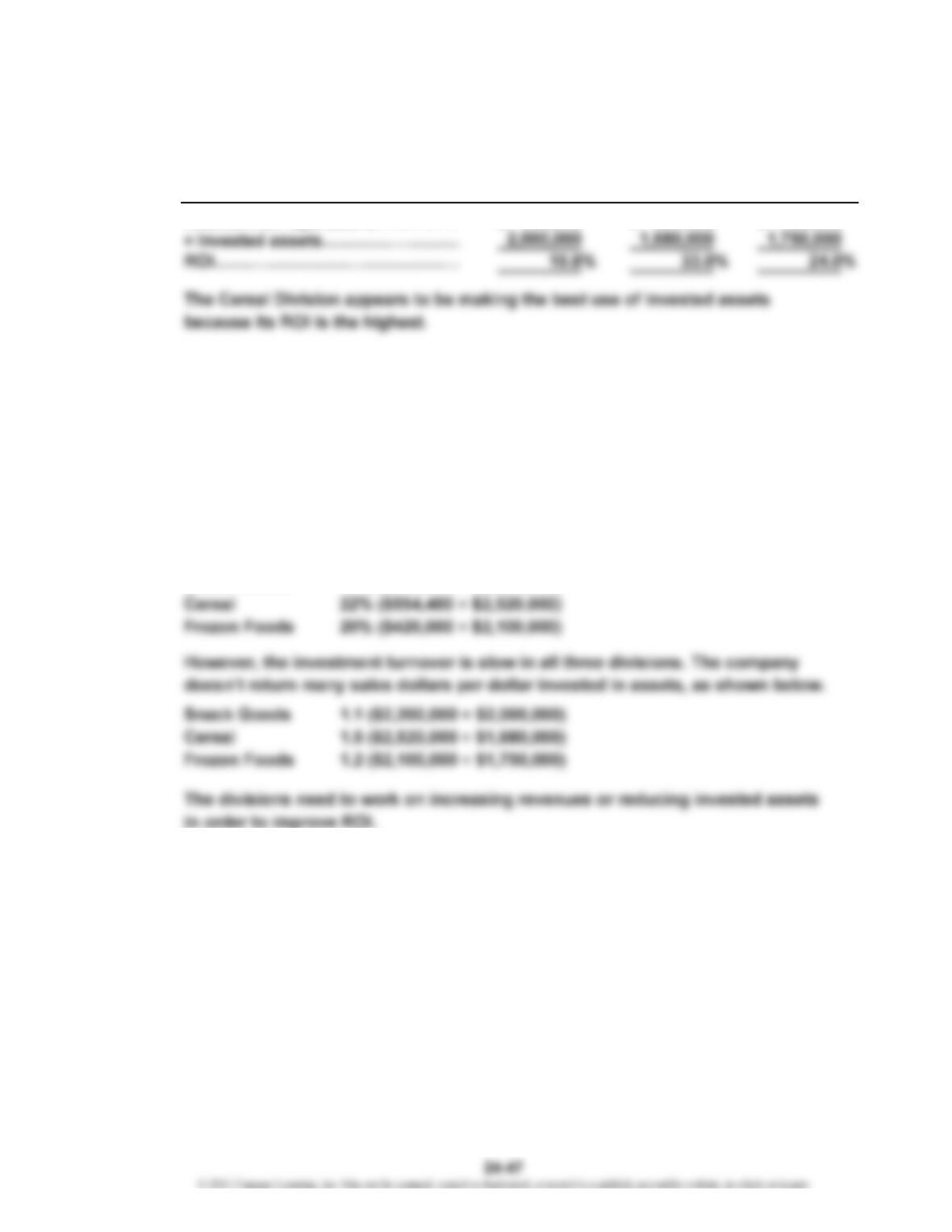
1. The rate of return on invested assets is computed as follows:
Snack Frozen
Goods Cereal Foods
Income from operations…………… $ 396,000 $ 554,400 $ 420,000
2. Not all projects that have a greater than 19% rate of return would be accepted.
This is because all three divisions have an ROI that is greater than 19%. Thus, any
project that is accepted between the 19% minimum and their existing ROI would
cause their ROI to drop. This is true because of averaging. There would be little
incentive to accept such projects if the divisions know they are competing against
each other on the basis of ROI.
3. There are two approaches to improving ROI: (1) improving the profit margin or
(2) improving the investment turnover. For all three divisions, the profit margin
is excellent:
Snack Goods 18% ($396,000 ÷ $2,200,000)
CP 24-6
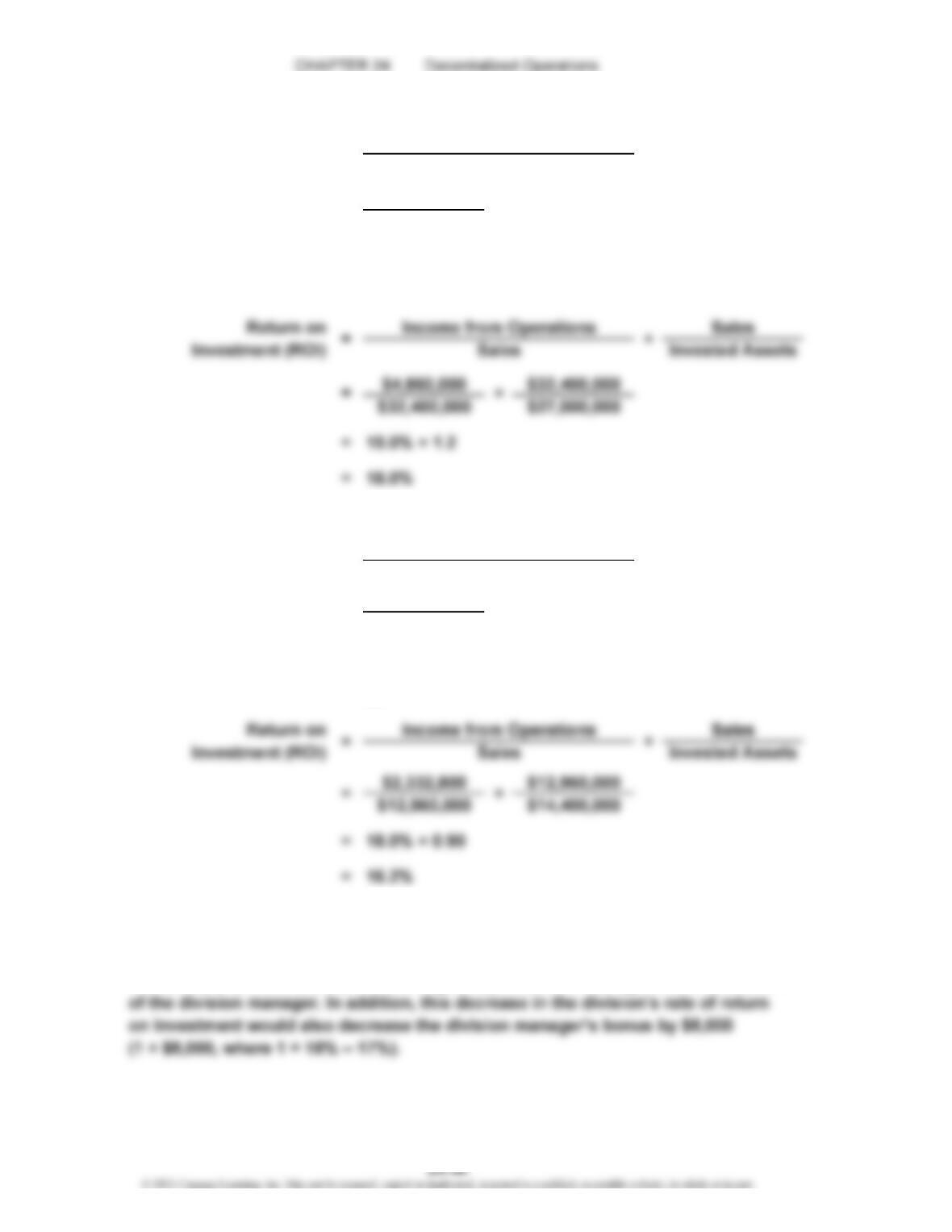
$4,860,000
$27,000,000
= 18.0%
or
2. $64,000 (8.0 × $8,000 = $64,000, where 8.0 = 18.0% – 10.0%)
$2,332,800
$14,400,000
= 16.2%
or
4. Even though the addition of the new product line would increase the overall
company return on investment, its addition would decrease the Specialty
Products Division’s rate of return on investment from 18.0% to 17.4% ($7,192,800
÷ $41,400,000). This decrease could negatively influence management’s evaluation
=
3. =Income from Operations
Invested Assets
Return on
Investment (ROI)
1. =Invested Assets
Income from OperationsReturn on
Investment (ROI)
=
CHAPTER 24 Decentralized Operations
CP 24-6 (Concluded)
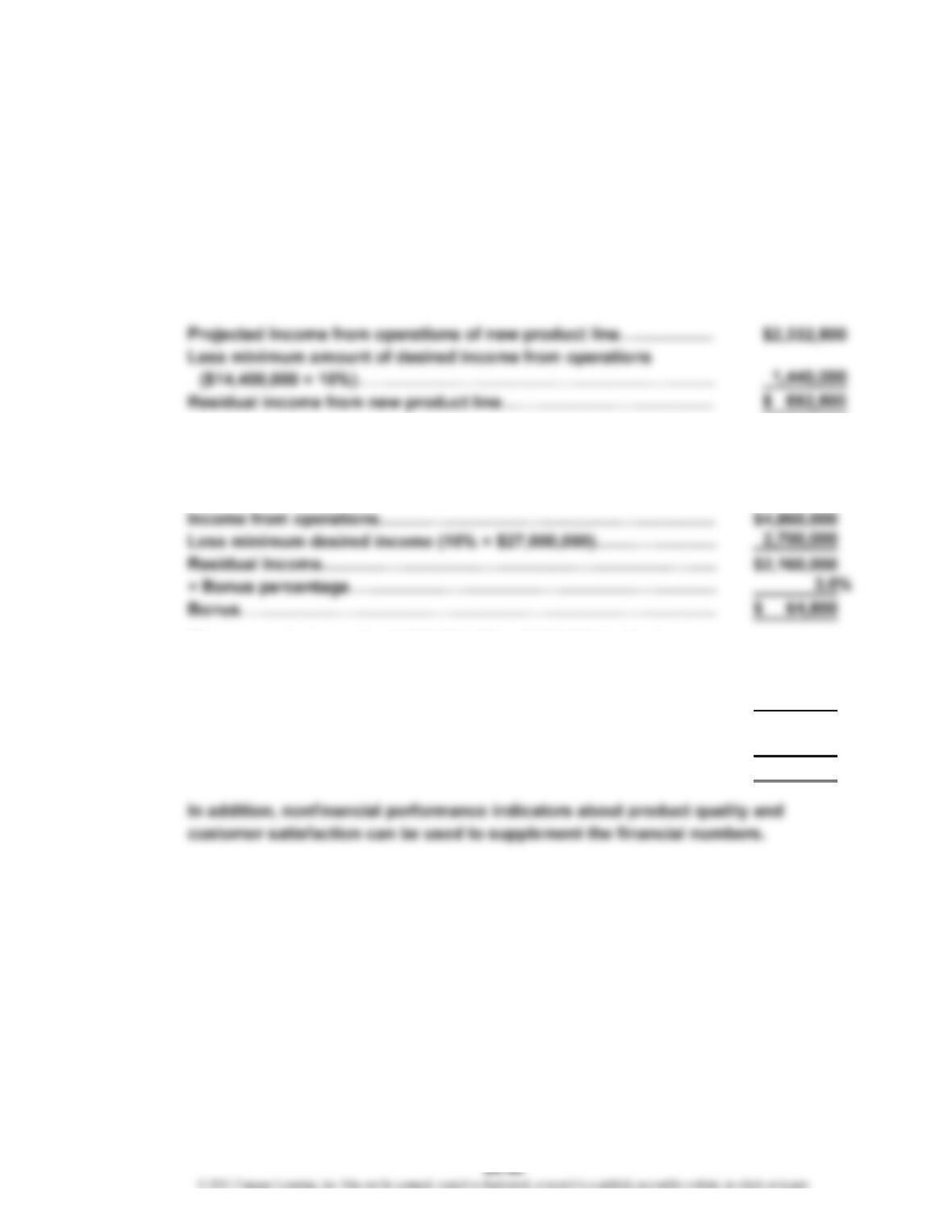
5. Use of residual income as a performance measure and as the basis for granting
bonuses would motivate division managers to accept investment opportunities
that exceed a minimum rate of return. If the minimum rate of return was set at
10%, the overall company average rate of return, any investment opportunity
whose rate exceeded 10% would be viewed as acceptable. If this performance
measure had been used, the Specialty Products Division manager would have
increased the division’s residual income by $892,800 through the addition of the
new product line, as shown below.
The manager’s bonus could then be computed as a percent of residual income. In
this case, a bonus equal to 3% of residual income would achieve a bonus similar
to the initial plan:
…
…
…
…
The new project would add $26,784 (3% × $892,800) to the bonus.
Income from operations with new product line………………………
…
$2,332,800
Less minimum desired income (10% × $14,400,000)…………………
…
1,440,000
Residual income……………………………………………………………
…
$ 892,800
× Bonus percentage………………………………………………………
…
3.0%
Bonus…………………………………………………………………………
…
$ 26,784