g.
844,920
h.
Overhead Spending Variance (favorable) ………………………………………
Overhead Volume Variance (favorable) ………………………………………….
Cost of Goods Sold ……………………………………………………
To close overhead variances to Cost of Goods Sold.
PROBLEM 24.4B
HANS ENTERPRISES (concluded)
Entry to close overapplied overhead to cost of goods sold:
Entry to transfer the 160 batches of crow bait produced in June to finished goods:
Finished Goods Inventory (at standard cost) …………………………………..
Work in Process Inventory (at standard cost) …………………………………….
To transfer 160 batches of crow bait to finished goods in June.
a. =
=
b. =
=
8,300 hours × ($15 – $14)
*Standard Hours Allowed = 10,000 cases × 0.80 hours/case = 8,000 hours
$8,300 Favorable
$15 per hour × (8,000 hours* – 8,300 hours)
-$4,500 (or $4,500 Unfavorable)
45 Minutes, Strong
Actual Quantity Used × (Standard Price – Actual Price)
34,000 gallons × ($1.32 – $1.28*)
Materials Price Variance
PROBLEM 24.5B
SMOOTH CORPORATION
Actual Labor Hours × (Standard Rate – Actual Rate)
Labor Rate Variance
$1,360 Favorable
*Actual Price per Pound = $43,520 ÷ 34,000 gallons = $1.28/gallon
-$5,280 (or $5,280 Unfavorable)
*Standard Quantity Allowed = 10,000 cases × 3.0 gallons/case = 30,000 gallons
c.
$ 5,252
d. (1) 39,600 *
Materials Quantity Variance (unfavorable) ……………………………………….
Materials Price Variance (favorable) ………………………………………………………….
Direct Materials Inventory (at actual cost) ……………………………………………………
To record the cost of direct materials charged to production.
(2) 120,000 *
4,500
Overhead Volume Variance (unfavorable) ……………………………………………
Manufacturing Overhead (at actual cost) …………………………………………………………
Overhead Spending Variance (favorable) ……………………………………………………….
To apply overhead to production.
Direct Labor (at actual cost) ………………………………………………………………………
Work in Process Inventory (at standard cost) …………………………………….
To record the cost of direct labor charged to production.
(4) 180,800
To transfer 10,000 cases to finished goods in June.
Overhead Volume Variance (unfavorable) ………………………………………………………
Cost of Goods Sold ………………………………………………………………………………..
Overhead Spending Variance (favorable) …………………………………..
PROBLEM 24.5B
SMOOTH CORPORATION (concluded)
Overhead variances:
$ 4,500
Costs Allowed
Fixed
Overhead
Costs Applied
Actual Overhead
Costs Incurred
Standard Overhead
Fixed
Work in Process Inventory (at standard cost) …………………………………..
8,300
Labor Rate Variance (favorable) …………………………………………………………………..
Work in Process Inventory (at standard cost) …………………………………………
Labor Efficiency Variance (unfavorable) ………………………………………
Finished Goods Inventory (at standard cost) ………………………………….
Work in Process Inventory (at standard cost) …………………………………………………
180,800*
40 Minutes, Strong PROBLEM 24.6B
MONOGLUT, INC.
a. Materials price variance:
Actual Quantity × (Standard Price – Actual Price)
(7,000 units × 13 ounces) × ($0.20/oz. – $0.22/oz.) (1,820)$ Unfavorable
Materials quantity variance:
Journal entry to record direct materials used in March:
Work in Process Inventory (7,000 units × 12 oz. × $0.20/oz.) 16,800
b. Labor rate variance:
Actual Hours × (Standard Hourly Rate – Actual Hourly Rate)
(7,000 units × 0.50 hr.) × ($12.00/hr. – $13.00/hr.) (3,500)$ Unfavorable
Labor efficiency variance:
Journal entry to record direct labor cost for March:
Work in Process Inventory (7,000 units × 0.6 hr. × $12/hr.) 50,400
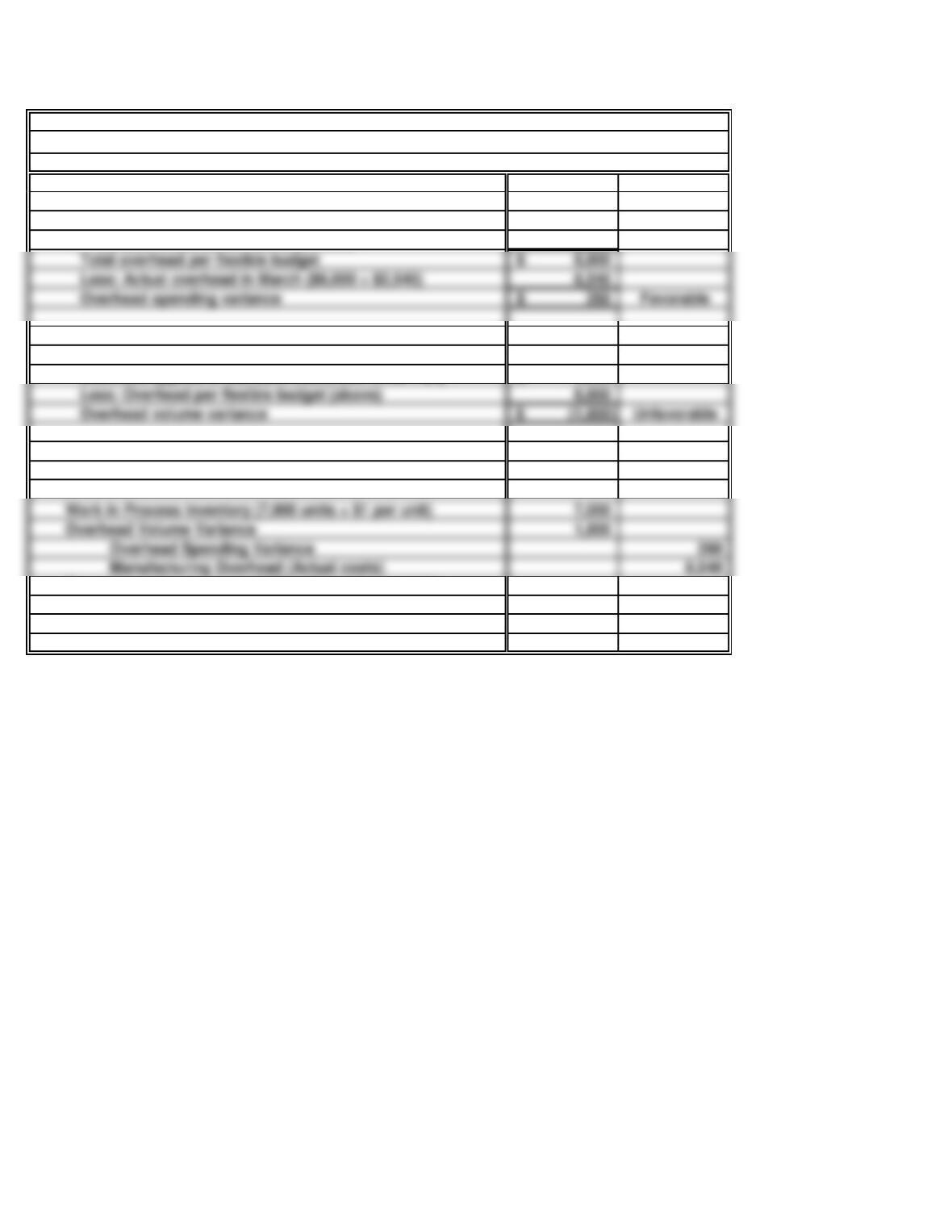
c. Overhead spending variance:
Overhead per flexible budget—7,000 units:
Fixed 6,000$
Variable (7,000 units × $0.40 per unit) 2,800
Overhead volume variance:
Overhead applied at standard cost (7,000 units × $1) 7,000$
Journal entry to record overhead applied to work in process:
To apply overhead cost to 7,000 units produced at the
standard rate of $1 per unit.
PROBLEM 24.6B
MONOGLUT, INC. (concluded)
PROBLEM 24.7B
COLONIAL FURNITURE CO.
a. (1)
(2)
$1.50/ft. × -9,000 ft.
Standard Price × (Standard Quantity – Actual Quantity)
-$13,500 (or $13,500 Unfavorable)
$1.50/ft. × [(1,800 units × 100 ft.) – (189,000 ft.)]
(3)
Actual Hours × (Standard Hourly Rate – Actual Hourly Rate)
(1,800 units × 4.5 hrs.) × ($10.00/hr. – $9.00/hr.)
8,100 hrs. × $1.00
$8,100 Favorable
(4)
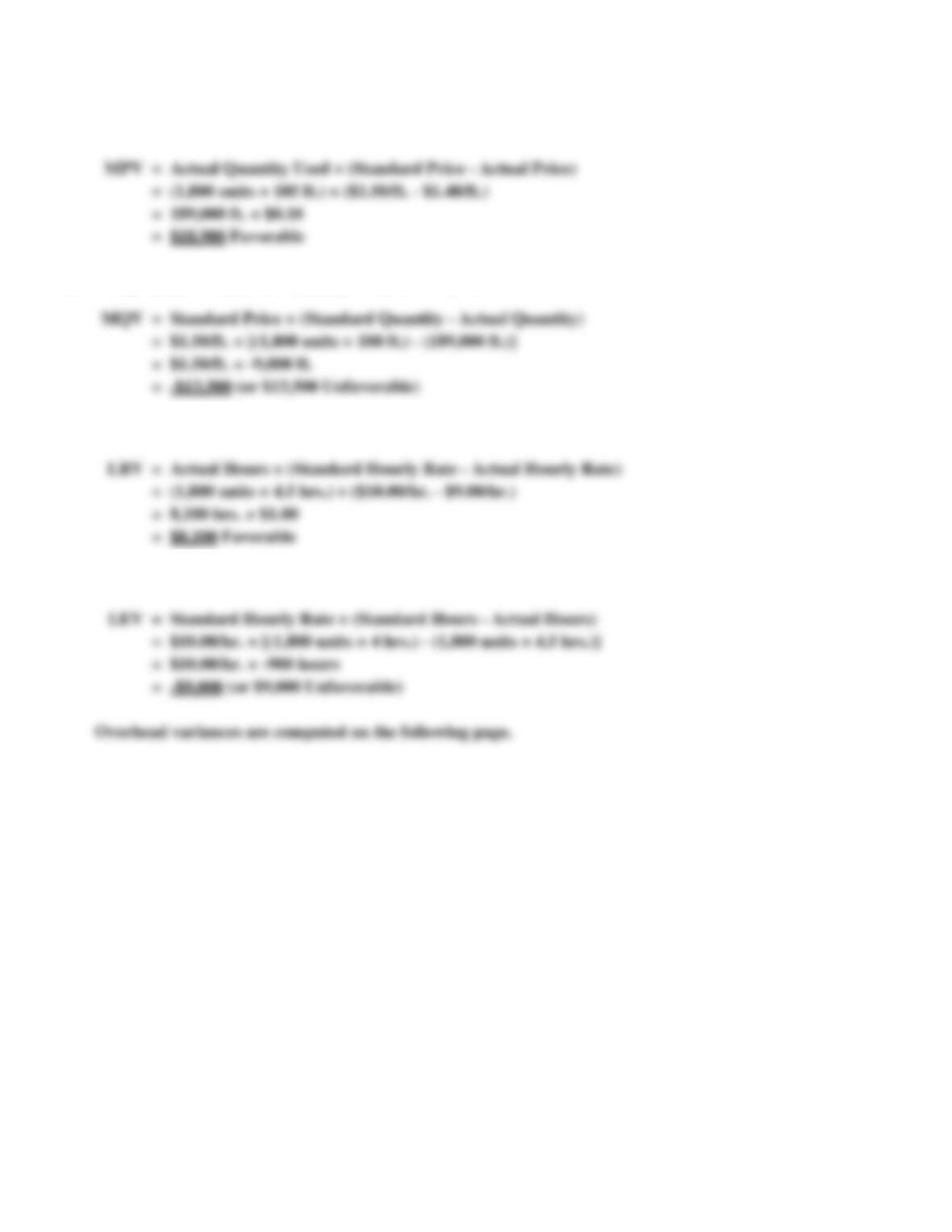
Overhead variances are computed on the following page.
-$9,000 (or $9,000 Unfavorable)
$10.00/hr. × -900 hours
Standard Hourly Rate × (Standard Hours – Actual Hours)
$10.00/hr. × [(1,800 units × 4 hrs.) – (1,800 units × 4.5 hrs.)]
40 Minutes, Strong
Computation of materials price variance (MPV):
Computation of labor efficiency variance (LEV):
Computation of labor rate variance (LRV)
Computation of materials quantity variance (MQV):
$18,900 Favorable
Actual Quantity Used × (Standard Price – Actual Price)
(1,800 units × 105 ft.) × ($1.50/ft. – $1.40/ft.)
189,000 ft. × $0.10
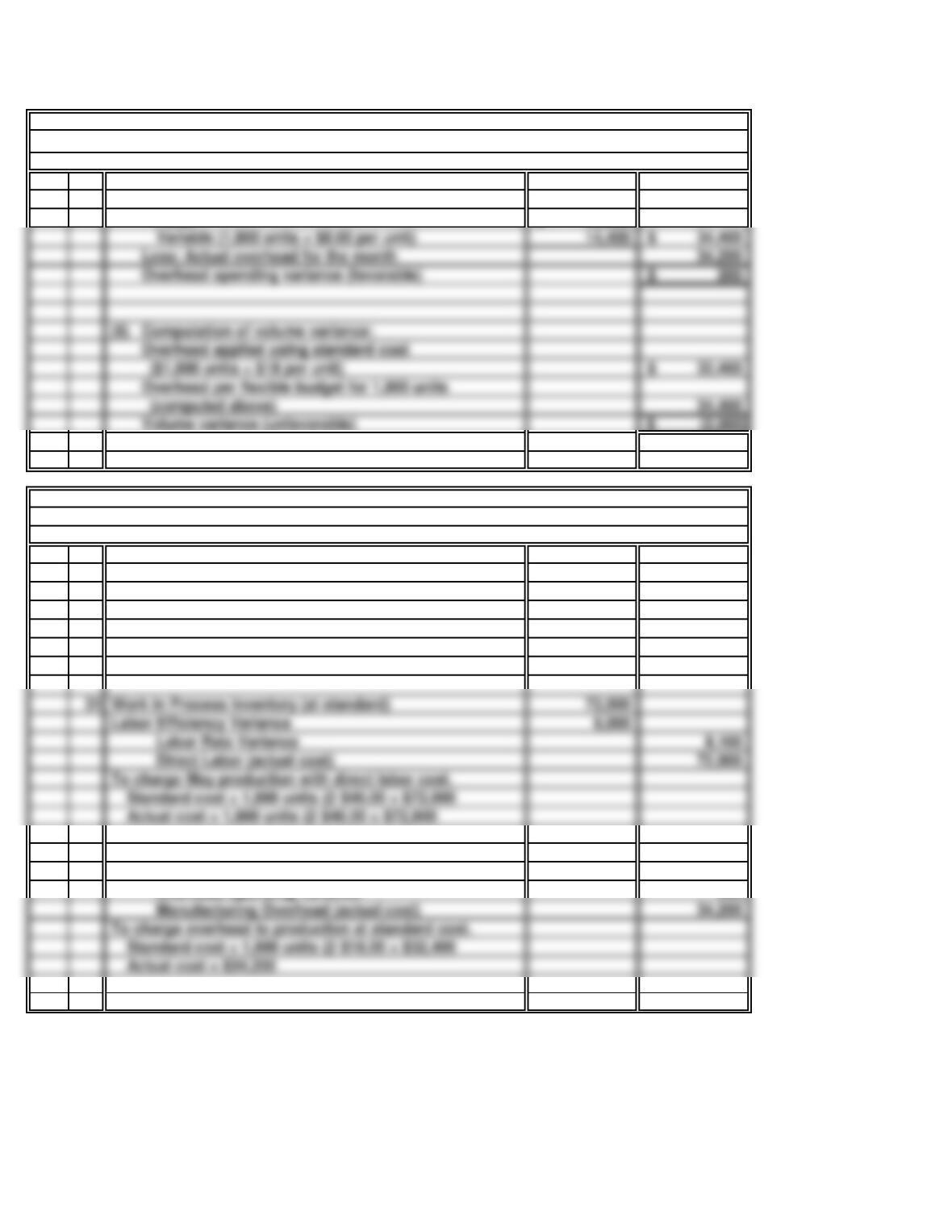
(5) Computation of overhead spending variance:
Overhead per flexible budget for 800 units:
Fixed 20,000$
b.
General Journal
May 31 Work in Process Inventory (at standard) 270,000
Materials Quantity Variance 13,500
Materials Price Variance 18,900
Materials Inventory (at actual) 264,600
To record direct materials used during May.
Standard cost = 1,800 units @ $150 = $270,000
Actual cost = 1,800 units @ $147 = $264,600
31 Work in Process Inventory (at standard) 72,000
Labor Efficiency Variance 9,000
Labor Rate Variance 8,100
Direct Labor (actual cost) 72,900
To charge May production with direct labor cost.
Standard cost = 1,800 units @ $40.00 = $72,000
Actual cost = 1,800 units @ $40.50 = $72,900
31 Work in Process Inventory (at standard) 32,400
Volume Variance 2,000
Overhead Spending Variance 200
Manufacturing Overhead (actual cost) 34,200
To charge overhead to production at standard cost.
Standard cost = 1,800 units @ $18.00 = $32,400
Actual cost = $34,200
PROBLEM 24.7B
COLONIAL FURNITURE CO. (continued)
Variable (1,800 units × $8.00 per unit) 14,400 34,400$
Less: Actual overhead for the month 34,200
Overhead spending variance (favorable) 200$
(6) Computation of volume variance:
Overhead applied using standard cost
($1,800 units × $18 per unit) 32,400$
Overhead per flexible budget for 1,800 units
(computed above) 34,400
Volume variance (unfavorable) (2,000)$
PROBLEM 24.7B
COLONIAL FURNITURE CO. (concluded)
c.
The company appears to be having significant problems in two areas. First, the large
unfavorable materials quantity variance ($13,500) indicates that far more material is being
used in the production process than is provided for in the cost standards. Assuming that the
The company had two significantly favorable variances: (1) the material price variance, and
(2) the labor rate variance. The favorable price variance may indicate that the purchasing
Comments on cost variances:
a.
b.
c.
d.
Standard Hourly Rate × (Standard Hours – Actual
60 Minutes, Strong
PROBLEM 24.8B
FODING CORPORATION
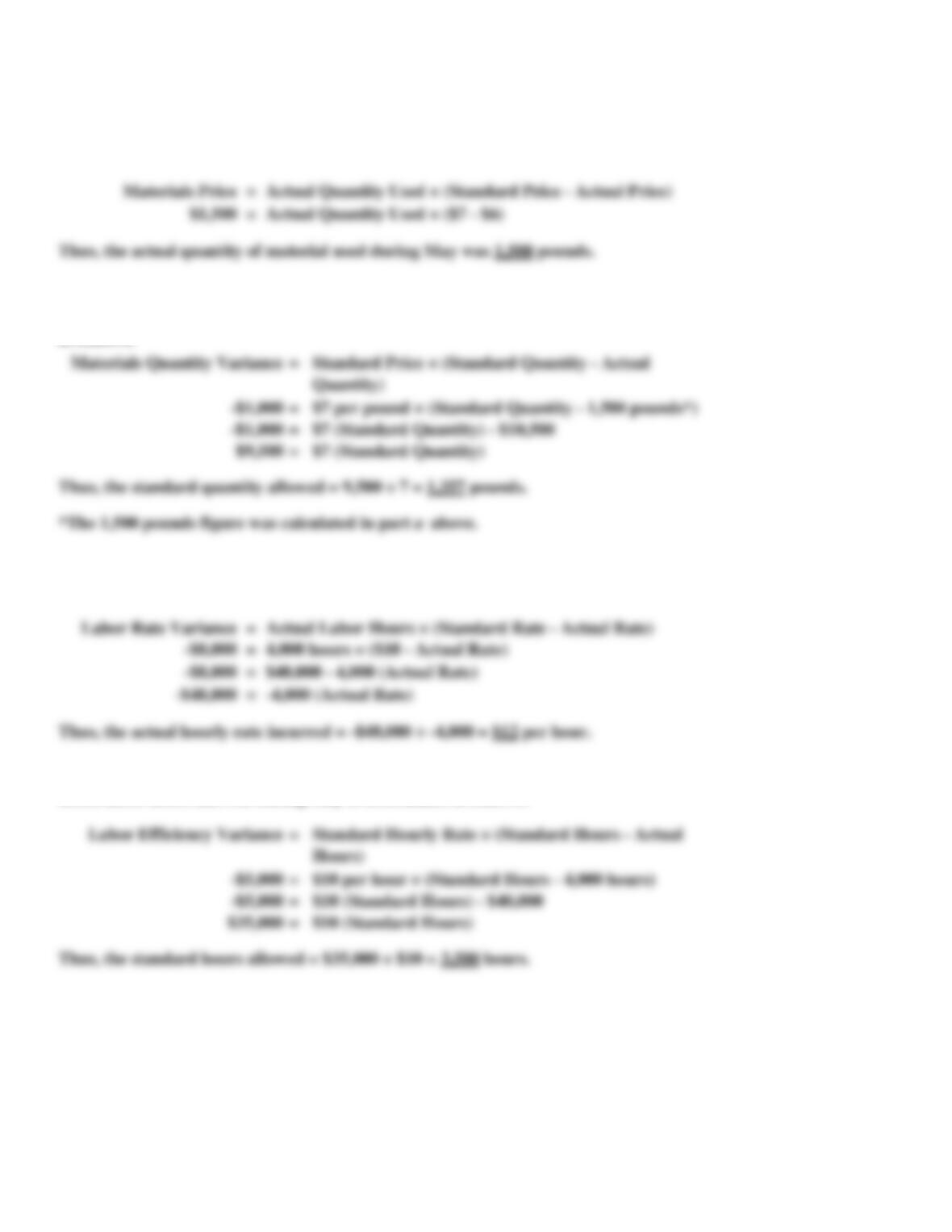
Based on the journal entry to charge direct materials costs to work in process, the actual
quantity of material purchased and used during May is determined as follows:
Based on the journal entry to charge direct material costs to work in process, the standard
quantity of material allowed for the actual level of output achieved in May is determined
as follows:
Based on the journal entry to charge direct labor costs to work in process, the standard
direct labor hours allowed during May is determined as follows:
Based on the journal entry to charge direct labor costs to work in process, the average per
hour labor cost incurred in May is determined as follows:
e.
f. 72,500
72,500*
PROBLEM 24.8B
FODING CORPORATION (concluded)
$25,000
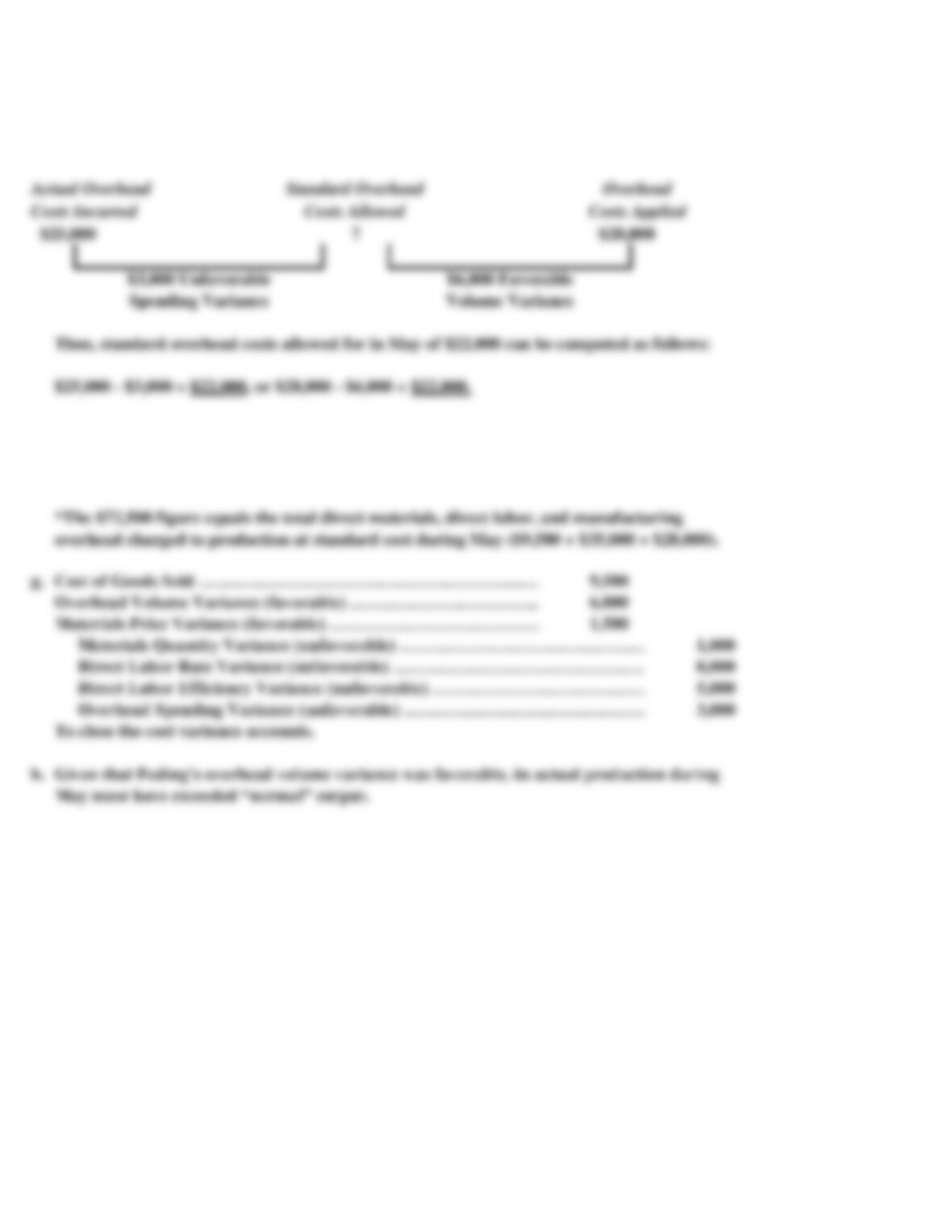
Thus, standard overhead costs allowed for in May of $22,000 can be computed as follows:
Based on the journal entry to charge overhead costs to work in process, the following
relationships exist:
Finished Goods Inventory (at standard cost) …………………………………….
Work in Process Inventory (at standard cost) …………………………………………………..
To transfer cost of completed units to finished goods.
Materials Price Variance (favorable) ……………………………………………..
Direct Labor Rate Variance (unfavorable) …………………………………………………………
Materials Quantity Variance (unfavorable) ………………………………………………………..
Overhead Volume Variance (favorable) …………………………………….
Cost of Goods Sold ………………………………………………………….
Direct Labor Efficiency Variance (unfavorable) …………………………………………………………..
Overhead Spending Variance (unfavorable) …………………………………………………………………
To close the cost variance accounts.
a.
c. =
=
=
=
$ 900
Fixed overhead allowed ($4 × 225 units) …………………………………………………………
500
$ 1,400
PROBLEM 24.9B
NINNA COMPANY
45 Minutes, Medium
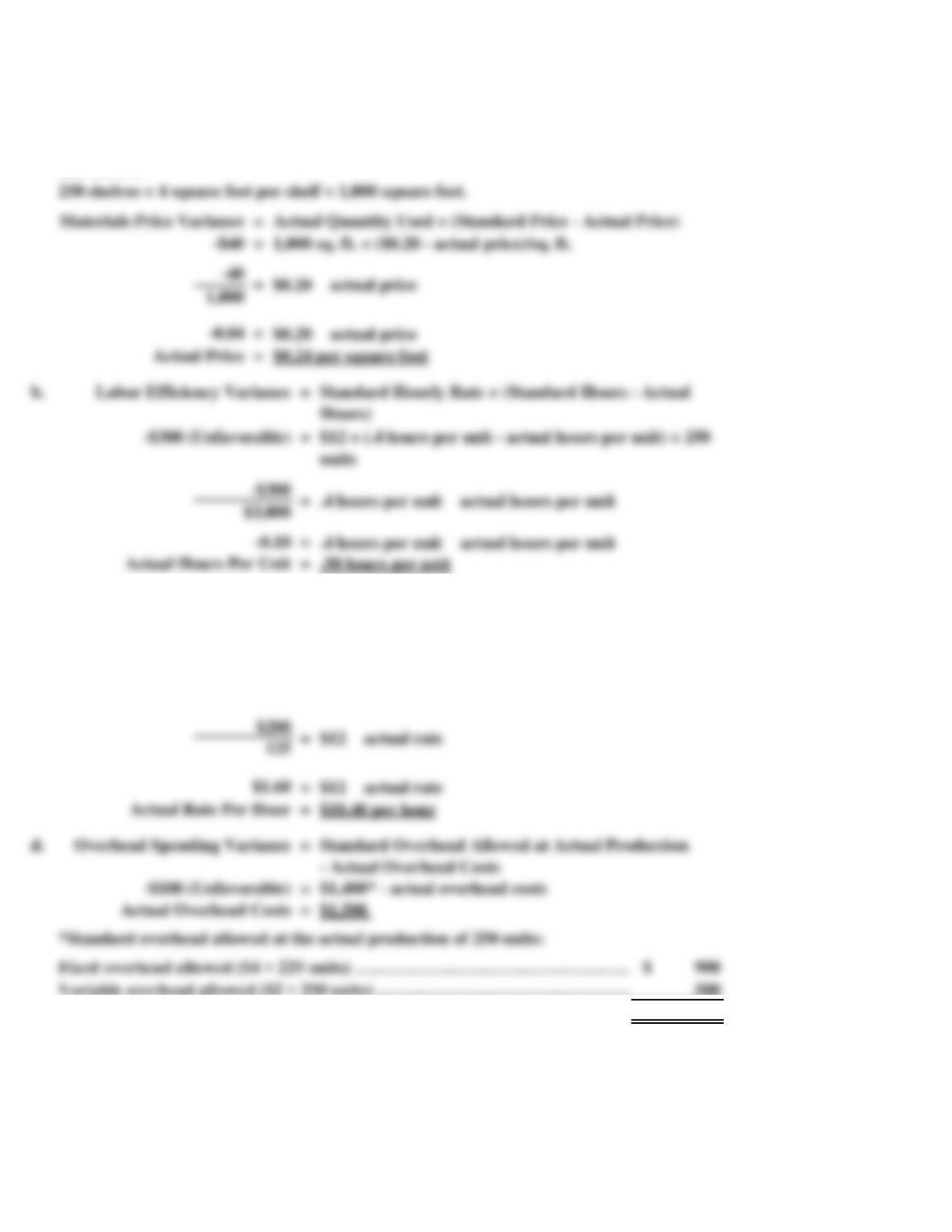
Since the direct materials quantity variance is $0, the actual quantity of materials used
per shelf must equal the budgeted quantity per shelf. Thus the total quantity purchased
and used is:
$200
.50 hours per unit × 250 units × ($12 per hour – actual
rate)
Labor Rate Variance
$200 (Favorable)
125 hours × ($12 per hour – actual rate)
Actual Labor Hours × (Standard Rate – Actual Rate)
Total overhead allowed …………………………………………………………………………
Variable overhead allowed ($2 × 250 units) ……………………………………………………
250 shelves × 4 square feet per shelf = 1,000 square feet.
1,000 sq. ft. × ($0.20 – actual price)/sq. ft.
Actual Quantity Used × (Standard Price – Actual Price)
Standard Hourly Rate × (Standard Hours – Actual
$12 × (.4 hours per unit – actual hours per unit) × 250
SOLUTIONS TO CRITICAL THINKING CASES
CASE 24.1
IT’S NOT MY FAULT
CABINETS, INC.
a.
b.
25 Minutes, Strong
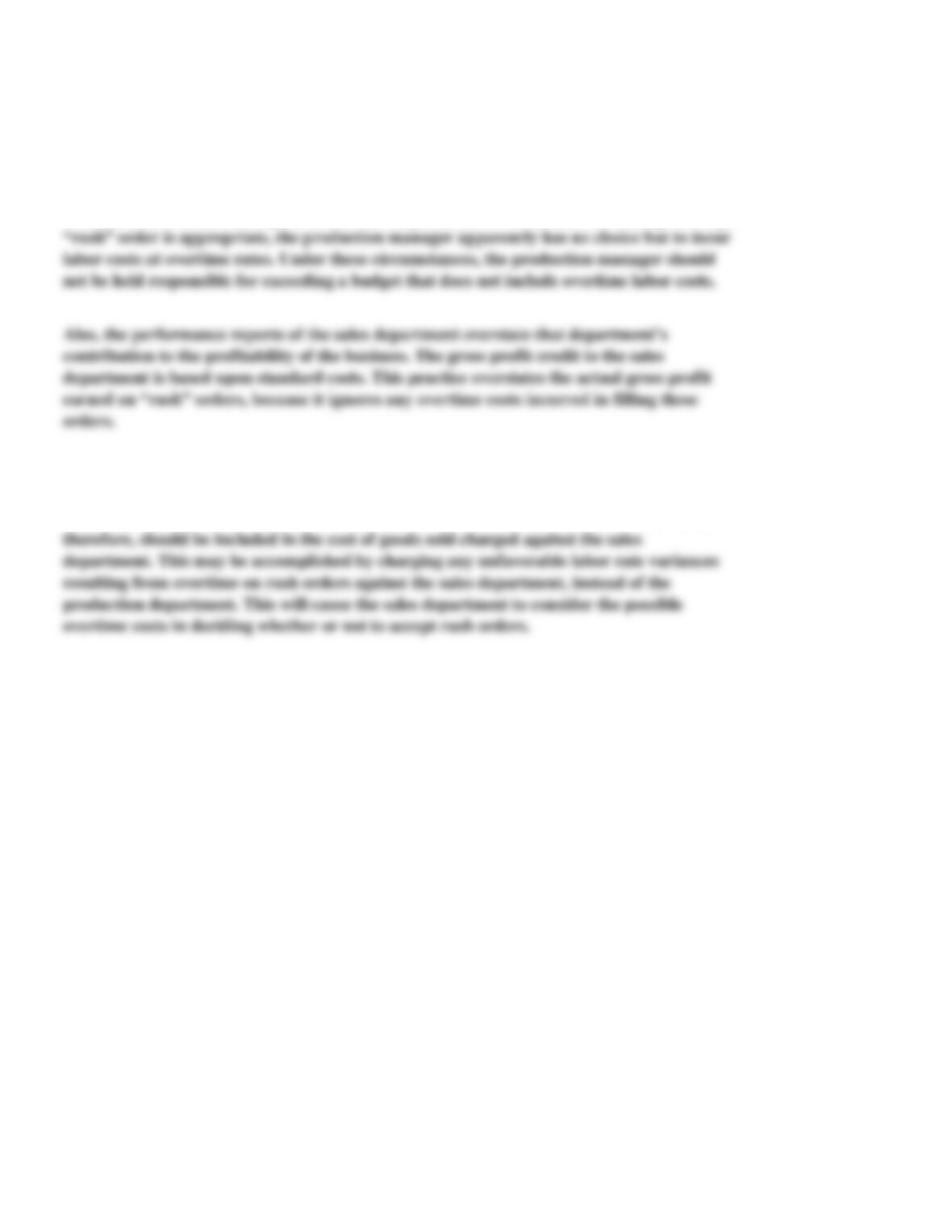
The basic problem is that the production manager is being unfairly charged with cost
overruns that should be assigned to the sales department. If we assume that filling the large
The production manager should not be penalized by the extra direct labor costs incurred
when the production department is asked to produce beyond normal capacity. The extra
costs relating to overtime should be considered a “normal” cost of the “rush” order and,
a.
b.
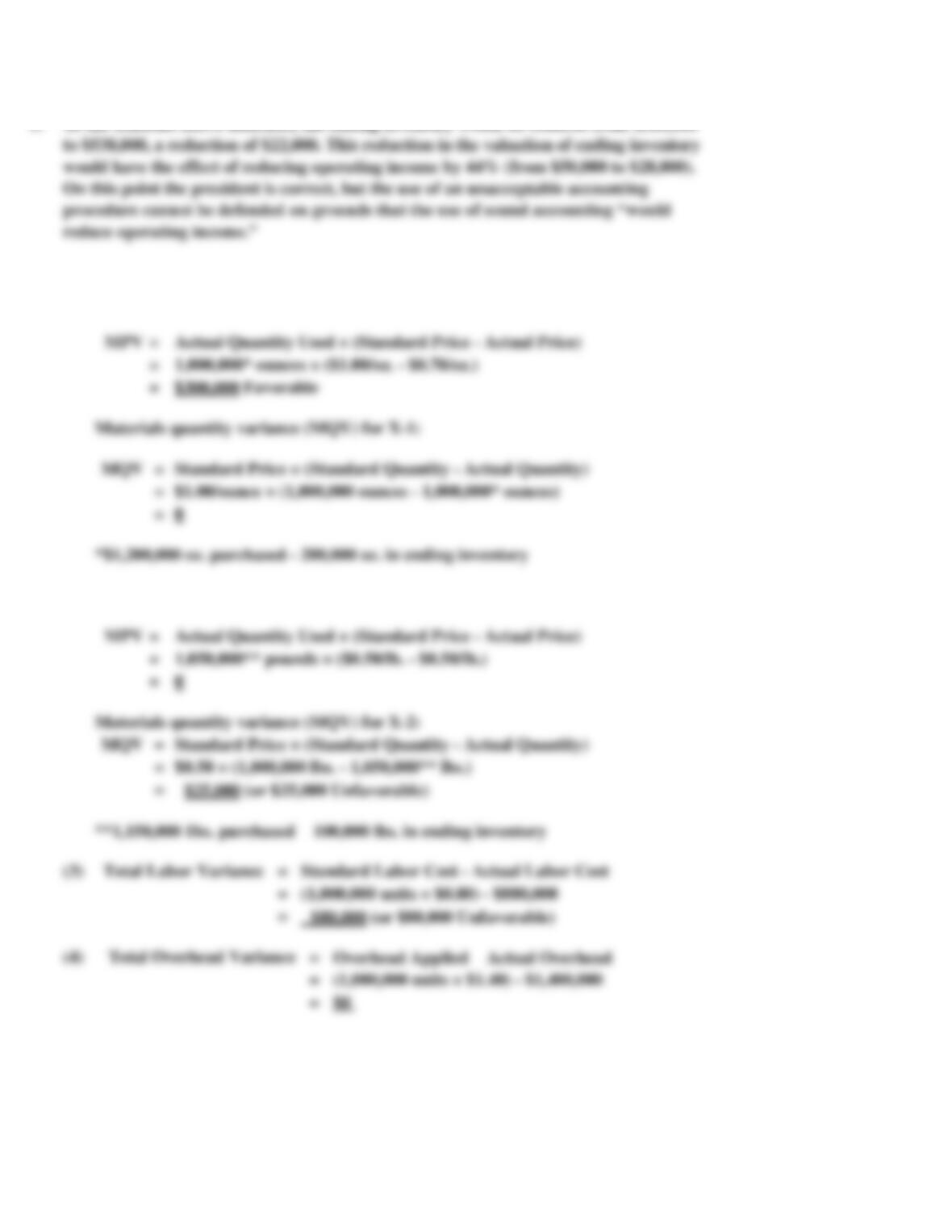
Revised
Standard
Cost
per Unit
$ 0.70
Material X-2, 100,000 pounds @ $0.50 …………….
Finished goods:
Material X-1, 200,000 ounces @ $0.70 …………….
Revised schedule of inventory at the end of the year:
Materials:
CASE 24.2
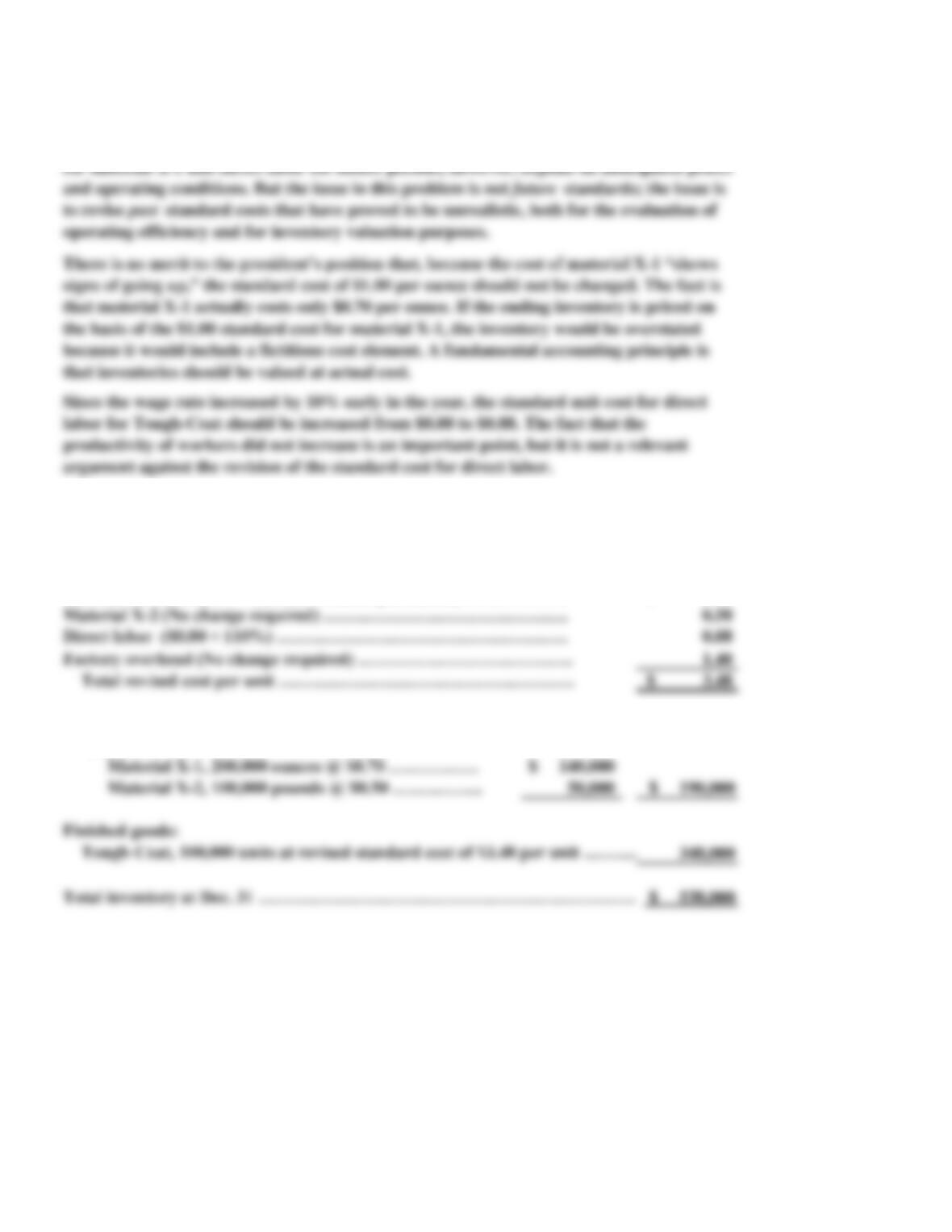
The president is not correct in arguing that the standard costs for Tough-Coat should not
be revised for purposes of valuing the inventory at the end of the year. The standards set
50 Minutes, Strong
ARMSTRONG CHEMICAL
Material X-1 ($840,000 ÷ 1,200,000 ounces purchased) ………………
0.50
1.40
$ 3.48
Total revised cost per unit …………………………………………….
Factory overhead (No change required) ………………………………..
Material X-2 (No change required) …………………………………….
CASE 24.2
c.
d. (1)
(2)
(1,000,000 units × $1.40) – $1,400,000
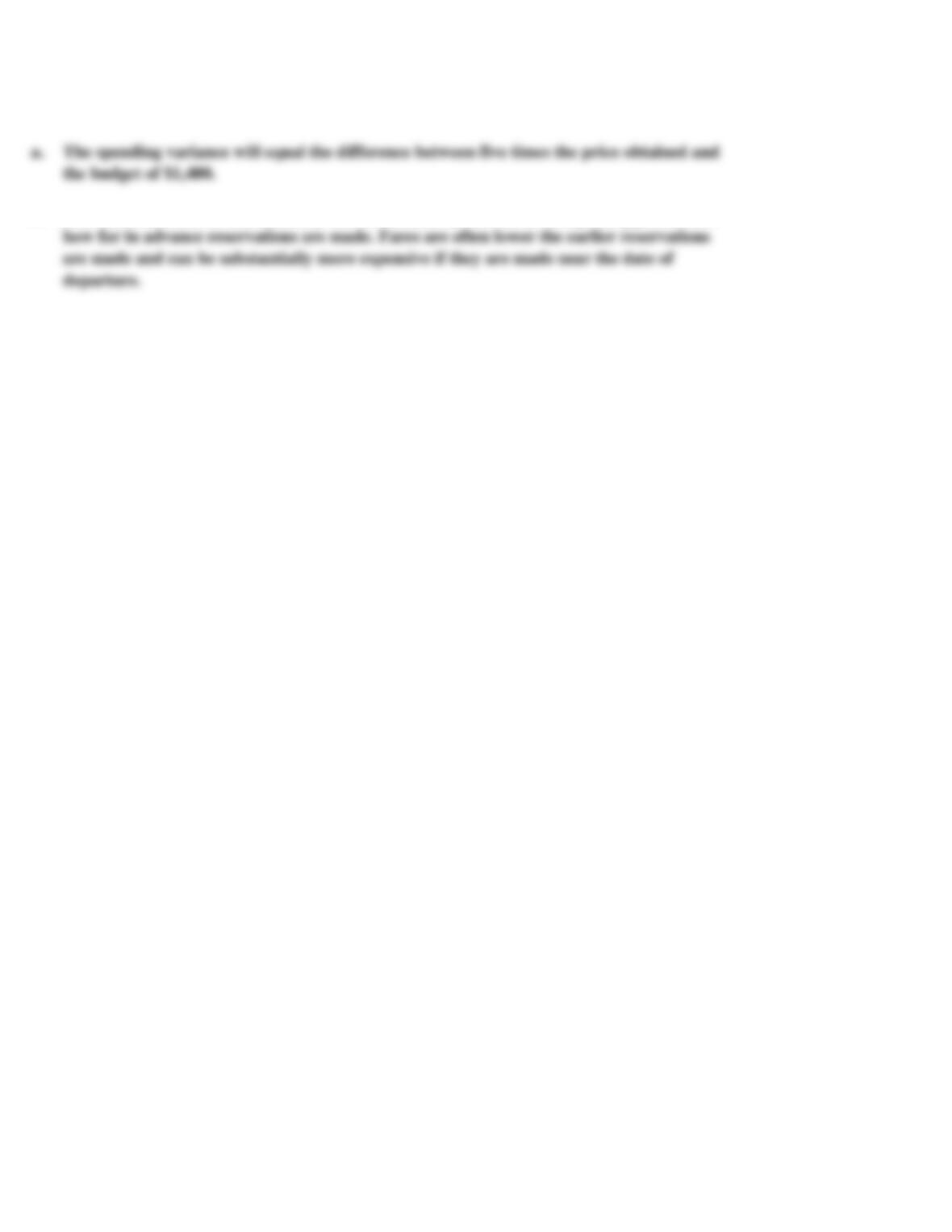
Actual Quantity Used × (Standard Price – Actual Price)
$0
Standard Labor Cost – Actual Labor Cost
(1,000,000 units × $0.80) – $880,000
1,050,000** pounds × ($0.50/lb. – $0.50/lb.)
0
$0.50 × (1,000,000 lbs. – 1,050,000** lbs.)
Standard Price × (Standard Quantity – Actual Quantity)
Materials quantity variance (MQV) for X-2:
Materials price variance (MPV) for X-2:
Materials price variance (MPV) for X-1:
As the schedule above indicates, the ending inventory would be reduced from $560,000
ARMSTRONG CHEMICAL (concluded)
$1.00/ounce × (1,000,000 ounces – 1,000,000* ounces)
*$1,200,000 oz. purchased – 200,000 oz. in ending inventory
Materials quantity variance (MQV) for X-1:
Actual Quantity Used × (Standard Price – Actual Price)
1,000,000* ounces × ($1.00/oz. – $0.70/oz.)
$300,000 Favorable
Standard Price × (Standard Quantity – Actual Quantity)
30 Minutes, Medium
CASE 24.3
TRAVELOCITY.COM
INTERNET
b.
The reasonableness of the standard will be affected by current airline pricing policies and
30 Minutes, Medium
CASE 24.4
STANDARD COST SYSTEM
AND INVENTORY MISSTATEMENT
JAMS AND JELLIES, INC.
a.
b.
•
Buck appears to be attempting to increase the factory’s profit by closing the material favorable
The IMA code of ethics suggests the following procedure to resolve ethical conflicts:
follow your organization’s established policies on the resolution of such conflict. If these policies
do not resolve the ethical conflict, Sheila should consider the following courses of action:
Sheila should discuss the issue with her immediate supervisor except when it appears that the
supervisor is involved. In that case, present the issue to the next level. If she cannot achieve a