CA 24.11
(a) The controller notes that the financial vice president is misrepresenting the financial condition of
the company by suggesting that the company has become more efficient when, in fact, the
improved ratio is gained through manipulation of estimates. The controller, however, hesitates
because estimating does not follow precise, clear-cut rules. The dilemma exists because Lilly is
asked to weigh the benefits that may accrue to the company if its profit margin on sales appears
CA 24.12
(a) The ethical issues involved are profitability, long-term versus short-term performance, and integrity
of financial reporting.
(b) Form should not dictate substance. The bonds should be issued when the company needs the
*CA 24.13
1.
b, j
4.
b, j
7.
a, e, i
2.
a, e, i
5.
j
8.
b, e, j
3.
e, h, i
6.
e
9.
d, j
FINANCIAL REPORTING PROBLEM
(a) Proctor & Gamble (P&G) commented on the following items in its note
on accounting policies:
Nature of operations Cash flow presentation
(b) P&G had the following reportable segments:
1. Beauty
(c) In Note 14, P&G reported quarterly information for net sales, operating
income, gross margin, net earnings, and diluted net earnings per
COMPARATIVE ANALYSIS CASE
THE COCA-COLA COMPANY VERSUS PEPSICO, INC.
(a) 1. Coca-Cola commented on the following list of items in its note on
accounting policies:
The Coca-Cola Company and Subsidiaries (Note 1)
• Cash Equivalents
• Short-term Investments
• Investments in Equity and Debt Securities
• Trade Accounts Receivable
• Inventories
2. PepsiCo commented on the following list of items in its note on
accounting policies:
PepsiCo, Inc. and Subsidiaries
Note 2—Our Significant Accounting Policies
COMPARATIVE ANALYSIS CASE (Continued)
Cash Equivalents
Software Costs
(b) Coca-Cola divided its operations into seven operating segments:
(1) Europe, Middle East and Africa, (2) Latin America, (3) North America,
(4) Asia Pacific, (5) Bottling Investments, and (6) Corporate.
(c) Coca–Cola’s independent auditors are Ernst & Young LLP, while PepsiCo’s
independent auditors are KPMG LLP.
*FINANCIAL STATEMENT ANALYSIS CASE
RNA INC.
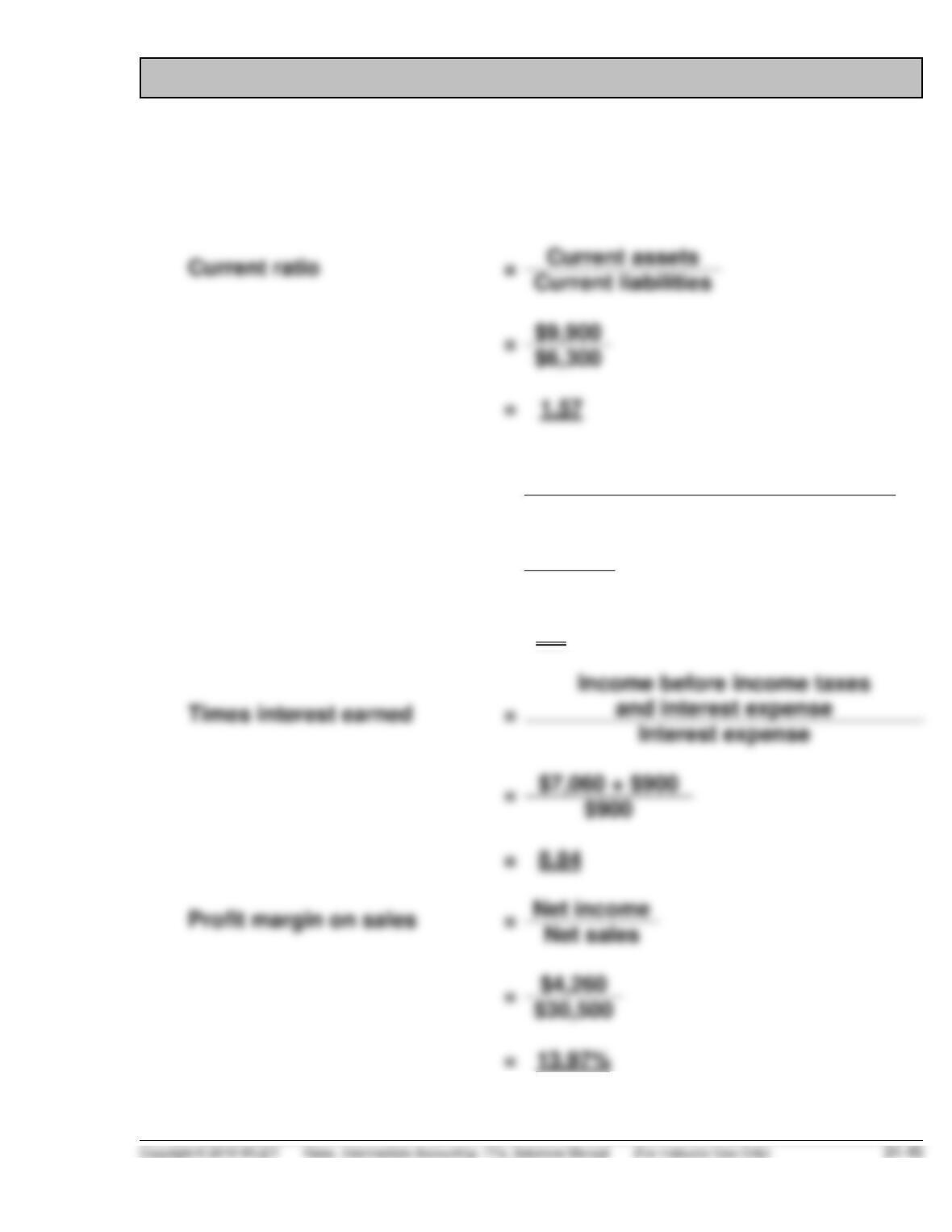
(a) The calculation of selected financial ratios for RNA for the fiscal year
2021 is as follows:
=
Current liabilities
=
Acid-test ratio
=
Short-term Net
Cash + Investments + receivables
Current liabilities
=
$3,900
$6,300
=
.62
=
=
=
Net income
=
=
13.97%
*FINANCIAL STATEMENT ANALYSIS CASE (Continued)
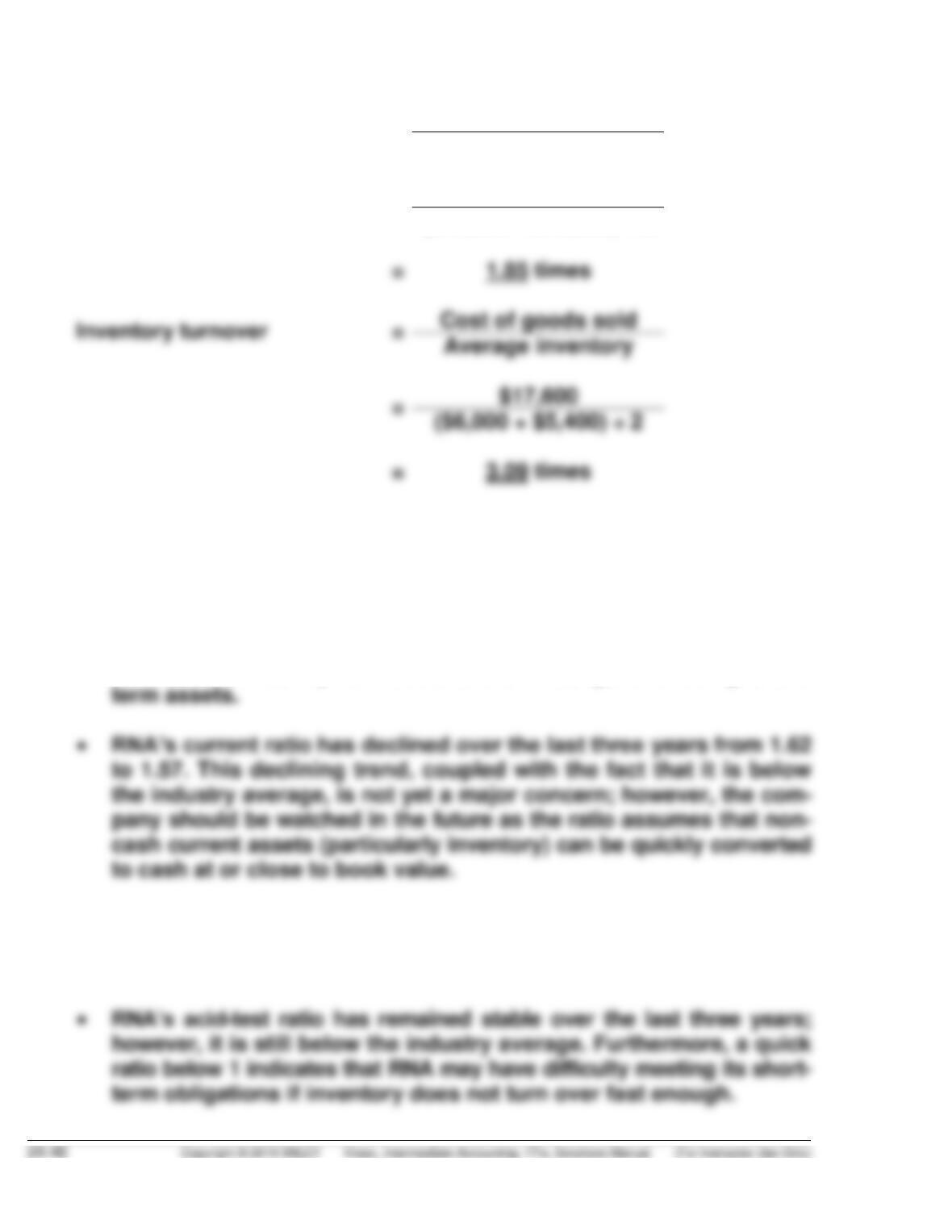
Asset turnover
=
Net sales
Average total assets
=
$30,500
($17,000 + $16,000) ÷ 2
Inventory turnover
=
=
$17,600
(b) The analytical use of each of the six ratios presented above and what
investors can learn about RNA’s financial stability and operating
efficiency are presented below.
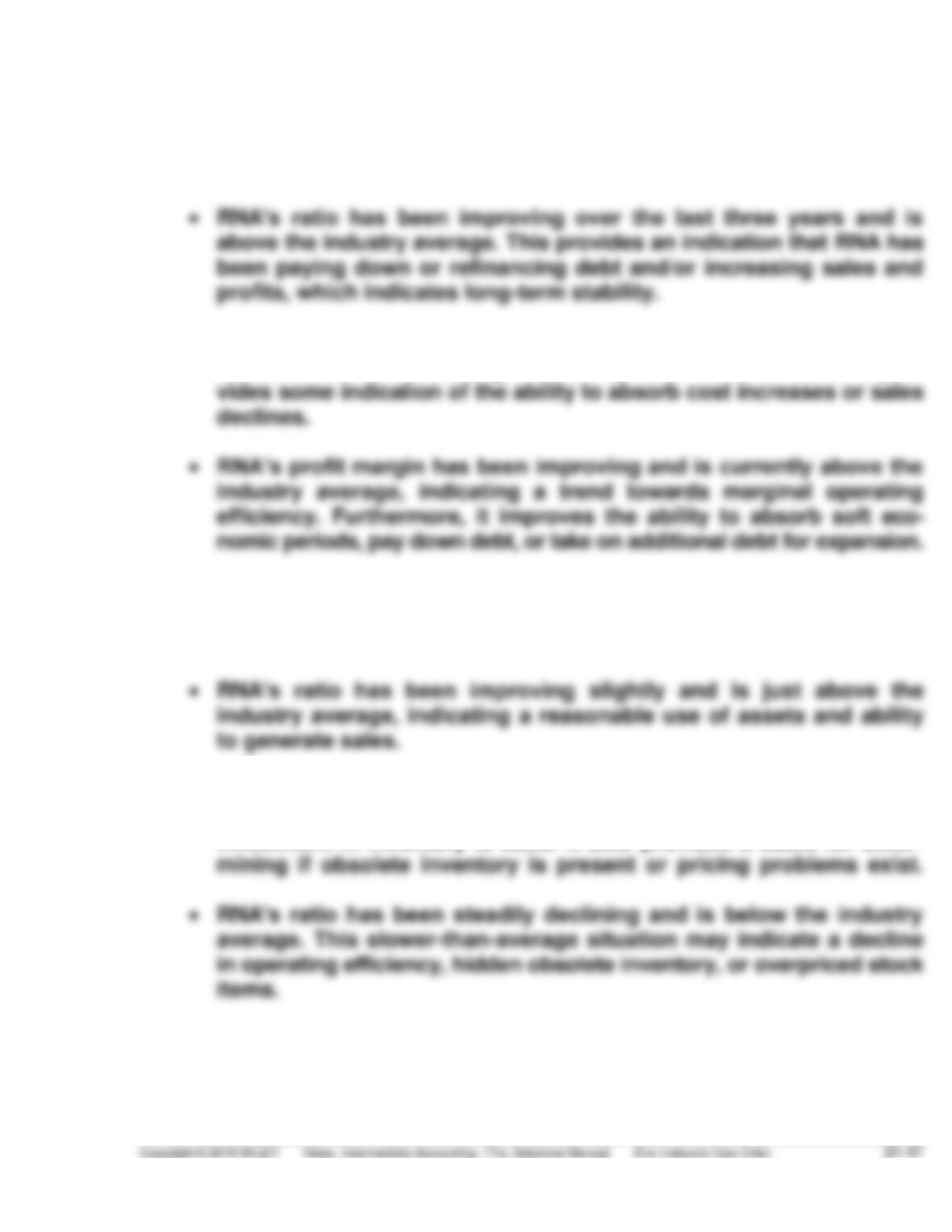
Current ratio
• Measures the ability to meet short-term obligations using short–
Acid-test ratio
• Measures the ability to meet short-term debt using the most liquid
assets.
*FINANCIAL STATEMENT ANALYSIS CASE (Continued)
Times interest earned
• Measures the ability to meet interest commitments from current
earnings. The higher the ratio, the more safety for long-term creditors.
Profit margin on sales
• Measures the net income generated by each dollar of sales. It pro–
Asset turnover
• Measures the efficiency of resource use; i.e., the ability to generate
sales through the use of assets.
Inventory turnover
• Measures how quickly inventory is sold, as well as how effectively
investment in inventory is used. It also provides a basis for deter–
*FINANCIAL STATEMENT ANALYSIS CASE (Continued)
(c) Limitations of ratio analysis include:
• Difficulty making comparisons among firms in the same industry
due to accounting differences. Different accounting methods may
ACCOUNTING, ANALYSIS, AND PRINCIPLES
Accounting
Integral Approach
1st Quarter
2nd Quarter
3rd Quarter
4th Quarter
Sales
$320,000
$600,000
$2,200,000
$480,000
Less: Variable manufacturing
costs
32,000
60,000
220,000
48,000
Fixed manufacturing costs
28,000
52,500
192,500
42,000
Net income
$ 687,500
Discrete Approach
1st Quarter
2nd Quarter
3rd Quarter
4th Quarter
Sales
$320,000
$600,000
$2,200,000
$480,000
Less: Variable manufacturing
costs
32,000
60,000
220,000
48,000
Fixed manufacturing costs
120,000
Variable non-manufacturing
costs
28,000
52,500
192,500
42,000
*Fixed non-manufacturing costs
270,000
270,000
Net income (Loss)
ACCOUNTING, ANALYSIS, AND PRINCIPLES (Continued)
Analysis
Profit margin on sales = Net income ÷ Net sales
Integral approach:
1st Quarter
2nd Quarter
3rd Quarter
4th Quarter
Net income (Loss)
$100,000
$187,500
$687,500
$150,000
Net sales
2,200,000
480,000
Discrete approach:
1st Quarter
2nd Quarter
3rd Quarter
4th Quarter
Net income (Loss)
$(74,000)
$97,500
$1,077,500
$24,000
Profit margin on sales
Principles
The concept underlying the integral approach is that an individual quarter
is part of a larger time interval about which we have more information. In
this problem, for example, we know that sales are seasonal. Therefore, we
CE24.1
Master Glossary
(a) Ordinary income (or loss) refers to income (or loss) from continuing operations before income
taxes (or benefits) excluding significant unusual or infrequently occurring items. Discontinued
operations, and cumulative effects of changes in accounting principles are also excluded from this
term. The term is not used in the income tax context of ordinary income vs. capital gain.
(c) The amount of earnings attributable to each share of common stock. For convenience, the term is
used to refer to either earnings or loss per share.
(d) A business entity that has any of the following characteristics:
a. Whose securities are traded in a public market on a domestic stock exchange or in the domestic
CE24.2
According to FASB ASC Glossary:
Related parties include:
a. Affiliates of the entity
b. Entities for which investments in their equity securities would be required, absent the election
of the fair value option under the Fair Value Option Subsection of Section 825-10-15, to be
CE24.3
According to FASB ASC 280-10–50-12 (Segment Reporting—Overall—Disclosure):
A public entity shall report separately information about an operating segment that meets any of the
following quantitative thresholds (see Example 2, Cases C, D, and E [paragraphs 280-10–55-39 through
55-45]):
(a) Its reported revenue, including both sales to external customers and intersegment sales or trans-
fers, is 10 percent or more of the combined revenue, internal and external, of all operating segments.
CE24.4
No. According to FASB ASC 270-10-S99-2 (Interim Reporting— Overall—SEC Materials):
Question 2: The staff believes disclosure of inventory components is important to investors. In reaching
this decision, the staff recognizes that registrants may not take inventories during interim periods and
CODIFICATION RESEARCH CASE
(a) According to FASB ASC 235-10–50:
50-3 Disclosure of accounting policies shall identify and describe the
accounting principles followed by the entity and the methods of
applying those principles that materially affect the determination of
financial position, cash flows, or results of operations. In general,
(b) According to FASB ASC 235-10–50.
Examples of Disclosures
50-4 Examples of disclosures by an entity commonly required with
respect to accounting policies would include, among others, those
relating to the following:
a. Basis of consolidation
IFRS CONCEPTS AND APPLICATION
IFRS24.1
The IFRS standards addressing related party disclosures are: IAS 1 (“First
Time Adoption of IFRS”); IAS 24 (“Related Party Disclosures”); disclosure
IFRS24.2
There are two types of subsequent events:
(1) Those which affect the financial statements directly and should
(a) Probably adjust the financial statements directly.
(b) Disclosure.
IFRS24.3
(1) Net income will decrease by $10,000 ($160,000 –$170,000) as a result
(2) The flood loss ($80,000) is an event that provides evidence about
conditions that did not exist at the statement of financial position date
IFRS24.4
(a) The issuance of ordinary shares is an example of a subsequent event
that provides evidence about conditions that did not exist at the
(b) The changed estimate of income taxes payable is an example of a
subsequent event that provides additional evidence about conditions that
existed at the statement of financial position date. The income tax
IFRS24-5
1.
(a)
4.
(b)
7.
(c)
10.
(c)
IFRS24.6
Interim reports are unaudited financial statements normally prepared four
The accounting problems related to the presentation of interim data are as
follows:
(a) The difficulty of allocating costs, such as income taxes, pensions,
IFRS24.7
A company records losses from inventory write-downs in an interim period
IFRS24-8
While U.S. GAAP has a preference for the integral approach, IFRS leans
toward the discrete approach to interim reports. Thus, if an IFRS company
IFRS24.9
(a) 1. The company should report its quarterly results as if each interim
period is discrete.
2. Under the discrete approach the amounts should be reported as
IFRS24.9 (Continued)
Sales revenue $60,000,000
Cost of goods sold 36,000,000
Variable selling expenses 1,000,000
(b) The financial information to be disclosed to its shareholders in its
quarterly reports as a minimum include:
1. Statement that the same accounting policies and methods of
computation are followed in the interim financial statements as
4. The nature and amount of changes in accounting policies and
estimates of amounts previously reported.
5. Issuances, repurchases, and repayments of debt and equity
securities.
6. Dividends paid (aggregate or per share) separately for ordinary
shares and other shares.
IFRS24.9 (Continued)
10. Other material events subsequent to the end of the interim period
that have not been reflected in the financial statements for the
IFRS24.10
(a) According to IAS 1, paragraph 117, “An entity shall disclose in the
summary of significant accounting policies:
(b) A few examples taken from IAS 1:
• Paragraph 118: It is important for an entity to inform users of the
measurement basis or bases used in the financial statements.
• Paragraph 120: Each entity considers the nature of its operations
and the policies that the users of its financial statements would
expect to be disclosed for that type of entity.
IFRS24.11
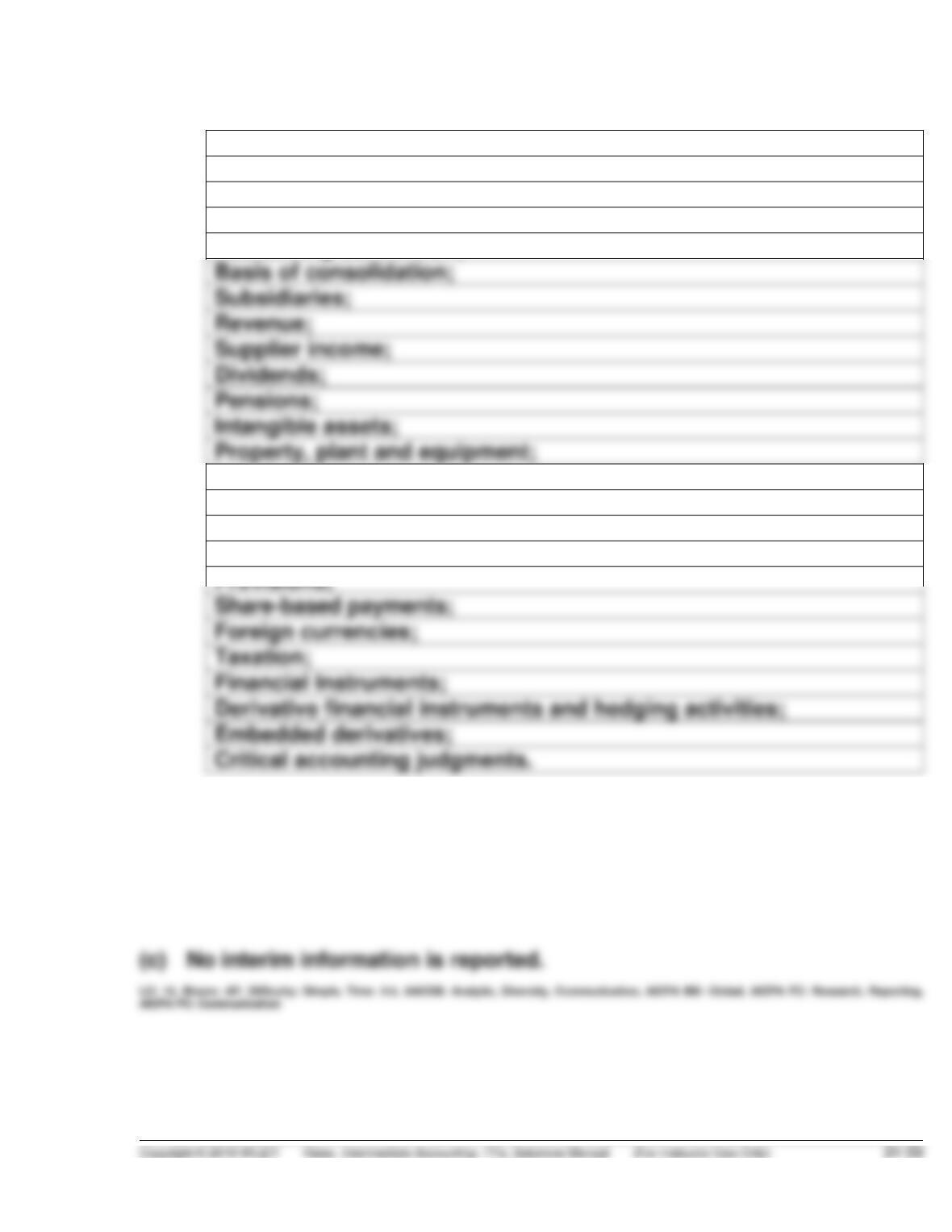
(a) The specific items M&S discusses in Note 1 are
Basis of Preparation;
New accounting standards adopted by the group;
New accounting standards in issue but not yet Effective;
Alternative performance measures;
Accounting convention;
Basis of consolidation;
Subsidiaries;
Revenue;
Supplier income;
Dividends;
Pensions;
Intangible assets;
Property, plant and equipment;
Leasing;
Leasehold prepayments;
Cash and cash equivalents;
Inventories;
Provisions;
Share-based payments;
Taxation;
Financial Instruments;
Derivative financial instruments and hedging activities;
Embedded derivatives;
Critical accounting judgments.
(b) M&S had reportable segments of Clothing & Home, Food, UK, Franchise,
Owned, and International. The UK segment is the largest segment in
terms of revenue and gross profit. M&S does not report its largest
customer.