
Financial and Managerial Accounting, 8th Edition
CHAPTER 24
CAPITAL BUDGETING AND INVESTMENT ANALYSIS
Related Assignment Materials
Student Learning Objectives
Discussion
Questions
Quick
Studies*
Exercises*
Problems*
AA and BTN
Analytical objectives:
Analytical objectives:
P1. Compute payback period and
describe its use.
1, 2, 3, 4, 5,
13, 14
24-11, 24–12,
24-14, 24–15,
24-18
24-11, 24-12,
24-14, 24-15
BTN 24-2, BTN 24-3,
BTN 24-4, BTN 24-5,
BTN 24-6
24-16
24-15, 24-16,
24-17
BTN 24-2, BTN 24-5
24-1, 24-4,
24-5, 24-18
24-1, 24-3,
24-4, 24-5,
24-1, 24-2,
24-5, 24-6
BTN 24-2, BTN 24-3,
BTN 24-4, BTN 24-5
*See additional information on next page that pertains to these quick studies, exercises and problems.
SP refers to the Serial Problem
Additional Information on Related Assignment Material
See Chapter 1 of the Instructor’s Resource Manual for more information on materials for this text available in
Connect.
Connect
Available on the instructor’s course-specific website, Connect:
• All numerical Quick Studies, all Exercises and Problems Set A.
Hints/Guided Examples

Financial and Managerial Accounting, 8th Edition
24-2
Please note that the Guided Examples are labeled as “Hints” in Connect assignments. The animated PowerPoints without
the video and audio functions for the Guided Examples are also available in the Connect Instructor Library and Exercise
Presentations. These are indicated in the Related Assignment Materials grid on page 1 in blue bold font.
Need-to-Know Videos
LO
Need–to-Know
Title
Time
P1
24-1
Payback Period
1:49
P2
24-2
Accounting Rate of Return
0:54
P3
24-3
Net Present Value
2:35
P4
24-4
Internal Rate of Return
1:45
Concept Overview Videos, (COV’s)
LO
Title
Time
A1
Analyze a capital investment project using break-even time.
Break-even Time
2:07
P1
Compute payback period and describe its use.
Payback Period with Even Cash Flows
1:12
Payback Period with Uneven Cash Flows
2:02
Evaluating Payback Period — Advantages
0:25
Evaluating Payback Period — Disadvantages
1:17
P2
Compute accounting rate of return and explain its use.
Accounting Rate of Return
2:04
Evaluating Accounting Rate of Return
0:31
P3
Compute net present value and describe its use.
Decision Rule
0:20
Impact of Salvage Value
0:44
Comparing Positive NPV Projects
0:32
P4
Compute internal rate of return and explain its use.
Internal Rate of Return
1:34
Synopsis of Chapter Revision
NEW opener—Fellow Robots and entrepreneurial assignment.
New discussion of post-audit of investment decisions.
Financial and Managerial Accounting, 8th Edition
24-3
Chapter Outline
I. Capital budgeting – process of analyzing alternative long-term investments and deciding which assets to
acquired or sell
A. An objective of capital budgeting decisions is to earn a satisfactory rate of return.
B. The process begins with department or plant managers submitting proposals for new investment in
II. Methods Not Using Time Value of Money⎯Investments are expected to produce net cash outflows; Net
Cash flows equal cash inflows minus cash outflows. Simple analysis methods do not consider the time value
of money.
A. Payback Period
1. Payback period is the expected amount of time to recover the initial investment amount.
2. Evaluating Payback Period: managers prefer investments with shorter payback periods.
3. To compute payback period, exclude all non-cash revenue and expenses from computation.
Depreciation is a non-cash expense, so it is not included.
a. When annual cash flows are even in amount:
B. Accounting Rate of Return
1. The percentage accounting return on annual average investment.
2. Called “accounting” return because it is based on net income instead of on cash flows.
3. Computed as:

Financial and Managerial Accounting, 8th Edition
24-4
Annual Average investment
7. Risk of an investment should be considered.
a. Investment’s return is satisfactory only when related to returns from other investments with
similar lives and risk.
b. Capital investment with least risk and highest return for the longest time is often identified as
best; analysis can be challenging because different investments often yield different rankings
depending on measure used.
8. Evaluating Accounting Rate of Return – should never be the only consideration in capital budgeting
decisions. Three major weaknesses:
III. Methods Using Time Value of Money⎯Net present value and internal rate of return methods consider time
value of money.
A. Net Present Value (see also Appendix B near end of textbook)
1. Net Present Value (NPV) analysis applies the time value of money to cash inflows and cash
outflows so management can evaluate a project’s benefits and cost at one point in time.
2. NPV is computed by discounting the future net cash flows from the investment at the required rate
of return, and then subtract the initial amount invested.
a. The required rate of return also called the hurdle rate or the cost of capital that the company
3. Net Present Value Decision Rule
a. Net Present Value = PV of cash flows – Amount Invested
b. If the NPV is greater than or equal to $0, then asset is expected to recover its cost and provide a
Financial and Managerial Accounting, 8th Edition
24-5
5. When annual net cash flows are equal in amount, NPV calculation can be simplified.
6. Cash savings from automation – NPV analysis can be used to decide whether to automate a
production process. Increased automation from use of robotics and computer numerical control
(CNC) machines can yield cash savings from reduced direct labor costs.
7. NPV analysis can also be applied when net cash flows are unequal. (Use procedures and decision-
rules above.)
11. Comparing positive NPV projects is of limited value for comparison purposes if initial investment
differs substantially across projects.
12. When a company can’t fund all positive net present value projects, they can be compared using the
profitability index:
B. Internal Rate of Return
1. IRR is a rate used to evaluate acceptability of an investment; it equals the rate that yields a NPV of
zero for an investment.
3. Two step process in computing IRR (equal cash flows)
a. Step 1: Compute the present value factor for the project by dividing the amount invested by
Financial and Managerial Accounting, 8th Edition
24-6
4. When cash flows are unequal, it is best to use either a calculator or spreadsheet software to compute
IRR.
C. Comparison of Capital Budgeting Methods (see Exhibit 24.12)
1. Payback period and accounting rate of return do not consider time value of money; NPV and IRR
do.
4. Net Present Value (NPV):
a. Considers all estimated net cash flows of project; can be applied to equal and unequal cash
5. Internal Rate of Return (IRR):
a. Considers all estimated cash flows of project.
6. Postaudit – an evaluation of a project’s actual results versus its projected results.
a. Same method used to support capital budgeting decision should be used in postaudit.
b. Benefits include:
i. Managers will likely be more careful in the investment proposals they submit.
ii. Poor investments can be identified earlier and management can change its investments.
IV. Break-Even Time – time-based measure used to evaluate a capital investment’s acceptability.
A. Yields a measure of expected time, which reflects the time period until the present value of the net cash
Financial and Managerial Accounting, 8th Edition
24-7
Chapter 24 Alternate Demo Problem
A company is planning to buy a new machine at a cost of $200,000. The machine is
expected to last for 10 years and have no salvage value at the end of its useful life.
Required:
1. Calculate the payback period on the investment in new machinery.
2. Calculate the rate of return on the average investment.
Financial and Managerial Accounting, 8th Edition
24-8
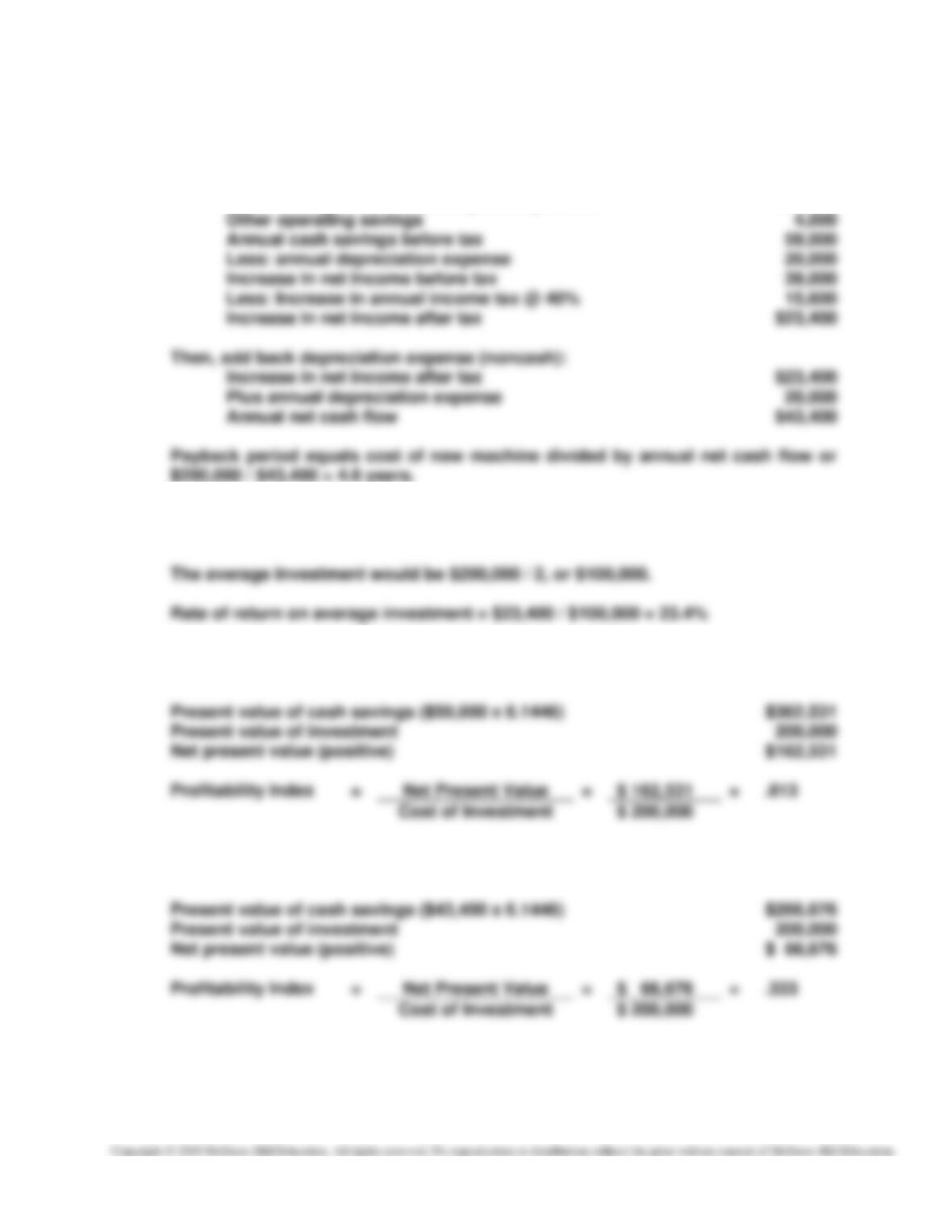
1.
Chapter 24 Alternate Demo Problem: Solution
First, calculate annual net cash flow:
Determine increase in after-tax net income:
Labor savings: 10,000 hours @ $5.50 per hour
$55,000
Other operating savings
Annual cash savings before tax
Less: annual depreciation expense
Increase in net income before tax
Less: Increase in annual income tax @ 40%
Increase in net income after tax
Then, add back depreciation expense (noncash):
Increase in net income after tax
Plus annual depreciation expense
Annual net cash flow
Payback period equals cost of new machine divided by annual net cash flow or
$200,000 / $43,400 = 4.6 years.
2.
The rate of return on average investment equals the increase in net income after
tax divided by the amount of the average investment.
The average investment would be $200,000 / 2, or $100,000.
Rate of return on average investment = $23,400 / $100,000 = 23.4%
3(a)
There is a cash savings of $59,000 each year for 10 years if income taxes are
ignored. The present value factor for a 10-year annuity at 10% is 6.1446.
Present value of cash savings ($59,000 x 6.1446)
Present value of investment
200,000
Net present value (positive)
Profitability Index
=
=
$ 162,531
=
.813
$ 200,000
3(b)
There is a cash savings of only $43,400 each year for 10 years if income taxes are
considered.
Present value of cash savings ($43,400 x 6.1446)
Present value of investment
200,000
Net present value (positive)
Profitability Index
=
=
$ 66,676
=
$ 200,000