Financial and Managerial Accounting, 9th Edition
23-1
CHAPTER 23
RELEVANT COSTS FOR MANAGERIAL DECISIONS
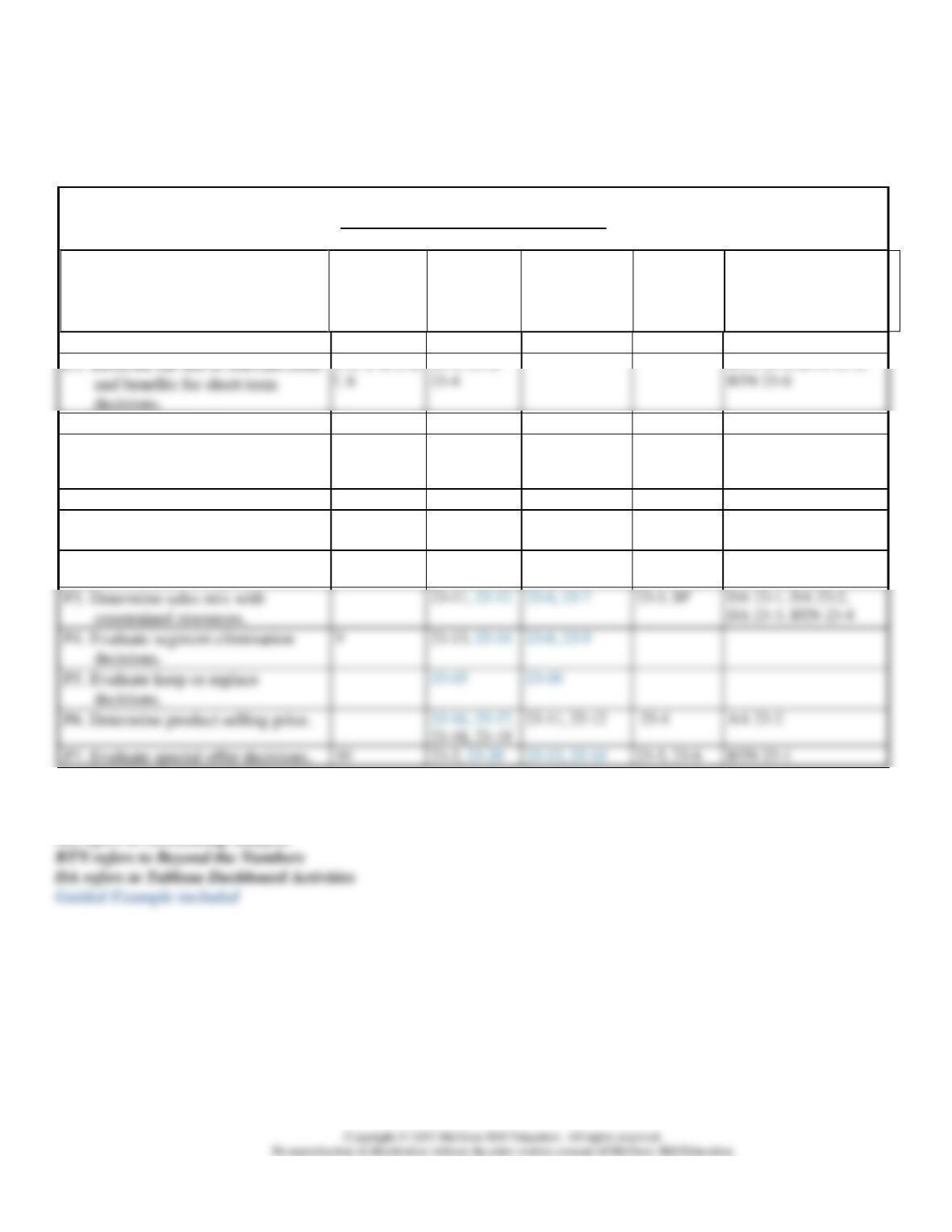
Related Assignment Materials
Student Learning Objectives
Discussion
Questions
Quick
Studies*
Exercises*
Problems*
AA, DA and BTN
Conceptual objectives:
1, 2, 3, 4, 5, 6,
23-1, 23-3,
BTN 23-2, BTN 23–3,
Analytical objectives:
A1. Determine price of services using
time and materials pricing.
11, 12
23–21, 23–22
23–15
AA 23-1, AA 23-3
Procedural objectives:
P1. Evaluate make or buy decisions.
23–5, 23–6,
23-1, 23-2
23-1
P2. Evaluate sell or process decisions.
23-7, 23-8,
23-9, 23–10
23-3, 23-4,
23-5
23-2
23–11, 23–12
23-6, 23-7
23-3, SP
DA 23-1, DA 23-2,
P4. Evaluate segment elimination
9
23–13, 23–14
23-8, 23-9
P5. Evaluate keep or replace
P6. Determine product selling price.
23-16, 23–17,
23-11, 23–12
23-4
AA 23-2
BTN 23-1
*See additional information on next page that pertains to these quick studies, exercises and problems.
SP refers to the Serial Problem
AA refers to Accounting Analysis
Financial and Managerial Accounting, 9th Edition
23-2
Additional Information on Related Assignment Material
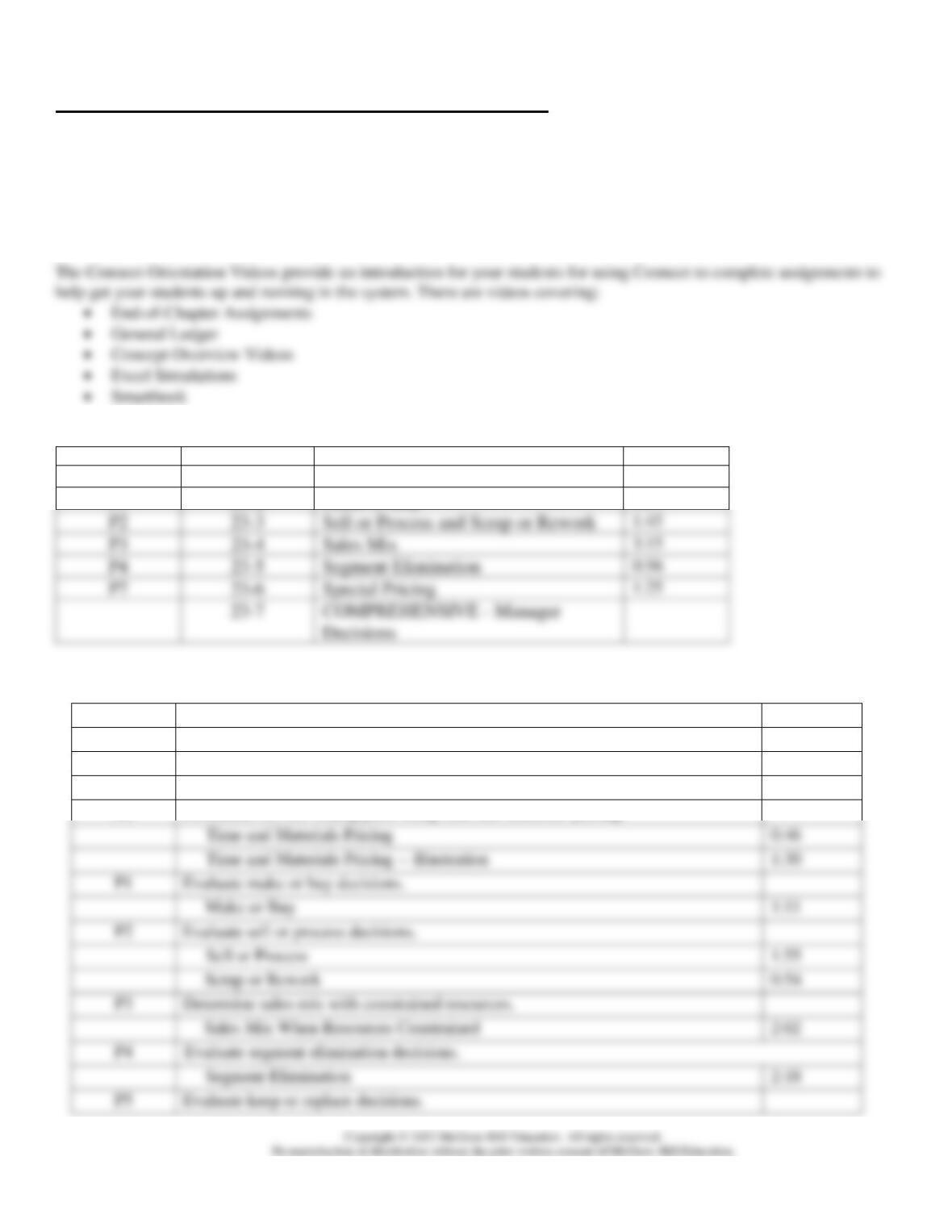
Connect
Available on the instructor’s course-specific website, Connect repeats all numerical Quick Studies, all Exercises, and
Problem Set A. Connect also provides algorithmic versions for Quick Study, Exercises, and Problems. It allows
instructors to monitor, promote, and assess student learning. It can be used in practice, homework, or exam mode.
Prebuilt Assignments and Turnkey courses are available.
Need-to-Know Videos
LO
Need–to-Know
Title
Time
C1
23-1
Relevant Costs
1:48
P1
23-2
Make or Buy
0:57
P2
23-3
Sell or Process and Scrap or Rework
1:45
P3
23-4
Sales Mix
3:15
P4
23-5
Segment Elimination
0:56
P7
23-6
Special Pricing
1:25
Concept Overview Videos
LO
Title
Time
C1
Describe the use of relevant costs and benefits for short-term decisions.
Decision Making
0:32
Relevant Costs and Benefits
1:50
A1
Determine service selling price using time and materials pricing.
Time and Materials Pricing
0:46
1:30
Evaluate make or buy decisions.
1:11
Sell or Process
1:55
0:54
2:02
Evaluate segment elimination decisions.
2:18
Financial and Managerial Accounting, 9th Edition
23-3
Keep or Replace
1:08
P6
Determine product selling price.
Normal Pricing
0:49
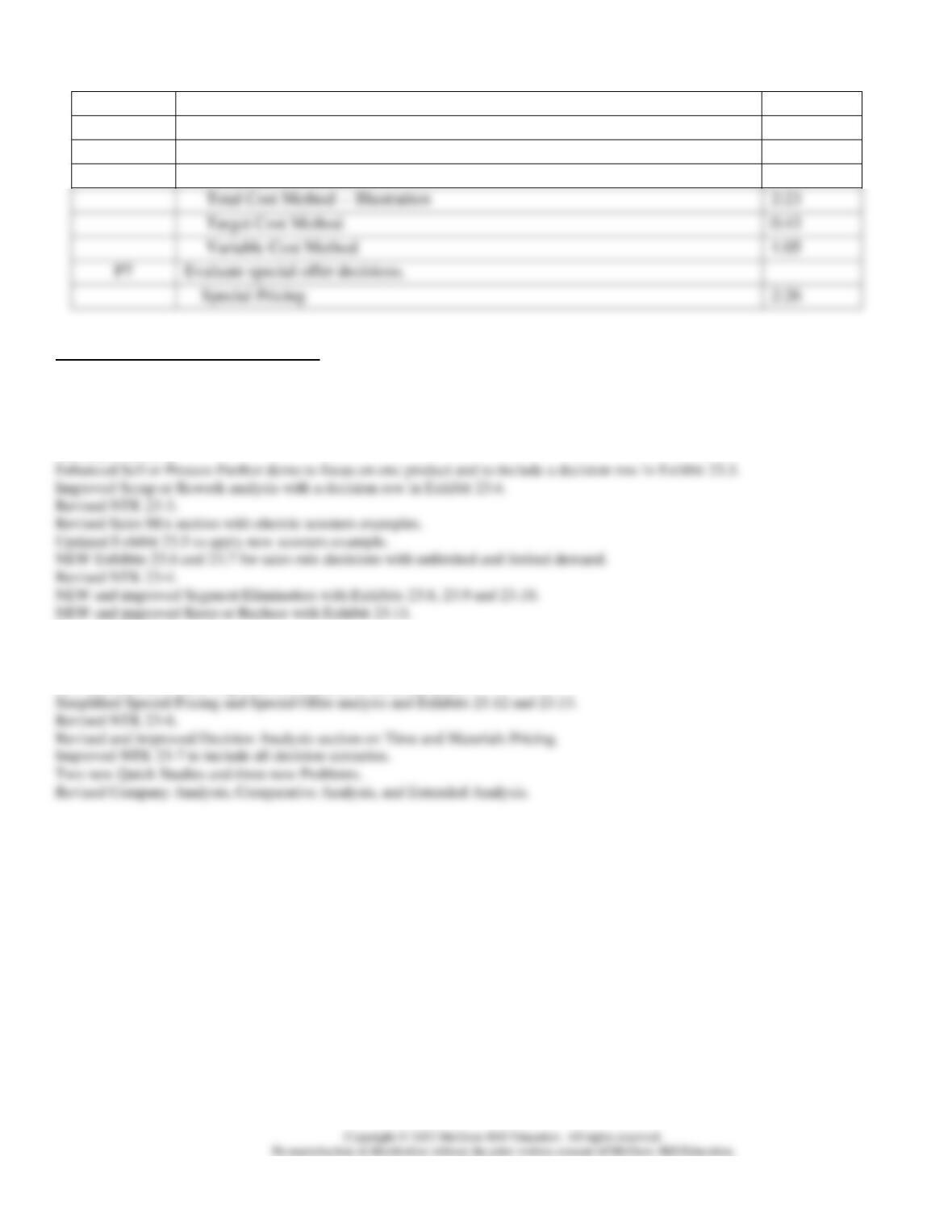
Total Cost Method
0:55
Total Cost Method — Illustration
2:23
Target Cost Method
0:43
Variable Cost Method
1:05
Evaluate special offer decisions.
Special Pricing
2:26
Synopsis of Chapter Revision
NEW opener – Eye Symmetry and entrepreneurial assignment.
Added avoidable cost in distinguishing between relevant and irrelevant costs.
Improved NTK 23–1.
Enhanced Make or Buy analysis with a decision row in Exhibit 23.2.
Revised NTK 23–2.
Revised NTK 23–5.
New visual aid for price takers versus price setters.
New formula for selling price per unit.
New illustration of three-step total cost method to determine price.
Financial and Managerial Accounting, 9th Edition
23-4
Chapter Outline
I. Decisions and Information
A. Decision Making
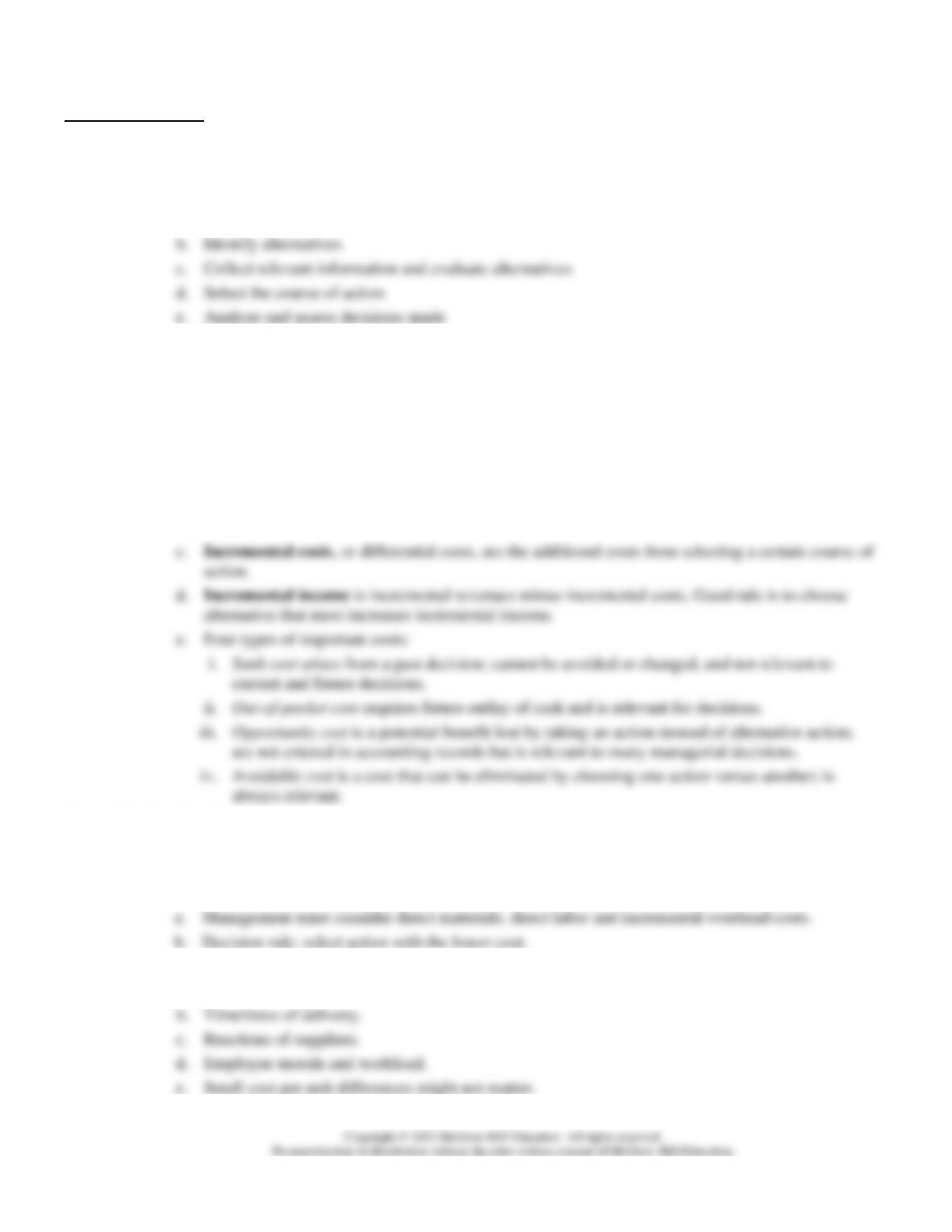
1. Five steps involved in managerial decision making.
a. Define the decision
2. Both financial and nonfinancial information are important making decisions.
a. Financial information includes expected revenues and costs.
b. Nonfinancial information includes environmental and social data.
B. Relevant Costs and Benefits
1. Managers must distinguish between relevant and irrelevant costs and benefits.
a. Relevant costs and benefits are future-oriented, and focus on incremental effects across
alternative managerial decisions.
b. Incremental revenues are the additional revenue from selecting a certain course of action over
another.
II. Production Decisions
A. Make or Buy
1. Buying goods or services from external supplier is called outsourcing.
2. Decision to make or buy depends on costs of each alternative.
3. Additional nonfinancial factors should be considered:
a. Product quality.
Financial and Managerial Accounting, 9th Edition
23-5
B. Sell or Process
1. Partially completed products can be sold as is or they can be processed further and sold as other
products.
C. Scrap or Rework
1. Variation of sell or process further analysis. When defective products are produced, managers must
decide whether to scrap or rework these products.
D. Sales Mix When Resources Constrained
1. When a company sells a mix of products and production facilities are operating at or near capacity,
management looks for most profitable sales mix of products.
2. To identify the best sales mix, management focuses on the contribution margin per unit of
constrained resource.
margin per unit of scarce resource.
E. Segment Elimination
1. If segment is performing poorly, management must consider eliminating it.
2. Need to consider avoidable and unavoidable expenses:
a. Avoidable expenses are eliminated when the segment is eliminated. Includes all variable costs
3. Decision rule: segment should be eliminated if income increases from elimination; it should continue
if income decreases from elimination.
Financial and Managerial Accounting, 9th Edition
23-6
F. Keep or Replace
1. Managers periodically must decide whether to keep using a plant asset, such as equipment, or replace
it.
replacement.
G. Normal Pricing – managers consider concepts involving supply and demand to determine pricing.
1. Price taker – have less control over setting prices. Use more target pricing type methods.
H. Cost-plus methods common when companies are price-setters. Management adds a markup to cost to get
selling price.
1. Total cost method – management sets price equal to product’s total cost plus a desired profit on the
product using a three-step process:
2. Target cost method – used when competition is high and they have little control in setting prices.
Target cost = expected selling price – target profit
3. Variable cost method – follows three steps:
a. Determine markup % = (Target profit + Total fixed costs) / Total variable cost.
c. Determine selling price per unit = Variable cost per unit + Markup per unit.
I. Special Pricing
1. Companies sometimes receive special offers at prices lower than their normal selling prices.
III. Decision Analysis⎯Time and Materials Pricing – commonly used to price services. Companies set a price
for direct labor, for direct materials, and each includes a charge for overhead and a target profit.
1. Compute time charge ($) per hour of direct labor. Includes charge for non-materials related overhead
costs plus a target profit.
Financial and Managerial Accounting, 9th Edition
23-7
Chapter 23 Alternate Demo Problem
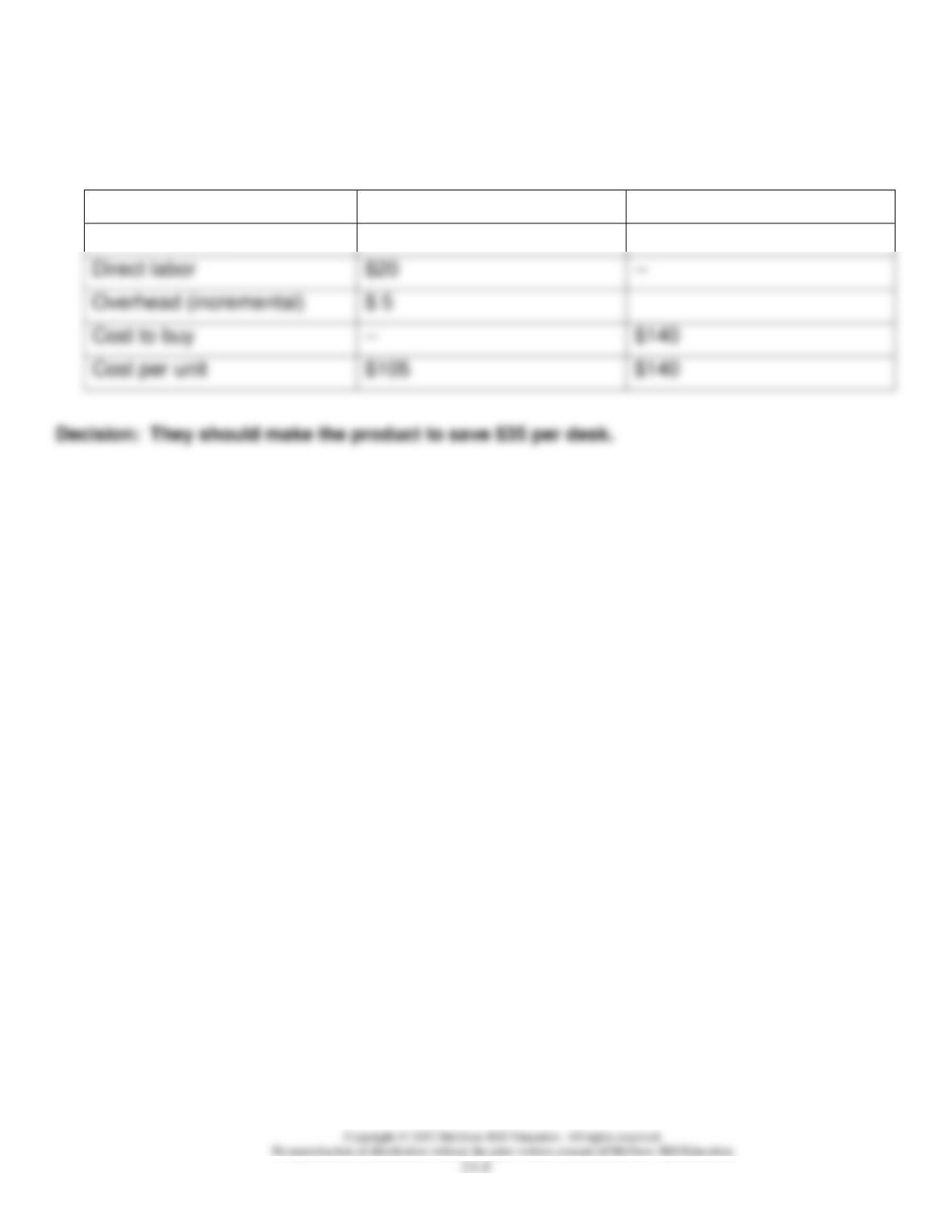
Modern Company currently buys wood desks for $140 each. They have excess
capacity and are considering making the desks. If they make the desks, they would
Should the desks be made or purchased?
Financial and Managerial Accounting, 9th Edition
Chapter 23 Alternate Demo Problem: Solution
Make or Buy Analysis
Make
Buy
Direct materials
$80
—
Direct labor
$20
—
Cost to buy
—
$140