CA 23.1 (Continued)
6. The details of changes in long-term debt should be shown separately. Payments should not be
netted against increases in long-term borrowings. The long-term borrowing of $620,000 should
CA 23.2
(a) From the information given, it appears that from an operating standpoint Pacific Clothing Store did
not have a superb first year, having suffered an $11,000 net loss. Lenny is correct; the statement of
(b) PACIFIC CLOTHING STORE
Statement of Cash Flows
For the Year Ended January 31, 2020
Cash flows from operating activities
Net loss ………………………………………………………
$ (11,000)*
Adjustments to reconcile net income
to net cash provided by operating
activities:
Depreciation expense …………………………...
Gain from sale of investment …………………
(25,000)
Net cash provided by operating activities ……..
Cash flows from investing activities
Sale of investment ……………………………………….
120,000
Purchase of fixtures and equipment ……………..
(330,000)
Purchase of investment ……………………………….
(95,000)
Net cash used by investing activities ……………
(305,000)
Sale of common stock ………………………………….
380,000
Purchase of treasury stock …………………………..
(10,000)
Net cash provided by financing activities ………
Supplemental disclosure of cash flow information:
CA 23.2 (Continued)
Note to Instructor: The data provided do not allow reconciliation of other
working capital accounts.
Noncash investing and financing activities
Issuance of note for truck ………………………………..
$ 30,000
Interest revenue ………………………………………………
Merchandise purchases …………………………………..
Interest expense ……………………………………………..
Net loss…………………………………………………………..
CA 23.3
1. The earnings are treated as an inflow of cash and should be reported as part of the net cash
provided by operating activities in the statement of cash flows.
2. The $315,000 depreciation expense is neither an inflow nor an outflow of cash. Because
3. The write-off of uncollectible accounts receivable against the allowance account has no effect on
cash because the net accounts receivable remain unchanged. An adjustment to income is only
necessary if the net receivable amount increases or decreases. Because the net receivable amount
4. The $6,000 gain realized on the sale of the machine must be deducted from net income to arrive
5. In this case, no cash flow resulted from the lightning damage. The net loss (a noncash event) must
CA 23.3 (Continued)
6. The $75,000 use of cash should be reported as a cash outflow from investing activities. The
CA 23.4
Where to Present
How to Present
1.
Investing and operating
Cash provided by the sale of fixed assets, $4,750 as an
investing activity. In addition, the loss of $2,250 ([($20,000 x
31/2) ÷ 10] – $4,750) on the sale would be added back to net
income.
use cash. The amount of $15,000 is added back to net income.
3.
Financing
Cash provided by the issuance of capital stock of $16,000.
activities is $300.
5.
Not reported in statement.
6.
Investing and operating
is deducted from net income in the operating activities section.
Cash provided by the sale of the investment, $10,600 as an
CA 23.5
(a) The primary purpose of the statement of cash flows is to provide information concerning the cash
receipts and cash payments of a company during a period. The information contained in the
statement of cash flows, together with related disclosures in other financial statements, may help
CA 23.5 (Continued)
Cash inflows from operating activities include receipts from the sale of goods and services,
receipts from returns on loans and equity securities (interest and dividends), and all other receipts
that do not arise from transactions defined as financing and investing activities. Cash outflows for
operating activities include payments to buy goods for manufacture and resale, payments to
employees for services, tax payments, payments to creditors for interest, and all other payments
that do not arise from transactions defined as financing and investing activities.
(c) Cash flows from operating activities may be presented using the direct method or the indirect
method. Under the direct method, the major classes of operating cash receipts and cash payments
are shown separately. The indirect method involves adjusting net income to net cash flow from
operating activities by removing the effects of deferrals of past cash receipts and payments,
accruals of future cash receipts and payments, and noncash items from net income.
CA 23.6
(a) It is true that selling current assets, such as receivables and notes to factors, will generate cash
flows for the company, but this practice does not cure the systemic cash problems for the
organization. In short, it may be a bad business practice to liquidate assets, incurring expenses
and losses, in order to “window dress” the cash flow statement.
The ethical implications are that Brockman creates a short-term cash flow at the longer-term
FINANCIAL REPORTING PROBLEM
(a) P&G uses the indirect method to compute and report net cash provided
by operating activities. The amounts of net cash provided by operating
activities for 2017, 2016, and 2015 are $12,753 million, $15,435 million,
and $14,608 million, respectively. The two items most responsible for
the decrease in cash provided by operating activities in 2017 are the
COMPARATIVE ANALYSIS CASE
(a) Both Coca-Cola and PepsiCo use the indirect method of computing and
reporting net cash provided by operating activities in 2015–2017.
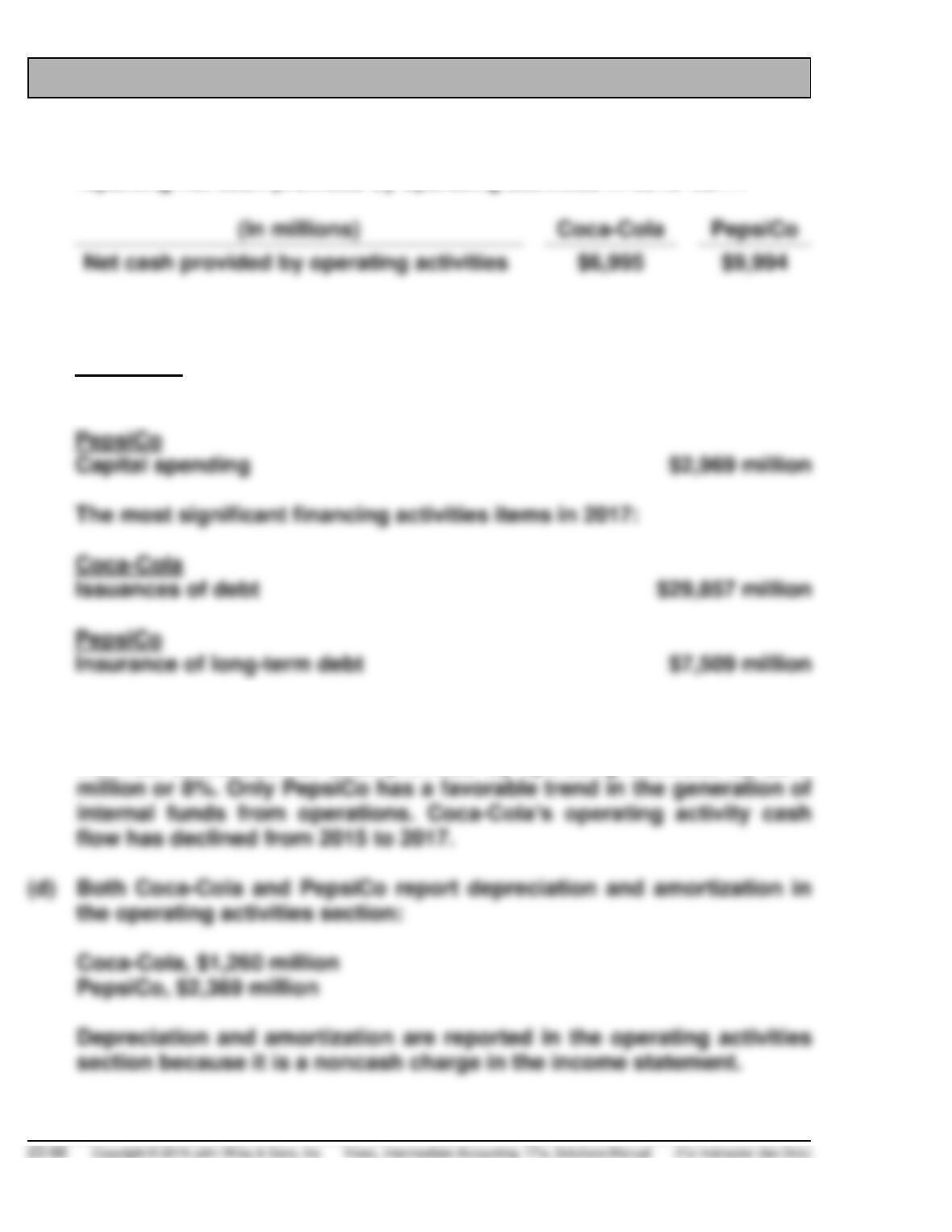
(b) The most significant investing activities items in 2017:
Coca-Cola
Purchases of investments $16,520 million
(c) The Coca-Cola Company’s net cash provided by operating activities
has declined from 2015 to 2017 by $3,533 million or 0.34%. PepsiCo,
Inc. has decreased net cash provided by operating activities by $870
COMPARATIVE ANALYSIS CASE (Continued)
(e)
Coca-Cola
PepsiCo
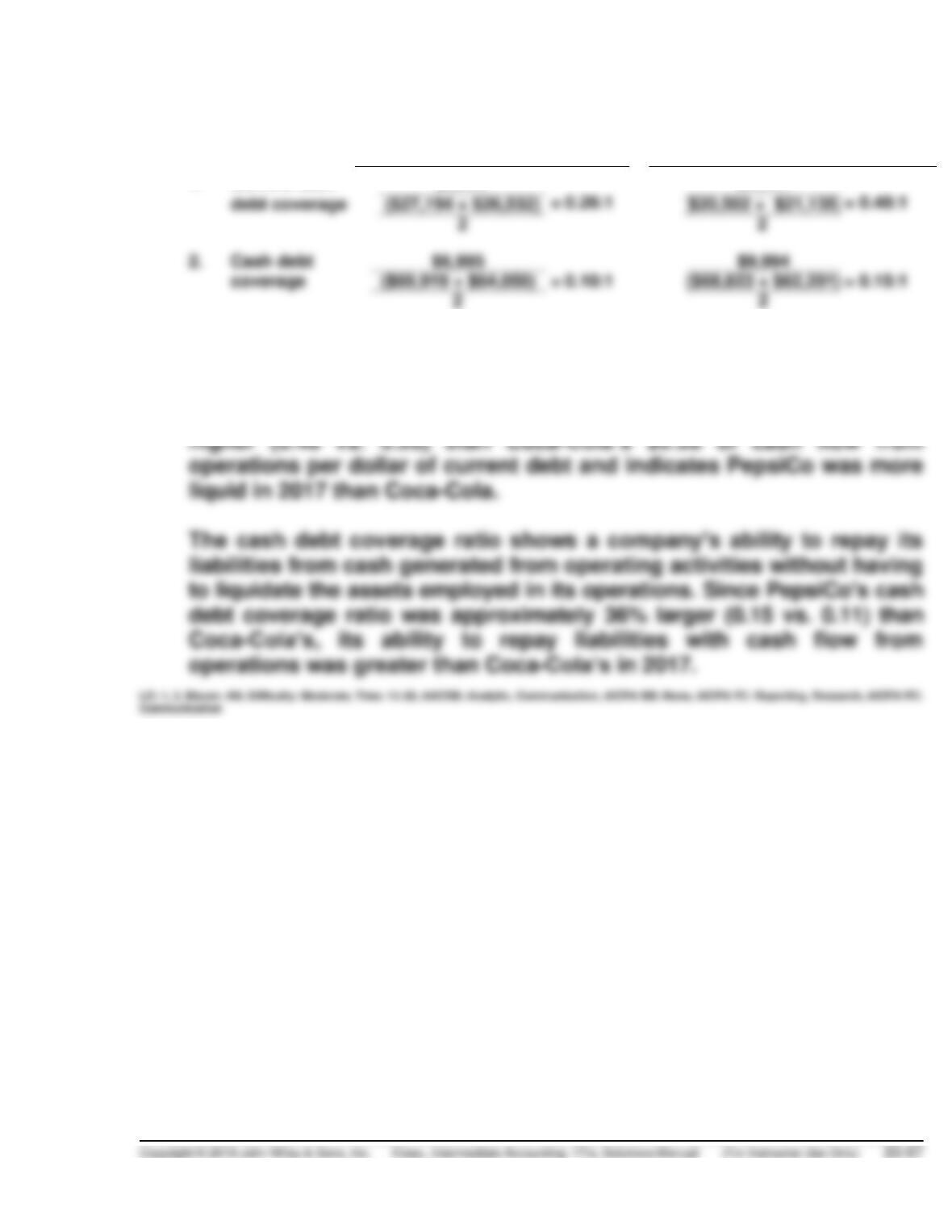
1.
Current cash
$6,995
$9,994
(f) The current cash debt coverage ratio uses cash generated from
operations during the period and provides a better representation of
liquidity on an average day. PepsiCo’s ratio of $0.48 of cash flow from
operations for every dollar of current debt was approximately 85%
FINANCIAL STATEMENT ANALYSIS CASE
VERMONT TEDDY BEAR CO.
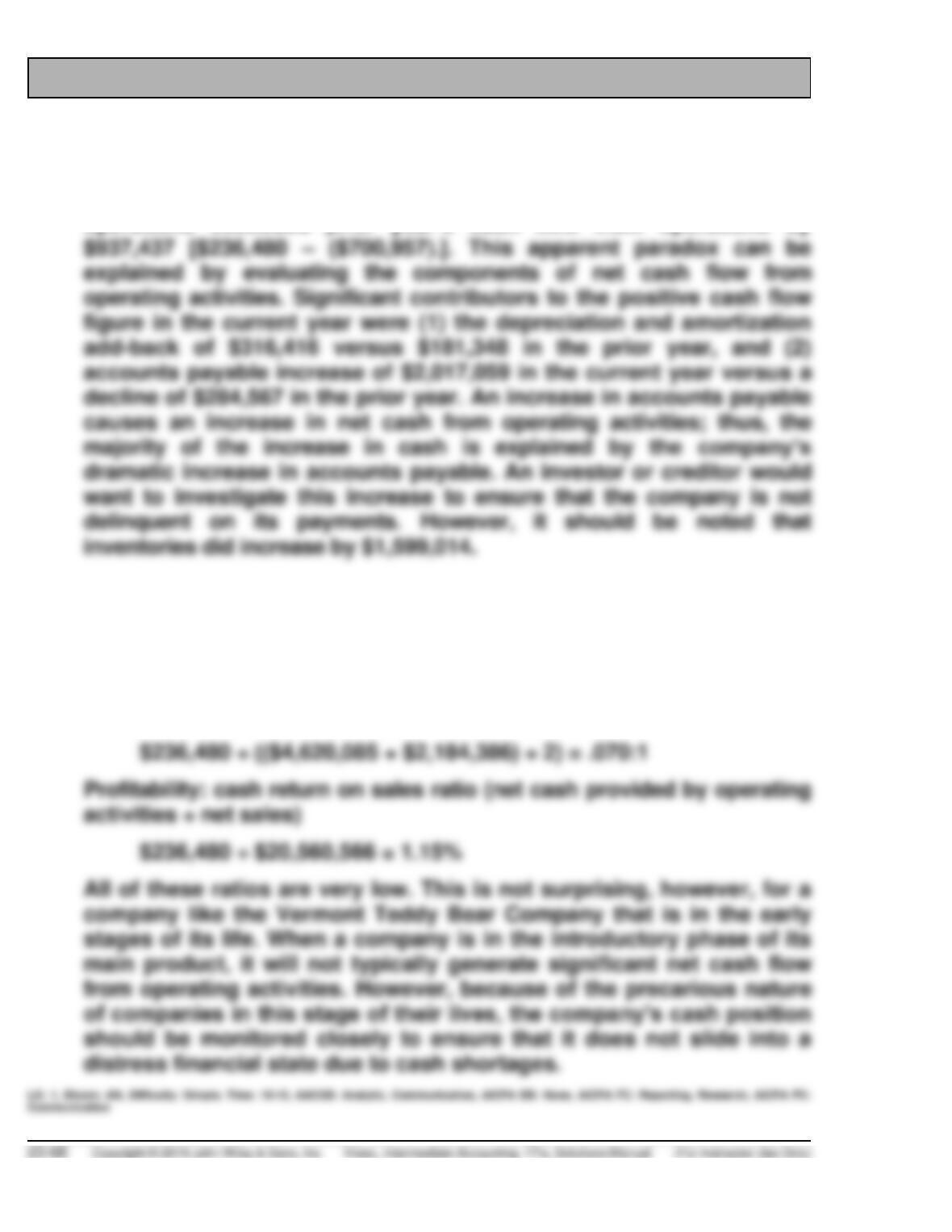
(a) Even though prior year income exceeded the current year income by
$821,432 ($838,955 – $17,523), the current year cash flow from
operations exceeded prior year’s cash flow from operations by
(b) Liquidity: current cash debt coverage ratio (net cash provided by
operating activities ÷ average current liabilities)
$236,480 ÷ (($4,055,465 + $1,995,600) ÷ 2) = .078:1
Solvency: cash debt coverage (net cash provided by operating
activities ÷ average total liabilities)
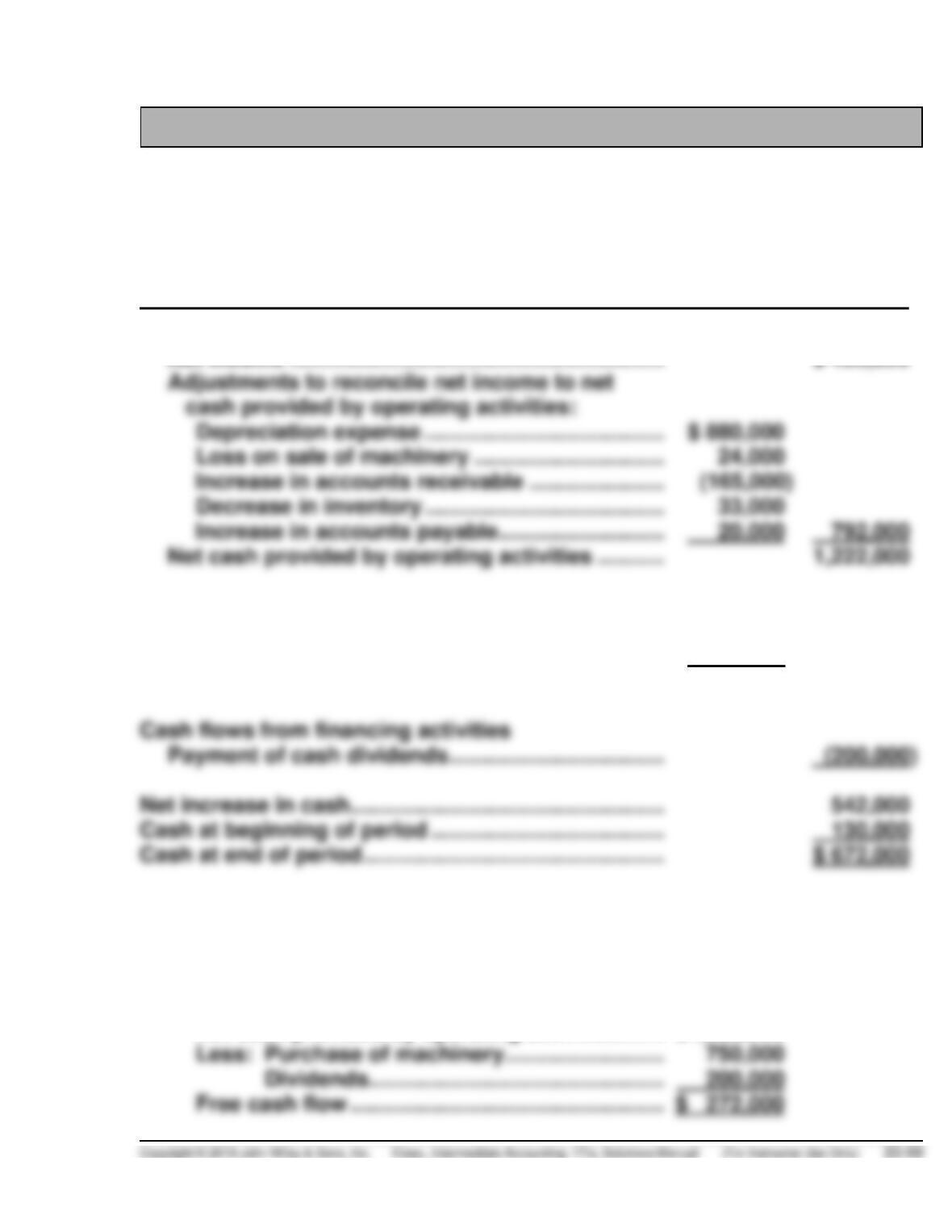
ACCOUNTING, ANALYSIS, AND PRINCIPLES
Accounting
LASKOWSKI COMPANY
Statement of Cash Flows
For the Year Ended December 31, 2020
Cash flows from operating activities
Net income ……………………………………………………. $ 430,000
Cash flows from investing activities
Sale of machinery ………………………………………….. 270,000
Purchase of machinery ………………………………….. (750,000)
Net cash used by investing activities ………………. (480,000)
Analysis
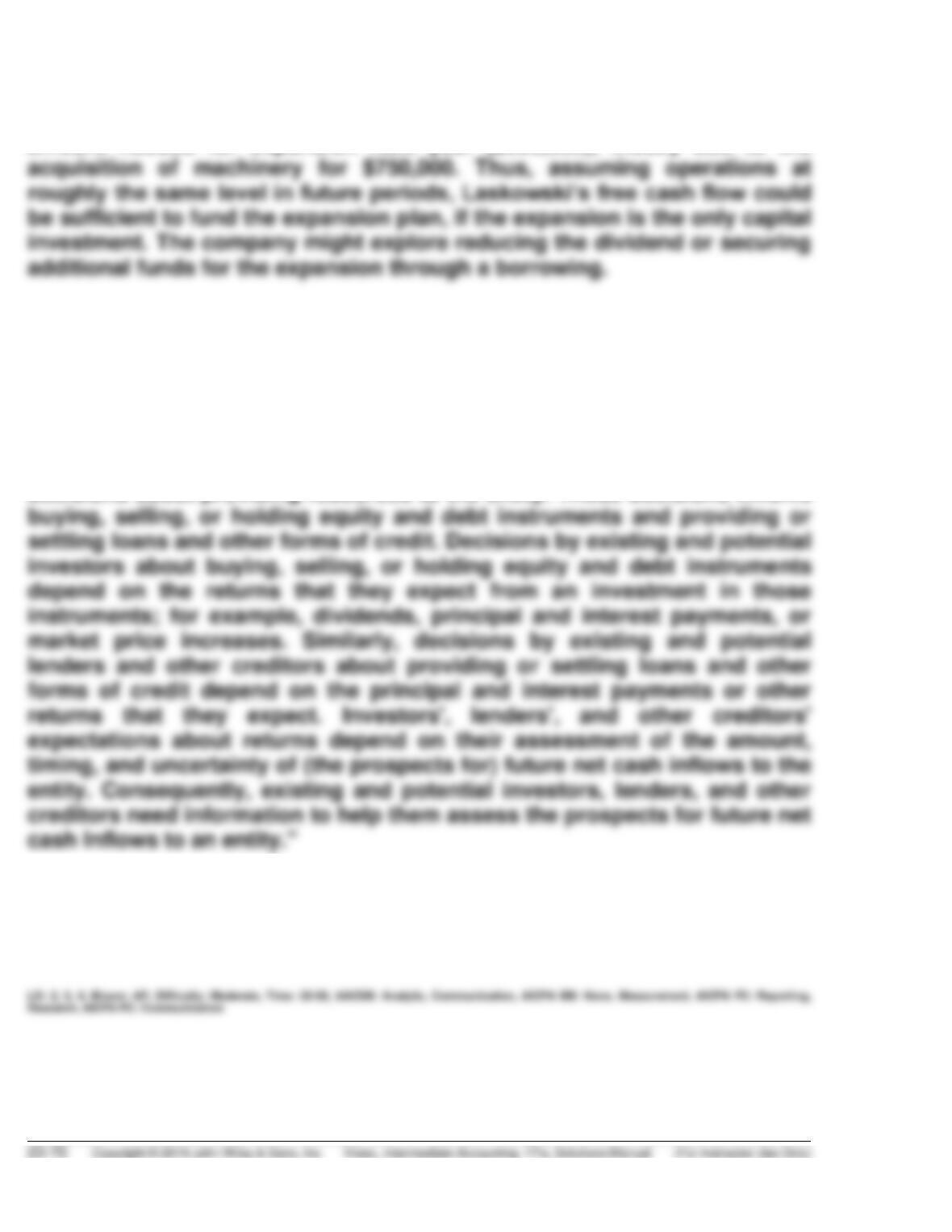
Laskowski’s free cash flow is:
Net cash provided by operating activities ……. $1,222,000
ACCOUNTING, ANALYSIS, AND PRINCIPLES (Continued)
Laskowski’s free cash flow for the current year ($272,000) is less than the
amount needed for expansion next year ($500,000), mostly due to the
Principles
According to Statement of Financial Accounting Concepts No. 8 paragraph
37-OB2-3, “The objective of general purpose financial reporting is to
provide financial information about the reporting entity that is useful to
existing and potential investors, lenders, and other creditors in making
decisions about providing resources to the entity. Those decisions involve
By reporting the cash provided by operations, and the inflows and outflows
of cash from investing and financing decisions, the statement of cash
flows provides information relevant to assessing a company’s future cash
flows.
CODIFICATION EXERCISES
CE23.1
Master Glossary
(a) Cash equivalents are short-term, highly liquid investments that have both of the following
characteristics:
1. Readily convertible to known amounts of cash
(b) Financing activities include obtaining resources from owners and providing them with a return
on, and a return of, their investment; receiving restricted resources that by donor stipulation must
be used for long-term purposes; borrowing money and repaying amounts borrowed, or otherwise
settling the obligation; and obtaining and paying for other resources obtained from creditors on
long-term credit.
(c) Investing activities include making and collecting loans and acquiring and disposing of debt or
equity instruments and property, plant, and equipment and other productive assets, that is,
CE23.2
According to FASB ASC 230-10–45-14 (Statement of Cash Flow—Other Presentation Matters—Cash
Flows from Financing Activities):
CE23.2 (Continued)
(c) Receipts from contributions and investment income that by donor stipulation are restricted for the
purposes of acquiring, constructing, or improving property, plant, equipment, or other long-lived
assets or establishing or increasing a permanent endowment or term endowment.
CE23.3
According to FASB ASC 230-10–45-11 (Statement of Cash Flows—Other Presentation Matters—Cash
Flows from Investing Activities):
CE23.4
According to FASB ASC 230-10–50-3 (Statement of Cash Flows—Disclosure—Noncash Investing and
Financing Activities):