Wild and Shaw, Financial & Managerial Accounting, 8e Solutions Manual: Chapter 23
Chapter 23
Relevant Costing for
Managerial Decisions
QUESTIONS
1. The five steps are: (1) define the decision task, (2) identify alternative courses of
action, (3) collect relevant information and evaluate each alternative, (4) select
the preferred course of action, and (5) analyze and assess decisions made.
2. Nonfinancial information is relevant to decision making because it includes
information about such matters as environmental considerations and social
responsibility. These issues can have a great effect on a business.
3. A relevant cost is a cost that differs between two alternatives in a decision
making process. Relevant costs include out of pocket costs and opportunity
costs.
4. Incremental revenues are the additional revenues generated by selecting one
course of action over another.
5. Qualitative factors can include impacts on relationships with other customers,
impact on the relationship with the customer buying more in a “special offer”
decision, and employee morale and workload in a “make or buy” decision.
Corporate social responsibility and environmental concerns might also be
9. Apple must consider such factors as: contribution margin lost from the closing of
the store and fixed costs saved from the closing. For instance it is possible that a
manager who is employed by the store will not be laid off but will be transferred to
another store. That person’s salary would not be saved, and so it is not relevant to
this decision. Apple must also consider the possibility that they will gain sales at
other stores. If a customer transfers their business to another store in the area, that
additional contribution margin must be considered as well. There also may be the
permanent loss of some customers if it becomes too difficult for them to find an
Apple store near them, and they may transfer their business to a competitor.
QUICK STUDIES
Quick Study 23-1 (5 minutes)
Item
Relevant
Not relevant
a.
Selling price of $6.00 per unit ………………………………………….
X
b.
Direct materials cost of $1.00 per unit …………………………..
X
c.
Direct labor of $2.00 per unit …………………………………………..
X
d.
Variable manuf. overhead of $1.50 per unit ………………………
X
e.
Fixed manuf. overhead of $0.75 per unit ………………………….
g.
X
Administrative expenses of $0.60 per unit ……………………….
Quick Study 23-2 (10 minutes)
Additional operating income if Helix accepts the order—
Per unit
Total for
2,000 units
Revenue …………………………………………………………………………
$6.00
$12,000
Direct materials ……………………………………………………….
(1.00)
(2,000)
Direct labor …………………………………………………………………….
(2.00)
(4,000)
Variable manufacturing overhead …………………………..
(1.50)
(3,000)
Additional selling expenses ……………………………………………
$ 2,000
Quick Study 23-3 (5 minutes)
Item
Relevant
Not relevant
a.
$15,000 cost already incurred ………………………………………….
X
b.
$20,000 selling price …………………………..…………………………..
X
c.
$22,000 additional processing costs …………………………..
$35,000 revenues from processing further ………………………
Quick Study 23-4 (5 minutes)
1. F 2. T 3. T 4. T 5. F
Quick Study 23-5 (15 minutes)
Revenue if repaired (10,000 x $5) ………………………………….
$50,000
Revenue if sold as is (10,000 x $2) ………………………………..
(20,000)
Incremental revenue …………………………………………………….
30,000
Cost to repair ……………………………………………………………….
(18,000)
Incremental net income if the units are repaired ……………
$12,000
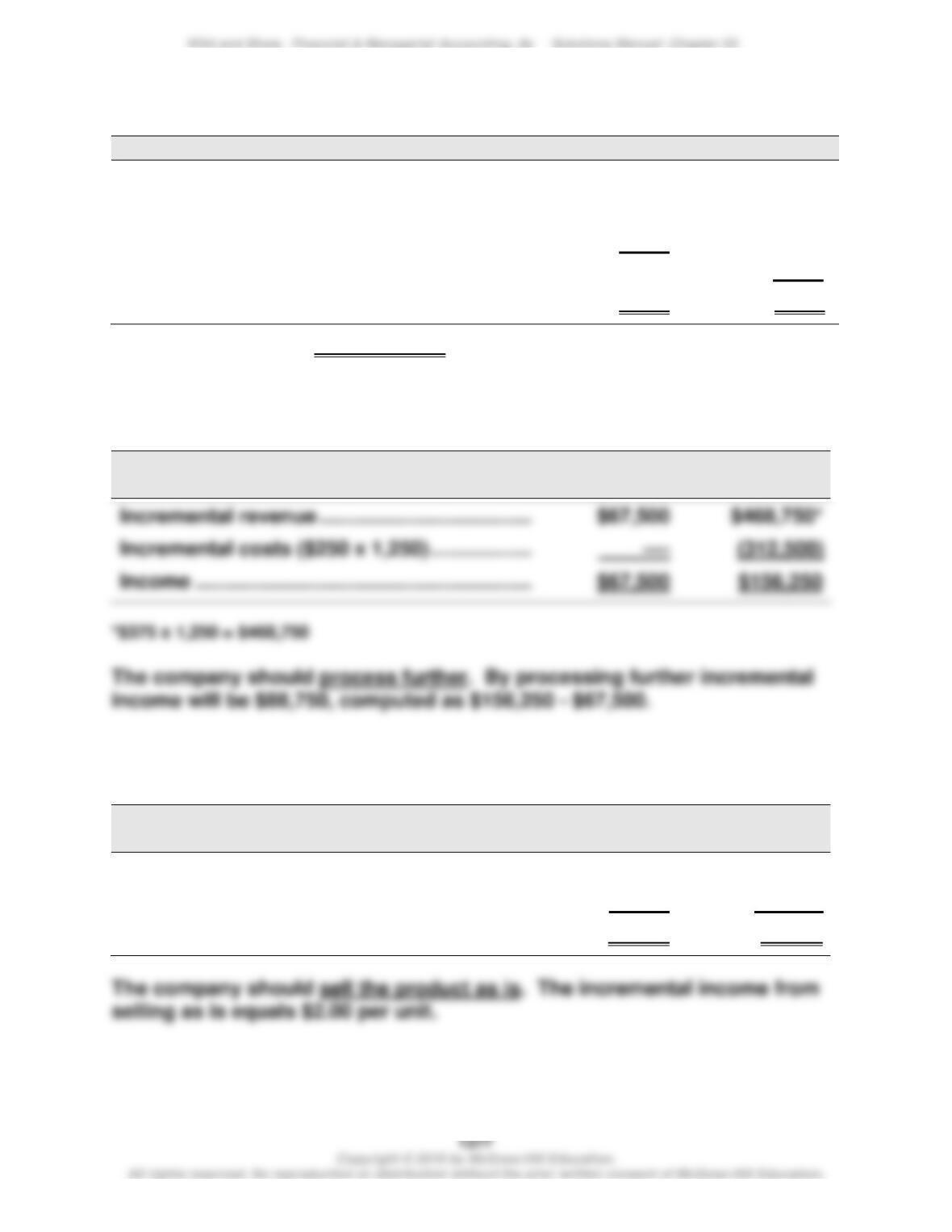
Quick Study 23-6 (15 minutes)
Incremental cost analysis
Costs of purchasing
Cost to purchase ………………………………………………………………………………
$5.00
Revenue loss from reduced price ($13.50 – $12.00) …………………………..
1.50
Total cost ……………………………………………………………………………………
6.50
Costs eliminated if purchased ($5 of $9) …………………………..……………….
5.00
Quick Study 23-7 (10 minutes)
(Per unit)
Make
Buy
Direct materials …………………………………………….
$2.25
—-
Direct labor …………………………………………………..
1.00
—-
Incremental overhead ……………………………………
Purchase price …………………………..…………………
$0.75
—-
—-
$5.00
Total ……………………………………………………….
$4.00
$5.00
Analysis: Xia should make the part.
Quick Study 23-8 (15 minutes)
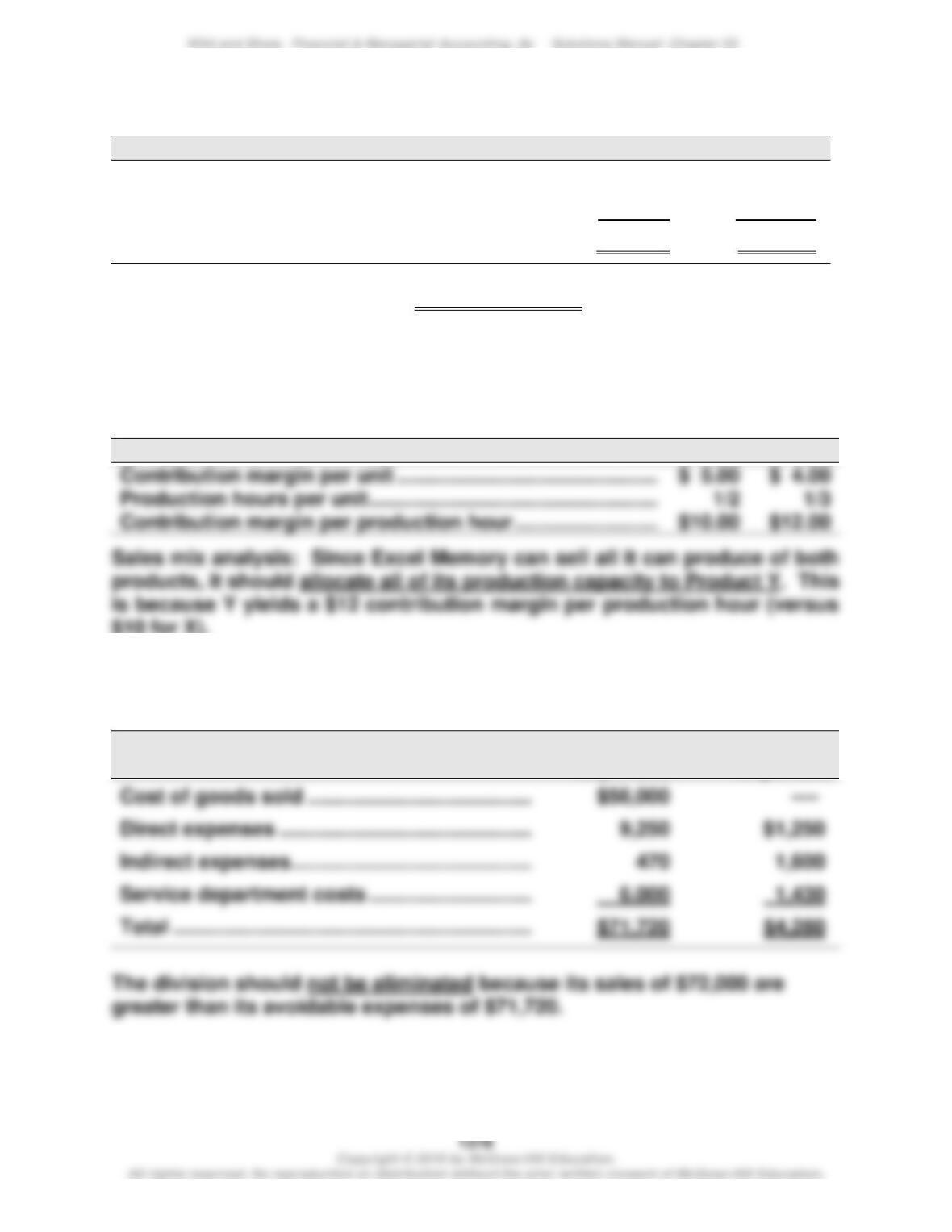
Sell as is
Process
further
Incremental revenue ……………………………………..
Incremental costs ($250 x 1,250) ……………………
Quick Study 23-9 (5 minutes)
(Per unit)
Sell as is
Process
further
Incremental revenue ……………………………………..
$15.00
$21.00
Incremental costs …………………………………………
—-
(8.00)
Income ……………………………………………………….
$15.00
$13.00
Quick Study 23–10 (15 minutes)
Scrap
Rework
Sale of scrapped/reworked units …………………..
$30,000
$120,000
Less out–of-pocket costs to rework ……………….
—-
(80,000)
Income ……………………………………………………….
$30,000
$ 40,000
Analysis: The company should rework the unitss as it will increase income
by $10,000.
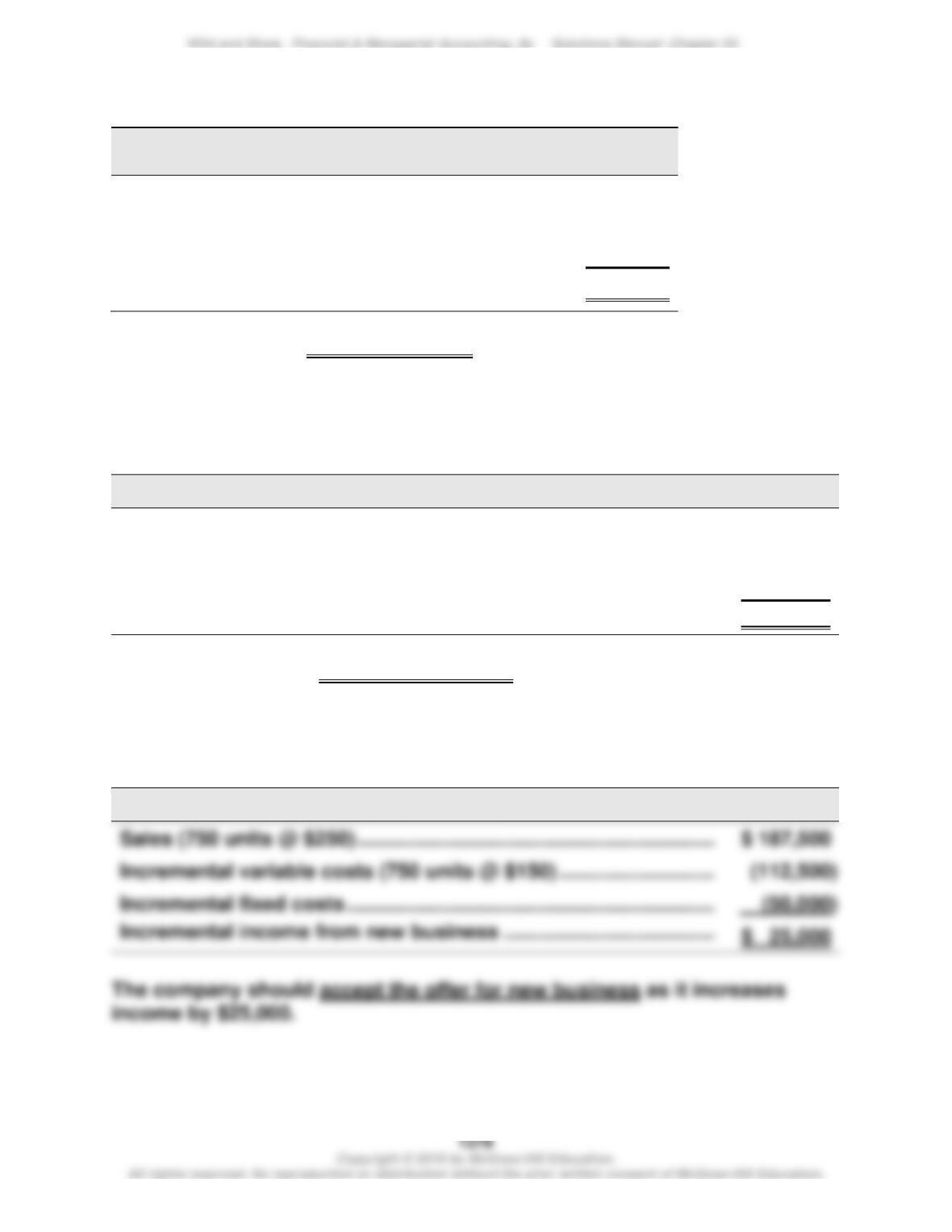
Quick Study 23-11 (15 minutes)
X
Y
$10 for X).
Quick Study 23–12 (15 minutes)
Avoidable
Unavoidable
Expenses
Expenses
$71,720
Quick Study 23-13 (5 minutes)
Avoidable
Expenses
Variable costs……………………………………………….
$145,000
Direct fixed costs ………………………………………….
30,000
Indirect expenses (40% avoidable) ………………..
20,000
Total ……………………………………………………….
$195,000
The division should not be eliminated because its sales of $200,000 are
greater than its avoidable expenses of $195,000.
Quick Study 23-14 (10 minutes)
INCREMENTAL INCOME FROM REPLACING MACHINE
Cost to buy new machine ……………………………………………………….
$(112,500)
Cash received to trade in old machine ………………………………………………
60,000
Reduction in variable manufacturing costs ……………………………………….
Incremental income ………………………………………………………………………….
65,000
$ 12,500
The company should replace the machine as this increases income by
$12,500.
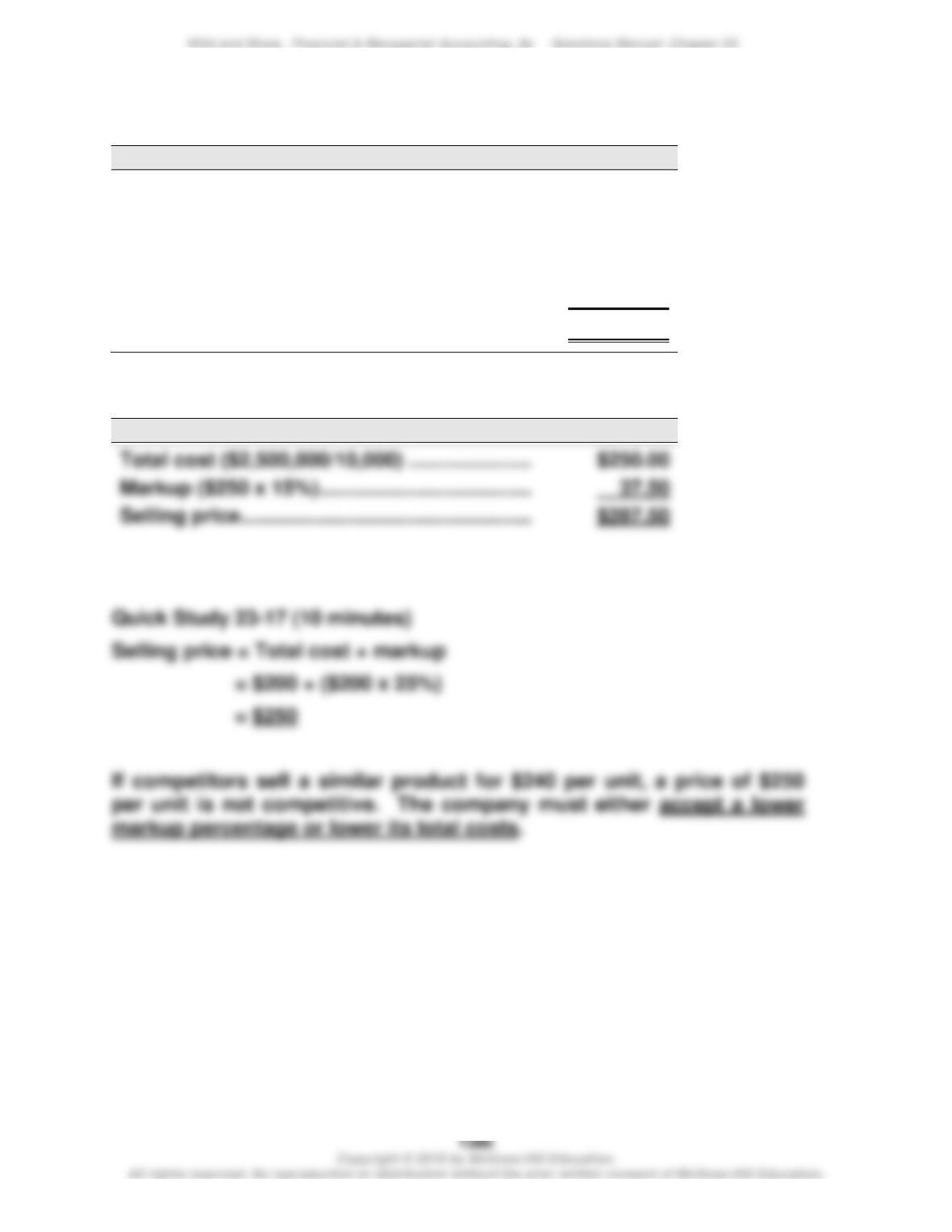
Quick Study 23–15 (15 minutes)
INCREMENTAL INCOME FROM NEW BUSINESS
Sales (750 units @ $250) ……………………………………………………….
Incremental variable costs (750 units @ $150) …………………………..
Quick Study 23-16 (10 minutes)
Total Costs
Direct materials ($100 x 10,000) …………………….
$1,000,000
Direct labor ($30 x 10,000) …………………………..
Variable overhead ($45 x 10,000) …………………..
Fixed overhead……………………………………………..
Fixed selling and administrative ……………………
300,000
450,000
635,000
115,000
Total ……………………………………………………….
$2,500,000
Per Unit
Total cost ($2,500,000/10,000) ……………………….
Quick Study 23-18 (10 minutes)
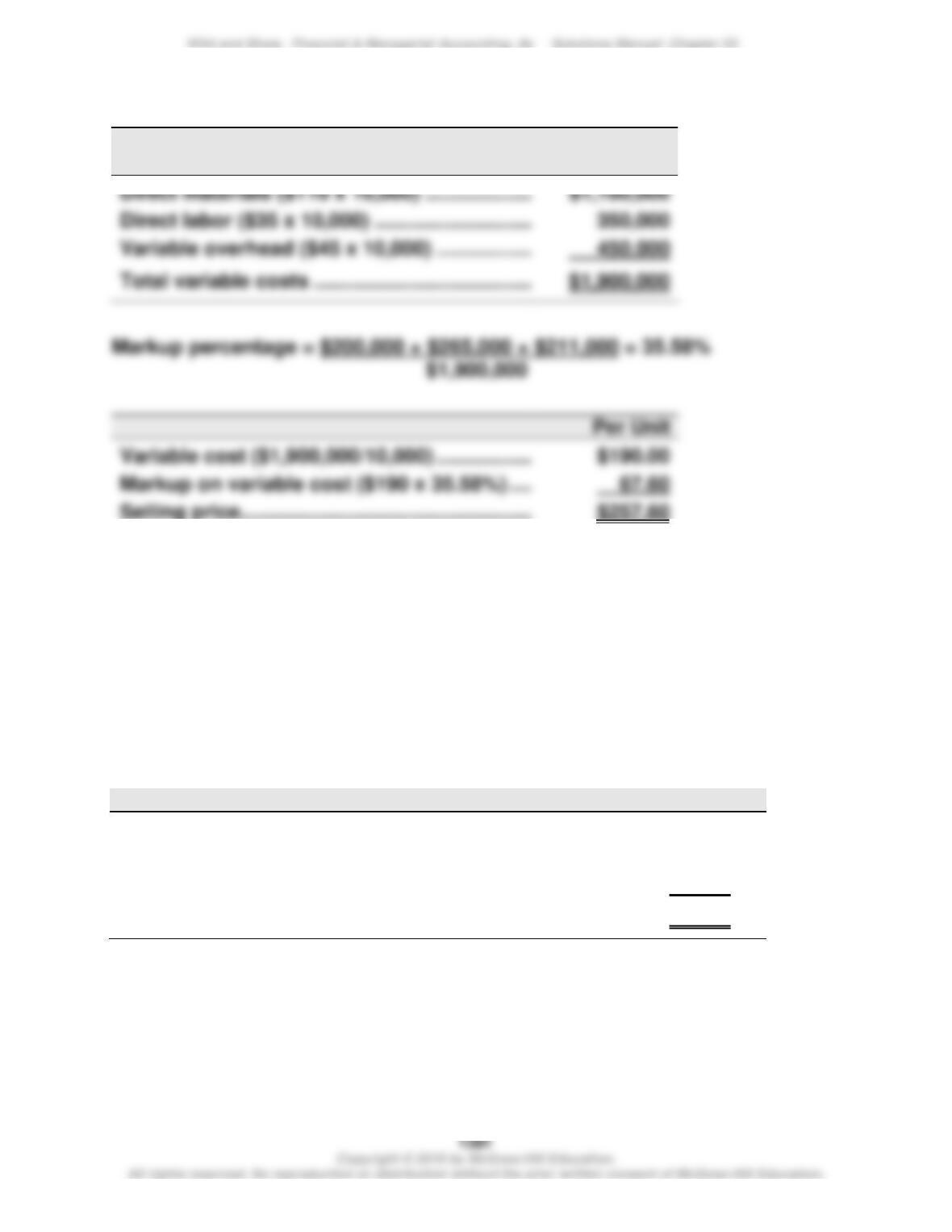
Variable
Costs
Direct materials ($110 x 10,000) …………………….
Variable cost ($1,900,000/10,000) …………………..
Quick Study 23–19 (5 minutes)
Target cost = Expected selling price – desired profit
Target cost = $80 – ($80 x 20%) = $64
Quick Study 23-20 (10 minutes)
Time and Materials Price Quote
Price Quote
Direct labor (80 hours x $55 per DLH) ………………………..
$4,400
Direct materials cost ………………………………………………..
Materials markup ($3,800 x 30%) ……………………………….
3,800
1,140
Time and materials price quote …………………………………
$9,340
Quick Study 23-21 (10 minutes)
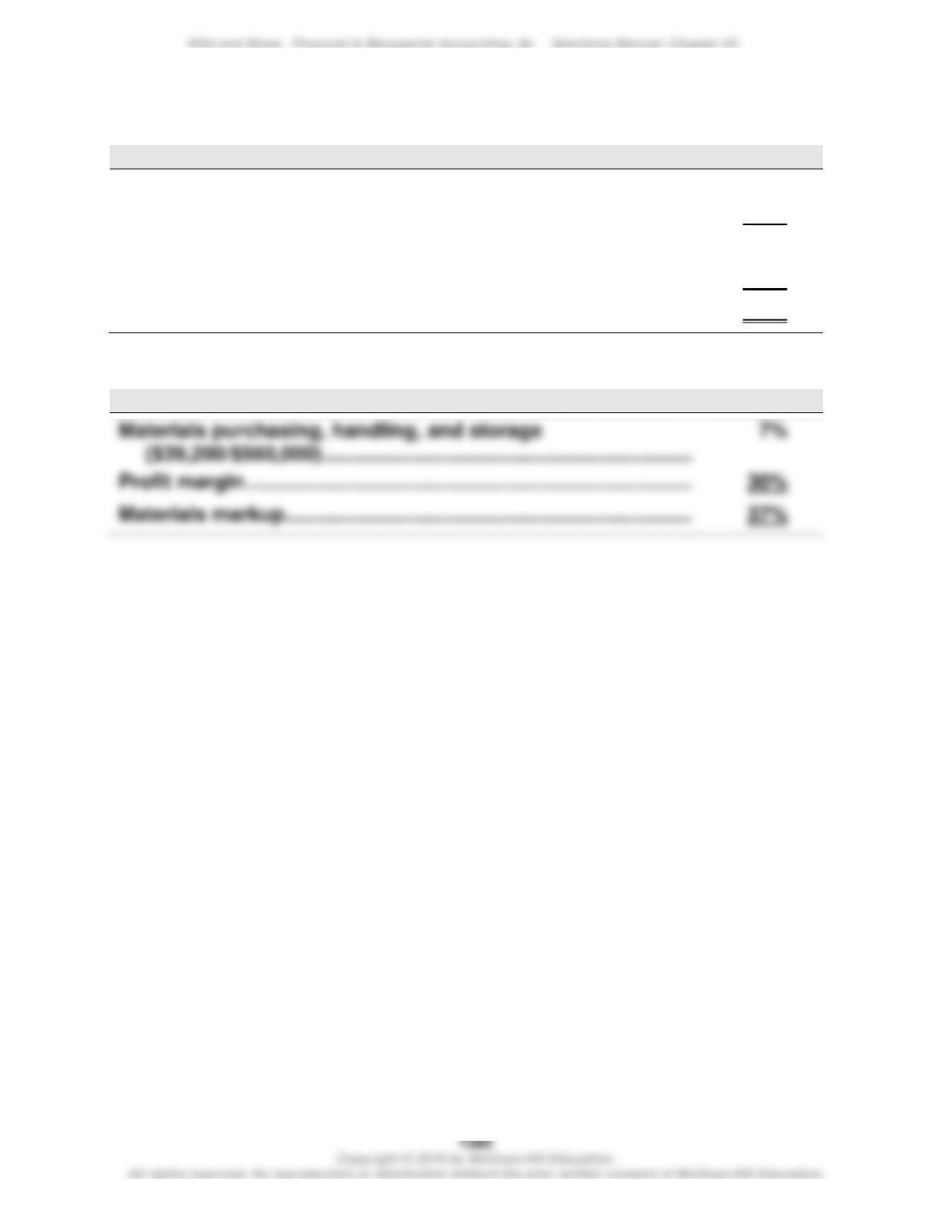
a.
Rate per Hour of Direct Labor
Direct labor rate per hour …………………………………………………..
$ 50
Non-materials related overhead per hour ($114,000/3,800) ….
30
Total hourly conversion cost ……………………………………………..
80
Profit margin ($80 x 30%) …………………………………………………..
24
Rate per hour of direct labor ………………………………………………
$104
b.
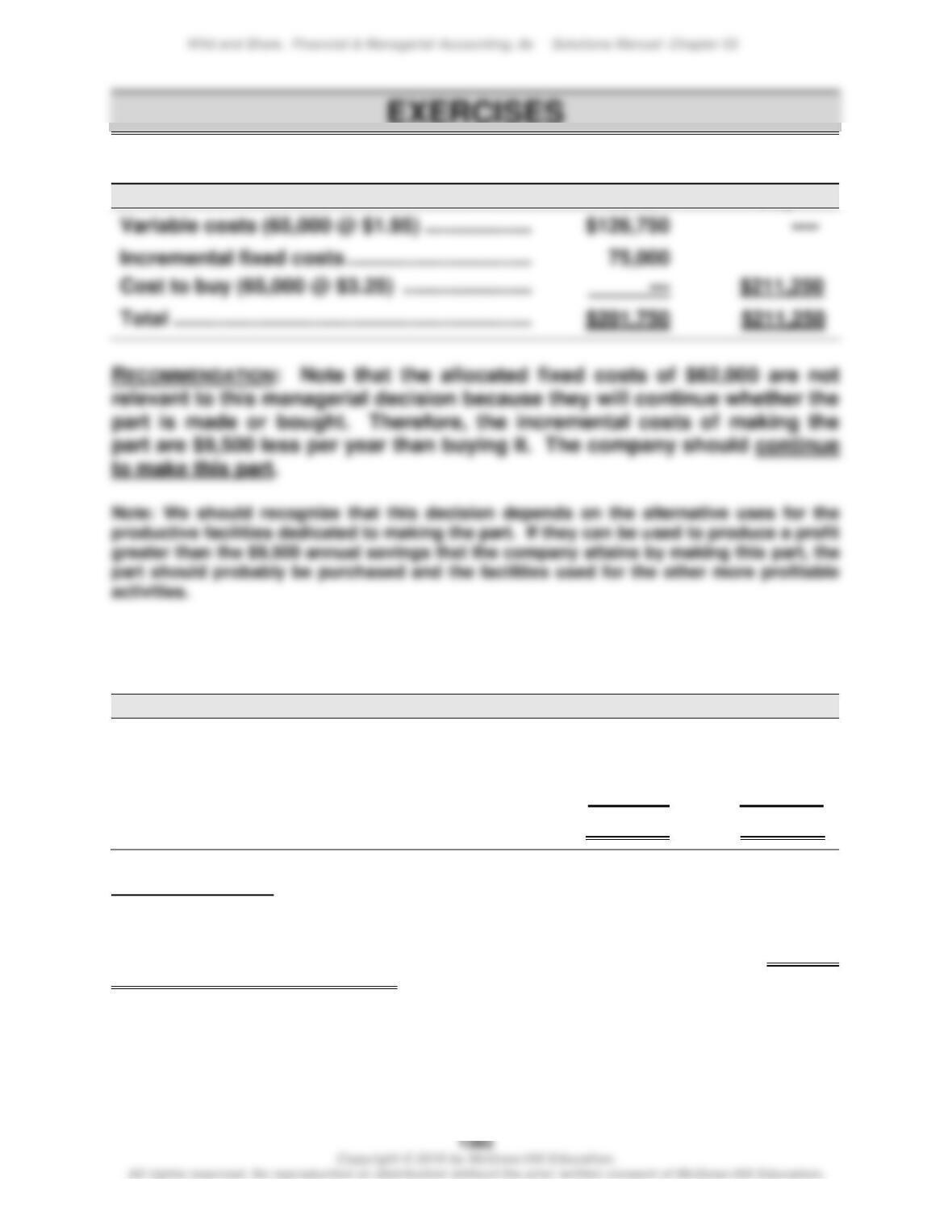
Materials Markup per Dollar of Materials Cost (%)
Exercise 23-1 (20 minutes)
Make
Buy
Incremental fixed costs …………………………………
75,000
Total ……………………………………………………….
$211,250
Exercise 23-2 (20 minutes)
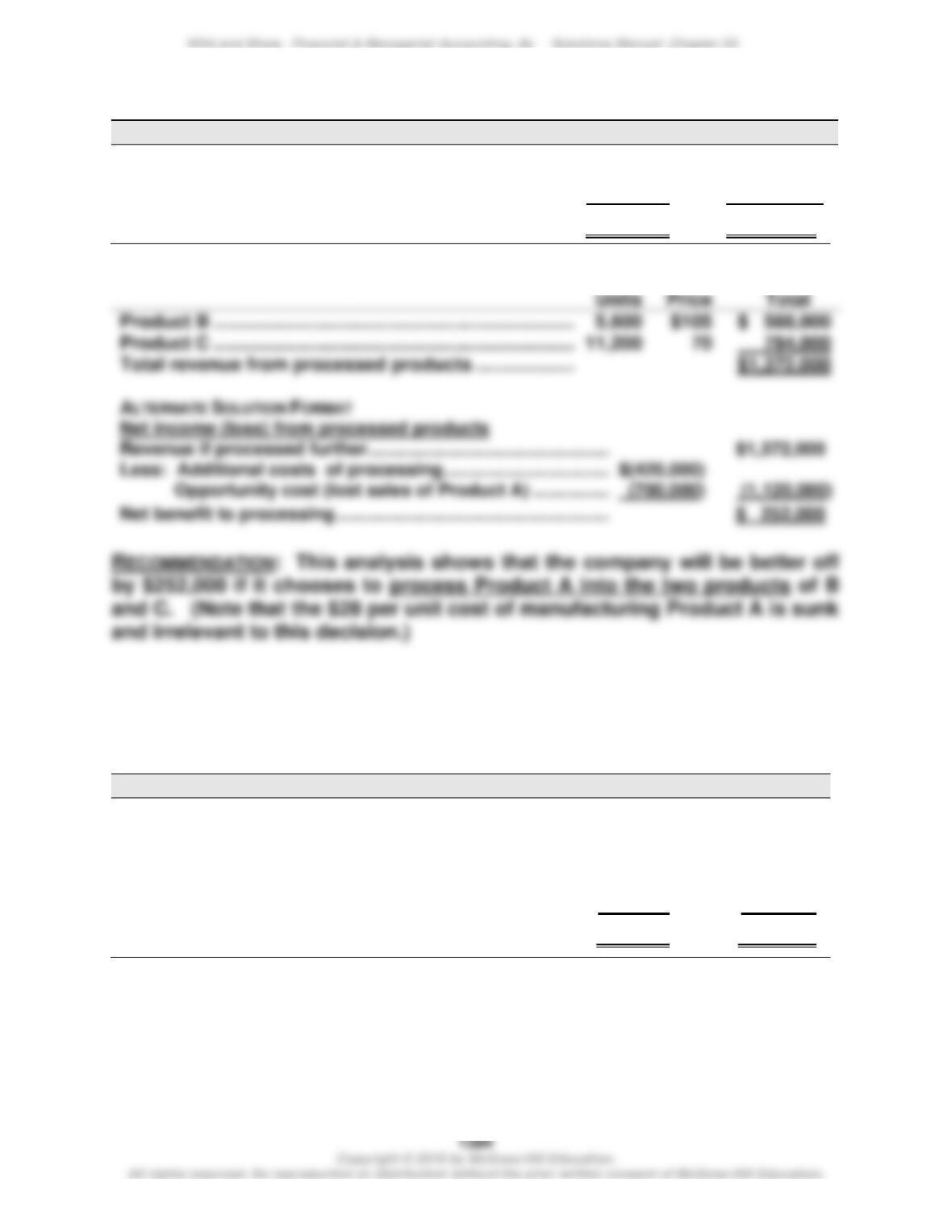
Make
Buy
Variable costs (40,000 @ $1.95) …………………….
$78,000
—-
Incremental fixed costs …………………………………
Cost to buy (40,000 @ $3.50) ………………………..
65,000
—
$140,000
Total ……………………………………………………….
$143,000
$140,000
RECOMMENDATION: Note that the allocated fixed costs of $58,500 are not
relevant to this managerial decision because they will continue whether the
part is made or bought. Therefore, the incremental costs of making the
part are $3,000 more per year than buying it. The company should buy the
part from the outside supplier rather than make the part.
Exercise 23-3 (25 minutes)
Sell as is
Process further
Incremental revenue ……………………………………..
$700,000
$1,372,000*
Incremental costs …………………………………………
—-
(420,000)
Incremental income ………………………………………
$700,000
$ 952,000
*Revenue from processed products
Exercise 23-4 (15 minutes)
Instructor note: In the first printing of this edition, this exercise included the sentence: “If the
units are sold as is, the company will be able to build 22,000 replacement units at a cost of $6
each and sell them at the full price of $8.50 each.” That sentence has been deleted in subsequent
printings and in Connect.”
Scrap
Rework
Sale of scrapped/reworked units …………………..
$44,000
$187,000*
Less out–of-pocket costs to rework ……………….
Less opportunity cost of not making new
units (22,000 @ $2.50) …………………………………..
—-
—-
(99,000)**
(55,000)
Total income from each alternative ……………….
$44,000
$ 33,000
* 22,000 x $8.50 **22,000 x $4.50
(1) The incremental income from selling as scrap is $44,000 (22,000 x $2.00).
(2) The incremental income from reworking is $33,000.
(3) The product should not be reworked as the $33,000 income from
reworking is less than the $44,000 income from selling as is.
Exercise 23-5 (15 minutes)
INCREMENTAL REVENUE AND COST OF ADDITIONAL PROCESSING
Revenue if processed further (7,000 x $25) ………………………………………..
$175,000
Revenue if sold as is (7,000 x $8) ………………………………………………………
56,000
Incremental revenue …………………………………………………………………………
119,000
Less incremental cost of processing …………………………………………………
125,000
Incremental net income …………………………………………………………………….
$ (6,000)
RECOMMENDATION: Varto should not process these units further, as they will
be $6,000 worse off if they do so. (Note that the $22 per unit manufacturing
cost is not relevant because it is a sunk cost.)
Exercise 23-6 (30 minutes)
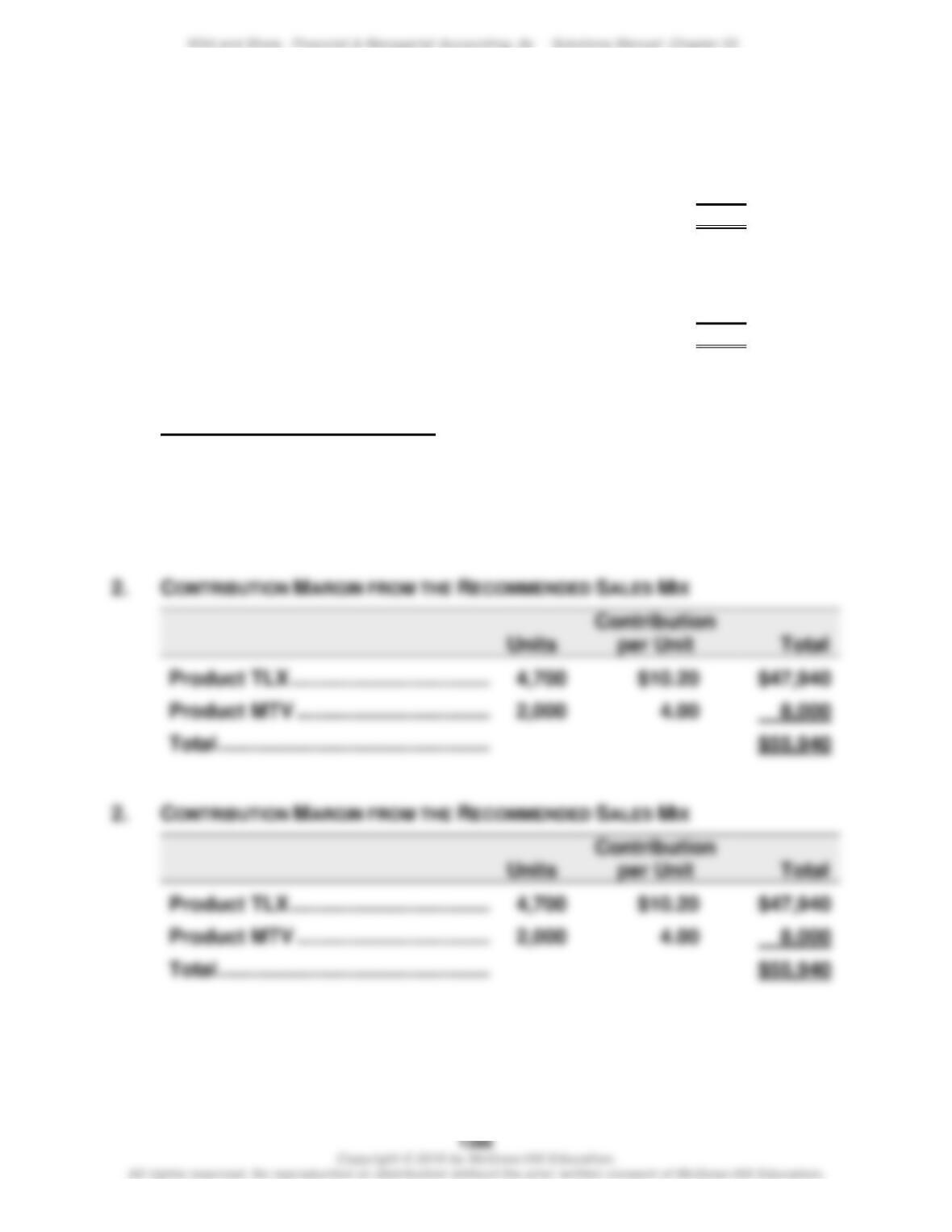
Preliminary computations
Contribution margin per hour
Product TLX
Product MTV
Selling price per unit ………………………………………………..
$15.00
$ 9.50
Variable costs per unit ……………………………………………..
4.80
5.50
Contribution per unit ………………………………………………..
$10.20
$ 4.00
Machine-hours to produce 1 unit …………………………..
0.50
0.20
Contribution margin per machine-hour
(or contribution/hours per unit) …………………………..
$20.40
$20.00
Exercise 23–6 (continued)
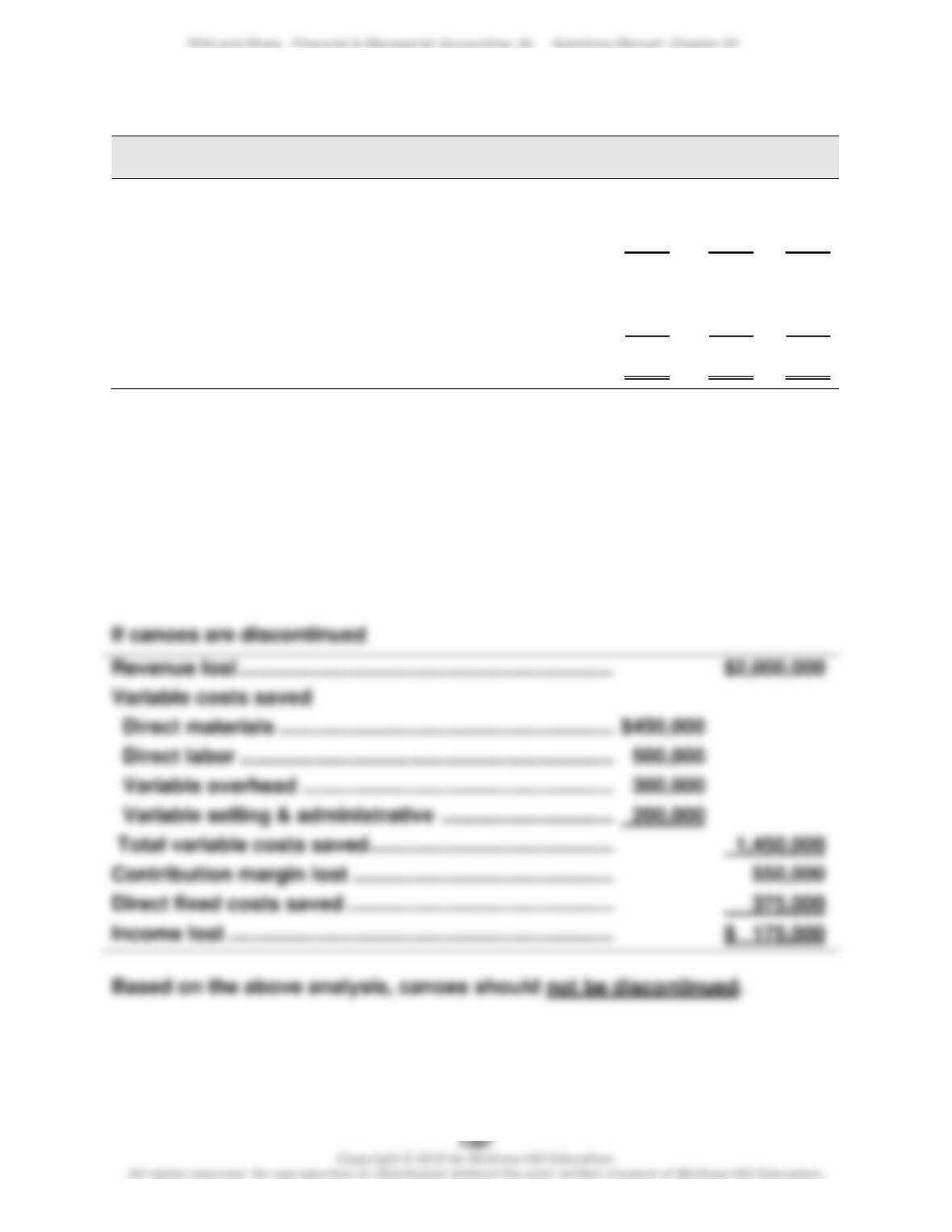
1. FOR PRODUCT TLX
Maximum sales ……………………………………………………….
4,700
units
Hours needed per unit ……………………………………………………
0.50
Total hours used (4,700 x 0.50) ……………………………………….
2,350
hours
FOR PRODUCT MTV
Remaining hours (2,750 – 2,350)……………………………………..
400
hours
Hours needed per unit ……………………………………………………
0.20
Maximum production* (400/0.20) …………………………..………..
2,000
units
*Below market maximum production.
SALES MIX RECOMMENDATION: These results suggest the company
should manufacture as many units of Product TLX as it can produce
and sell until reaching a (market or production) constraint. Thereafter,
any remaining capacity should be devoted to Product MTV, up to the
maximum that can be produced and/or sold.
Total ……………………………………………
Total ……………………………………………
Exercise 23-7 (30 minutes)
K1
S5
G9
Selling price per unit………………………………
$160
$112
$210
Variable costs per unit……………………………
96
85
144
Contribution margin per unit……………………
64
27
66
Pounds of material required……………………
÷ 4
÷ 3
÷ 6
Contribution margin per pound…………………
$ 16
$ 9
$ 11
Childress should produce and fill orders for K1 first because it has the
highest contribution margin per pound of materials. Production and orders
for G9 should be addressed second, and production and orders for S5
should be addressed third.
Exercise 23-8 (15 minutes)
1. DEPARTMENTS WITH EXPECTED NET LOSSES ELIMINATED
Total
M
N
O
P
T
Sales…………………………..
$119,000
$63,000
$ 0
$56,000
$ 0
$ 0
Expenses
Avoidable …………………………..
32,200
9,800
0
22,400
0
0
Unavoidable …………………………..
107,800
51,800
12,600
4,200
29,400
9,800
Total expenses …………………………..
140,000
61,600
12,600
26,600
29,400
9,800
Net income (loss) …………………………..
$ (21,000)
$ 1,400
$(12,600)
$29,400
$(29,400)
$(9,800)
Explanation: This income statement reflects elimination of Departments N,
P, and T. The sales and avoidable expenses are the combined amounts for
Departments M and O. The net loss has actually increased because the
excess of sales dollars over avoidable expenses has declined and less
remains to cover unavoidable expenses.
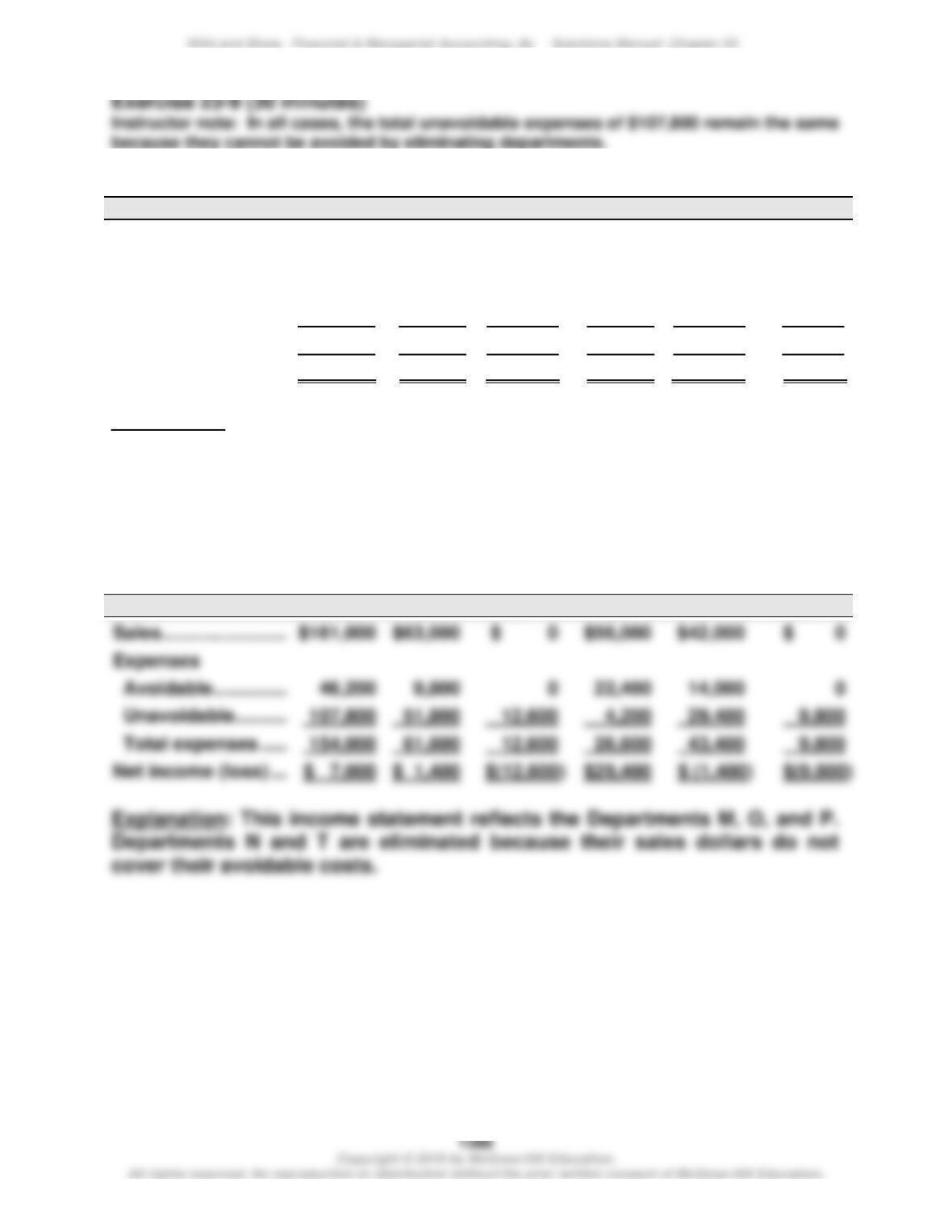
2. DEPARTMENTS WITH LESS SALES THAN AVOIDABLE EXPENSES ELIMINATED
Total
M
N
O
P
T
Sales…………………………..
$161,000
$ 0
Expenses
Avoidable …………………………..
46,200
0
Unavoidable …………………………..
51,800
Total expenses …………………………..
61,600
Net income (loss) …………………………..
$ 1,400
Exercise 23-10 (20 minutes)
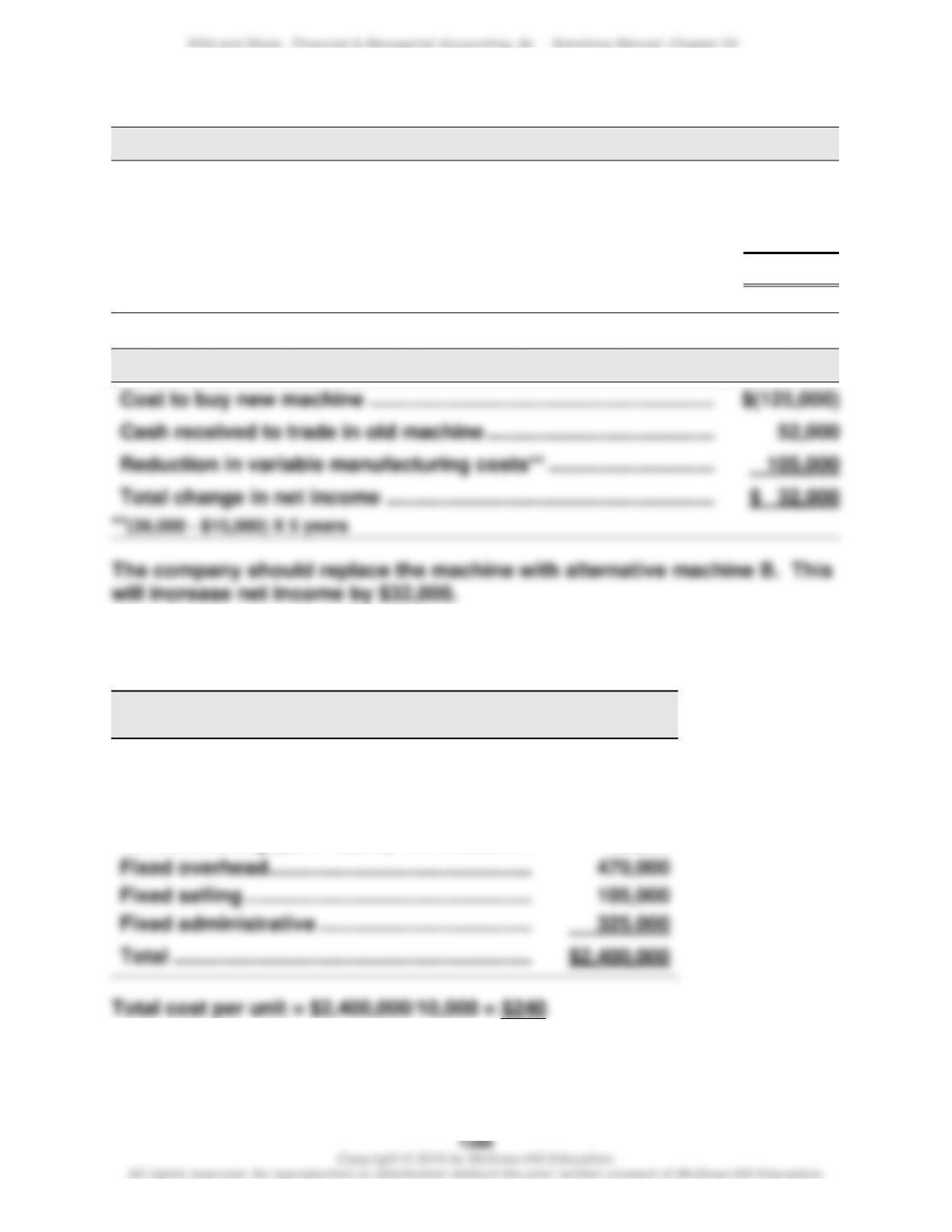
ALTERNATIVE A: INCREASE OR (DECREASE) IN NET INCOME
Cost to buy new machine ……………………………………………………….
$(115,000)
Cash received to trade in old machine ………………………………………………
52,000
Reduction in variable manufacturing costs* …………………………..
85,000
Total change in net income ……………………………………………………….
$ 22,000
*(36,000 – $19,000) X 5 years
ALTERNATIVE B: INCREASE OR (DECREASE) IN NET INCOME
Cost to buy new machine ……………………………………………………….
$(125,000)
Cash received to trade in old machine ………………………………………………
52,000
Reduction in variable manufacturing costs** …………………………..
Total change in net income ……………………………………………………….
$ 32,000
Exercise 23-11 (20 minutes)
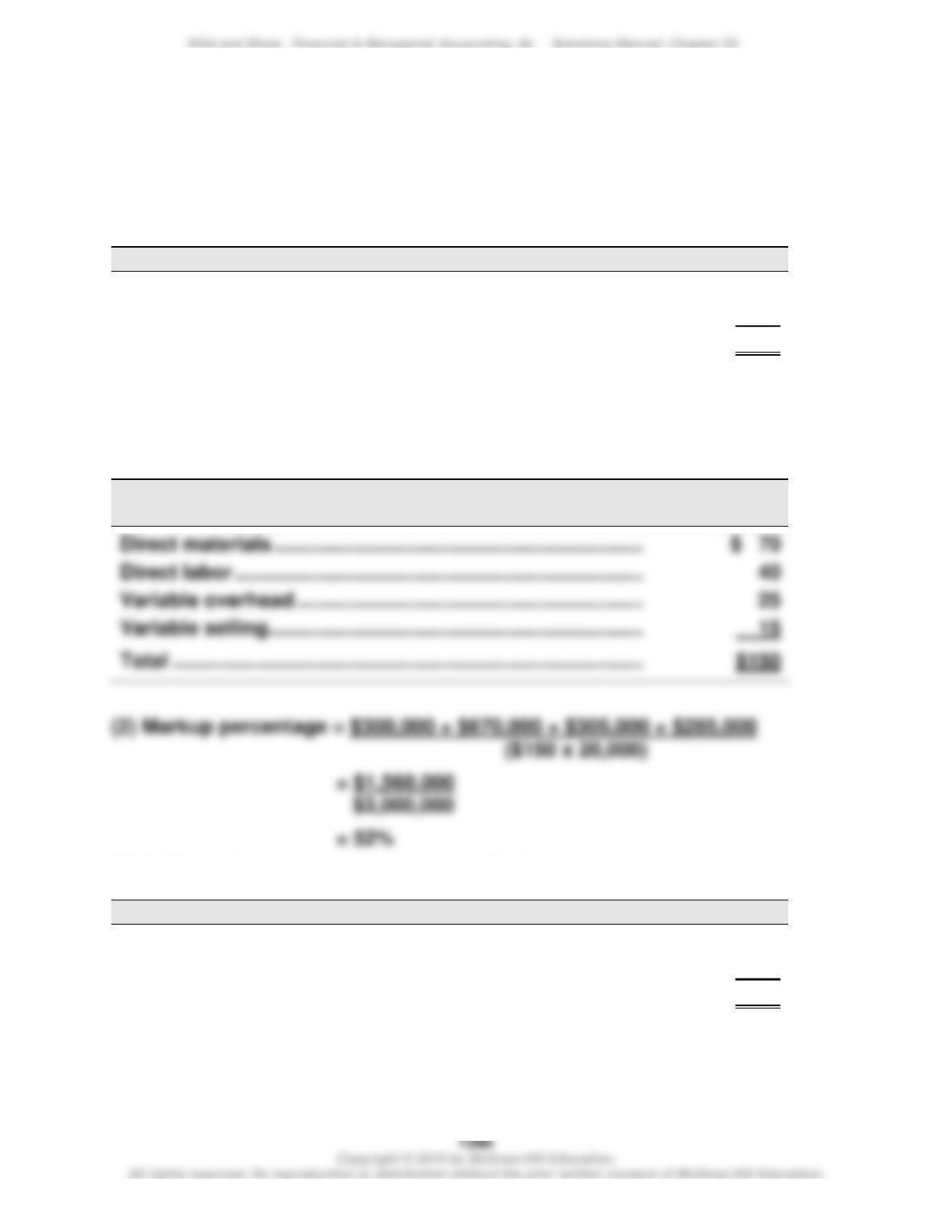
(1)
Total
Costs
Direct materials ($100 x 10,000) …………………….
$ 1,000,000
Direct labor ($25 x 10,000) …………………………..
Variable overhead ($20 x 10,000) …………………..
Variable selling ($5 x 10,000) ………………………..
250,000
200,000
50,000
Exercise 23–11 (continued)
(2) Markup percentage = Target profit/Total cost
= $300,000/$2,400,000
= 12.5%
(3)
Per Unit
Total cost ……………………………………………………….………….
$240
Markup on total cost ($240 x 12.5%) …………………………..
Selling price ……………………………………………………………….
30
$270
Exercise 23-12 (20 minutes)
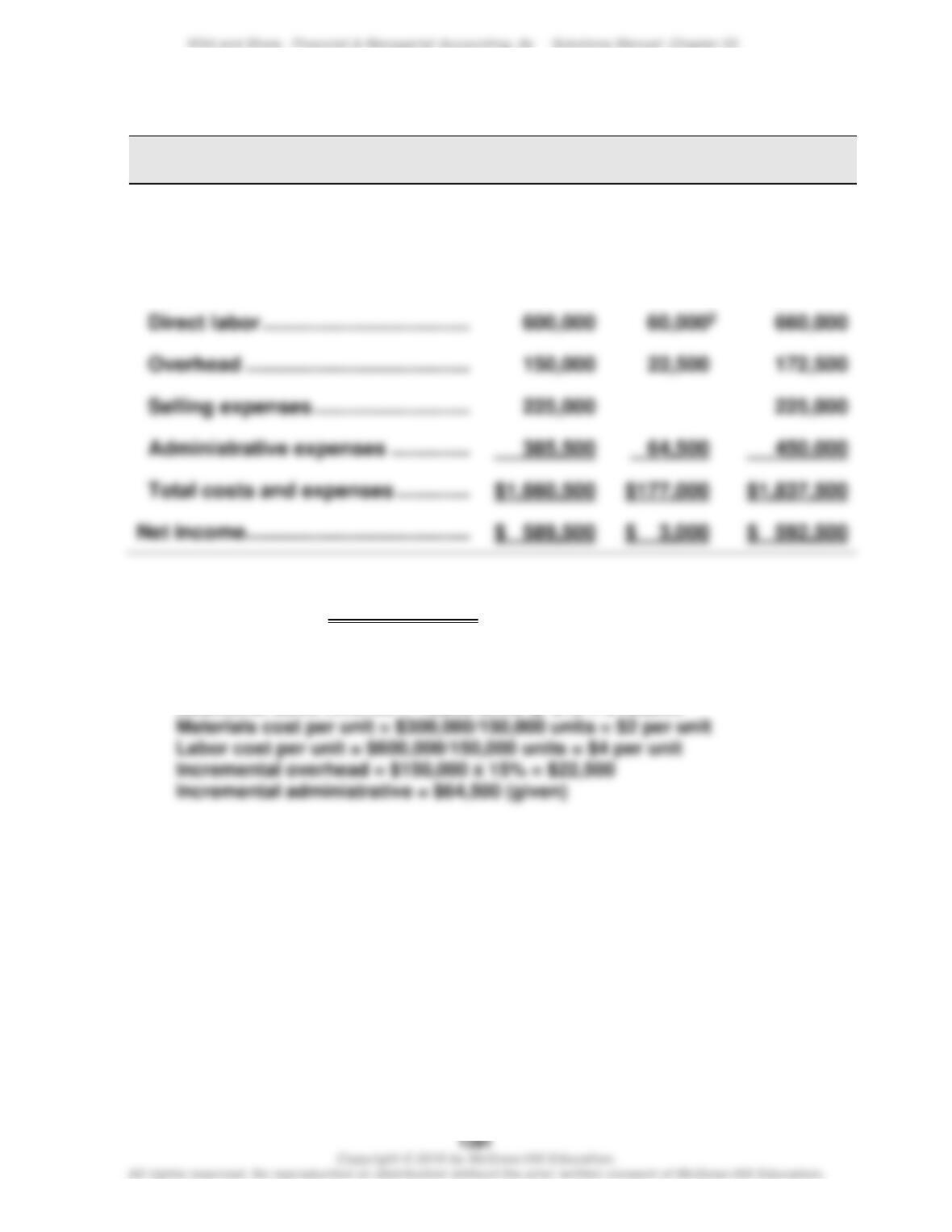
(1) Variable cost per unit
Variable Cost
Per Unit
Variable overhead ………………………………………………………
(3) Selling price using variable cost method
Per Unit
Total variable cost ……………………………………………………..
Markup on variable cost ($150 x 52%) …………………………
Selling price ……………………………………………………………….
$150
78
$228
Exercise 23–13 (25 minutes)
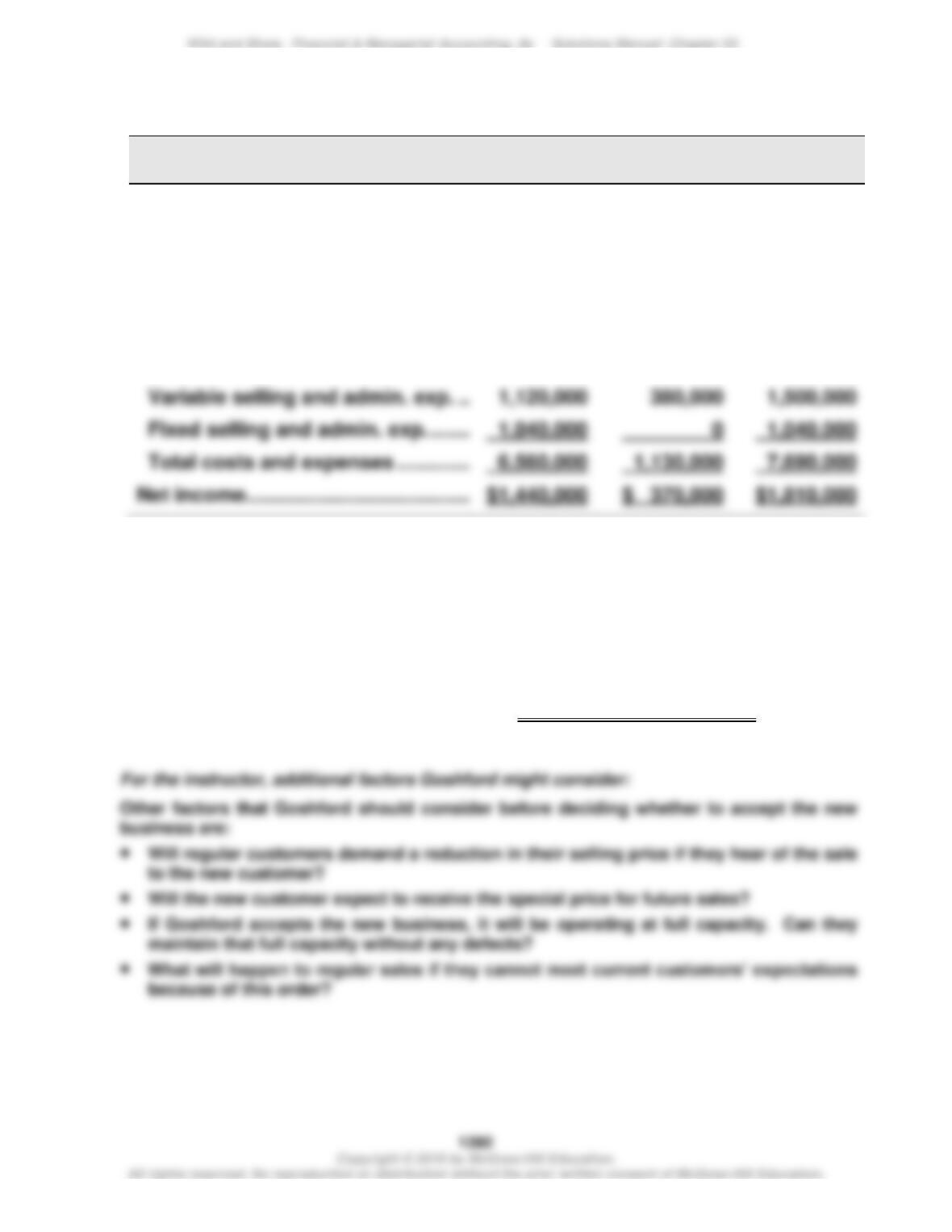
Normal
Additional
Combined
Volume
Volume*
Total
Sales …………………………………………..
$2,250,000
$180,000
$2,430,000
Costs and expenses
Direct materials …………………………
300,000
30,0001
330,000
Overhead ………………………………….
150,000
172,500
Administrative expenses …………..
The company should accept the offer as it increases income by $3,000.
1 (15,000 x $2) 2 (15,000 x $4)
* ADDITIONAL VOLUME COMPUTATIONS
Exercise 23-14 (20 minutes)
Normal
Additional
Combined
Volume
Volume
Total
Sales …………………………………………..
$8,000,000
$1,500,000
$9,500,000
Costs and expenses
Direct materials …………………………
1,000,000
250,000
1,250,000
Direct labor ……………………………….
1,200,000
300,000
1,500,000
Variable overhead ……………………..
800,000
200,000
1,000,000
Fixed overhead………………………….
1,400,000
0
1,400,000
Variable selling and admin. exp. ..
1,120,000
380,000
1,500,000
Fixed selling and admin. exp. …….
Total costs and expenses ………….
Calculations:
Normal volume sales: 80,000 units x $100 per unit = $8,000,000
Additional revenue from new order: 20,000 units x $75 per unit = $1,500,000
Additional direct materials: 20,000 units x $12.50 per unit = $250,000
Additional direct labor: 20,000 units x $15.00 per unit = $300,000
Additional variable overhead: 20,000 units x $10.00 per unit = $200,000
Additional selling and administrative expense: 20,000 units x ($14 + $5) per unit = $380,000
Based on this analysis, Goshford should accept the new business.