23-35
23-33 (20 min.) Executive compensation, balanced scorecard.
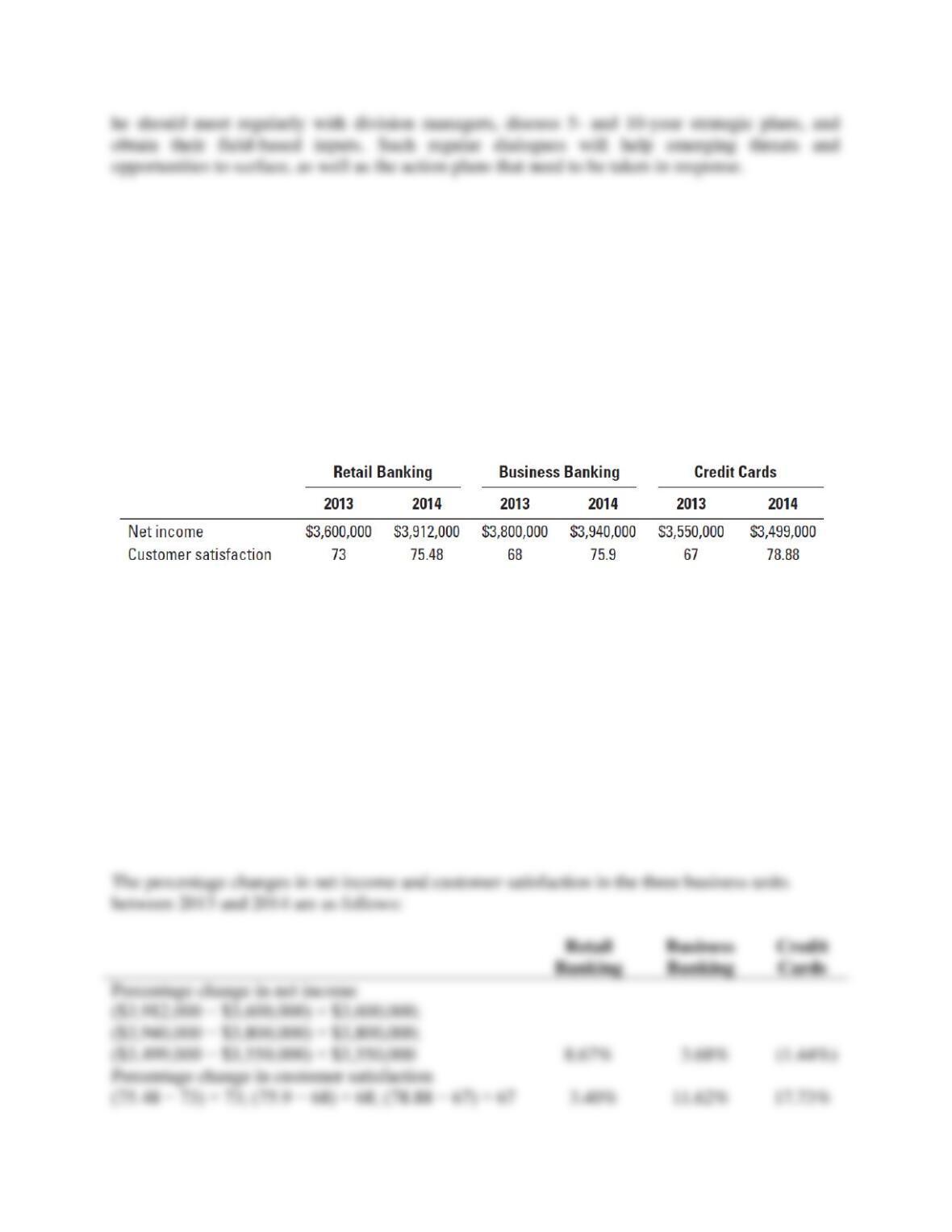
Mercantile Bank recently introduced a new bonus plan for its business unit executives. The
company believes that current profitability and customer satisfaction levels are equally important
to the bank’s long-term success. As a result, the new plan awards a bonus equal to 1% of salary
for each 1% increase in business unit net income or 1% increase in the business unit’s customer
satisfaction index. For example, increasing net income from $3 million to $3.3 million (or 10%
from its initial value) leads to a bonus of 10% of salary, while increasing the business unit’s
customer satisfaction index from 70 to 73.5 (or 5% from its initial value) leads to a bonus of 5%
of salary. There is no bonus penalty when net income or customer satisfaction declines. In 2013
and 2014, Mercantile Bank’s three business units reported the following performance results:
Required:
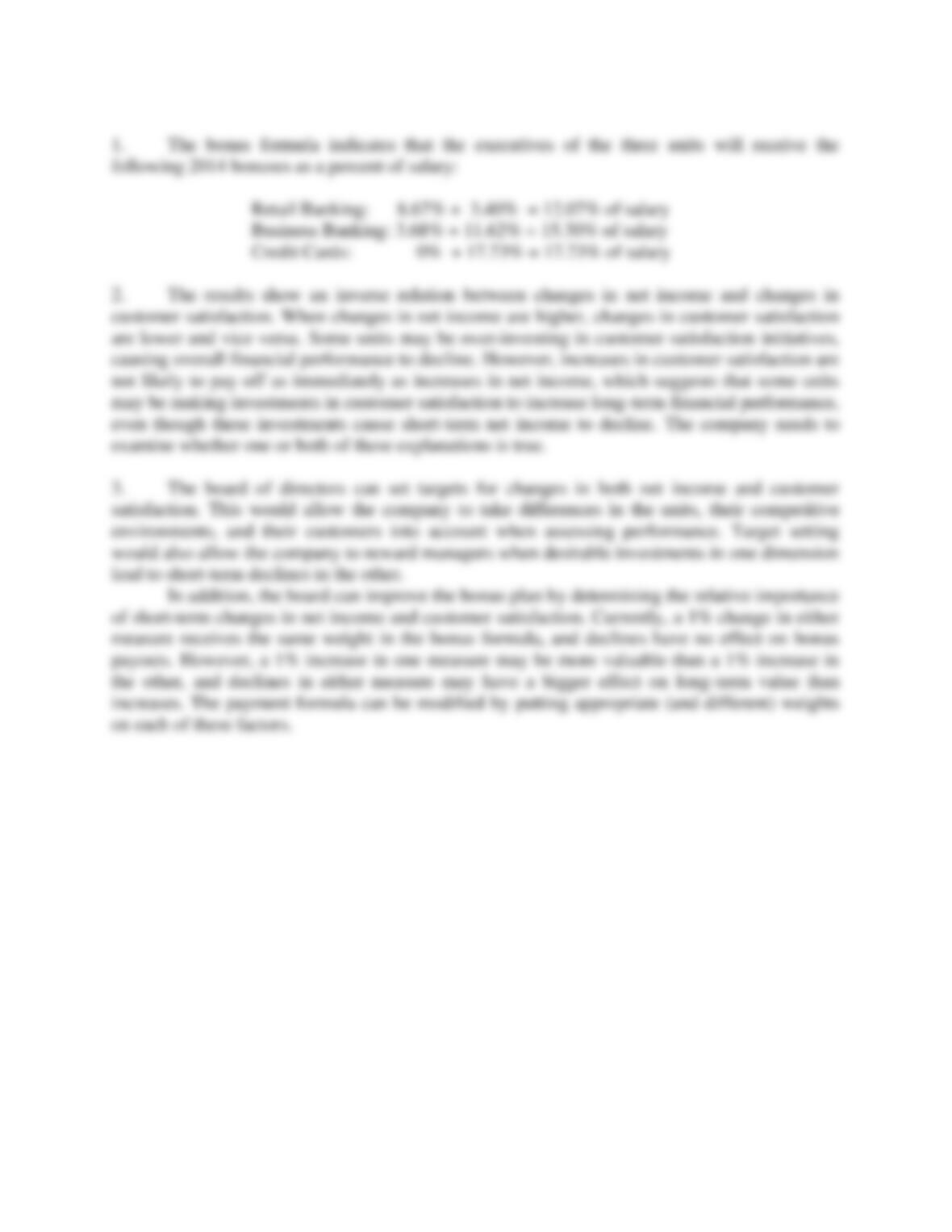
1. Compute the bonus as a percent of salary earned by each business unit executive in 2014.
2. What factors might explain the differences between improvement rates for net income and
those for customer satisfaction in the three units? Are increases in customer satisfaction
likely to result in increased net income right away?
3. Mercantile Bank’s board of directors is concerned that the 2014 bonus awards may not
actually reflect the executives’ overall performance. In particular, the bank is concerned that
executives can earn large bonuses by doing well on one performance dimension but
underperforming on the other. What changes can it make to the bonus plan to prevent this
from happening in the future? Explain briefly.
SOLUTION
23-36
23-37
23-34 (30 min.) Financial and nonfinancial performance measures, goal congruence.
(CMA, adapted) Precision Equipment specializes in the manufacture of medical equipment, a
field that has become increasingly competitive. Approximately 2 years ago, Pedro Mendez,
president of Precision, decided to revise the bonus plan (based, at the time, entirely on operating
income) to encourage division managers to focus on areas that were important to customers and
that added value without increasing cost. In addition to a profitability incentive, the revised plan
includes incentives for reduced rework costs, reduced sales returns, and on-time deliveries. The
company calculates and rewards bonuses semiannually on the following basis: A base bonus is
calculated at 2% of operating income; this amount is then adjusted as:
a. (i) Reduced by excess of rework costs over and above 2% of operating income
(ii) No adjustment if rework costs are less than or equal to 2% of operating income
b. (i) Increased by $4,000 if more than 98% of deliveries are on time and by $1,500 if 96–
98% of deliveries are on time
(ii) No adjustment if on-time deliveries are below 96%
23-38
c. (i) Increased by $2,500 if sales returns are less than or equal to 1.5% of sales
(ii) Decreased by 50% of excess of sales returns over 1.5% of sales
Note: If the calculation of the bonus results in a negative amount for a particular period, the
manager simply receives no bonus, and the negative amount is not carried forward to the next
period.
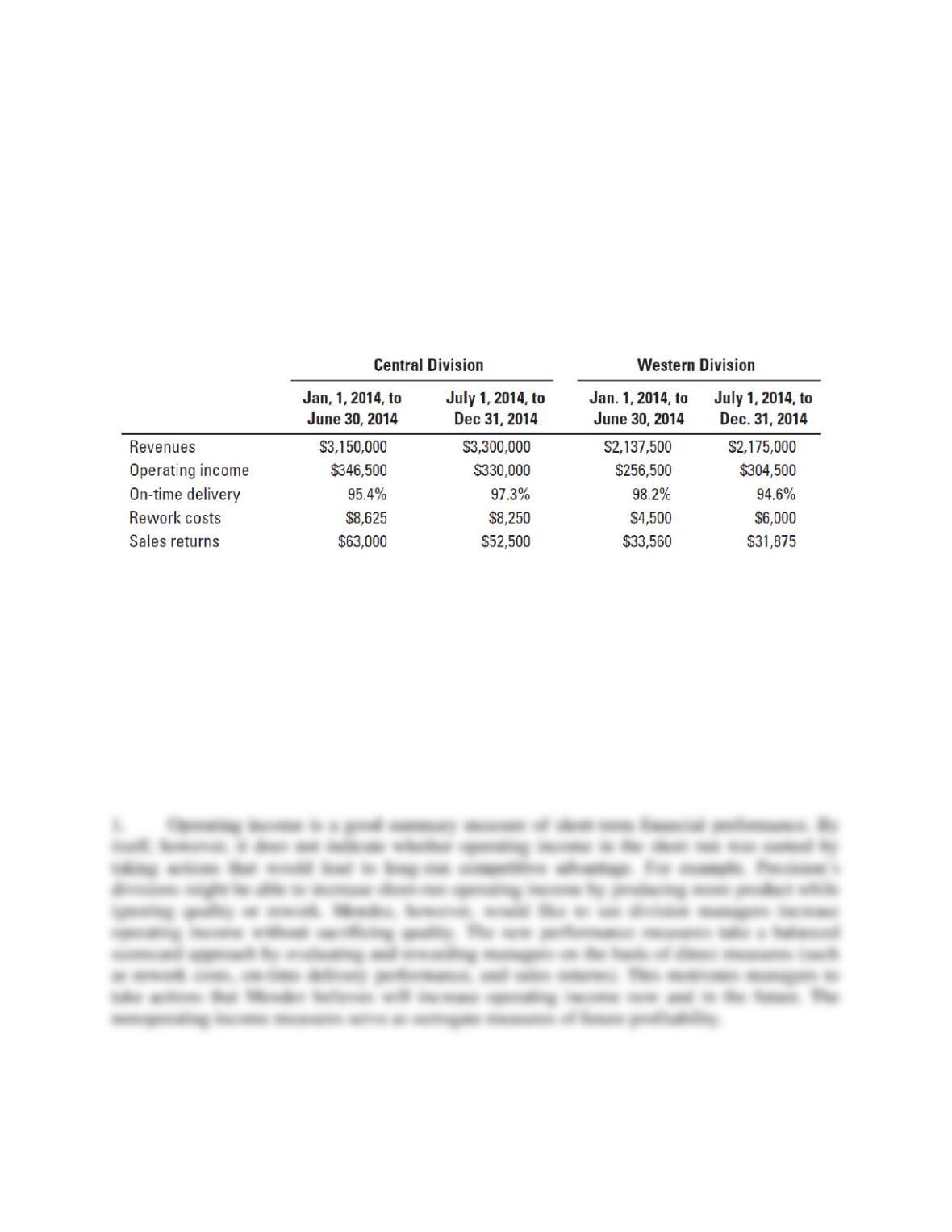
Results for Precision’s Central division and Western division for 2014, the first year under the
new bonus plan, follow. In 2013, under the old bonus plan, the Central division manager earned
a bonus of $20,295 and the Western division manager a bonus of $15,830.
Required:
1. Why did Mendez need to introduce these new performance measures? That is, why does
Mendez need to use these performance measures in addition to the operating-income
numbers for the period?
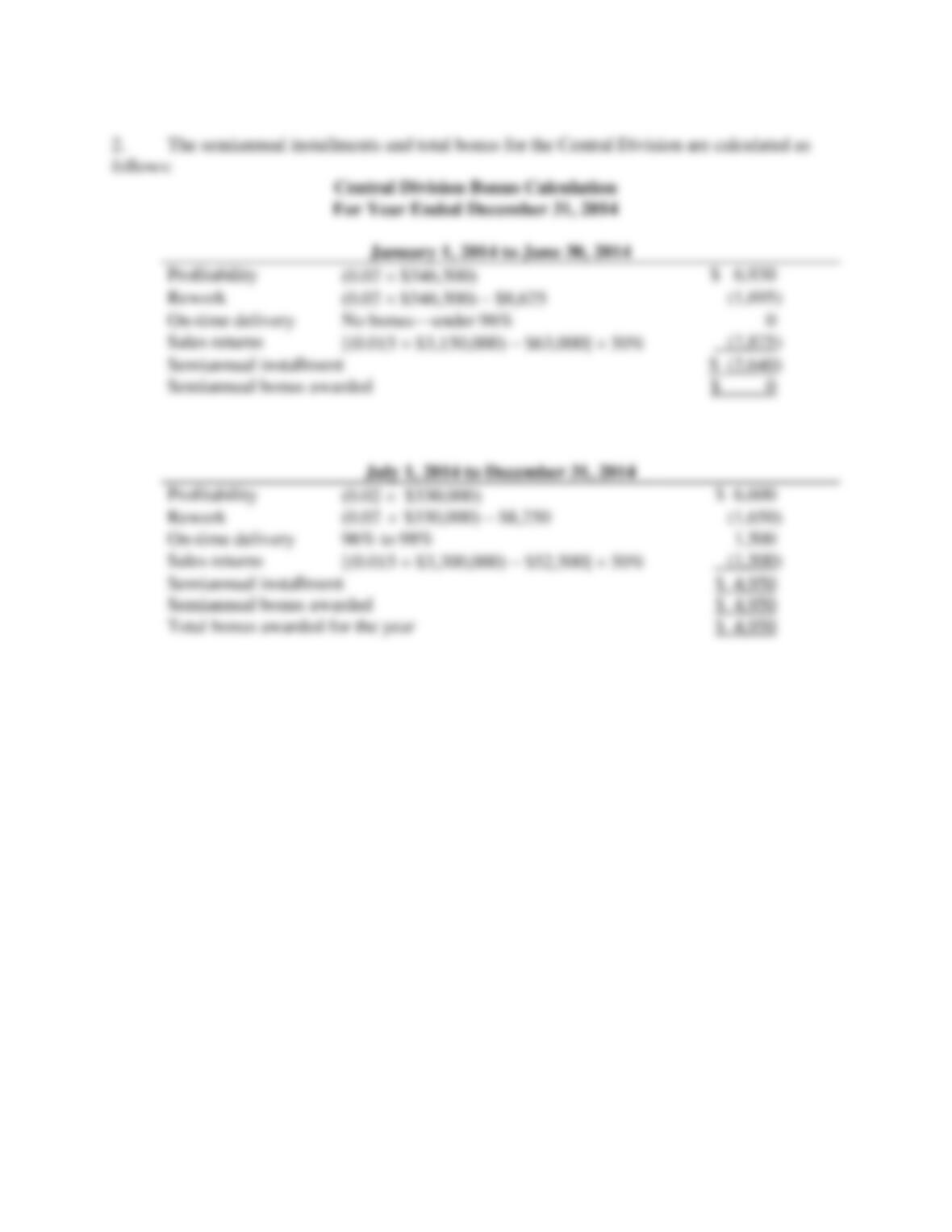
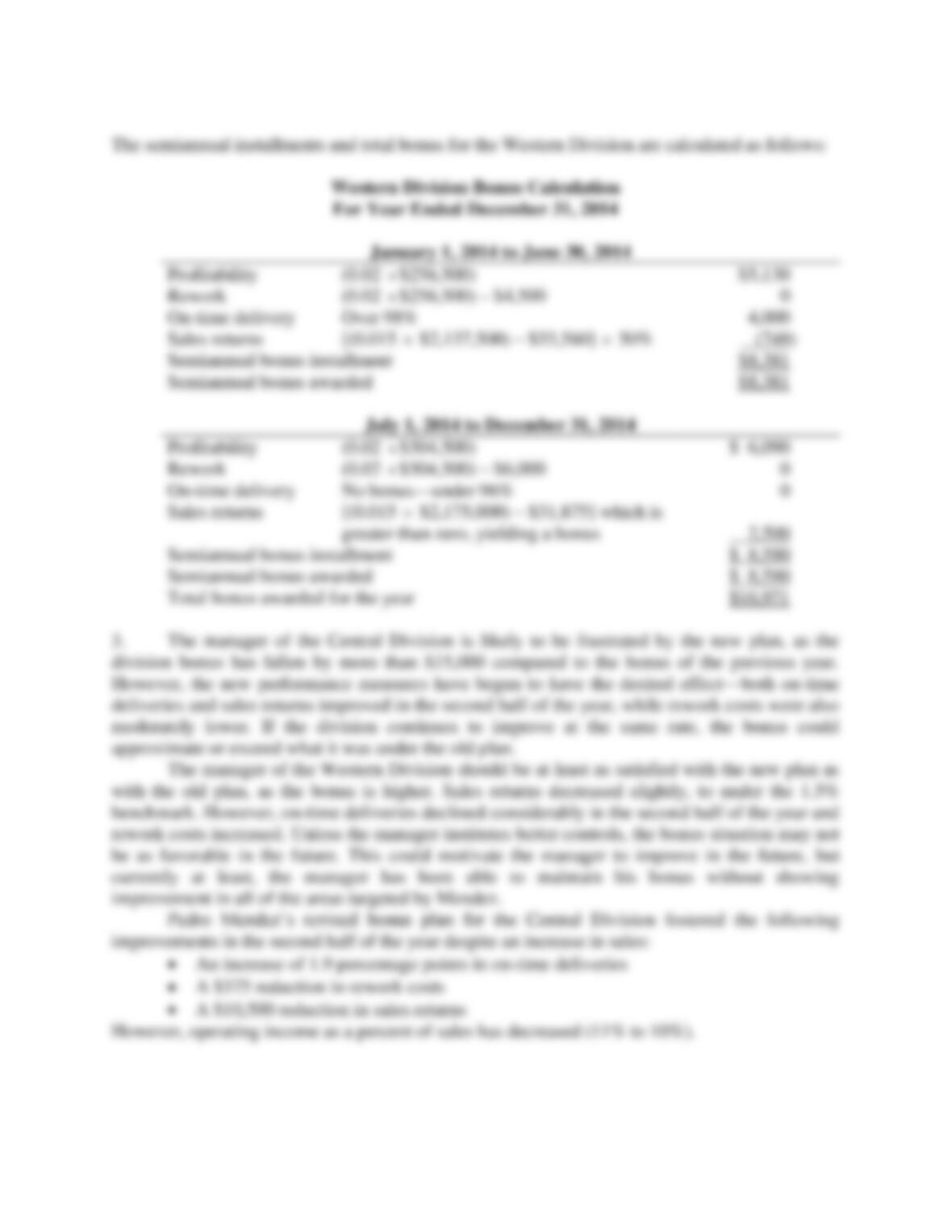
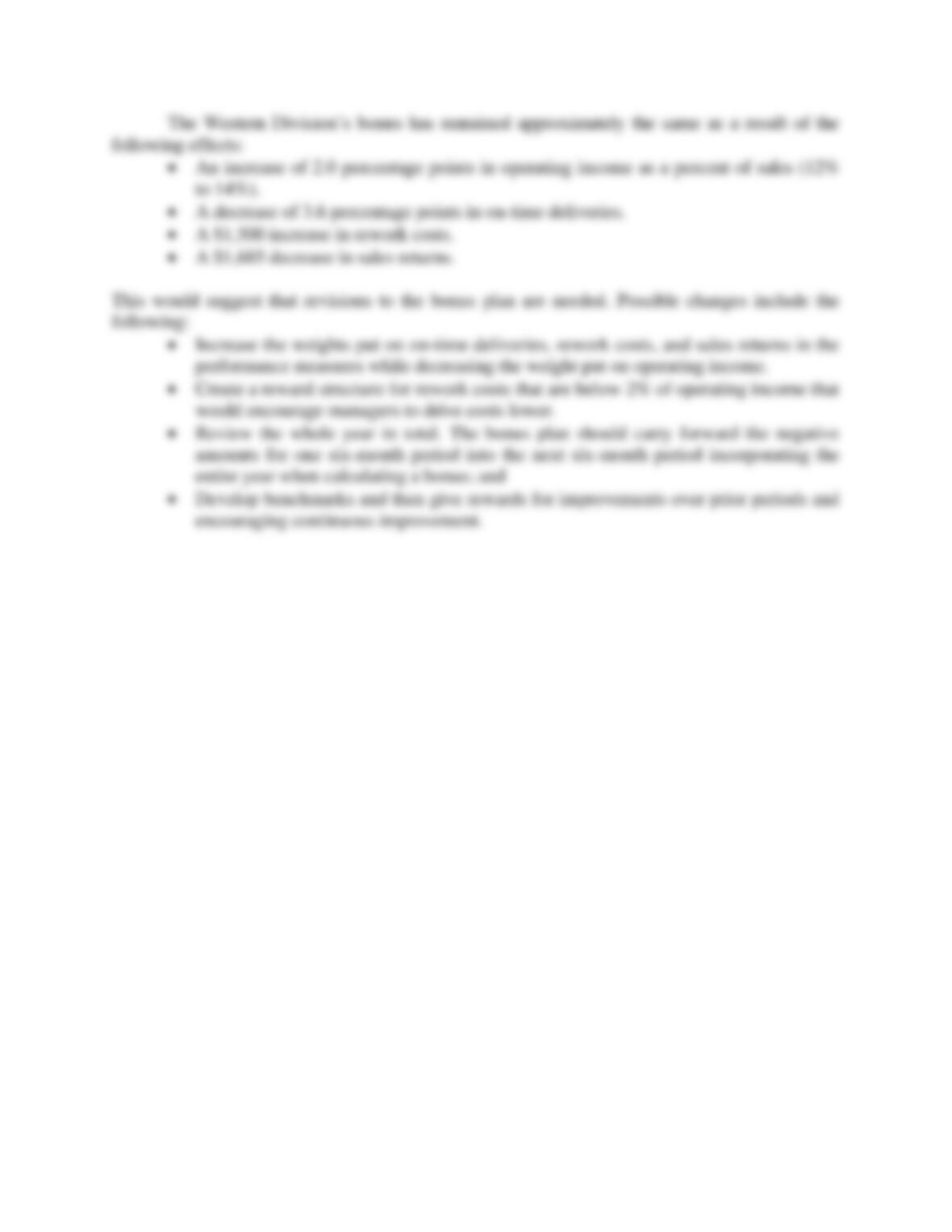
2. Calculate the bonus earned by each manager for each 6-month period and for 2014.
3. What effect did the change in the bonus plan have on each manager’s behavior? Did the new
bonus plan achieve what Mendez wanted? What changes, if any, would you make to the new
bonus plan?
SOLUTION
23-39
23-40
23-41
23-35 (25 min.) ROI, RI, decision making.
The following data refer to the successful Munger division of Buffett, Inc. Munger makes and
sells high-end cordless drills. The drills sell for $80 each, and Munger expects sales of 300,000
units in 2014. Munger’s annual fixed costs are $4 million. The variable cost per drill is $48.
Buffett evaluates Munger based on residual income. The total investment attributed to
Munger is $16 million, and Buffett has a required rate of return on investment of 20%.
Ignore taxes and depreciation expense. Answer each of the following parts independently,
unless otherwise stated.
Required:
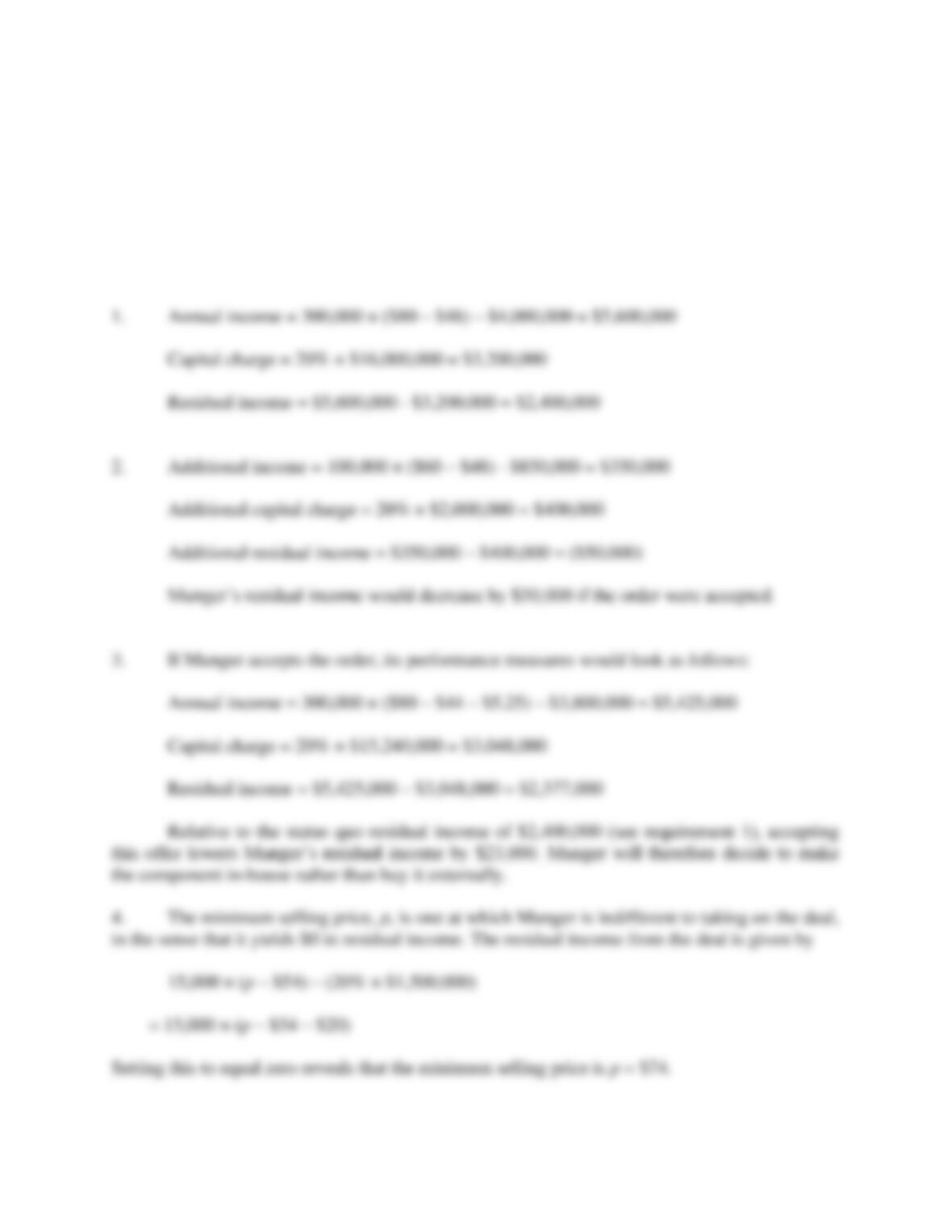
1. What is the expected residual income in 2014?
2. Munger receives an external special order for 100,000 units at $60 each. If the order is
accepted, Munger will have to incur incremental fixed costs of $850,000 and invest an
additional $2 million in various assets.
What is the effect on Munger’s residual income of accepting the order?
3. One of the components Munger manufactures for its drill has a variable cost of $4. An
outside vendor has offered to supply the 300,000 units required at a cost of $5.25 per unit. If
the component is purchased outside, fixed costs will decline by $200,000 and assets with a
book value of $760,000 will be sold at book value.
Will Munger decide to make or buy the component? Explain your answer.
4. One of Munger’s regular customers asks for a special drill made of tempered steel. The
customer requires 15,000 drills. Munger estimates its variable cost for these special units at
$54 apiece. Munger will also have to undertake new investment of $1,500,000 to produce the
drills.
What is the minimum selling price that will make the deal acceptable to Munger?
23-42
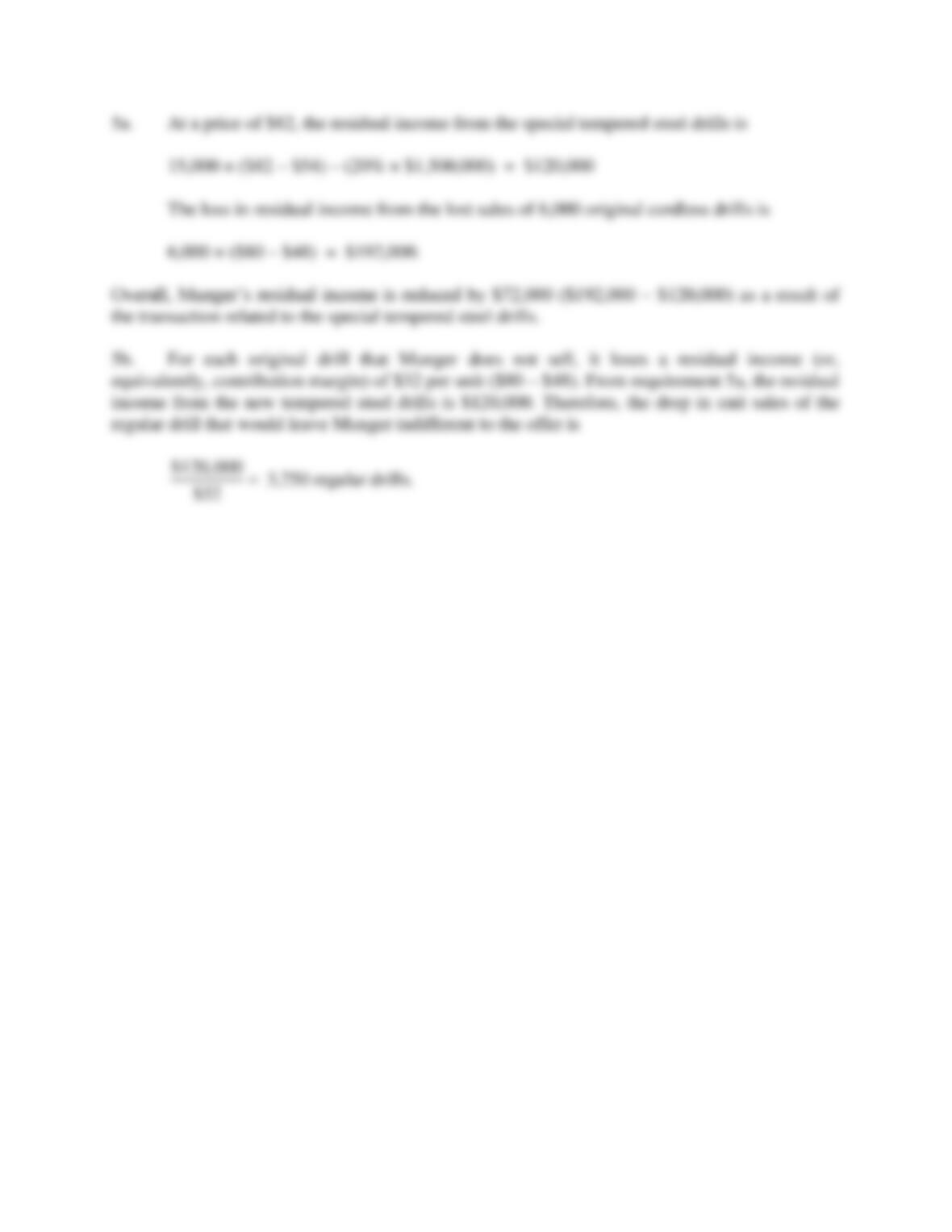
5. Assume the same facts as in requirement 4. Also suppose that the customer has offered $82
for each special drill. In addition, the customer has indicated that its purchases of the existing
product will drop by 6,000 units.
a. What is the net change in Munger’s residual income from taking the offer, relative to its
planned 2014 situation?
b. At what drop in unit sales of the regular drill would Munger be indifferent to the offer?
SOLUTION
23-43
23-36 (15 min.) Ethics, levers of control.
Best Moulding is a large manufacturer of wood picture frame moulding. The company operates
distribution centers in Dallas and Philadelphia. The distribution centers cut frames to size (called
“chops”) and ship them to custom picture framers. Because of the exacting standards and natural
flaws of wood picture frame moulding, the company typically produces a large amount of waste
in cutting chops. In recent years, the company’s average yield has been 78% of length moulding.
The remaining 22% is sent to a wood recycler. Best’s performance–evaluation system pays its
distribution center managers substantial bonuses if the company achieves annual budgeted profit
numbers. In the last quarter of 2014, Stuart Brown, Best’s controller, noted a significant increase
in yield percentage of the Dallas distribution center, from 76% to 87%. This increase resulted in
a 6% increase in the center’s profits.
During a recent trip to the Dallas center, Brown wandered into the moulding warehouse. He
noticed that much of the scrap moulding was being returned to the inventory bins rather than
being placed in the discard pile. Upon further inspection, he determined that the moulding was in
fact unusable. When he asked one of the workers, he was told that the center’s manager had
directed workers to stop scrapping all but the very shortest pieces. This practice resulted in the
center overreporting both yield and ending inventory. The overstatement of Dallas inventory will
have a significant impact on Best’s financial statements.
Required:
1. What should Brown do? You may want to refer to the IMA Statement of Ethical Professional
Practice, page 18.
2. Which lever of control is Best emphasizing? What changes, if any, should be made?
SOLUTION
23-44
23-37 (45 minutes) RI, EVA, measurement alternatives, goal congruence.
Refresh Resorts, Inc., operates health spas in Key West, Florida; Phoenix, Arizona; and Carmel,
California. The Key West spa was the company’s first and opened in 1988. The Phoenix spa
opened in 2001, and the Carmel spa opened in 2010. Refresh Resorts has previously evaluated
23-45
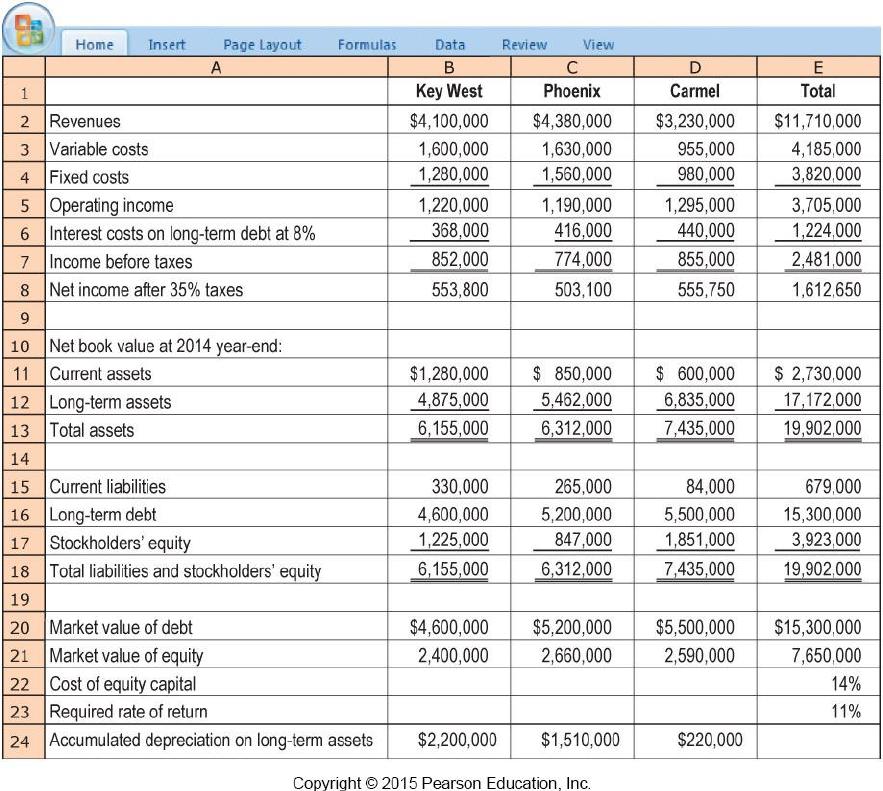
divisions based on RI, but the company is considering changing to an EVA approach. All spas
are assumed to face similar risks. Data for 2014 are:
Required:
1. Calculate RI for each of the spas based on operating income and using total assets as the
measure of investment. Suppose that the Key West spa is considering adding a new group of
saunas from Finland that will cost $225,000. The saunas are expected to bring in operating
income of $22,000. What effect would this project have on the RI of the Key West spa?
Based on RI, would the Key West manager accept or reject this project? Why? Without
resorting to calculations, would the other managers accept or reject the project? Why?
2. Why might Refresh Resorts want to use EVA instead of RI for evaluating the performance of
the three spas?
3. Refer back to the original data. Calculate the WACC for Refresh Resorts.
4. Refer back to the original data. Calculate EVA for each of the spas, using net book value of
long-term assets. Calculate EVA again, this time using gross book value of long-term assets.
Comment on the differences between the two methods.
5. How does the selection of asset measurement method affect goal congruence?
23-46
23-47
SOLUTION
23-48