Financial and Managerial Accounting, 8th Edition
23-1
CHAPTER 23
RELEVANT COSTING FOR MANAGERIAL DECISIONS
Related Assignment Materials
Student Learning Objectives
Discussion
Questions
Quick
Studies*
Exercises*
Problems*
AA and BTN
Conceptual objectives:
C1. Describe the importance of
relevant costs for short-term
decisions.
1, 2, 3, 4, 5, 6,
7, 8
23-1, 23-3,
23-4
AA 23-1, AA 23-3,
BTN 23-2, BTN 23-4,
BTN 23-6
Analytical objectives:
A1. Determine service selling price
using time and materials pricing.
11, 12
23-20, 23–21
23-15
AA 23-2,
Procedural objectives:
23-11, 23-12,
23-1, 23-2
*See additional information on next page that pertains to these quick studies, exercises and problems.
SP refers to the Serial Problem
AA refers to Accounting Analysis
P2
Sell Process Further
P3
Evaluate segment elimination decisions.
Additional Information on Related Assignment Material
See Chapter 1 of the Instructor’s Resource Manual for more information on materials for this text available in
Connect.
Connect
Available on the instructor’s course-specific website, Connect:
• All numerical Quick Studies, all Exercises and Problems Set A.
o Connect also provides algorithmic versions for Quick Study, Exercises, and Problems.
• General Ledger Problems
• Excel Simulations
• LearnSmart/SmartBook
Hints/Guided Examples
Please note that the Guided Examples are labeled as “Hints” in Connect assignments. The animated PowerPoints without
the video and audio functions for the Guided Examples are also available in the Connect Instructor Library and Exercise
Presentations. These are indicated in the Related Assignment Materials grid on page 1 in blue bold font.
Need-to-Know Videos
LO
Need–to-Know
Title
Time
C1
23-1
Relevant costs and benefits
0:29
P1
23-2
Make or buy
0:55
P2
23-3
Sell or process
2:04
P3
23-4
Sales Mix
3:15
P7
23-6
Special Order
3:04
Concept Overview Videos
LO
Title
Time
C1
Describe the importance of relevant costs for short-term decisions.
Decision Making
Relevant Costs and Benefits
A1
Evaluate short-term managerial decisions using relevant words.
Time and Materials Pricing
Time and Materials Pricing — Illustration
P1
Evaluate make or buy decisions.
Make or Buy
23-3
Keep or Replace Equipment
P6
Determine product selling price using cost data.
Total Cost Method
Total Cost Method — Illustration
P7
Evaluate special offer decisions.
Special Offers
Synopsis of Chapter Revision
NEW opener—Solugen and entrepreneurial assignment.
Organized decision scenarios into three types: Production, capacity, and pricing.
Expanded discussion of product pricing.
Added other pricing methods: value-based, auction-based, and dynamic.
New Decision Analysis on time and materials pricing of services.
Chapter Outline
I. Decisions and Information
A. Decision Making
1. Five steps involved in managerial decision making.
a. Define task and goal
b. Identify alternative actions
c. Collect relevant information and evaluate each alternative.
d. Select the preferred course of action.
e. Analyze and assess the decision.
2. Both managerial and financial accounting information play important role in making decisions
a. Accounting system provides primarily financial information such as performance reports and
budget analyses.
b. Non-financial information is also relevant, such as environmental effects, political sensitivities,
and social responsibility.
B. Relevant Costs and Benefits
1. Managers should focus on relevant benefits and relevant costs.
a. Relevant costs are the incremental costs, or differential costs which are the additional costs
incurred if a company pursues a certain course of action.
b. Incremental revenues are the additional revenue generated by selecting a certain course of
action over another. Three types of costs:
II. Production Decisions
A. Make or Buy
1. When determining whether to make or buy a component of a product, only incremental costs are
relevant.
2. Only incremental (additional) overhead costs are relevant; an incremental overhead rate should be
determined.
B. Sell or Process Further
1. Partially completed products can be sold as is or they can be processed further and then sold as other
products.
2. Compute incremental revenue from further processing (amount of revenue after further processing
C. Scrap or Rework – variation of sell or process decision.
1. Costs already incurred in manufacturing units of product not meeting quality are sunk costs and are
irrelevant in any decision on whether to sell to substandard units as scrap or rework to meet quality
standards.
2. Incremental revenues, incremental costs of reworking defects, and opportunity costs (the selling price
as scrap) are all relevant.
D. Sales Mix Selection When Resources Are Constrained
1. When more than one product is sold, some are likely to be more profitable than others; management
should concentrate sales efforts on more profitable products.
2. If production facilities or other factors are limited, an increase in production and sale of one product
usually requires reduction in production and sale of others.
3. The most profitable combination, or sales mix, of products should be determined. To identify the best
sales mix, management focuses on the contribution margin per unit of scarce resource. The scarce
resource could be the machines used to make the products.
E. Segment Elimination
1. If segment, division, or store is performing poorly, management must consider eliminating it.
2. It is not sufficient to base the decision on net income (loss) or its contribution to overhead.
3. Need to consider avoidable and unavoidable expenses:
4. Decision rule – Segment is candidate for elimination if its revenues are less than its avoidable
expenses.
5. Should also assess impact of elimination on other segments.
a. Profitable segment might be eliminated if its space, assets and staff can be more profitably used
by another segment or new segment.
F. Keep or Replace Equipment
1. Must decide whether the reduction in variable manufacturing costs over its life is greater than the net
23-6
purchase price of the new equipment.
a. Net purchase price is the cost of the new equipment less any trade in allowance given or cash
receipt for the old equipment.
b. Book value of the old equipment is not used. It is a sunk cost.
2. Decision rule: if the reduction in variable manufacturing cost is greater than the net cost to buy the
new machine, the machine should be replaced. The analysis ignores the time value of money.
G. Pricing Decisions – managers consider several factors in setting normal prices including:
1. Target profit – expected return on investment (ROI)
2. Customer demand – how much customers will pay and how will the respond to price increases.
H. Cost-plus methods common when companies are price-setters. Management adds a markup to cost to
reach a target price.
1. Total cost method – management sets price equal to product’s total cost plus a desired profit on the
2. Target costing – used when competition is high and they have little control in setting prices.
Target cost = expected selling price – desired profit
3. Variable cost method – the markup percentage is determined as:
a. Markup % = (Target profit + Fixed OH + Fixed S&A) / Total variable costs.
b. Selling price = (direct materials + direct labor + OH + selling costs + administrative costs) = total
cost + markup.
4. Increased global competition and technological advances have led to other pricing methods:
I. Special Offers
1. Effect on net income must be considered when deciding whether to accept or reject an order; reject if
loss results.
2. Historical costs are not relevant to this decision.
3. Incremental or additional costs (also called differential costs) are additional costs incurred if company
pursues certain course of action; relevant to this decision.
4. Minimum acceptable price per unit can be determined by dividing incremental cost by the number of
units in the order.
5. Incremental costs of additional volume are relevant.
23-7
6. If additional volume approaches or exceeds existing available capacity of factory, incremental costs
required to expand capacity may quickly exceed incremental revenue.
9. Key point: management must not blindly use historical costs, especially allocated to overhead costs.
Instead the accounting system needs to provide incremental cost information if the additional
business is accepted.
III. Decision Analysis⎯Time and Materials Pricing – commonly used to price services. Companies set a price
for labor, materials, overhead and a desired profit margin.
23-8
Chapter 23 Alternate Demo Problem
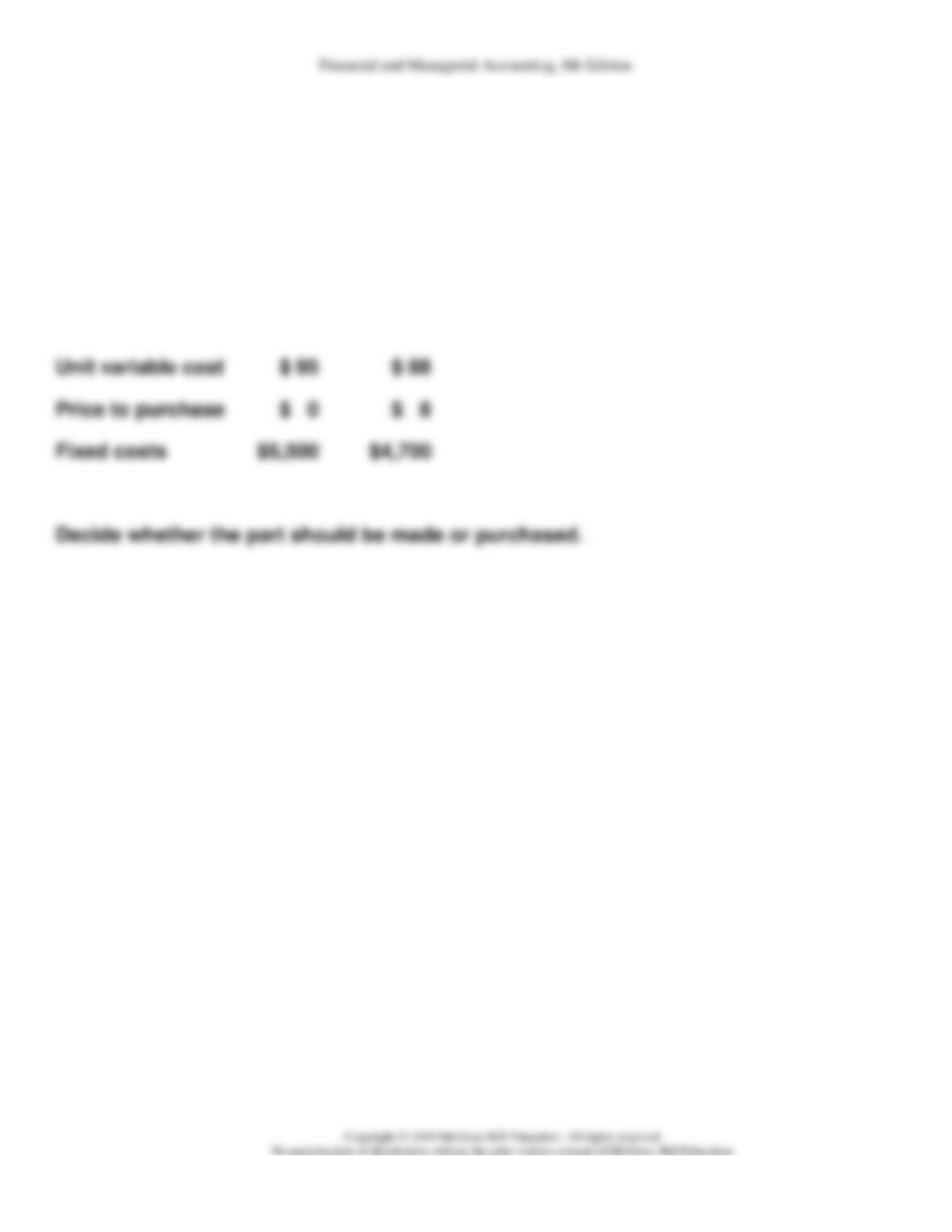
Modern Company manufactures wood desks. They have the opportunity to buy
handles for the desks at $8 per unit. This purchase would affect costs as follows:
Make Buy
Unit selling price: $340 $340
Volume (monthly) 500 500
23-9
Chapter 23 Alternate Demo Problem: Solution
Buy Make
Revenue $170,000 $170,000
Less:
Variable costs 48,000 47,500
Contribution Margin $ 122,000 $ 122,500
Less:
Fixed Costs 4,700 5,500