23-1
CHAPTER 23
PERFORMANCE MEASUREMENT, COMPENSATION, AND
MULTINATIONAL CONSIDERATIONS
23-1 Examples of financial and nonfinancial measures of performance are
Financial: ROI, residual income, economic value added, and return on sales
Nonfinancial: Customer perspective: Market share, customer satisfaction
23-2 The three steps in designing an accounting-based performance measure are as follows:
1. Choose performance measures that align with top management’s financial goals.
2. Choose the details of each performance measure in Step 1, including the time horizon and
measurement of various aspects of the measure.
3. Choose a target level of performance and feedback mechanism for each performance
measure in Step 1.
23-3 The DuPont method highlights that ROI is increased by any action that increases return
on sales or investment turnover. ROI increases with
23-4 Yes. Residual income (RI) is not identical to return on investment (ROI). ROI is a
percentage with investment as the denominator of the computation. RI is an absolute monetary
amount which includes an imputed interest charge based on investment.
23-5 Economic value added (EVA) is a specific type of residual income measure that is
calculated as follows:
Economic value
added (EVA)
=
After-tax
operating income
–
( )
Total assets minus
Weighted-average
cost of capital current liabilities
23-6 Definitions of investment used in practice when computing ROI are as follows:
1. Total assets available
23-7 Current cost is the cost of purchasing an asset today identical to the one currently held if
an identical asset can currently be purchased; it is the cost of purchasing an asset that provides
23-2
based measures of ROI compute the asset base as the original purchase cost of an asset minus
any accumulated depreciation.
Some commentators argue that current cost is oriented to current prices, while historical
cost is past-oriented.
23-8 Special problems arise when evaluating the performance of divisions in multinational
companies because
a. the economic, legal, political, social, and cultural environments differ significantly
across countries.
23-9 In some cases, the subunit’s performance may not be a good indicator of a manager’s
performance. For example, companies often put the most skillful division manager in charge of
the weakest division in an attempt to improve the performance of the weak division. Such an
effort may yield results in years, not months. The division may continue to perform poorly with
respect to other divisions of the company. But it would be a mistake to conclude from the poor
performance of the division that the manager is performing poorly.
23-10 Moral hazard describes situations in which an employee prefers to exert less effort (or to
report distorted information) compared with the effort (or accurate information) desired by the
owner because the employee’s effort (or validity of the reported information) cannot be
accurately monitored and enforced.
23-11 No, rewarding managers on the basis of their performance measures only, such as ROI,
subjects them to uncontrollable risk because managers’ performance measures are also affected
23-12 Benchmarking or relative performance evaluation is the process of evaluating a
manager’s performance against the performance of other similar operations. The ideal
benchmark is another operation that is affected by the same noncontrollable factors that affect
23-3
the manager’s performance. Benchmarking cancels the effects of the common noncontrollable
factors and provides better information about the manager’s performance.
23-13 When employees have to perform multiple tasks as part of their jobs, incentive problems
can arise when one task is easy to monitor and measure while the other task is more difficult to
23-14 Disclosures required by the Securities and Exchange Commission are as follows:
a. A summary compensation table showing the salary, bonus, stock options, other stock
awards, and other compensation earned by the five top officers in the previous three
years
23-15 The four levers of control in an organization are diagnostic control systems, boundary
systems, belief systems, and interactive control systems.
• Diagnostic control systems are the set of critical performance variables that help
managers track progress toward the strategic goal. These measures are periodically
monitored and action is usually only taken if a measure is outside its acceptable
limits.
23-16 (30 min.) ROI, comparisons of three companies.
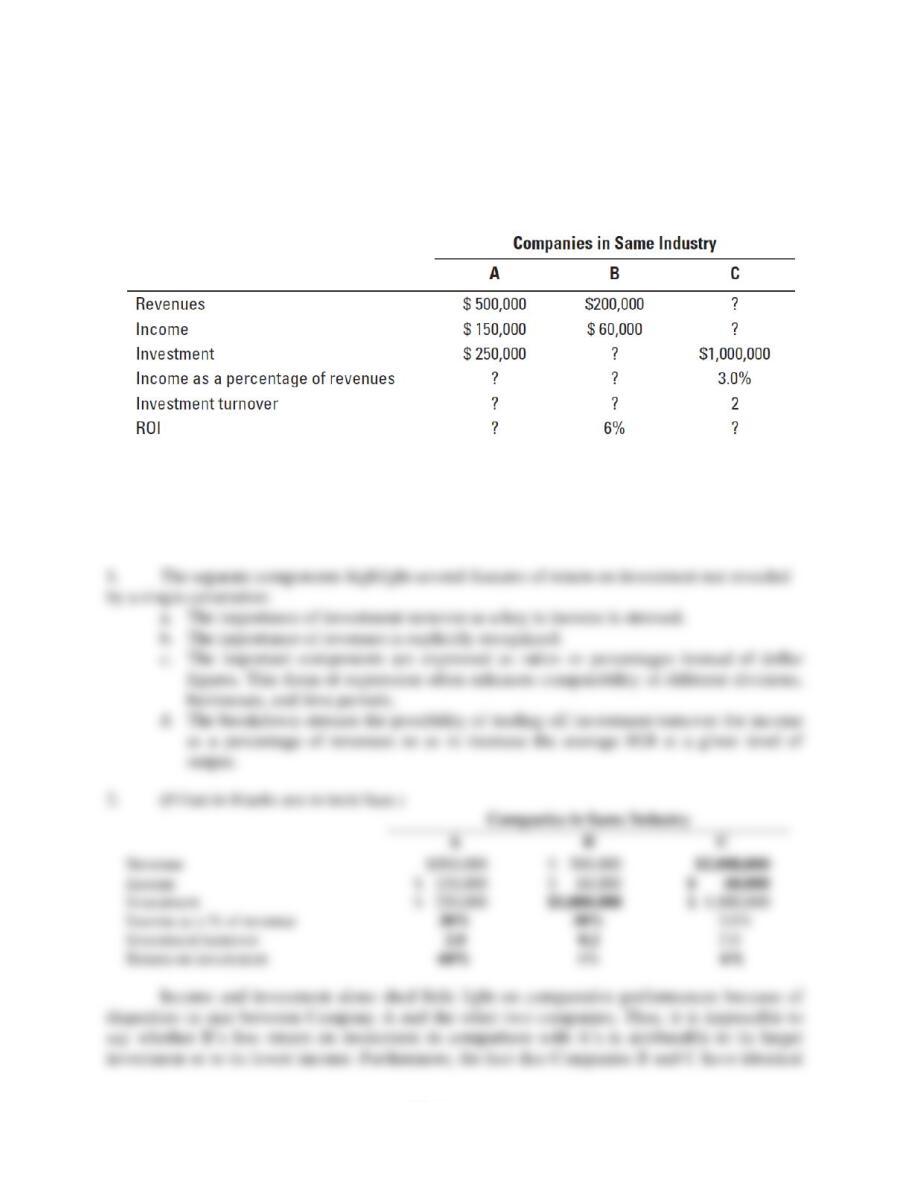
(CMA, adapted) Return on investment (ROI) is often expressed as follows:
23-4
Required:
1. What advantages are there in the breakdown of the computation into two separate
components?
2. Fill in the following blanks:
After filling in the blanks, comment on the relative performance of these companies as
thoroughly as the data permit.
SOLUTION
23-5
23-6
23-17 (30 min.) Analysis of return on invested assets, comparison of two divisions, DuPont method.
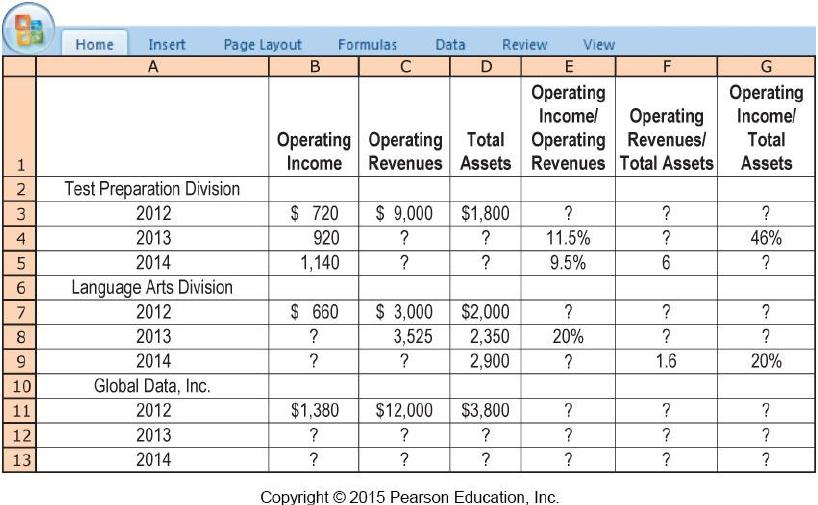
Global Data, Inc., has two divisions: Test Preparation and Language Arts. Results (in millions) for the past three years are partially
displayed here:
Required:
1. Complete the table by filling in the blanks.
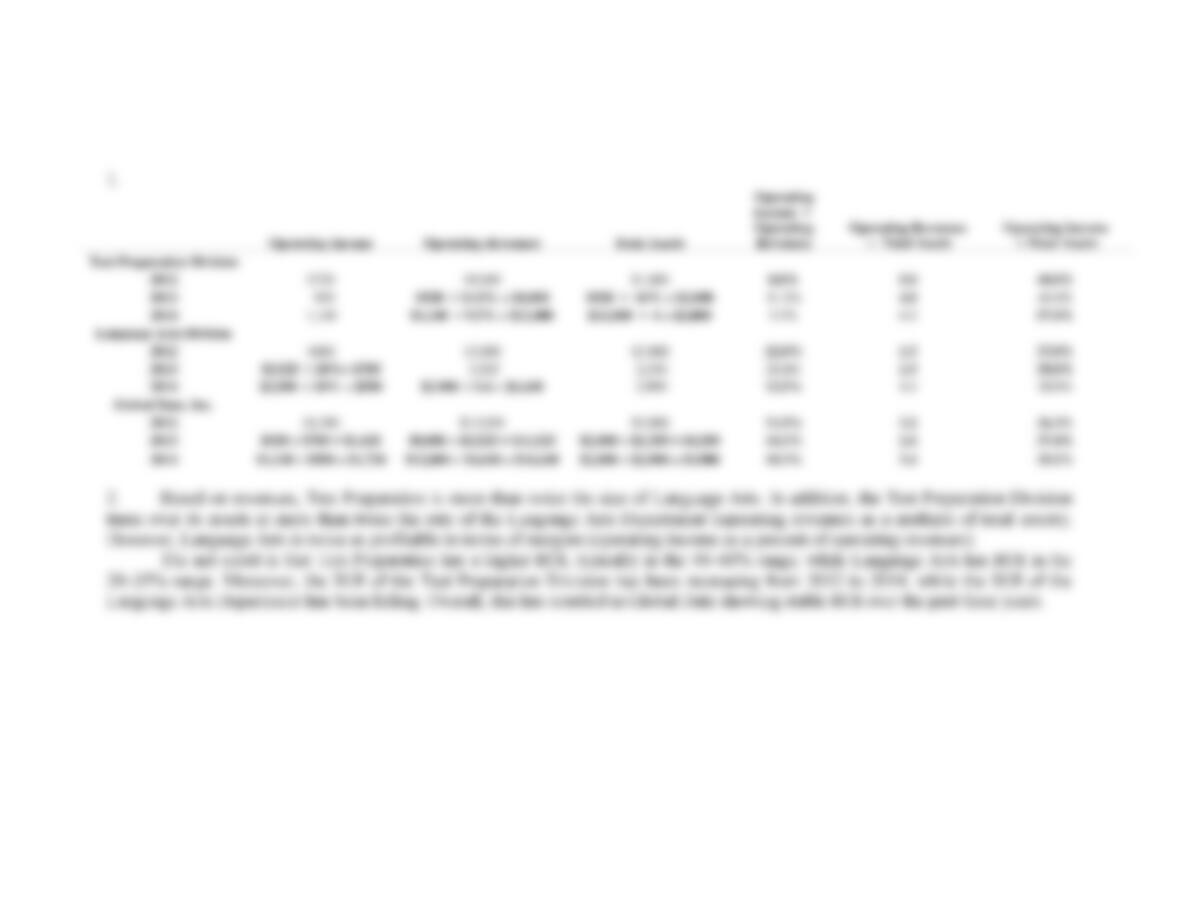
2. Use the DuPont method of profitability analysis to explain changes in the operating-income-to-total assets ratios over the 2012–
2014 period for each division and for Global Data as a whole. Comment on the results.
23-7
SOLUTION
23-8
23-18 (10–15 min.) ROI and RI.
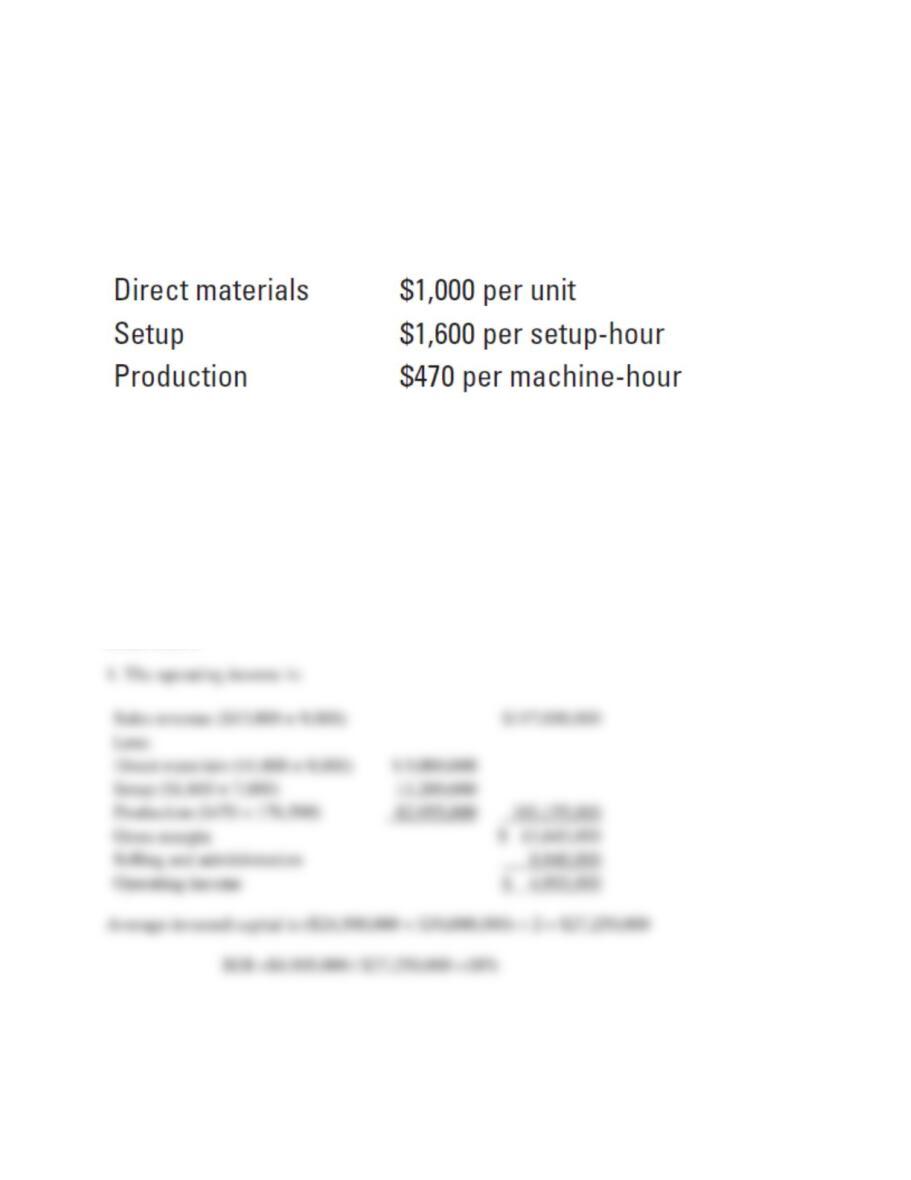
(D. Kleespie, adapted) The Outdoor Sports Company produces a wide variety of outdoor sports
equipment. Its newest division, Golf Technology, manufactures and sells a single product—
AccuDriver, a golf club that uses global positioning satellite technology to improve the accuracy
of golfers’ shots. The demand for AccuDriver is relatively insensitive to price changes. The
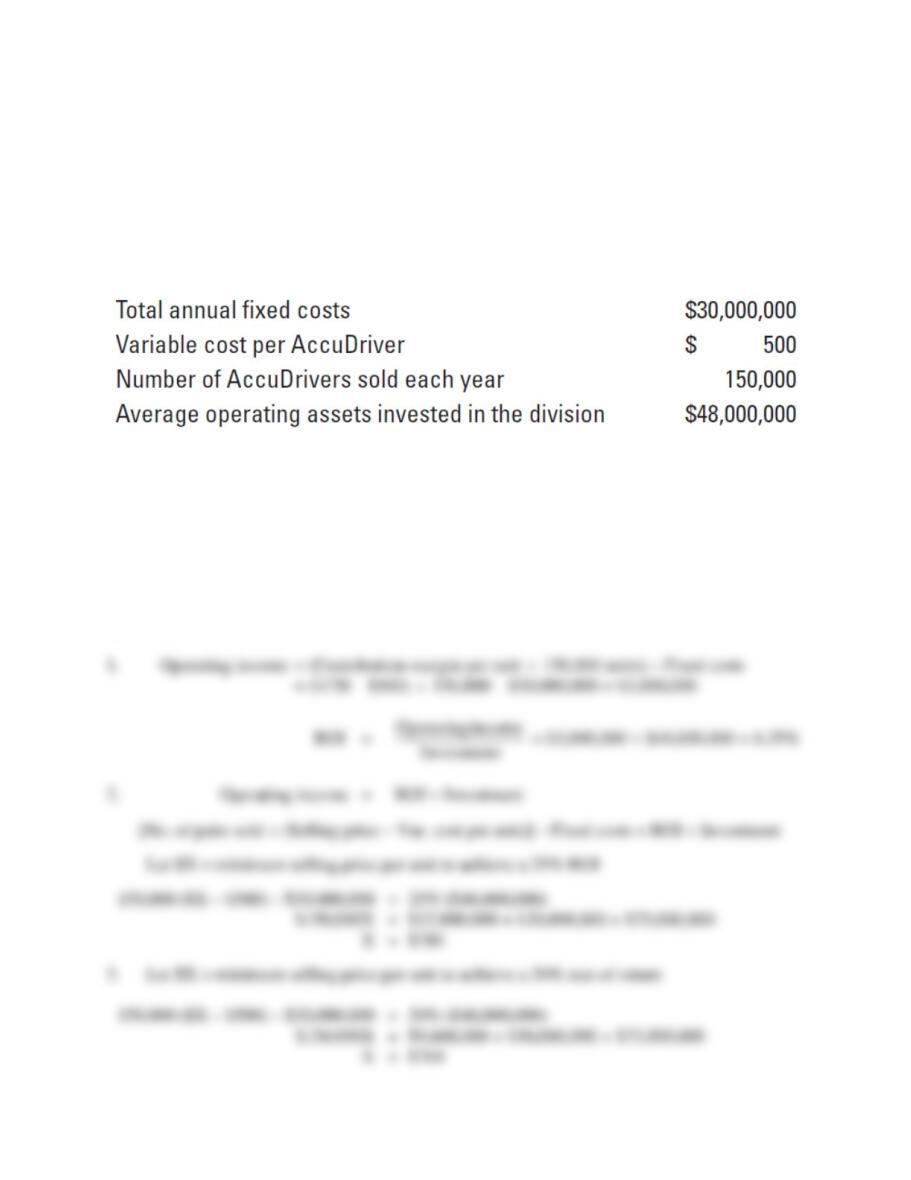
following data are available for Golf Technology, which is an investment center for Outdoor
Sports:
Required:
1. Compute Golf Technology’s ROI if the selling price of AccuDrivers is $720 per club.
2. If management requires an ROI of at least 25% from the division, what is the minimum
selling price that the Golf Technology Division should charge per AccuDriver club?
3. Assume that Outdoor Sports judges the performance of its investment centers on the basis of
RI rather than ROI. What is the minimum selling price that Golf Technology should charge
per AccuDriver if the company’s required rate of return is 20%?
SOLUTION
23-9
23-19 (20 min.) ROI and RI with manufacturing costs.
Fabulous Motor Company makes electric cars and has two products, the Simplegreen and the
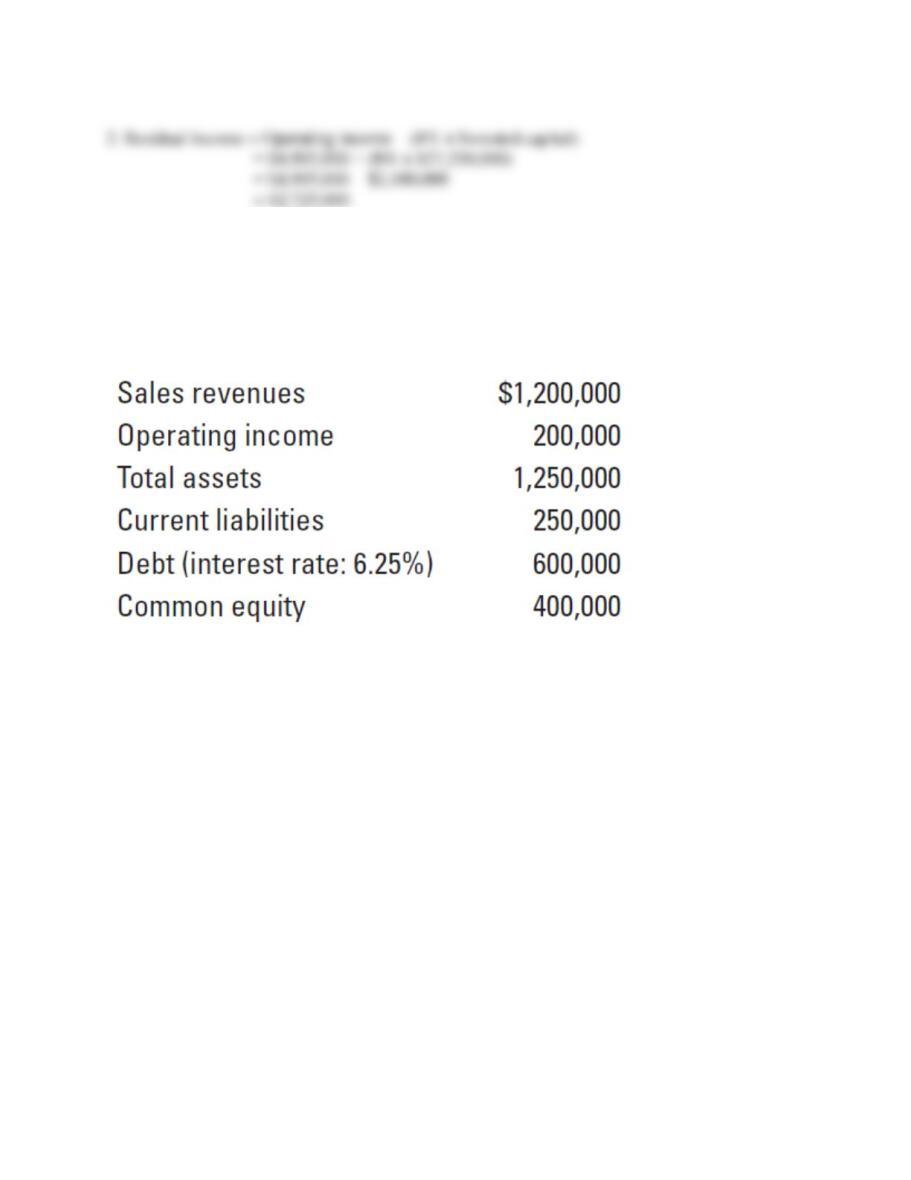
Fabulousgreen. To produce the Simplegreen, Fabulous Motor employed assets of $24,500,000 at
the beginning of the period and $30,000,000 of assets at the end of the period. Other costs to
manufacture the Simplegreen include the following:
General administration and selling costs total $8,940,000 for the period. In the current period,
Fabulous Motor produced 9,000 Simplegreen cars using 7,000 setup-hours and 176,500
machine-hours. Fabulous Motor sold these cars for $13,000 each.
Required:
1. Assuming that Fabulous Motor defines investment as average assets during the period, what
is the return on investment for the Simplegreen division?
2. Calculate the residual income for Simplegreen if Fabulous Motor has a required rate of return
of 8% on investments.
SOLUTION
23-10
23-20 (20 min.) ROI, RI, EVA.
Hamilton Corp. is a reinsurance and financial services company. Hamilton strongly believes in
evaluating the performance of its standalone divisions using financial metrics such as ROI and
residual income. For the year ended December 31, 2013, Hamilton’s CFO received the following
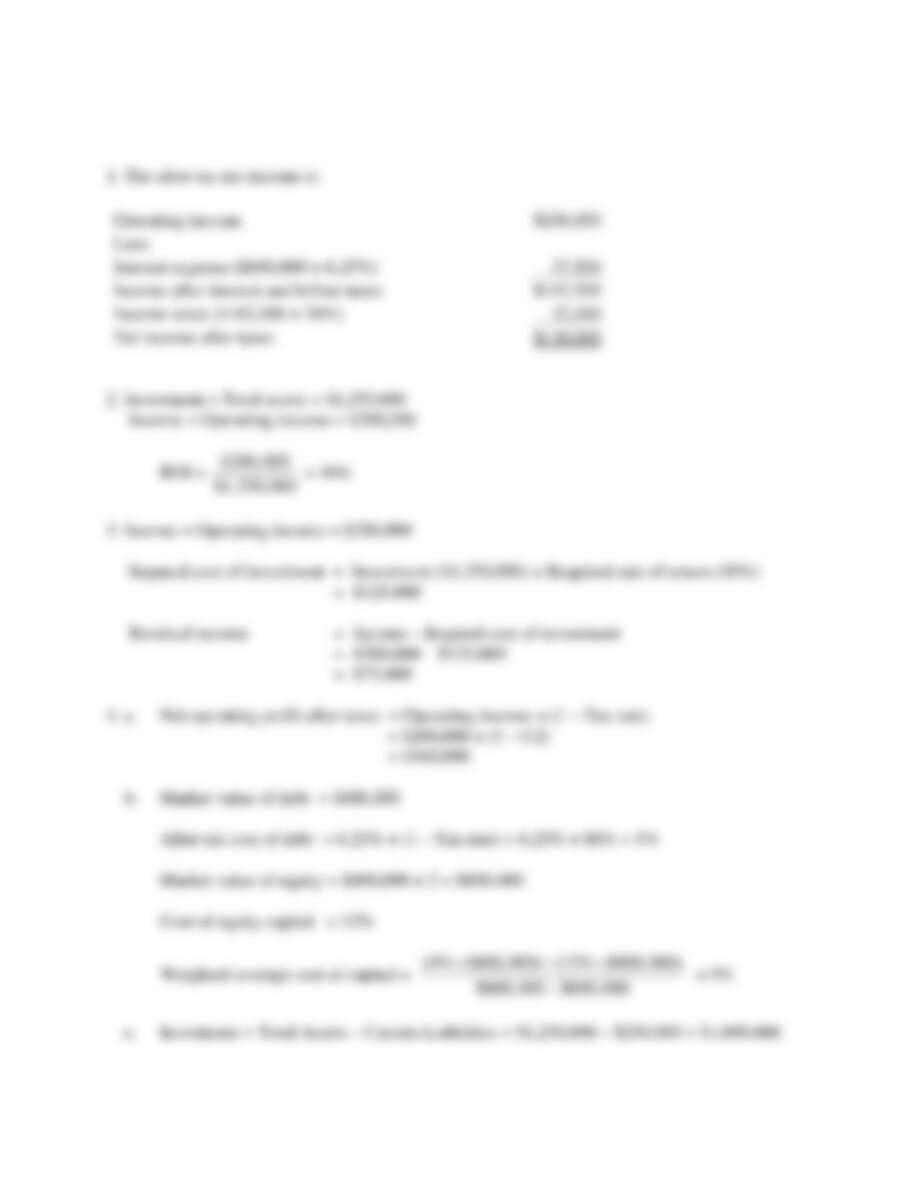
information about the performance of the property/casualty division:
For the purposes of divisional performance evaluation, Hamilton defines investment as total
assets and income as operating income (that is, income before interest and taxes). The firm pays
a flat rate of 20% in taxes on its income.
Required:
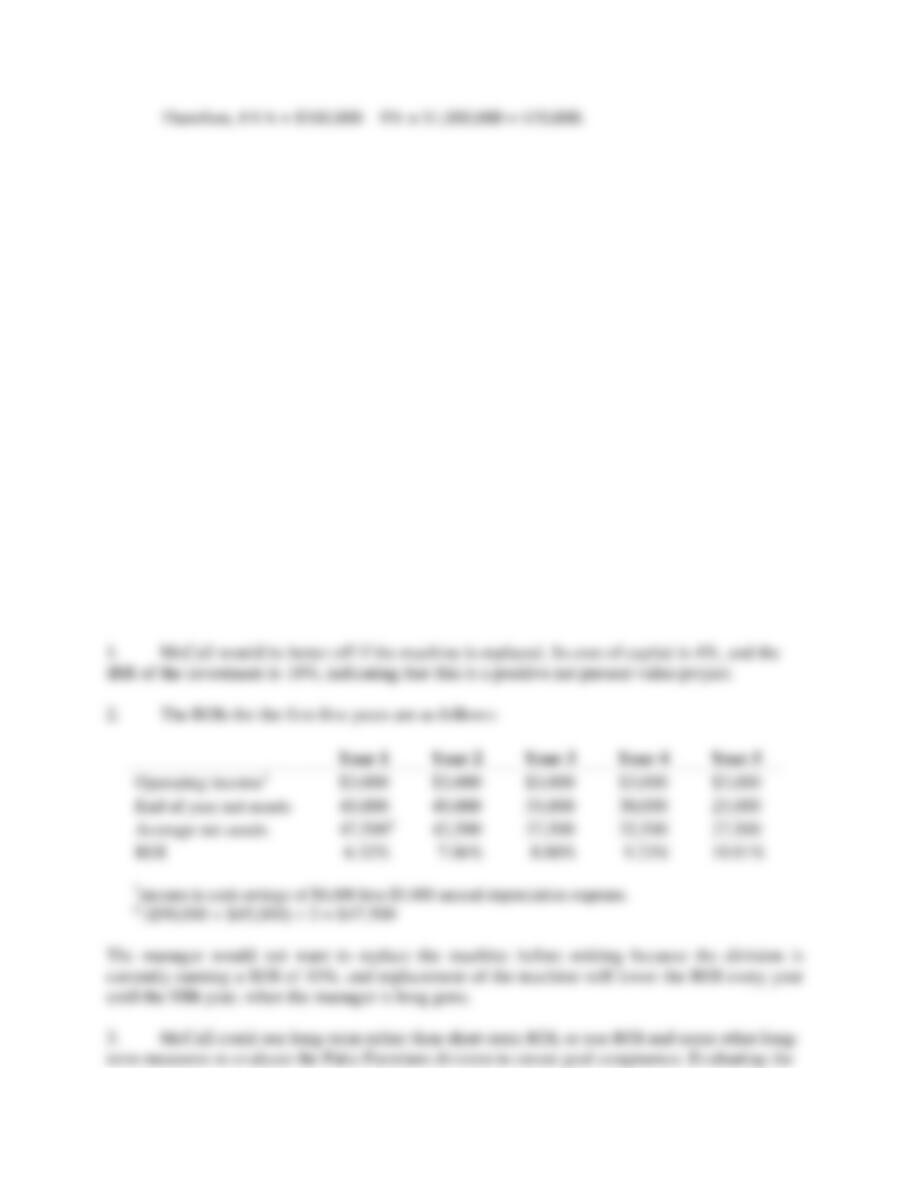
1. What was the net income after taxes of the property/casualty division?
2. What was the division’s ROI for the year?
3. Based on Hamilton’s required rate of return of 10%, what was the property/casualty
division’s residual income for 2013?
4. Hamilton’s CFO has heard about EVA and is curious about whether it might be a better
measure to use for evaluating division managers. Hamilton’s four divisions have similar risk
characteristics. Hamilton’s debt trades at book value while its equity has a market value
approximately twice that of its book value. The company’s cost of equity capital is 12%.
Calculate each of the following components of EVA for the property/casualty division, as
well as the final EVA figure:
a. Net operating profit after taxes
b. Weighted-average cost of capital
c. Investment, as measured for EVA calculations
23-11
SOLUTION
23-12
23-21 (25 min.) Goal incongruence and ROI.
McCall Corporation manufactures furniture in several divisions, including the patio furniture
division. The manager of the patio furniture division plans to retire in two years. The manager
receives a bonus based on the division’s ROI, which is currently 10%.
One of the machines that the patio furniture division uses to manufacture the furniture is rather
old, and the manager must decide whether to replace it. The new machine would cost $50,000
and would last 10 years. It would have no salvage value. The old machine is fully depreciated
and has no trade-in value. McCall uses straight-line depreciation for all assets. The new machine,
being new and more efficient, would save the company $8,000 per year in cash operating costs.
The only difference between cash flow and net income is depreciation. The internal rate of return
of the project is approximately 10%. McCall Corporation’s weighted-average cost of capital is
4%. McCall is not subject to any income taxes.
Required:
1. Should McCall Corporation replace the machine? Why or why not?
2. Assume that “investment” is defined as average net long-term assets after depreciation.
Compute the project’s ROI for each of its first five years. If the patio furniture manager is
interested in maximizing his bonus, would he replace the machine before he retires? Why or
why not?
3. What can McCall do to entice the manager to replace the machine before retiring?
SOLUTION
23-13
23-22 (25 min.) ROI, RI, EVA.
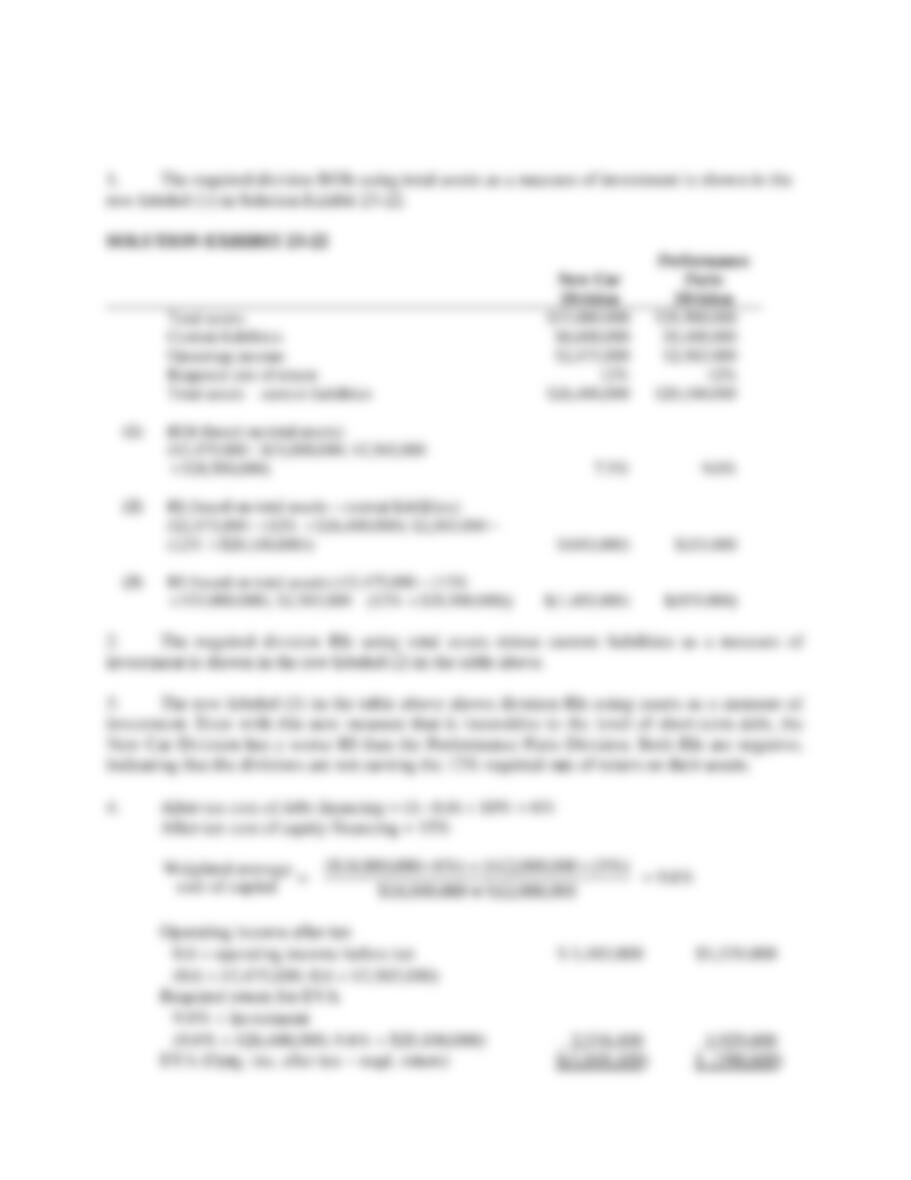
Performance Auto Company operates a new car division (that sells high-performance sports cars)
and a performance parts division (that sells performance-improvement parts for family cars).
Some division financial measures for 2014 are as follows:
Required:
1. Calculate return on investment (ROI) for each division using operating income as a measure
of income and total assets as a measure of investment.
2. Calculate residual income (RI) for each division using operating income as a measure of
income and total assets minus current liabilities as a measure of investment.
3. William Abraham, the new car division manager, argues that the performance parts division
has “loaded up on a lot of short–term debt” to boost its RI. Calculate an alternative RI for
each division that is not sensitive to the amount of short-term debt taken on by the
performance parts division. Comment on the result.
4. Performance Auto Company, whose tax rate is 40%, has two sources of funds: long-term
debt with a market value of $18,000,000 at an interest rate of 10% and equity capital with a
market value of $12,000,000 and a cost of equity of 15%. Applying the same weighted–
average cost of capital (WACC) to each division, calculate EVA for each division.
5. Use your preceding calculations to comment on the relative performance of each division.
23-14
SOLUTION
23-15
23-23 (30 min.) Capital budgeting, RI.
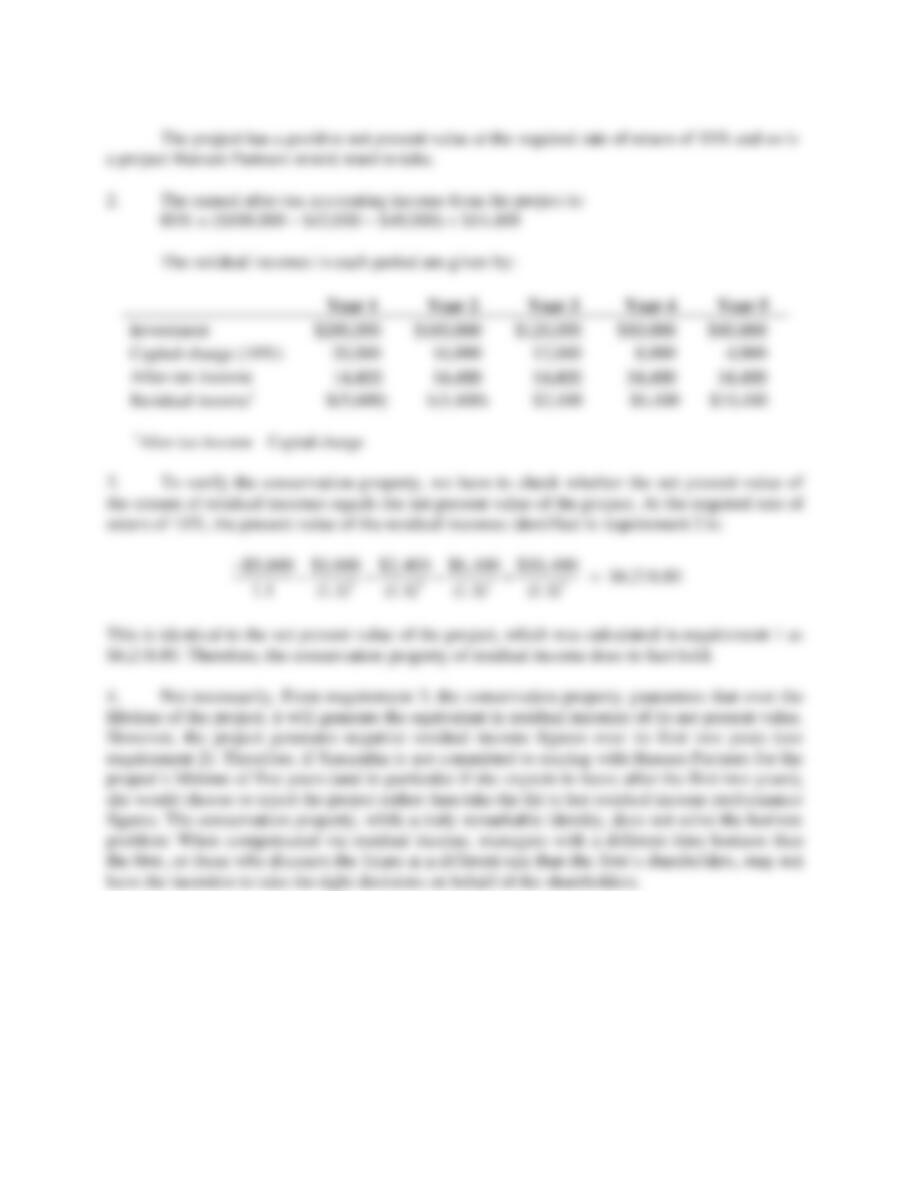
Samantha Shiells, a new associate at Hansen Partners, has compiled the following data for a
potential venture:
Hansen faces a 20% tax rate on income and knows that the tax authorities will only permit
straight-line depreciation for tax purposes. Hansen imposes an after-tax required rate of return of
10%.
Required:
1. Based on net present value considerations, is this a project Hansen Partners would want to
take?
2. Hansen Partners use straight-line depreciation for internal accounting and measure
investment as the net book value of assets at the start of the year. Calculate the residual
income in each year if the project were adopted.
3. Demonstrate that the conservation property of residual income, as described on page 883,
holds in this example.
4. If Samantha Shiells is evaluated on the residual income of the projects she undertakes, would
she take this project? Explain.
SOLUTION
23-16
23-24 (20 min.) Multinational performance measurement, ROI, RI.
The Mountainside Corporation manufactures similar products in the United States and Norway.
The U.S. and Norwegian operations are organized as decentralized divisions. The following
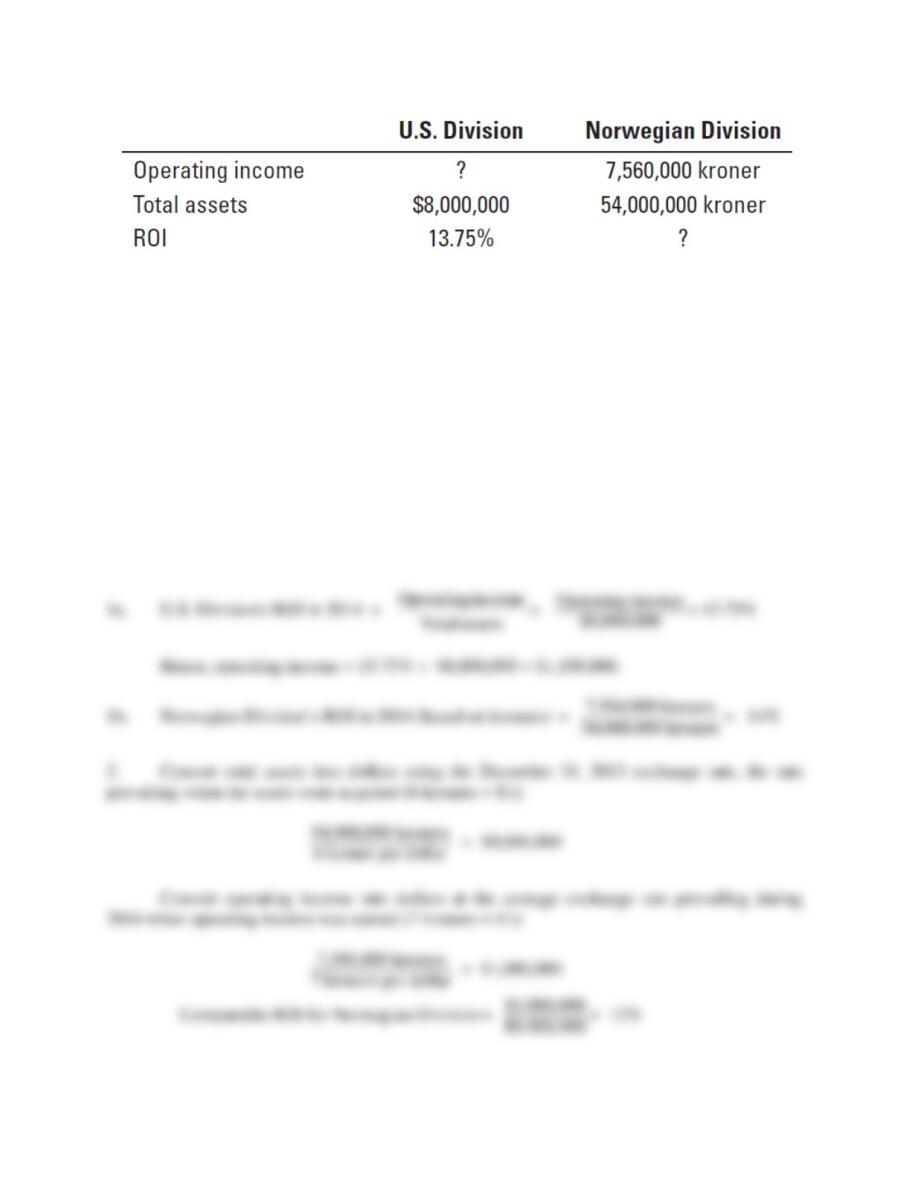
information is available for 2014; ROI is calculated as operating income divided by total assets:
23-17
Both investments were made on December 31, 2013. The exchange rate at the time of
Mountainside’s investment in Norway on December 31, 2013, was 6 kroner = $1. During 2014,
the Norwegian kroner decreased steadily in value so that the exchange rate on December 31,
2014, is 8 kroner = $1. The average exchange rate during 2014 is [(6 + 8) ÷ 2] = 7 kroner = $1.
Required:
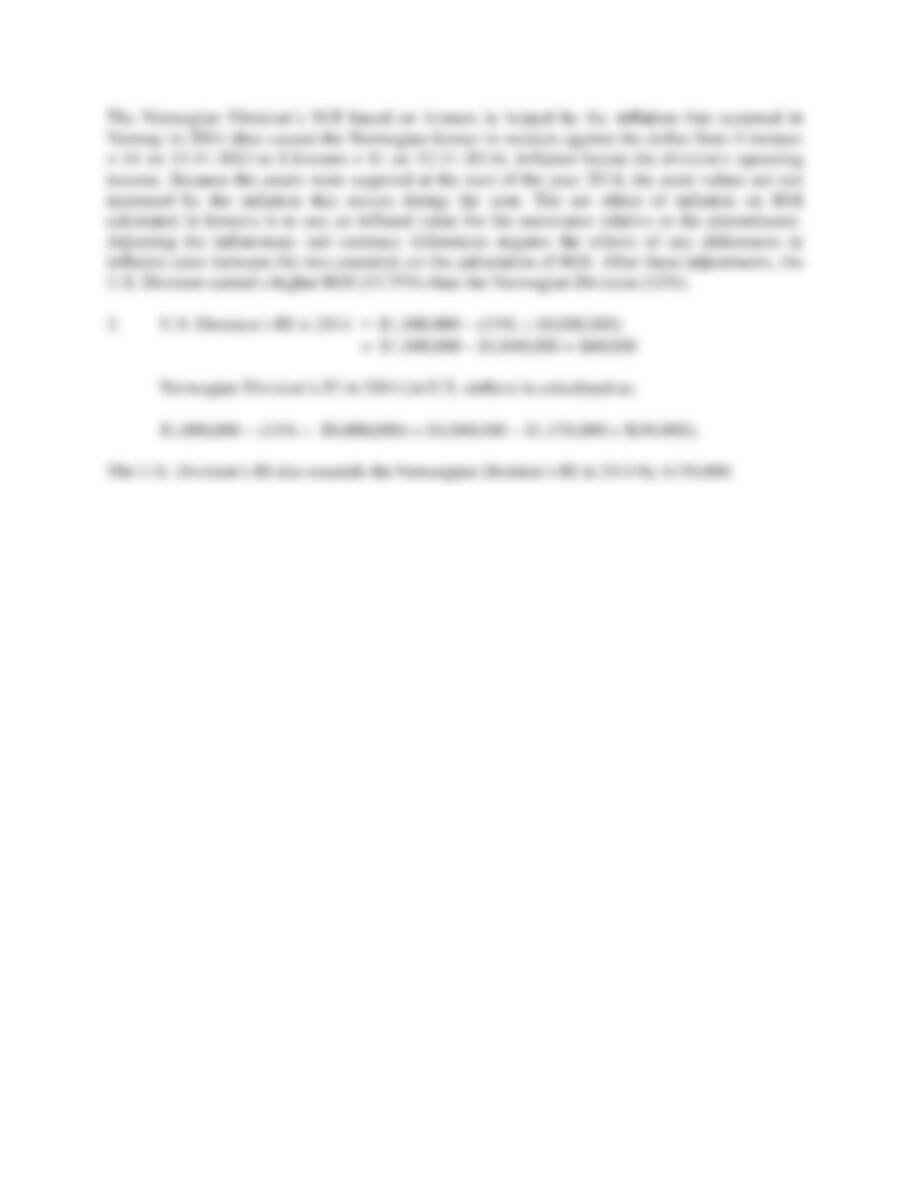
1. a. Calculate the U.S. division’s operating income for 2014.
b. Calculate the Norwegian division’s ROI for 2014 in kroner.
2. Top management wants to know which division earned a better ROI in 2014. What
would you tell them? Explain your answer.
3. Which division do you think had the better RI performance? Explain your answer. The
required rate of return on investment (calculated in U.S. dollars) is 13%.
SOLUTION
23-18
23-25 (20 min.) ROI, RI, EVA and Performance Evaluation.
Lucy Manufacturing makes fashion products and competes on the basis of quality and leading–
edge designs. The company has $3,200,000 invested in assets in its clothing manufacturing
division. After-tax operating income from sales of clothing this year is $800,000. The cosmetics
division has $7,500,000 invested in assets and an after-tax operating income this year of
$1,800,000. Income for the clothing division has grown steadily over the past few years. The
weighted-average cost of capital for Lucy is 11%. The CEO of Lucy has told the manager of
each division that the division that “performs best” this year will get a bonus.
Required:
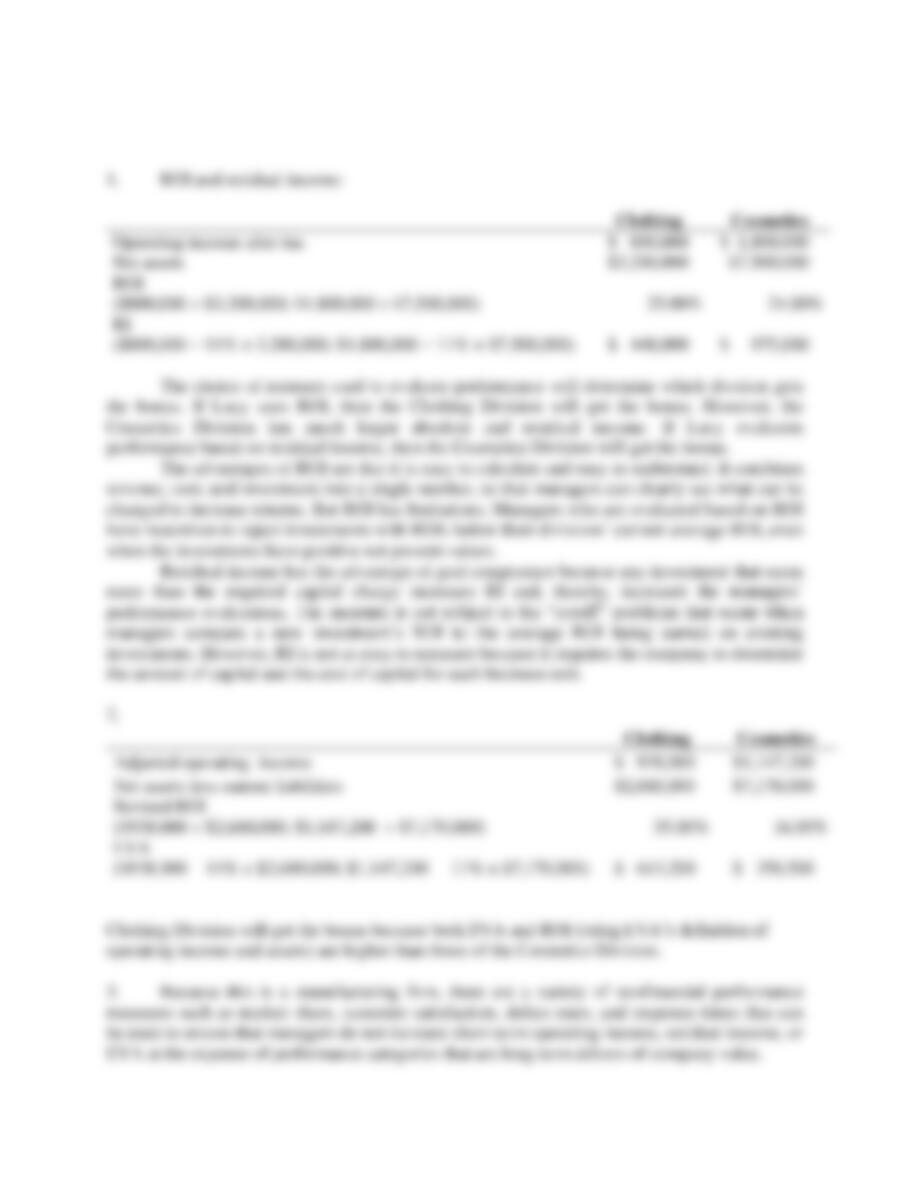
1. Calculate the ROI and residual income for each division of Lucy Manufacturing, and briefly
explain which manager will get the bonus. What are the advantages and disadvantages of
each measure?
2. The CEO of Lucy Manufacturing has recently heard of another measure similar to residual
income called EVA. The CEO has the accountant calculate EVA adjusted incomes of
clothing and cosmetics and finds that the adjusted after-tax operating incomes are $938,000
and $1,147,200, respectively. Also, the clothing division has $520,000 of current liabilities,
while the cosmetics division has only $330,000 of current liabilities. Using the preceding
information, calculate EVA and discuss which division manager will get the bonus.
3. What nonfinancial measures could Lucy use to evaluate divisional performances?
23-19
SOLUTION
23-20
23-26 (20–30 min.) Risk sharing, incentives, benchmarking, multiple tasks.
The Dexter division of AMCO sells car batteries. AMCO’s corporate management gives Dexter
management considerable operating and investment autonomy in running the division. AMCO is
considering how it should compensate Jim Marks, the general manager of the Dexter division.
Proposal 1 calls for paying Marks a fixed salary. Proposal 2 calls for paying Marks no salary and
compensating him only on the basis of the division’s ROI, calculated based on operating income
before any bonus payments. Proposal 3 calls for paying Marks some salary and some bonus
based on ROI. Assume that Marks does not like bearing risk.
Required:
1. Evaluate the three proposals, specifying the advantages and disadvantages of each.
2. Suppose that AMCO competes against Tiara Industries in the car battery business. Tiara is
approximately the same size as the Dexter division and operates in a business environment
that is similar to Dexter’s. The top management of AMCO is considering evaluating Marks
on the basis of Dexter’s ROI minus Tiara’s ROI. Marks complains that this approach is
unfair because the performance of another company, over which he has no control, is
included in his performance-evaluation measure. Is Marks’s complaint valid? Why or why
not?
3. Now suppose that Marks has no authority for making capital-investment decisions. Corporate
management makes these decisions. Is ROI a good performance measure to use to evaluate
Marks? Is ROI a good measure to evaluate the economic viability of the Dexter division?
Explain.
4. Dexter’s salespeople are responsible for selling and providing customer service and support.
Sales are easy to measure. Although customer service is important to Dexter in the long run,
it has not yet implemented customer-service measures. Marks wants to compensate his sales
force only on the basis of sales commissions paid for each unit of product sold. He cites two
advantages to this plan: (a) It creates strong incentives for the sales force to work hard, and
(b) the company pays salespeople only when the company itself is earning revenues. Do you
like his plan? Why or why not?
SOLUTION