Wild, Shaw & Chiappetta: Fundamental Accounting Principles, 23rd Edition
23-1
CHAPTER 23
FLEXIBLE BUDGETS AND STANDARD COSTS
Related Assignment Materials
Student Learning Objectives
Discussion
Questions
Quick
Studies*
Exercises*
Problems*
Beyond the
Numbers
Conceptual objectives:
explain how standard cost
information is useful for
management by exception.
23-5, 23–7,
23-8
what they reveal about
performance.
23-7
Analytical objectives:
A1. Analyze changes in sales from
expected amounts.
23-20, 23-21
23–23
23-2
23-2, 23-9
Procedural objectives:
P1. Prepare a flexible budget and
performance report.
1, 2, 3, 4, 5,
23-1, 23-2,
23–22
23-1, 23-2,
23-1, 23-2,
variances.
23–9, 23-10,
23-11, 23-12,
23–16
23-4, ES
P3. Compute overhead controllable
and volume variances.
9, 10, 12, 13,
16
23–13, 23-14,
23-15, 23-16,
23–23
23-17, 23-19,
23-20, 23-21,
23–22
23-3, 23-4
P4 Compute overhead spending and
efficiency variances.
(Appendix 23A)
23-18, 23–19
23–18
23-5, ES
P5. Prepare journal entries for
standard costs and account for
price and quantity variances.
(Appendix 23A)
23–17
23–14
23-6
23-4
*See additional information on next page that pertains to these quick studies, exercises and problems.
SP refers to the Serial Problem
ES refers to Excel Simulations
C1. Define standard costs and
23-5
23-5, 23-6
23-6
23-1, 23-3,
Wild, Shaw & Chiappetta: Fundamental Accounting Principles, 23rd Edition
23-2
Additional Information on Related Assignment Material
Connect
Available on the instructor’s course-specific website) repeats all numerical Quick Studies, all Exercises
and Problems Set A. Connect also provides algorithmic versions for Quick Study, Exercises and
Problems. It allows instructors to monitor, promote, and assess student learning. It can be used in
practice, homework, or exam mode.
Connect Insight
The first and only analytics tool of its kind, Connect Insight is a series of visual data displays that are each framed
by an intuitive question and provide at-a-glance information regarding how an instructor’s class is performing.
Connect Insight is available through Connect titles.
The Serial Problem (SP) for Success Systems continues in this chapter.
General Ledger
Assignable within Connect, General Ledger (GL) problems offer students the ability to see how transactions post
Excel Simulations
Assignable within Connect, Excel Simulations allow students to practice their Excel skills—such as basic formulas
and formatting—within the context of accounting. These questions feature animated, narrated Help and Show Me
tutorials (when enabled). Excel Simulations are auto-graded and provide instant feedback to the student.
Synopsis of Chapter Revision
NEW opener—Riide and entrepreneurial assignment.
New exhibit on fixed versus flexible budgets.
Revised discussion of fixed versus flexible budgets.
New 3-step process to prepare a flexible budget.
Added section on formula for computing total budgeted cost in a flexible budget.
Revised discussion of setting standard costs.
Revised exhibit on cost variance formula.
Added discussion of potential causes of direct labor variances.
New 3-step process for determining standard overhead rate.
New exhibit, formula, and computation of standard overhead applied.
Revised discussion of overhead volume and controllable variances.
Added calculations of controllable variance and budgeted overhead costs.
Wild, Shaw & Chiappetta: Fundamental Accounting Principles, 23rd Edition
23-3
Chapter Outline
Section 1⎯Fixed and Flexible Budgets
I. Budgetary Process
1. Budgetary Control and Reporting
a. Budgetary control⎯managers use budgets to control operations
and see that planned objectives are met.
b. Budget reports
2. Compare budgeted results to actual results.
4. Common periods for budget reports are for a month, a quarter and for
a year.
5. Fixed budgeting: a fixed budget (also called a static budget) is based
on a single product amount of sales or other activity measure.
6. Flexible budgeting: a flexible budget (also called a variable budget) is
based on several different amounts of sales or activity levels.
7. A flexible budget is more useful when actual results are different from
predicted.
8. Fixed Budget Performance Report
a. A fixed budget performance report compares actual results with
9. Favorable variance (F)⎯actual revenue is greater than budgeted
revenue, or actual cost is lower than budgeted cost.
10. Unfavorable variance (U)⎯Actual revenue is lower than budgeted
revenue, or actual cost is greater than budgeted cost.
12. Primary use of budget reports is to help management monitor and
control operations.
13. Fixed budget reports show variances from budget, but manager
14. Major limitation of fixed budget performance report is inability of
fixed budget reports to adjust for changes in activity levels.
II. Flexible Budget Reports –Superior alternative to fixed budget reports.
A. Purpose of Flexible Budgets
Notes
Chapter Outline
1. Flexible budget (also called variable budget) is based on predicted
Notes
23-4
2. Useful both before and after the period’s activities are complete
4. Flexible budgets prepared after the period help managers evaluate past
performance.
5. Especially useful because it reflects the different levels of activities in
different amounts of revenues and costs.
a. Comparisons of actual results with budgeted performance are
more likely to reveal the causes of any differences.
b. Helps managers to focus attention on problem areas and to
implement corrective actions.
A. Preparation of Flexible Budgets
1. To prepare a flexible budget, follow these steps:
a. Identify the activity level, units produced or sold.
2. Must classify costs as variable and fixed within a relevant range.
a. Variable cost per unit of activity remains constant; total amount of
3. When numbers making up a flexible budget are created:
a. Each variable cost is expressed as either a constant amount per
4. Layout follows a contribution margin format (Exhibit 23.3)
a. Sales are followed by variable costs (per unit), and then by fixed
costs⎯difference between sales and variable costs equals
Wild, Shaw & Chiappetta: Fundamental Accounting Principles, 23rd Edition
23-5
Chapter Outline
d. Total Budgeted Costs = Total Fixed Cost + (Total Variable Cost
Per Unit x Units of Activity).
B. Flexible Budget Performance Report
1. Lists differences between actual performance and budgeted
performance based on actual sales volume (or other level of activity).
2. Helps direct management’s attention to those costs or revenues that
3. Used for variance analysis.
a. Actual and budgeted sales volumes are the same; as such, any
variance in total dollar sales must have resulted from a selling
price that was different than expected.
b. Difference between actual price per unit of input and budgeted
price per unit of input can be described as a price variance.
c. Difference between actual quantity of input used and budgeted
quantity can be described as a quantity variance.
Section 2⎯Standard Costs
I. Standard Costs⎯Actual costs are amounts paid in past transactions; a
measure of comparison is usually needed to decide whether actual cost
amounts are reasonable or excessive, and standard costs offer one basis for
comparison.
A. Standard costs are preset costs for delivering a product or service expected
under normal conditions.
1. Used by management to assess the reasonableness of actual costs
incurred for producing the product or service.
3. Management by exception: managers focus attention on most
4. Often used in preparing budgets because they are the anticipated costs
incurred under normal conditions.
5. Can also help control nonmanufacturing costs.
II. Materials and Labor Standards
A. Identifying Standard Costs
1. Managerial accountants, engineers, personnel administrators, and other
managers work together to set standard costs.
Notes
Wild, Shaw & Chiappetta: Fundamental Accounting Principles, 23rd Edition
23-6
Chapter Outline
2. Regardless, actual costs frequently differ from standard costs;
differences often due to more than one factor.
a. Actual quantity used (of direct labor hours or direct materials) may
differ from standard.
B. Setting Standard Costs
1. Due to inefficiencies and waste, materials may be lost as part of
process.
a. An ideal standard is the quantity of material required if process
2. A standard cost card shows the standard costs of direct materials,
direct labor, and overhead for one unit of product or service.
.
III. Cost Variances⎯Cost variance (or simply variance) is difference between
actual and standard costs; can be favorable (if actual cost is less than standard
cost) or unfavorable (if actual cost is more than standard cost). Note that short–
term favorable variances can lead to long-term unfavorable variances.
A. Cost Variance Analysis
1. Variances are commonly identified in performance reports.
2. Management examines circumstances to determine factors causing the
variance; analysis, evaluation, and explanation involved.
4. Four steps involved in proper management of variance analysis.
a. Preparation of standard cost performance report.
b. Computation and analysis of variances.
d. Corrective and strategic action.
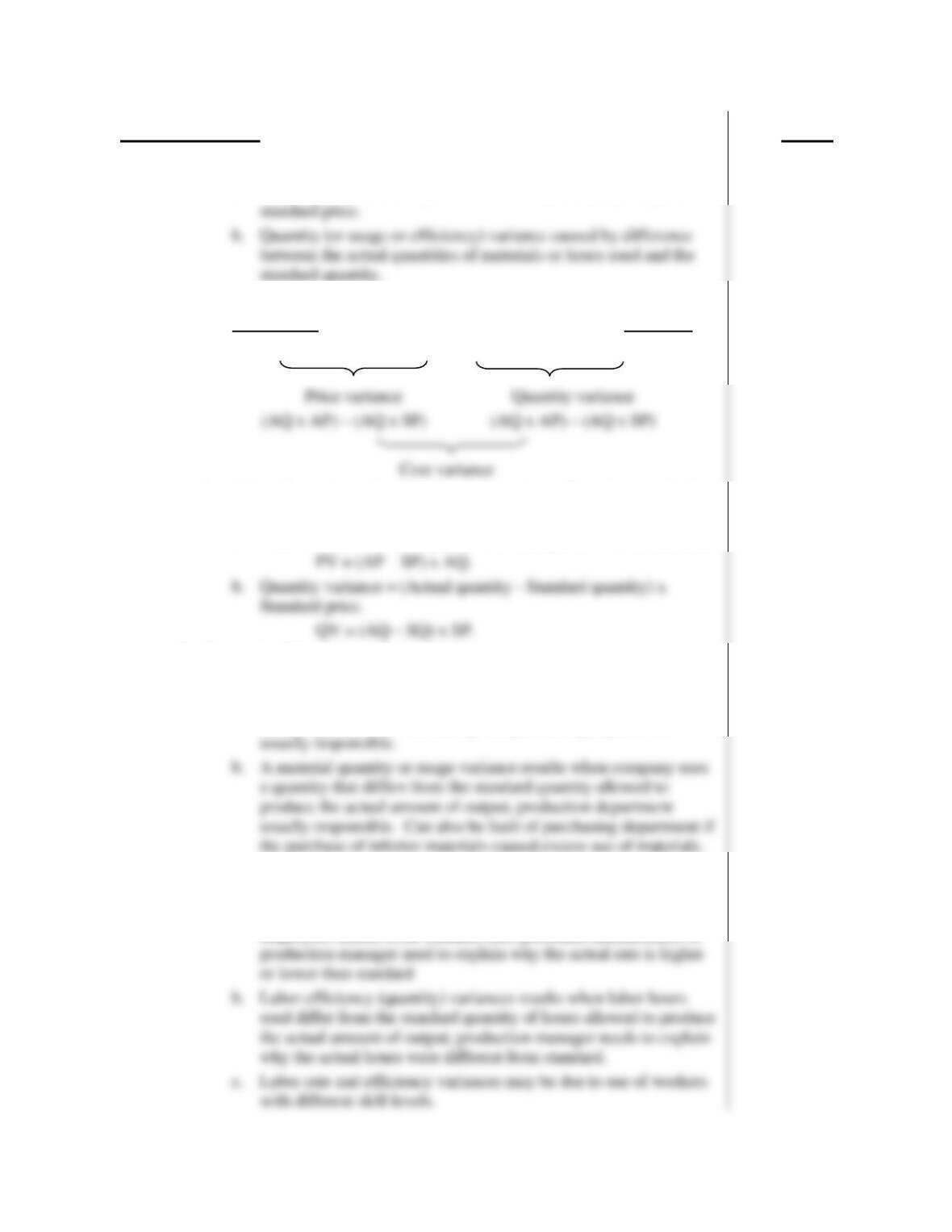
B. Cost Variance Computation⎯Cost variance (CV) equals difference
between actual cost (AC) and standard cost (SC).
1. Actual quantity (AQ ) Standard quantity (SQ)
2. Actual quantity is actual amount of material or labor used in
3. Actual Price is amount paid for acquiring the input (material or labor),
and Standard Price is the expected price.
Notes
Wild, Shaw & Chiappetta: Fundamental Accounting Principles, 23rd Edition
23-7
Chapter Outline
4. Two main factors cause a cost variance
a. Price variance caused by difference between actual price paid and
5. Price variance and quantity variance can be determined by formulas.
Actual Cost Standard
AQ x AP AQ x SP SQ x SP
6. Alternative price variance and quantity variance formulas can also be
used.
a. Price variance = (Actual price – Standard price) x Actual quantity.
C. Computing Materials and Labor Variances
1. Material cost variances may be due to price and/or quantity factors.
a. A materials price variance results when company pays different
amount per unit than standard price; purchasing department
2. Labor cost variances may be due to rate (price) and/or efficiency
(quantity) factors.
a. Labor rate (price) variance results when wage rate paid to
employees differs from standard rate; personnel administrator or
Notes
Wild, Shaw & Chiappetta: Fundamental Accounting Principles, 23rd Edition
23-8
Chapter Outline
IV. Overhead Standards and Variances⎯A predetermined overhead rate is used
to assign standard overhead costs to products or services produced;
predetermined rate is often based on relation between standard overhead and
standard labor cost, standard labor hours, standard machine hours, or another
measure of production.
A. Standard Overhead Rate
1. Standard overhead costs are amounts expected to occur at a certain
level of activity.
2. Overhead includes both variable and fixed costs; as such, average
overhead cost per unit changes as the predicted volume changes.
4. To allocate overhead costs to products or services, management
establishes standard overhead cost rate using a 3-step process:
a. Step 1: determine an allocation base: a measure of input
management believes is related to overhead costs, such as direct
labor hours or machine hours.
b. Step 2: choose a predicted activity level: management considers
many factors which affect predicted activity level.
i. Level of 100% of capacity rarely used.
B. Computing Overhead Cost Variances
1. Cost accounting system applies overhead using predetermined
overhead rate when standard costs are used as described in Step 3.
2. The standard overhead applied is based on the predetermined overhead
rate and the standard number of hours that should have been used,
based on the actual production output.
Notes
Chapter Outline
3. To help identify factors causing the total overhead cost variance
managers will analyze the variance separately for volume and
controllable variances.
a. The controllable variance is the difference between the actual total
overhead costs incurred and the budgeted total overhead costs
Notes
Wild, Shaw & Chiappetta: Fundamental Accounting Principles, 23rd Edition
23-9
based on a flexible budget; named because it refers to activities
usually under management control.
4. Analyzing controllable and volume variances
a. An unfavorable volume means the company did not reach its
expected operating level – a favorable variance means the
5. Overhead Variance Reports
a. Help managers isolate the reasons for a controllable variance.
b. Provides information about specific overhead costs and how they
differ from budgeted amounts
V. Decision Analysis⎯Sales Variances⎯Similar to computation and analysis of
cost variances.
A. Sales price variance and sales volume variance can be computed.
Managers use sales variances for planning and control purposes.
2. Sales volume variance measures the impact of operating at a different
capacity level than predicted by the fixed budget.
B. When multiple products sold:
1. Sales mix variance is difference between actual and budgeted sales
mix of products.
Wild, Shaw & Chiappetta: Fundamental Accounting Principles, 23rd Edition
23–10
Chapter Outline
Appendix 23A
I. Expanded Overhead Variances
A. Computing Overhead Cost Variances⎯assume predetermined rate is
based on relation between standard overhead and standard labor hours.
1. Framework uses classifications of overhead costs as either variable or
fixed
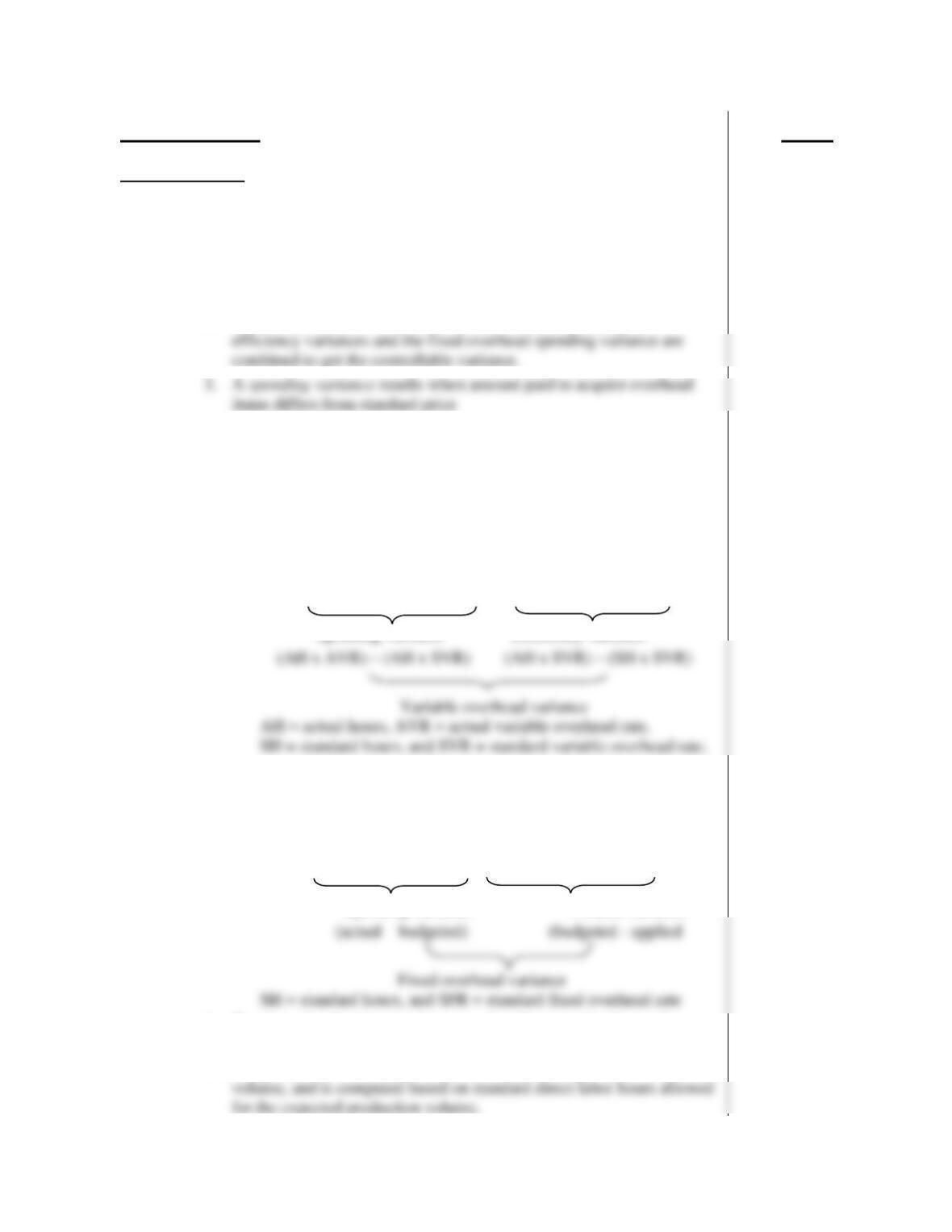
2. Exhibit 23A.1 shows that the variable overhead spending and
4. An efficiency variance results when standard direct labor hours (the
assumed allocation base) expected for actual production are different
from actual direct labor hours used; reflects on the cost-effectiveness
in using the overhead allocation base such as direct labor hours.
B. Variable overhead cost variances can be determined by formulas.
Formulas:
Actual Overhead Applied Overhead
AH x AVR AH x SVR SH x SVR
Spending variance Efficiency variance
C. Fixed overhead cost variances can be determined by formulas that include
only the fixed portion of overhead.
Formulas:
Actual Overhead Budgeted Overhead Applied Overhead
(given) (from budget) SH x SFR
Spending variance Volume variance
1. Fixed overhead volume variance results when actual volume of
production differs from standard volume of production.
2. Budgeted fixed overhead amount remains same regardless of expected
Notes
Wild, Shaw & Chiappetta: Fundamental Accounting Principles, 23rd Edition
23–11
II. Standard Cost Accounting Systems
Standard cost systems also record standard costs and variances in most
accounts.
1. Simplifies recordkeeping
2. Helpful in report preparation.
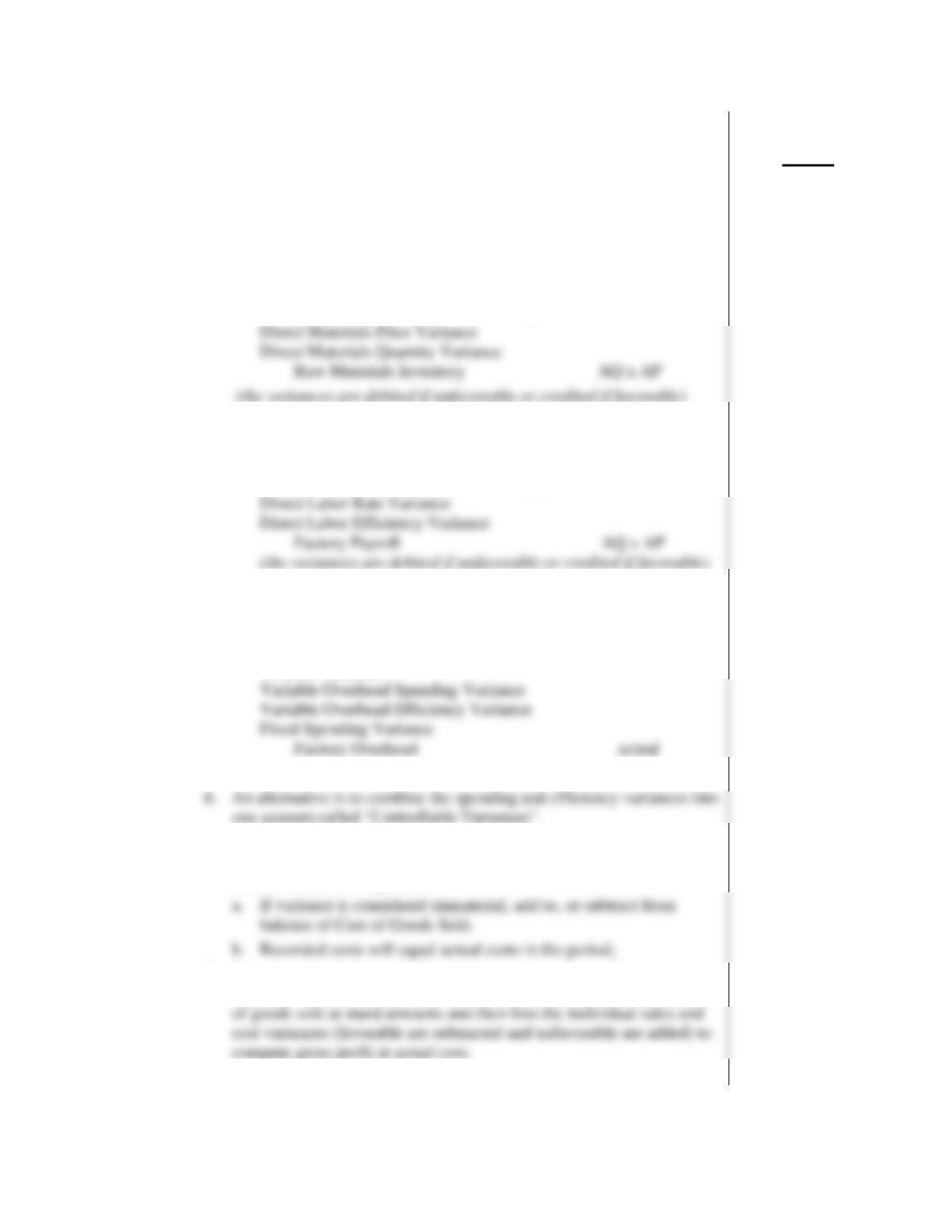
3. Record standard materials costs incurred:
Work in Process Inventory SQ x SP
4. Record standard labor cost of goods manufactured:
Work in Process Inventory SQ x SP
5. Assign standard predetermined overhead to Work in Process:
Work in Process Inventory SQ x SPR
Volume Variance
(the variances are debited if unfavorable or credited if favorable)
7. Accumulate balances in the different variance accounts until end of
accounting period; to close, add to or subtract from the manufacturing
costs recorded in the period.
8. Can use a standard costing income statement to summarize a
company’s performance. The Income Statement reports sales and cost
Notes
Wild, Shaw & Chiappetta: Fundamental Accounting Principles, 23rd Edition
23–12
Chapter 23 Alternate Demo Problem #1
Problem #1
XYZ Company manufactures tables. A standard cost card for the
manufacture of one table shows the following:
Standard Cost per Table:
Direct material: 4 sq. ft. @ $3/sq. ft.
$12
In November, the company produced 1,000 tables. Actual production costs
and quantities were:
Direct material: 3,900 sq. ft. @ $3.10/sq. ft.
$12
Required:
Calculate the price and quantity variances for direct material and direct
labor.
Total prime costs
$28
Wild, Shaw & Chiappetta: Fundamental Accounting Principles, 23rd Edition
23–13
Chapter 23 Alternate Demo Problem #2
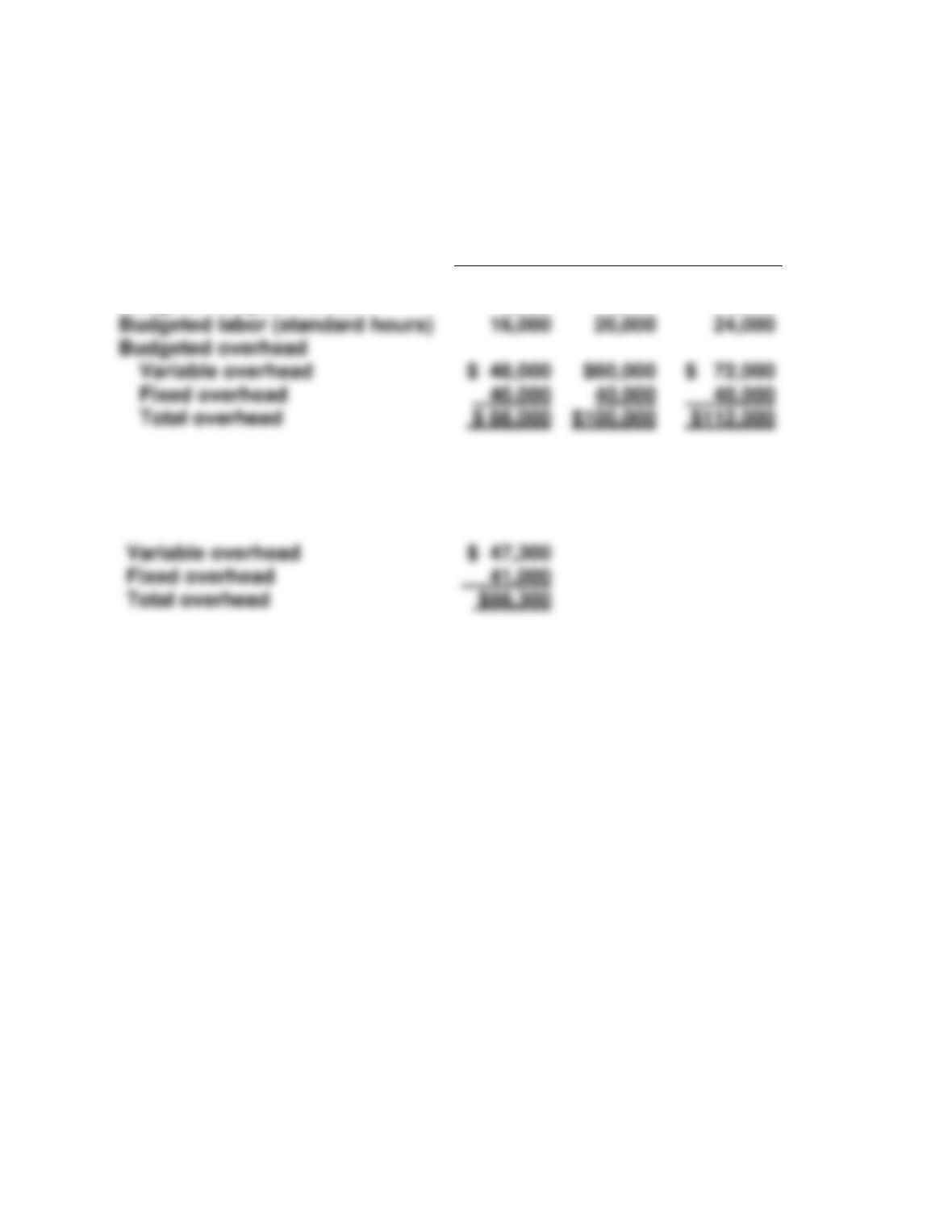
Atlantic Company has the following monthly flexible budget information
based on an expectation of operating at 80% of the factory’s capacity or
10,000 units produced:
Operating Levels
70%
80%
90%
Budgeted output in units
8,000
10,000
12,000
During the current month, the company operated at 70% of capacity and
employees worked 16,500 hours and the flowing actual overhead costs
were incurred:
Required:
1. Compute the predetermined overhead rate per direct labor hour for
variable overhead, fixed overhead, and total overhead.
2. Compute the variable overhead spending and efficiency variances.
3. Compute the fixed overhead spending and volume variance.
Budgeted labor (standard hours)
16,000
Budgeted overhead
Wild, Shaw & Chiappetta: Fundamental Accounting Principles, 23rd Edition
23–14
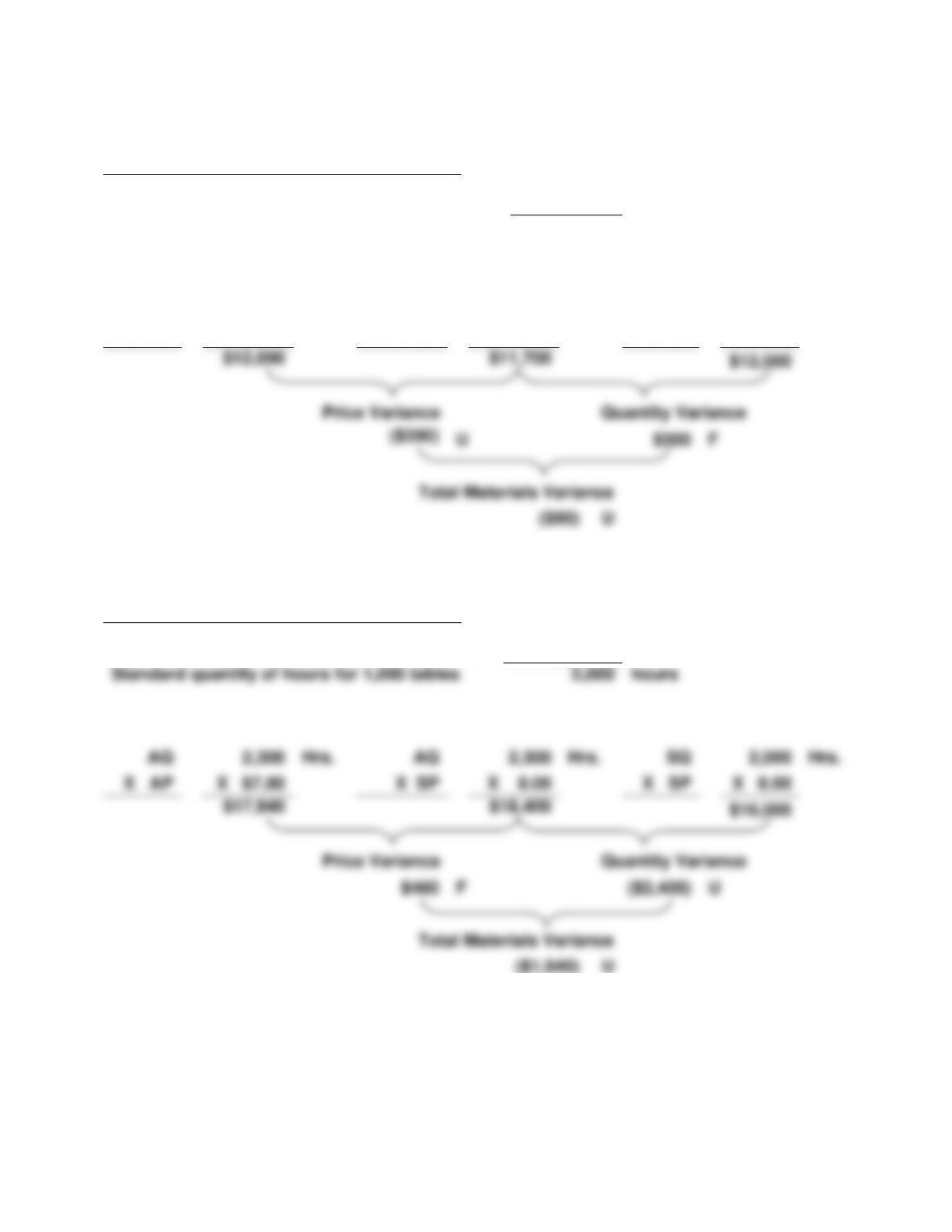
Chapter 23 Alternate Demo Problem #1: Solution
Materials Variances
Units produced……………………………………..
1,000
tables
X std. quantity of materials per unit…………..
X 4
Sq. ft per table
Standard quantity of materials for 1,000 tables
4,000
Sq ft
AQ
3,900
Sq ft.
AQ
3,900
Sq ft.
SQ
4,000
Sq ft.
X AP
X $3.10
X SP
X 3.00
X SP
X 3.00
Labor Variances
Units produced……………………………………..
1,000
tables
X standard direct labor hrs per unit…………..
X 2
hours
Standard quantity of hours for 1,000 tables
2,000
hours
U
U
Wild, Shaw & Chiappetta: Fundamental Accounting Principles, 23rd Edition
23–15
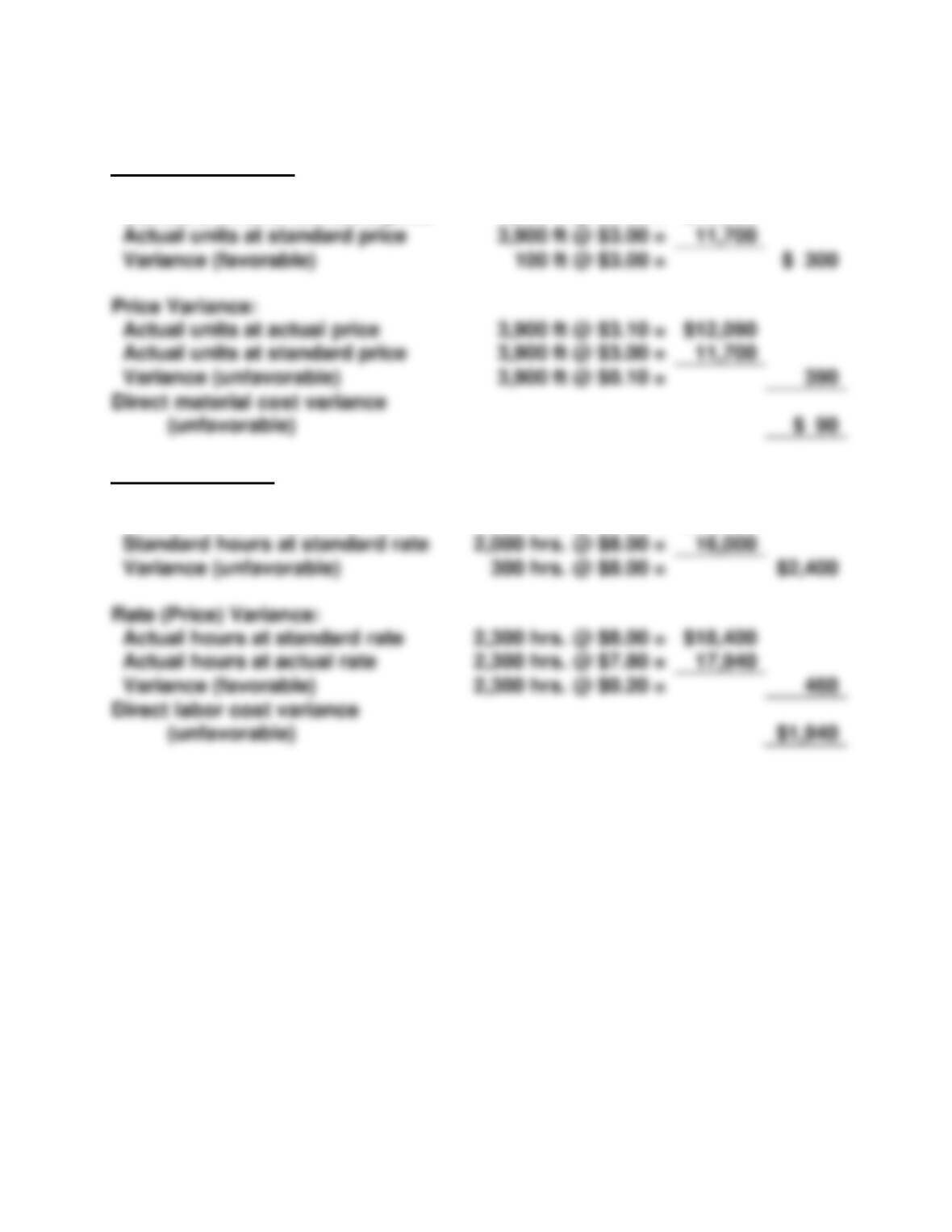
Material Variances:
Quantity Variance:
Standard units at standard price
4,000 ft @ $3.00 =
$12,000
Labor Variances:
Efficiency (Quantity) Variance
Actual hours at standard rate
2,300 hrs. @ $8.00 =
$18,400
Standard hours at standard rate
2,000 hrs. @ $8.00 =
Variance (unfavorable)
Actual hours at standard rate
2,300 hrs. @ $8.00 =
$18,400
Actual hours at actual rate
2,300 hrs. @ $7.80 =
Variance (favorable)
2,300 hrs. @ $0.20 =
(unfavorable)
Actual units at standard price
3,900 ft @ $3.00 =
Variance (favorable)
Price Variance:
Actual units at actual price
3,900 ft @ $3.10 =
$12,090
Actual units at standard price
3,900 ft @ $3.00 =
Variance (unfavorable)
3,900 ft @ $0.10 =
(unfavorable)
Wild, Shaw & Chiappetta: Fundamental Accounting Principles, 23rd Edition
23–16
Chapter 23 Alternate Demo Problem #2: Solution
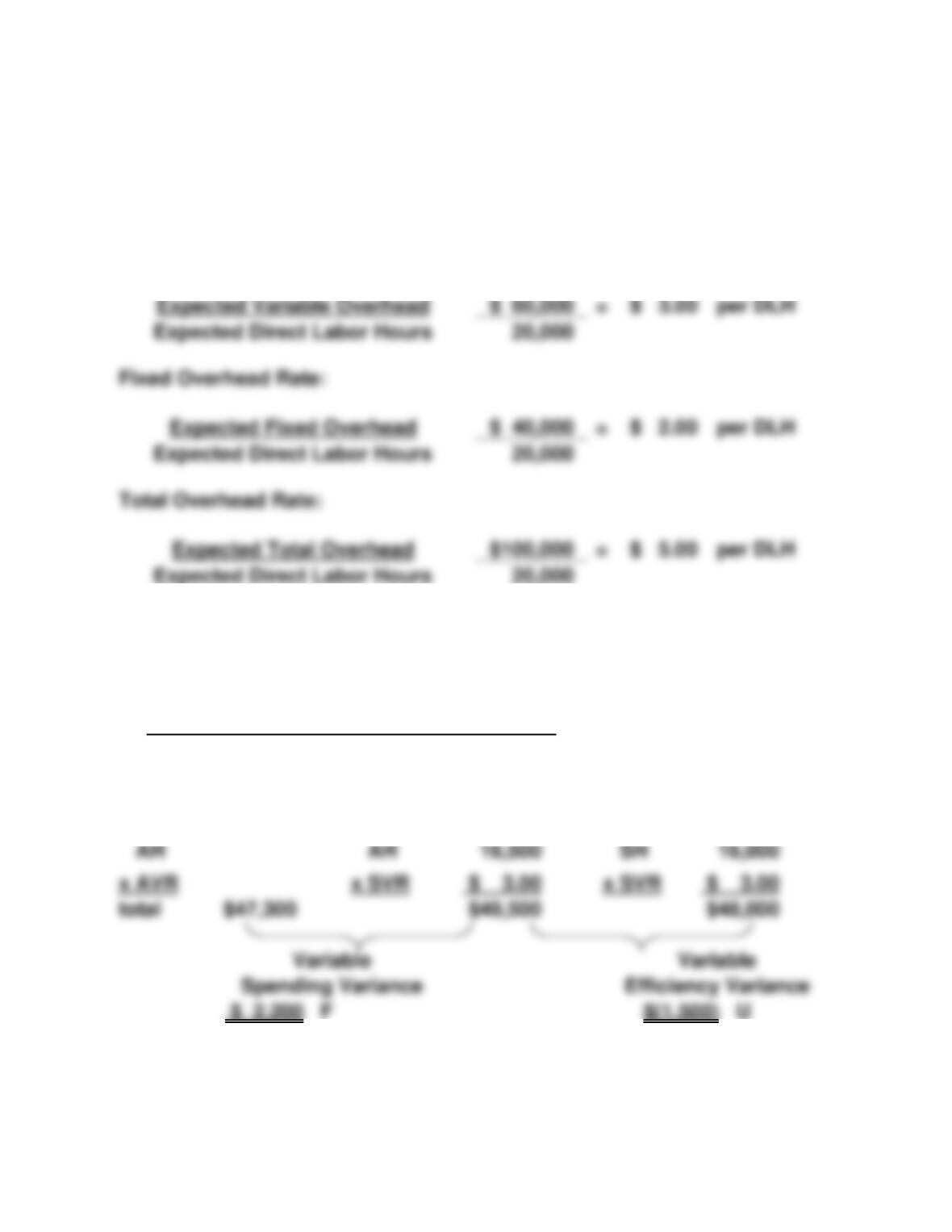
1. Compute the predetermined overhead rates
Overhead at operating level expected (80%) or 10,000 units
Variable Overhead Rate:
2. Variable Overhead Variance Computations
Actual Variable
Applied Variable
Overhead
Overhead
$ 3.00
total
$47,300
$49,500
$48,000
F
U
$ 60,000
=
$ 3.00
$ 40,000
=
$ 2.00
Total Overhead Rate:
$100,000
=
$ 5.00
Wild, Shaw & Chiappetta: Fundamental Accounting Principles, 23rd Edition
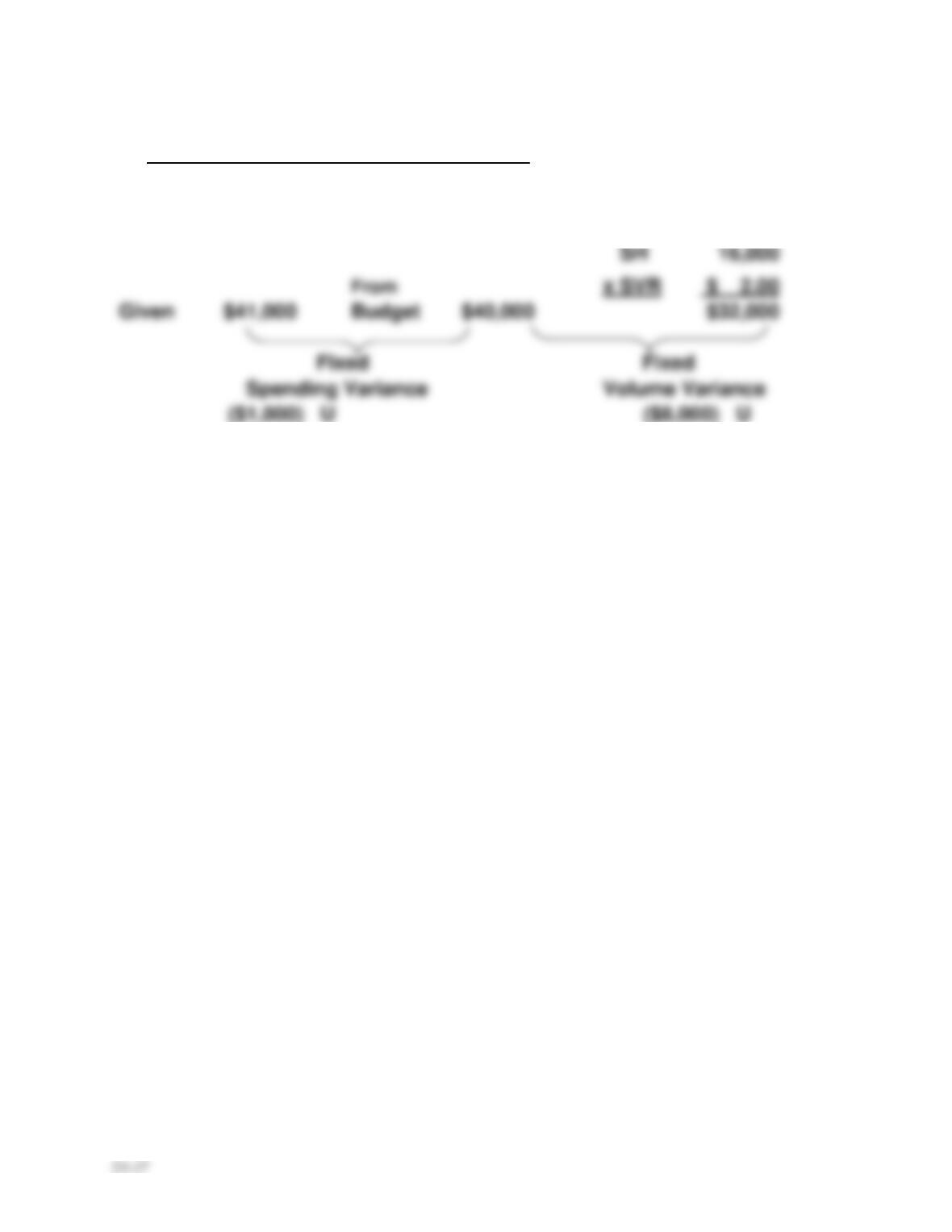
3. Fixed Overhead Variance Computations
Actual Fixed
Applied Fixed
Overhead
Overhead
$41,000
$40,000
$32,000
U
U