
CHAPTER 23
Budgetary Planning
ASSIGNMENT CLASSIFICATION TABLE
Learning Objectives
Questions
Brief
Exercises
Do It!
Exercises
A
Problems
1. State the essentials of effective
budgeting and the components of
the master budget.
1, 2, 3, 4, 5,
6, 7, 8, 9,
10
1
1
1
2. Prepare budgets for sales,
production, and direct materials.
11, 12, 13
2, 3, 4,
2
2, 3, 4, 5, 6,
7, 8, 10
1A, 2A, 3A
3. Prepare budgets for direct labor,
manufacturing overhead, and
selling and administrative
expenses, and a budgeted
income statement.
14, 15, 16,
17, 18
5, 6, 7, 8
3
9, 10, 11,
12, 13
1A, 2A, 6A
4. Prepare a cash budget and a
budgeted balance sheet.
19, 20
9
4
14, 15, 16,
17, 18, 19
4A, 6A
5. Apply budgeting principles to
nonmanufacturing companies.
21, 22
10
5
19, 20, 21
5A

ASSIGNMENT CHARACTERISTICS TABLE
Problem
Number
Description
Difficulty
Level
Time
Allotted (min.)
1A
Prepare budgeted income statement and supporting
budgets.
Simple
30–40
2A
Prepare sales, production, direct materials, direct labor,
and income statement budgets.
Simple
40–50
3A
Prepare sales and production budgets and compute cost
per unit under two plans.
Moderate
30–40
4A
Prepare cash budget for two months.
Moderate
30–40
5A
Prepare purchases and income statement budgets for a
merchandiser.
Simple
30–40
6A
Prepare budgeted cost of goods sold, income statement,
retained earnings and balance sheet.
Complex
40–50

BLOOM’ S TAXONOMY TABLE
Correlation Chart between Bloom’s Taxonomy, Learning Objectives and End–of-Chapter Exercises and Problems
Learning Objective
Knowledge
Comprehension
Application
Analysis
Synthesis
Evaluation
1. State the essentials of
effective budgeting and
the components of the
master budget.
DI23-1
Q23-1
Q23-2
Q23-3
Q23-4
Q23-5
Q23-6
Q23-7
Q23-8
Q23-9
Q23-10
E23-1
BE23-1
2. Prepare budgets for sales,
production, and direct
materials.
Q23-11
Q23-12
Q23-13
BE23-2
BE23-3
BE23-4
DI23-2
E23-2
E23-3
E23-4
E23-5
E23-6
E23-7
E23-8
E23-10
P23-1A
P23-2A
P23-3A
3. Prepare budgets for direct
labor, manufacturing
overhead, and selling and
administrative expenses,
and a budgeted income
statement.
Q23-14
Q23-15
Q23-16
Q23-18
Q23-17
BE23-5
BE23-6
BE23-7
BE23-8
DI23-3
E23-9
E23-10
E23-11
E23-12
E23-13
P23-1A
P23-2A
P23-6A
4. Prepare a cash budget and
a budgeted balance sheet.
Q23-19
Q23-20
BE23-9
DI23-4
E23-14
E23-15
E23-17
E23-18
E23-19
P23-4A
P23-6A
E23-16
5. Apply budgeting
principles to
nonmanufacturing
companies.
Q23-21
Q23-22
BE23-10
DI23-5
E23-19
E23-20
E23-21
P23-5A
Broadening Your Perspective
BYP23-2
BYP23-3
BYP23-4
BYP23-1
BYP23-5
BYP23-6
BYP23-7
ANSWERS TO QUESTIONS
1. (a) A budget is a formal written statement of management’s plans for a specified future time period,
expressed in financial terms.
(b) A budget aids management in planning because it represents the primary method of commu–
nicating agreed-upon objectives throughout the organization. Once adopted, a budget becomes
an important basis for evaluating performance.
2. The primary benefits of budgeting are:
(1) It requires all levels of management to plan ahead and to formalize goals on a recurring basis.
(2) It provides definite objectives for evaluating performance at each level of responsibility.
(3) It creates an early warning system for potential problems, so that management can make
changes before things get out of hand.
4. (a) Disagree. Accounting information makes major contributions to the budgeting process. Accounting
provides the starting point of budgeting by providing historical data on revenues, costs, and
5. The budget period should be long enough to provide an attainable goal under normal business
conditions. The budget period should minimize the impact of seasonal and cyclical business
fluctuations, but it should not be so long that reliable estimates are impossible. The most common
budget period is one year.
6. Disagree. Long-range planning usually encompasses a period of at least five years. It involves
Questions Chapter 23 (Continued)
8. Budgetary slack is the amount by which a manager intentionally underestimates budgeted
revenues or overestimates budgeted expenses in order to make it easier to achieve budgetary
goals. Managers may have an incentive to create budgetary slack in order to increase the likelihood of
receiving a bonus, or decrease the likelihood of losing their job.
9. A master budget is a set of interrelated budgets that constitutes a plan of action for a specified
time period. The master budget is developed within the framework of a sales forecast.
15. (a) Manufacturing overhead rate based on direct labor cost is 48% [$198,000 + $162,000 =
$360,000; $360,000 ÷ (150,000 X 1/3 X $15/hr.) = 48%].
19. The three sections of a cash budget are: (1) cash receipts, (2) cash disbursements, and (3) financing.
The cash budget also shows the beginning and ending cash balances.
20. Cash collections are:
January—$600,000 X 40% = $240,000.
SOLUTIONS TO BRIEF EXERCISES
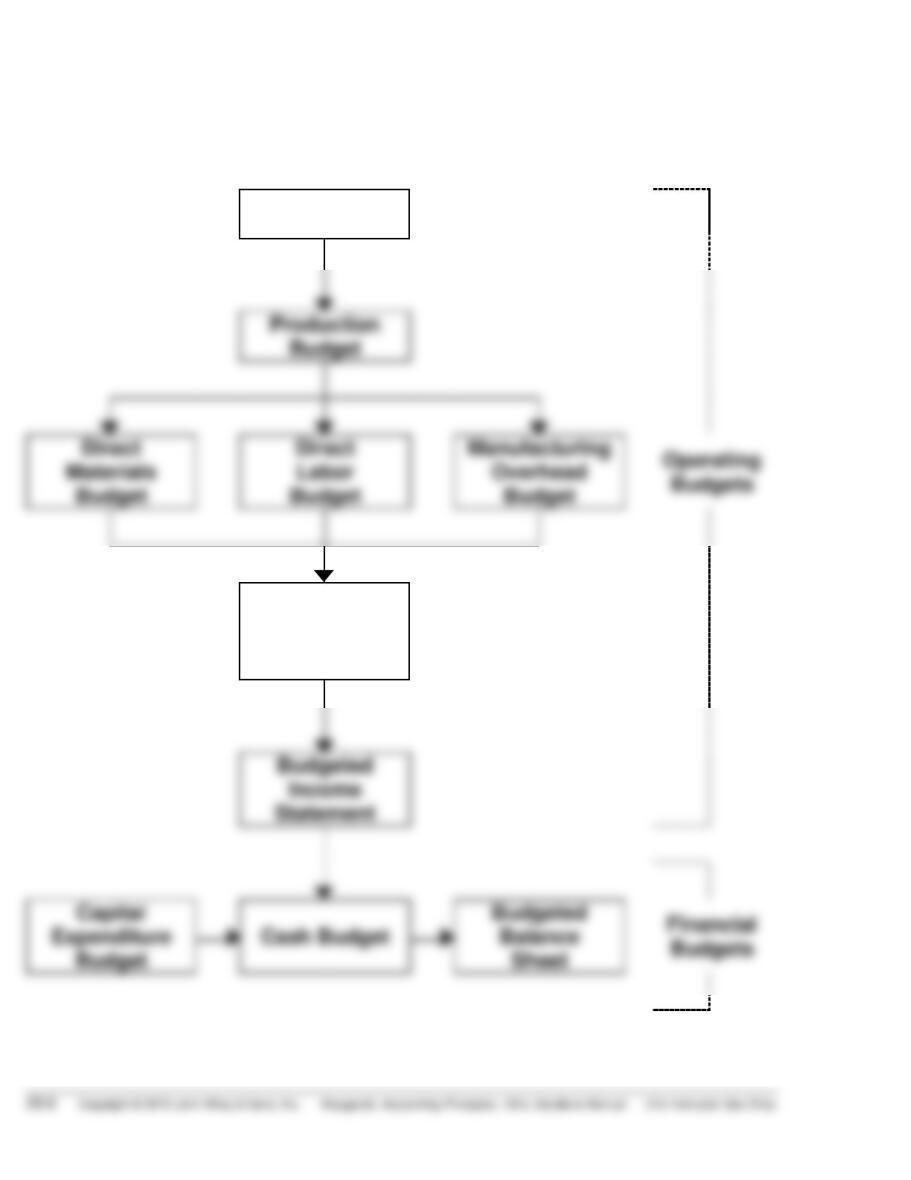
BRIEF EXERCISE 23-1
Sales
Budget
Selling and
Administrative
Expense
Budget
BRIEF EXERCISE 23-2
PAIGE COMPANY
Sales Budget
For the Year Ending December 31, 2017
Quarter
1
2
3
4
Year
Expected
unit sales
10,000
14,000
15,000
18,000
57,000
BRIEF EXERCISE 23-3
PAIGE COMPANY
Production Budget
For the Six Months Ending June 30, 2017
Quarter
Six
Months
1
2
Expected unit sales
Add: Desired ending finished goods
10,000
3,500
a
14,000
3,750
c
BRIEF EXERCISE 23-4
PERINE COMPANY
Direct Materials Budget
For the Month Ending January 31, 2017
Units to be produced ………………………………………………. 4,000
Direct materials per unit …………………………………………. X 2
BRIEF EXERCISE 23-5
GUNDY COMPANY
Direct Labor Budget
For the Six Months Ending June 30, 2017
Quarter
Six
Months
1
2
Units to be produced
Direct labor time (hours) per unit
5,000
X 1.6
7,000
X 1.6
BRIEF EXERCISE 23-6
ROCHE INC.
Manufacturing Overhead Budget
For the Year Ending December 31, 2017
Quarter
1
2
3
4
Year
Total manufacturing overhead
Variable costs
$20,000
$25,000
$30,000
$35,000
$110,000
BRIEF EXERCISE 23-7
ELBERT COMPANY
Selling and Administrative Expense Budget
For the Year Ending December 31, 2017
Quarter
1
2
3
4
Year
Variable expenses
$24,000
$28,000
$32,000
$36,000
$120,000
BRIEF EXERCISE 23-8
NORTH COMPANY
Budgeted Income Statement
For the Year Ending December 31, 2017
Sales ………………………………………………………………………. $2,250,000
Cost of goods sold (50,000 X $25) ……………………………. 1,250,000
Gross profit …………………………………………………………….. 1,000,000
BRIEF EXERCISE 23-9
Collections from Customers
Credit Sales
January
February
March
January, $220,000
$165,000
$ 55,000
BRIEF EXERCISE 23–10
Budgeted cost of goods sold ($400,000 X 65%) …………………… $260,000
Add: Desired ending inventory ($480,000 X 65% X 20%) ……. 62,400
SOLUTIONS FOR DO IT! REVIEW EXERCISES
DO IT! 23-1
1. Operating budgets
2. Master budget
DO IT! 23-2
PARGO COMPANY
Sales Budget
For the Year Ending December 31, 2017
Quarter
1
2
3
4
Year
Expected unit sales
200,000
250,000
250,000
300,000
1,000,000
Total sales
DO IT! 23-2 (Continued)
PARGO COMPANY
Production Budget
For the Year Ending December 31, 2017
Quarter
1
2
3
4
Year
Expected unit sales
Add: Desired ending finished
goods units
200,000
62,500
250,000
62,500
250,000
75,000
300,000
60,000*
PARGO COMPANY
Direct Materials Budget
For the Year Ending December 31, 2017
Quarter
1
2
3
4
Year
Units to be produced
Direct materials per unit
Total pounds needed for
production
Add: Desired ending
direct materials
212,500
X 2
425,000
250,000
X 2
500,000
262,500
X 2
525,000
285,000
X 2
570,000
DO IT! 23-3
(a) Total unit cost:
Cost Element
Quantity
Unit Cost
Total
Direct materials …………………………
2 pounds
$12.00
$24.00
(b) PARGO COMPANY
Budgeted Income Statement
For the Year Ending December 31, 2017
Sales (1,000,000) units from sales budget, page 23–10 ….. $41,500,000
Cost of goods sold (1,000,000 X $34.50/unit) ……………… 34,500,000
DO IT! 23-4
BATISTA COMPANY
Cash Budget
April
Beginning cash balance…………………………………………………….. $ 25,000
Add: Cash receipts for April ……………………………………………… 245,000
Total available cash …………………………………………………………… 270,000
DO IT! 23-5
Zeller COMPANY
Merchandise Purchases Budget
For the Six Months Ending June 30, 2017
Quarter
Six
1
2
Months
Budgeted cost of goods sold
(Sales .50)
$20,000
$24,000
Total
Required merchandise purchases
Add: Desired ending merchandise
inventory (10% of next
SOLUTIONS TO EXERCISES
EXERCISE 23-1
MEMO
To Jim Dixon
From: Student
Re: Budgeting
I am glad Trusler Company is considering preparing a formal budget. There are
many benefits derived from budgeting, as I will discuss later in this memo.
A budget is a formal written statement of management’s plans for a specified
future time period, expressed in financial terms. The master budget gener–
The primary benefits of budgeting are:
1. It requires all levels of management to plan ahead and to formalize
goals on a recurring basis.
2. It provides definite objectives for evaluating performance at each
level of responsibility.
3. It creates an early warning system for potential problems, so that
management can make changes before things get out of hand.
4. It facilitates the coordination of activities within the business by cor–

EXERCISE 23-2
EDINGTON ELECTRONICS INC.
Sales Budget
For the Six Months Ending June 30, 2017
Quarter 1
Quarter 2
Six Months
Product
Units
Selling
Price
Total
Sales
Units
Selling
Price
Total
Sales
Units
Selling
Price
Total
Sales
XQ–103
20,000
$15
$300,000
22,000
$15
$330,000
42,000
$15
$ 630,000

THOME AND CREDE, CPAs
Sales Revenue Budget
For the Year Ending December 31, 2017
Quarter 1
Quarter 2
Quarter 3
Quarter 4
Billable
Billable
Total
Billable
Billable
Total
Billable
Billable
Total
Billable
Billable
Total
Dept.
Hours
Rate
Rev.
Hours
Rate
Rev.
Hours
Rate
Rev.
Hours
Rate
Rev.
Auditing
2,300
$ 80
$184,000
1,600
$ 80
128,000
2,000
$ 80
$160,000
2,400
$ 80
$192,000
Tax
3,000
90
270,000
2,200
90
198,000
2,000
90
180,000
2,500
90
225,000
EXERCISE 23-3
1,500
1,500
1,500
1,500
$619,000
$491,000
$505,000
$582,000
Billable
Billable
Dept.
Hours
Rate
Auditing
$ 80
$ 664,000
$2,197,000
EXERCISE 23-4
TURNEY COMPANY
Production Budget
For the Year Ending December 31, 2017
Product HD-240
Quarter
1
2
3
4
Year
Expected unit sales
Add: Desired ending
finished goods units(1)
5,000
2,800
7,000
3,200
8,000
4,000
10,000
2,500
(2)
EXERCISE 23-5
DEWITT INDUSTRIES
Direct Materials Purchases Budget
For the Quarter Ending March 31, 2017
January
February
March
Units to be produced
Direct materials per unit
Total pounds needed for production
Add: Desired ending direct materials
10,000
X 2
20,000
8,000
X 2
16,000
5,000
X 2
10,000
EXERCISE 23-6
(a) HARDIN COMPANY
Production Budget
For the Six Months Ending June 30, 2017
Quarter
Six
Months
1
2
Expected unit sales
5,000
6,000
EXERCISE 23-6 (Continued)
(b) HARDIN COMPANY
Direct Materials Budget
For the Six Months Ending June 30, 2017
Quarter
Six
Months
1
2
$67,800
Units to be produced
Direct materials per unit
Total pounds needed for production
5,250
X 3
15,750
6,250
X 3
18,750
EXERCISE 23-7
Finished goods:
Sales ……………………………………………………………… 2,675
Plus: Ending inventory ……………………………………. 2,200
Total required …………………………………………………….. 4,875
Less: Beginning inventory ……………………………… 2,230
EXERCISE 23-8
(a) FUQUA COMPANY
Production Budget
For the Two Months Ending February 28, 2017
_____________________________________________________________
January
February
Expected unit sales ……………………………………..
10,000
12,000
Add: Desired ending finished goods
inventory …………………………………………..
2,400*
2,600***
Total required units ……………………………………..
12,400
14,600
10,400
12,200
(b) FUQUA COMPANY
Direct Materials Budget
For the Month Ending January 31, 2017
_____________________________________________________________
January
Units to be produced ……………………………………………………
10,400
Direct material pounds per unit …………………………………….
X 4
Total pounds needed for production …………………………..…
41,600
Add: desired pounds in ending materials inventory ………
19,520*
Total materials required ……………………………………………….
61,120
Less: beginning direct materials (pounds) …………………….
Direct materials purchases …………………………………………..
44,480
Cost per pound …………………………..……………………………….
X $2
Total cost of direct materials purchases ………………………..
$88,960