23-21
23-22
23-27 (20 min.) Residual income and EVA; timing issues.
Doorharmony Company makes doorbells. It has a weighted-average cost of capital of 5% and
total assets of $5,900,000. Doorharmony has current liabilities of $750,000. Its operating income
for the year was $690,000. Doorharmony does not have to pay any income taxes. One of the
expenses for accounting purposes was a $120,000 advertising campaign. The entire amount was
deducted this year, although the Doorharmony CEO believes the beneficial effects of this
advertising will last 4 years.
Required:
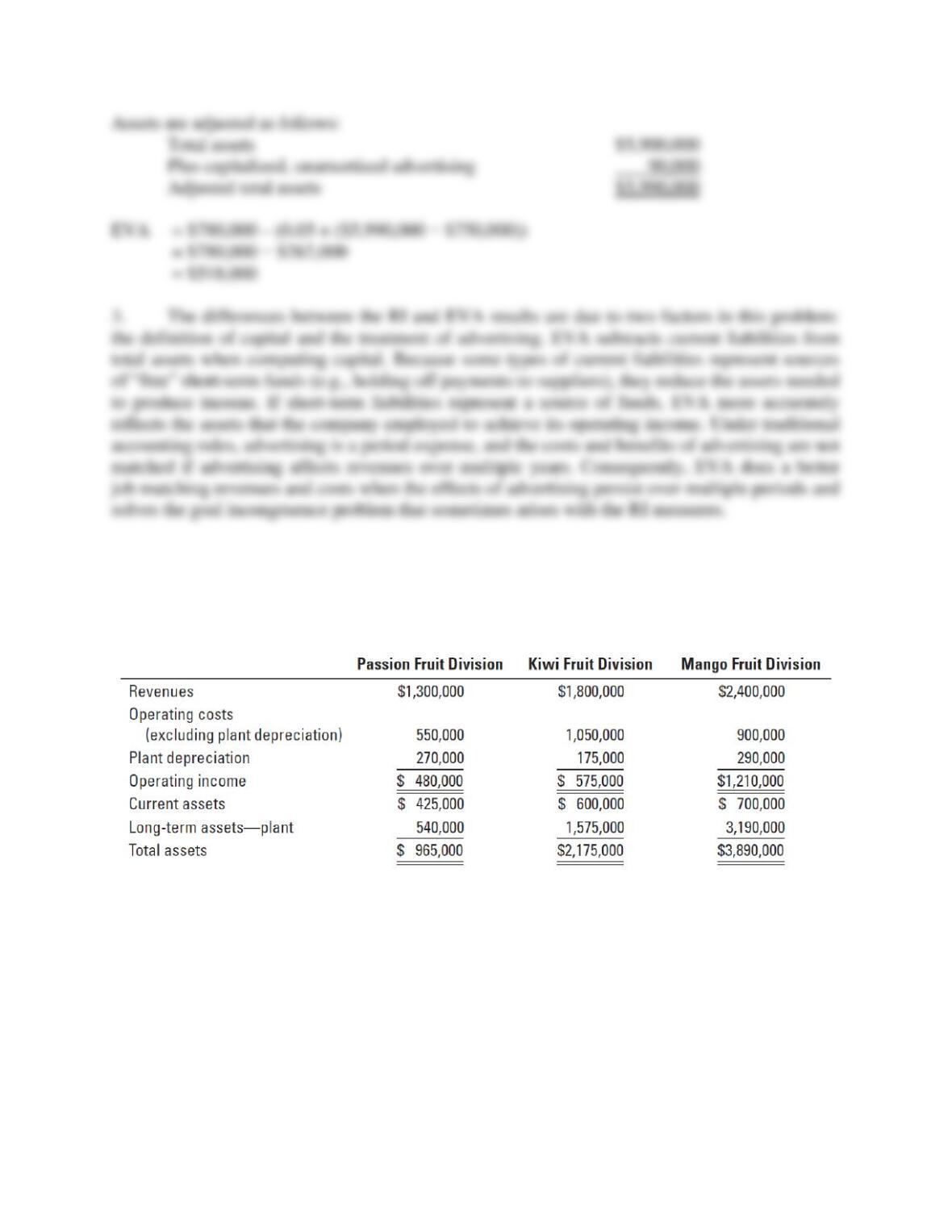
1. Calculate residual income, assuming Doorharmony defines investment as total assets.
2. Calculate EVA for the year. Adjust both the assets and operating income for advertising
assuming that for the purposes of economic value added the advertising is capitalized and
amortized on a straight-line basis over 4 years.
3. Discuss the difference between the outcomes of requirements 1 and 2 and which measure is
preferred.
SOLUTION
23-23
23-28 (40–50 min.) ROI performance measures based on historical cost and current cost.
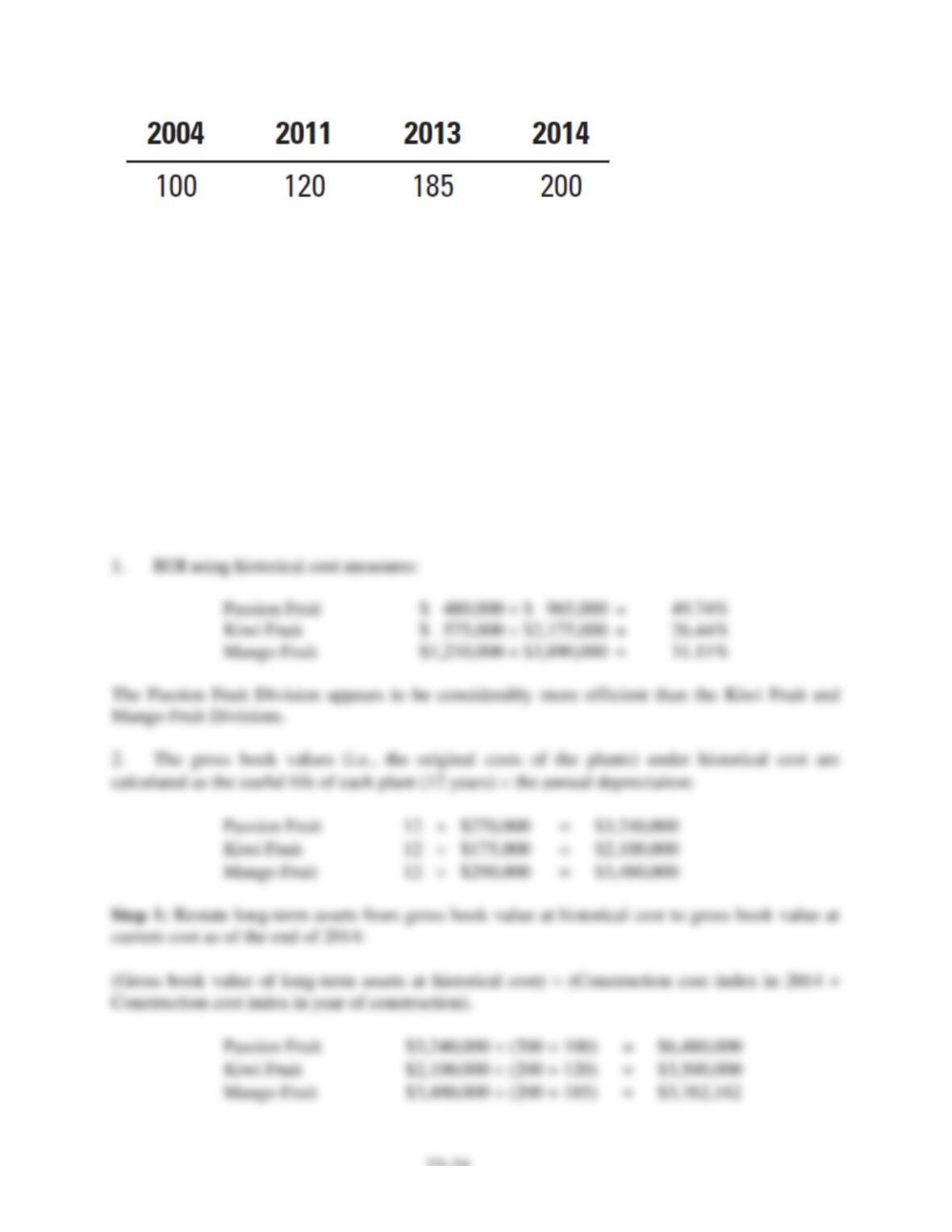
Nature’s Juice Corporation operates three divisions that process and bottle natural fruit juices.
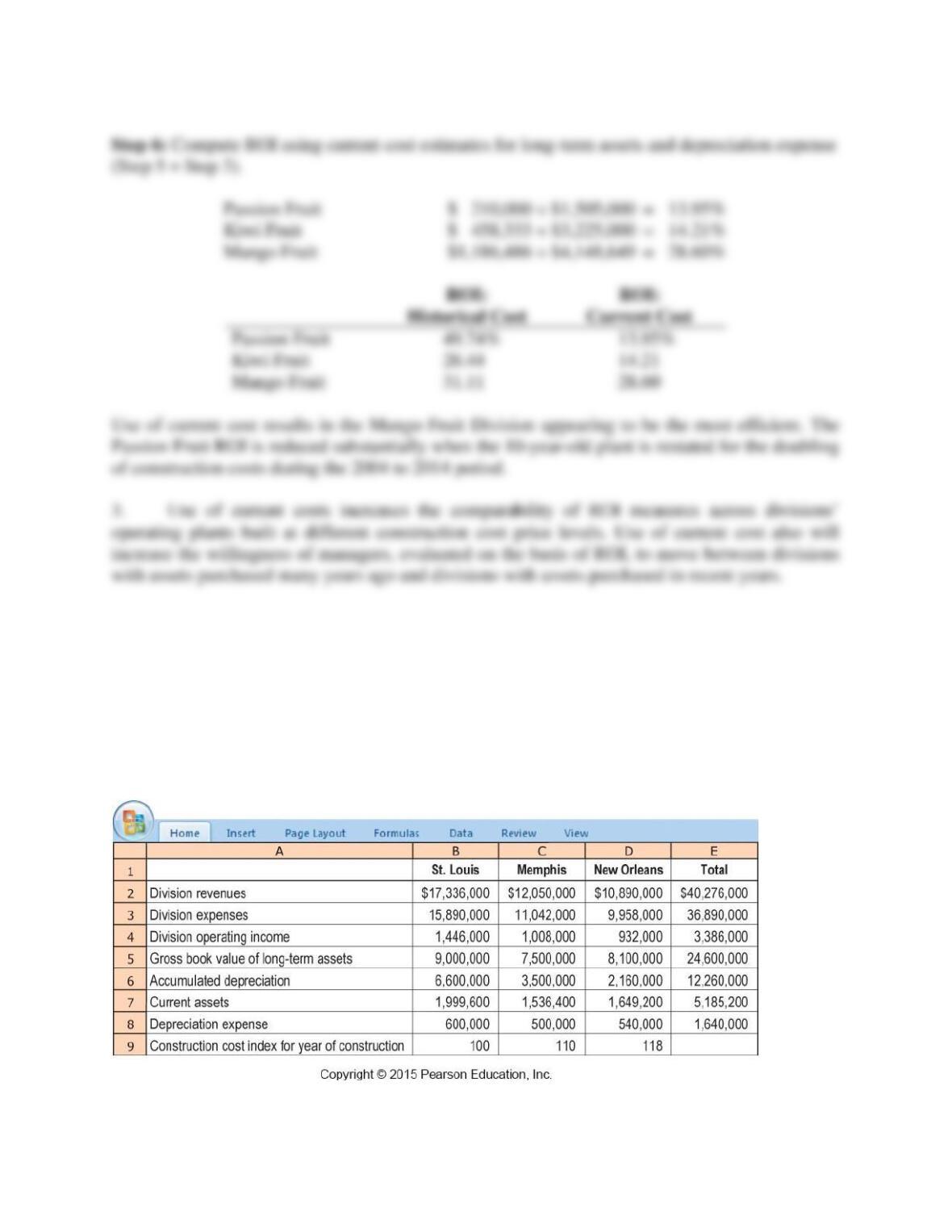
The historical-cost accounting system reports the following information for 2014:
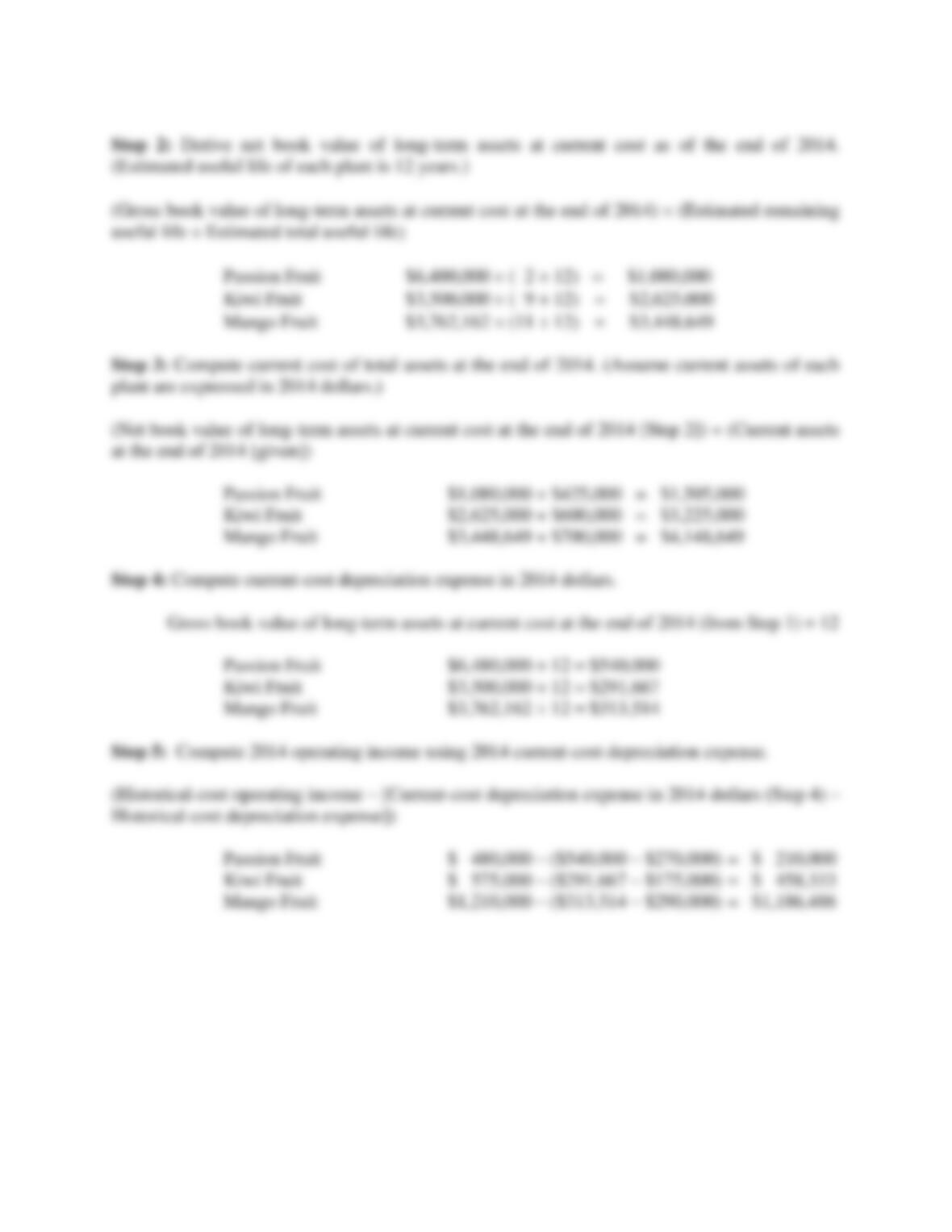
Nature’s Juice estimates the useful life of each plant to be 12 years, with no terminal disposal
value. The straight-line depreciation method is used. At the end of 2014, the passion fruit plant is
10 years old, the kiwi fruit plant is 3 years old, and the mango fruit plant is 1 year old. An index
of construction costs over the 10-year period that Nature’s Juice has been operating (2004 year–
end =100) is as follows:
23-24
Given the high turnover of current assets, management believes that the historical-cost and
current-cost measures of current assets are approximately the same.
Required:
1. Compute the ROI ratio (operating income to total assets) of each division using historical-
cost measures. Comment on the results.
2. Use the approach in Exhibit 23-2 (page 885) to compute the ROI of each division,
incorporating current-cost estimates as of 2014 for depreciation expense and long-term
assets. Comment on the results.
3. What advantages might arise from using current-cost asset measures as compared with
historical-cost measures for evaluating the performance of the managers of the three
divisions?
SOLUTION
23-25
23-26
23-29 (40–50 min.) ROI, measurement alternatives for performance measures.
Appleton’s owns and operates a variety of casual dining restaurants in three cities: St. Louis,
Memphis, and New Orleans. Each geographic market is considered a separate division. The St.
Louis division includes four restaurants, each built in early 2004. The Memphis division consists
of three restaurants, each built in January 2008. The New Orleans division is the newest,
consisting of three restaurants built 4 years ago. Division managers at Appleton’s are evaluated
on the basis of ROI. The following information refers to the three divisions at the end of 2014:
23-27
Required:
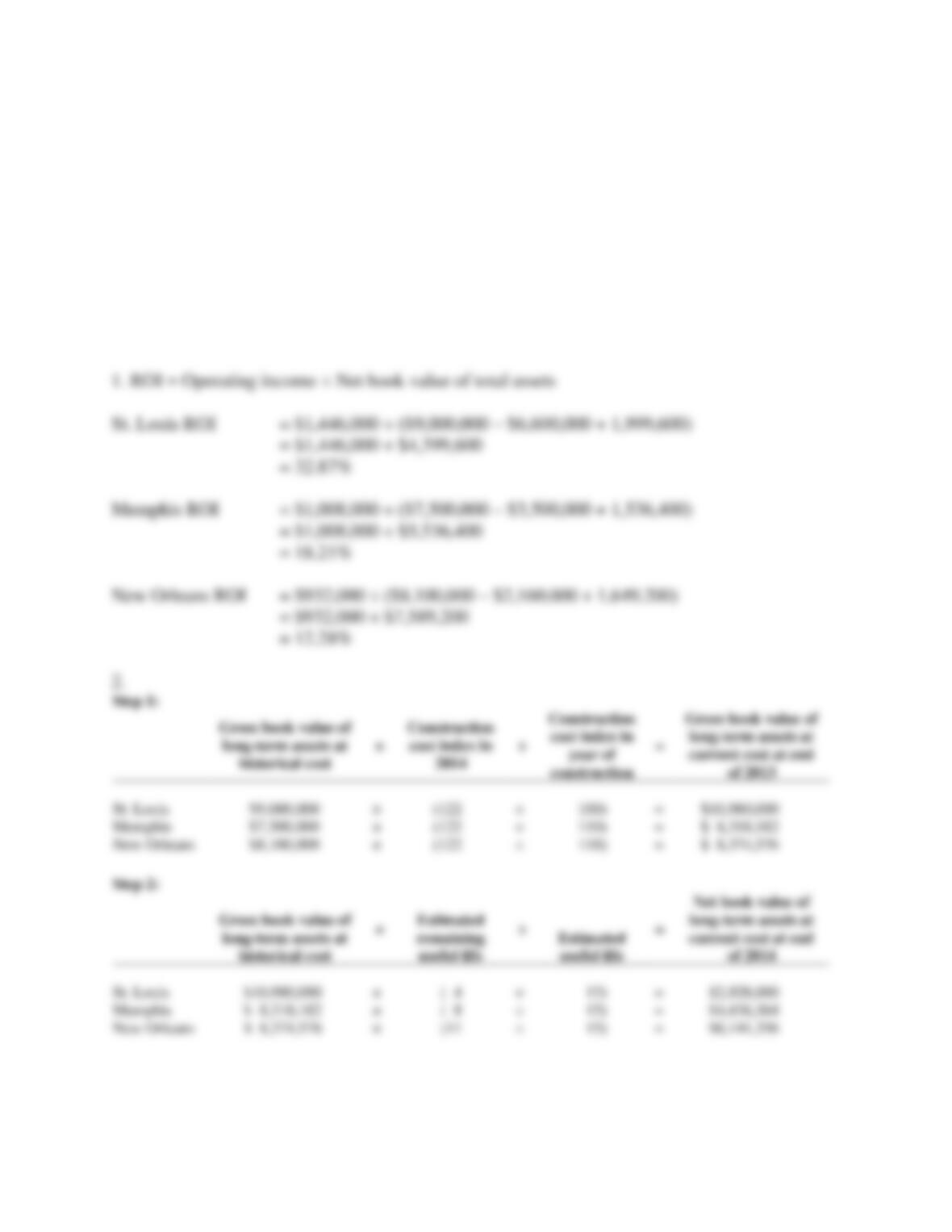
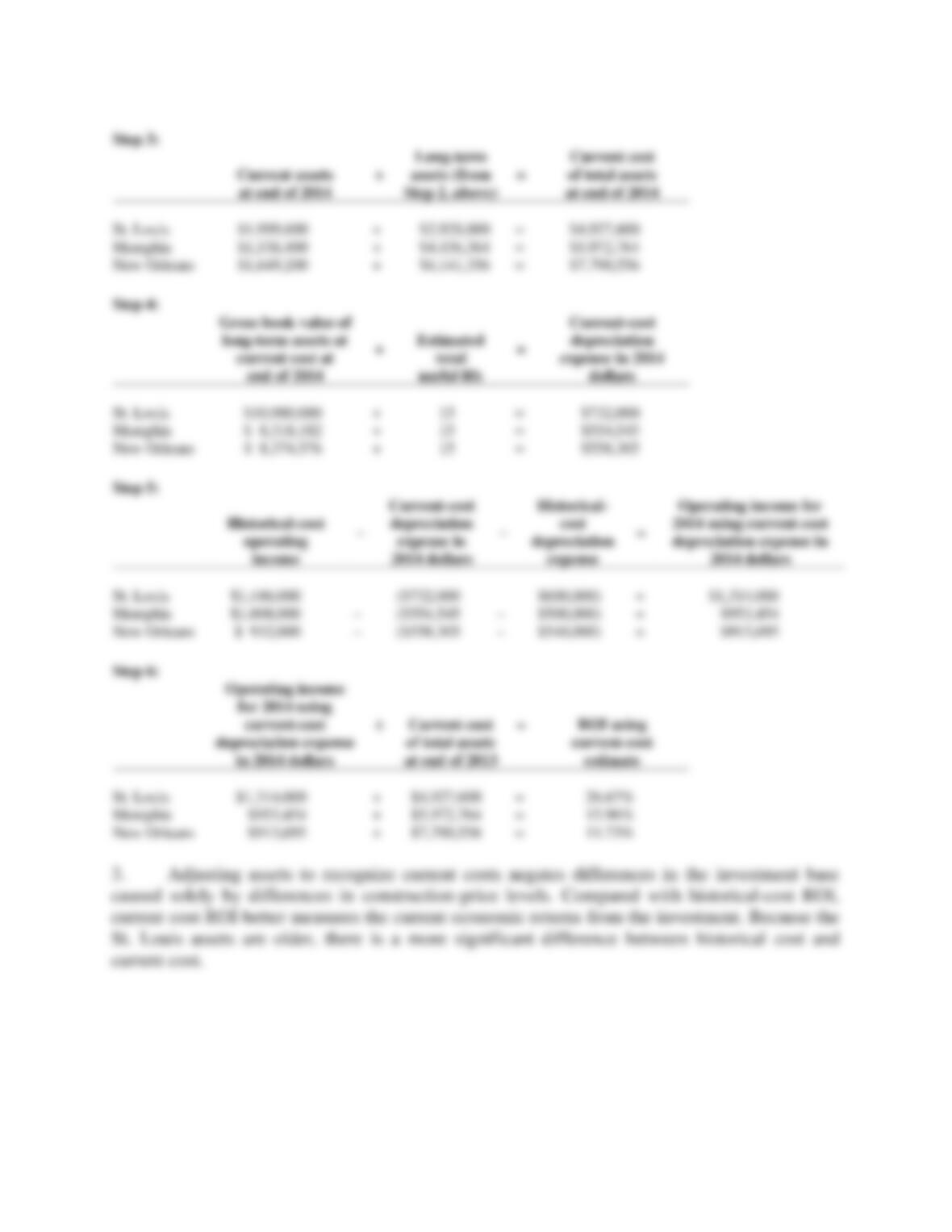
1. Calculate ROI for each division using net book value of total assets.
2. Using the technique in Exhibit 23-2, compute ROI using current-cost estimates for long-term
assets and depreciation expense. The construction cost index for 2014 is 122. Estimated
useful life of operational assets is 15 years.
3. How does the choice of long-term asset valuation affect management decisions regarding
new capital investments? Why might this choice be more significant to the St. Louis division
manager than to the New Orleans division manager?
SOLUTION
23-28
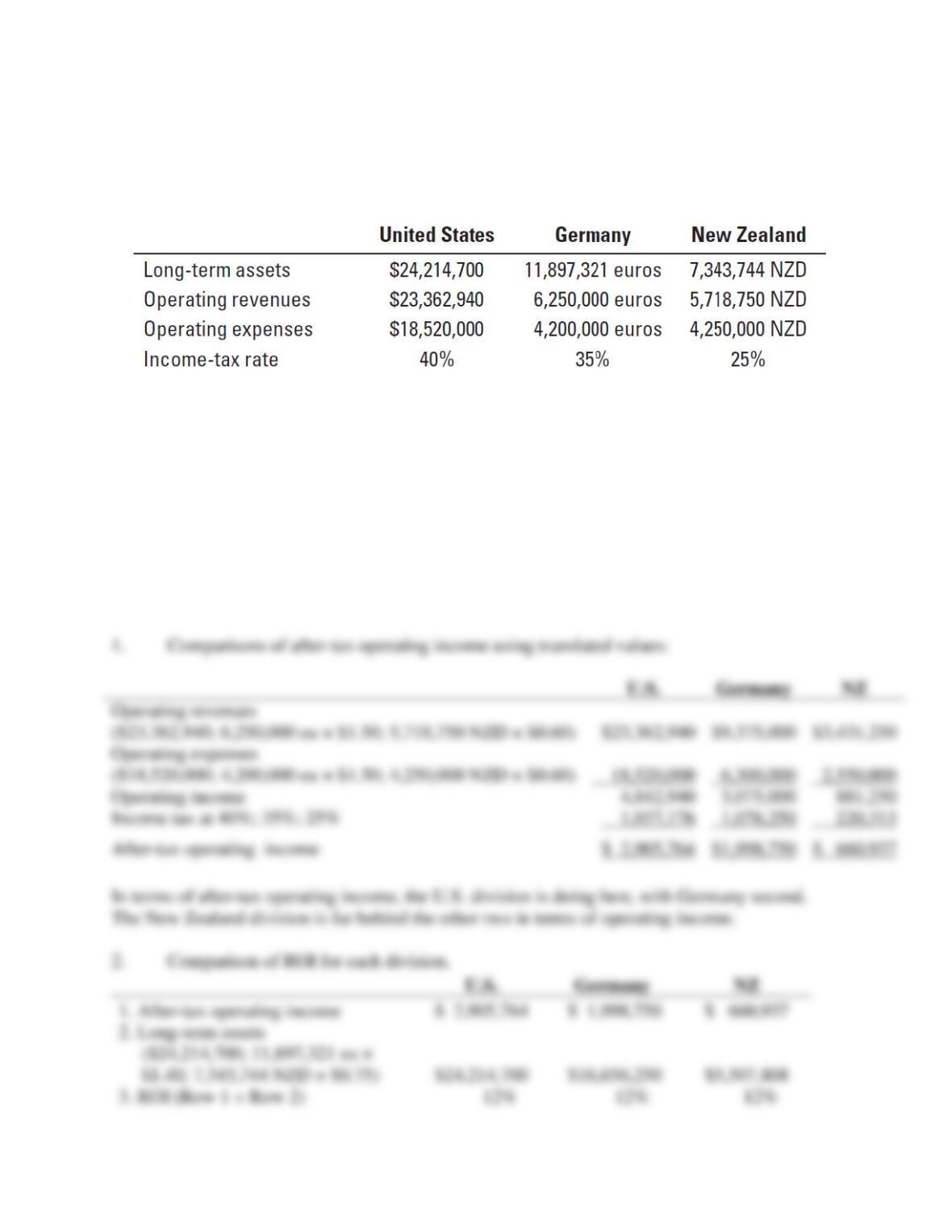
23-30 (30 min.) Multinational firms, differing risk, comparison of profit, ROI, and RI.
Zeiss Multinational, Inc., has divisions in the United States, Germany, and New Zealand. The
U.S. division is the oldest and most established of the three and has a cost of capital of 6.5%. The
German division was started 3 years ago when the exchange rate for the euro was 1 euro = $1.40.
23-29
The German division is a large and powerful division of Zeiss, Inc., with a cost of capital of
10%. The New Zealand division was started this year, when the exchange rate was 1 New
Zealand Dollar (NZD) = $0.75. Its cost of capital is 13%. Average exchange rates for the current
year are 1 euro = $1.50 and 1 NZD = $0.60. Other information for the three divisions includes:
Required:
1. Translate the German and New Zealand information into dollars to make the divisions
comparable. Find the after-tax operating income for each division and compare the profits.
2. Calculate ROI using after-tax operating income. Compare among divisions.
3. Use after-tax operating income and the individual cost of capital of each division to calculate
residual income and compare.
4. Redo requirement 2 using pretax operating income instead of net income. Why is there a big
difference, and what does it mean for performance evaluation?
SOLUTION
23-30
23-31 (30 min.) ROI, RI, DuPont method, investment decisions, balanced scorecard.
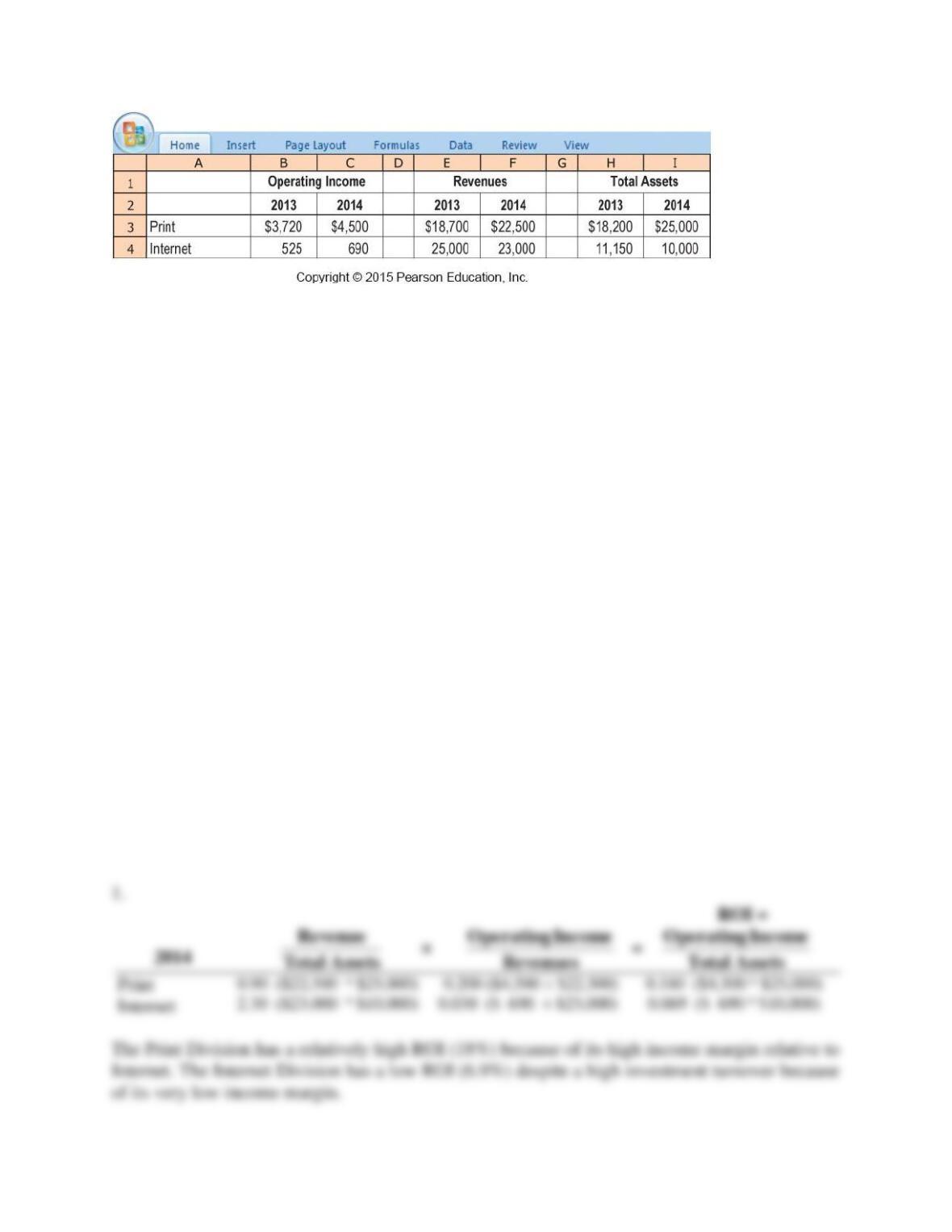
News Report Group has two major divisions: Print and Internet. Summary financial data (in
millions) for 2013 and 2014 are as follows:
23-31
The two division managers’ annual bonuses are based on division ROI (defined as operating
income divided by total assets). If a division reports an increase in ROI from the previous year,
its management is automatically eligible for a bonus; however, the management of a division
reporting a decline in ROI has to present an explanation to the News Report Group board and is
unlikely to get any bonus.
Carol Mays, manager of the Print division, is considering a proposal to invest $2,580 million
in a new computerized news reporting and printing system. It is estimated that the new system’s
state-of-the-art graphics and ability to quickly incorporate late-breaking news into papers will
increase 2015 division operating income by $360 million. News Report Group uses a 10%
required rate of return on investment for each division.
Required:
1. Use the DuPont method of profitability analysis to explain differences in 2014 ROIs between
the two divisions. Use 2014 total assets as the investment base.
2. Why might Mays be less than enthusiastic about accepting the investment proposal for the
new system despite her belief in the benefits of the new technology?
3. John Mendenhall, CEO of News Report Group, is considering a proposal to base division
executive compensation on division RI.
a. Compute the 2014 RI of each division.
b. Would adoption of an RI measure reduce Mays’ reluctance to adopt the new
computerized system investment proposal?
4. Mendenhall is concerned that the focus on annual ROI could have an adverse long-run effect
on News Report Group’s customers. What other measurements, if any, do you recommend
that Mendenhall use? Explain briefly.
SOLUTION
23-32
23-33
23-32 (20–30 min.) Division manager’s compensation, levers of control.
John Mendenhall seeks your advice on revising the existing bonus plan for division managers of
News Report Group. Assume division managers do not like bearing risk. Mendenhall is
considering three ideas:
▪ Make each division manager’s compensation depend on division RI.
▪ Make each division manager’s compensation depend on company-wide RI.
▪ Use benchmarking and compensate division managers on the basis of their division’s RI
minus the RI of the other division.
Required:
1. Evaluate the three ideas Mendenhall has put forth using performance-evaluation concepts
described in this chapter. Indicate the positive and negative features of each proposal.
2. Mendenhall is concerned that the pressure for short-run performance may cause managers to
cut corners. What systems might Mendenhall introduce to avoid this problem? Explain
briefly.
3. Mendenhall is also concerned that the pressure for short-run performance might cause
managers to ignore emerging threats and opportunities. What system might Mendenhall
introduce to prevent this problem? Explain briefly.
SOLUTION
23-34