EVALUATING VARIANCES FROM STANDARD COSTS
1. Standards are performance goals. Manufacturing companies normally use standard cost for
each of the three following product costs:
a. Direct materials
b. Direct labo
r
c. Factory overhead
Standard cost systems enable management to determine the following:
a. How much a product should cost (standard cost)
b. How much it does cost (actual cost)
4. The offsetting variances might have been caused by the purchase of low-priced, inferior
materials. The low price of the materials would generate a favorable materials price variance,
while the inferior quality of the materials would cause abnormal spoilage and waste, thus
generating an unfavorable materials quantity variance.
5. a. The two variances in direct labor costs are:
(1) Direct labor rate
(2) Direct labor time
b. The direct labor cost variance is usually under the control of the production supervisor.
7. Standards can be very appropriate in repetitive service operations. Fast-food restaurants can
use standards for evaluating the productivity of the counter and food preparation employees.
In addition, standards could be used to plan staffing patterns around various times of the day
(e.g., increasing staff during the lunch hour).
CHAPTER 23
DISCUSSION QUESTIONS
CHAPTER 23 Evaluating Variances from Standard Costs
DISCUSSION QUESTIONS (Continued)
8. a. The variable factory overhead controllable variance results from incurring a total amount
of variable factory overhead cost greater or less than the amount budgeted for the level of
operations achieved. The fixed factory overhead volume variance results from operating
at a level above or below 100% of normal capacity.
b. The factory overhead cost variance report presents the standard factory overhead cost
variance data (i.e., the volume and the controllable variance).
CHAPTER 23 Evaluating Variances from Standard Costs
PE 23-1A
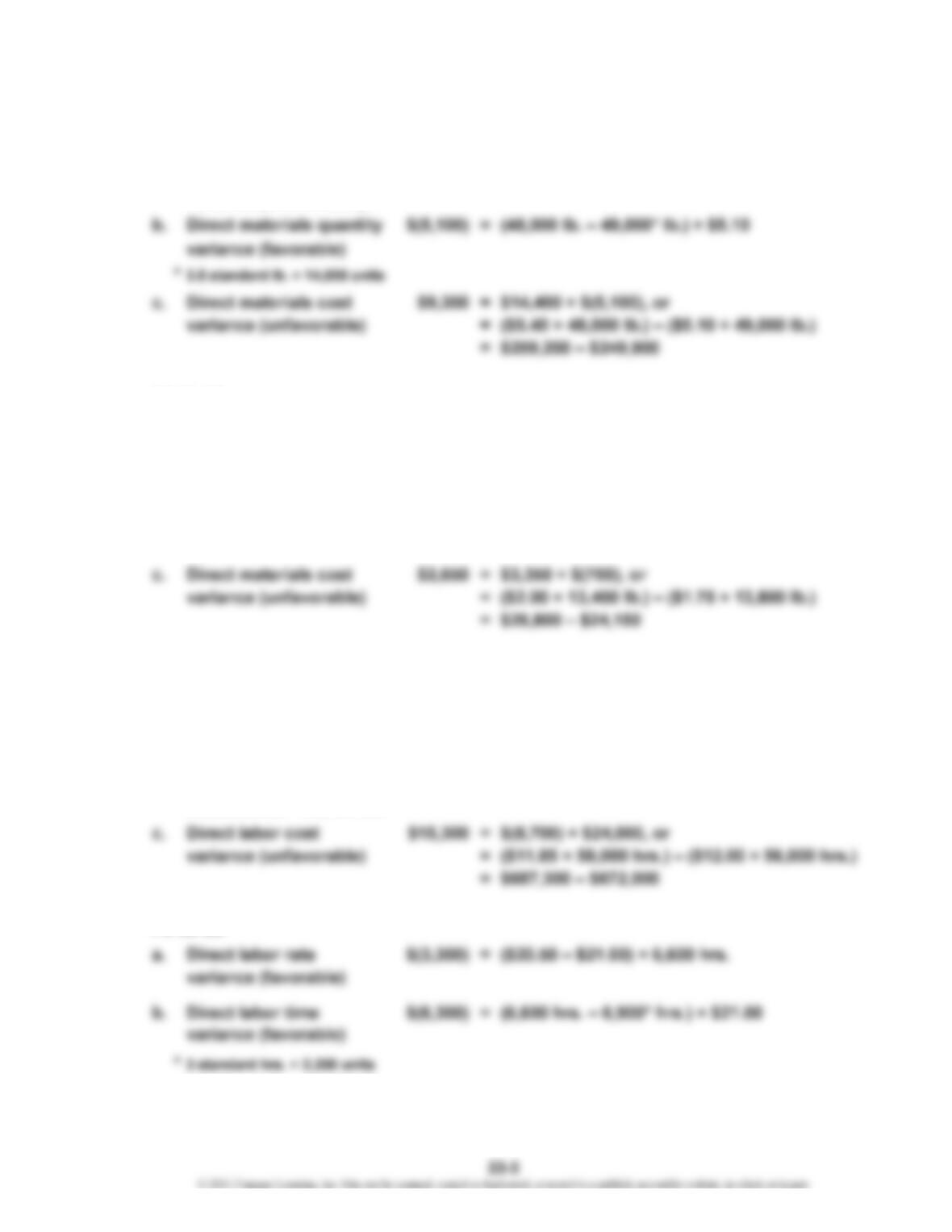
a. Direct materials price $14,400 = ($5.40 – $5.10) × 48,000 lb.
variance (unfavorable)
PE 23-1B
a. Direct materials price $3,350 = ($2.00 – $1.75) × 13,400 lb.
variance (unfavorable)
b. Direct materials quantity $(700) = (13,400 lb. – 13,800* lb.) × $1.75
variance (favorable)
*6 standard lb. × 2,300 units
PE 23-2A
a. Direct labor rate $(8,700) = ($11.85 – $12.00) × 58,000 hrs.
variance (favorable)
b. Direct labor time $24,000 = (58,000 hrs. – 56,000* hrs.) × $12.00
variance (unfavorable)
*4 standard hrs. × 14,000 units
PE 23-2B
c. Direct labor cost $(9,600) = $(3,300) + $(6,300), or
variance (favorable) = ($20.50 × 6,600 hrs.) – ($21.00 × 6,900 hrs.)
= $135,300 – $144,900
PRACTICE EXERCISES
CHAPTER 23 Evaluating Variances from Standard Costs
PE 23-3B
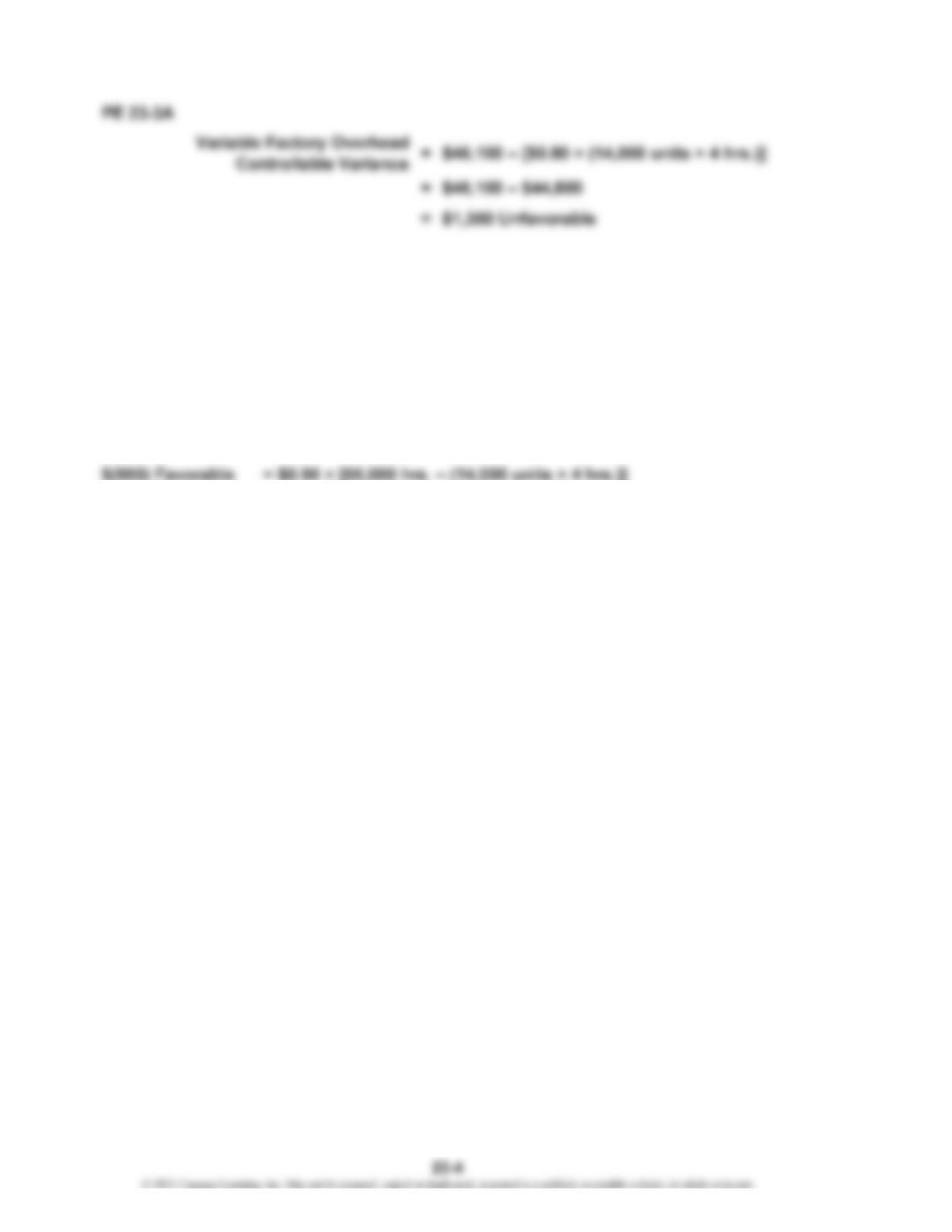
= $11,905 – $13,110
= $(1,205) Favorable
PE 23-4A
PE 23-4B
= $1.20 × [7,100 hrs. – (2,300 units × 3 hrs.)]
Variable Factory Overhead
Controllable Variance = $11,905 – [$1.90 × (2,300 units × 3 hrs.)]
$240 Unfavorable
CHAPTER 23 Evaluating Variances from Standard Costs
PE 23-5A
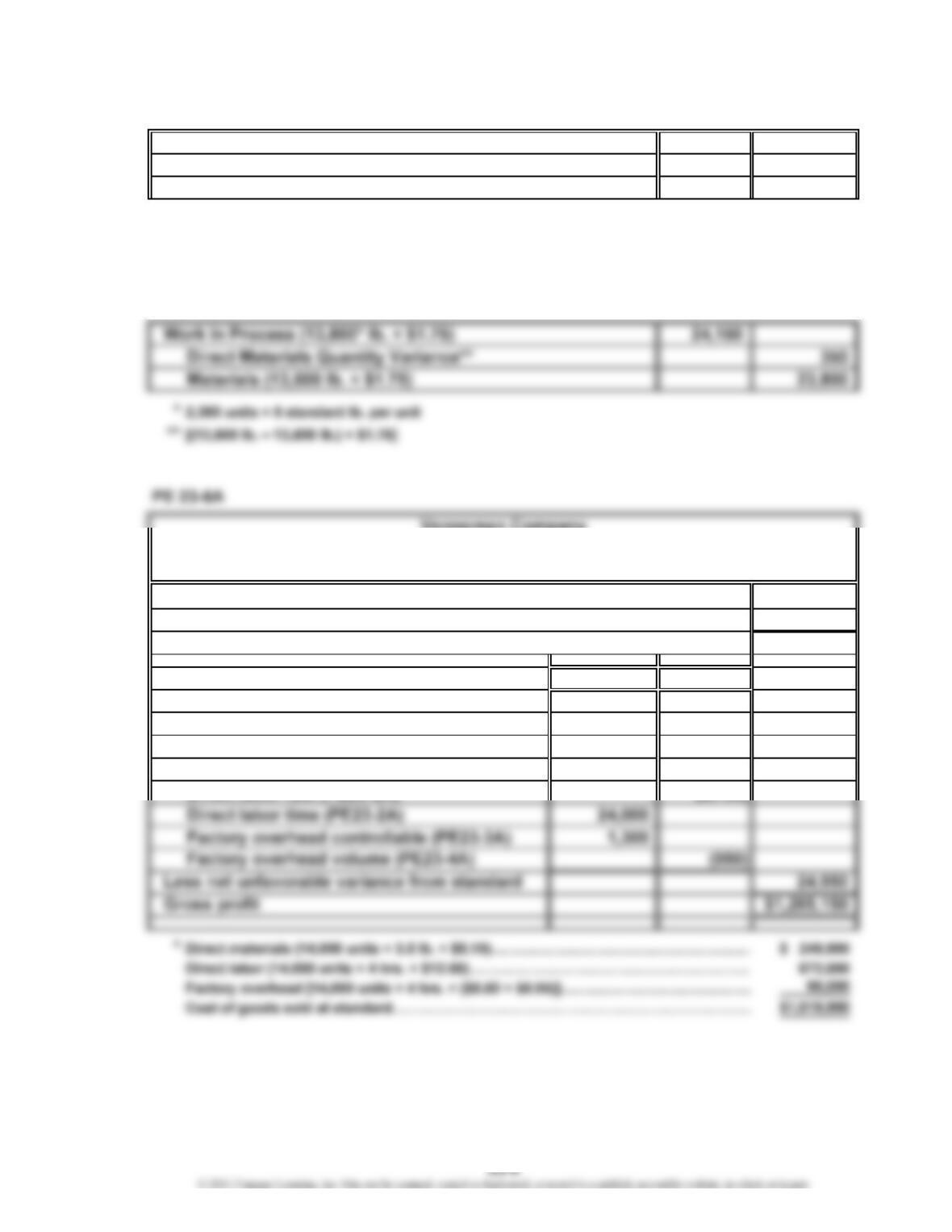
Work in Process (49,000* lb. × $5.10) 249,900
Direct Materials Quantity Variance** 2,550
Materials (48,500 lb. × $5.10) 247,350
*14,000 units × 3.5 standard lb. per unit
** [(48,500 lb. – 49,000 lb.) × $5.10]
PE 23-5B
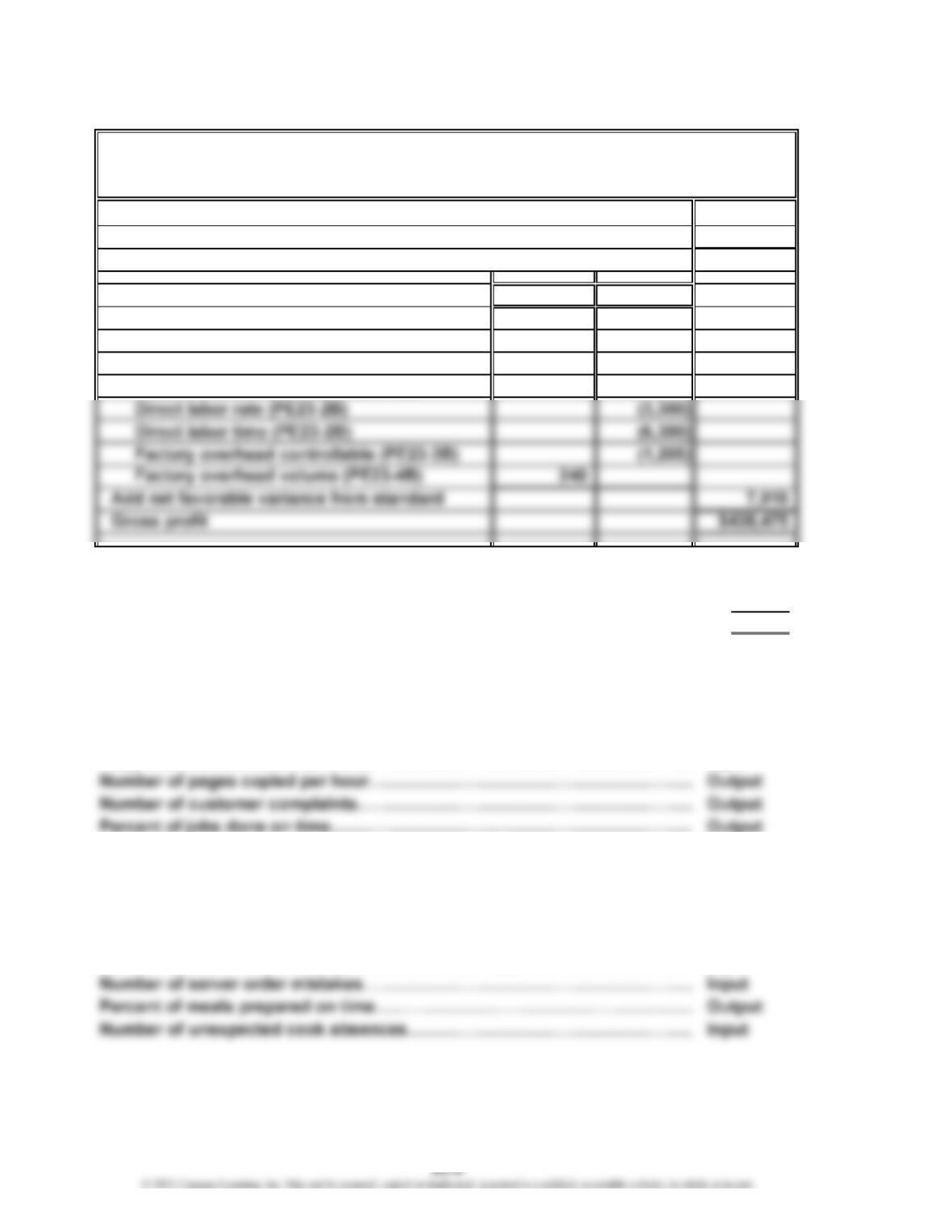
Sales (14,000 units × $165) $2,310,000
Cost of goods sold—at standard* 1,019,900
Gross profit—at standard $1,290,100
Unfavorable (Favorable)
Variance adjustments to gross profit
at standard:
Direct materials price (PE23-1A) $14,400
Direct materials quantity (PE23-1A) $(5,100)
Venneman Company
Income Statement Through Gross Profit
For the Month Ended March 31
CHAPTER 23 Evaluating Variances from Standard Costs
PE 23-6B
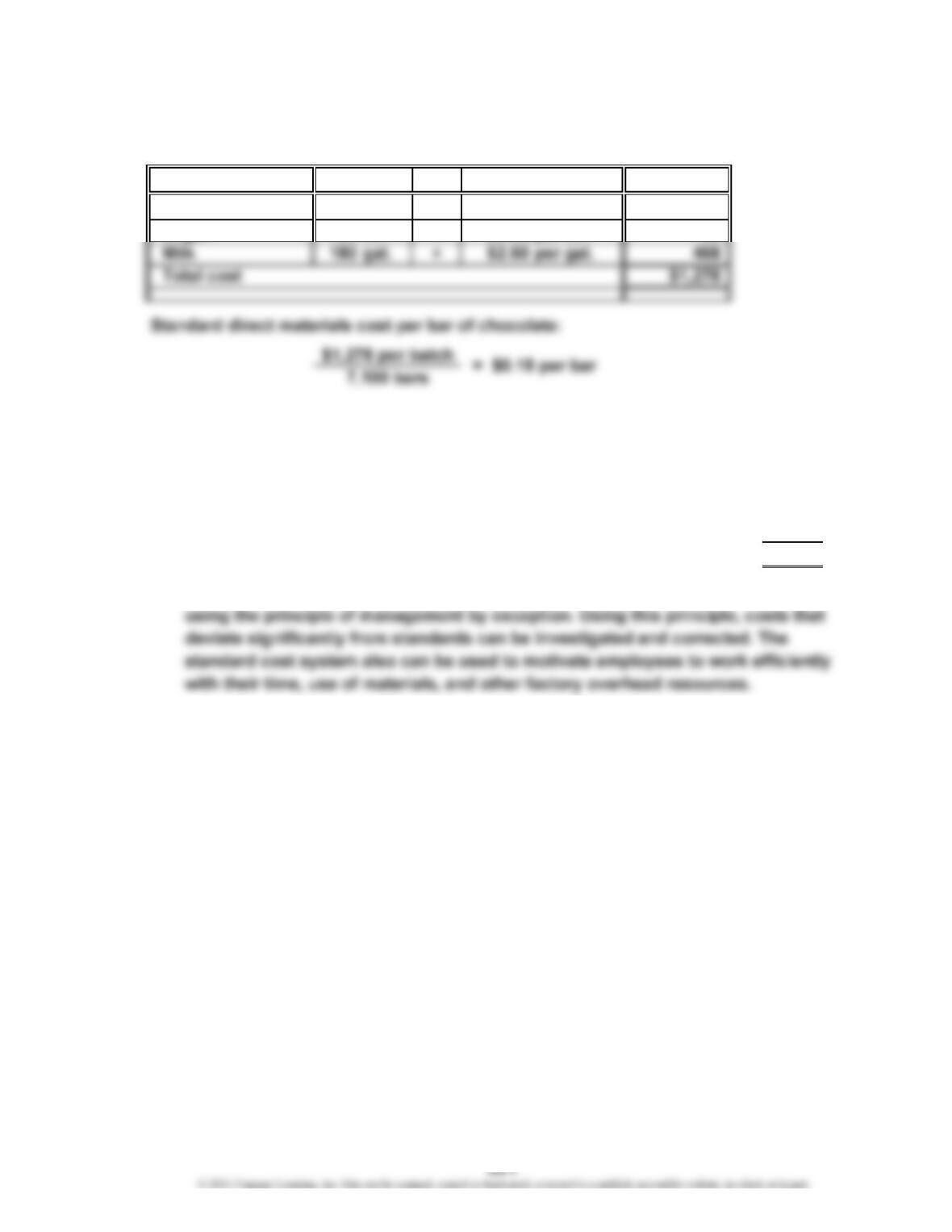
Sales (2,300 units × $270) $621,000
Cost of goods sold—at standard* 190,440
Gross profit—at standard $430,560
Unfavorable (Favorable)
Variance adjustment to gross profit
at standard:
Direct materials price (PE23-1B) $3,350
Direct materials quantity (PE23-1B) $ (700)
*Direct materials (2,300 units × 6 lb. × $1.75)……………………………………………………
…
$ 24,150
Direct labor (2,300 units × 3 hrs. × $21.00)……………………………………………………… 144,900
Factory overhead [2,300 units × 3 hrs. × ($1.90 + $1.20)]……………………………………
…
21,390
Cost of goods sold at standard…………………………………………………………………… $190,440
PE 23-7A
Number of employee errors…………………………………………………………
…
Input
Number of times paper supply runs out…………………………………………
…
Input
Copy machine downtime (broken)…………………………………………………
…
Input
PE 23-7B
Number of times ingredients are missing………………………………………… Input
Number of customer complaints…………………………………………………… Output
Number of hours kitchen equipment is down for repairs……………………… Input
…
Encinas Company
Income Statement Through Gross Profit
For the Month Ended July 31
CHAPTER 23 Evaluating Variances from Standard Costs
Ex. 23-1
× Total
600 lb. ×$ 750
120 lb. ×60
Ex. 23-2
a. Direct labor……………………………………
…
$19.00 ×3.5 hrs. $ 66.50
Direct materials………………………………
…
$16.50 ×27 bd. ft. 445.50
V
ariable factory overhead……………………
…
$3.90 ×3.5 hrs. 13.65
Fixed factory overhead………………………
…
$2.10 ×3.5 hrs. 7.35
Total cost per unit…………………………
…
$533.00
b. A standard cost system provides the company’s management a cost control tool
EXERCISES
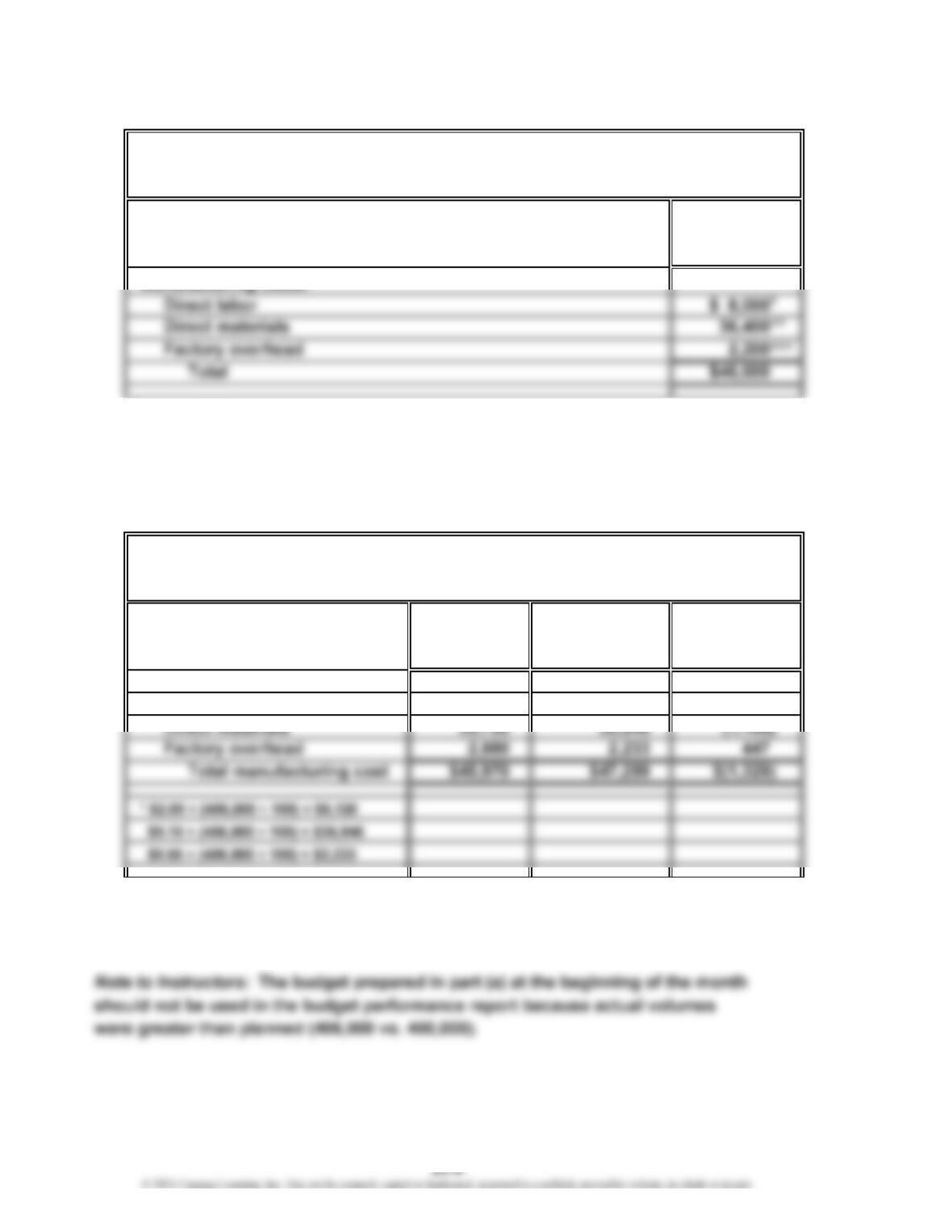
Ingredient
Cocoa
Sugar
Price
$1.25 per lb.
$0.50 per lb.
Quantity
CHAPTER 23 Evaluating Variances from Standard Costs
Ex. 23-3
a.
Standard Cost at
Planned Volume
(400,000 Bottles)
*
$2.00 × (400,000 ÷ 100) = $8,000
**
$9.10 × (400,000 ÷ 100) = $36,400
***
$0.55 × (400,000 ÷ 100) = $2,200
Note: The cost standards are expressed as “per 100 bottles.”
b.
Standard Cost at Cost Variance—
Actual Actual Volume (Favorable)
Costs (406,000 Bottles)* Unfavorable
Manufacturing costs:
Direct labor $ 7,540 $ 8,120 $ (580)
c. Genie in a Bottle Company’s actual costs were $1,329 less than budgeted. Favorable
direct labor and direct materials cost variances more than offset a small
unfavorable factory overhead cost variance.
Genie in a Bottle Company
Manufacturing Cost Budget
For the Month Ended July 31
For the Month Ended July 31
Genie in a Bottle Company
Manufacturing Costs—Budget Performance Report
CHAPTER 23 Evaluating Variances from Standard Costs
Ex. 23-4
a. Price variance:
= ($3.00 per lb. – $2.95 per lb.) × 438,000 lb.
= $21,900 Unfavorable
Total direct materials cost variance:
= $21,900 + $(23,600)
= $(1,700) Favorable
b. The direct materials price variance should normally be reported to the
Purchasing Department, which may or may not be able to control this variance.
If materials of the same quality were purchased from another supplier at a price
higher than the standard price, the variance was controllable. However, if the
variance resulted from a market-wide price increase, the variance was not
subject to control.
The direct materials quantity variance should be reported to the proper level of
Direct Materials Price Variance +
Direct Materials Quantity Variance
=
Direct Materials
Price Variance
Direct Materials
Cost Variance
(Actual Price – Standard Price) × Actual Quantity=
CHAPTER 23 Evaluating Variances from Standard Costs
Ex. 23-5
Price variance:
Direct Materials Price Variance = (Actual Price – Standard Price) × Actual Quantity
= ($21.75 per unit* – $23.00 per unit) × 960
= $(1,200) Favorable
*$20,880 ÷ 960 units = $21.75 per unit
Total direct materials cost variance:
= $(1,200) Favorable + $575 Unfavorable
= $(625) Favorable
Direct Materials Price Variance +
Direct Materials Quantity Variance
=Direct Materials Cost Variance
CHAPTER 23 Evaluating Variances from Standard Costs
Ex. 23-6
Product finished……………………………………………………
…
1,400 units
Standard finished product for direct materials used
(3,000 lb. ÷ 2 lb.)…………………………………………………
…
1,500
Deficiency of finished product for materials used………
…
(100) units
Standard cost for direct materials:
Quantity variance divided by deficiency of product
for materials used ($1,000 ÷ 100 units)……………………
…
$10.00 per unit
Alternative Solution for Standard Price:
=(Actual Price – Standard Price) × Actual Quantity
$1,500 U = ($5.50 – Standard Price) × 3,000
$1,500 U = $16,500 – (3,000 × Standard Price)
$15,000 = 3,000 × Standard Price
$5.00 = Standard Price
or:
Direct Materials Price Variance
…
CHAPTER 23 Evaluating Variances from Standard Costs
Ex. 23-7
a.
× =
Whole tomatoes… 4,000 lb. $ 0.60 per lb. $2,400
V
inegar…………… 260 gal. 2.25 per gal. 585
Corn syrup………
…
25 gal. 28.00 per gal. 700
Salt………………… 100 lb. 2.25 per lb. 225
$3,910
÷ Pounds per batch………………………………………
…
3,128 lb.
$ 1.25 per lb.
Standard
Quantity
Standard
Price
Standard
Cost per
Batch
CHAPTER 23 Evaluating Variances from Standard Costs
Ex. 23-8
a. Rate variance:
= ($49.50 – $51.00) × 6,330 hours
= $(9,495) Favorable
Total direct labor cost variance:
= $(9,495) Favorable + $4,590 Unfavorable
= $(4,905) Favorable
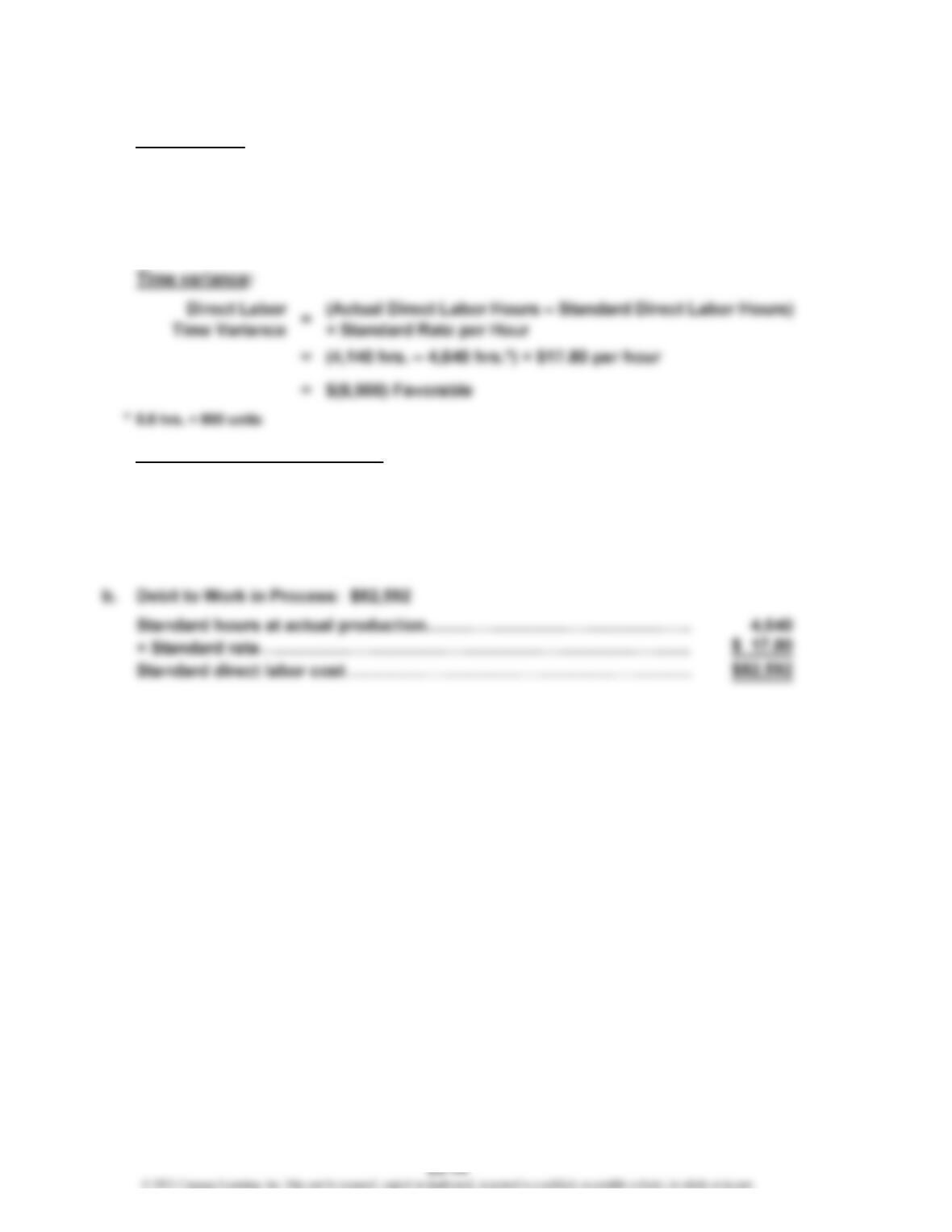
Direct Labor
Cost Variance =
Direct Labor
Rate Variance
(Actual Rate per Hour – Standard Rate per Hour)
× Actual Hours
=
Direct Labor Rate Variance + Direct Labor Time Variance
CHAPTER 23 Evaluating Variances from Standard Costs
Ex. 23-9
a. Rate variance:
= ($18.30 – $17.80) × 4,140 hrs.
= $2,070 Unfavorable
Total direct labor cost variance:
= $2,070 Unfavorable + $(8,900) Favorable
= $(6,830) Favorable
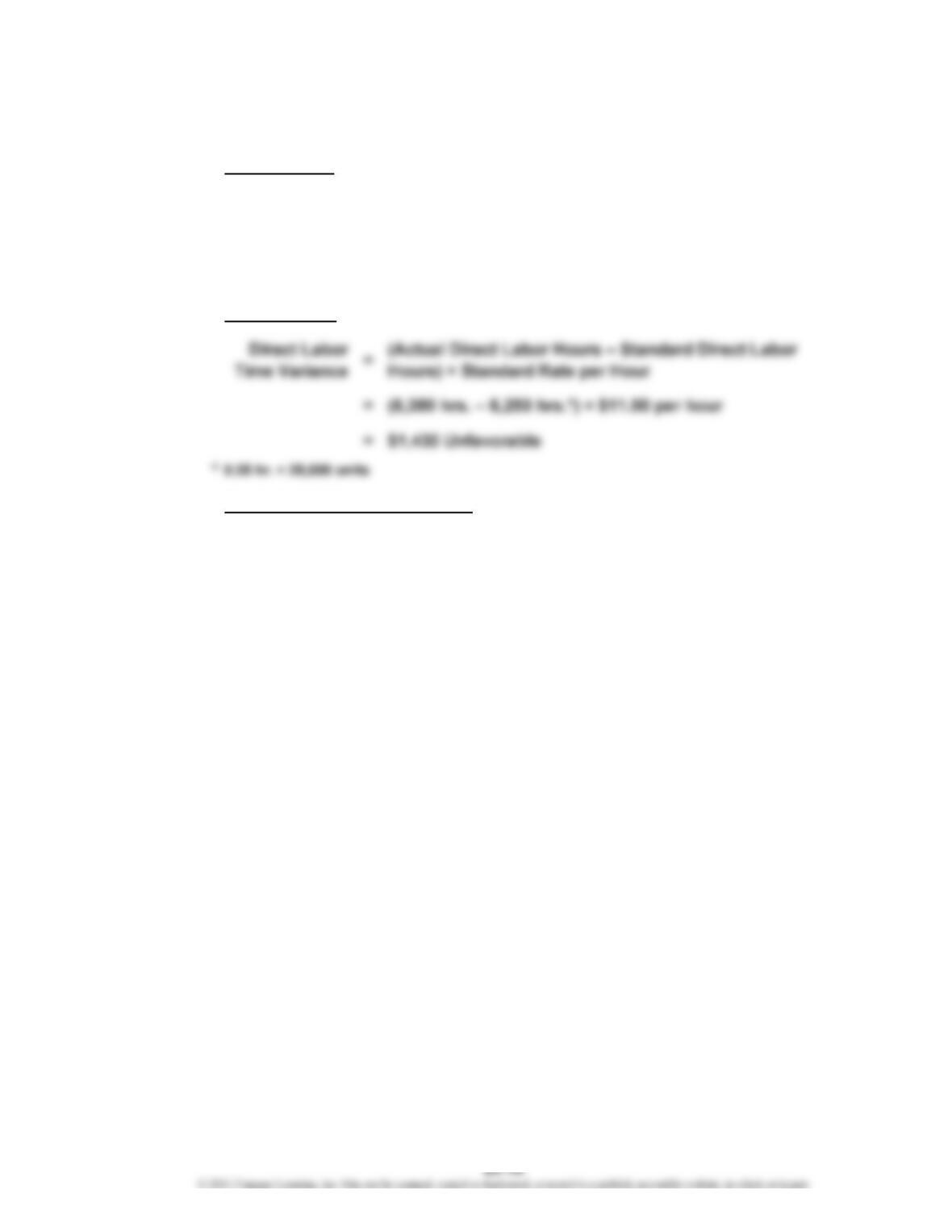
Direct Labor Rate Variance + Direct Labor Time Variance
Direct Labor
Cost Variance =
=
Direct Labor
Rate Variance
(Actual Rate per Hour – Standard Rate per Hour)
× Actual Hours
CHAPTER 23 Evaluating Variances from Standard Costs
Ex. 23-10
a. (1) Cutting Department
Rate variance:
= ($10.90 – $11.00) × 6,380 hours
= $(638) Favorable
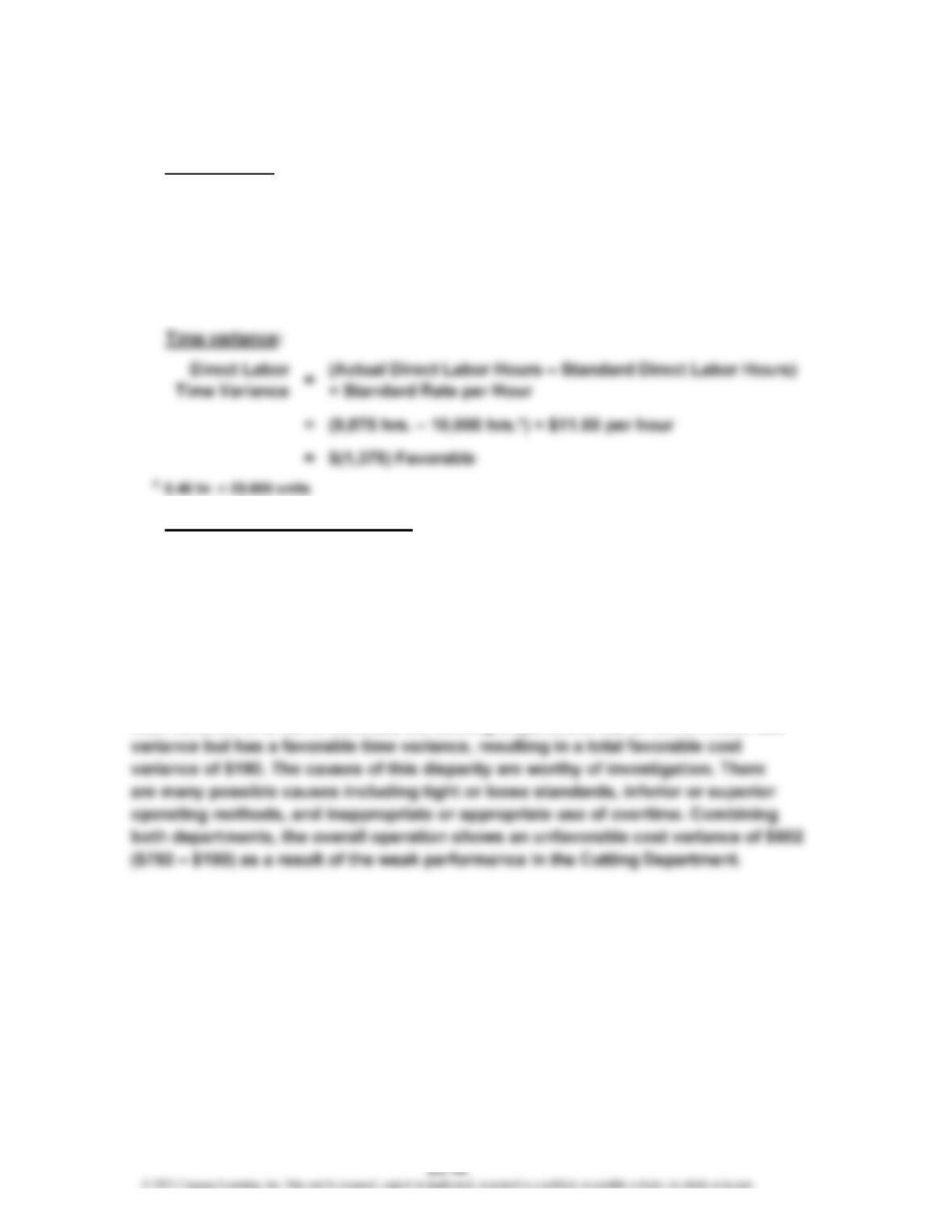
Time variance:
Total direct labor cost variance:
= $(638) Favorable + $1,430 Unfavorable
= $792 Unfavorable
(Actual Rate per Hour – Standard Rate per Hour)
× Actual Hours
Direct Labor
Rate Variance =
Direct Labor Rate Variance + Direct Labor Time Variance
Direct Labor
Cost Variance
=
CHAPTER 23 Evaluating Variances from Standard Costs
Ex. 23-10 (Concluded)
(2) Sewing Department
Rate variance:
= ($11.12 – $11.00) × 9,875 hours
= $1,185 Unfavorable
Total direct labor cost variance:
= $1,185 Unfavorable + $(1,375) Favorable
= $(190) Favorable
b. The two departments have opposite results. The Cutting Department has a
favorable rate and an unfavorable time variance, resulting in a total unfavorable
cost variance of $792. In contrast, the Sewing Department has an unfavorable rate
(Actual Rate per Hour – Standard Rate per Hour)
× Actual Hours
Direct Labor
Rate Variance =
Direct Labor
Cost Variance =
Direct Labor Rate Variance + Direct Labor Time Variance
CHAPTER 23 Evaluating Variances from Standard Costs
Ex. 23-11
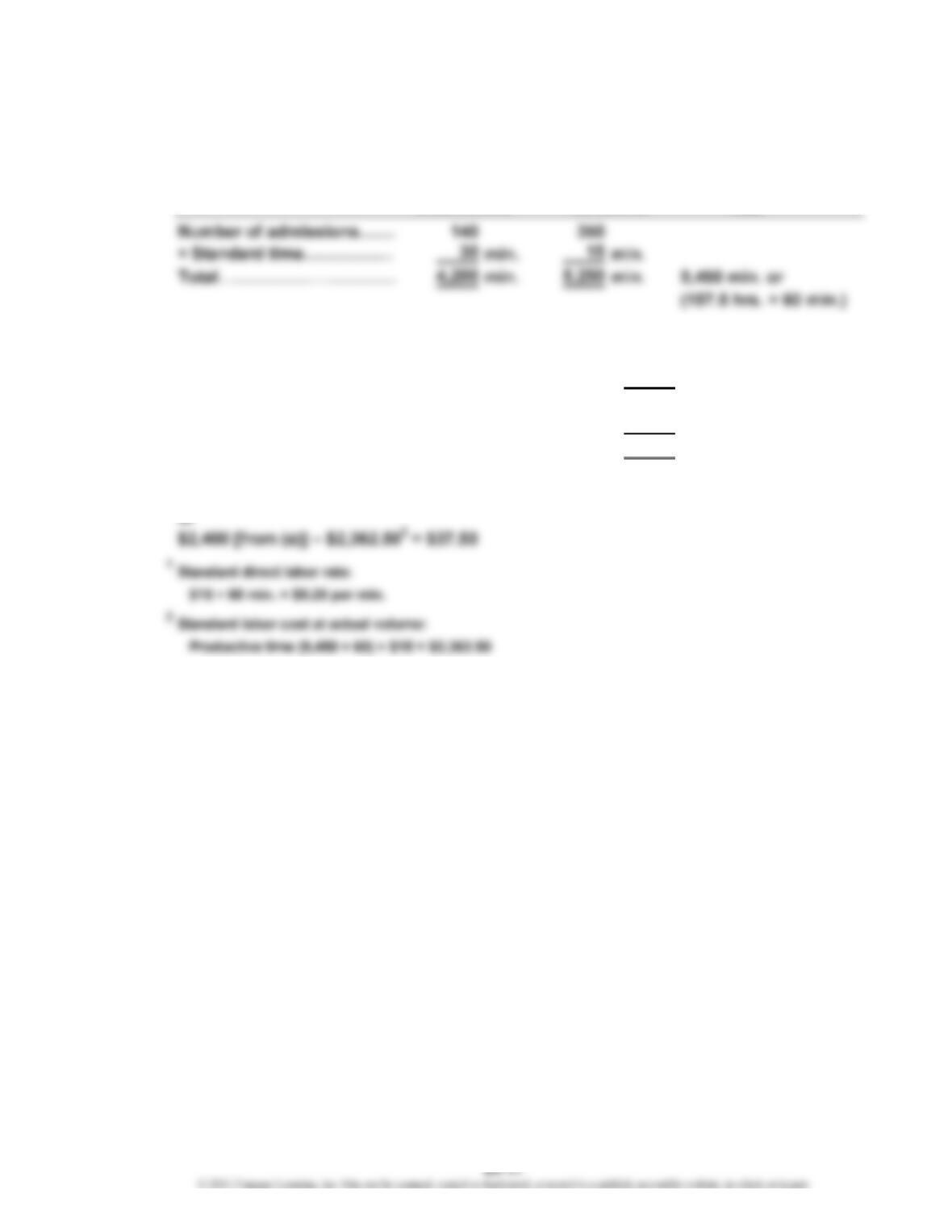
a. Actual weekly expenditure: 4 people × $15 per hour × 40 hrs. per week = $2,400
b. Standard time used for the volume of admissions:
Total
c. Actual productive minutes available
(4 employees × 40 hrs. × 60 min.)………………………
…
9,600 minutes
Less standard minutes used at actual volume………… 9,450 minutes
Time difference from standard……………………………
…
150 minutes
× Standard rate per minute
1
………………………………
…
$ 0.25
Direct labor time variance—unfavorable………………
…
$37.50
or
[(4 × 40 hrs.) – 157.5 hrs.] × $15 per hr. = $37.50
2
The Admissions Department consumed 150 minutes, or 2.5 hours, more than the
standard hours needed for the week’s admissions. This is equal to $37.50 at the
standard rate of $15 per hour.
Unscheduled Scheduled
CHAPTER 23 Evaluating Variances from Standard Costs
Ex. 23-12
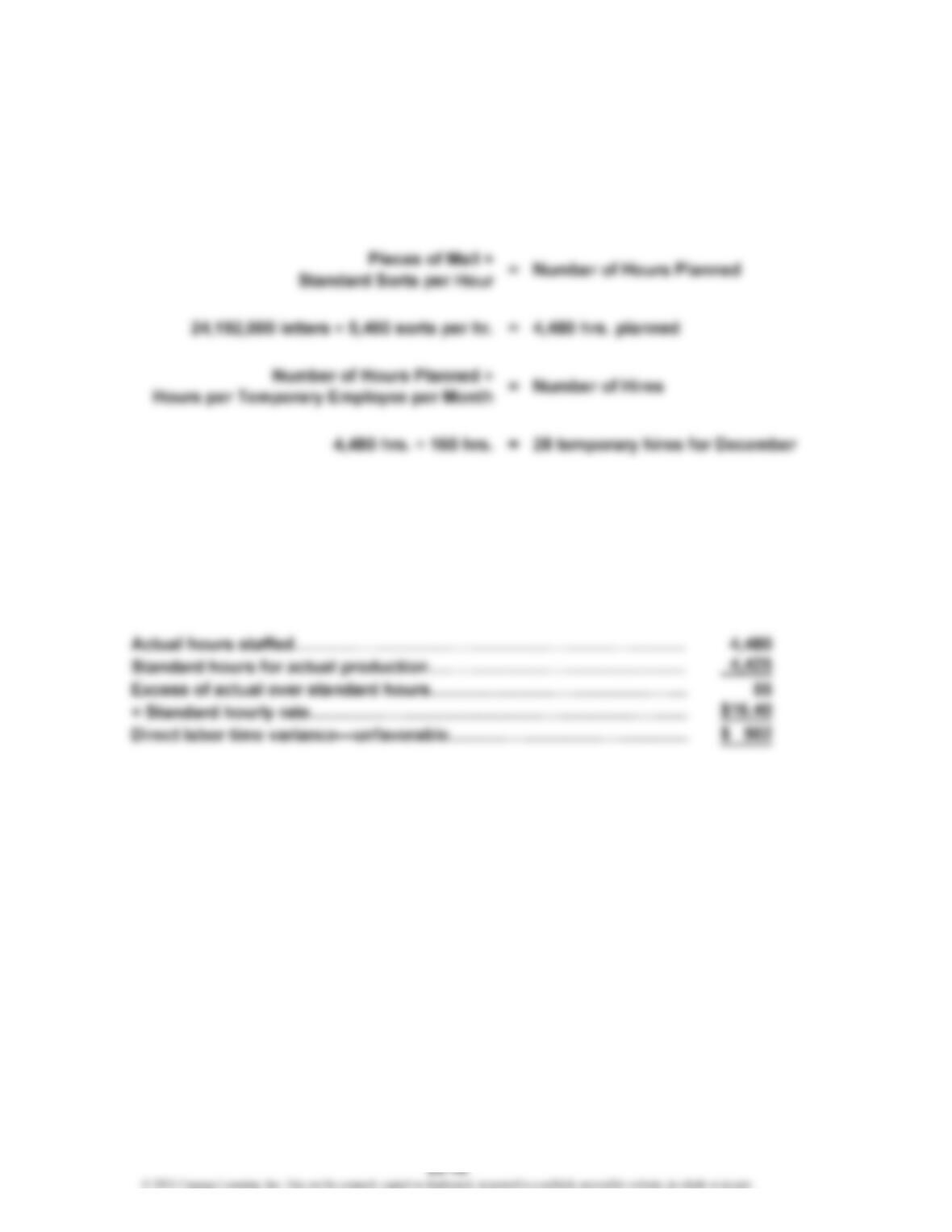
a.
b. Actual pieces sorted = 23,895,000
Standard Sorts per Hour
(per employee)
= 5,400 standard sorts per hr.
Standard Sorts per Minute ×
Standard Minutes per Hour =
90 sorts per min. × 60 min. per hr.
23,895,000 ÷ 5,400 standard sorts per hr. =
4,425 standard hrs.
for actual production
Actual Pieces of Mail Sorted ÷
Standard Sorts per Hour
Standard Number of Hours
for Actual Production
=
CHAPTER 23 Evaluating Variances from Standard Costs
Ex. 23-13
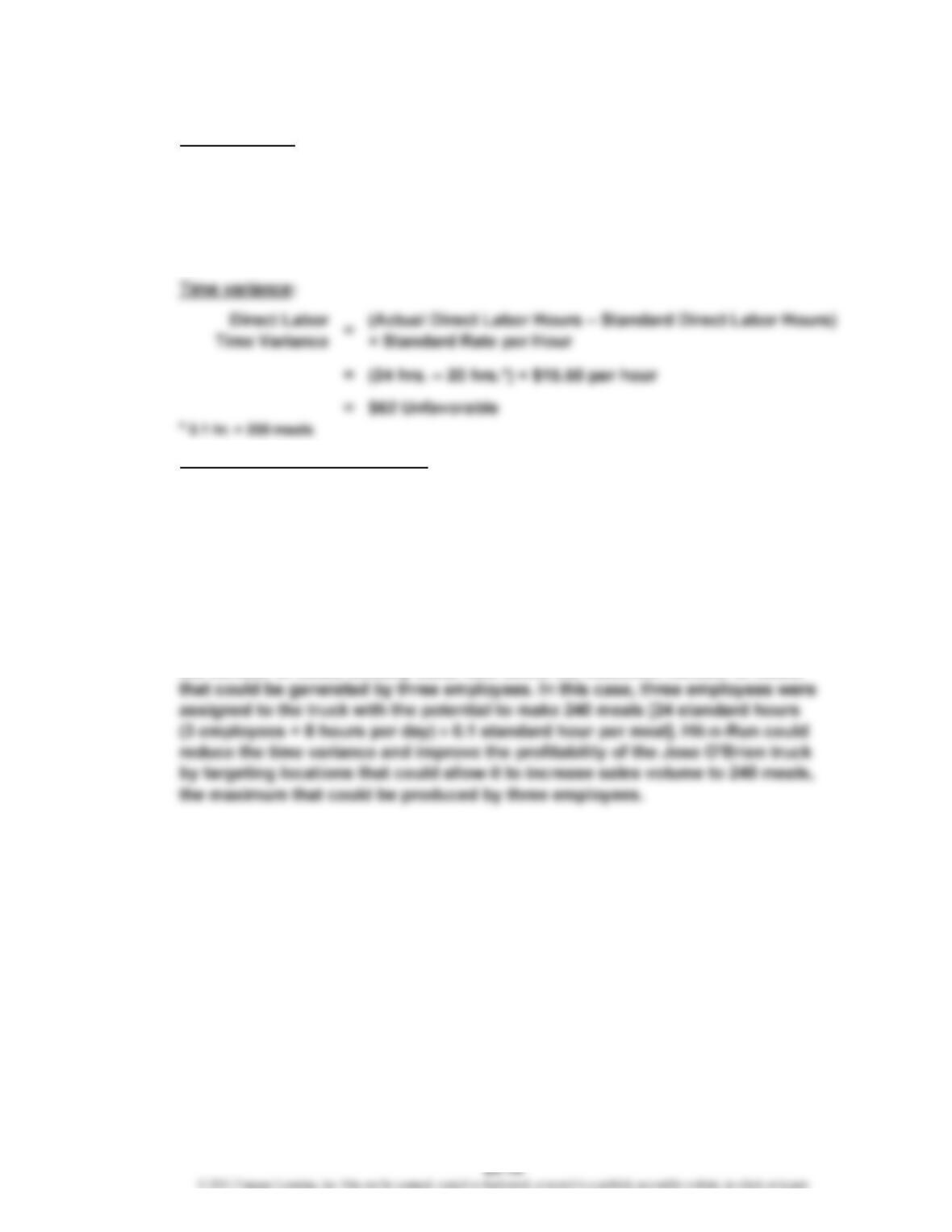
a. Rate variance:
= ($15.00 – $15.50) × 24 hours
= $(12) Favorable
Total direct labor cost variance:
= $(12) Favorable + $62 Unfavorable
= $50 Unfavorable
b. The mobile kitchen must be staffed with at least three employees to meet demand
(200 meals). Employees are unable to move to another truck once they are
assigned for the day. As a result, an unfavorable time variance will occur any time
Direct Labor
Rate Variance =(Actual Rate per Hour – Standard Rate per Hour)
× Actual Hours
Direct Labor
Cost Variance = Direct Labor Rate Variance + Direct Labor Time Variance
CHAPTER 23 Evaluating Variances from Standard Costs
Ex. 23-14
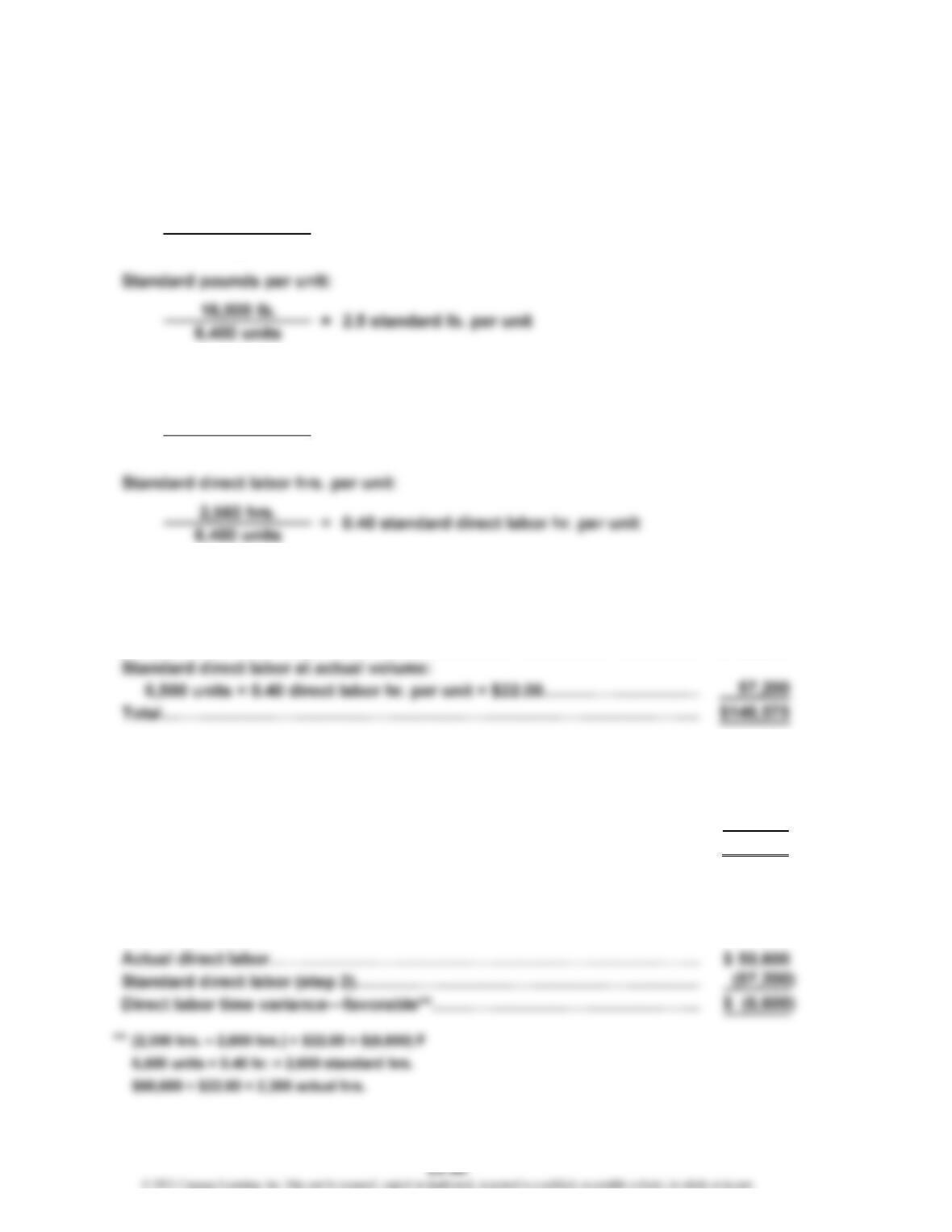
Step 1: Determine the standard direct materials and direct labor per unit.
Standard direct materials quantity per unit:
Direct materials lb. budgeted for June:
$88,000
$5.50 per lb.
Standard direct labor time per unit:
Direct labor hrs. budgeted for June:
$56,320
$22.00 per hr.
Step 2: Using the standard quantity and time rates in step 1, determine the
standard costs for the actual June production.
Standard direct materials at actual volume:
6,500 units × 2.5 lb. per unit × $5.50…………………………………………
…
$ 89,375
Step 3: Determine the direct materials quantity and direct labor time variances,
assuming no direct materials price or direct labor rate variances.
Actual direct materials used in production……………………………………
…
$ 82,060
Standard direct materials (step 2)………………………………………………
…
(89,375)
Direct materials quantity variance—favorable*………………………………
…
$ (7,315)
*(14,920 lbs. – 16,250 lbs.) × $5.50 = $(7,315) F
$82,060 ÷ $5.50 = 14,920 actual lbs.
$89,375 ÷ $5.50 = 16,250 standard lbs.
…
= 2,560 direct labor hrs.
= 16,000 lb.