chapter
23
Performance Evaluation
Using Variances from
Standard Costs
______________________________________________
OPENING COMMENTS
Standard cost systems set budgets for the materials, labor, and factory overhead used by a manufacturer to
produce its product. Deviations from these standards are reported as variances.
After studying the chapter, your students should be able to:
2. Describe and illustrate how standards are used in budgeting.
4. Compute and interpret factory overhead controllable and volume variances.
6. Describe and provide examples of nonfinancial performance measures.
STUDENT FAQS
• Do we need to know all these variance formulas? If so, is there a shortcut method we can use to
calculate the six formulas?
• What is a standard, and why can it vary from company to company?
• How often should a standard change?
78 Chapter 23 Performance Evaluation Using Variances from Standard Costs
• Why does management need to evaluate variances and make adjustments?
• Factory overhead is divided into fixed and variable costs. Why not call volume, fixed and
controllable, variable? It is easier to remember.
• Remind me again, what’s the difference between “applied” and “budgeted”?
• What do volume and controllable variances really mean?
OBJECTIVE 1
Describe the types of standards and how they are established.
KEY TERMS
Currently Attainable Standards Standard Cost Systems
Ideal Standards Standards
Standard Cost
SUGGESTED APPROACH
Manufacturing firms set standards for the amount and price of direct materials, direct labor, and overhead
consumed by their products. Standards establish a benchmark to be used in evaluating actual
performance. They allow management to recognize when costs are not in line with the company’s
projections and to take corrective action.
Ask your students to describe examples of standards in their daily lives. Examples include maximum and
minimum speed limits on highways or rating scales on video games (such as novice, expert, etc.)
This objective also discusses the motivational impact of standards and when they should be revised.
Stress the following points:
1. Unrealistically high standards frustrate employees and stifle motivation. As a result, most companies
do not use theoretical standards, which can be achieved only under perfect operating conditions.
3. Standards should be changed when they no longer reflect operating conditions. They should not be
revised simply because workers fail to meet standards.
CLASS DISCUSSION — Motivational Impact of Standards
Ask your students to discuss whether they view the grading standards of this course, or other college
courses, as ideal (theoretical standards) or normal (currently attainable standards). Ask them to comment
Chapter 23 Performance Evaluation Using Variances from Standard Costs 79
OBJECTIVE 2
Describe and illustrate how standards are used in budgeting.
KEY TERMS
Budget Performance Report Total Manufacturing Cost Variance
Cost Variances Unfavorable Cost Variance
Favorable Cost Variance
SUGGESTED APPROACH
Budgets exist to help companies plan, direct, and control operations. The budget performance report is a
tool that compares actual costs to budgeted costs.
A sample budget performance report is presented in text Exhibit 2. Point out that the column labeled
“Standard Cost at Actual Volume” is essentially a flexible budget. Flexible budgets were introduced in
Chapter 22.
The following example can be used to illustrate performance measurement under standard costing.
Assume a pizza company has set $5 as the standard cost of ingredients per pizza. The company
anticipates selling 1,000 pizzas during the next week. The budget at the beginning of the week would be
$5,000. This amount would be used for planning.
This information would be presented on a budget performance report as follows:
Standard Cost
Actual at Actual Volume Cost Variance
Cost (1,200 pizzas) (Favorable)/Unfavorable
Pizza Ingredients $6,900 $6,000 $900
Management should investigate to determine whether this variance resulted from using ingredients that
were more expensive than anticipated or from using more ingredients per pizza than budgeted. Note that
comparing the $6,900 actual cost to the $5,000 original budget is not meaningful.
80 Chapter 23 Performance Evaluation Using Variances from Standard Costs
OBJECTIVE 3
Compute and interpret direct materials and direct labor variances.
KEY TERMS
Direct Labor Rate Variance Direct Materials Price Variance
Direct Labor Time Variance Direct Materials Quantity Variance
SUGGESTED APPROACH — Direct Material
Variances are a perplexing topic for many students. As a result, you will probably need to dedicate
significant class time to this topic. For materials variances, demonstrate how each variance is calculated
and give your students the opportunity to practice these calculations using group learning activities.
DEMONSTRATION PROBLEM — Direct Materials Variances
To demonstrate materials variances, use the following data for Martin Manufacturing during the month of
November.
Standard: 5 pounds of direct materials are required per unit at $3.20 per pound
Actual: 104,000 pounds were used to produce 20,000 units; actual materials cost was
$3.15 per pound
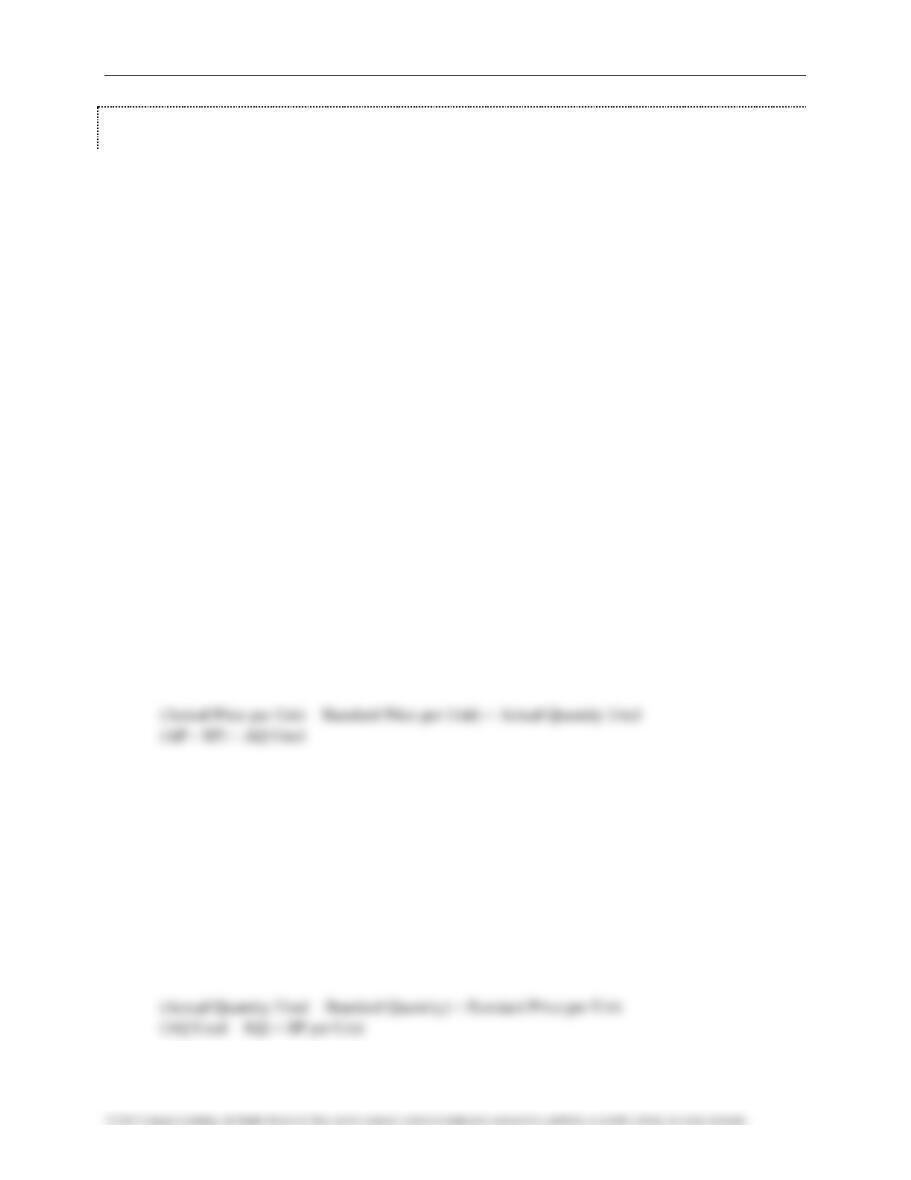
Price Variance: Emphasize that a direct materials price variance shows the difference between the actual
and standard price for the actual quantity of materials used. The formula for this calculation is:
Using the data from Martin Manufacturing:
($3.15 – $3.20) 104,000 = $5,200 favorable price variance
This variance is favorable because the materials cost $0.05 less per pound than standard.
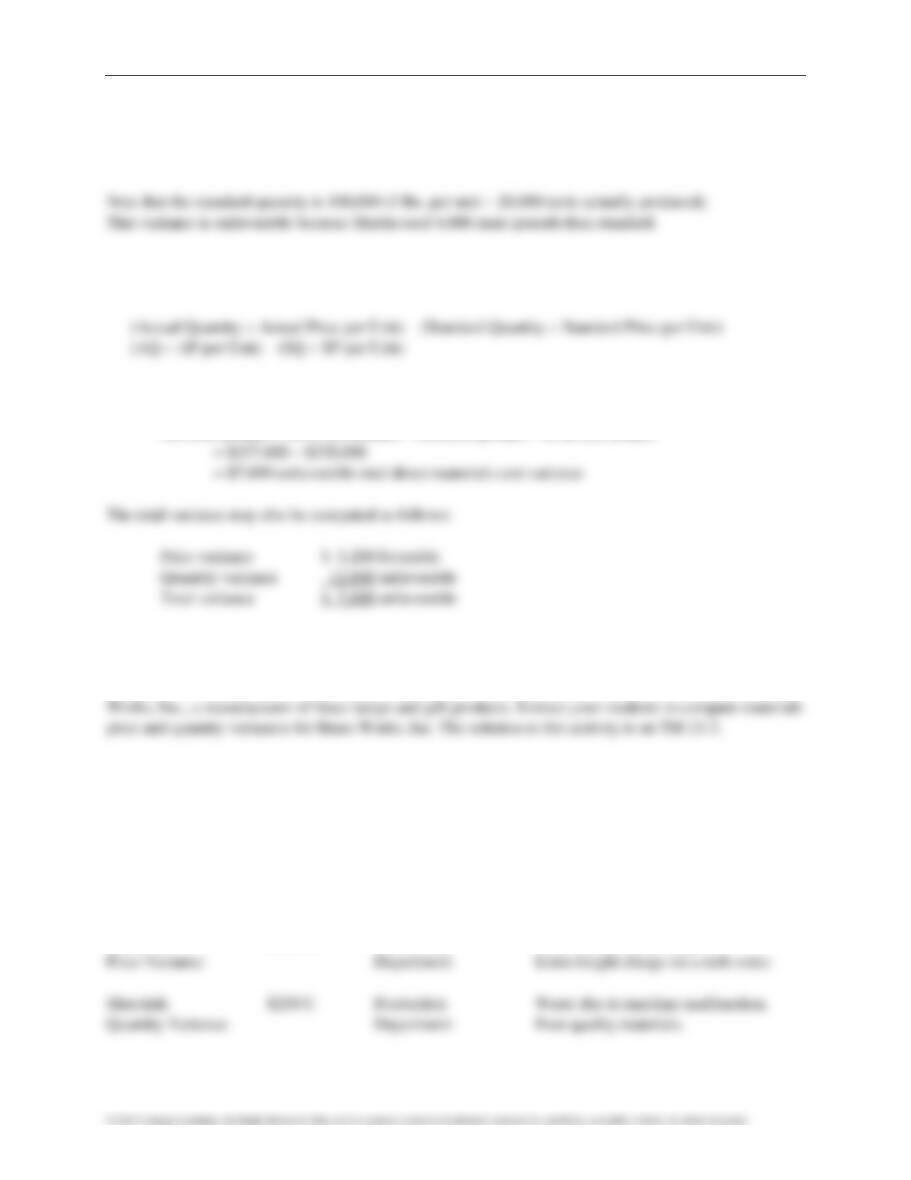
Quantity Variance: Emphasize that the direct materials quantity variance shows the difference between
the actual and standard quantity of materials used. This difference is measured at the standard price
because the effect of the $0.05 per pound price savings was computed in the price variance. The formula
to compute the quantity variance is:
Chapter 23 Performance Evaluation Using Variances from Standard Costs 81
Using the data from Martin Manufacturing:
(104,000 – 100,000) $3.20 = $12,800 unfavorable quantity variance
Total Variance: The total materials variance is the difference between the actual and standard cost of
materials. It may be computed as follows:
Using the data from Martin Manufacturing:
(104,000 pounds $3.15 per pound) – (100,000 pounds $3.20 per pound)
GROUP LEARNING ACTIVITY — Direct Materials Variances
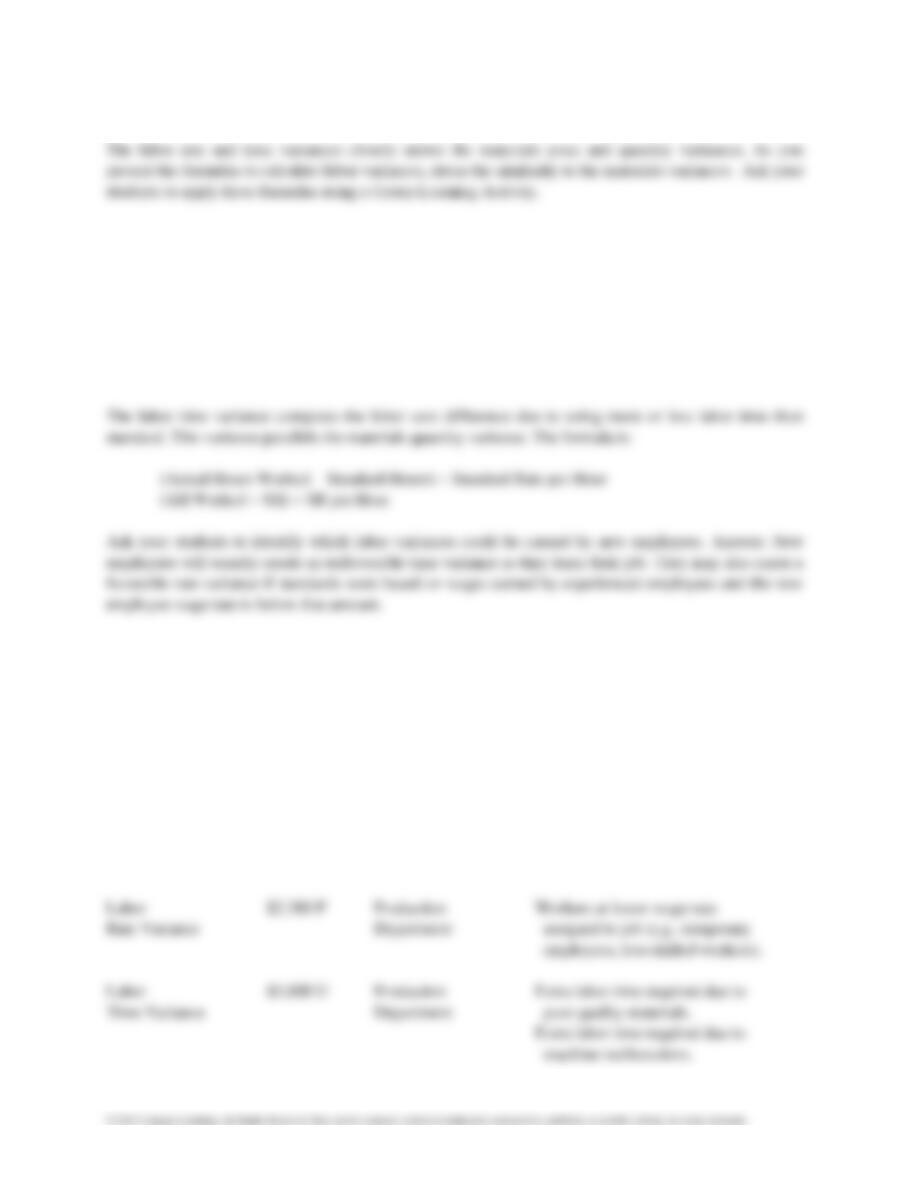
Transparency Master (TM) 23-1 presents standard and actual cost data for direct materials used by Brass
CLASS DISCUSSION — Interpreting Materials Variances
As you review the solution to the group learning activity above (TM 23-2), ask your students to identify
which department of Brass Works, Inc. should be held accountable for each variance. Also ask them to
brainstorm possible reasons for the variance. Some examples follow:
Amount Responsibility Possible Reason(s) for Variance
Materials $420 U Purchasing Price increase from supplier.
82 Chapter 23 Performance Evaluation Using Variances from Standard Costs
SUGGESTED APPROACH — Direct Labor
LECTURE AID — Direct Labor Variances
Differences between actual and standard labor costs are analyzed by computing a rate and a time
variance. The labor rate variance essentially performs the same analysis as the materials price variance. It
computes the cost difference due to a change in labor rate. The formula for the rate variance is:
(Actual Rate per Hour – Standard Rate per Hour) Actual Hours Worked
(AR per Hour – SR per Hour) AH Worked
GROUP LEARNING ACTIVITY — Direct Labor Variances
TM 23-3 presents labor data for Brass Works, Inc. Ask your students to work in groups to calculate labor
rate and time variances using the above formulas. The solution is shown on TM 23-4.
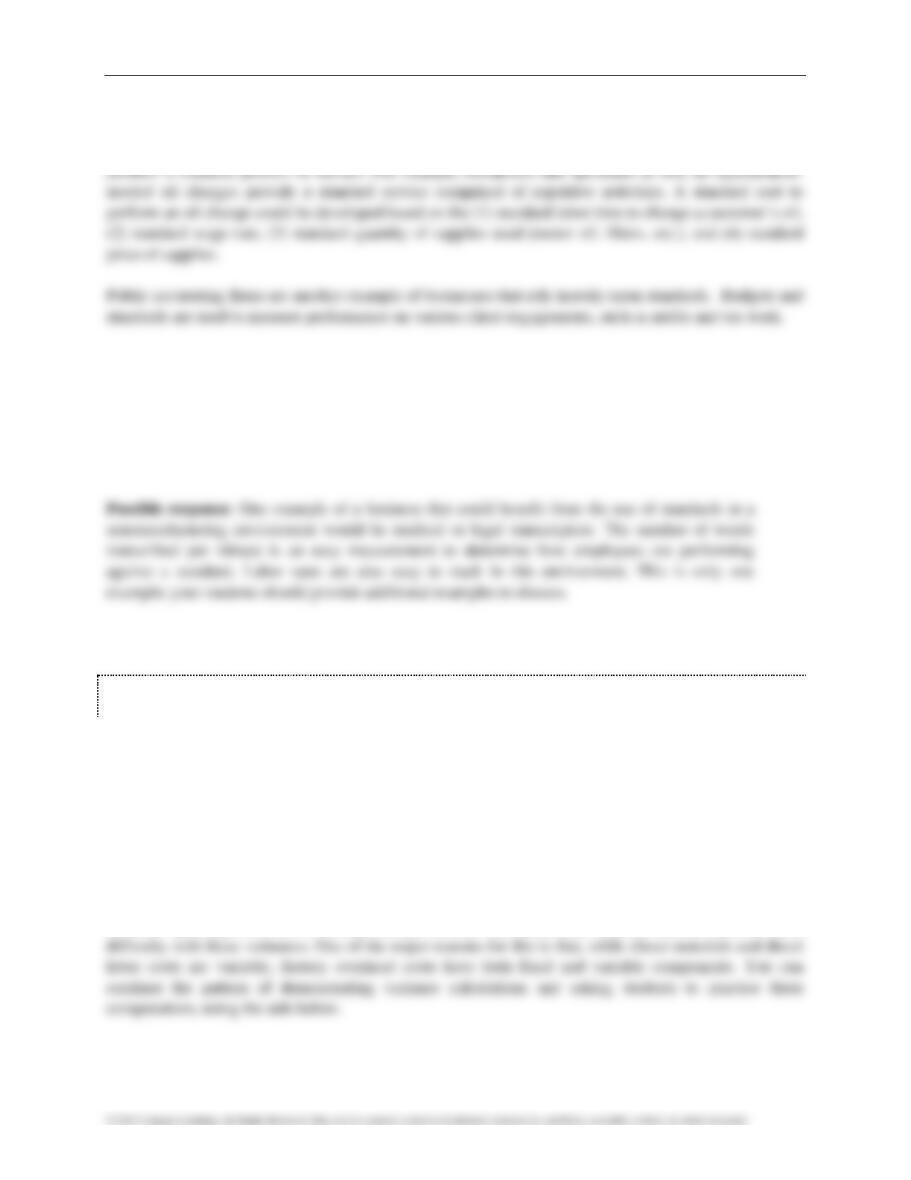
CLASS DISCUSSION — Interpreting Materials Variances
As you review the solution on TM 23-4, ask your students to identify which department of Brass Works,
Inc. should be held accountable for each labor variance. Also ask them to brainstorm possible reasons for
the variance. Some examples follow:
Amount Responsibility Possible Reason(s) for Variance
Chapter 23 Performance Evaluation Using Variances from Standard Costs 83
SUGGESTED APPROACH — Nonmanufacturing Businesses
Standards can be applied to nonmanufacturing businesses, provided that they use repetitive activities to
WRITING EXERCISE — Standards in a Nonmanufacturing Environment
Ask your students to answer the following in writing (TM 23-8).
Describe a nonmanufacturing business that could benefit from the use of standards. Also
explain how standards would help that business control its operations.
OBJECTIVE 4
Compute and interpret factory overhead controllable and volume variances.
KEY TERMS
Budgeted Variable Factory Overhead Factory Overhead Cost Variance Report
Controllable Variance Volume Variance
SUGGESTED APPROACH
Consider spending extra time covering factory overhead variances, since students seem to have the most
84 Chapter 23 Performance Evaluation Using Variances from Standard Costs
DEMONSTRATION PROBLEM — Overhead Variances
In most cases, factory overhead costs are applied to production, using a predetermined factory overhead
rate, calculated as follows:
Estimated Total Factory Overhead Costs
Estimated Activity Base (or Driver) (e.g., direct labor or machine hours)
Factory overhead variances result when factory overhead applied to products does not equal actual
overhead. Therefore, factory overhead variances occur whenever:
1. Factory overhead costs were greater or less than estimated.
2. The company operated above or below the capacity anticipated when estimating the activity driver.
Use the following data to illustrate factory overhead variances.
Martin Manufacturing applies factory overhead to products using direct labor hours. To calculate a
predetermined overhead rate, Martin developed the following estimates for one month of production.
As a result, Martin’s predetermined factory overhead rate is $17 per direct labor hour. Of that rate, fixed
factory overhead is $10 per hour ($120,000/12,000 hrs.) and variable factory overhead is $7 per hour
($84,000/12,000 hrs.).
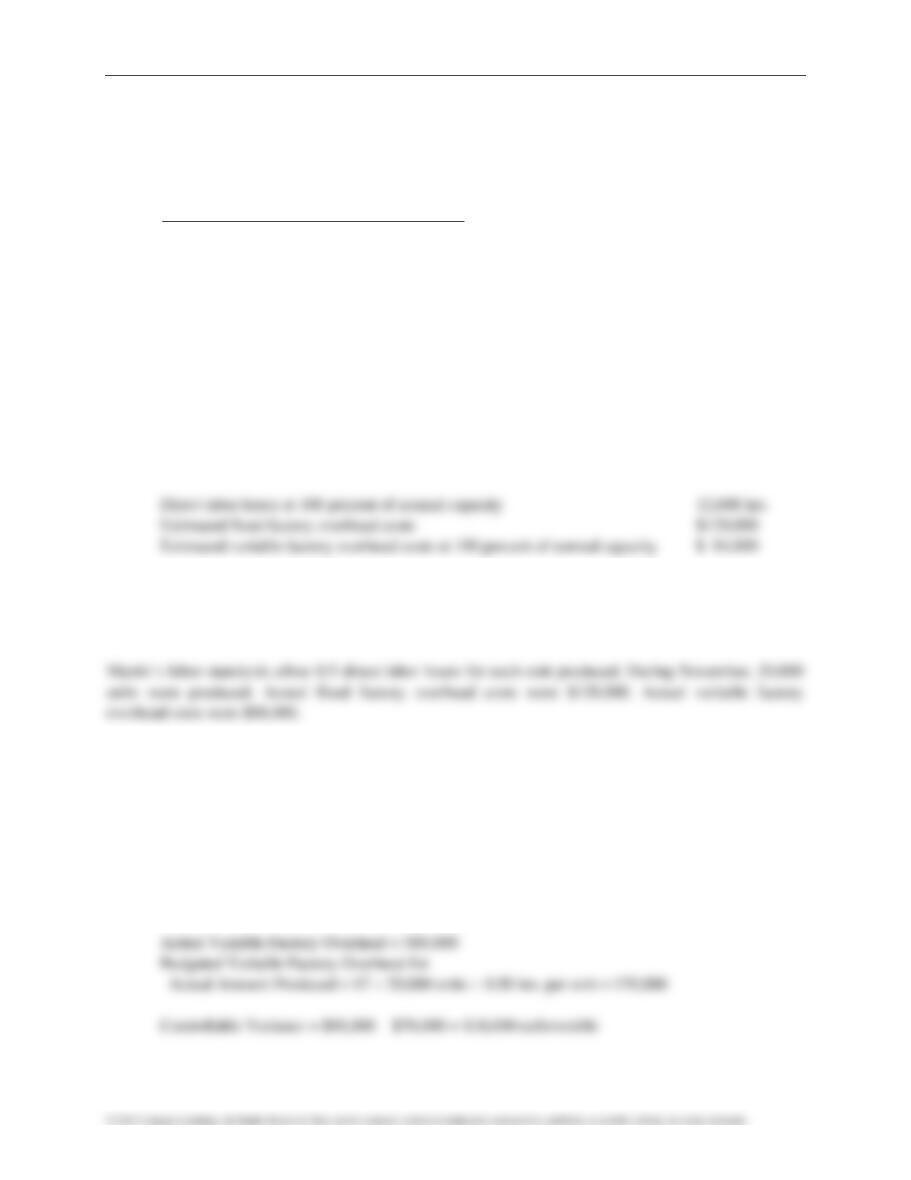
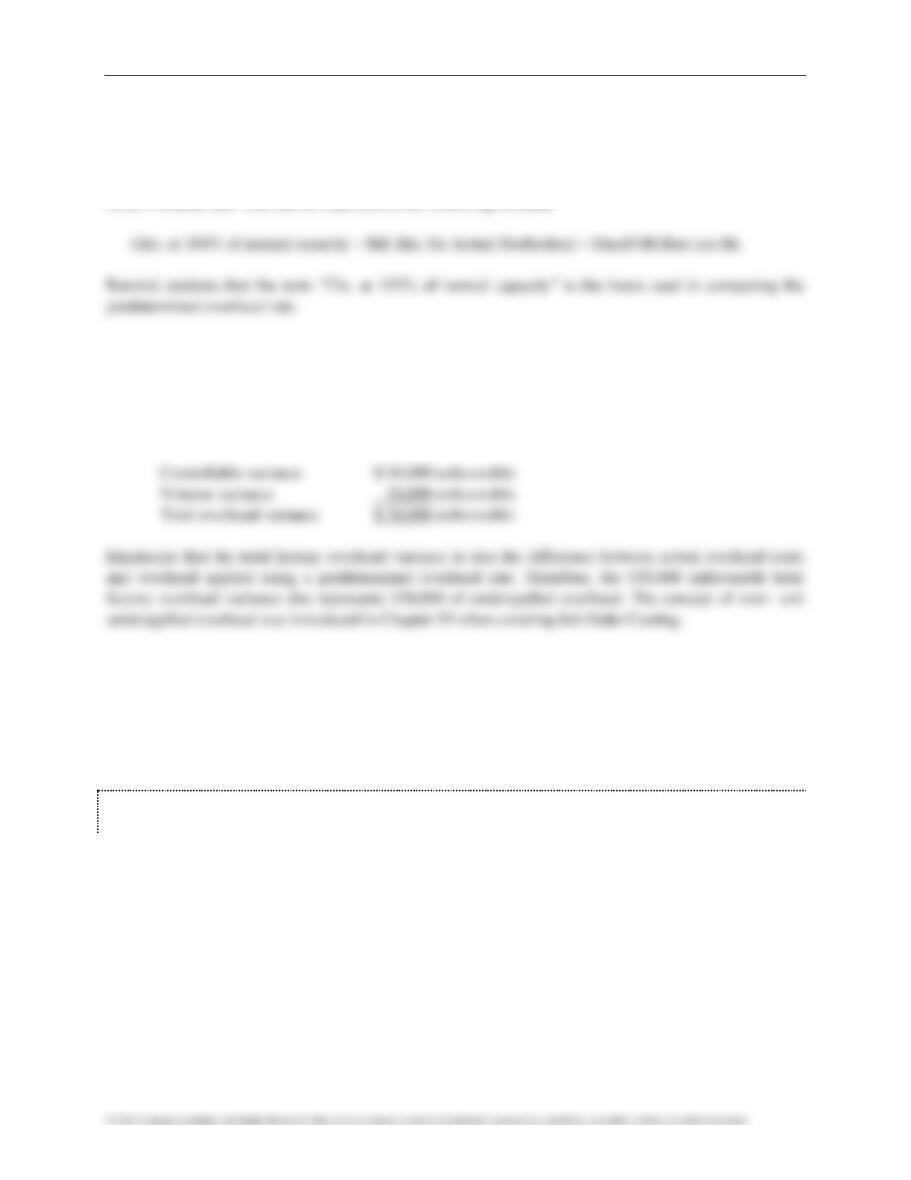
Variable Factory Overhead Controllable Variance: The text defines this variance as the difference
between actual variable overhead costs and variable overhead budgeted for the amount of product actually
produced. (Note that the text is essentially presenting a two-way overhead analysis.) This can be
expressed in the following formula:
Actual Var. OH – (Var. OH Rate per Hr. Units Produced Standard Hrs. per Unit)
Using data from Martin Manufacturing:
Chapter 23 Performance Evaluation Using Variances from Standard Costs 85
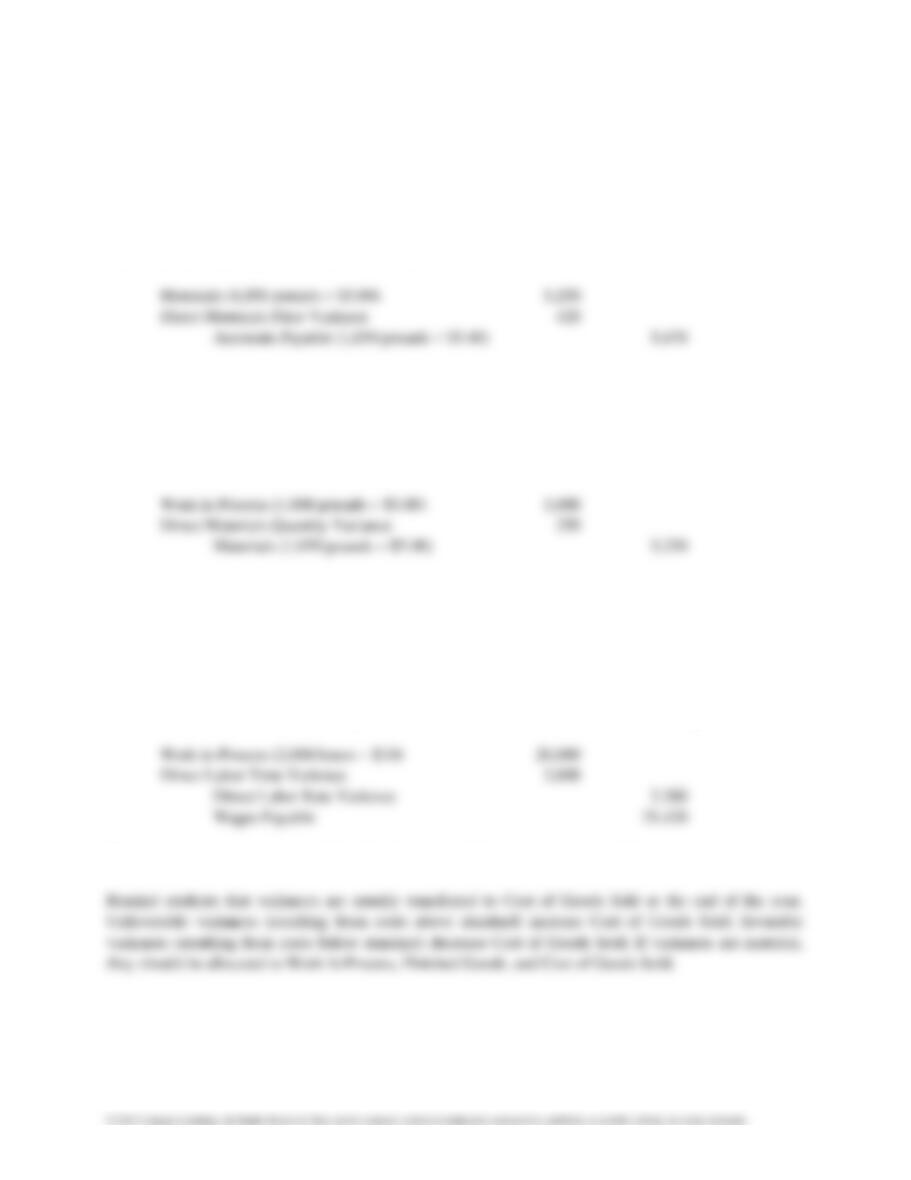
Fixed Factory Overhead Volume Variance: This variance measures the difference between the budgeted
fixed overhead at 100 percent of normal capacity and the standard fixed overhead for the amount of
product actually produced. In essence, it measures the impact of spreading fixed overhead over the wrong
number of units, whenever actual production does not equal the amount anticipated by the predetermined
fixed overhead rate. This can be expressed in the following formula:
Using the data from Martin Manufacturing:
(12,000 hours – 10,000 hours) $10 per hr. = $20,000 unfavorable
Therefore, Martin’s total overhead variance is as follows:
GROUP LEARNING ACTIVITY — Overhead Variances
TM 23-5 presents data for your students to use in calculating overhead variances. The solution to the
exercise is provided on TM 23-6.
OBJECTIVE 5
Journalize the entries for recording standards in the accounts and prepare an income
statement that includes variances from standard.
SUGGESTED APPROACH
Some companies choose to integrate standards and variances into their accounting records. When this
occurs, entries to the materials, work in process, and finished goods inventory accounts are recorded at
standard, not actual, costs. It is helpful to illustrate these entries for your students. A demonstration
problem is included below for that purpose.
86 Chapter 23 Performance Evaluation Using Variances from Standard Costs
DEMONSTRATION PROBLEM — Journal Entries at Standard
The group learning activities under Objectives 3 and 4 asked your students to compute materials and labor
variances. Use these calculations to illustrate the following journal entries.
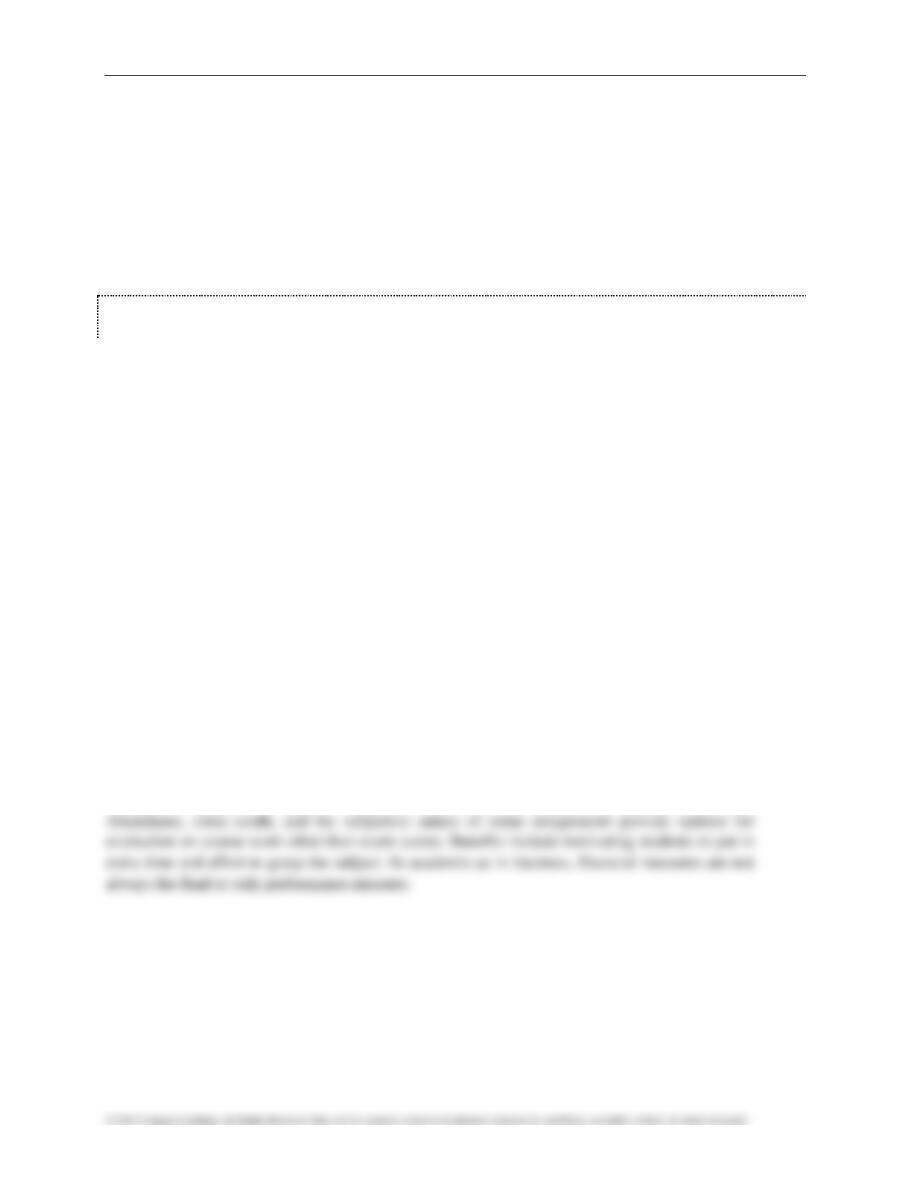
Purchase of Materials: Brass Works used 1,050 pounds of direct materials that cost $5.40 per pound. The
effect of paying $0.40 more per pound than standard was a $420 unfavorable price variance. The purchase
of these materials would be recorded as follows:
Note that the Materials account is debited for the standard cost of materials purchased.
Requisition of Materials: Brass Works used 1,050 pounds of direct materials for production when the
standard materials quantity was only 1,000 pounds. The effect of using more materials than standard is
recorded when the materials are transferred to Work in Process.
Note that the work in process account is debited for the standard price and quantity of materials. The
materials account is credited for the actual quantity of materials used but at the standard price. The actual
quantity of materials used must be removed from the account in order to have an accurate record of the
amount of materials still on hand.
Payment of Direct Labor Costs: Brass Works incurred 2,380 direct labor hours at a cost of $9 per hour.
The standard was 2,000 hours at $10 per hour. The payroll entry to record direct labor wages is:
The work in process account is debited for the standard labor rate and standard labor time.
Chapter 23 Performance Evaluation Using Variances from Standard Costs 87
LECTURE AID — Reporting Variances on the Income Statement
Variances are not usually reported on financial statements prepared for stockholders, creditors, or other
parties outside company management. However, they may be included on income statements prepared for
management use. Exhibit 9 in the text provides an example of an income statement that reports variances.
The key to this exhibit is understanding how the variances affect gross profit. Use the chart on TM 23-7 to
explain the impact of favorable and unfavorable variances on gross profit.
OBJECTIVE 6
Describe and provide examples of nonfinancial performance measures.
KEY TERMS
Nonfinancial Performance Measure Process
SUGGESTED APPROACH
Measurements encourage improving the actions that are being measured. This is true both in the business
world and in the classroom. Use the writing exercise below to stimulate your students to think about the
benefits and difficulties of nonfinancial performance measures.
WRITING EXERCISE — Nonfinancial Performance Measures
Ask your students to write their opinion on the following questions (TM 23-9):
Students’ scores on exams may be equated to financial measures used to evaluate
employee performance in a business. Should college professors limit their evaluation of
students to these “financial” measures? Do you see any potential benefits or disadvantages
of including other measures of student performance in assigning course grades?
Possible response: Professors use optional measures to evaluate students all the time.
CLASS DISCUSSION — Nonfinancial Performance Measures
Ask your students to share examples of any nonfinancial measures used by their employers to evaluate
their work. Question your students on why these measures are used. In other words, what behavior is the
employer trying to encourage with these nonfinancial measures?
DIFFICULTY BUSPROG ACBSP IMA BLOOM’S TIME
Problem
Learning
Objective
Description Primary Primary
Managerial
Only
Spread-
sheet
GL
DQ23-1 23-1 Easy Analytic Budgeting and Responsibility
Performance
Measurement
Knowledge 5 min.
Performance
DQ23-2 23-1 Easy Analytic Budgeting and Responsibility
Measurement
Knowledge 5 min.
DQ23-3 23-3 Easy Analytic Budgeting and Responsibility
Performance
Measurement
Knowledge 5 min.
DQ23-4 23-2 Easy Analytic Budgeting and Responsibility
Performance
Measurement
Knowledge 5 min.
DQ23-5 23-3 Easy Analytic Budgeting and Responsibility
Performance
Measurement
Knowledge 5 min.
Performance
DQ23-6 23-3 Easy Analytic Budgeting and Responsibility
Measurement
Knowledge 5 min.
DQ23-7 23-3 Easy Analytic Budgeting and Responsibility
Performance
Measurement
Knowledge 5 min.
DQ23-8 23-4 Easy Analytic Budgeting and Responsibility
Performance
Measurement
Knowledge 5 min.
DQ23-9 23-5 Easy Analytic Budgeting and Responsibility
Performance
Measurement
Knowledge 5 min.
Performance
DQ23-10 23-6 Easy Analytic Budgeting and Responsibility
Measurement
Knowledge 5 min.
PE23-1A 23-3 Direct materials variances Easy Analytic Budgeting and Responsibility
Performance
Measurement
Application 10 min.
PE23-1B 23-3 Direct materials variances Easy Analytic Budgeting and Responsibility
Performance
Measurement
Application 10 min.
PE23-2A 23-3 Direct labor variances Easy Analytic Budgeting and Responsibility
Performance
Measurement
Application 10 min.
Performance
PE23-2B 23-3 Direct labor variances Easy Analytic Budgeting and Responsibility
Measurement
Application 10 min.
PE23-3A 23-4
Factory overhead controllable
variance
Easy Analytic Budgeting and Responsibility
Performance
Measurement
Application 5 min.
PE23-3B 23-4
Factory overhead controllable
variance
Easy Analytic Budgeting and Responsibility
Performance
Measurement
Application 5 min.
PE23-4A 23-4 Factory overhead volume variance Easy Analytic Budgeting and Responsibility
Performance
Measurement
Application 5 min.
Performance
PE23-4B 23-4 Factory overhead volume variance Easy Analytic Budgeting and Responsibility
Measurement
Application 5 min.
PE23-5A 23-5 Standard cost journal entries Easy Analytic Budgeting and Responsibility
Performance
Measurement
Application 5 min.
PE23-5B 23-5 Standard cost journal entries Easy Analytic Budgeting and Responsibility
Performance
Measurement
Application 5 min.
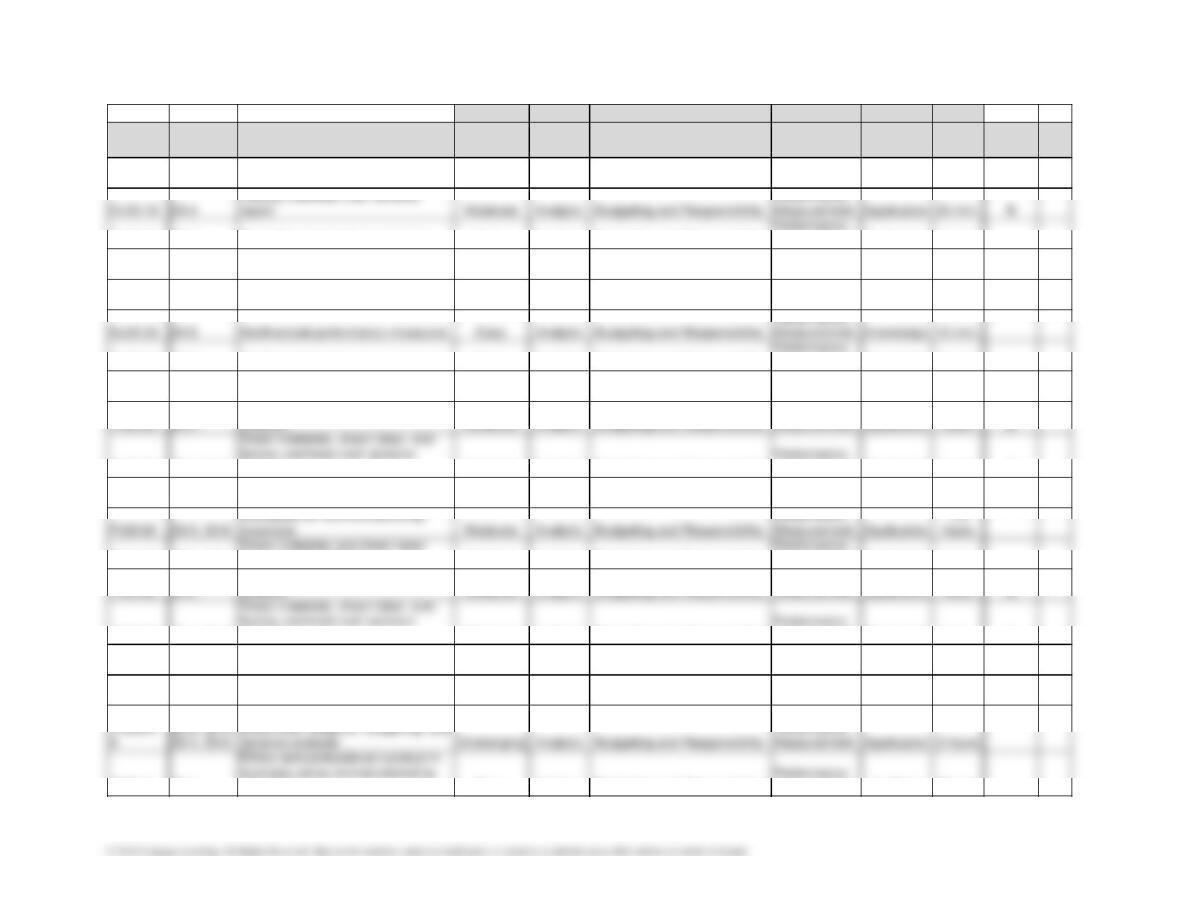
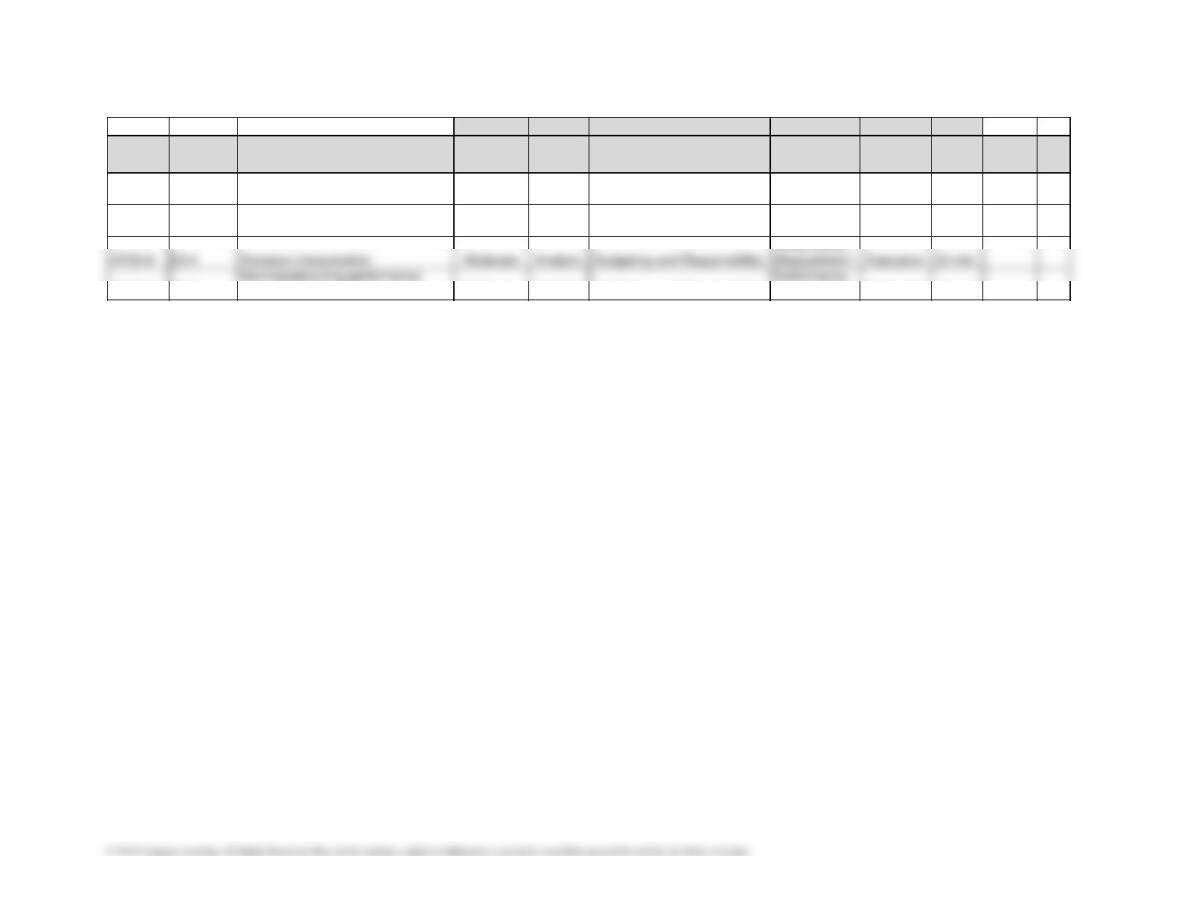
HOMEWORK CHART WITH LEARNING OUTCOMES TAGGING
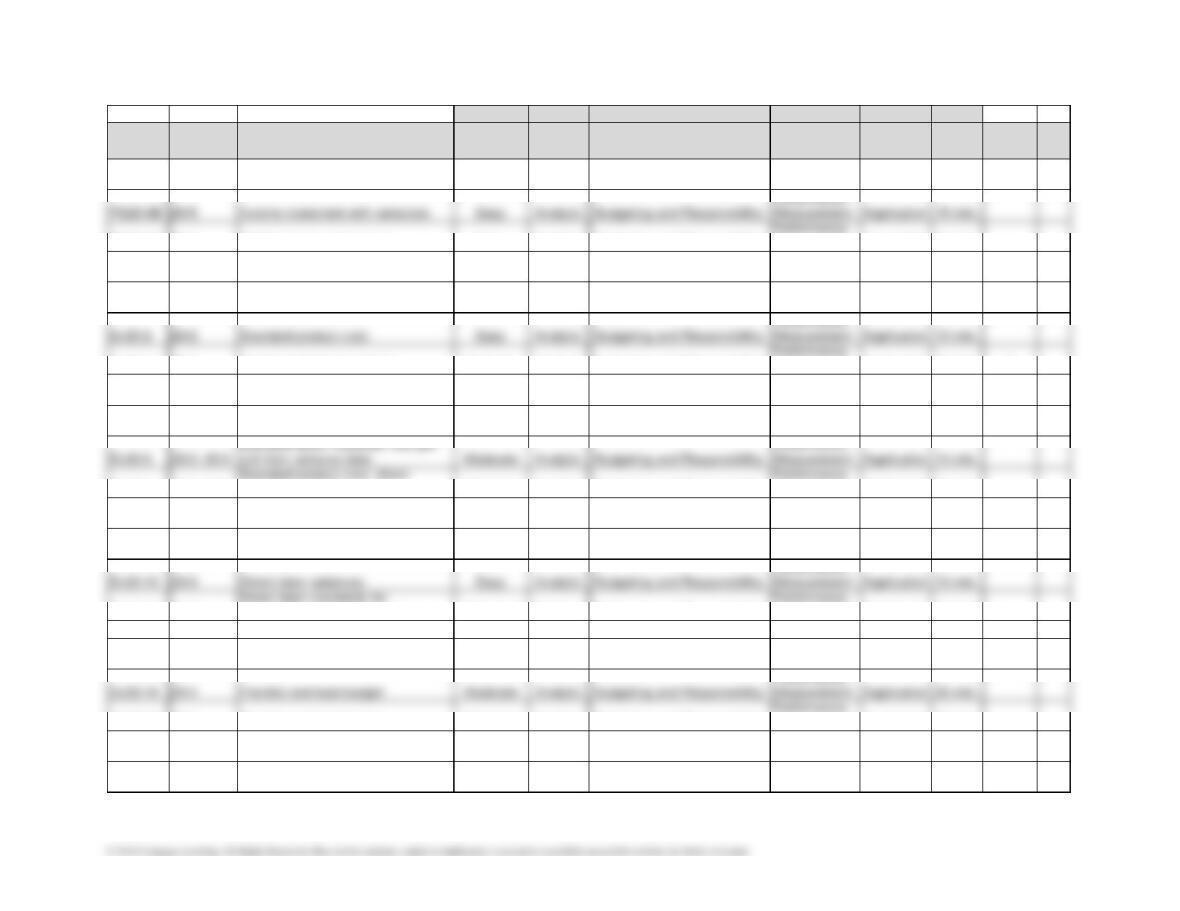
DIFFICULTY BUSPROG ACBSP IMA BLOOM’S TIME
Problem
Learning
Objective
Description Primary Primary
Managerial
Only
Spread-
sheet
GL
PE23-6A 23-5 Income statement with variances Easy Analytic Budgeting and Responsibility
Performance
Measurement
Application 15 min.
PE23-6B 23-5 Income statement with variances Easy Analytic Budgeting and Responsibility
Performance
Measurement
Application 15 min.
Performance
PE23-7A 23-6 Activity inputs and outputs Easy Analytic Budgeting and Responsibility
Measurement
Knowledge 5 min.
PE23-7B 23-6 Activity inputs and outputs Easy Analytic Budgeting and Responsibility
Performance
Measurement
Knowledge 5 min.
Ex23-1 23-2
Standard direct materials cost per
unit
Easy Analytic Budgeting and Responsibility
Performance
Measurement
Application 10 min.
Ex23-2 23-2 Standard product cost Easy Analytic Budgeting and Responsibility
Performance
Measurement
Application 10 min.
Performance
Ex23-3 23-2 Budget performance report Moderate Analytic Budgeting and Responsibility
Measurement
Application 20 min. X
Ex23-4 23-3 Direct materials variances Easy Analytic Budgeting and Responsibility
Performance
Measurement
Application 10 min.
Ex23-5 23-3 Direct material variances Easy Analytic Budgeting and Responsibility
Performance
Measurement
Application 10 min.
Ex23-6 23-2, 23-3
Standard direct materials cost per
unit from variance data
Performance
Measurement
Application 15 min.
Standard product cost, direct
Performance
Ex23-7 23-2, 23-3
materials variance
Moderate Analytic Budgeting and Responsibility
Measurement
Application 15 min.
Ex23-8 23-3 Direct labor variances Easy Analytic Budgeting and Responsibility
Performance
Measurement
Application 10 min.
Ex23-9 23-3, 23-5 Direct labor variances Moderate Analytic Budgeting and Responsibility
Performance
Measurement
Application 15 min.
Ex23-10 23-3 Direct labor variances Easy Analytic Budgeting and Responsibility
Performance
Measurement
Application 10 min.
Direct labor standards for
Performance
Ex23-11 23-3
nonmanufacturing expenses
Moderate Analytic Budgeting and Responsibility
Measurement
Application 15 min.
Ex23-12 23-2, 23-3
Direct labor standards for
nonmanufacturing operations
Easy Analytic Budgeting and Responsibility
Performance
Measurement
Application 15 min.
Ex23-13 23-3
Direct materials and direct labor
variances
Moderate Analytic Budgeting and Responsibility
Performance
Measurement
Application 15 min.
Ex23-14 23-4 Flexible overhead budget Moderate Analytic Budgeting and Responsibility
Measurement
Application 30 min.
Ex23-15 23-4 Flexible overhead budget Moderate Analytic Budgeting and Responsibility
Measurement
Application 30 min.
Ex23-16 23-4 Factory overhead cost variances Moderate Analytic Budgeting and Responsibility
Performance
Measurement
Application 20 min.
Ex23-17 23-4 Factory overhead cost variances Easy Analytic Budgeting and Responsibility
Performance
Measurement
Application 15 min. X
DIFFICULTY BUSPROG ACBSP IMA BLOOM’S TIME
Problem
Learning
Objective
Description Primary Primary
Managerial
Only
Spread-
sheet
GL
Ex23-18 23-4
Factory overhead variance
corrections
Moderate Analytic Budgeting and Responsibility
Performance
Measurement
Application 20 min.
Ex23-19 23-4
Factory overhead cost variance
report
Moderate Analytic Budgeting and Responsibility
Performance
Measurement
Application 30 min. X
Performance
Ex23-20 23–5 Recording standards in accounts Easy Analytic Budgeting and Responsibility
Measurement
Application 10 min.
Ex23-21 23–5 Recording standards in accounts Easy Analytic Budgeting and Responsibility
Performance
Measurement
Application 10 min.
Ex23-22 23-5
Income statement indicating
standard cost variances
Moderate Analytic Budgeting and Responsibility
Performance
Measurement
Application 20 min.
Ex23-23 23–6 Nonfinancial performance measures Easy Analytic Budgeting and Responsibility
Performance
Measurement
Knowledge 10 min.
Performance
Ex23-24 23–6 Nonfinancial performance measures Easy Analytic Budgeting and Responsibility
Measurement
Knowledge 10 min.
Pr23-1A 23-2, 23-3
Direct materials and direct labor
variance and analysis
Moderate Analytic Budgeting and Responsibility
Performance
Measurement
Application 1 hour
Pr23-2A
23-1, 23-2,
23-3
Flexible budgeting and variance
analysis
Moderate Analytic Budgeting and Responsibility
Performance
Measurement
Application
1.5
hours
X
Pr23-3A 23-3, 23-4
factory overhead cost variance
Performance
analysis
Moderate Analytic Budgeting and Responsibility
Measurement
Application 1 hour X
Pr23-4A 23–4
Standard factory overhead variance
report
Challenging Analytic Budgeting and Responsibility
Performance
Measurement
Application 1 hour X X
Pr23-5A 23-3, 23-6
Standards for nonmanufacturing
expenses
Moderate Analytic Budgeting and Responsibility
Performance
Measurement
Application
hours
Direct materials and direct labor
Performance
Pr23-1B 23-2, 23-3
variance and analysis
Moderate Analytic Budgeting and Responsibility
Measurement
Application 1 hour
Pr23-2B
23-1, 23-2,
23-3
Flexible budgeting and variance
analysis
Moderate Analytic Budgeting and Responsibility
Performance
Measurement
Application
1.5
hours
X
Pr23-3B 23-3, 23-4
factory overhead cost variance
Performance
analysis
Moderate Analytic Budgeting and Responsibility
Measurement
Application 1 hour X
Pr23-4B 23–4
Standard factory overhead variance
report
Challenging Analytic Budgeting and Responsibility
Performance
Measurement
Application 1 hour X X
Pr23-5B 23-3, 23-6
Standards for nonmanufacturing
expenses
Moderate Analytic Budgeting and Responsibility
Performance
Measurement
Application
1.5
hours
Problem
5
23-2, 23-3,
23-4, 23-5
Break-even analysis, budgeting, and
variance analysis
Challenging Analytic Budgeting and Responsibility
Performance
Measurement
Application 3 hours
Comp
CP23-1 23-1
standards
Easy Ethics Budgeting and Responsibility
Measurement
Analysis 15 min.
DIFFICULTY BUSPROG ACBSP IMA BLOOM‘S TIME
Problem
Learning
Objective
Description Primary Primary
Managerial
Only
Spread-
sheet
GL
CP23-2 23–6 Nonfinancial performance measures Easy Analytic Budgeting and Responsibility
Performance
Measurement
Analysis 15 min.
CP23-3 23–3 Variance interpretation Moderate Analytic Budgeting and Responsibility
Performance
Measurement
Evaluation 30 min.
CP23-4 23–4 Variance interpretation Moderate Analytic Budgeting and Responsibility
Performance
Measurement
Evaluation 20 min.
CP23-5 23-6
measures—government
Moderate Analytic Budgeting and Responsibility
Measurement
Application 1 hour