standard will be dependent on the specific facts and circumstances of
future individual impairments, if any.
In March 2017, the FASB issued ASU 2017-07, “Compensation-Retirement
Benefits: Improving the Presentation of Net Periodic Pension Cost and Net
Periodic Postretirement Benefit Cost (Topic 715).” This guidance requires
retrospectively no later than July 1, 2018. The adoption of ASU 2017-07 is
not expected to have a material impact on our Consolidated Financial
Statements. We currently classify all net periodic pension costs within
(b) Use of Estimates
Preparation of financial statements in conformity with accounting
principles generally accepted in the United States of America (U.S. GAAP)
requires management to make estimates and assumptions that affect the
amounts reported in the Consolidated Financial Statements and
accompanying disclosures. These estimates are based on management’s
best knowledge of current events and actions the Company may undertake
in the future. Estimates are used in accounting for, among other items,
COMPARATIVE ANALYSIS CASE
THE COCA-COLA COMPANY VS. PEPSICO, INC.
(a) and (c) for Coca-Cola Company:
NOTE 1: SUMMARY OF SIGNIFICANT ACCOUNTING POLICIES
In May 2014, the Financial Accounting Standards Board (“FASB”) issued
Accounting Standards Update (“ASU”) 2014-09, Revenue from Contracts
with Customers, which will replace most existing revenue recognition
guidance in U.S. GAAP and is intended to improve and converge with
The Company will adopt ASU 2014-09 and its amendments on a modified
retrospective basis. We have closely assessed the new guidance, including
the interpretations by the FASB Transition Resource Group for Revenue
Recognition, throughout 2017. We have concluded that ASU 2014-09’s
broad definition of variable consideration will require the Company to
estimate and record certain variable payments resulting from collaborative
COMPARATIVE ANALYSIS CASE (Continued)
and is expected to decrease the opening balance of retained earnings by
less than $350 million, net of tax.
Additionally, the provisions of the new guidance provided clarification
relating to the classification of certain costs incurred relating to revenue
arrangements with customers. As a result, we will be classifying certain
amounts in cost of goods sold or selling, general and administrative
expenses that were previously classified as reductions in net operating
revenues. The Company also evaluated the principal versus agent
considerations as it relates to certain of its arrangements with third-party
manufacturers and co-packers. We concluded that certain costs from these
arrangements will be reflected in net operating revenues rather than in cost
of goods sold. These changes will have no impact on the Company’s
consolidated operating income.
In November 2015, the FASB issued ASU 2015-17, Balance Sheet
Classification of Deferred Taxes. The amendments in this update are
intended to simplify the presentation of deferred income taxes and require
that deferred tax liabilities and assets be classified as noncurrent in a
COMPARATIVE ANALYSIS CASE (Continued)
impact for the reclassifications as of December 31, 2016 would have
increased the noncurrent line items other assets and deferred income
taxes in our consolidated balance sheet by $54 million and $666 million,
respectively.
In February 2016, the FASB issued ASU 2016-02, Leases, which requires
lessees to recognize right-of-use assets, representing their right to use the
underlying asset for the lease term, and lease liabilities on the balance
sheet for all leases with terms greater than 12 months. The guidance also
requires qualitative and quantitative disclosures designed to assess the
amount, timing and uncertainty of cash flows arising from leases. The
Company has initiated its plan for the adoption and implementation of this
COMPARATIVE ANALYSIS CASE (Continued)
In March 2016, the FASB issued ASU 2016-09, Compensation — Stock
Compensation: Improvements to Employee Share-Based Payment
Accounting. The standard is intended to simplify several areas of
accounting for share-based compensation arrangements, including the
income tax impact, classification on the statement of cash flows and
forfeitures. The Company adopted ASU 2016-09 on January 1, 2017 by
prospectively recognizing excess tax benefits and tax deficiencies in our
consolidated statement of income as the awards vested or were settled.
Effective January 1, 2017, the Company also prospectively presented
In June 2016, the FASB issued ASU 2016-13, Financial Instruments —
Measurement of Credit Losses on Financial Instruments, which requires
measurement and recognition of expected credit losses for financial assets
held. ASU 2016-13 is effective for the Company beginning January 1, 2020
and we are currently evaluating the impact that it will have on our
consolidated financial statements.
COMPARATIVE ANALYSIS CASE (Continued)
operating activities, however upon adoption of the new standard, we will
reflect these proceeds in investing activities.
In October 2016, the FASB issued ASU 2016-16, Intra-Entity Transfers of
Assets Other Than Inventory, which requires the Company to recognize the
income tax consequences of an intra-entity transfer of an asset other than
other assets in our consolidated balance sheet.
In November 2016, the FASB issued ASU 2016-18, Restricted Cash. The
amendments in this update address diversity in practice that exists in the
classification and presentation of changes in restricted cash and require
that a statement of cash flows explain the change during the period in the
In January 2017, the FASB issued ASU 2017-01, Clarifying the Definition of
a Business, which clarifies the definition of a business with the objective of
COMPARATIVE ANALYSIS CASE (Continued)
In March 2017, the FASB issued ASU 2017-07, Improving the Presentation
of Net Periodic Pension Cost and Net Periodic Postretirement Benefit Cost,
which requires that the service cost component of the Company’s net
periodic pension cost and net periodic postretirement benefit cost be
included in the same line item as other compensation costs arising from
In August 2017, the FASB issued ASU 2017-12, Targeted Improvements to
Accounting for Hedging Activities, which eliminates the requirement to
separately measure and report hedge ineffectiveness and requires
companies to recognize all elements of hedge accounting that impact
earnings in the same income statement line item where the hedged item
resides. The amendments include new alternatives for measuring the
COMPARATIVE ANALYSIS CASE (Continued)
Critical Accounting Policies and Estimates
Our consolidated financial statements are prepared in accordance with
accounting principles generally accepted in the United States (“U.S.
GAAP”), which require management to make estimates, judgments and
assumptions that affect the amounts reported in our consolidated financial
statements and accompanying notes. We believe our most critical
accounting policies and estimates relate to the following:
• Principles of Consolidation
• Recoverability of Current and Noncurrent Assets
(b) and (c) for Pepsi:
Recently Issued Accounting Pronouncements – Adopted
In 2017, the SEC issued guidance related to the TCJ Act which allows
recording of provisional tax expense using a measurement period, not to
exceed one year, when information necessary to complete the accounting
for the effects of the TCJ Act is not available. We elected to apply the
COMPARATIVE ANALYSIS CASE (Continued)
In 2016, the Financial Accounting Standards Board (FASB) issued
guidance that changes the accounting for certain aspects of share-based
payments to employees. We adopted the provisions of this guidance
during our first quarter of 2017, resulting in the following impacts to our
financial statements:
• Income tax effects of vested or settled awards were recognized in the
provision for income taxes on our income statement on a prospective
basis. Previously, these tax effects were recorded on our equity
statement in capital in excess of par value. For the year ended
• Excess tax benefits are retrospectively presented within operating
activities and withholding tax payments upon vesting of RSUs, PSUs
The guidance also allows for the employer to repurchase more of an
employee’s shares, up to the maximum statutory rate, for tax withholding
purposes and not classify the award as a liability that requires valuation on
a mark-to-market basis. Our accounting treatment for outstanding awards
COMPARATIVE ANALYSIS CASE (Continued)
In 2016, the FASB issued guidance that eliminates the requirement that an
investor retrospectively apply equity method accounting for an investment
originally accounted for by another method. The guidance requires that an
equity method investor add the cost of acquiring the additional interest in
the investee to the current basis of the investor’s previously held interest
Recently Issued Accounting Pronouncements – Not Yet Adopted
[In 2018, the FASB issued guidance related to the TCJ Act for the optional
reclassification of the residual tax effects, arising from the change in the
corporate tax rate, in accumulated other comprehensive loss to retained
COMPARATIVE ANALYSIS CASE (Continued)
In 2017, the FASB issued guidance to amend and simplify the application
of hedge accounting guidance to better portray the economic results of
risk management activities in the financial statements. The guidance
expands the ability to hedge nonfinancial and financial risk components,
In 2017, the FASB issued guidance that requires companies to
retrospectively present the service cost component of net periodic benefit
cost for pension and retiree medical plans along with other compensation
costs in operating profit and present the other components of net periodic
benefit cost below operating profit in the income statement. The guidance
also allows only the service cost component of net periodic benefit cost to
In 2016, the FASB issued guidance to clarify how restricted cash should be
presented in the cash flow statement. We will adopt the guidance when it
becomes effective in the first quarter of 2018. The guidance is not expected
to have a material impact on our financial statements.
In 2016, the FASB issued guidance that requires companies to account for
the income tax effects of intercompany transfers of assets, other than
COMPARATIVE ANALYSIS CASE (Continued)
first quarter of 2018. The guidance is not expected to have a material
impact on our financial statements.
In 2016, the FASB issued guidance that requires lessees to recognize most
leases on the balance sheet, but record expenses on the income statement
in a manner similar to current accounting. For lessors, the guidance
modifies the classification criteria and the accounting for sales-type and
direct financing leases. The guidance is effective beginning in 2019 with
In 2016, the FASB issued guidance that requires companies to measure
investments in certain equity securities at fair value and recognize any
changes in fair value in net income. We will adopt the guidance when it
becomes effective in the first quarter of 2018. The guidance is not expected
COMPARATIVE ANALYSIS CASE (Continued)
In 2014, the FASB issued guidance on revenue recognition, with final
amendments issued in 2016. The guidance provides for a five-step model
to determine the revenue recognized for the transfer of goods or services
to customers that reflects the expected entitled consideration in exchange
for those goods or services. It also provides clarification for principal
2018.
We are utilizing a comprehensive approach to assess the impact of the
guidance on our contract portfolio by reviewing our current accounting
policies and practices to identify potential differences that would result
from applying the new requirements to our revenue contracts, including
evaluation of our performance obligations, principal versus agent
considerations and variable consideration. We are substantially complete
COMPARATIVE ANALYSIS CASE (Continued)
Estimates
The preparation of our consolidated financial statements requires us to
make estimates and assumptions that affect reported amounts of assets,
liabilities, revenues, expenses and disclosure of contingent assets and
liabilities. Estimates are used in determining, among other items, sales
incentives accruals, tax reserves, share-based compensation, pension and
ACCOUNTING, ANALYSIS, AND PRINCIPLES
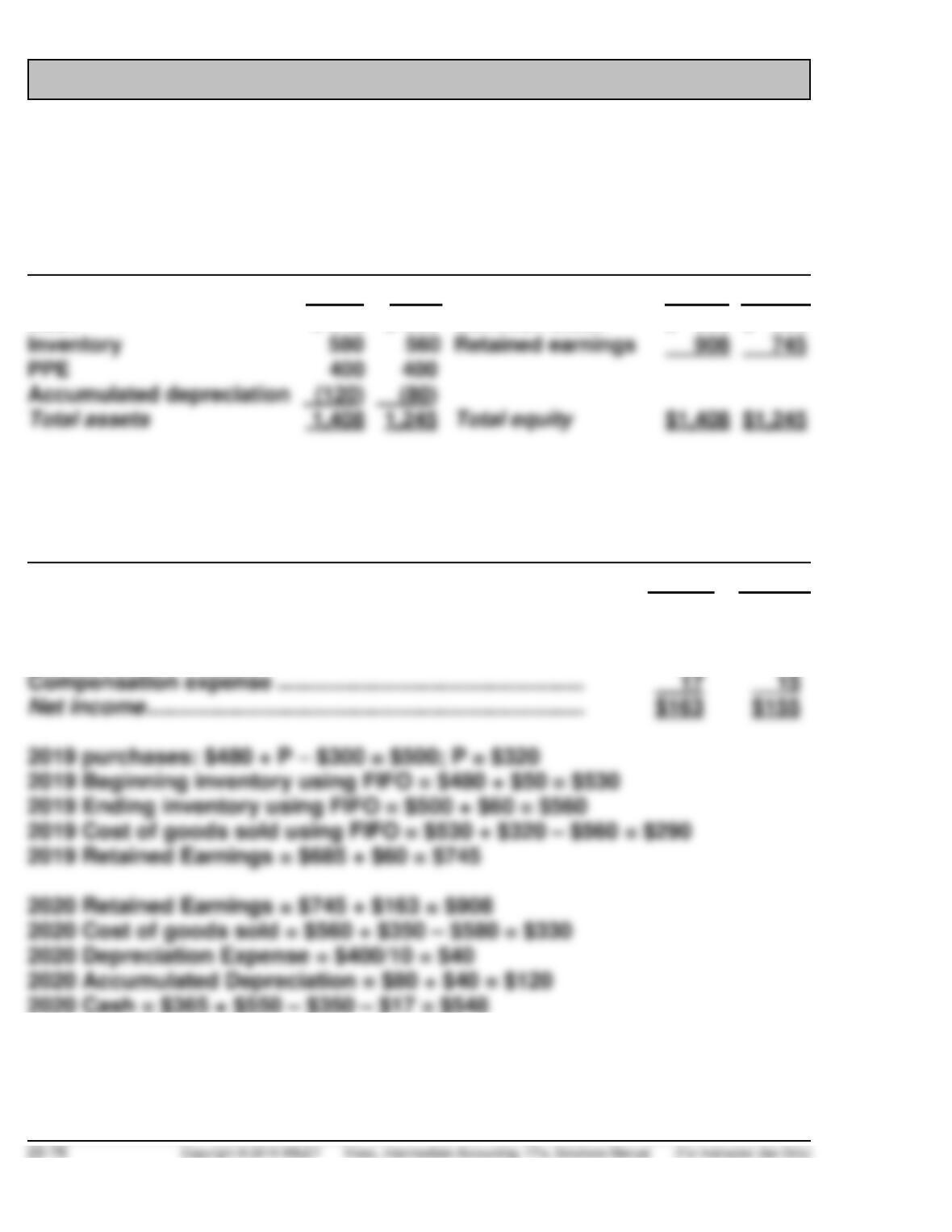
Accounting
ABC CO.
Balance Sheet
at December 31
2020 2019 2020 2019
Cash $ 548 $ 365 Common stock $ 500 $ 500
ABC CO.
Income Statement
for the Year Ended December 31,
2020 2019
Sales ……………………………………………………………………… $550 $500
Cost of goods sold …………………………………………………. 330 290
Depreciation expense …………………………………………….. 40 40