Financial and Managerial Accounting, 8th Edition
22-1
CHAPTER 22
PERFORMANCE MEASUREMENT AND
RESPONSIBILITY ACCOUNTING
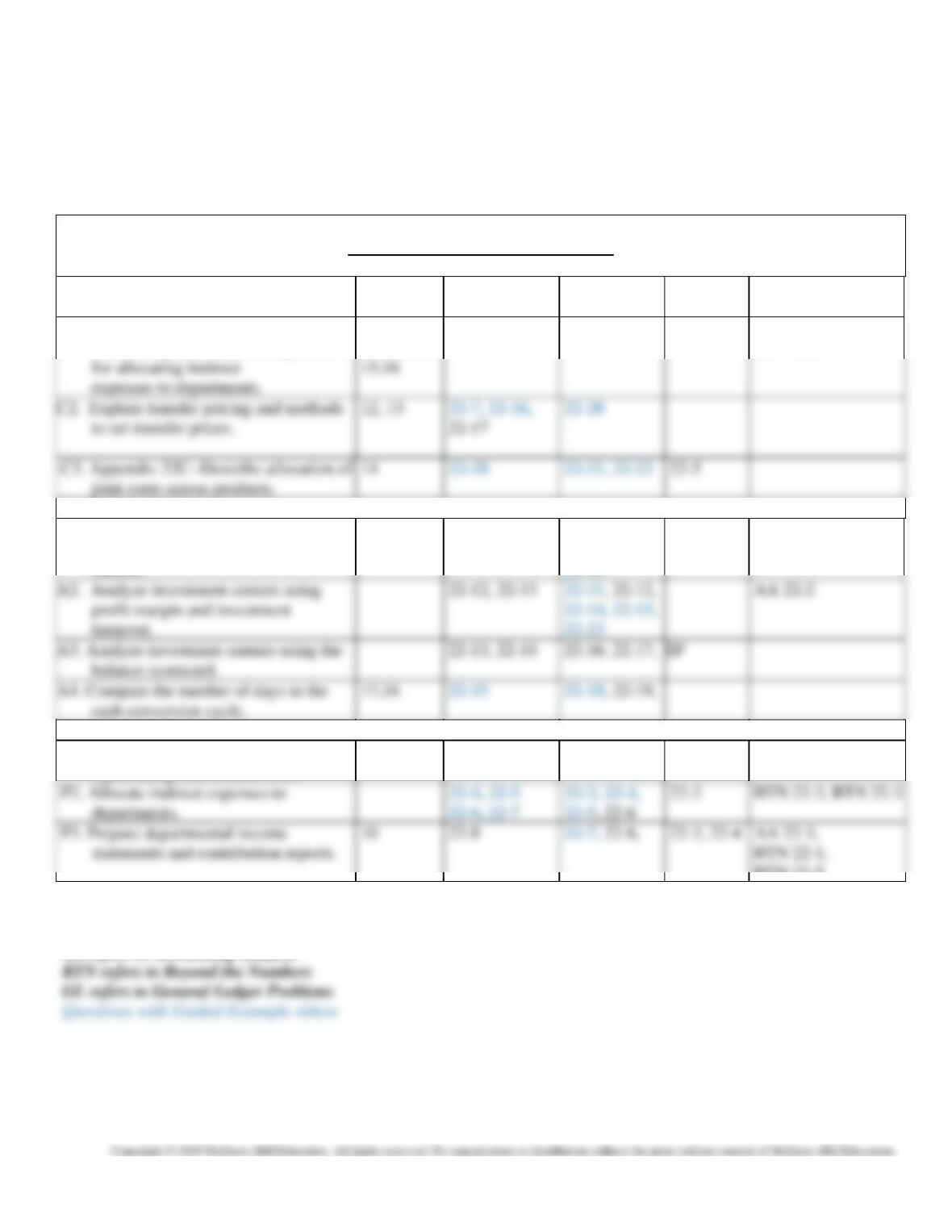
Related Assignment Materials
Student Learning Objectives
Discussion
Questions
Quick Studies*
Exercises*
Problems*
AA and BTN
expenses to departments.
C2. Explain transfer pricing and methods
to set transfer prices.
12, 13
22-7, 22-16,
22-17
22-20
C3. Appendix 22C—Describe allocation of
joint costs across products.
14
22-18
22-21, 22-22
22-5
C1. Distinguish between direct and
indirect expenses and identify bases
1,2,3,4,5,
6,7,8,9,11,
22-1, 22-2
AA 22-1,
BTN 22-6
Analytical objectives:
A1. Analyze investment centers using
return on investment and residual
income.
22-9, 22-10,
22-12, 22-19
22-9, 22-10,
22-12, 22-13,
22-15
profit margin and investment
turnover.
22-14, 22-15,
A3. Analyze investment centers using the
balance scorecard.
22-13, 22-14
22-16, 22-17,
A4. Compute the number of days in the
cash conversion cycle.
17,18
22-15
22-18, 22-19,
Procedural objectives:
P1. Prepare a responsibility accounting
report using controllable costs.
22-3
22-1, 22-2
22-1
BTN 22-4, BTN 22-6
P2. Allocate indirect expenses to
departments.
22-4, 22-5
22-3, 22-4,
22-2
BTN 22-2, BTN 22-3
P3. Prepare departmental income
statements and contribution reports.
10
22-8
22-7, 22-8,
22-3, 22-4
AA 22-3,
BTN 22-1,
BTN 22-5
*See additional information on next page that pertains to these quick studies, exercises, and problems.
SP refers to the Serial Problem
AA refers to Accounting Analysis
Issues in Computing These Measures
1:08
Analyze investment centers using profit margin and investment turnover.
1:50
Analyze investment centers using the balance scorecard.
Balanced Scorecard
0:40
Financial and Managerial Accounting, 8th Edition
22-2
Additional Information on Related Assignment Material
See Chapter 1 of the Instructor’s Resource Manual for more information on materials for this text available in
Connect.
Connect
Available on the instructor’s course-specific website, Connect:
Hints/Guided Examples
Please note that the Guided Examples are labeled as “Hints” in Connect assignments. The animated PowerPoints without
Need-to-Know Videos
LO
Need–to-Know
Title
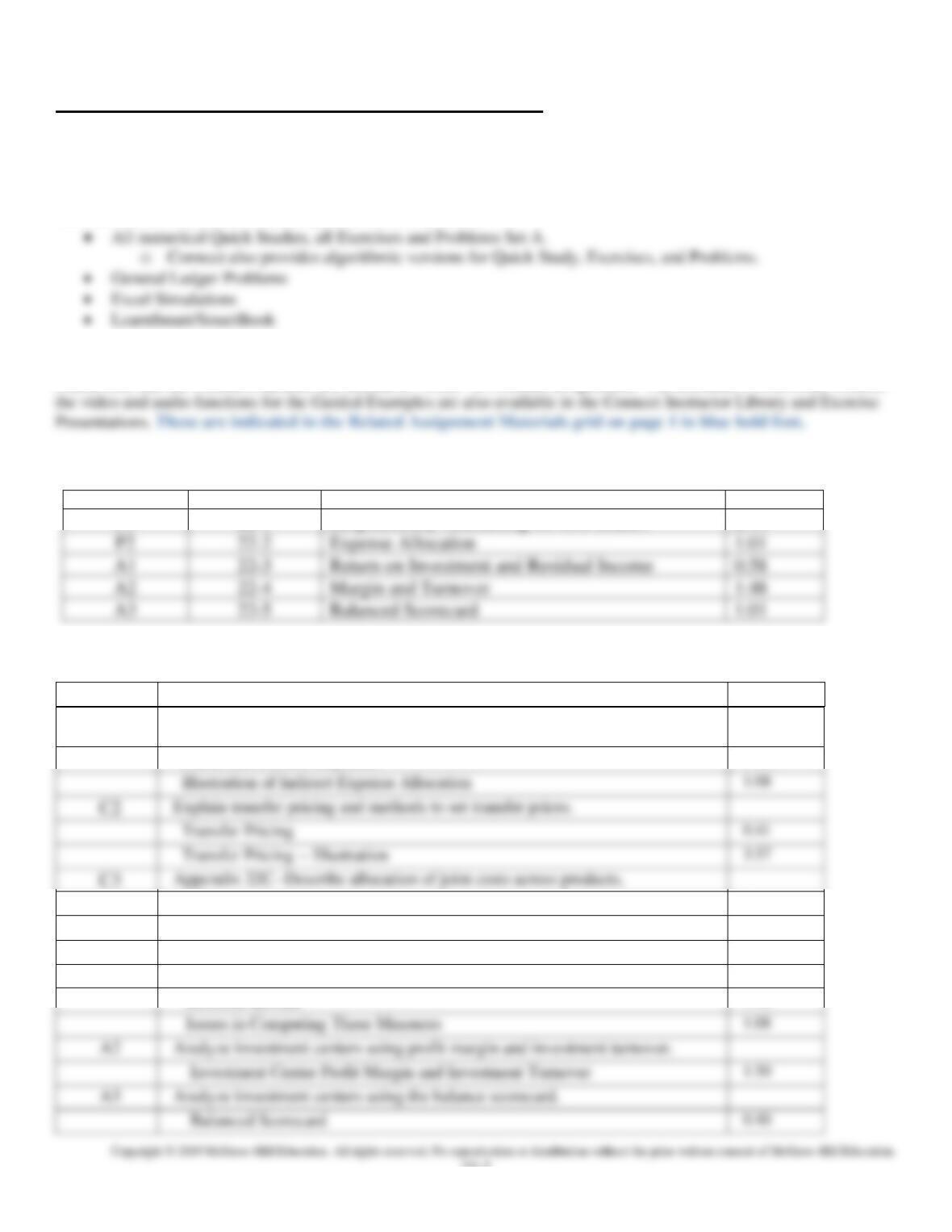
Time
P1
22-1
Responsibility Accounting for cost centers
2:44
P2
22-2
Expense Allocation
1:01
22-3
Return on Investment and Residual Income
0:58
22-4
Margin and Turnover
1:48
22-5
Balanced Scorecard
1:01
Concept Overview Videos
LO
Title
Time
C1
Distinguish between direct and indirect expenses and identify bases for
allocating indirect expenses to departments.
Direct and Indirect Expenses
1:32
Illustration of Indirect Expense Allocation
1:08
Explain transfer pricing and methods to set transfer prices.
Transfer Pricing
0:41
Transfer Pricing — Illustration
3:57
Appendix 22C—Describe allocation of joint costs across products.
Allocation of Joint Costs
1:11
Allocation Methods
1:50
A1
Analyze investment centers using return on investment and residual income.
Return on Investment
1:24
Residual Income
1:38
Financial and Managerial Accounting, 8th Edition
22-3
Applying the Four Perspectives
1:27
A4
Compute the number of days in the cash conversion cycle.
Cash Conversion Cycle
0:58
Cash Conversion Cycle — Illustration
2:00
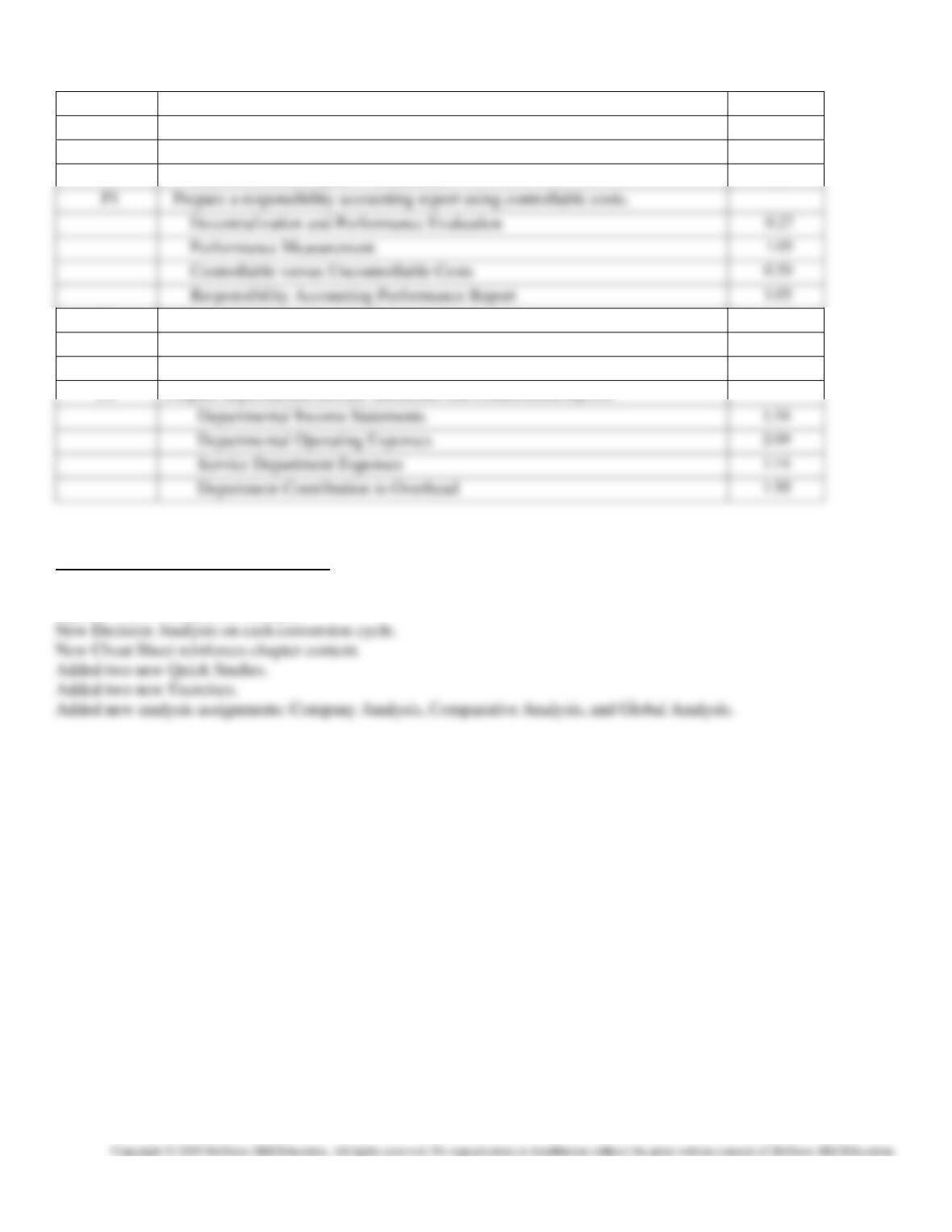
Prepare a responsibility accounting report using controllable costs.
Decentralization and Performance Evaluation
Performance Measurement
1:05
Controllable versus Uncontrollable Costs
Responsibility Accounting Performance Report
P2
Allocate indirect expenses to departments.
Allocating Indirect Expenses
2:24
Allocating Service Department Expenses
0:37
P3
Prepare departmental income statements and contribution reports.
1:34
2:09
1:14
1:50
Synopsis of Chapter Revisions
NEW opener—Jibu and entrepreneurial assignment.
Updated Walt Disney ROI example.
Financial and Managerial Accounting, 8th Edition
22-4
Chapter Outline
I. Responsibility Accounting
A. Performance Evaluation
1. Large companies are easier to manage if divided into smaller units called divisions, segments, or
departments.
2. In decentralized organizations, decisions are made by unit managers rather than top
management.
5. Basis for evaluating performance:
generate income.
II. Controllable versus Uncontrollable Costs
A. Controllable Costs –
1. Those which a manager has the power to determine or at least significantly affect the amount
incurred.
B. Uncontrollable costs –
1. Are not within the manager’s control.
C. Responsibility Accounting Performance Report
1. Reports actual expenses that a manager is responsible for and their budgeted amounts.
a. Management’s analysis of differences between actual and budget often results in corrective
c. Recognizes that control over costs and expenses belongs to several layers of management.
2. Responsibility Accounting Report
Financial and Managerial Accounting, 8th Edition
22-5
III. Profit Centers
A. The responsibility report focuses on how well each department controlled costs and generated
revenues.
B. The departmental income statement is a common way to report profit center performance.
C. When computing department profits, two key accounting challenges involve allocating expenses:
D. Direct and Indirect Expenses
1. Direct Expenses are readily traced to a department.
E. General Model—indirect and service department expenses are allocated across departments
benefiting from them. Allocated using a cause-effect relation. Sometimes hard to identify.
1. Allocated Cost = Total Cost to Allocate x Percentage of Allocation Base Used.
F. Allocating Indirect Expenses – allocation bases vary across departments and organizations. Managers
must use careful judgment in developing allocation bases. Commonly used allocation bases:
G. Service Department expenses – provide support to an organization’s operating departments.
Common allocation bases:
1. Office, personnel, and payroll expenses – allocated based on number of employees in each
department.
Financial and Managerial Accounting, 8th Edition
22-6
H. Departmental Income Statements
1. Departmental income is computed using the following formula: Departmental income = Dept.
sales – Dept. direct expenses – Allocated indirect expenses – Allocated service dept. expenses.
2. Four Steps for allocating costs and preparing departmental income statements:
a. Step one – accumulate revenues, direct and indirect expenses by department. Involves
collecting the necessary data from general company and departmental accounts.
i. Direct and indirect expenses include salaries, depreciation and supplies expenses.
I. Departmental Contribution to Overhead (see Exhibit 22.12)
1. Departmental income statements are not always best for evaluating each profit center’s
performance especially when indirect expenses are a large portion of total expenses.
IV. Investment Center
A. Return-on-Investment and Residual Income
1. Return on investment, return on assets, computed as investment center income / by investment
center average invested assets.
2. Residual income – Expressed in dollars. Encourages division managers to accept all
opportunities that return more than target income. Computed as investment center income –
Financial and Managerial Accounting, 8th Edition
22-7
assets. Expressed as the number of times assets were converted into sales.
4. Nonfinancial Performance Evaluation Measures – using solely financial measures has limitations.
Companies can consider nonfinancial measures to help in evaluating division manager’s
performance.
5. Balanced Scorecard: system of performance measures, including nonfinancial measures used to
V. Decision Analysis Cash Conversion Cycle
A. Effectively managing working capital is important for survival and profit.
1. Accounts receivable, accounts payable, and inventory ratios are used to evaluate performance on
working capital dimensions.
a. Combining these ratios summarize how effectively a company manages its working capital.
2. The cash conversion (or cash-to-cash) cycle measures the average time it takes to convert cash
VI. Appendix 22A – Cost Allocations uses the general model of cost allocation to show how the cost
allocations in Exhibits 22.10 and 22.11 for A-1 Hardware. Rent expense, utilities expense, advertising
expense and insurance expense are allocated first. Then, the two service department’s expenses are
allocated to the three operating departments.
Financial and Managerial Accounting, 8th Edition
22-8
VII. Appendix 22B – Transfer Pricing
The price used to record transfers between divisions in the same company is called a transfer price.
Can be used in cost, profit and investment centers.
A. If there is no excess capacity, the internal supplier will not accept a transfer price less than the
market price. This is called market-based transfer pricing.
VIII. Appendix 22C – Joint Costs
A. Joint Costs⎯the costs incurred to produce or purchase two or more products at the same time;
similar to indirect expense in that it’s shared across more than one cost object.
1. Ignored when deciding to sell product as is or process further.
3. Allocation bases
a. Physical basis⎯allocates joint costs using physical characteristics such as ratio of
Financial and Managerial Accounting, 8th Edition
22-9
Chapter 22 Alternate Demo Problem
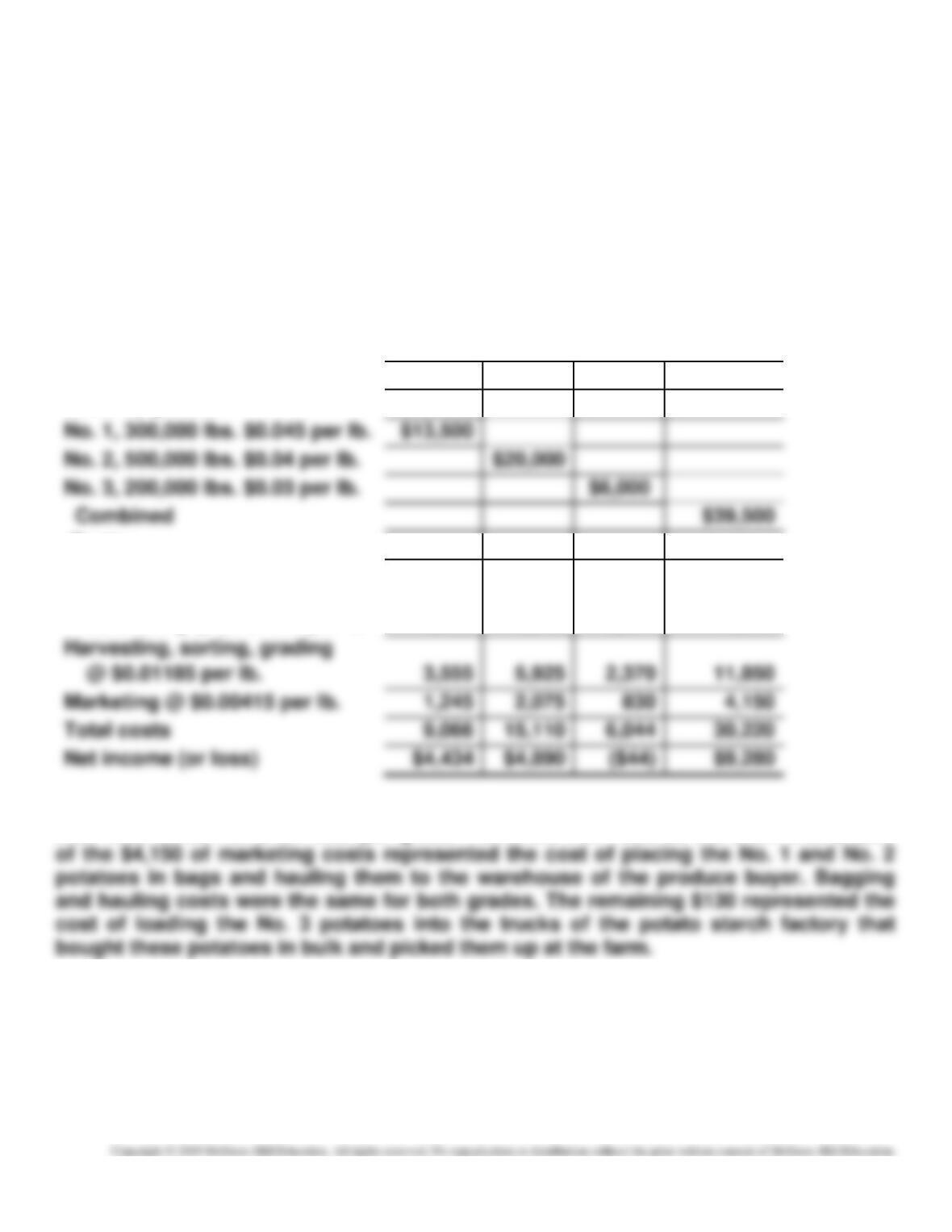
Jack and Susan Roberts own a farm that produces potatoes. Based on a review of the
income statement shown below, Jack remarked that they should have fed the No. 3
potatoes to the pigs; then they would have avoided the loss from the sale of the those
potatoes.
JACK AND SUSAN ROBERTS
Income from the Production and Sale of Potatoes
For Year Ended December 31, 20xx
Results by Grade
No. 1
No. 2
No. 3
Combined
Sales by grades:
Combined
Costs:
Land preparation, seed,
planting,
cultivating @ $0.01422 per lb.
4,266
7,110
2,844
14,220
@ $0.01185 per lb.
3,555
5,925
2,370
11,850
Marketing @ $0.00415 per lb.
1,245
2,075
830
Total costs
Jack and Susan divided their costs among the grades on a per pound basis, because
their records do not show cost per grade. However, their records did show that $4,020
Required:
Prepare an income statement that will better show the results of producing and
marketing the each of the grades of potatoes.
Financial and Managerial Accounting, 8th Edition
22–10
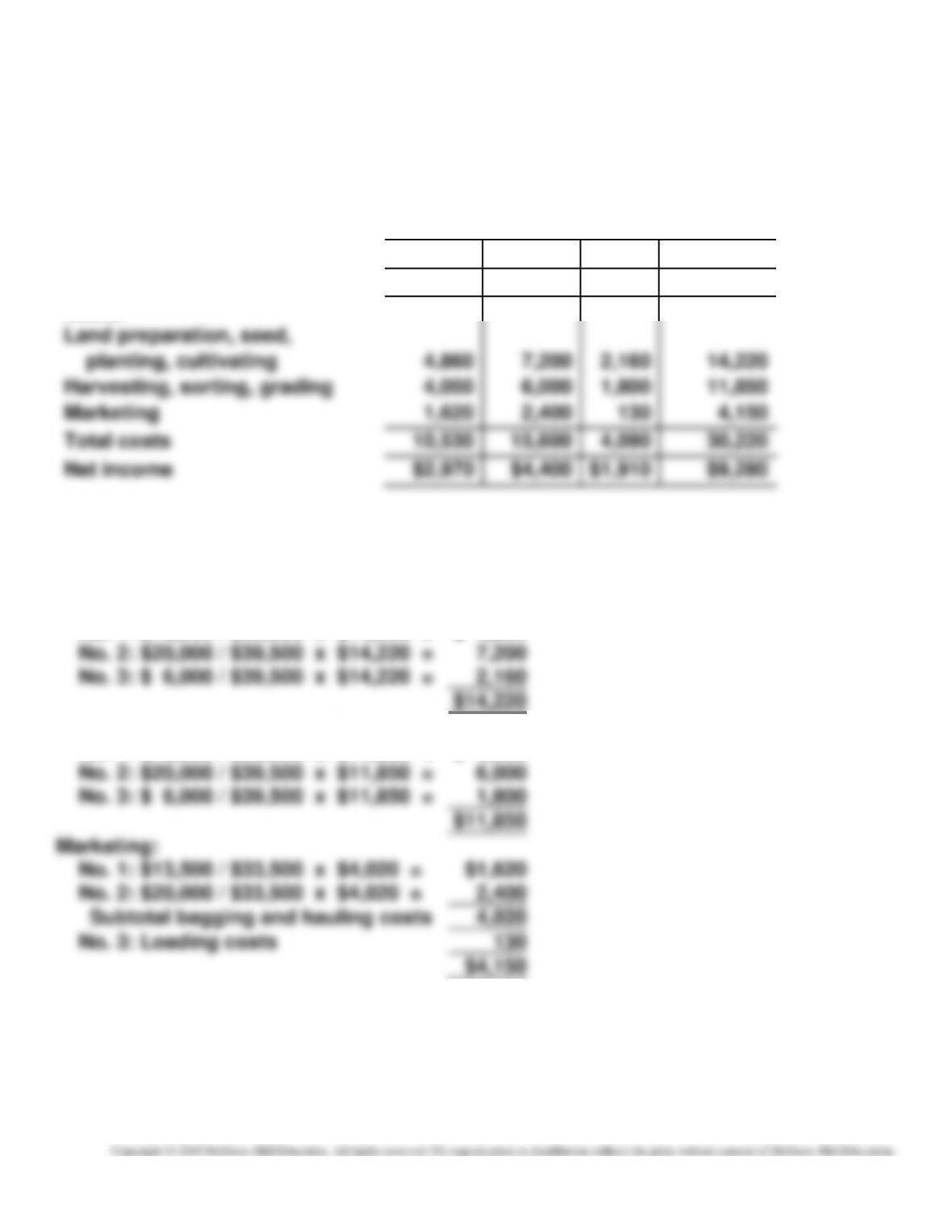
Chapter 22 Alternate Demo Problem: Solution
JACK AND SUSAN ROBERTS
Income from the Production and Sale of Potatoes
For Year Ended December 31, 20xx
Results by Grade
No. 1
No. 2
No. 3
Combined
Revenue from sales:
$13,500
$20,000
$6,000
$39,500
Costs:
Marketing
Total costs
$1,910
COST ALLOCATIONS
Land preparation, seed, planting, and
cultivating:
No. 1: $13,500 / $39,500 x $14,220 =
$ 4,860
Harvesting, sorting, and grading:
No. 1: $13,500 / $39,500 x $11,850 =
$ 4,050