CHAPTER 22
SYSTEMS DESIGN, IMPLEMENTATION, AND OPERATION
SUGGESTED ANSWERS TO DISCUSSION QUESTIONS
22.1 Prism Glass is converting to a new information system. To expedite and speed up
implementation, the CEO asked your consulting team to postpone establishing standards
and controls until after the system is fully operational. How should you respond to the
CEO’s request?
The consulting team should strongly advise the CEO that postponing standards and controls
is not advisable. Rather than save time and money, the company will probably lose time in the
future when unanticipated problems and weaknesses arise due to the lack of standards and
controls. The following are reasons why performance standards and control procedures should be
established before the system becomes operational:
Accounting Information Systems
22-2
22.2 When a company converts from one system to another, many areas within the organization
are affected. Explain how conversion to a new system will affect the following groups, both
individually and collectively.
The following are possible responses to each of the five areas:
a. Personnel: Employees will be affected in at least two important ways.
1. They may be reluctant to accept the new system. They may fear for their jobs, feel as if
they are no longer vital components of the organization, or they may completely reject
the new system, and refuse to utilize it.
b. Data Storage: One of the primary logistical concerns of implementing a new system is
making the required data accessible to the new system. This often requires that files be
converted to new formats and that the company’s databases are restructured to accommodate
Accounting Information Systems
22.3 The following notice was posted in the employee cafeteria on Monday morning:
To: All Accounting and Clerical Employees
From: I.M. Krewel, President
Subject: Termination of Employee Positions
Effective this Friday, all accounting and clerical employees not otherwise contacted will be
terminated. Our new computer system eliminates the need for most of these jobs. We’re
grateful for the loyal service you’ve rendered as employees and wish you success. You may
wish to pick up your final checks on Friday before you go.
Discuss the president’s approach to human resource management.
What are the possible repercussions of this episode?
• Sabotage of the new system by disgruntled employees.
Assuming that job termination is the best alternative available, how should management
approach the situation?
• Management should discuss the situation in person with each employee.
Accounting Information Systems
22-4
22.4 In which phase of the systems development life cycle would each of the following positions
be most actively involved? Justify your answers.
a. Managerial accountant – The managerial accountant is usually involved in the analysis
phase as designers assess their needs as users. The project development team may also ask
Accounting Information Systems
22-5
22.5 During which of the five SDLC stages is each task, labeled (a) through (m), performed?
More than one answer may apply for each activity.
a. Writing operating procedures manuals – Physical (detailed) systems design phase and
Implementation and conversion phase
Accounting Information Systems
22-6
SUGGESTED ANSWERS TO THE PROBLEMS
22.1 You were hired to manage the accounting and control functions at the Glass Jewelry
Company. During your introductory meeting, the president asked you to design and
implement a new AIS within six months. Company sales for the past year were $10 million,
and they are expected to double in the next 18 months.
Outline the procedures you would follow to complete the assigned project.
a. You would perform the following steps to design and implement a new AIS:
• systems analysis (initial investigation, systems survey, feasibility study, and determining
information needs and system requirements)
Include a description of the following:
1. Sources of Information
o company documents (organization charts, job descriptions, and procedure manuals)
2. Methods of Recording Information
o prepare narrative descriptions and organization charts
3. Methods of Verifying the System Description
o discussion with users
Accounting Information Systems
22-7
b. The accounts payable system will contain a number of programs, including Enter
Invoices and Print Payable Checks. For each program, describe its purpose and outline
application control considerations.
1. Enter Invoices
This program permits operators to enter unpaid vendor invoices into the Accounts
Payable system. The program should enable the distribution of the invoice to specific
2. Print Payable Checks
This program generates supplier checks to pay outstanding invoices. Controls include:
o ensures that the vendor number on the invoice is valid (i.e., vendor is still on file)
Accounting Information Systems
22.2 Wang Lab’s tremendous growth left the company with a serious problem. Customers would
often wait months for Wang to fill orders and process invoices. Repeated attempts by
Wang’s understaffed IS department to solve these problems met with failure. Finally, Wang
hired a consulting firm to solve its revenue tracking problems and expedite prompt receipt
of payments. The 18-month project turned into a doubly long nightmare. After three years
and $10 million, the consultants were dismissed from the unfinished project.
The project failed for many reasons. The systems development process was so dynamic that
the failure to complete the project quickly became self-defeating as modifications took over
the original design. Second, management did not have a clear vision of the new AIS and
lacked a strong support staff. As a result, a number of incompatible tracking systems
sprang from the company’s distributed computer system. Third, the project was too large
and complex for the consulting firm, who had little experience with the complex database at
the heart of the new system. Finally, the project had too many applications.
Interdependencies among subprograms left consultants with few completed programs.
Every program was linked to several subprograms, which in turn were linked to several
other programs. Programmers eventually found themselves lost in a morass of subroutines
with no completed program.
The IS department finally developed a system to solve the problem, but their revenue
tracking system suffered quality problems for years.
Wang Labs asked you, a member of the IS staff, to write a memo explaining the failure of
the systems development project.
a. Why did the development project fail? What role did the consultants play in the
failure?
• Dynamic requirements. The development process was so dynamic that the failure to
b. Identify the organizational issues that management must address in the future.
• Management should develop a unified strategic information plan. Organizations
should reinforce their business strategy with a complementary information strategy.
Accounting Information Systems
c. Recommend steps the company could take to guarantee consulting service quality.
• Wang should improve existing development policies. Wang must first establish its
internal development policies that govern the systems development process. For
Accounting Information Systems
22–10
22.3 Tiny Toddlers, a manufacturer of children’s toys and furniture, is designing and
implementing a distributed system to assist its sales force. Each of the 10 sales offices in
Canada and 20 in the United States maintains its own customers and is responsible for
granting credit and collecting receivables. Reports used by each sales office to maintain the
customer master file and to enter the daily sales orders are shown in Figures 22-4 and 22-5.
Evaluate the reports shown in Figures 22-4 and 22-5 using the following format:
Weakness Explanation Recommendation(s)
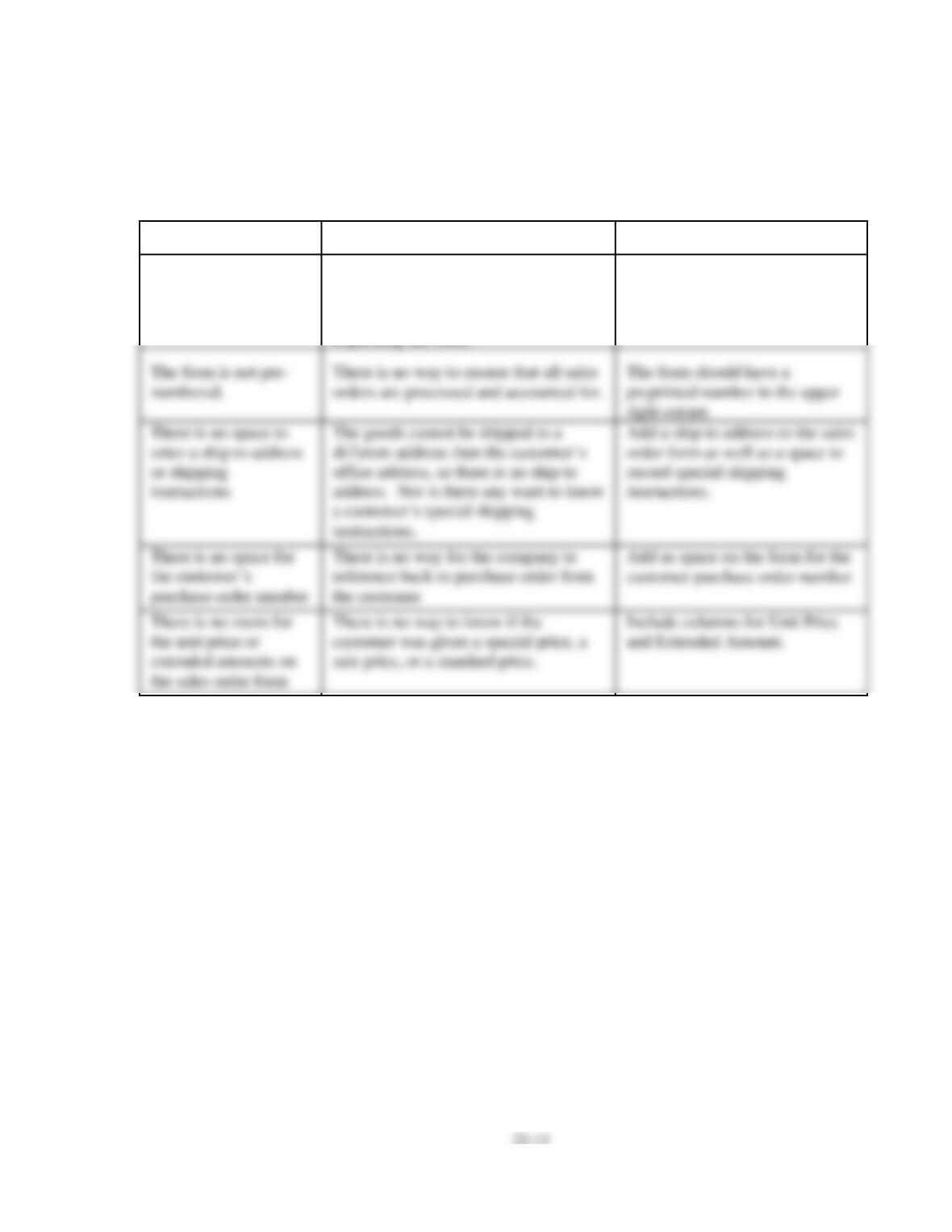
Customer Maintenance Form
Weakness
Explanation
Recommendation(s)
No fields for recording a
new customer’s phone
number, email address,
or website.
Tiny Toddlers cannot call or
email the customer or visit their
website without this data.
The form should have fields for this
information after the address
information.
There is no space
provided for recording
date the form is created
(or the effective date of
the change).
The company would not know the
effective date of the change nor
when the form was created.
An effective change date should be
added to this report. If the effective
change date can be different from
the date the form is created, a field
for that date should also be
Accounting Information Systems
22.3 (continued)
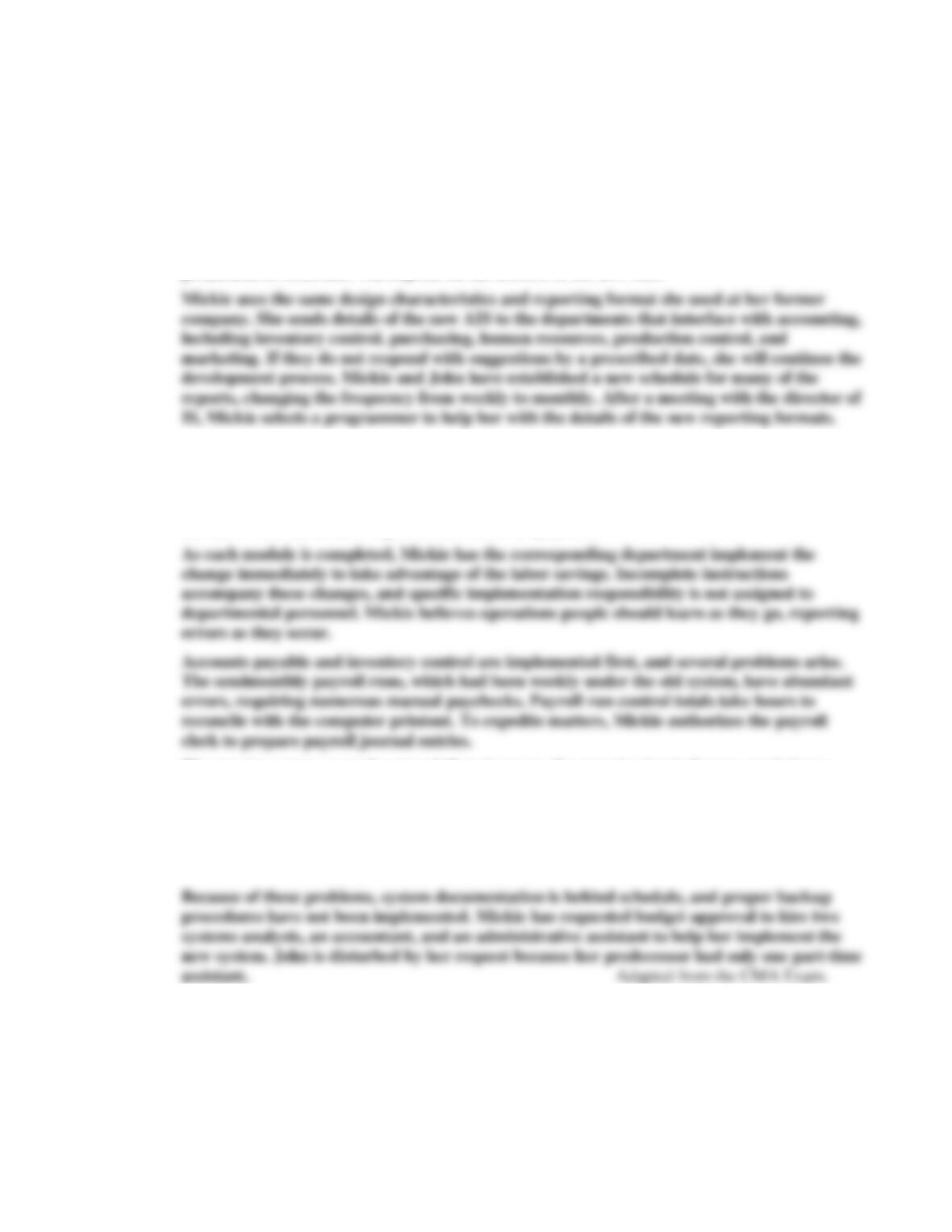
Sales Order Form
Weakness
Explanation
Recommendation(s)
There is no indication
that the customer
approves of the order.
Where possible, all orders should be
signed by the customer to ensure that
the customer is responsible for
requesting the order.
Provision should be provided on
the form for the customer’s order
approval.
Some students may refer to the sales order form shown in the Revenue Cycle chapter.
Accounting Information Systems
22–12
22.4 Mickie Louderman is the new assistant controller of Pickens Publishers. She was the
controller of a company in a similar industry, where she was in charge of accounting and had
considerable influence over computer center operations. Pickens wants to revamp its
information system, placing increased emphasis on decentralized data access and online
systems. John Richards, the controller, is near retirement. He has put Mickie in charge of
developing a new system that integrates the company’s accounting-related functions. Her
promotion to controller will depend on the success of the new AIS.
Most control features of the old system are maintained to decrease the installation time, with
a few new ones added for unusual situations. The procedures for maintaining the controls are
substantially changed. Mickie makes all the AIS control change and program-testing
decisions, including screening the control features related to payroll, inventory control,
accounts receivable, cash deposits, and accounts payable.
The new inventory control system fails to improve the carrying level of many stock items.
This causes critical stock outs of raw material that result in expensive rush orders. The new
system’s primary control procedure is the availability of ordering and user information. The
information is available to both inventory control and purchasing personnel so that both
departments can issue timely purchase orders. Because the inventory levels are updated daily,
Mickie discontinues the previous weekly report.
a. List the steps Mickie should have taken during while designing the AIS to ensure that
end-user needs were satisfied.
• Interviews should have been conducted with users affected by the changes to understand
existing system and business processes, what organizational units are affected by the
changes, procedures used to provide information, decision users make and the
Accounting Information Systems
22–13
information needed to make them, current problems users face, needed improvements,
and future information needs
• Mickie and John should not take upon themselves the responsibility of determining what
information users need or when they need it. They should not have established a new
schedule for many of the reports, changing the frequency from weekly to monthly.
• Mickie should not have assumed that the control features of the old system were
sufficient in the new system. While this may save time, it does not ensure adequate
controls. Mickie should not change the procedures for maintaining the controls without
user input and approval. In fact, all controls issues should be approved by the users.
• Incomplete instructions accompanied the changes, and specific implementation
responsibility was not assigned to departmental personnel. That, and Mickie’s belief that
operations people should learn as they go and report errors as they occur, is very bad
development policy.
• Documentation should be complete and back up procedures should be in place before a
systems conversion takes place.
b. Identify and describe three ways Mickie violated internal control principles during the
AIS implementation.
• Most of the control features of the “old” system were retained in the “new” system;