22-21
22-25 (20 min.) Transfer-pricing dispute.
The Kelly-Elias Corporation, manufacturer of tractors and other heavy farm equipment, is
organized along decentralized product lines, with each manufacturing division operating as a
separate profit center. Each division manager has been delegated full authority on all decisions
involving the sale of that division’s output both to outsiders and to other divisions of Kelly-Elias.
Division C has in the past always purchased its requirement of a particular tractor–engine
component from division A. However, when informed that division A is increasing its selling
price to $135, division C’s manager decides to purchase the engine component from external
suppliers.
Division C can purchase the component for $115 per unit in the open market. Division A
insists that, because of the recent installation of some highly specialized equipment and the
resulting high depreciation charges, it will not be able to earn an adequate return on its
investment unless it raises its price. Division A’s manager appeals to top management of Kelly–
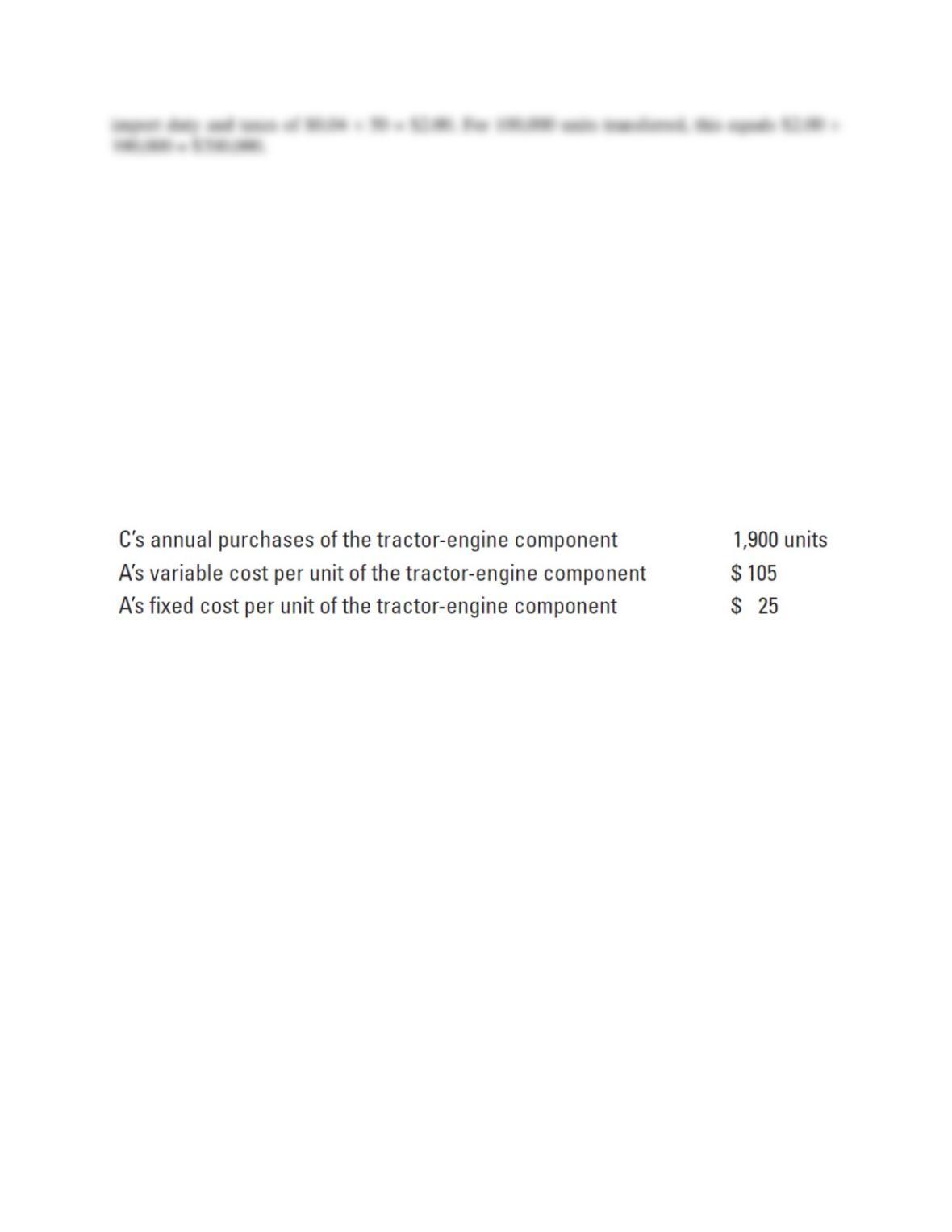
Elias for support in the dispute with division C and supplies the following operating data:
Required:
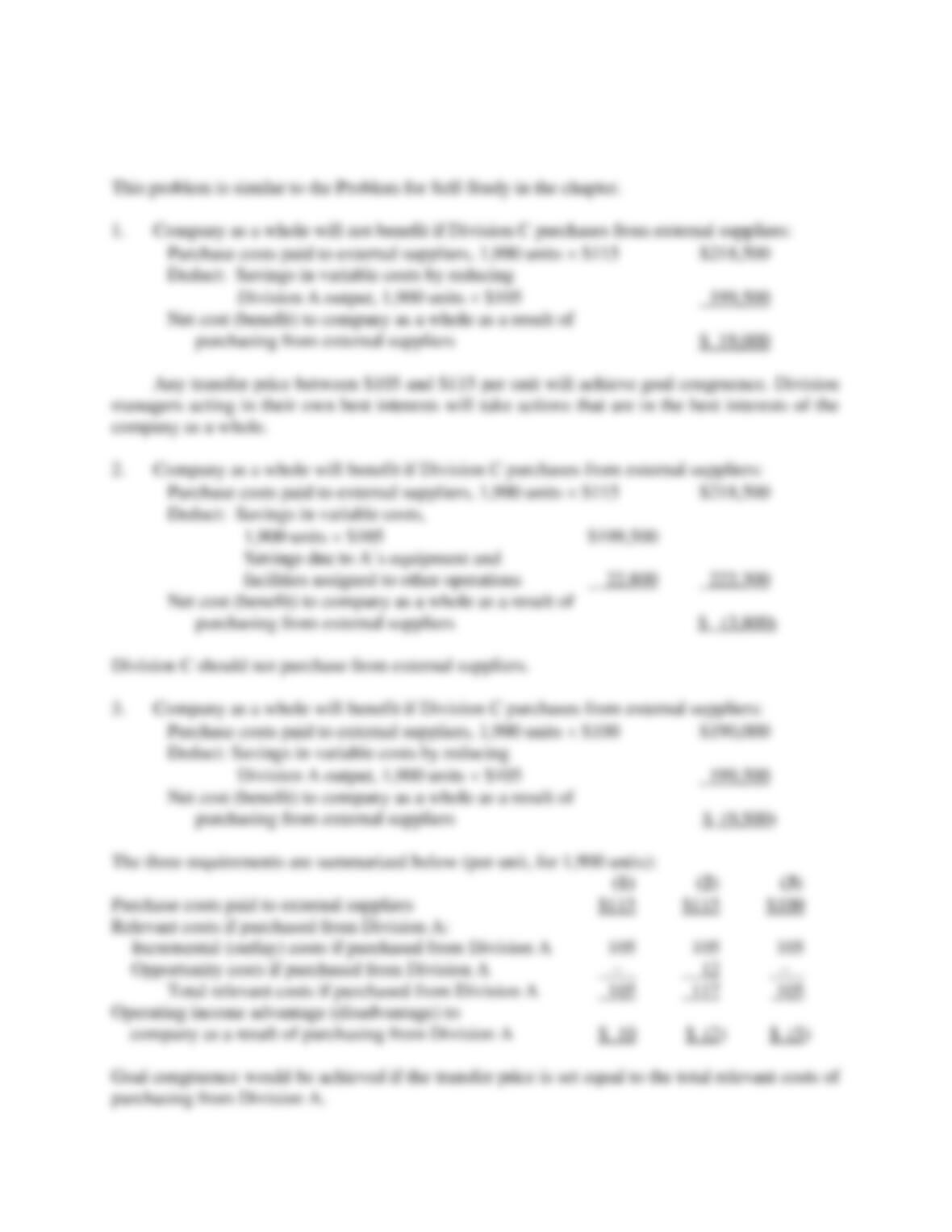
1. Assume that there are no alternative uses for internal facilities of division A. Determine
whether the company as a whole will benefit if division C purchases the component from
external suppliers for $115 per unit. What should the transfer price for the component be set
at so that division managers acting in their own divisions’ best interests take actions that are
also in the best interest of the company as a whole?
2. Assume that internal facilities of division A would not otherwise be idle. By not producing
the 1,900 units for division C, division A’s equipment and other facilities would be used for
other production operations that would result in annual cash-operating savings of $22,800.
Should division C purchase from external suppliers? Show your computations.
3. Assume that there are no alternative uses for division A’s internal facilities and that the price
from outsiders drops $15. Should division C purchase from external suppliers? What should
the transfer price for the component be set at so that division managers acting in their own
divisions’ best interests take actions that are also in the best interest of the company as a
whole?
22-22
SOLUTION
22-23
22-24
22-26 (5 min.) Transfer-pricing problem (continuation of 22-25).
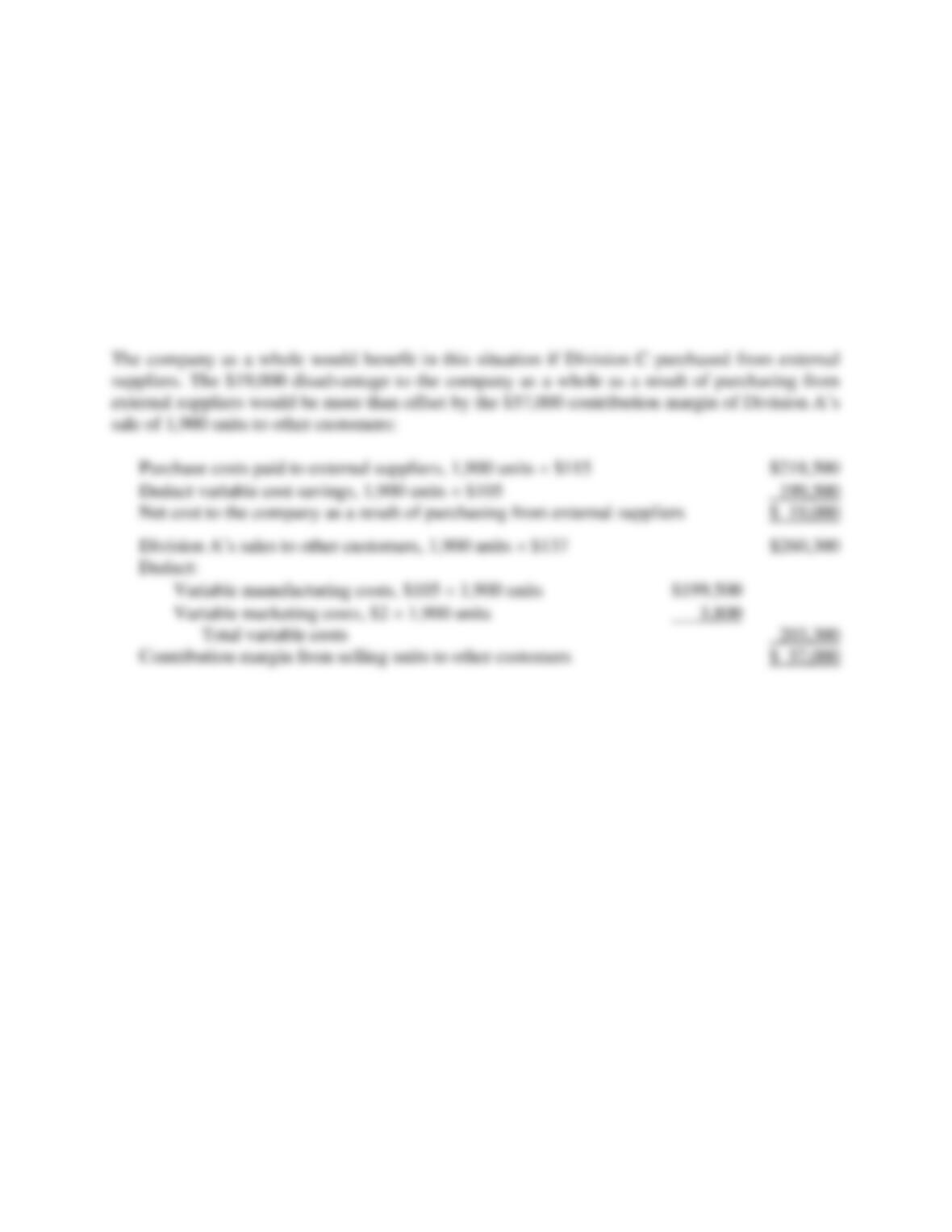
Refer to Exercise 22-25. Assume that division A can sell the 1,900 units to other customers at
$137 per unit, with variable marketing cost of $2 per unit.
Required:
Determine whether Kelly-Elias will benefit if division C purchases the 1,900 units from external
suppliers at $115 per unit. Show your computations.
SOLUTION
22-25
22-27 (20 min.) General guideline, transfer pricing.
The Slate Company manufactures and sells television sets. Its assembly division (AD) buys
television screens from the screen division (SD) and assembles the TV sets. The SD, which is
operating at capacity, incurs an incremental manufacturing cost of $65 per screen. The SD can
sell all its output to the outside market at a price of $100 per screen, after incurring a variable
marketing and distribution cost of $8 per screen. If the AD purchases screens from outside
suppliers at a price of $100 per screen, it will incur a variable purchasing cost of $7 per screen.
Slate’s division managers can act autonomously to maximize their own division’s operating
income.
Required:
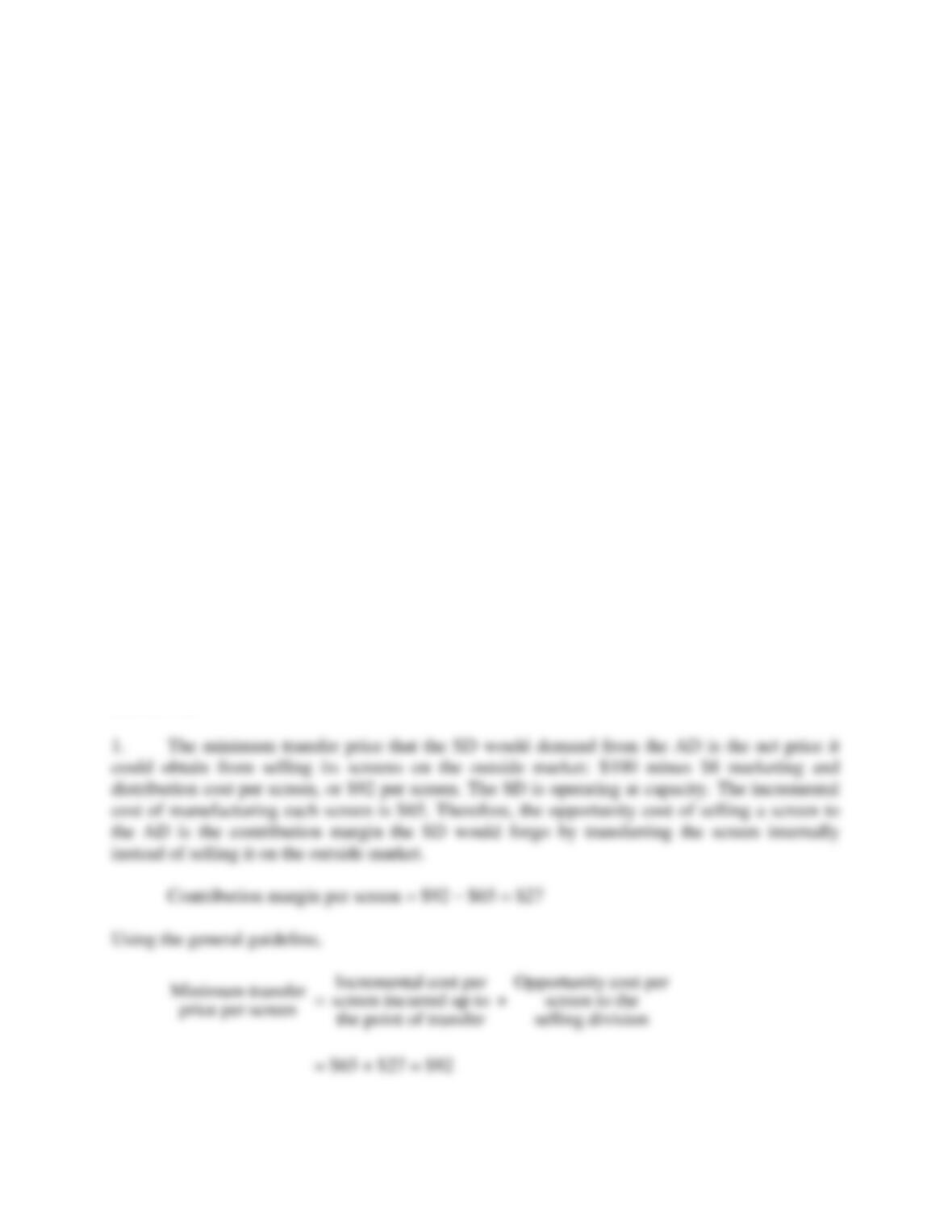
1. What is the minimum transfer price at which the SD manager would be willing to sell screens
to the AD?
2. What is the maximum transfer price at which the AD manager would be willing to purchase
screens from the SD?
3. Now suppose that the SD can sell only 70% of its output capacity of 20,000 screens per
month on the open market. Capacity cannot be reduced in the short run. The AD can
assemble and sell more than 20,000 TV sets per month.
a. What is the minimum transfer price at which the SD manager would be willing to sell
screens to the AD?
b. From the point of view of Slate’s management, how much of the SD output should be
transferred to the AD?
c. If Slate mandates the SD and AD managers to “split the difference” on the minimum and
maximum transfer prices they would be willing to negotiate over, what would be the
resulting transfer price? Does this price achieve the outcome desired in requirement 3b?
SOLUTION
22-26
22-27
22-28 (20–30 min.) Pertinent transfer price, perfect and imperfect markets.
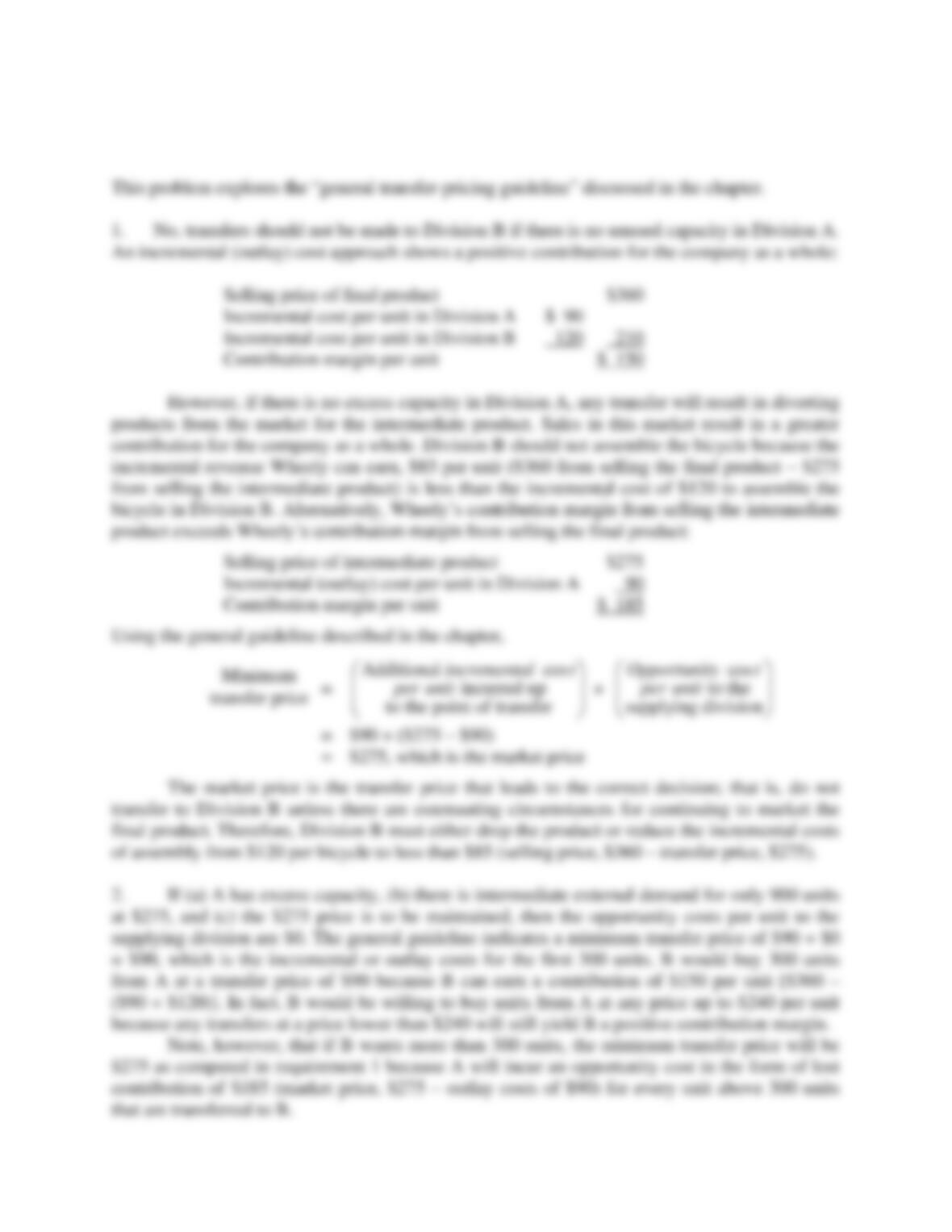
Wheely, Inc., has two divisions, A and B, that manufacture expensive bicycles. Division A
produces the bicycle frame, and division B assembles the rest of the bicycle onto the frame.
There is a market for both the subassembly and the final product. Each division has been
designated as a profit center. The transfer price for the subassembly has been set at the long-run
average market price. The following data are available for each division:
The manager of division B has made the following calculation:
Required:
1. Should transfers be made to division B if there is no unused capacity in division A? Is the
market price the correct transfer price? Show your computations.
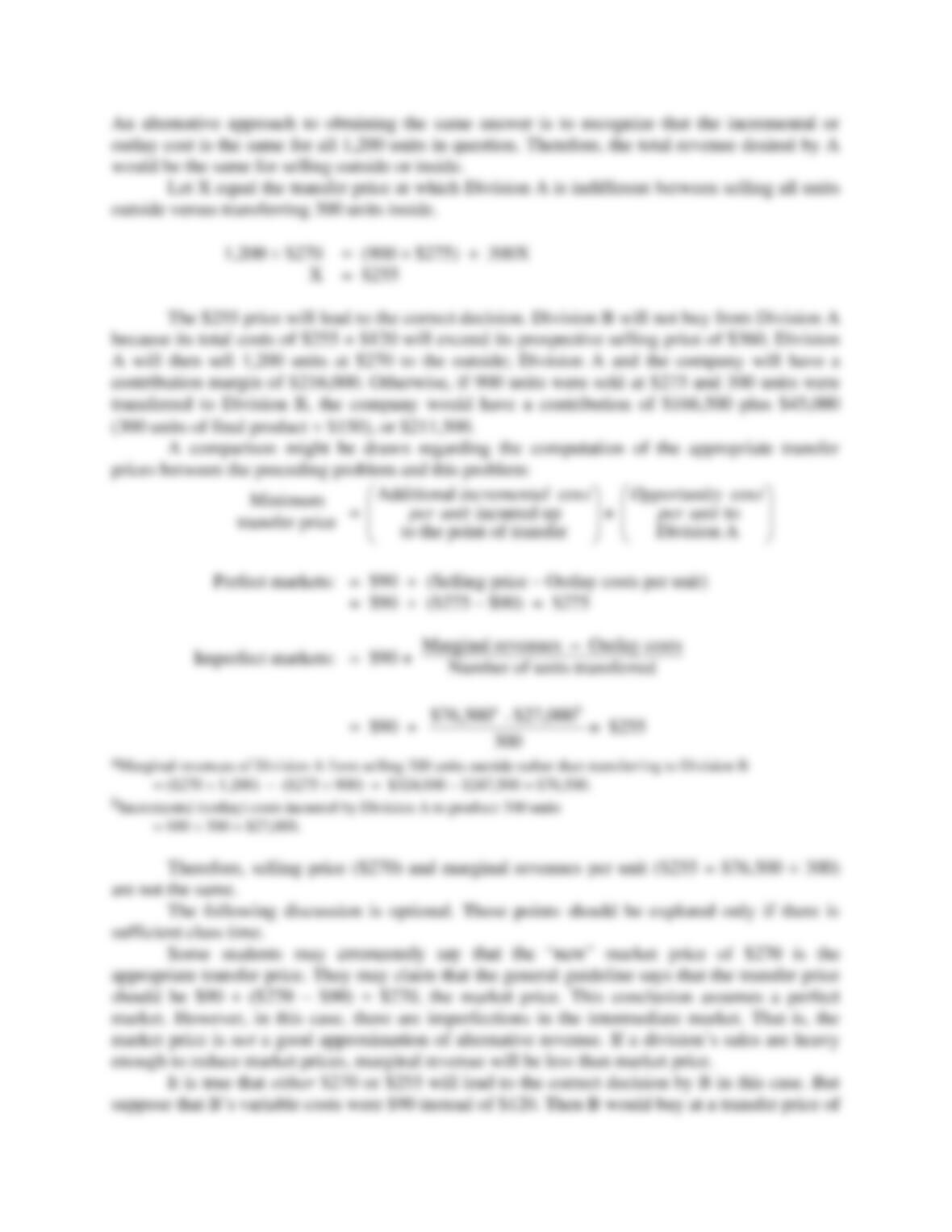
2. Assume that division A’s maximum capacity for this product is 1,200 units per month and
sales to the intermediate market are now 900 units. Should 300 units be transferred to
division B? At what transfer price? Assume that for a variety of reasons, division A will
maintain the $275 selling price indefinitely. That is, division A is not considering lowering
the price to outsiders even if idle capacity exists.
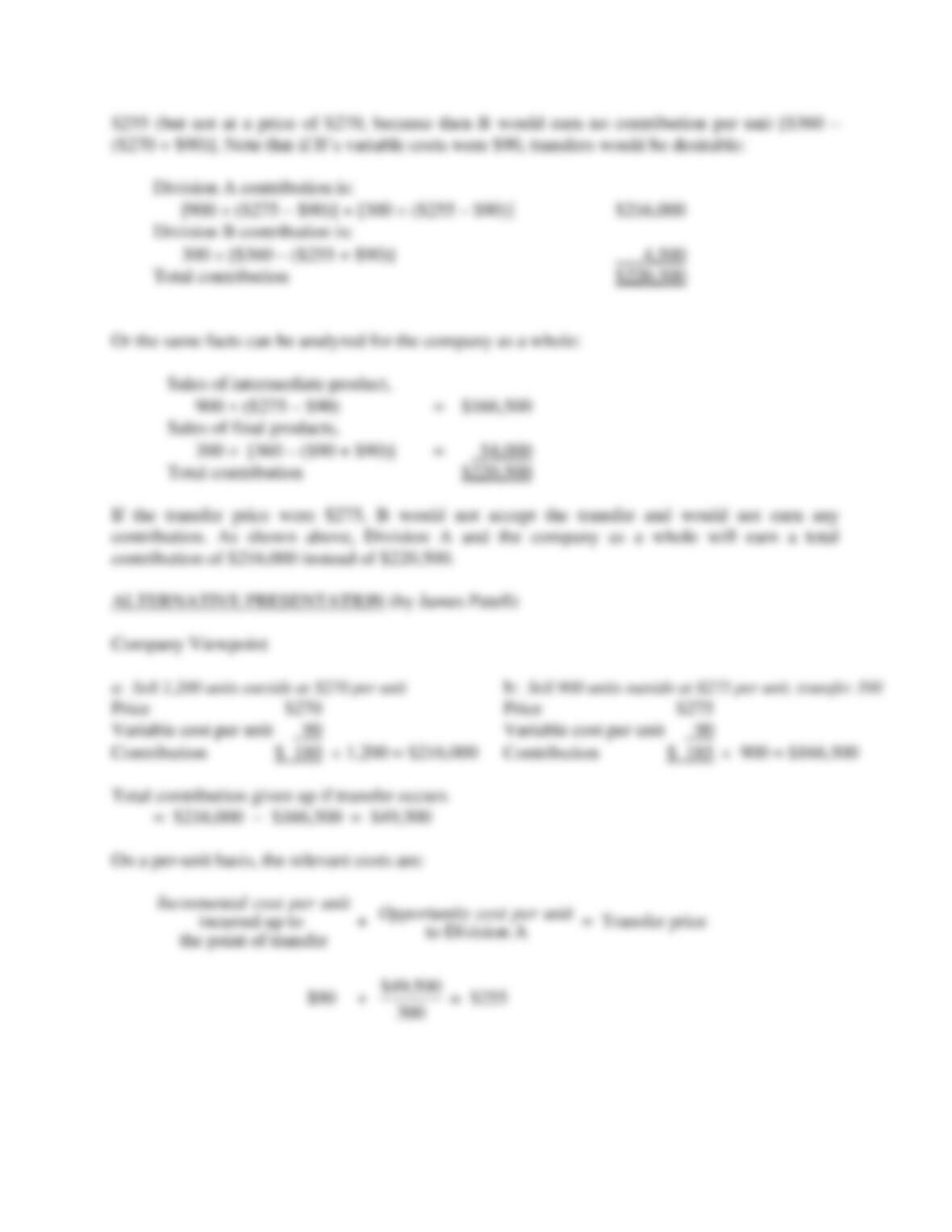
3. Suppose division A quoted a transfer price of $240 for up to 300 units. What would be the
contribution to the company as a whole if a transfer were made? As manager of division B,
would you be inclined to buy at $240? Explain.
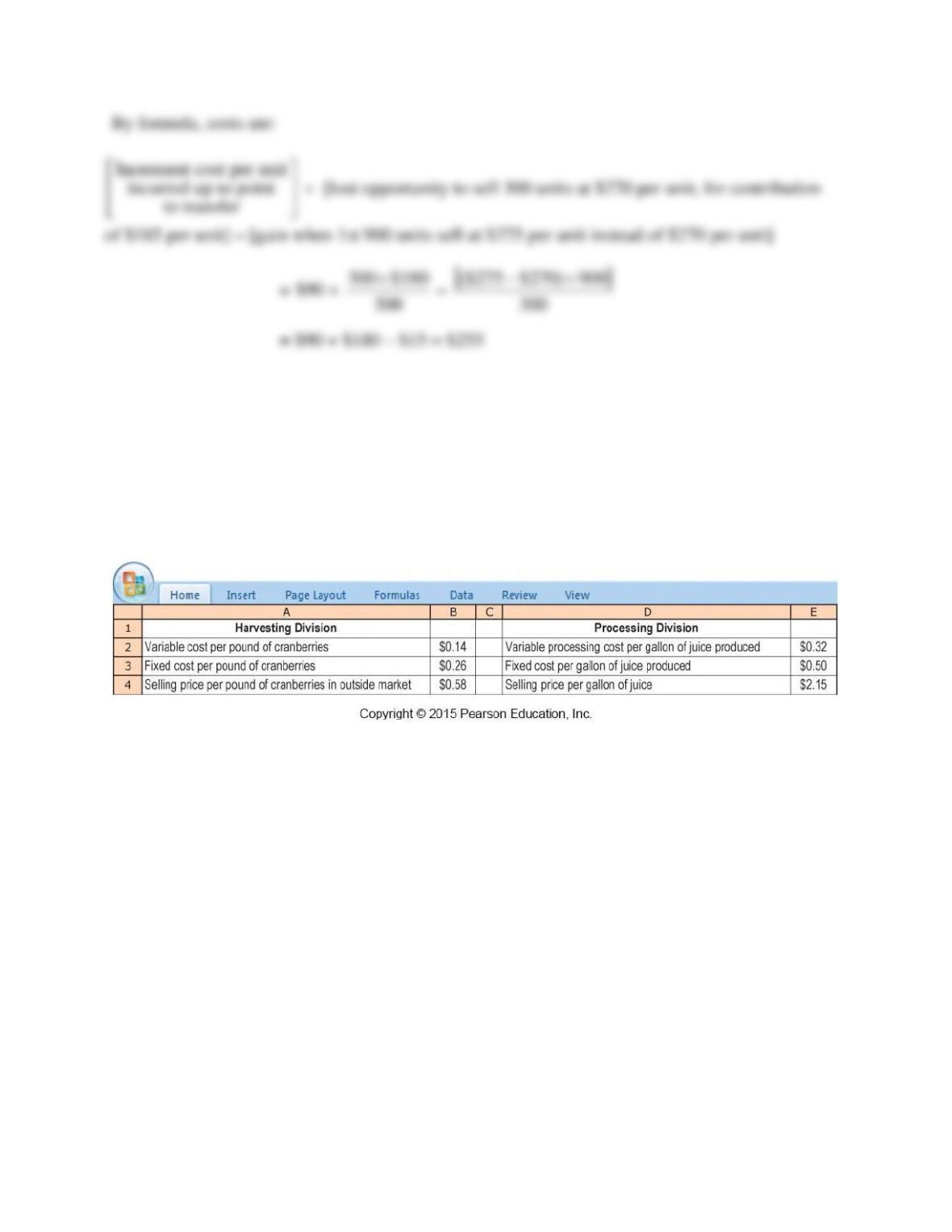
4. Suppose the manager of division A has the option of (a) cutting the external price to $270,
with the certainty that sales will rise to 1,200 units, or (b) maintaining the external price of
$275 for the 900 units and transferring the 300 units to division B at a price that would
produce the same operating income for division A. What transfer price would produce the
same operating income for division A? Is that price consistent with that recommended by the
general guideline in the chapter so that the resulting decision would be desirable for the
company as a whole?
22-28
SOLUTION
22-29
22-30
22-31
22-32
22-29 (30–35 min.) Effect of alternative transfer-pricing methods on division operating
income.
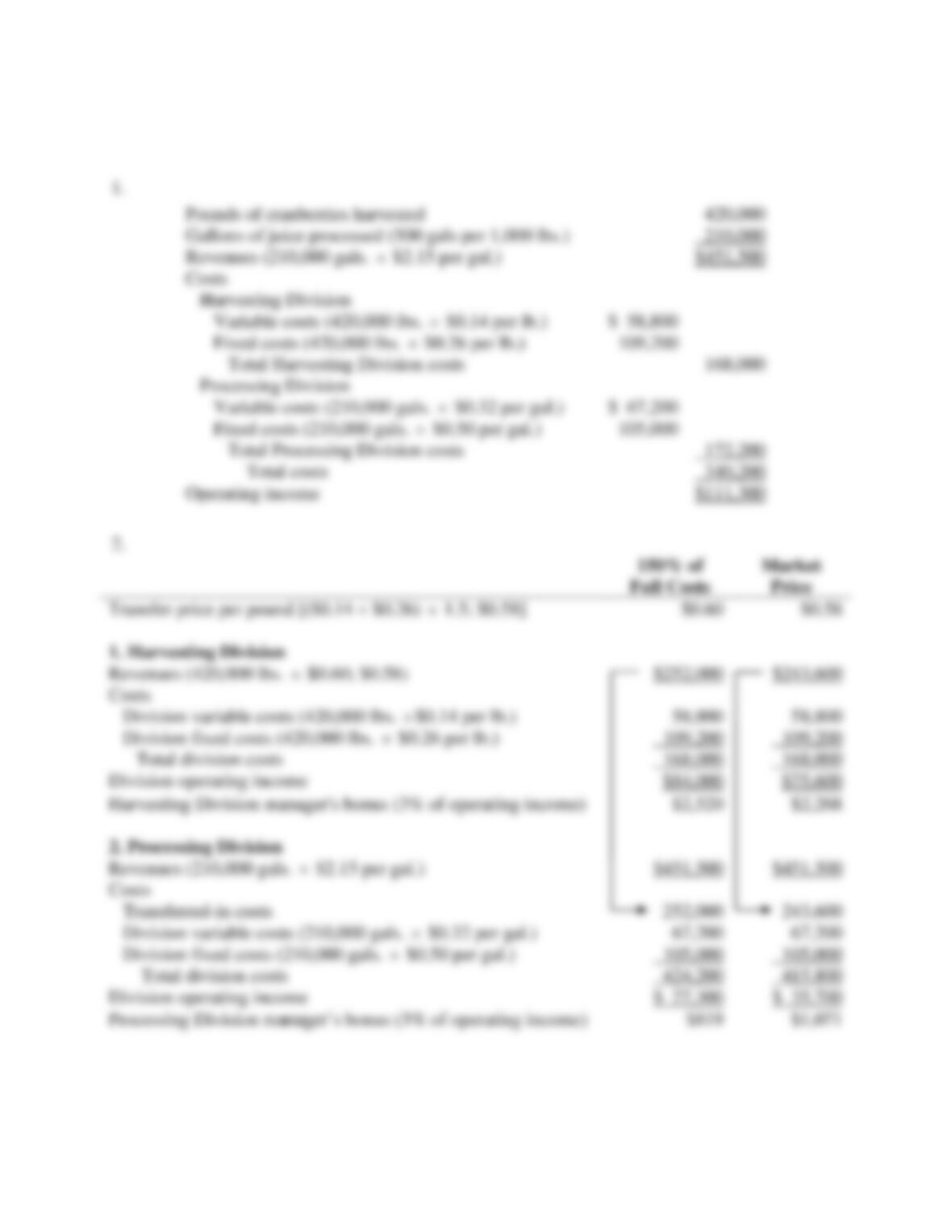
Cranergy Products is a cranberry cooperative that operates two divisions, a harvesting division
and a processing division. Currently, all of harvesting’s output is converted into cranberry juice
by the processing division, and the juice is sold to large beverage companies that produce
cranberry juice blends. The processing division has a yield of 500 gallons of juice per 1,000
pounds of cranberries. Cost and market price data for the two divisions are as follows:
Required:
1. Compute Cranergy’s operating income from harvesting 420,000 pounds of cranberries during
June 2014 and processing them into juice.
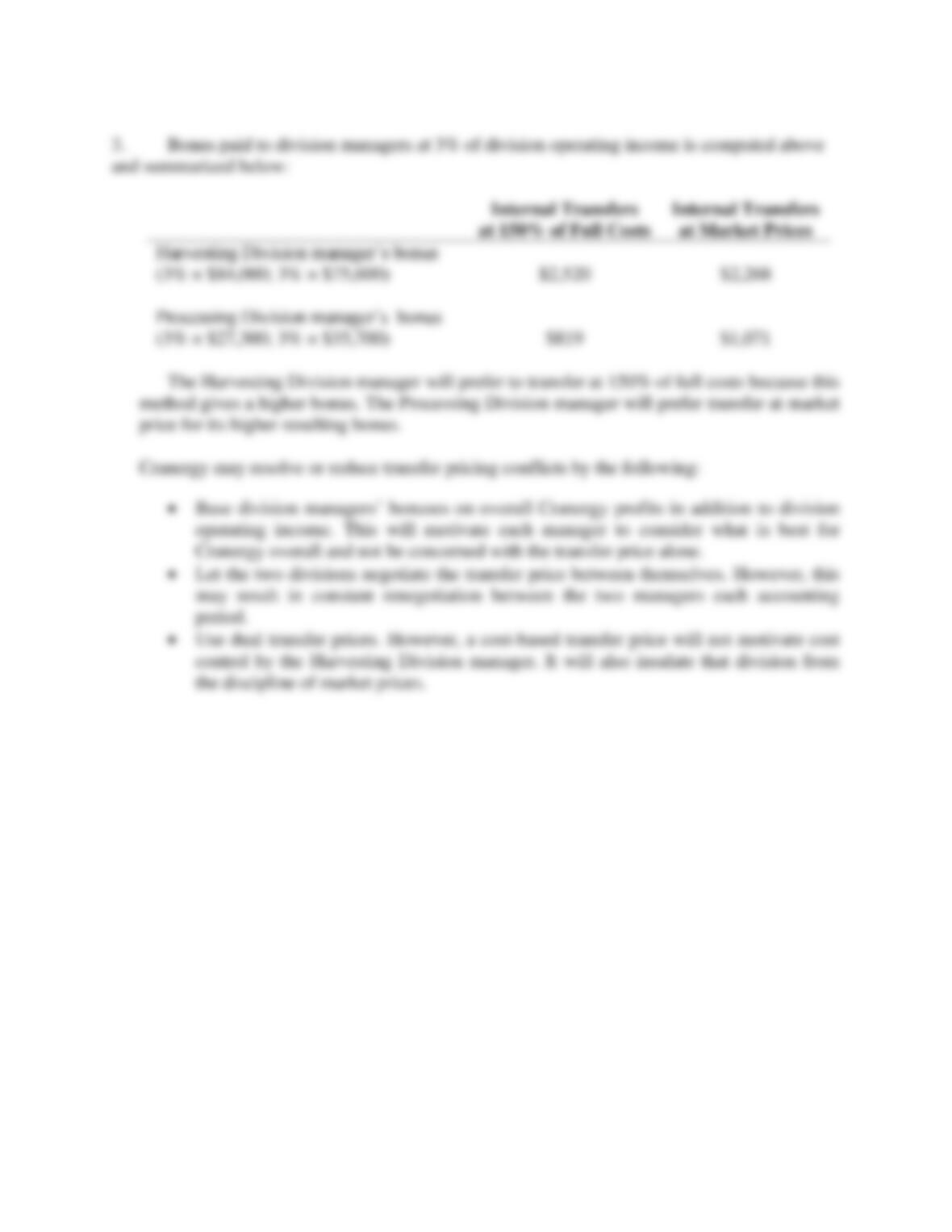
2. Cranergy rewards its division managers with a bonus equal to 3% of operating income.
Compute the bonus earned by each division manager in June 2014 for each of the following
transfer pricing methods:
a. 150% of full cost
b. Market price
3. Which transfer-pricing method will each division manager prefer? How might Cranergy
resolve any conflicts that may arise on the issue of transfer pricing?
22-33
SOLUTION
22-34
22-30 (25 min.) Goal congruence problems with cost-plus transfer-pricing methods, dual
pricing system (continuation of 22-29).
Assume that Pat Borges, CEO of Cranergy, had mandated a transfer price equal to 150% of full
cost. Now he decides to decentralize some management decisions and sends around a memo that
states the following: “Effective immediately, each division of Cranergy is free to make its own
decisions regarding the purchase of direct materials and the sale of finished products.”
Required:
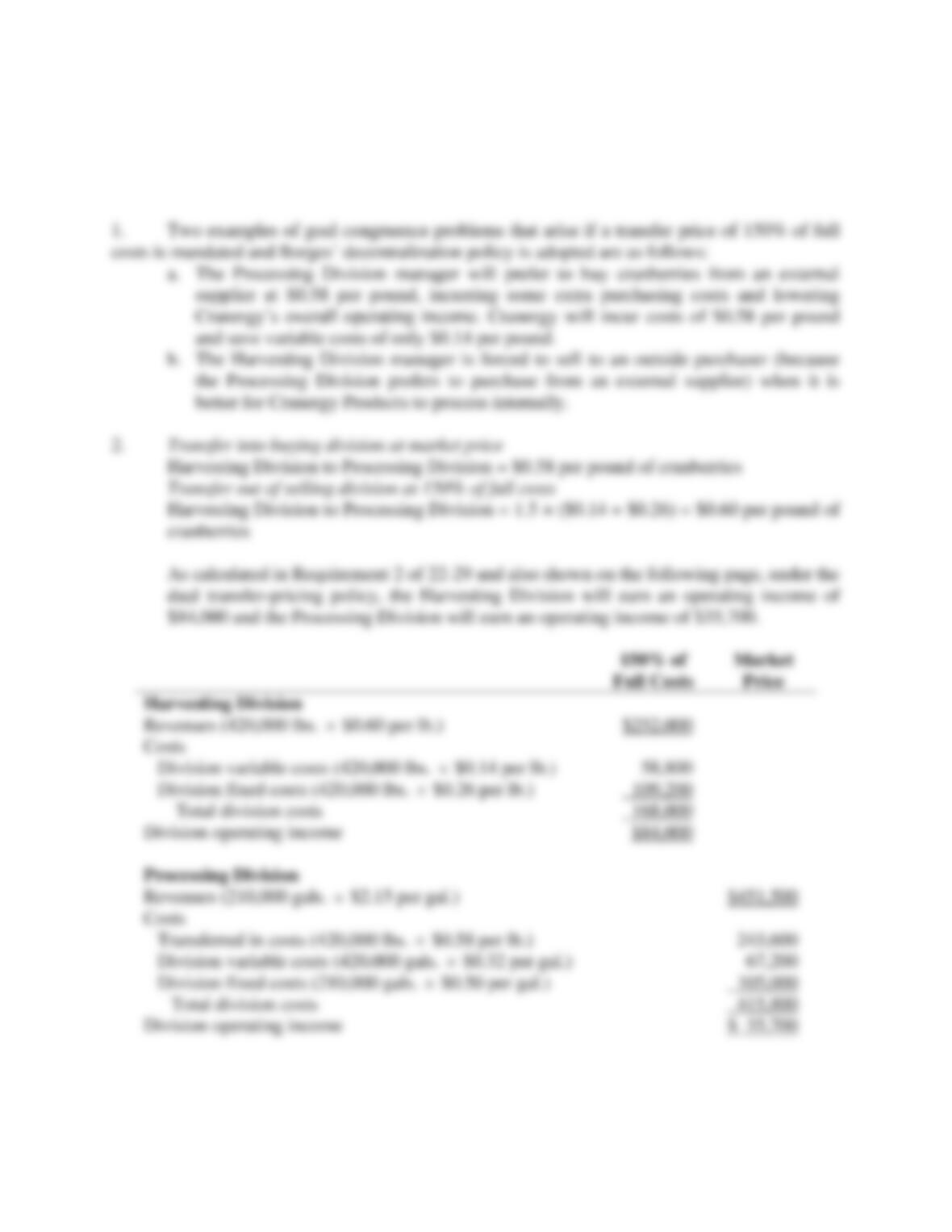
1. Give an example of a goal-congruence problem that will arise if Cranergy continues to use a
transfer price of 150% of full cost and Borges’s decentralization policy is adopted.
2. Borges feels that a dual transfer-pricing policy will improve goal congruence. He suggests
that transfers out of the harvesting division be made at 150% of full cost and transfers into
the processing division be made at market price. Compute the operating income of each
division under this dual transfer-pricing method when 420,000 pounds of cranberries are
harvested during June 2014 and processed into juice.
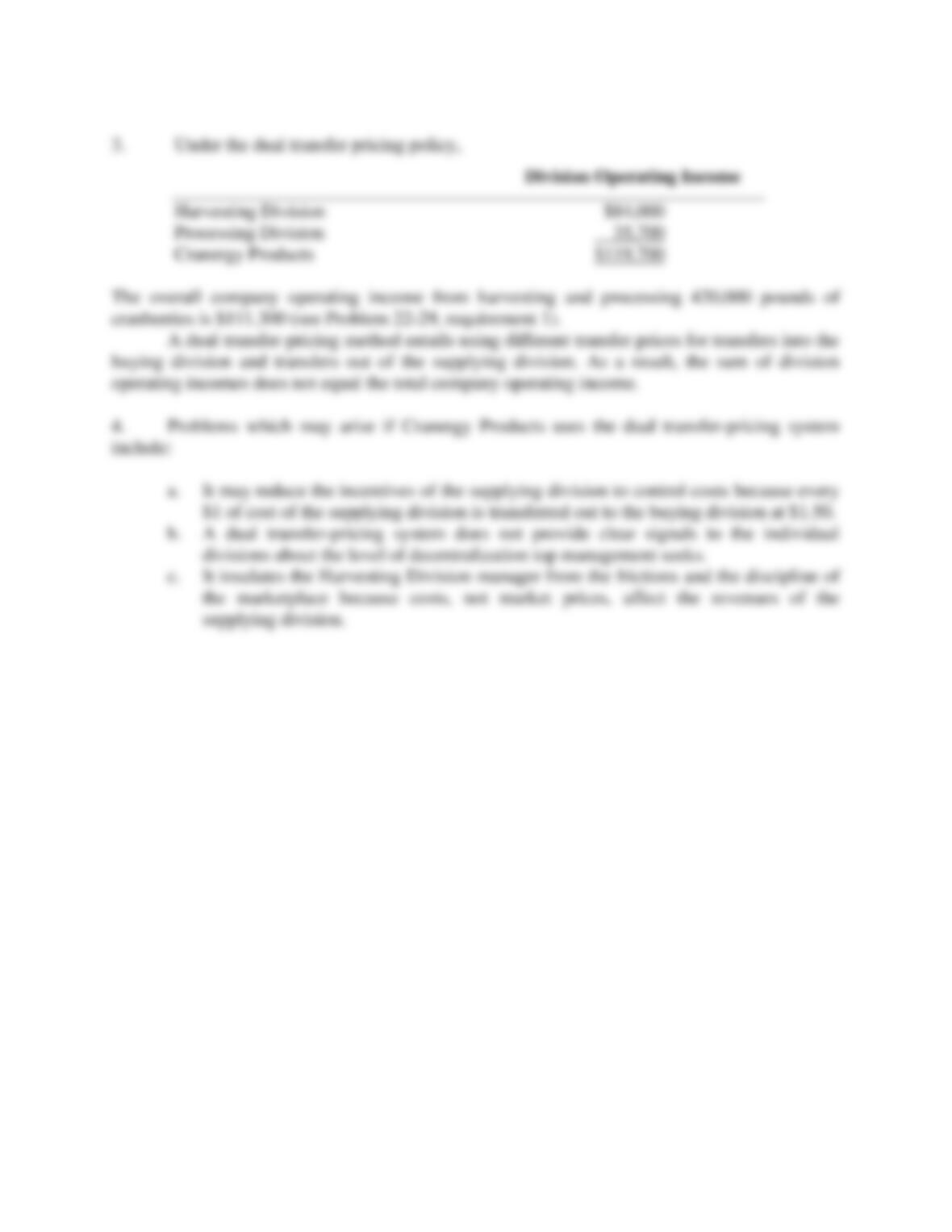
3. Why is the sum of the division operating incomes computed in requirement 2 different from
Cranergy’s operating income from harvesting and processing 420,000 pounds of cranberries?
22-35
4. Suggest two problems that may arise if Cranergy implements the dual transfer prices
described in requirement 2.
SOLUTION
22-36