chapter
22
Budgeting
______________________________________________
OPENING COMMENTS
Chapter 22 emphasizes accounting activities that help managers plan, direct, and control the operations of
a business. Budgeting is used to establish business goals in the planning function. Budgets help guide
managers’ operational decisions. Budgets are also used to control operations as actual results are
compared to the budgeted results.
After studying the chapter, your students should be able to:
2. Describe the basic elements of the budget process, the two major types of budgeting, and the use of
computers in budgeting.
4. Prepare the basic income statement budgets for a manufacturing company.
5. Prepare balance sheet budgets for a manufacturing company.
STUDENT FAQS
• Since budgets are estimates made before a period begins and may prove wrong, are they worth the
time and effort put into them?
• Why are the cash budget and the capital expenditures budget so important from the balance sheet
budgeting process?
• In a production budget, the volume of production is the first thing to calculate, but deducting the
estimated units in beginning inventory and adding the desired units in ending inventory seems
opposite. Can you explain so I can understand better?
• How do you calculate manufacturing cost?
64 Chapter 22 Budgeting
• The cost of goods sold budget is so long. Why do you expect us to learn to calculate it without the
formula written out?
OBJECTIVE 1
Describe budgeting, its objectives, and its impact on human behavior.
KEY TERMS
Budgets Goal Conflict
Budgetary Slack Responsibility Center
SUGGESTED APPROACH
A budget is used to plan and control operational departments and divisions. Review this explanation and
stress the following points:
2. Directing involves decisions and actions to achieve the budgeted goals.
4. Budgets are most effective if:
a. Employees help set goals they are expected to achieve.
b. Budgets are realistic, not too strict.
c. Budgets are not “padded” or too loose.
d. Budgets do not encourage employees to act in ways that conflict with business goals.
An example of goal conflict can be taken from the way many instructors assign course grades. There may
be a conflict if the instructor wants students to participate in class discussions, but bases course grades
strictly on exam scores.
CLASS DISCUSSION — Human Behavior and Budgeting
Ask your students to share examples from their own experiences where budgets caused employees to act
in a manner that hurt the performance or profitability of their organization. After accumulating your
students’ ideas, add observations from your own experience. For example, there is usually no incentive
for managers to spend less than their allowed budget, since it will be difficult to negotiate a higher budget
the next year. As a result, managers frequently “spend the budget” as the fiscal year closes.
WRITING EXERCISE — Evaluating Budgeting Procedures
Ask your students to write an answer to the following question (Transparency Master [TM] 22-1).
Chapter 22 Budgeting 65
Pretorious Manufacturing has just hired a new controller, Diana Metcalf. During her first
week on the job, Diana was asked to establish a budget for operating expenses in 2014.
Since Diana was not yet familiar with the operations of Pretorious Manufacturing, she
decided to budget these expenses using the same procedures as the prior controller.
Therefore, in order to establish a budget for operating expenses, Diana started with actual
operating expenses incurred in 2013 and added 4.3 percent. Diana based this percentage
on inflation as measured by the consumer price index.
Comment on the effectiveness of Diana’s budgeting strategy.
Possible response: This method of budgeting would be the least desirable method. Although the
previous year’s budget is a starting point, additional input is required to validate that budget to
determine if changes need to be made. Proper budgeting procedures require the input of various
INTERNET ACTIVITY — Personal Budgeting
To spark interest in the topic of budgeting, ask your students to do a Web search using the word
“Budgeting” as the search criteria. This search should find a variety of Web sites with information on
preparing a personal budget. Ask your students to find a couple of tips on developing a personal budget to
share with the class.
OBJECTIVE 2
Describe the basic elements of the budget process, the two major types of budgeting, and the
use of computers in budgeting.
KEY TERMS
Continuous Budgeting Static Budget
Flexible Budget Zero-Based Budgeting
SUGGESTED APPROACH
TM 22-2 describes the two major types of budgets, the static budget and the flexible budget. When
covering zero-based budgeting, point out that it is rare for an organization to require zero-based budgeting
every year. More typically, zero-based budgeting is used as a tool to take a fresh view of operations each
year. Also point out that the more common approach to budgeting is to start with the prior year’s budget
and revise it to reflect changes that are expected in the coming year. Static budgeting is used mostly for
66 Chapter 22 Budgeting
administrative, selling, and overhead departments. A production department would use flexible
budgeting.
Follow this introduction with additional material to reinforce the concept of a flexible budget. A thorough
understanding of flexible budgeting is essential to material presented in this chapter and Chapter 23,
which addresses standard costing.
WRITING EXERCISE — Flexible Budgets
As an introduction to flexible budgets, ask your students to write a response to the following question
(TM 22-3).
Assume that you manage one store in a chain of sporting goods retailers. Each month,
your store is evaluated by comparing actual operating results to budgeted results.
During December of the current year, your store’s sales were up 25 percent from sales
projected on the budget. As a result of this increase in sales, would you expect any other
items to come in over (or under) their budgeted amounts? If so, list the items and describe
why they would vary from the budget.
Possible response: Items that would be affected by sales higher than budgeted might include cost
DEMONSTRATION PROBLEM — Benefits of Flexible Budgeting
As an alternative to the writing exercise above, you may want to capture your students’ attention by
demonstrating the ineffectiveness of a static budget. Relate a static budget to a student’s personal budget.
Assume the student budgets $30 per month for gas. However, during the year, the student gets a job
delivering pizza. As a result, the student spends more than the budget because of increased gas expenses.
Is this really “bad news”? Not if the student’s wages and tips exceed the additional expenses.
TM 22-4 presents information for the Laboratory Services department of Eastgate Hospital. On this TM, a
static budget is compared to actual results. Ask students to comment on how actual results compared to
the hospital’s budget. They will quickly point out that the department was $50,000 over budget. Next, ask
students to evaluate why the variance occurred or to comment on the efficiency of operations. It will be
impossible for them to make any meaningful conclusions from the limited data given.
Next, show TM 22-5, which presents actual results compared against a flexible budget at two activity

Chapter 22 Budgeting 67
LECTURE AID — Preparing a Flexible Budget
By definition, variable costs increase as sales or production increases. Flexible budgets allow a company
to budget for varying levels of sales and production. The following steps are used in preparing a flexible
budget.
1. Identify the relevant activity levels.
3. Prepare the budget for each activity level then add the fixed cost for the period.
GROUP LEARNING ACTIVITY — Flexible Budget
TM 22-6 provides information to be used to complete a flexible budget for a manufacturer. Divide your
class into small groups and ask them to prepare the budget for the indicated levels. Recalculating the
budget for three activity levels will emphasize the usefulness of computers in preparing budgets. You may
want to mention that computer software systems such as spreadsheets and integrated budget and planning
programs ease the budget preparation process as well as serve to provide timely results for analysis. The
correct solution is listed on TM 22-7.
OBJECTIVE 3
Describe the master budget for a manufacturing company.
KEY TERM
Master Budget
SUGGESTED APPROACH
The master budget is the comprehensive budget plan that includes the many individual budgets used to
estimate income statement and balance sheet items. These budgets are listed in the text under Objective 3.
The actual preparation of the components of the master budget is covered under Objectives 4 and 5.
Refer your students to Exhibit 7 in the text. This exhibit diagrams the relationship between the income
statement budgets within the master budget. Use this illustration to emphasize the importance of properly
organizing the budgeting process. Also stress the dramatic affect budgeting errors can have as they “ripple
down” through the organization.
You may also want to obtain a copy of your college or university budget and distribute it in class as an
example of a master budget. The budgets of most state agencies are public information.

68 Chapter 22 Budgeting
OBJECTIVE 4
Prepare the basic income statement budgets for a manufacturing company.
KEY TERMS
Cost of Goods Sold Budget Factory Overhead Cost Budget
Direct Labor Cost Budget Production Budget
Direct Materials Purchases Budget Sales Budget
SUGGESTED APPROACH
The budgets prepared by a manufacturer related to income statement items include:
1. Sales budget
2. Production budget
4. Direct labor cost budget
5. Factory overhead cost budget
6. Cost of goods sold budget
8. Budgeted income statement
It is difficult (if not impossible) to demonstrate all of these budgets in class. Therefore, you may want to
restrict class coverage to the more complicated budgets: production, direct materials purchases, and cost
of goods sold.
Do take the time to emphasize the importance of the sales budget. An accurate sales budget is critical,
since other budgets depend upon the planned level of sales.
DEMONSTRATION PROBLEM — Production Budget
The basic format of a production budget is as follows:
Expected Sales in Units
+ Desired Units in Ending Inventory
= Total Units Needed
– Estimated Units in Beginning Inventory
Total Units to be Produced
Explain that the ending inventory provides a cushion in case sales exceed projections or production falls
short of the budget. It also gives the company units to sell at the beginning of the following budget period.
Demonstrate this budget using the following information:
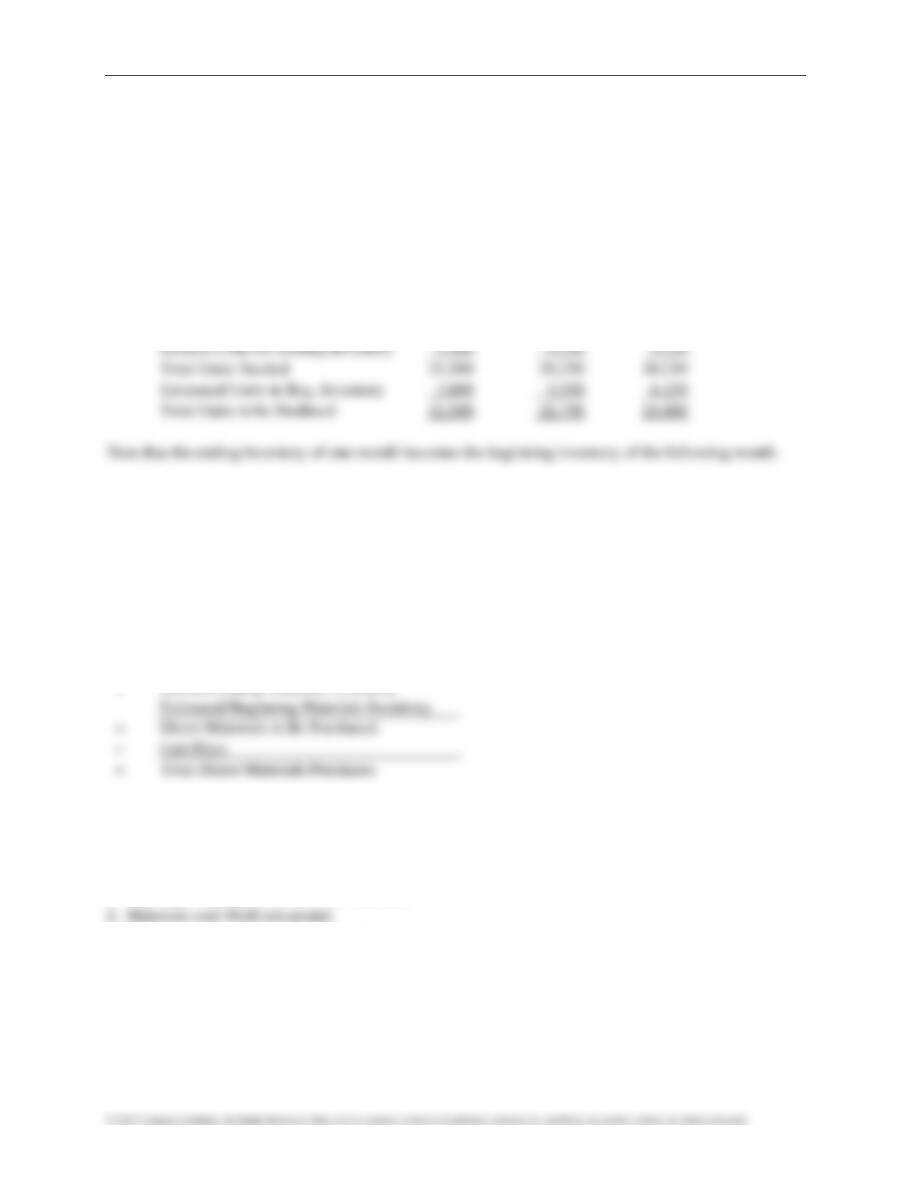
Chapter 22 Budgeting 69
Miles Manufacturing has prepared the following sales budget for the first four months of
the year:
January February March April
Sales 20,000 22,000 25,000 21,000
Miles estimates that it will begin the year with 3,000 units in inventory. The company
wants to end each month with inventory equal to 25 percent of the next month’s projected
sales. Prepare a production budget for January through March.
January February March
Expected Sales in Units 20,000 22,000 25,000
GROUP LEARNING ACTIVITY — Direct Materials Purchases Budget
The direct materials purchases budget follows the same basic format as the production budget. The only
modification is that this budget must be prepared in both units and dollars because the cost of materials
purchased is used in the cost of goods sold budget.
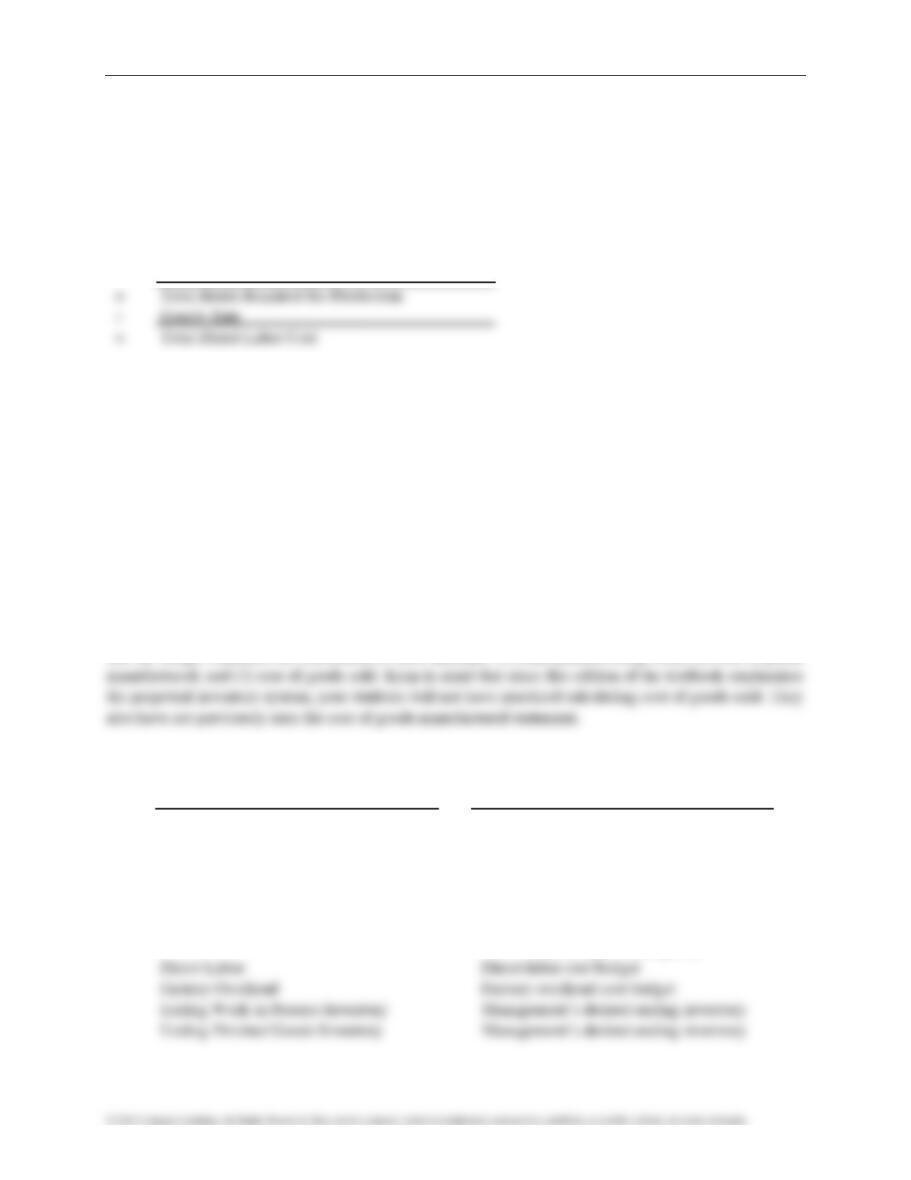
The direct materials purchases budget is prepared as follows:
Materials Required for Production
+ Desired Ending Materials Inventory
Divide your class into small groups. Ask students to prepare a direct materials purchases budget for Miles
Manufacturing for January and February, using their notes from the preceding demonstration problem and
the following additional information:
1. Each unit requires two pounds of materials.
3. Miles estimates that it will have 4,000 pounds of materials inventory on January 1.
4. Miles’ desired ending inventory for materials is 5,000 pounds.
The solution to this activity is presented on TM 22-8.
70 Chapter 22 Budgeting
LECTURE AID — Direct Labor and Overhead Budgets
Because the direct labor and overhead budgets are used in the cost of goods sold budget, you may want to
quickly review their format.
The direct labor cost budget is prepared as follows:
Units to Be Produced (from production budget)
Hours Required per Unit
A direct labor budget is illustrated in text Exhibit 11. Emphasize that the production and direct labor
budgets must be closely coordinated. If a failure to properly budget labor time results in a labor shortage,
the business may be forced to pay significant amounts of overtime, delay production, or use untrained
workers whose output is poor in quality.
To prepare an overhead budget, expected overhead costs are listed and totaled. Exhibit 12 illustrates an
overhead budget. Point out that real-world organizations normally have detailed schedules to support each
item presented on an overhead budget.
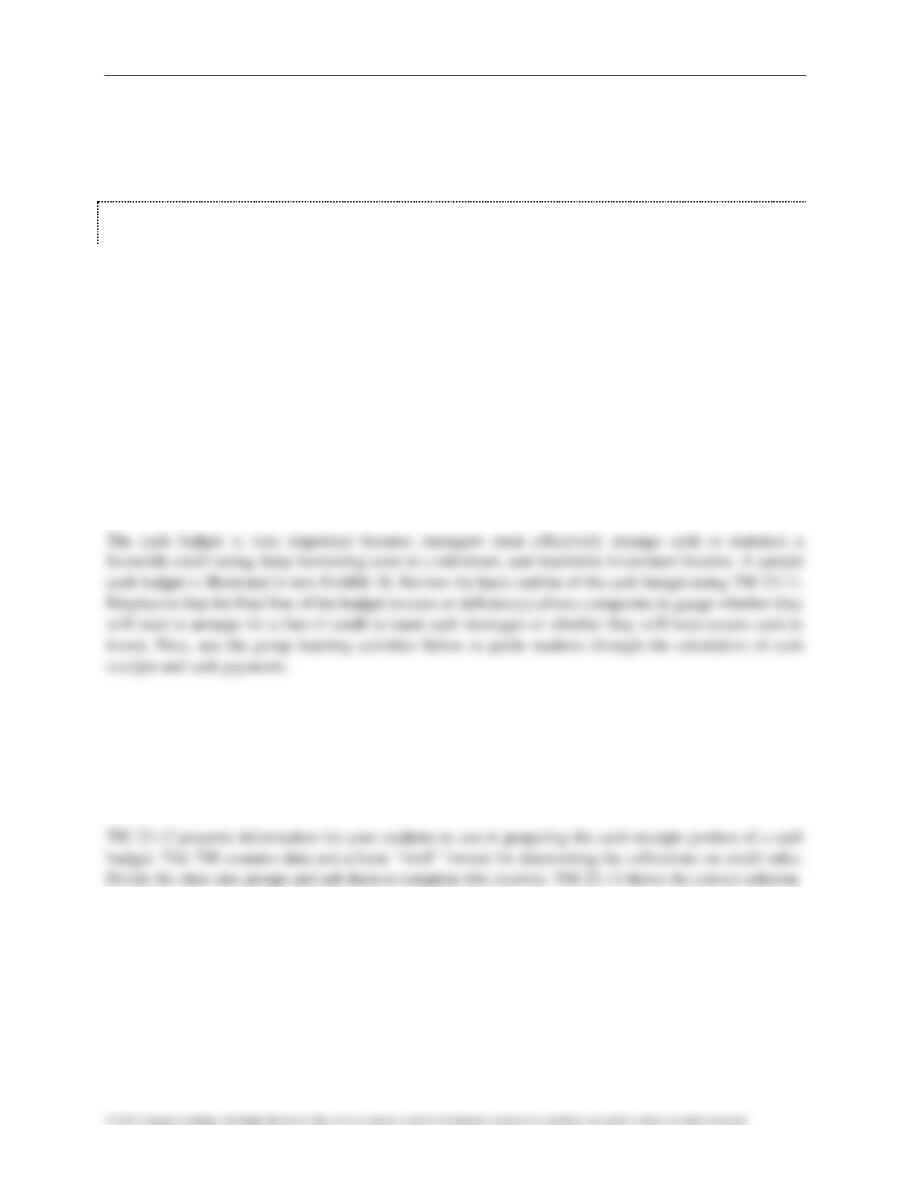
GROUP LEARNING ACTIVITY — Cost of Goods Sold Budget
The cost of goods sold budget is complex enough to merit a brief explanation plus an in-class practice
problem. Use TM 22-9 to review the basic format of the cost of goods sold budget. This TM emphasizes
that the budget combines the calculation of three amounts: (1) total manufacturing costs, (2) cost of goods
While reviewing TM 22-9, stress the sources for the following information:
Information Source
Beginning Finished Goods Inventory Management’s estimate
Beginning Work in Process Inventory Management’s estimate
Beginning Direct Materials Inventory Direct materials purchases budget
(no. of units unit price)
Direct Materials Purchases Direct materials purchases budget
Ending Direct Materials Inventory Direct materials purchases budget
(no. of units unit price)
Chapter 22 Budgeting 71
Handout 22-1 presents information that your students can use to practice preparing a cost of goods sold
budget. Ask them to complete this budget as a group activity. The solution is displayed on TM 22-10.
OBJECTIVE 5
Prepare balance sheet budgets for a manufacturing company.
KEY TERMS
Capital Expenditures Budget Cash Budget
SUGGESTED APPROACH
The two balance sheet budgets presented under this objective are the cash budget and the capital
expenditures budget. The capital expenditures budget, which summarizes plans for acquiring fixed assets,
is illustrated in Exhibit 19 in the text. Refer your students to this illustration. Emphasize that most
companies budget capital expenditures for several years into the future, due to the large dollar amounts
associated with these expenditures and the variation in need for capital improvements from year to year.
GROUP LEARNING ACTIVITY — Cash Receipts
The portion of the cash budget that tends to be the most difficult for students is determining the cash
receipts from sales. The difficulty occurs because credit sales are frequently collected over two or more
months.
GROUP LEARNING ACTIVITY — Cash Payments
TMs 22-14 and 22-15 present an opportunity for your students to practice preparing a schedule of cash
payments. Prior to assigning this activity, remind students that financial accounting recognizes expenses
when they are incurred, not when they are paid. A cash budget reports expenses in the month they are
paid. The solution to this exercise is shown on TM 22-16.
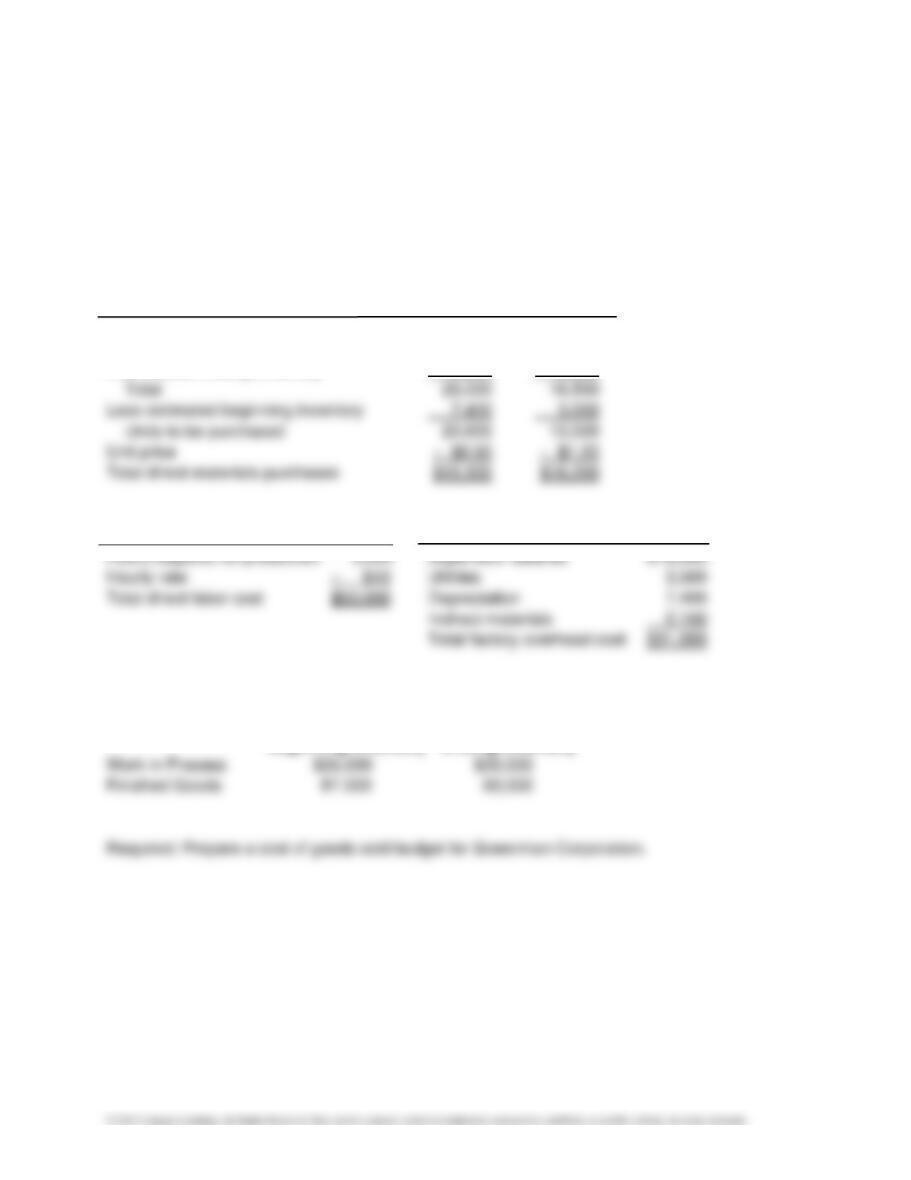
Handout 22-1
Cost of Goods Sold Budget
The following are the direct materials purchases, direct labor cost, and factory overhead
budgets for Bowerman Corporation for the month of August.
Direct Materials Purchases Budget
Material A Material B
Units required for production 20,000 14,000
Plus desired ending inventory 8,000 2,500
Direct Labor Cost Budget Factory Overhead Cost Budget
Bowerman also estimates the following beginning and ending inventory amounts.
Beginning Inventory Ending Inventory
DIFFICULTY BUSPROG ACBSP IMA BLOOM’S TIME
Problem
Learning
Objective
Description Primary Primary Managerial Only
Spread-
sheet
DQ22–1 22-1 Easy Analytic Budgeting and Responsibility Budget Preparation Knowledge 5 min.
DQ22–2 22-1 Easy Analytic Budgeting and Responsibility Budget Preparation Knowledge 5 min.
DQ22–3 22-1 Easy Analytic Budgeting and Responsibility Budget Preparation Knowledge 5 min.
DQ22–4 22-1 Easy Analytic Budgeting and Responsibility Budget Preparation Knowledge 5 min.
DQ22–5 22-2 Easy Analytic Budgeting and Responsibility Budget Preparation Knowledge 5 min.
DQ22–6 22-2 Easy Analytic Budgeting and Responsibility Budget Preparation Knowledge 5 min.
DQ22–7 22-4 Easy Analytic Budgeting and Responsibility Budget Preparation Knowledge 5 min.
DQ22–8 22-4 Easy Analytic Budgeting and Responsibility Budget Preparation Knowledge 5 min.
DQ22–9 22-5 Easy Analytic Budgeting and Responsibility Budget Preparation Knowledge 5 min.
DQ22–10 22-5 Easy Analytic Budgeting and Responsibility Budget Preparation Knowledge 5 min.
PE22-1A 22–2 Flexible budgeting Easy Analytic Budgeting and Responsibility Budget Preparation Application 5 min.
PE22-1B 22–2 Flexible budgeting Easy Analytic Budgeting and Responsibility Budget Preparation Application 5 min.
PE22-2A 22–4 Production budget Easy Analytic Budgeting and Responsibility Budget Preparation Application 5 min.
PE22-2B 22–4 Production budget Easy Analytic Budgeting and Responsibility Budget Preparation Application 5 min.
PE22-3A 22–4 Direct materials purchases budget Easy Analytic Budgeting and Responsibility Budget Preparation Application 5 min.
PE22-3B 22–4 Direct material purchases budget Easy Analytic Budgeting and Responsibility Budget Preparation Application 5 min.
PE22-4A 22–4 Direct labor cost budget Easy Analytic Budgeting and Responsibility Budget Preparation Application 5 min.
PE22-4B 22–4 Direct labor cost budget Easy Analytic Budgeting and Responsibility Budget Preparation Application 5 min.
PE22-5A 22–4 Cost of goods sold budget Easy Analytic Budgeting and Responsibility Budget Preparation Application 10 min.
PE22-5B 22–4 Cost of goods sold budget Easy Analytic Budgeting and Responsibility Budget Preparation Application 10 min.
PE22-6A 22–5 Cash budget Easy Analytic Budgeting and Responsibility Budget Preparation Application 5 min.
PE22-6B 22–5 Cash budget Easy Analytic Budgeting and Responsibility Budget Preparation Application 5 min.
Ex22-1 22–2, 22-5 Personal budget Easy Analytic Budgeting and Responsibility Budget Preparation Application 15 min. X
Ex22-2 22–2, 22-4
Flexible budget for selling and
administrative expenses
Easy Analytic Budgeting and Responsibility Budget Preparation Application 20 min. x
Ex22-3 22–2, 22-4 Static budget vs. flexible budget Easy Analytic Budgeting and Responsibility Budget Preparation Application 20 min. X
Ex22-4 22–2
Department
Easy Analytic Budgeting and Responsibility Budget Preparation Application 15 min. X
Ex22-5 22–4 Production Budget Easy Analytic Budgeting and Responsibility Budget Preparation Application 15 min.
Ex22-6 22–4 Sales and production budgets Easy Analytic Budgeting and Responsibility Budget Preparation Application 20 min. X
Ex22-7 22–4 Professional fees earned budget Easy Analytic Budgeting and Responsibility Budget Preparation Application 10 min.
Ex22-8 22–4 Professional labor cost budget Easy Analytic Budgeting and Responsibility Budget Preparation Application 10 min.
Ex22-9 22–4 Direct materials purchases budget Moderate Analytic Budgeting and Responsibility Budget Preparation Application 20 min. X
Ex22-10 22-4 Direct materials purchases budget Moderate Analytic Budgeting and Responsibility Budget Preparation Application 20 min.
HOMEWORK CHART WITH LEARNING OUTCOMES TAGGING
DIFFICULTY BUSPROG ACBSP IMA BLOOM’S TIME
Problem
Learning
Objective
Description Primary Primary Managerial Only
Spread-
sheet
Ex22-11 22–4 Direct materials purchases budget Moderate Analytic Budgeting and Responsibility Budget Preparation Application 20 min. X
Ex22-12 22–4 Direct labor cost budget Moderate Analytic Budgeting and Responsibility Budget Preparation Application 20 min.
Ex22-13 22–4 Direct labor budget-service business Moderate Analytic Budgeting and Responsibility Budget Preparation Application 20 min.
Ex22-14 22-4
budgets
Moderate Analytic Budgeting and Responsibility Budget Preparation Application 30 min. X
Production and direct labor cost
Ex22-15 22–4 Factory overhead cost budget Moderate Analytic Budgeting and Responsibility Budget Preparation Application 20 min. X
Ex22-16 22–4 Cost of goods sold budget Moderate Analytic Budgeting and Responsibility Budget Preparation Application 20 min. X
Ex22-17 22–4 Cost of goods sold budget Challenging Analytic Budgeting and Responsibility Budget Preparation Application 30 min.
Ex22-18 22-5
Schedule of cash collections of
accounts receivable
Schedule of cash collections of
Ex22-19 22-5
accounts receivable
Easy Analytic Budgeting and Responsibility Budget Preparation Application 15 min.
Ex22-20 22–5 Schedule of cash payments Easy Analytic Budgeting and Responsibility Budget Preparation Application 15 min.
Ex22-21 22–5 Schedule of cash payments Moderate Analytic Budgeting and Responsibility Budget Preparation Application 20 min. X
Ex22-22 22–5 Capital expenditures budget Challenging Analytic Budgeting and Responsibility Budget Preparation Application 30 min. X
Forecast sales volume and sales
Pr22–1A 22-4
budget
Moderate Analytic Budgeting and Responsibility Budget Preparation Application 1.5 hours X
Pr22–2A 22-4
Sales, production, direct materials
purchases, and direct labor cost
budgets
Moderate Analytic Budgeting and Responsibility Budget Preparation Application 2 hours X
supporting budgets
Budgeted income statement and
Pr22–4A 22–5 Cash budget Challenging Analytic Budgeting and Responsibility Budget Preparation Application 2 hours X
Pr22–5A 22–4, 22-5
balance sheet
Forecast sales volume and sales
Budgeted income statement and
Pr22–1B 22-4
budget
Moderate Analytic Budgeting and Responsibility Budget Preparation Application 1.5 hours X
Pr22–2B 22-4
Sales, production, direct materials
purchases, and direct labor cost
budgets
Moderate Analytic Budgeting and Responsibility Budget Preparation Application 2 hours X
Budgeted income statement and
Pr22–4B 22–5 Cash budget Challenging Analytic Budgeting and Responsibility Budget Preparation Application 2 hours X
Pr22–5B 22–4, 22-5
balance sheet
Ethics and professional conduct in
Budgeted income statement and
CP22–1 22–1
business
Moderate Ethics Budgeting and Responsibility Budget Preparation Analysis 20 min.
CP22–2 22–1, 22–2 Evaluating budgeting systems Moderate Analytic Budgeting and Responsibility Budget Preparation Evaluation 20 min.
DIFFICULTY BUSPROG ACBSP IMA BLOOM‘S TIME
Problem
Learning
Objective
Description Primary Primary Managerial Only
Spread–
sheet
Service company static decision
CP22-4 22-3 Objectives of the master budget Easy Analytic Budgeting and Responsibility Budget Preparation Analysis 15 min.
Integrity and evaluating budgeting
CP22-6 22-2 Budget for a state government Moderate Analytic Budgeting and Responsibility Budget Preparation Application 1 hour