
1. The three major objectives of budgeting are (1) to establish specific goals for future
operations, (2) to execute plans to achieve the goals, and (3) to periodically compare
actual results with the goals.
2. If goals set by the budgets are viewed as unrealistic or unachievable, employees and
managers may become discouraged and may not be committed to the achievement of the
goals, resulting in the budget becoming less effective as a planning and control tool.
3. A budget that is set too loosely may fail to motivate managers and other employees to perform
efficiently. In addition, a loose budget may cause a “spend it or lose it” mentality, where excess
b
udget resources are spent in order to protect the budget from future reductions.
4. Conflicting goals can cause employees or department managers to act in their own self-
interests to the detriment of the organization’s objectives.
5. A static budget is most appropriate in situations where costs are not variable to an underlying
activity level. As a result, it is reasonable to plan spending on the basis of a fixed quantity of
resources for the year. This will occur in some administrative functions, such as human
resources, accounting, or public relations.
6. Computers not only speed up the budgeting process, but they also reduce the cost of budget
p
reparation when large quantities of data need to be processed. In addition, by using
computerized simulation models, management can determine the impact of various operating
alternatives on the master budget.
7. The production requirements must be carefully coordinated with the sales budget to ensure
that production and sales are kept in balance during the period. Ideally, manufacturing
operations should be maintained at 100% of capacity, with no idle time or overtime, and
there should be neither excessive inventories nor inventories insufficient to fill sales orders.
8. Purchases of direct materials should be closely coordinated with the production budget so
that inventory levels can be maintained within reasonable limits.
9. a. The cash budget contributes to effective cash planning. This involves advance planning
so that a cash shortage does not arise and excess cash is not permitted to remain “idle.”
b. The excess cash can be invested in readily marketable income-producing securities or
used to reduce loans.
10. The plans for financing the capital expenditures budget may affect the cash budget.
CHAPTER 22
BUDGETING
DISCUSSION QUESTIONS
22-1
CHAPTER 22 Budgeting
PE 21–1A
Variable cost:
Direct labor (7,500 hours × $16.00* per hour)…………………………………
…
$120,000
Fixed cost:
PE 21–1B
Variable cost:
Direct labor (600 hours × $14.50* per hour)……………………………………
…
$ 8,700
Fixed cost:
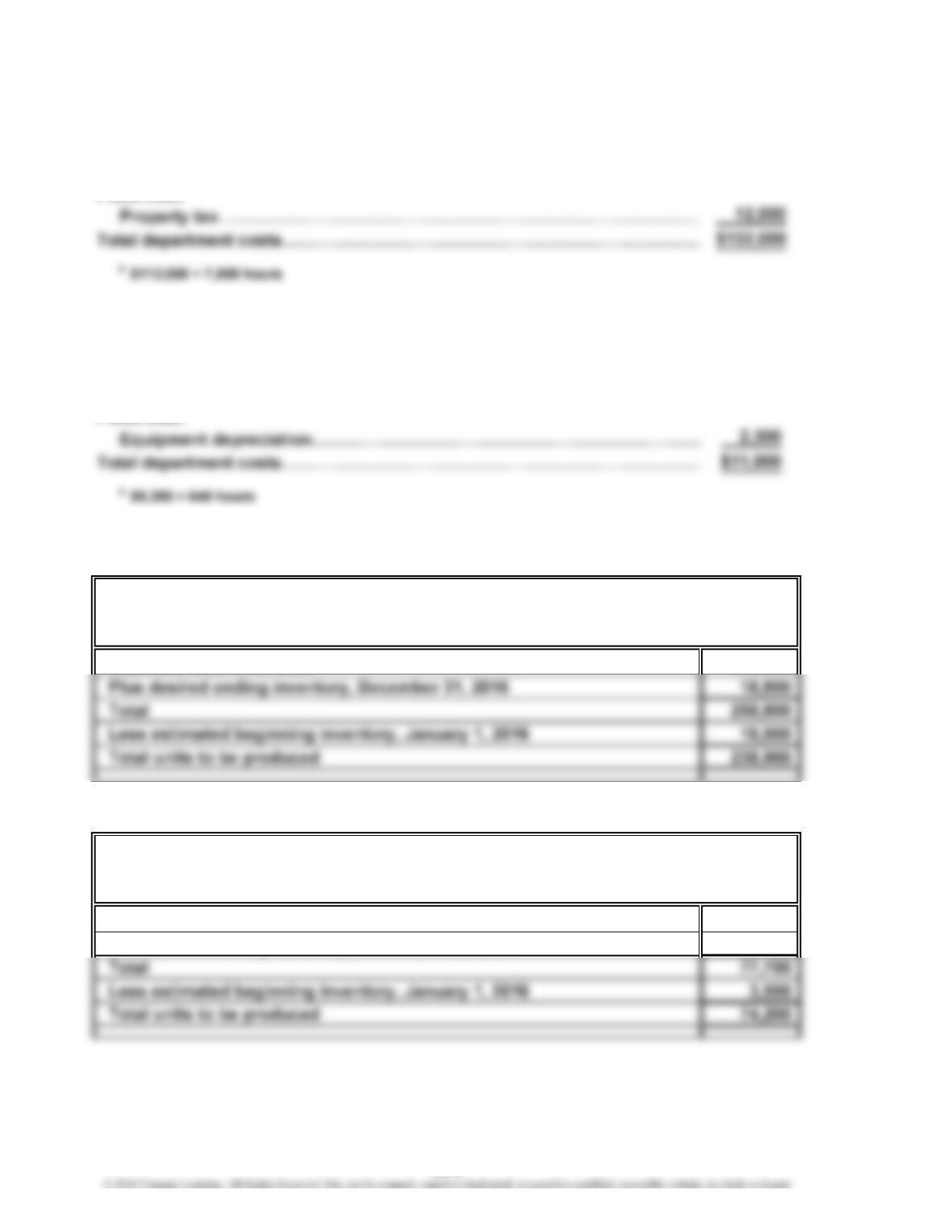
PE 22–2A
Expected units to be sold 240,000
PE 22–2B
Expected units to be sold 75,000
Plus desired ending inventory, December 31, 2016 2,700
MyLife Chronicles Inc.
Production Budget
For the Year Ending December 31, 2016
Magnolia Candle Inc.
Production Budget
For the Year Ending December 31, 2016
22-2
CHAPTER 22 Budgeting
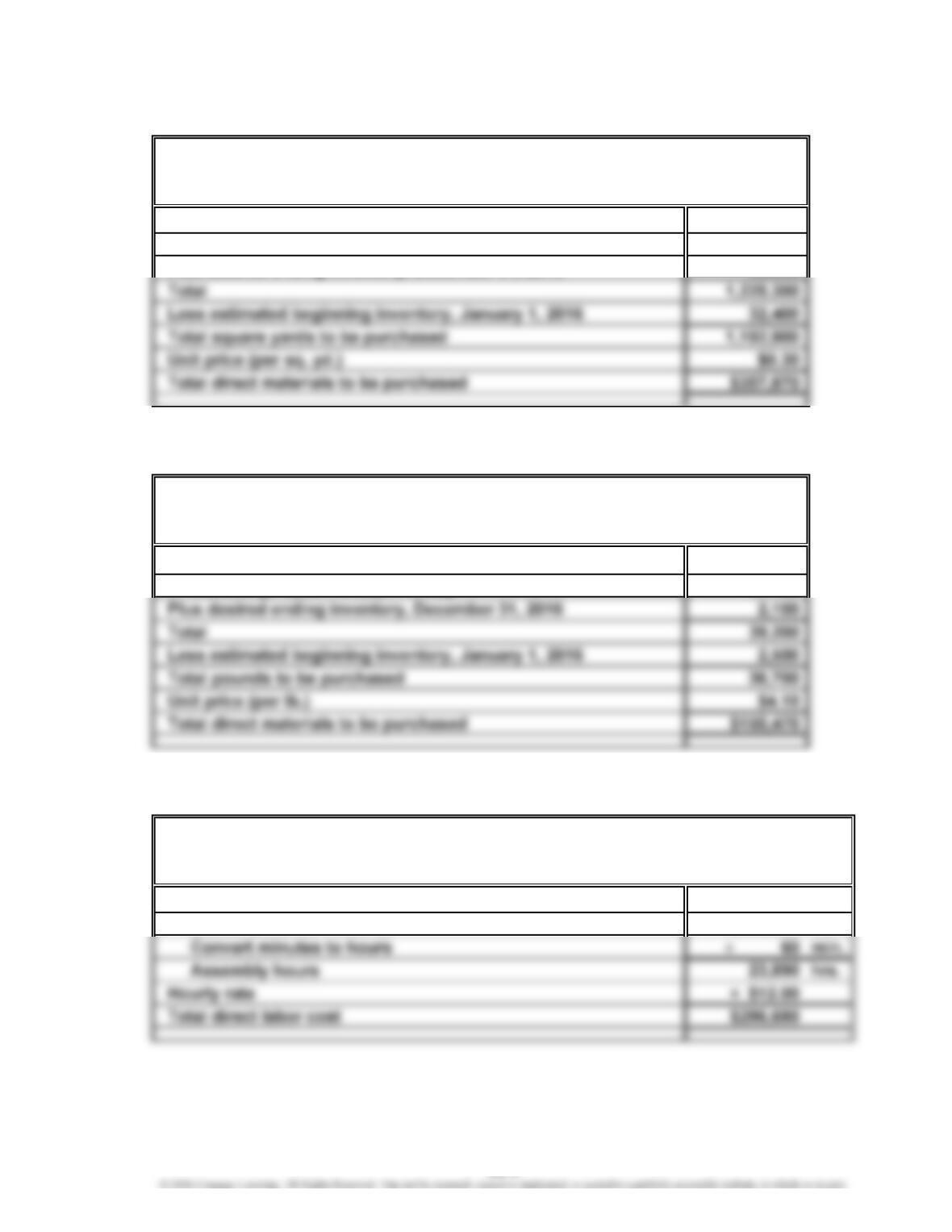
PE 22–3A
Square yards required for production:
Diaries (238,900 × 5 sq. yd.) 1,194,500
Plus desired ending inventory, December 31, 2016 30,800
PE 22–3B
Pounds of wax required for production:
Candles [(74,200 × 8 oz.) ÷ 16 oz.] 37,100
PE 22–4A
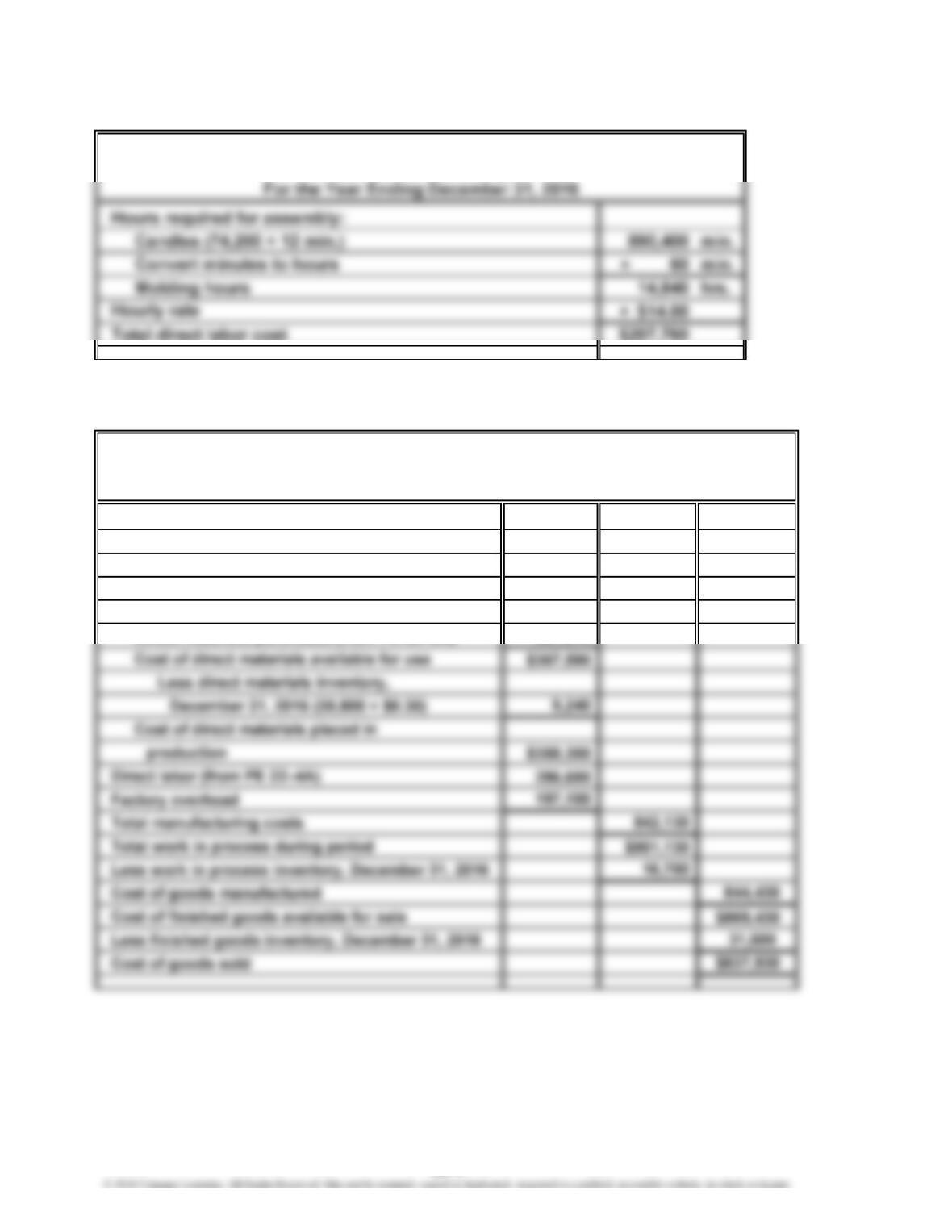
Hours required for assembly:
Diaries (238,900 × 6 min.) 1,433,400 min.
MyLife Chronicles Inc.
Direct Materials Purchases Budget
For the Year Ending December 31, 2016
Magnolia Candle Inc.
Direct Materials Purchases Budget
For the Year Ending December 31, 2016
MyLife Chronicles Inc.
Direct Labor Cost Budget
For the Year Ending December 31, 2016
22-3
CHAPTER 22 Budgeting
PE 22–4B
PE 22–5A
Finished goods inventory, January 1, 2016
Work in process inventory, January 1, 2016 $ 19,000
Direct materials:
Direct materials inventory, January 1, 2016
(32,400 × $0.30) $ 9,720
Direct materials purchases (from PE 22–3A) 357,870
Magnolia Candle Inc.
Direct Labor Cost Budget
MyLife Chronicles Inc.
Cost of Goods Sold Budget
For the Year Ending December 31, 2016
$ 25,000
22-4
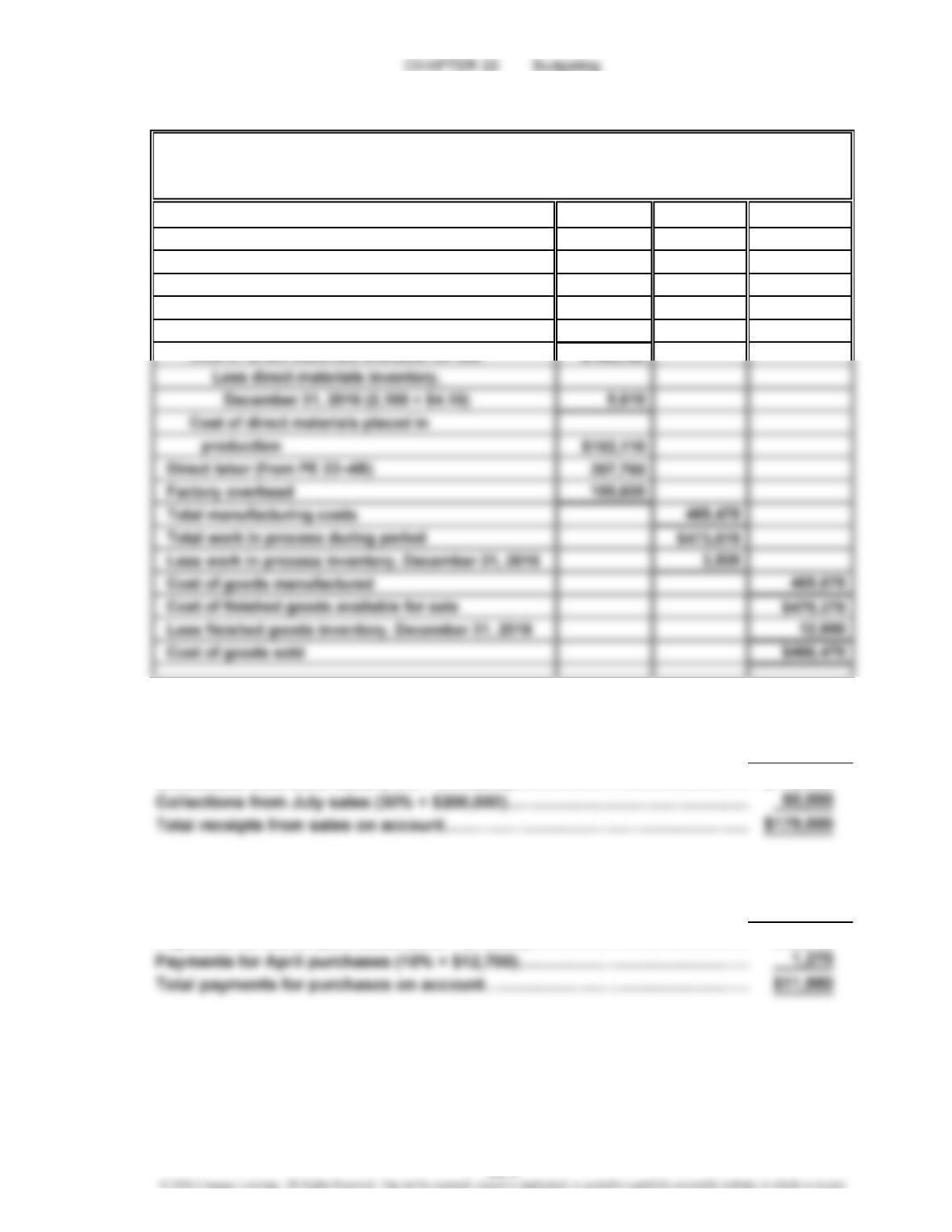
PE 22–5B
Finished goods inventory, January 1, 2016 $ 9,800
Work in process inventory, January 1, 2016 $ 3,600
Direct materials:
Direct materials inventory, January 1, 2016
(2,500 × $4.10) $ 10,250
Direct materials purchases (from PE 22–3B) 150,470
Cost of direct materials available for use $160,720
PE 22–6A
July
Collections from June sales (70% × $170,000)……………………………………
…
$119,000
PE 22–6B
April
Payments for March purchases (90% × $11,900)…………………………………
…
$10,710
Magnolia Candle Inc.
Cost of Goods Sold Budget
For the Year Ending December 31, 2016
22-5
CHAPTER 22 Budgeting
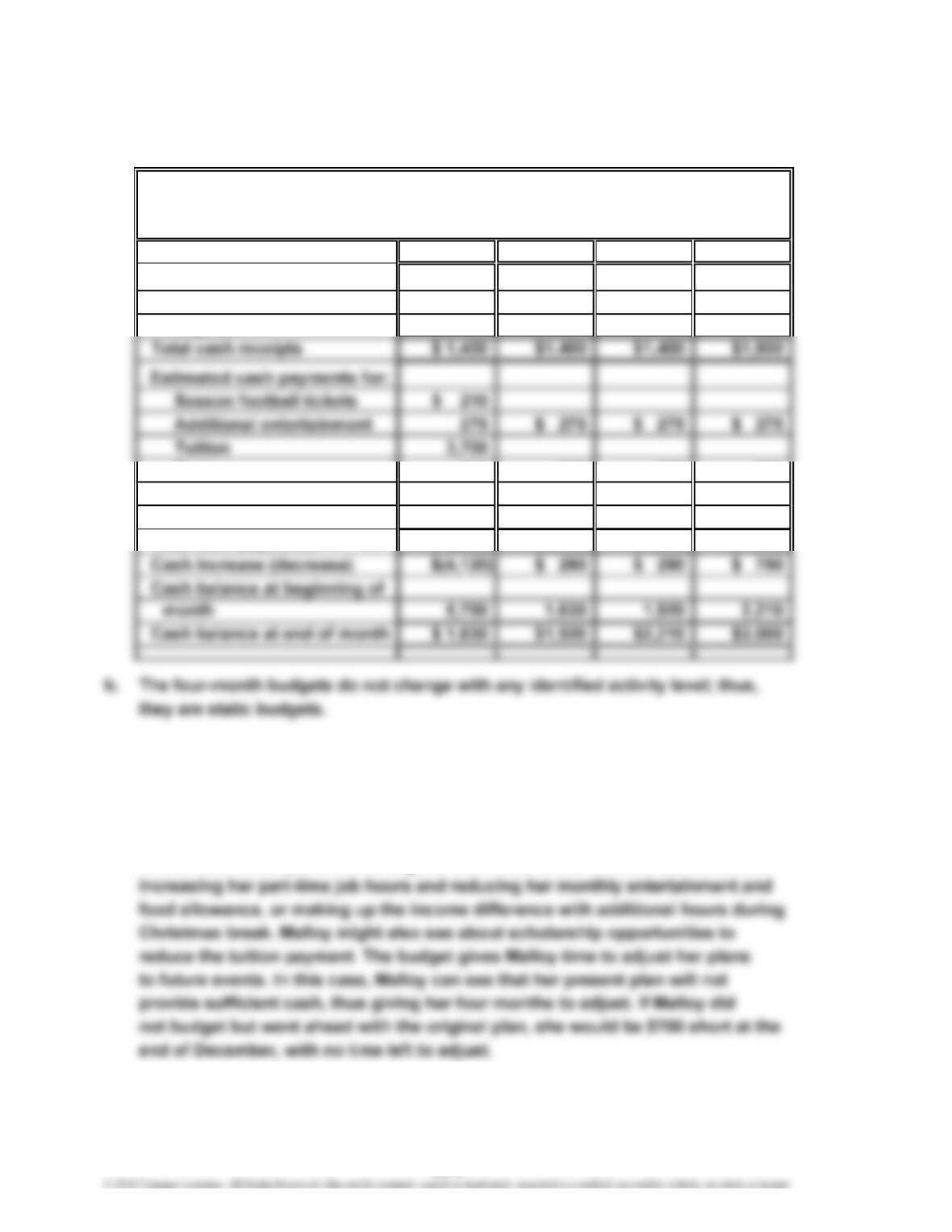
Ex. 22–1
a.
September October November December
Estimated cash receipts from:
Part-time job $ 1,400 $1,400 $1,400 $1,400
Deposit 500
Rent 600 600 600 600
Food 235 235 235 235
Deposit 500
Total cash payments $ 5,520 $1,110 $1,110 $1,110
c. While Malloy’s budget might first appear satisfactory, Malloy must earn
enough cash in order to pay for the spring semester tuition. Her present budget
shows that she will be $700 short of the tuition amount ($3,700 – $3,000) by the
time she needs to pay her spring tuition. Thus, Malloy will likely need to
adjust the plan before the fall term even begins. Some possibilities would be to
rent a lower cost apartment or to get a roommate. Other considerations include
For the Four Months Ending December 31, 2016
KATHERINE MALLOY
Cash Budget
EXERCISES
22-6
CHAPTER 22 Budgeting
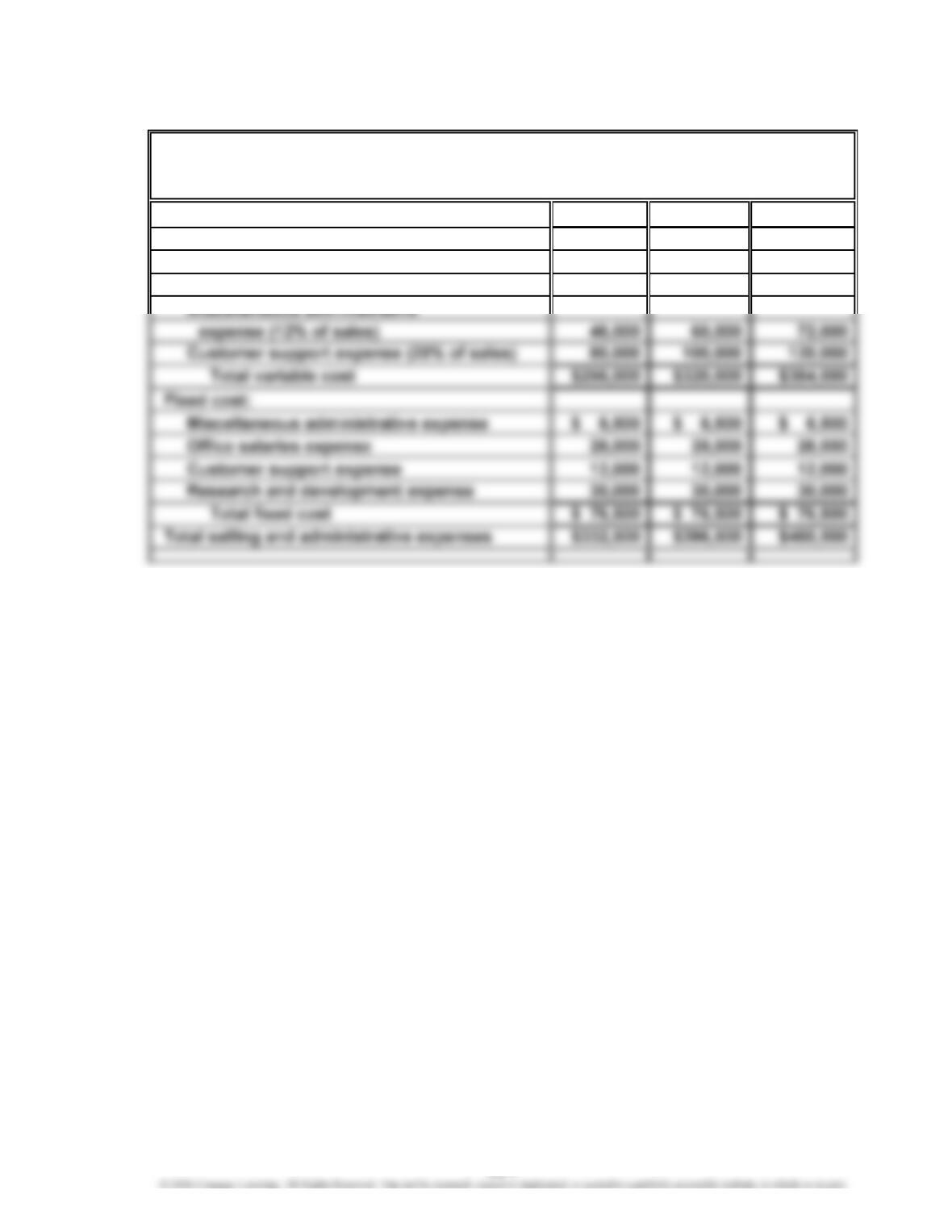
Ex. 22–2
Total sales $400,000 $500,000 $600,000
Variable cost:
Sales commissions (14% of sales) $ 56,000 $ 70,000 $ 84,000
Advertising expense (18% of sales) 72,000 90,000 108,000
CLOUD PRODUCTIVITY INC.
Flexible Selling and Administrative Expenses Budget
For the Month Ending March 31, 2016
22-7
CHAPTER 22 Budgeting
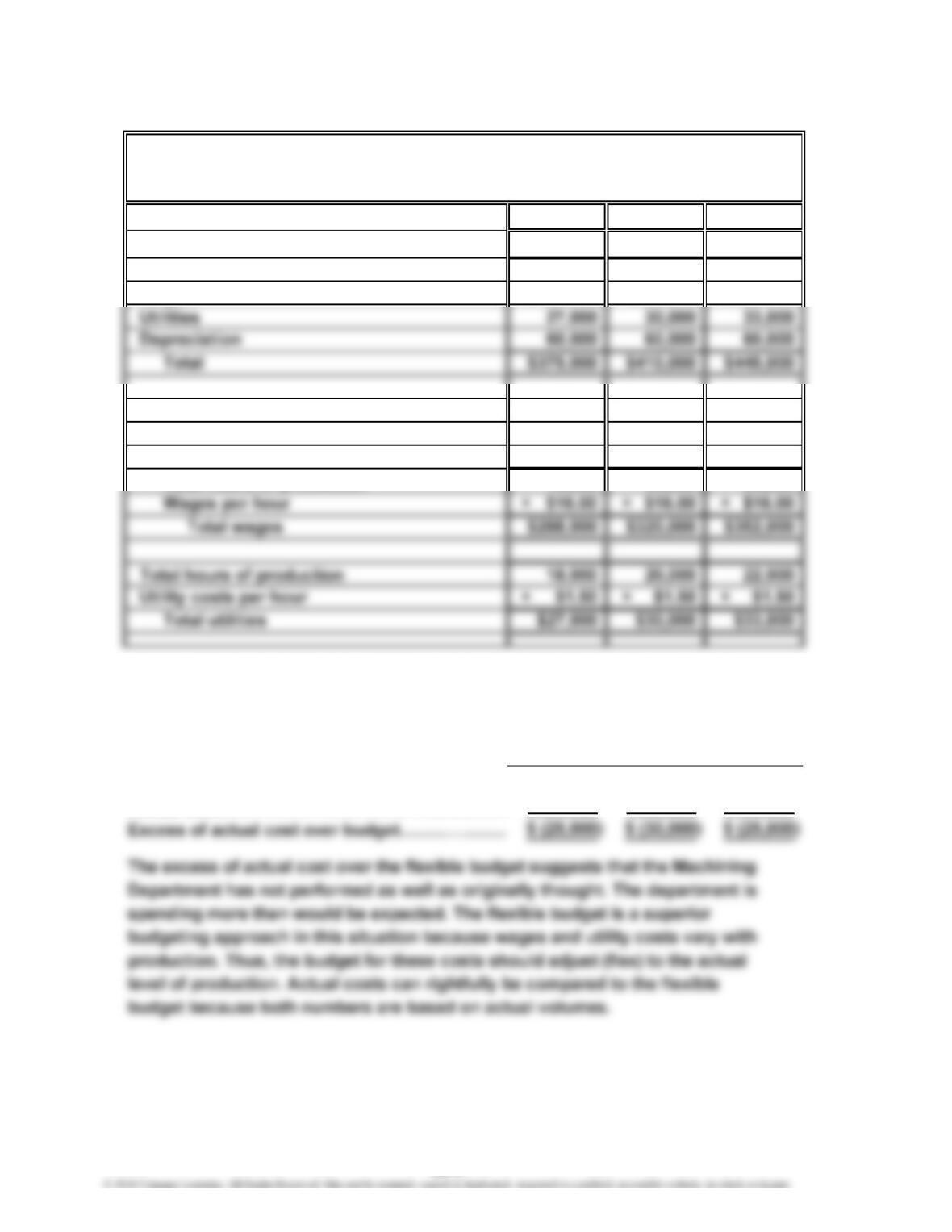
Ex. 22–3
a.
January February March
Units of production 90,000 100,000 110,000
Wages $288,000 $320,000 $352,000
Supporting calculations:
Units of production 90,000 100,000 110,000
Hours per unit 0.20 0.20 0.20
Total hours of production 18,000 20,000 22,000
Depreciation is a fixed cost, so it does not “flex” with changes in production.
Because it is the only fixed cost, the variable and fixed costs are not classified in
the budget.
b.
January February March
Total flexible budget………………………………
…
$375,000 $410,000 $445,000
Actual cost……………………………………………
…
400,000 440,000 470,000
RODRIGUEZ COMPANY—MACHINING DEPARTMENT
Flexible Production Budget
For the Three Months Ending March 31, 2016
×××
22-8
CHAPTER 22 Budgeting
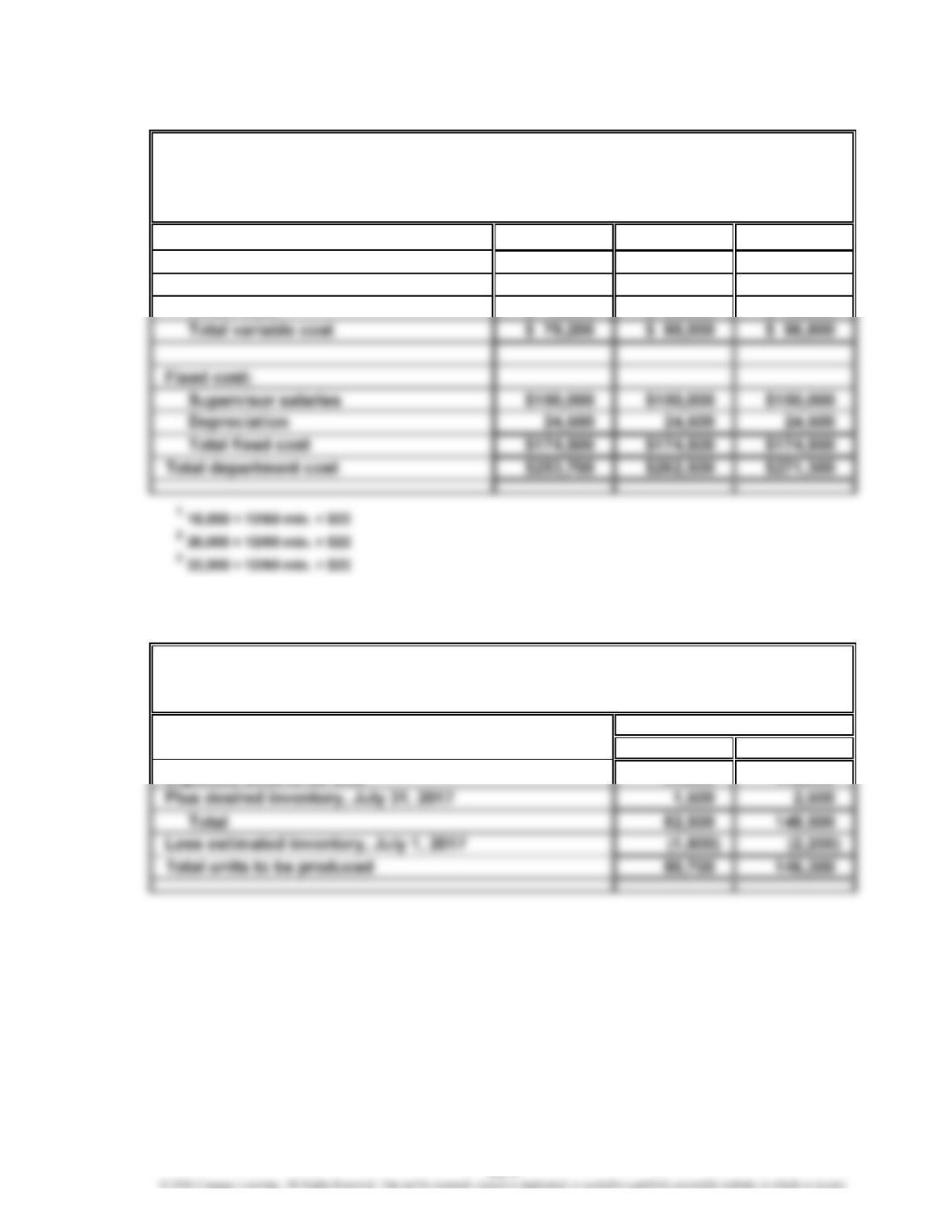
Ex. 22–4
Units of production 18,000 20,000 22,000
Variable cost:
Direct labor $ 79,200 $ 88,000 $ 96,800
Ex. 22–5
Small Scale Large Scale
Expected units to be sold 81,000 146,000
For the Month Ending July 31, 2017
Units
STEELCASE INC.—ASSEMBLY DEPARTMENT
Flexible Production Budget
(assumed data)
August 2016
TRUE TAB INC.
Production Budget
123
22-9
CHAPTER 22 Budgeting
Ex. 22–6
a.
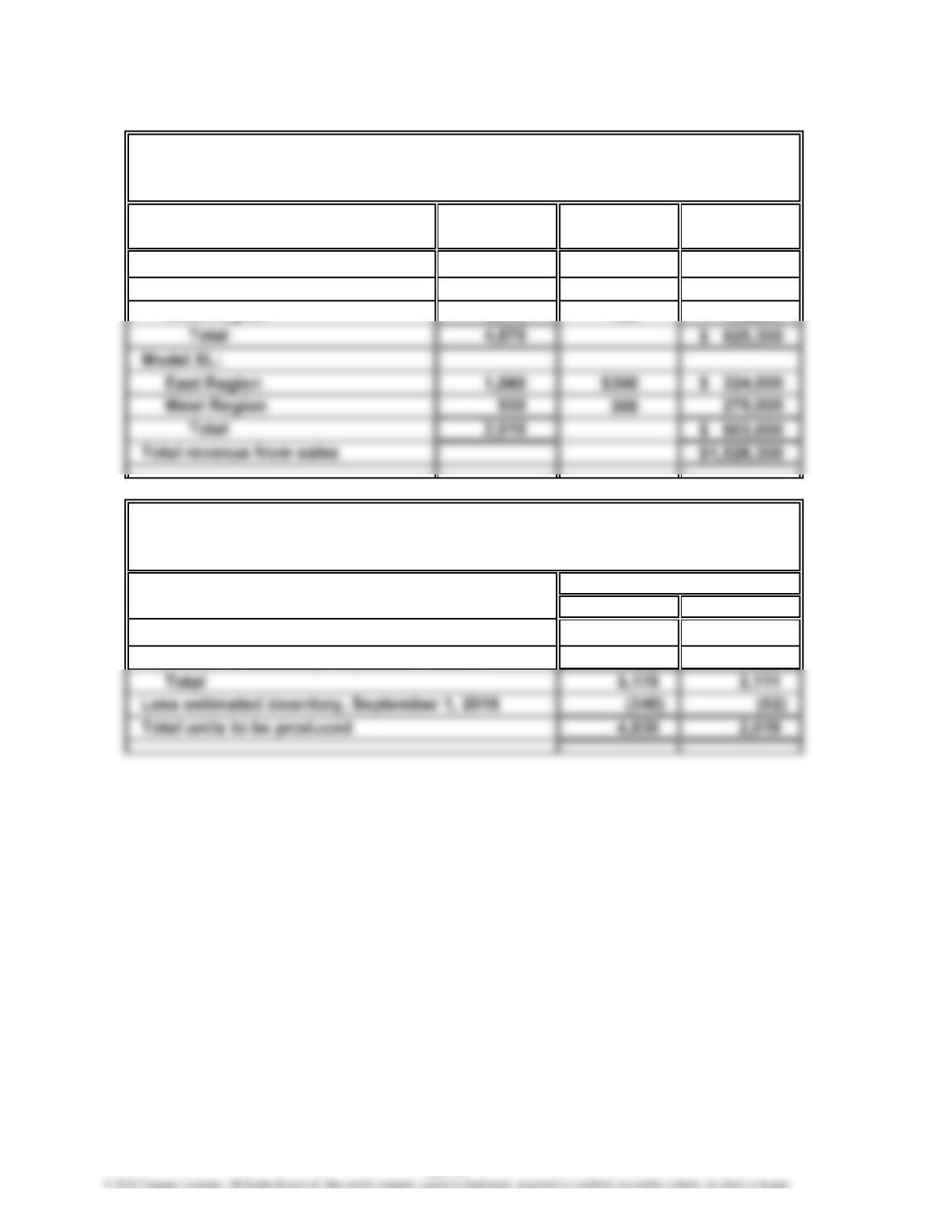
Unit Sales Unit Selling
Volume Price Total Sales
Model DL:
East Region 2,560 $190 $ 486,400
West Region 2,310 190 438,900
b.
Model DL Model XL
Expected units to be sold 4,870 2,010
Plus desired inventory, September 30, 2016 300 101
For the Month Ending September 30, 2016
Units
Product and Area
SOUNDLAB INC.
Sales Budget
For the Month Ending September 30, 2016
SOUNDLAB INC.
Production Budget
22-10
CHAPTER 22 Budgeting
Ex. 22–7
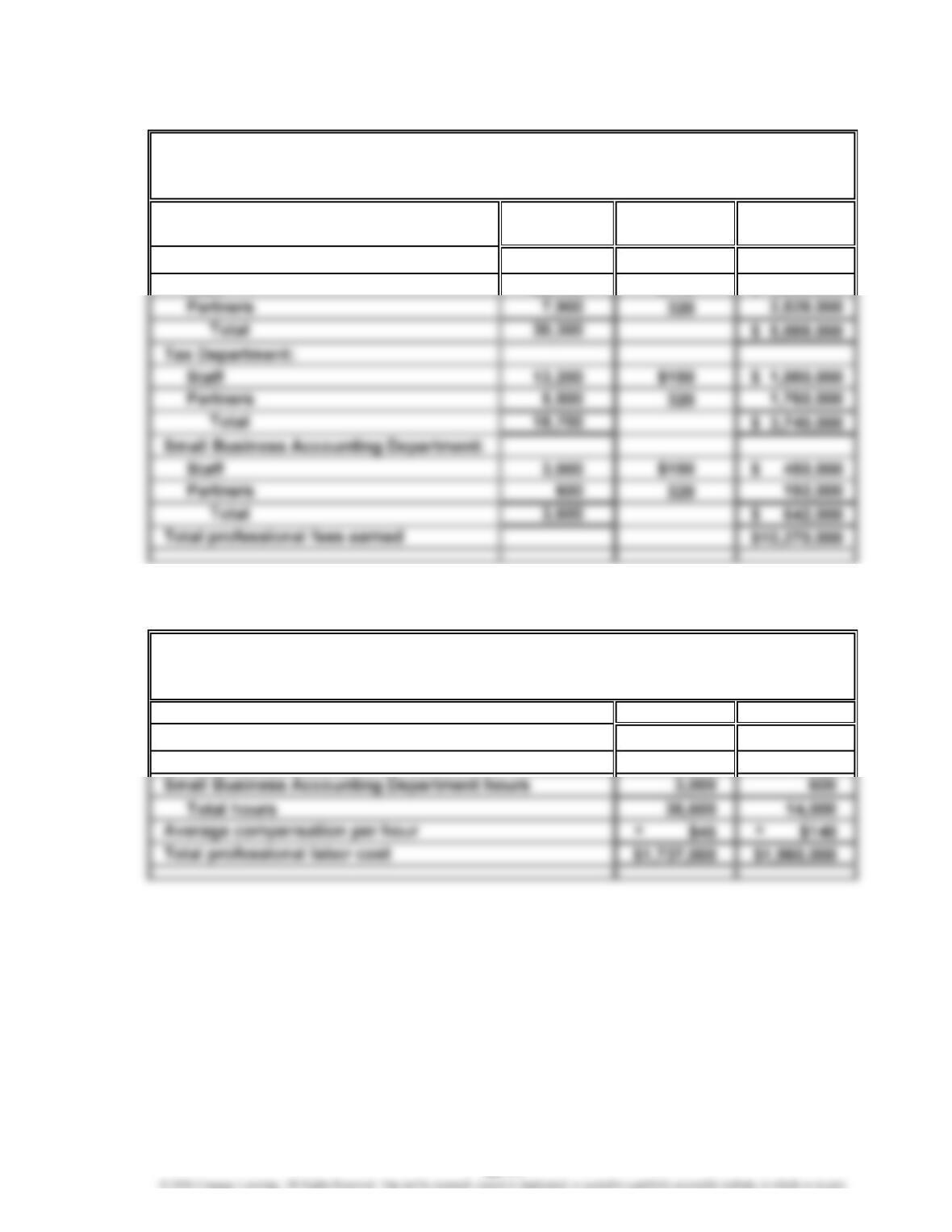
Billable Hourly Total
Hours Rate Revenue
Audit Department:
Staff 22,400 $150 $ 3,360,000
Ex. 22–8
Staff Partners
Audit Department hours 22,400 7,900
Tax Department hours 13,200 5,500
Professional Labor Cost Budget
For the Year Ending December 31, 2016
ROLLINS AND COHEN, CPAs
Professional Fees Earned Budget
For the Year Ending December 31, 2016
ROLLINS AND COHEN, CPAs
22-11
CHAPTER 22 Budgeting
Ex. 22–9
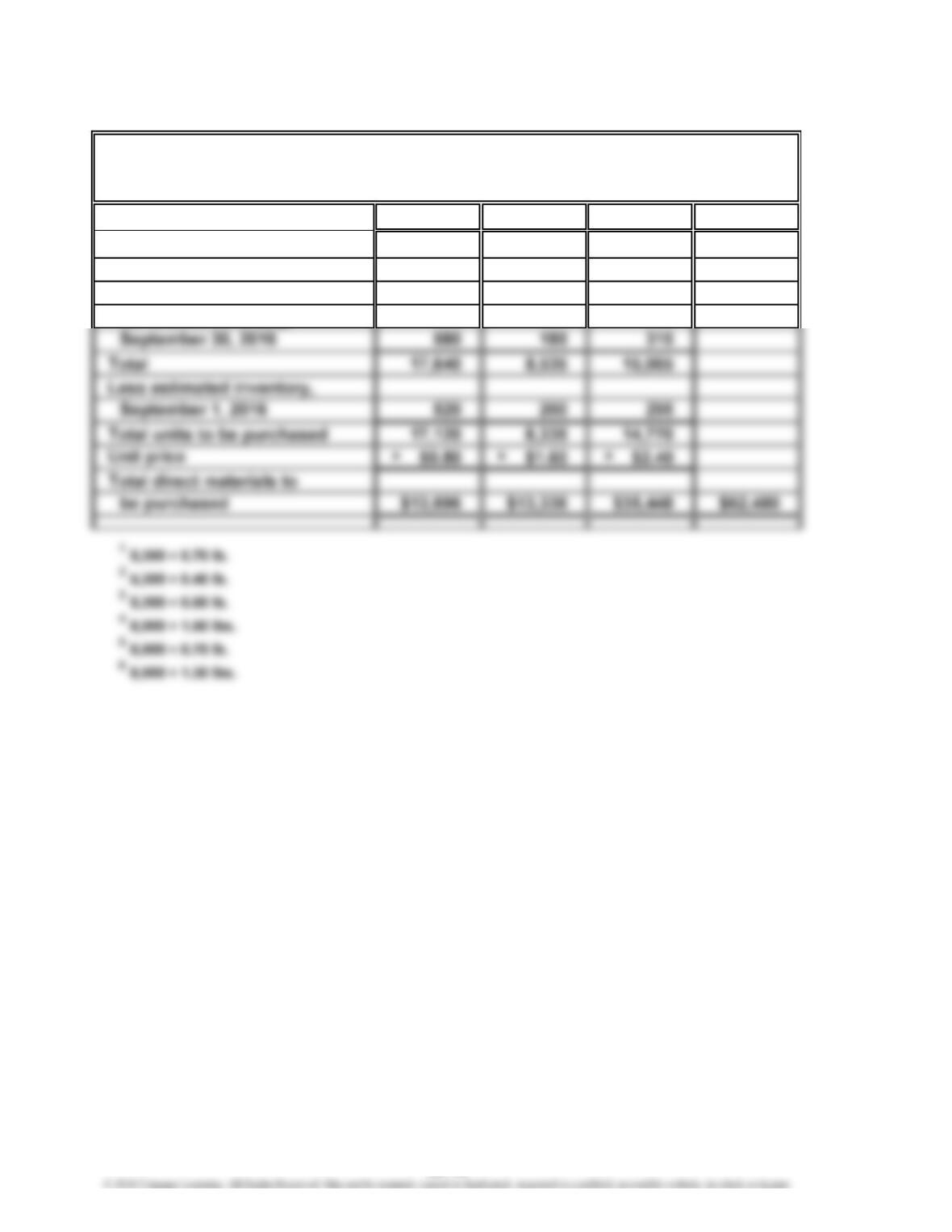
Dough Tomato Cheese Total
Units required for production:
12″ pizza 3,710 2,120 3,180
16″ pizza 13,350 6,230 11,570
Plus desired inventory,
ROMANO’S FROZEN PIZZA INC.
Direct Materials Purchases Budget
For the Month Ending September 30, 2016
12
45
3
6
22-12
CHAPTER 22 Budgeting
Ex. 22–10
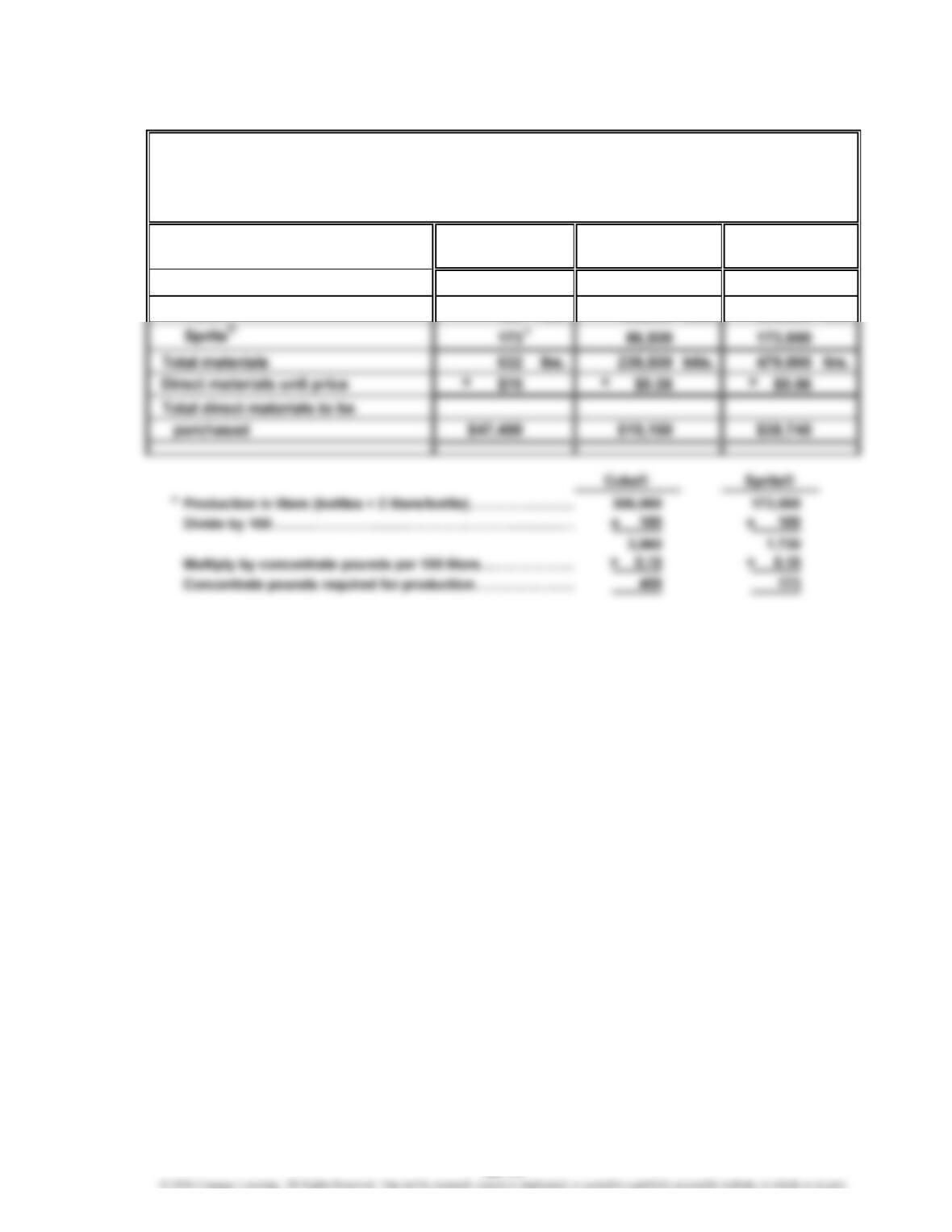
Materials required for production:
Coke® 459 lbs. 153,000 btls. 306,000 ltrs.
COCA-COLA ENTERPRISES—WAKEFIELD PLANT
For the Month Ending May 31, 2016
(assumed data)
Direct Materials Purchases Budget
2-Liter Carbonated
Concentrate Bottles Water
*
22-13
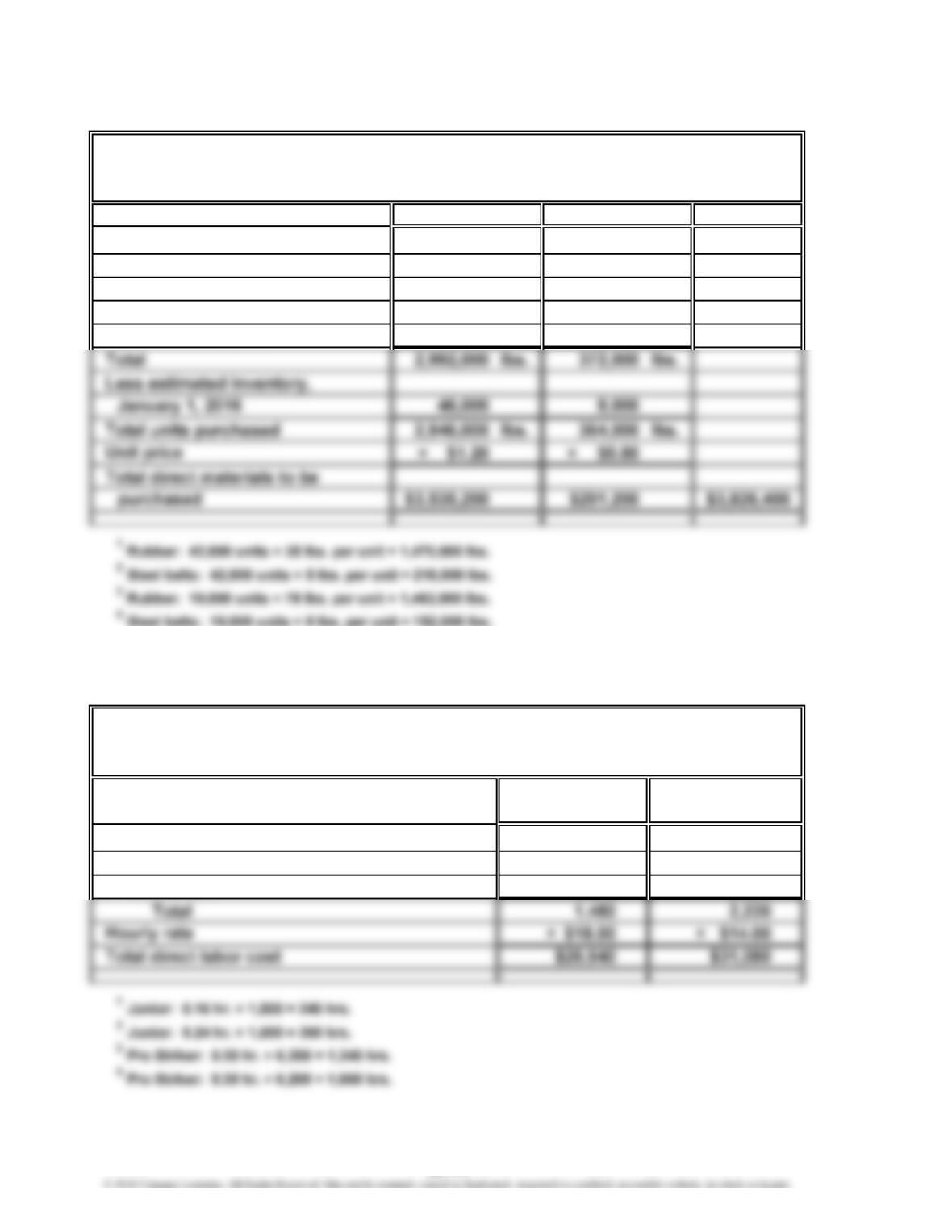
CHAPTER 22 Budgeting
Ex. 22–11
Total
Pounds required for production:
Passenger tires 1,470,000 lbs. 210,000 lbs.
Truck tires 1,482,000 152,000
Plus desired inventory,
December 31, 2016 40,000 10,000
Steel belts: 19,000 units × 8 lbs. per unit = 152,000 lbs.
Ex. 22–12
Hours required for production:
Junior
Pro Striker
SAFETY GRIP COMPANY
Direct Materials Purchases Budget
For the Year Ending December 31, 2016
Rubber Steel Belts
240
1,240
360
1,860
Direct Labor Cost Budget
For the Month Ending July 31, 2016
ACE RACKET COMPANY
Department
Forming Assembly
Department
12
34
12
34
22-14
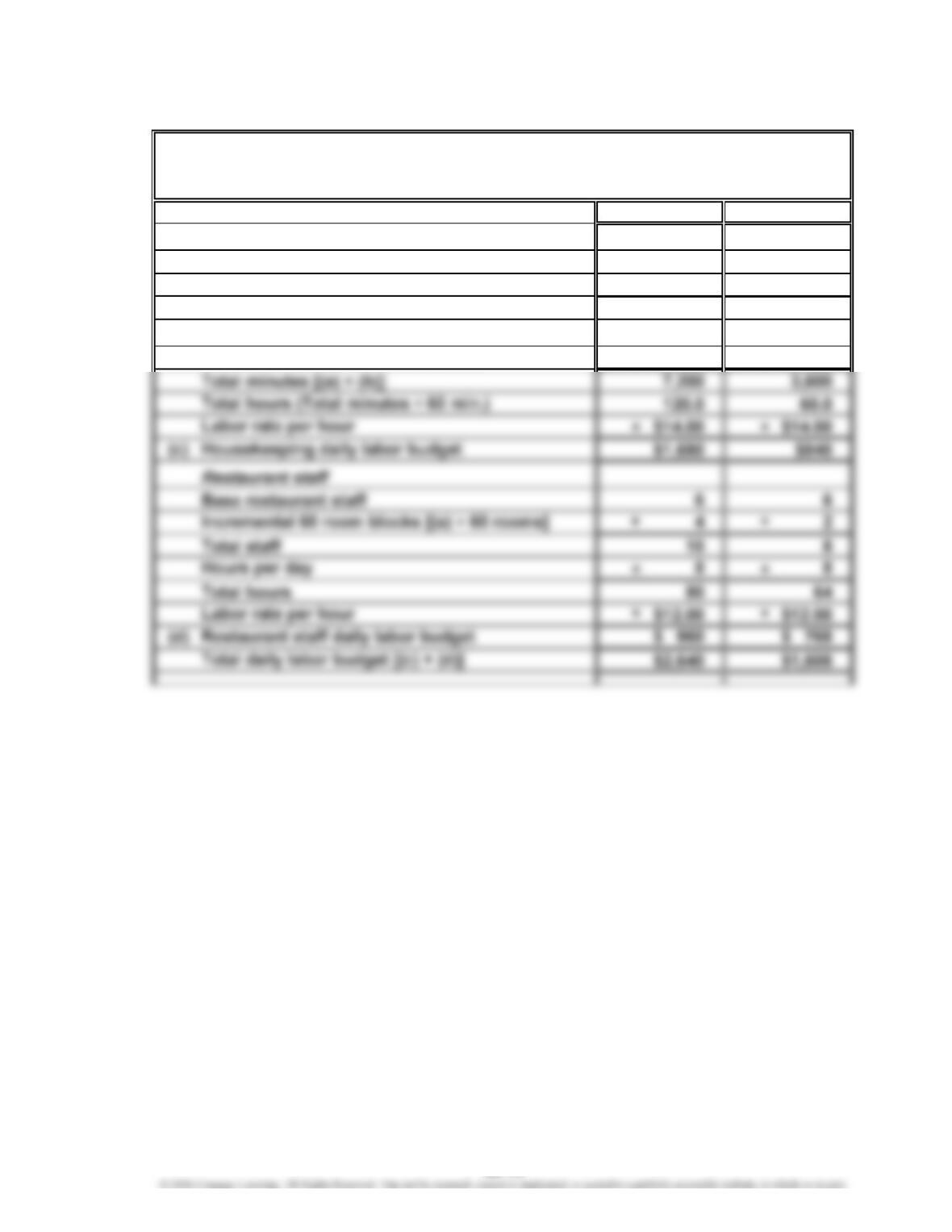
CHAPTER 22 Budgeting
Ex. 22–13
Weekday Weekend Day
Room occupancy
Room capacity 300 300
Occupied percent (occupancy) 80% 40%
(a) Rooms occupied 240 120
Housekeeping
(b) Number of minutes to clean a room 30 30
AMBASSADOR SUITES INC.
Direct Labor Cost Budget
For a Weekday or a Weekend Day
××
××
22-15
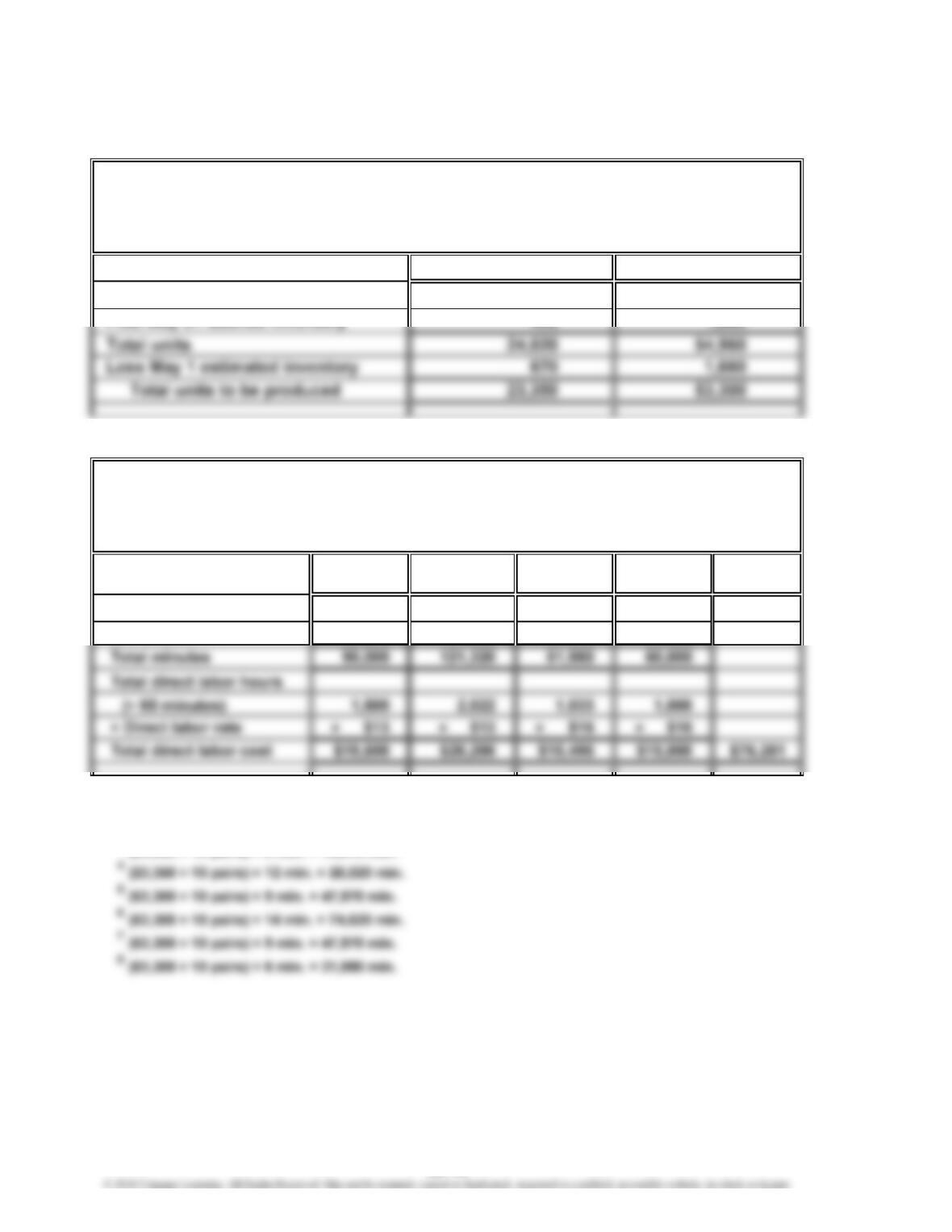
CHAPTER 22 Budgeting
Ex. 22–14
a.
Expected units to be sold
Plus May 31 desired inventory
b.
Outer-
Inseam seam Pockets Zipper Total
Dockers® 42,030 46,700 14,010 28,020
501 Jeans® 47,970 74,620 47,970 31,980
1
(23,350 ÷ 10 pairs) × 18 min. = 42,030 min.
2
(23,350 ÷ 10 pairs) × 20 min. = 46,700 min.
3
(23,350 ÷ 10 pairs) × 6 min. = 14,010 min.
LEVI STRAUSS & CO.
Production Budget
(assumed data)
May 2016
LEVI STRAUSS & CO.
Direct Labor Cost Budget
501 Jeans®
53,100
Dockers®
23,600
420
(assumed data)
May 2016
1,860
1234
5678
22-16
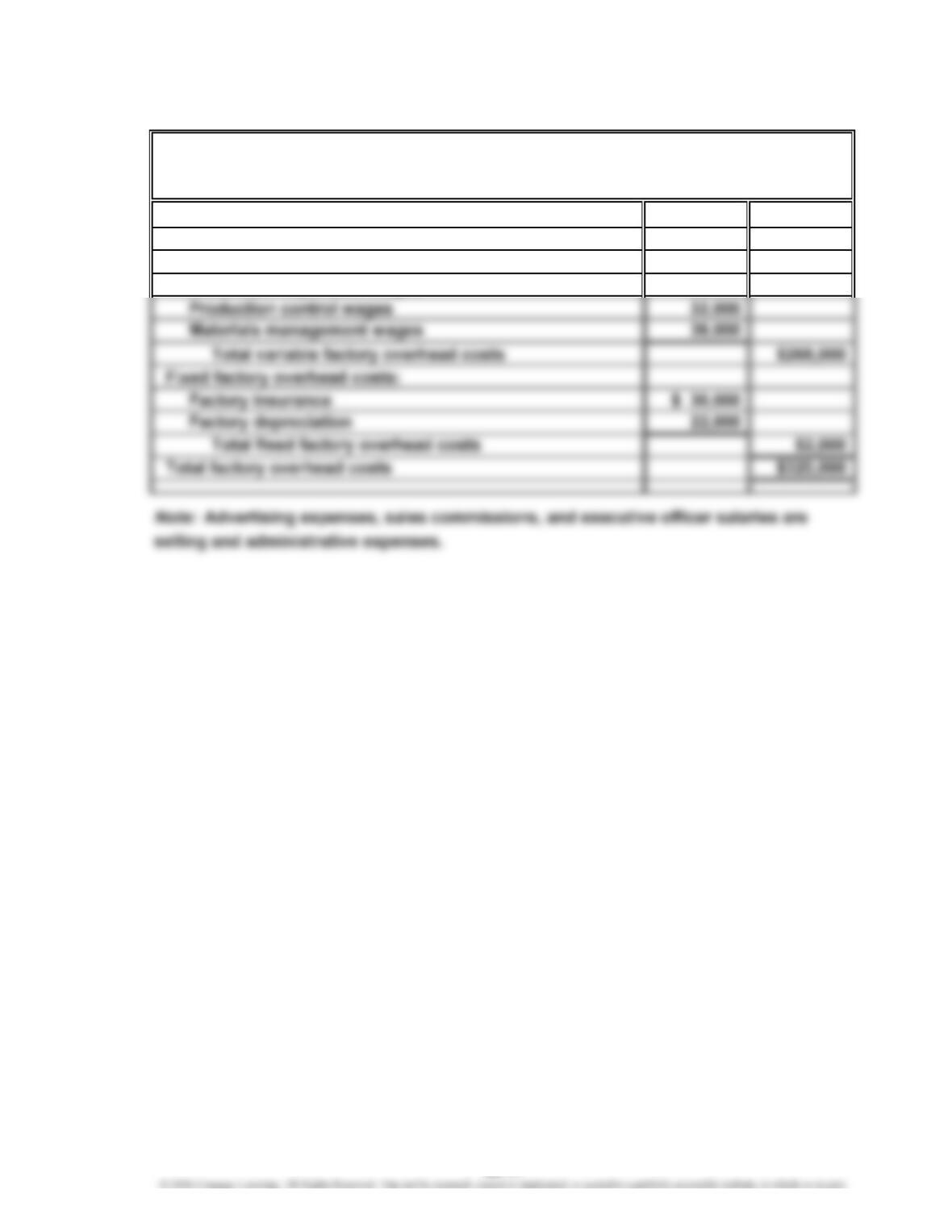
CHAPTER 22 Budgeting
Ex. 22–15
Variable factory overhead costs:
Manufacturing supplies $ 14,000
Power and light 48,000
Production supervisor wages 135,000
SWEET TOOTH CANDY COMPANY
Factory Overhead Cost Budget
For the Month Ending August 31, 2016
22-17
CHAPTER 22 Budgeting
Ex. 22–16
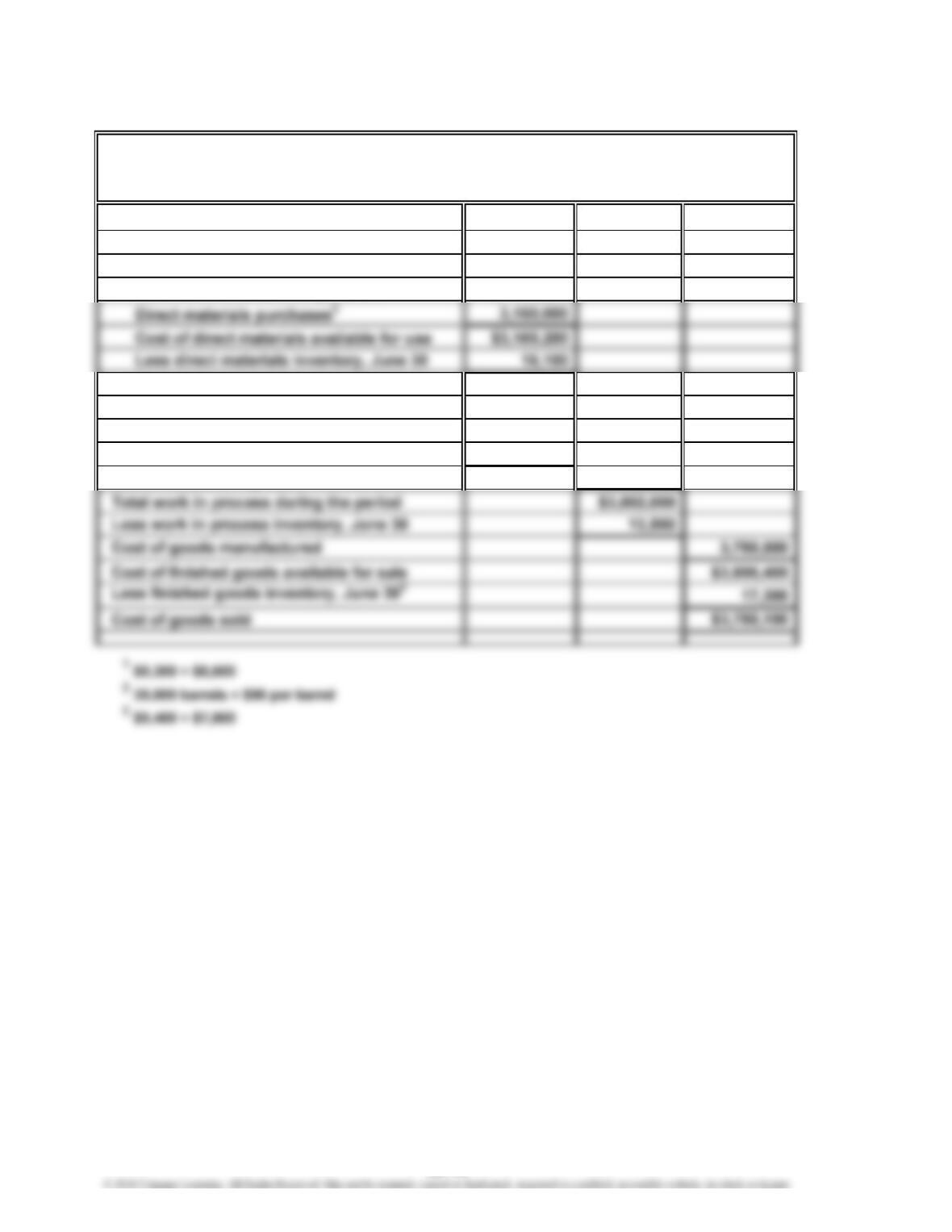
Finished goods inventory, June 1
1
$ 16,900
Work in process inventory, June 1 $ 12,900
Direct materials:
Direct materials inventory, June 1 $ 15,200
Cost of direct materials placed in
production $3,149,100
Direct labor 240,000
Factory overhead 400,000
Total manufacturing costs 3,789,100
DELAWARE CHEMICAL COMPANY
Cost of Goods Sold Budget
For the Month Ending June 30, 2017
22-18
CHAPTER 22 Budgeting
Ex. 22–17
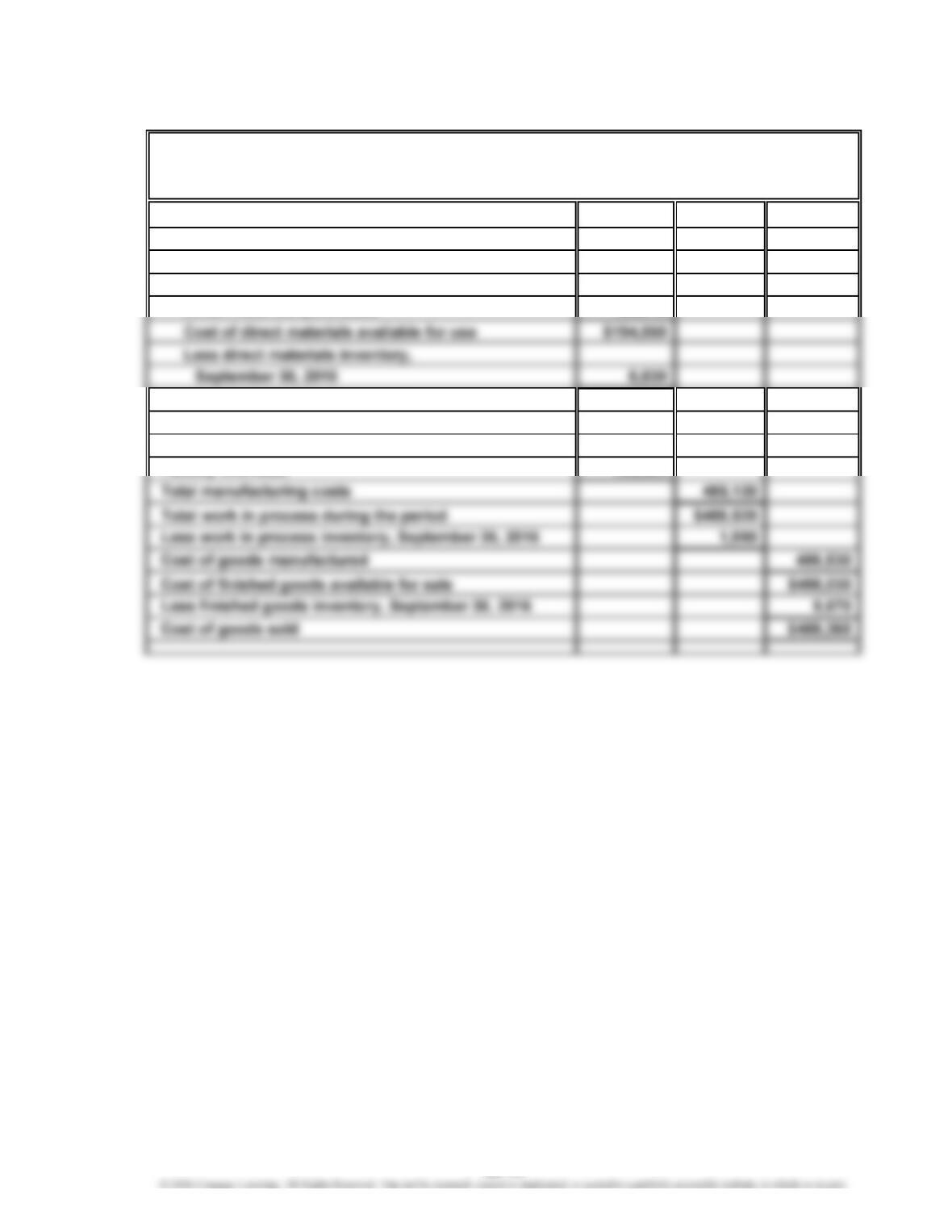
Finished goods inventory, September 1, 2016 $ 11,500
Work in process inventory, September 1, 2016 $ 3,400
Direct materials:
Direct materials inventory, September 1, 2016 $ 6,440
Direct materials purchases 188,410
Cost of direct materials placed in
production $186,020
Direct labor 193,600
Factory overhead 105,500
MINGWARE CERAMICS INC.
Cost of Goods Sold Budget
For the Month Ending September 30, 2016
22-19
CHAPTER 22 Budgeting
Ex. 22–18
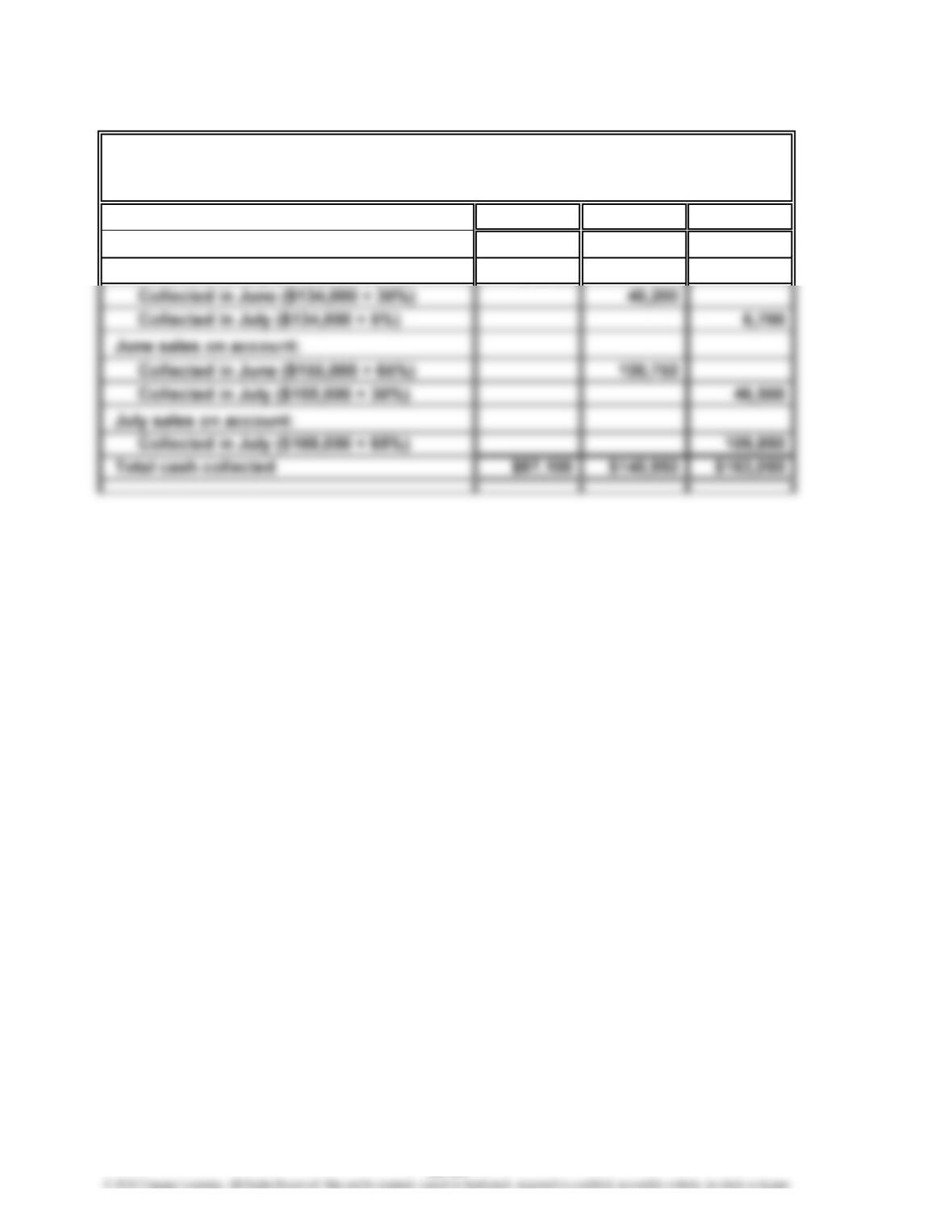
May June July
May sales on account:
Collected in May ($134,000 × 65%) 87,100
PET PLACE SUPPLIES INC.
Schedule of Collections from Sales
For the Three Months Ending July 31, 2016
22-20