22-1
CHAPTER 22
MANAGEMENT CONTROL SYSTEMS, TRANSFER PRICING,
AND MULTINATIONAL CONSIDERATIONS
22-1 A management control system is a means of gathering and using information to aid and
coordinate the planning and control decisions throughout an organization and to guide the
behavior of its managers and employees. The goal of the system is to improve the collective
decisions within an organization.
22-3 Motivation combines goal congruence and effort. Motivation is the desire to attain a
selected goal specified by top management (the goal-congruence aspect) combined with the
resulting pursuit of that goal (the effort aspect).
22-4 The chapter cites four benefits of decentralization:
1. Creates greater responsiveness to local needs
2. Leads to gains from faster decision making
3. Assists management development and learning
4. Sharpens the focus of subunit managers
22-5 No. Organizations typically compare the benefits and costs of decentralization on a
function-by-function basis. For example, companies with highly decentralized operating
divisions frequently have centralized income tax strategies.
22-7 The three general methods for determining transfer prices are
1. market-based transfer prices,
2. cost-based transfer prices, and
3. hybrid transfer prices.
22-2
22-9 No, the chapter illustration demonstrates how division operating incomes differ
dramatically under the variable-cost, full-cost, and market-price methods of transfer pricing.
22-10 Transferring products or services at market prices generally leads to optimal decisions
when (1) the market for the intermediate product market is perfectly competitive,
(2) interdependencies of subunits are minimal, and (3) there are no additional costs or benefits to
the company as a whole from buying or selling in the external market instead of transacting
internally.
22-12 Reasons why a dual-pricing approach to transfer pricing is not widely used in practice
include the following:
1. In this approach, the manager of the supplying division uses a cost-based method to record
revenues and does not have sufficient incentives to control costs.
2. This approach does not provide clear signals to division managers about the level of
decentralization top management wants.
3. This approach tends to insulate managers from the frictions of the marketplace because
costs, not market prices, affect the revenues of the supplying division.
4. It leads to problems in computing the taxable income of subunits located in different tax
jurisdictions.
22-3
specific relationship to either costs or prices. But the negotiated price will generally fall between
the variable costs-based floor and the market price-based ceiling.
22-15 Alternative transfer-pricing methods can result in sizable differences in the reported
operating income of divisions in different income tax jurisdictions. If these jurisdictions have
different tax rates or deductions, the net income of the company as a whole is significantly
affected by the choice of the transfer-pricing method.
22-16 (15 min.) Evaluating management control systems, balanced scorecard.
Adventure Parks Inc. (API) operates 10 theme parks throughout the United States. The
company’s slogan is “Name Your Adventure,” and its mission is to offer an exciting theme park
experience to visitors of all ages. API’s corporate strategy supports this mission by stressing the
importance of sparkling clean surroundings, efficient crowd management, and, above all,
cheerful employees. Of course, improved shareholder value drives this strategy.
Required:
1. Assume that API uses a balanced scorecard approach (see Chapter 12) to formulating its
management control system. List three measures that API might use to evaluate each of the
four balanced scorecard perspectives: financial perspective, customer perspective, internal–
business-process perspective, and learning-and-growth perspective.
2. How would the management controls related to financial and customer perspectives at API
differ between the following three managers: a souvenir shop manager, a park general
manager, and the corporation’s CEO?
SOLUTION
22-4
22-17 (25 min.) Cost centers, profit centers, decentralization, transfer prices.
Fenster Corporation manufactures windows with wood and metal frames. Fenster has three
departments: glass, wood, and metal. The glass department makes the window glass and sends it
to either the wood or metal department where the glass is framed. The window is then sold.
Upper management sets the production schedules for the three departments and evaluates them
on output quantity, cost variances, and product quality.
Required:
1. Are the three departments cost centers, revenue centers, or profit centers?
2. Are the three departments centralized or decentralized?
3. Can a centralized department be a profit center? Why or why not?
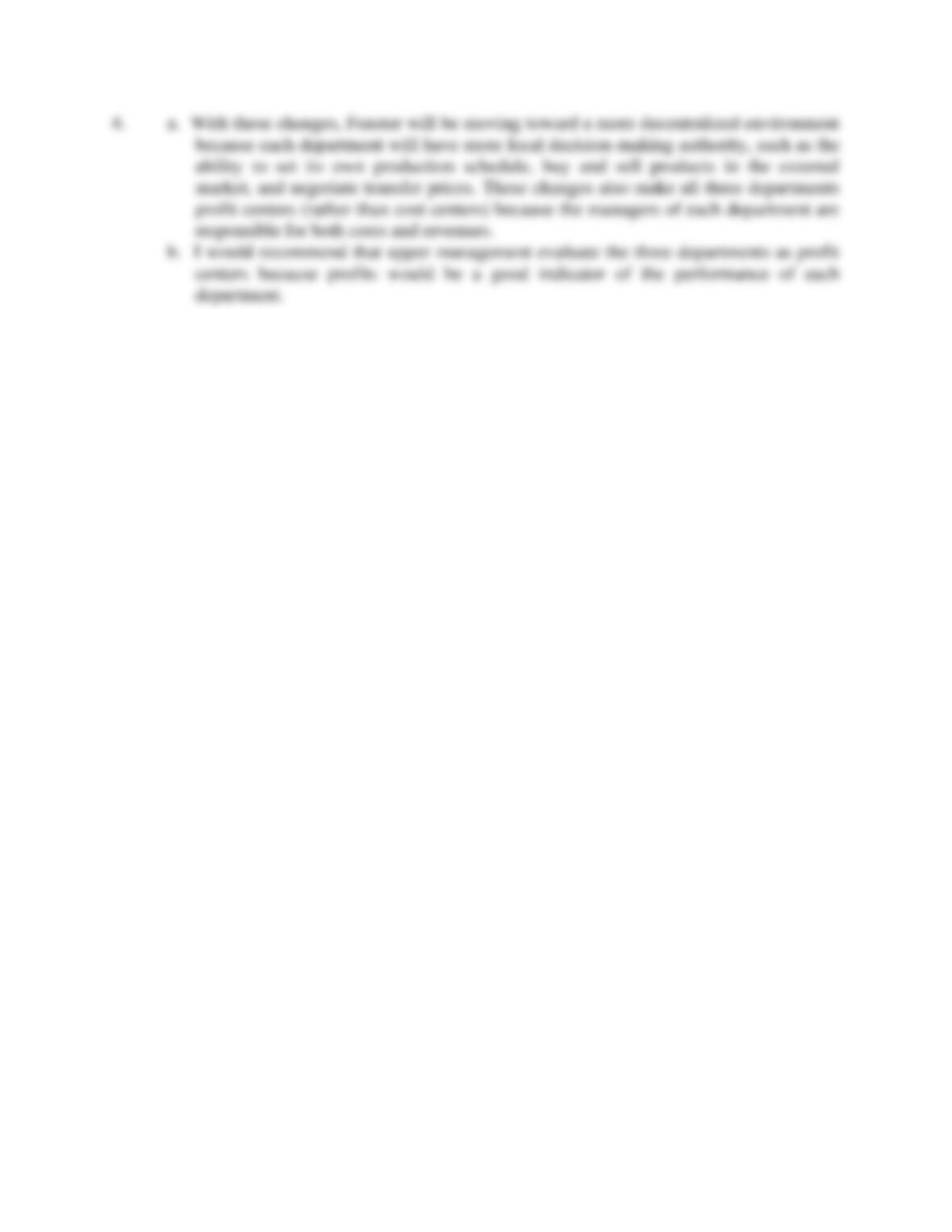
4. Suppose the upper management of Fenster Corporation decides to let the three departments
set their own production schedules, buy and sell products in the external market, and have the
wood and metal departments negotiate with the glass department for the glass panes using a
transfer price.
a. Will this change your answers to requirements 1 and 2?
b. How would you recommend upper management evaluate the three departments if this
change is made?
SOLUTION
22-5
22-18 (15 min.) Benefits and costs of decentralization.
Jackson Markets, a chain of traditional supermarkets, is interested in gaining access to the
organic and health food retail market by acquiring a regional company in that sector. Jackson
intends to operate the newly acquired stores independently from its supermarkets.
One of the prospects is Health Source, a chain of 20 stores in the mid-Atlantic region. Buying
for all 20 stores is done by the company’s central office. Store managers must follow strict
guidelines for all aspects of store management in an attempt to maintain consistency among
stores. Store managers are evaluated on the basis of achieving profit goals developed by the
central office.
The other prospect is Harvest Moon, a chain of 30 stores in the Northeast. Harvest Moon
managers are given significant flexibility in product offerings, allowing them to negotiate
purchases with local organic farmers. Store managers are rewarded for exceeding self-developed
return-on-investment goals with company stock options. Some managers have become
significant shareholders in the company and have even decided on their own to open additional
store locations to improve market penetration. However, the increased autonomy has led to
competition and price cutting among Harvest Moon stores within the same geographic market,
resulting in lower margins.
Required:
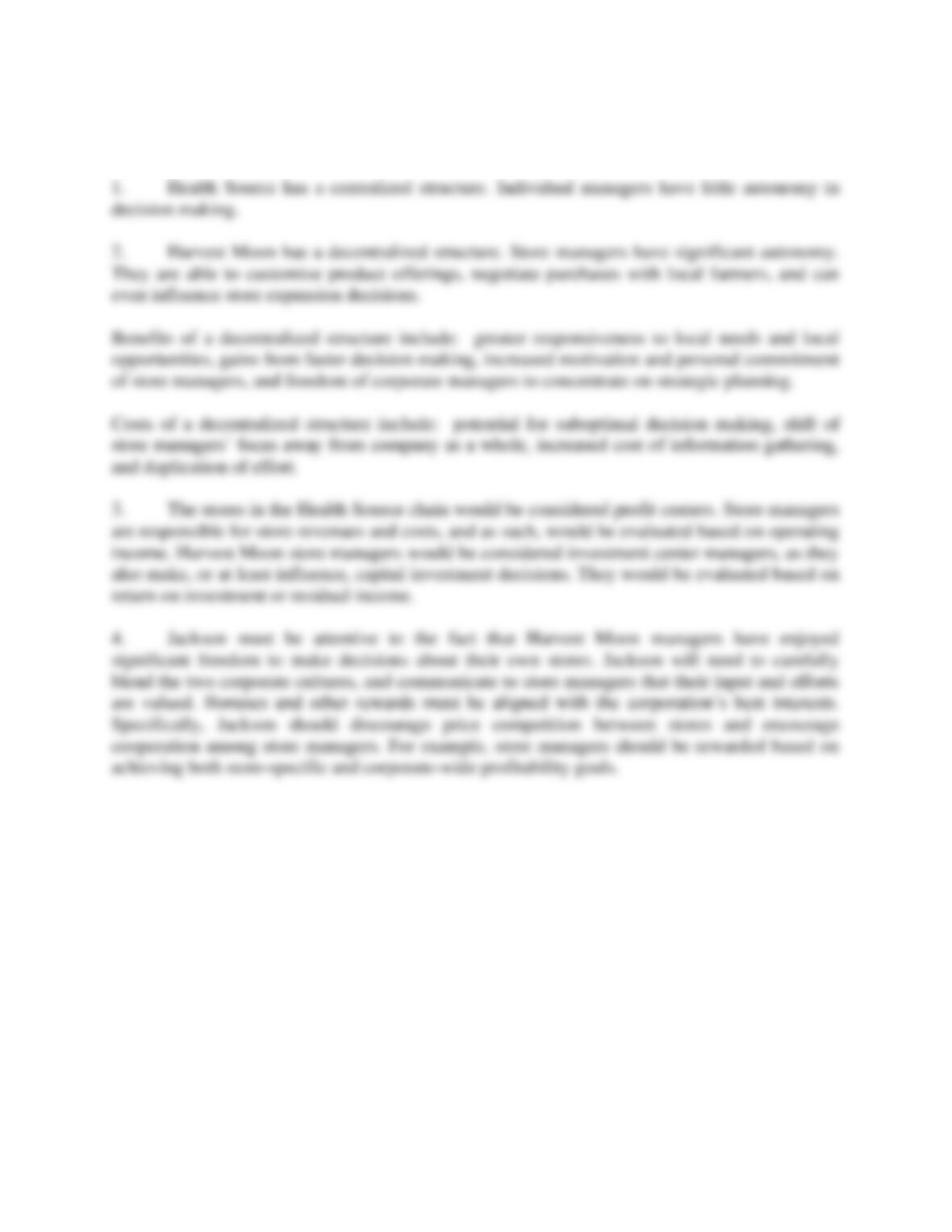
1. Would you describe Health Source as having a centralized or a decentralized structure?
Explain.
2. Would you describe Harvest Moon as having a centralized or a decentralized structure?
Discuss some of the benefits and costs of that type of structure.
3. Would stores in each chain be considered cost centers, revenue centers, profit centers, or
investment centers? How does that tie into the evaluation of store managers?
4. Assume that Jackson chooses to acquire Harvest Moon. What steps can Jackson take to
improve goal congruence between store managers and the larger company?
22-6
SOLUTION
22-19 (30 min.) Transfer-pricing methods, goal congruence.
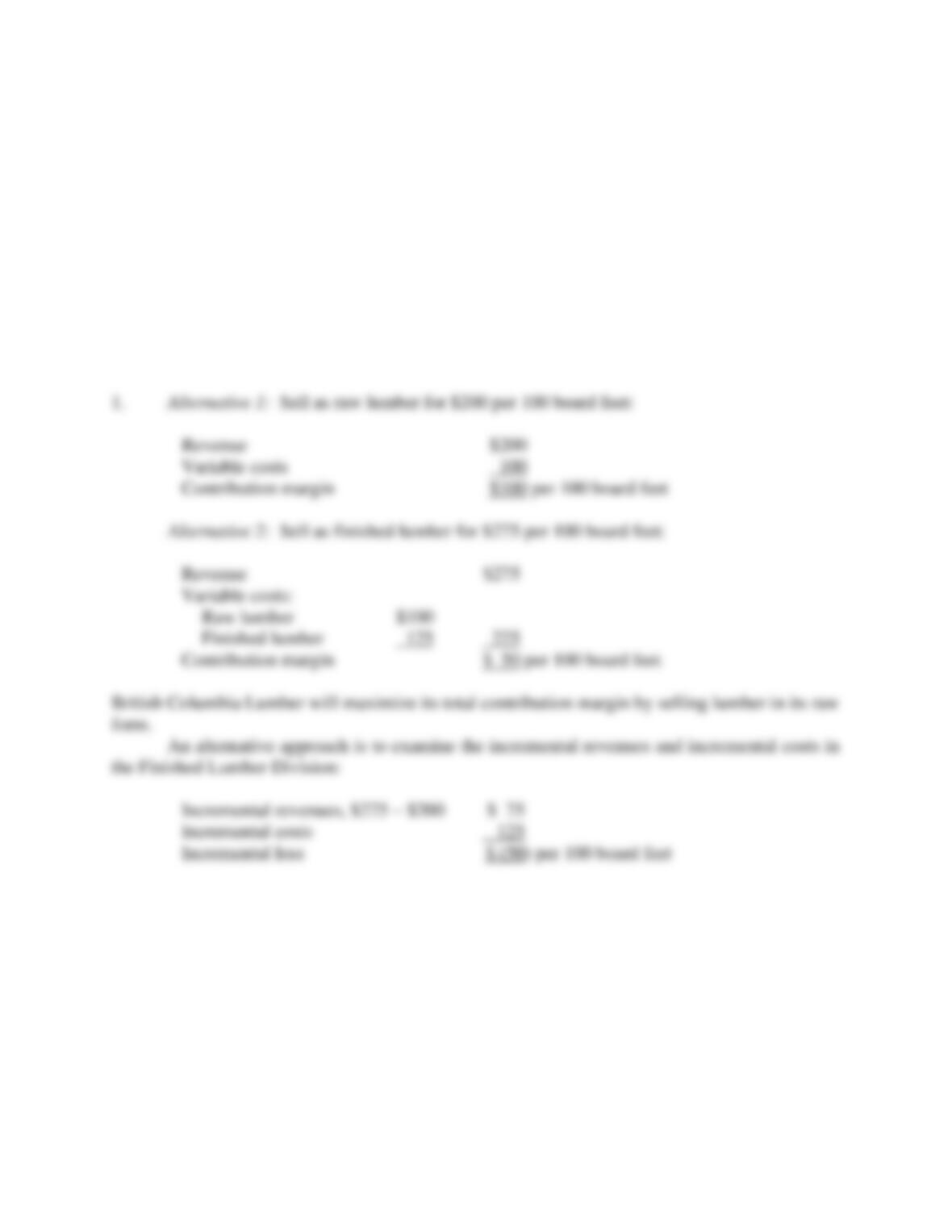
British Columbia Lumber has a raw lumber division and a finished lumber division. The variable
costs are as follows:
▪ Raw lumber division: $100 per 100 board-feet of raw lumber
▪ Finished lumber division: $125 per 100 board-feet of finished lumber
Assume that there is no board-feet loss in processing raw lumber into finished lumber. Raw
lumber can be sold at $200 per 100 board-feet. Finished lumber can be sold at $275 per 100
board-feet.
22-7
Required:
1. Should British Columbia Lumber process raw lumber into its finished form? Show your
calculations.
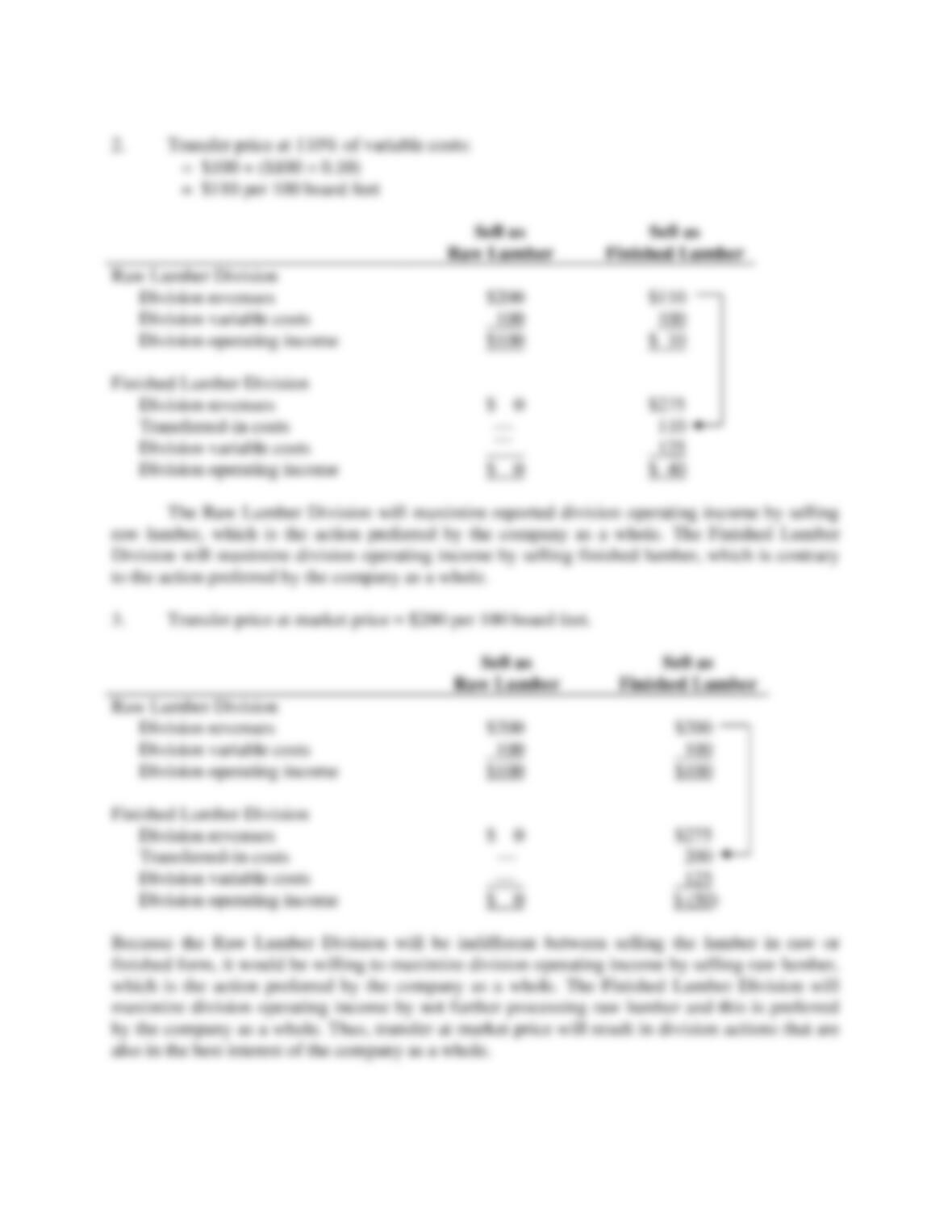
2. Assume that internal transfers are made at 110% of variable cost. Will each division
maximize its division operating-income contribution by adopting the action that is in the best
interest of British Columbia Lumber as a whole? Explain.
3. Assume that internal transfers are made at market prices. Will each division maximize its
division operating-income contribution by adopting the action that is in the best interest of
British Columbia Lumber as a whole? Explain.
SOLUTION
22-8
22-9
22-20 (35 min.) Multinational transfer pricing, effect of alternative transfer-pricing
methods, global income tax minimization.
Tech Friendly Computer, Inc., with headquarters in San Francisco, manufactures and sells a
desktop computer. Tech Friendly has three divisions, each of which is located in a different
country:
a. China division—manufactures memory devices and keyboards
b. South Korea division—assembles desktop computers using locally manufactured parts, along
with memory devices and keyboards from the China division
c. U.S. division—packages and distributes desktop computers
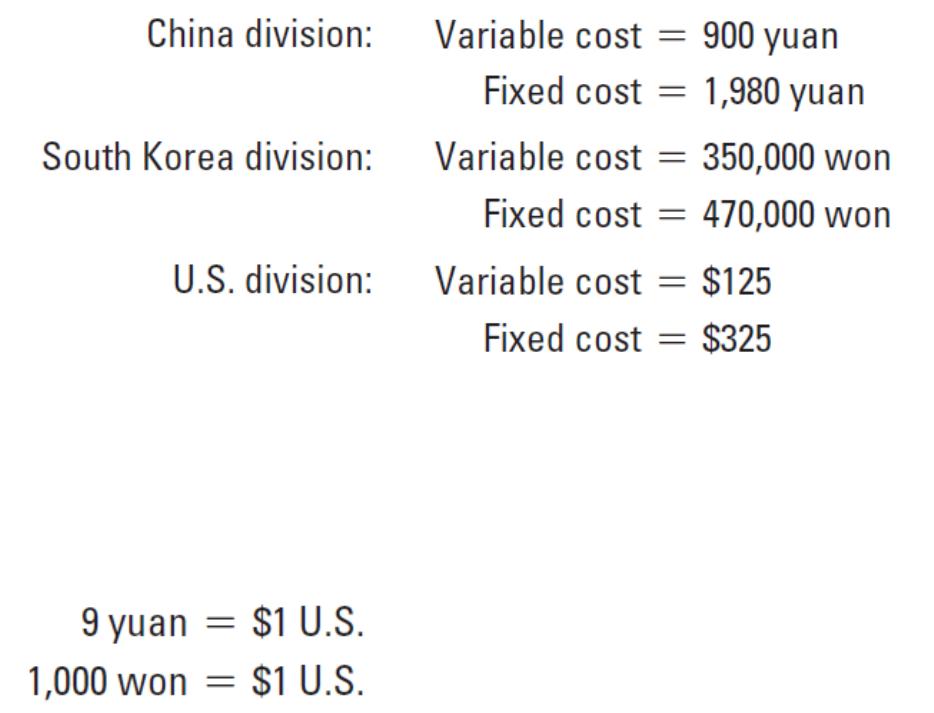
Each division is run as a profit center. The costs for the work done in each division for a single
desktop computer are as follows:
▪ Chinese income tax rate on the China division’s operating income: 40%
▪ South Korean income tax rate on the South Korea division’s operating income: 20%
▪ U.S. income tax rate on the U.S. division’s operating income: 30%
Each desktop computer is sold to retail outlets in the United States for $3,800. Assume that the
current foreign exchange rates are as follows:
Both the China and the South Korea divisions sell part of their production under a private label.
The China division sells the comparable memory/keyboard package used in each Tech Friendly
22-10
desktop computer to a Chinese manufacturer for 4,500 yuan. The South Korea division sells the
comparable desktop computer to a South Korean distributor for 1,340,000 won.
Required:
1. Calculate the after-tax operating income per unit earned by each division under the following
transfer-pricing methods: (a) market price, (b) 200% of full cost, and (c) 350% of variable
cost. (Income taxes are not included in the computation of the cost-based transfer prices.)
2. Which transfer-pricing method(s) will maximize the after-tax operating income per unit of
Tech Friendly Computer?
SOLUTION
22-11
22-12
22-21 (30 min.) Effect of alternative transfer-pricing methods on division operating income.
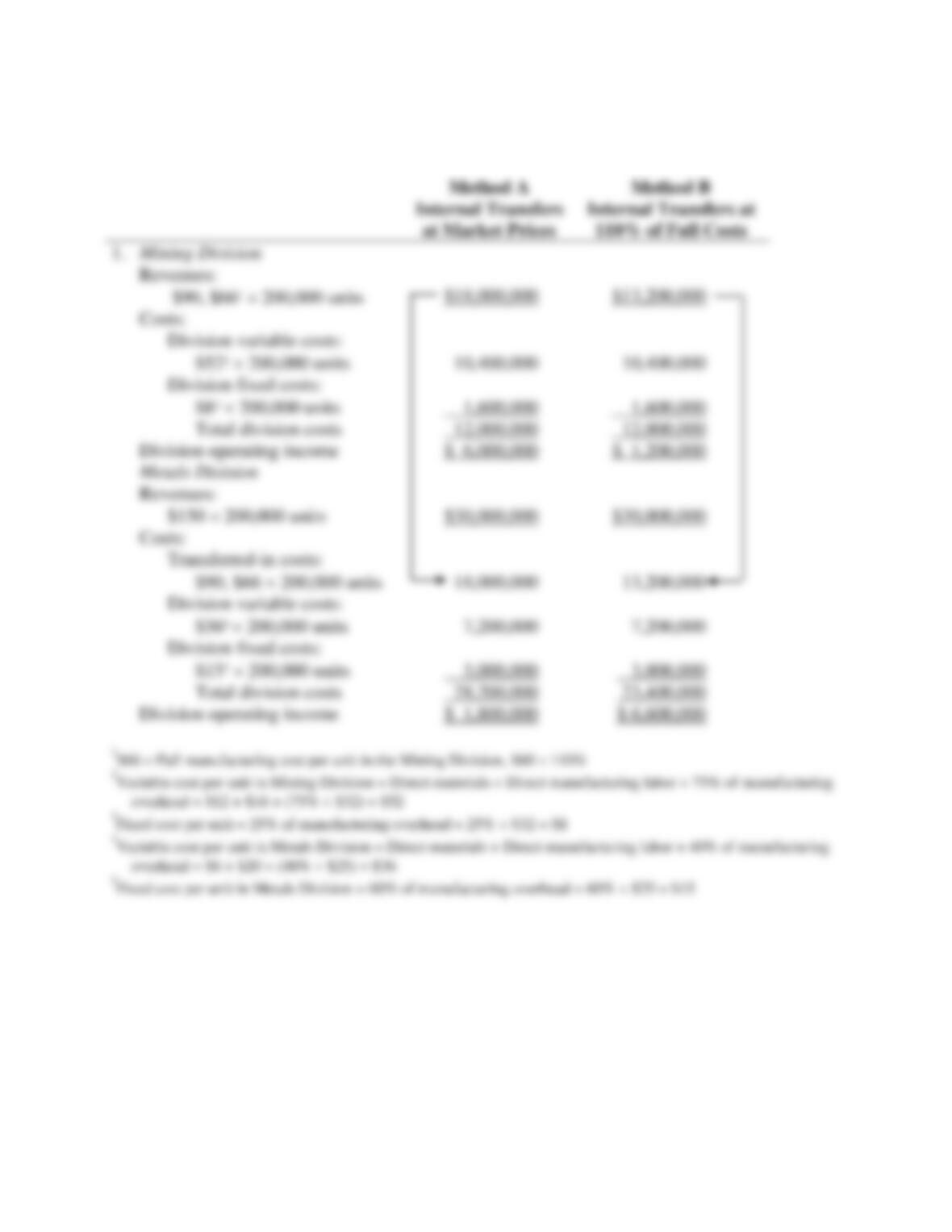
(CMA, adapted) Ajax Corporation has two divisions. The mining division makes toldine, which
is then transferred to the metals division. The toldine is further processed by the metals division
and is sold to customers at a price of $150 per unit. The mining division is currently required by
Ajax to transfer its total yearly output of 200,000 units of toldine to the metals division at 110%
of full manufacturing cost. Unlimited quantities of toldine can be purchased and sold on the
outside market at $90 per unit.
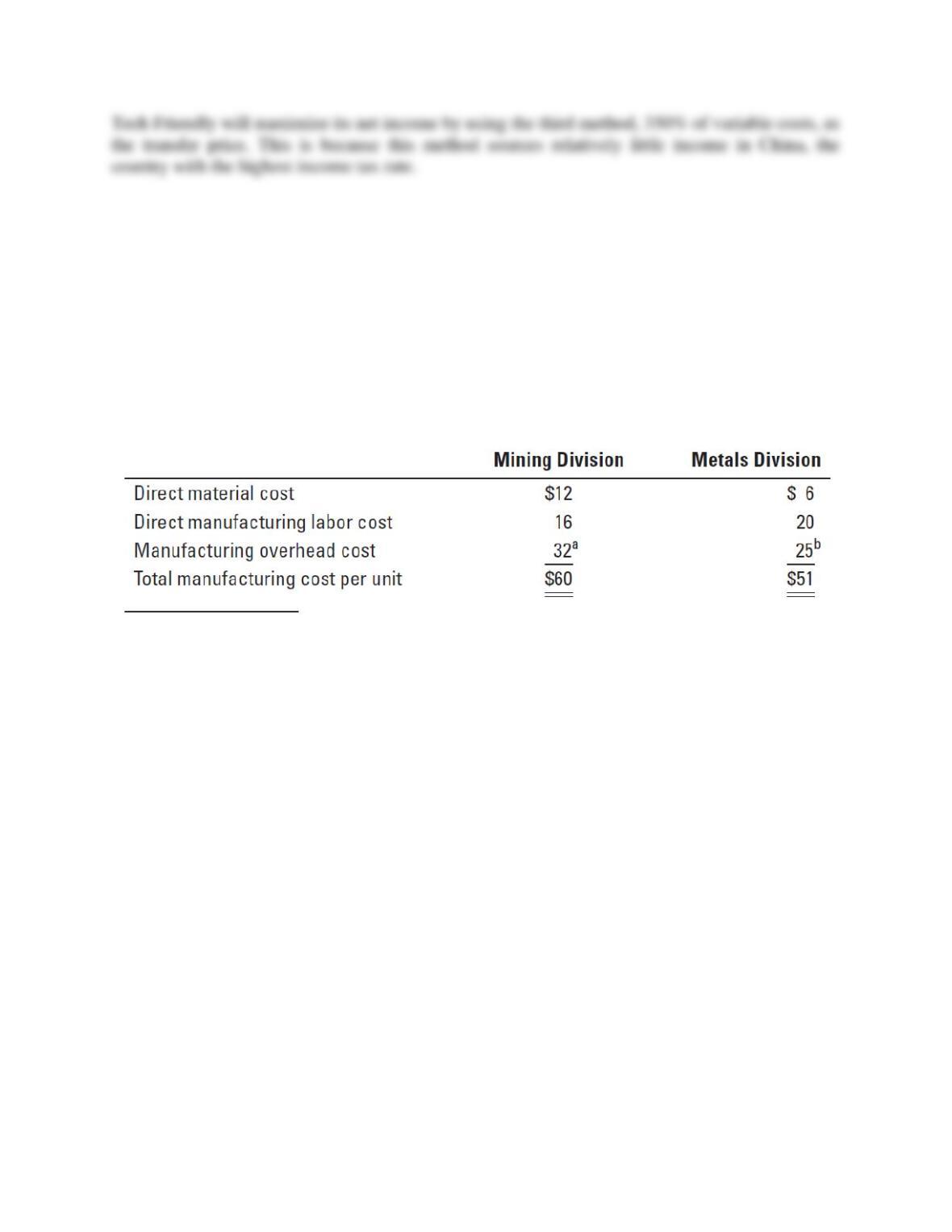
The following table gives the manufacturing cost per unit in the mining and metals divisions
for 2014:
aManufacturing overhead costs in the mining division are 25% fixed and 75% variable.
bManufacturing overhead costs in the metals division are 60% fixed and 40% variable.
Required:
1. Calculate the operating incomes for the mining and metals divisions for the 200,000 units of
toldine transferred under the following transfer-pricing methods: (a) market price and (b)
110% of full manufacturing cost.
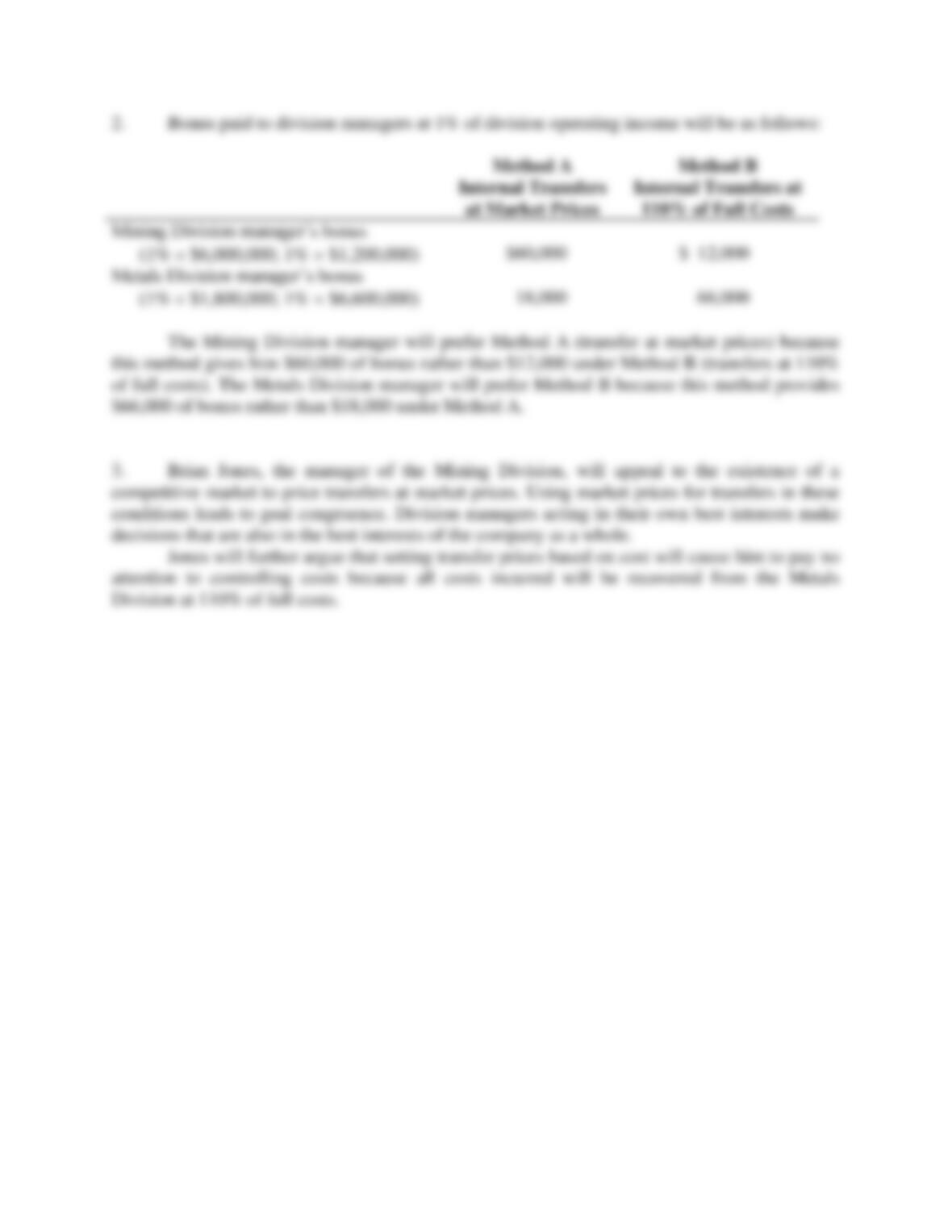
2. Suppose Ajax rewards each division manager with a bonus, calculated as 1% of division
operating income (if positive). What is the amount of bonus that will be paid to each division
manager under the transfer-pricing methods in requirement 1? Which transfer-pricing method
will each division manager prefer to use?
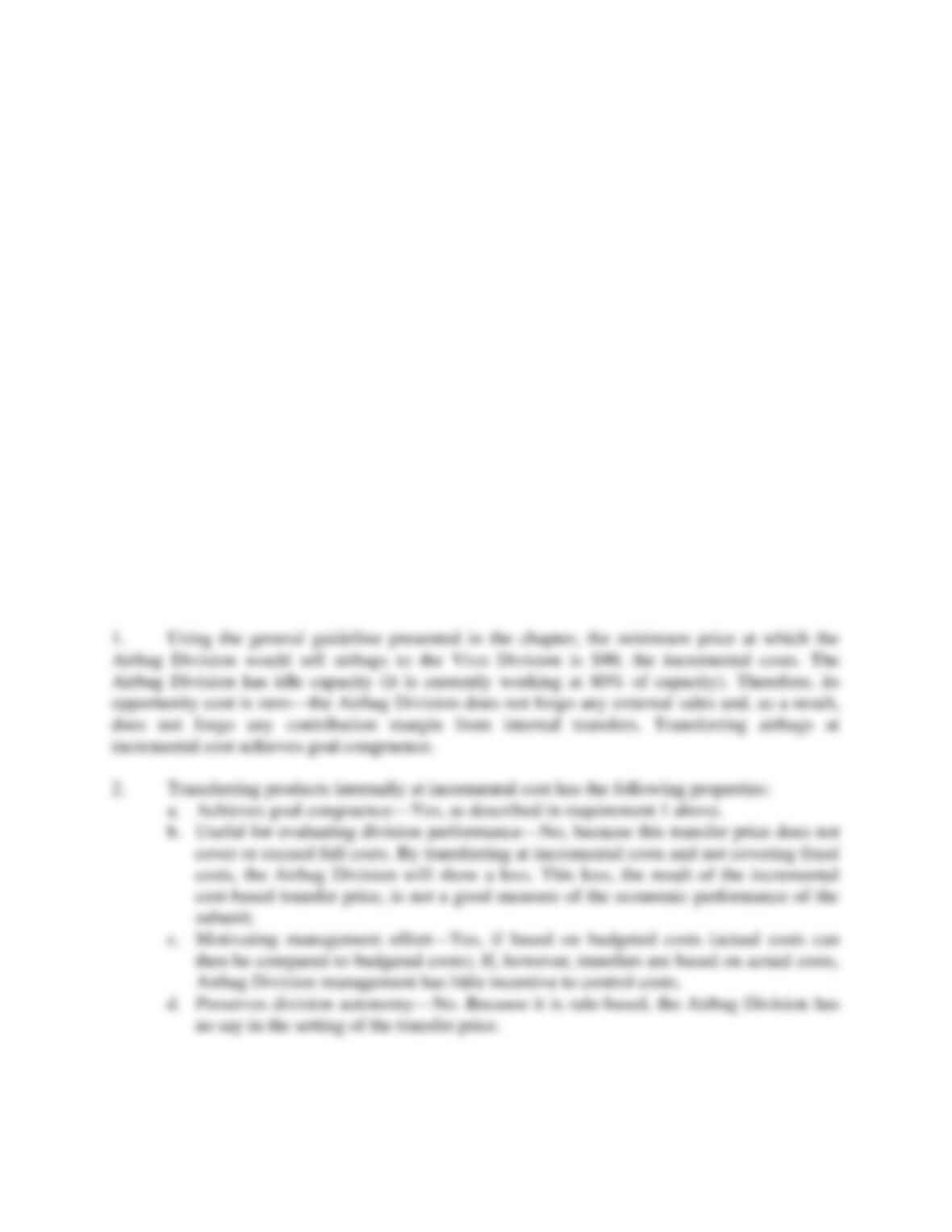
3. What arguments would Brian Jones, manager of the mining division, make to support the
transfer-pricing method that he prefers?
22-13
SOLUTION
22-14
22-15
22-22 (30 min.) Transfer pricing, general guideline, goal congruence.
(CMA, adapted). Quest Motors, Inc., operates as a decentralized multidivision company. The
Vivo division of Quest Motors purchases most of its airbags from the airbag division. The airbag
division’s incremental cost for manufacturing the airbags is $90 per unit. The airbag division is
currently working at 80% of capacity. The current market price of the airbags is $125 per unit.
Required:
1. Using the general guideline presented in the chapter, what is the minimum price at which the
airbag division would sell airbags to the Vivo division?
2. Suppose that Quest Motors requires that whenever divisions with unused capacity sell
products internally, they must do so at the incremental cost. Evaluate this transfer-pricing
policy using the criteria of goal congruence, evaluating division performance, motivating
management effort, and preserving division autonomy.
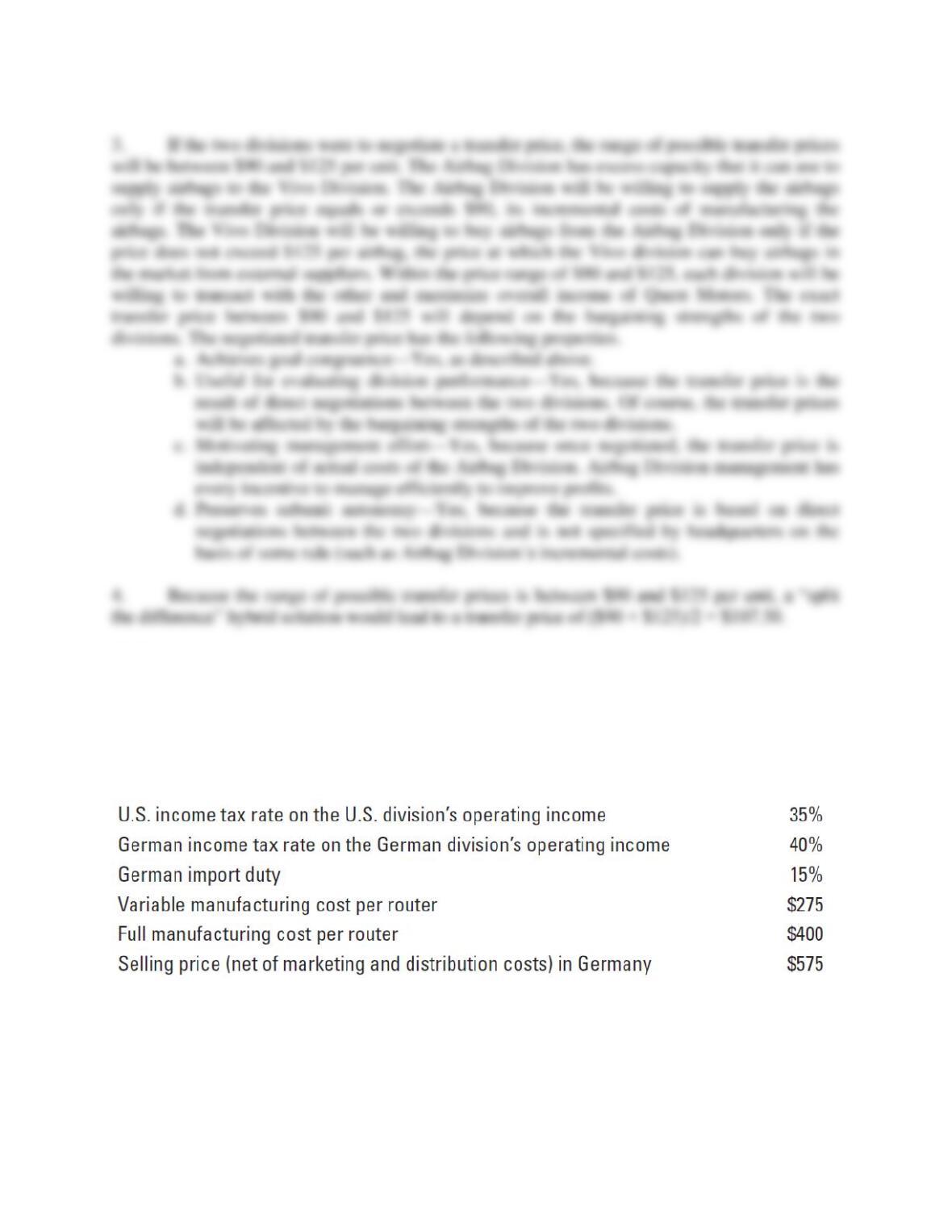
3. If the two divisions were to negotiate a transfer price, what is the range of possible transfer
prices? Evaluate this negotiated transfer-pricing policy using the criteria of goal congruence,
evaluating division performance, motivating management effort, and preserving division
autonomy.
4. Instead of allowing negotiation, suppose that Quest specifies a hybrid transfer price that
“splits the difference” between the minimum and maximum prices from the divisions’
standpoint. What would be the resulting transfer price for airbags?
SOLUTION
22-16
22-23 (25 min.) Multinational transfer pricing, global tax minimization.
The Questron Company manufactures telecommunications equipment at its plant in Scranton,
Pennsylvania. The company has marketing divisions throughout the world. A Questron
marketing division in Hamburg, Germany, imports 100,000 broadband routers from the United
States. The following information is available:
Suppose the United States and German tax authorities only allow transfer prices that are between
the full manufacturing cost per unit of $400 and a market price of $475, based on comparable
imports into Germany. The German import duty is charged on the price at which the product is
transferred into Germany. Any import duty paid to the German authorities is a deductible
expense for calculating German income taxes.
22-17
Required:
1. Calculate the after-tax operating income earned by the United States and German divisions
from transferring 100,000 broadband routers (a) at full manufacturing cost per unit and (b) at
market price of comparable imports. (Income taxes are not included in the computation of the
cost-based transfer prices.)
2. Which transfer price should the Questron Company select to minimize the total of company
import duties and income taxes? Remember that the transfer price must be between the full
manufacturing cost per unit of $400 and the market price of $475 of comparable imports into
Germany. Explain your reasoning.
SOLUTION
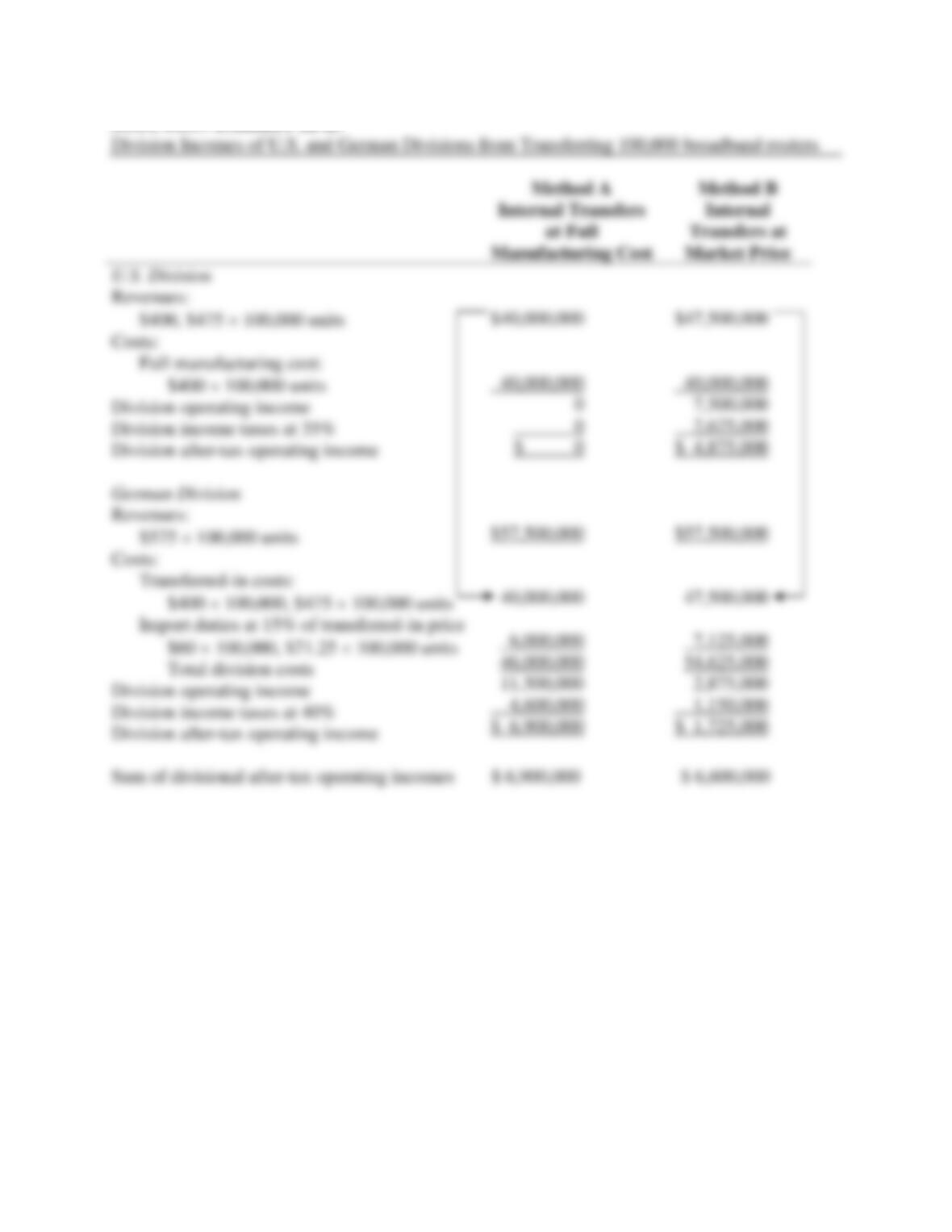
22-18
SOLUTION EXHIBIT 22-23
22-19
22-24 (30 min.) Multinational transfer pricing, goal congruence (continuation of 22-23).
Suppose that the U.S. division could sell as many broadband routers as it makes at $450 per unit
in the U.S. market, net of all marketing and distribution costs.
Required:
1. From the viewpoint of the Questron Company as a whole, would after-tax operating income
be maximized if it sold the 100,000 routers in the United States or in Germany? Show your
computations.
2. Suppose division managers act autonomously to maximize their division’s after-tax operating
income. Will the transfer price calculated in requirement 2 in Exercise 22-23 result in the
U.S. division manager taking the actions determined to be optimal in requirement 1 of this
exercise? Explain.
3. What is the minimum transfer price that the U.S. division manager would agree to? Does this
transfer price result in the Questron Company as a whole paying more import duty and taxes
than the answer to requirement 2 in Exercise 22-23? If so, by how much?
SOLUTION
22-20